



Articles Archive - Page 230 of 928 - REMINET
REMI

Ombudsman calls for change at failing LTB

Ombudsman Paul Dubé paints a grim picture of the Landlord and Tenant Board (LTB) in his latest investigation report, released May 4th. Long plagued by severe backlogs, staff shortages, and antiquated technology, LTB operations have only gotten worse thanks to the added pressures of COVID-19 lockdowns, remote work, eviction moratoriums and virtual hearings.

“As an administrative tribunal, the Board is fundamentally failing in its role of providing swift justice to those seeking resolution of residential landlord and tenant issues. In doing so, it is denying justice to a significant segment of Ontarians,” Dubé said. “Where once it took the Board a matter of days to schedule hearings, it now takes an average of seven to eight months – and scheduling of some tenant applications can take up to two years.”

Delays also plagued other stages of the LTB’s process. Even after decisions were made, many found they had to wait months for the adjudicators orders to be issued, while others had to have their cases reheard because Board members had retired.

“Over the past few years, the Board has proven itself unequipped for the task of reducing its extraordinary backlog of applications,” Dubé wrote. “More importantly, those applications represent tens of thousands of Ontarians suffering hardship caused by the Board’s inability to provide timely service.”

The Ombudsman received more than 4,000 complaints from people on both sides of the landlord-tenant relationship. Many described the financial and mental harm they suffered while “trapped in the queue” waiting for their applications to be heard – from tenants enduring harassment and unsafe living conditions, to landlords coping with  criminal conduct and facing financial ruin.

The investigation conducted by the Special Ombudsman Response Team reviewed the Board’s existing systemic problems, as well as its struggles with COVID-related challenges. Inefficiencies identified in the investigation include:

  • A shortage of qualified adjudicators (members), compounded by a lengthy, cumbersome appointment and training process
  • A complex application process that sometimes forces applicants to start over for errors
  • Antiquated systems that are not equipped to triage or expedite urgent cases, track orders and member caseloads, or identify members near the end of their terms
  • A lack of available bilingual adjudicators, and issues with application forms that only identify if applicants require services in French, not respondents

The bulk of the Ombudsman’s 61 recommendations are directed at the Board and/or Tribunals Ontario and set out detailed proposals for reforms. Three recommendations call for the government to change legislation to remove impediments to appointing members, while others urge the Ministry, Board and Tribunals Ontario to work together to ensure the Board’s backlog is reduced.

Tribunals Ontario, on behalf of the Board, has accepted the recommendations, as has the Ministry, and both have pledged to report back to the Ombudsman on their progress in implementing them.

“I urge the Government of Ontario to act quickly to increase the Board’s adjudicative capacity and fund the additional staff required to support the new members. Otherwise, given the timelines involved in recruitment and training, the positive impacts of this initiative could be significantly delayed,” the Ombudsman says in the report. “The sooner this initiative moves forward, the sooner the Board will be in a position to improve its service levels.”

Find out more at: Home – Ontario Ombudsman

Christine Bergeron to lead Concert Properties

Christine Bergeron, current president and chief executive officer of Vancity Group, will step into those roles with Concert Properties beginning in September. David Podmore will remain as chair of the board.

Bergeron is highly regarded for her leadership skills at Vancity, where she has overseen a national company with 2,600 employees, $34 billion in assets and a $9-billion real estate lending portfolio, and for her input as a board member. She is currently chair of the board of InBC Investment Corporation and a member of the leadership council of the United Nations Environment Programme Finance Initiative.

“Christine’s impressive background in corporate finance, portfolio management, deal structuring and investments, combined with her inclusive and collaborative leadership style, makes her the ideal person to lead Concert Properties,” Podmore says.

In addition to delivering record profitability at Vancity in 2020 and 2021, she clearly enunciated the company’s support for climate action, reconciliation and diversity, equity and inclusiveness. She also has a background working with entrepreneurs in the clean tech, sustainability and impact investing sectors.

“I am excited to be joining Concert Properties this September and to continue my leadership in building sustainable communities,” she says. “I am eager to apply my leadership, finance and investment experience to support Concert Properties’ objective of creating resilient, inclusive and sustainable communities.”

How to avoid mistakes with cleaning chemicals

With cleaning and hygiene, using products safely and properly is vital, and that means paying special attention to the cleaning chemicals you’re using. It’s a great reminder to focus on common sense practices like reading labels before each use, but there’s more to it than that.

Making sure your team is aware of the requirements of the products you use and following instructions carefully is a crucial part of commercial cleaning.

RELATED: Why reading chemical labels has never been more important

Choose the proper products

Making sure that you are using the correct chemicals for the job not only makes it safer, but could also save you time and money. If you are using a product that is designed for a less complicated job, it may require you to use more of the product or spend more time getting the job done. Choosing the correct chemicals allow for safe and efficient cleaning.

Often, more than one product is needed to complete the job. For example, a gentle product may do the job for some parts of the bathroom, but other sections will require something stronger. So, part of choosing the right cleaners means evaluating the job and dividing it into separate sections to address all issues correctly and safely.

Follow instructions

The instructions are designed to allow the product to be used as intended so following the exact instructions is required. Rather than just eyeballing it, measuring the correct amount of solution-to-water ratio is crucial for peak performance. Again, using it correctly will mean that you don’t need to spend money on more products than necessary, and it will do the job it’s designed to do.

Using more water than necessary means that the strength of the product isn’t there, and with not enough water, you could be attracting dirt or pathogens, rather than sanitizing the area effectively.

Avoid mixing

Be very careful about mixing chemicals that are incompatible; mixing things like ammonia and chlorine bleach can inadvertently create a toxic chemical cloud. It can be tempting to multitask by combining two products to tackle multiple jobs at the same time, but that can be dangerous. Chemicals can also be mixed by accident, so special care is necessary. For example, if someone pours acid cleaner into the toilet bowl after someone uses bleach to remove a stain, that can cause a serious issue.

Also, don’t forget to clean and empty your equipment after each use to avoid accidental mixing or spreading any germs sitting in the equipment, ready to be spread the next time you need them.

Be sure that your staff is aware, too, of the risks and take every precaution to avoid mixing incompatible chemicals.

Taking the time to choose the correct products, read labels, and follow instructions makes commercial cleaning safer and more effective for everyone in your building.

New report explores fiscal benefits of long-term care insurance

The National Institute on Ageing (NIA) has taken a deeper dive into the subject of publicly funded long-term care insurance as a potential solution to the fiscal burdens associated with Canada’s ageing population.

The study involved an analysis of five countries and one U.S. state where public LTC insurance programs have been established. The NIA has concluded that this model deserves more serious consideration in Canada, and has published its findings and recommendations in a newly published paper, entitled: Could a National Long-Term Care Insurance Program be a Feasible Solution to Address Canada’s Growing Long-Term Care Crisis? Lessons from Six Countries.

According to the report, Canada’s governments spent approximately $38 billion on publicly funded LTC services in 2019. Meanwhile, Canadian households spent an additional $9.4 billion out-of-pocket to access additional services. With Canadians now expected to live an additional 22 years after age 65, the NIA contends those costs could add up to a crippling amount.

“It’s already clear that the current level of public funding has not been enough on its own to meet Canadians’ LTC needs,” said Dr. Samir Sinha, Director of Health Policy Research for the NIA. “Establishing a national LTC insurance program could present a unique opportunity to re-imagine Canada’s social contract and better align its provision of LTC services to the needs and preferences of older Canadians, giving them more opportunities to age in the right place.”

Though private LTC insurance is already available in Canada, the high premiums have led to limited uptake.

“Establishing a national LTC insurance program could also present an opportunity to standardize LTC policies and programs across Canada,” said Cameron Feil, NIA Associate Fellow and lead author of the report. “A national LTC insurance program could present a chance to establish a national definition of LTC services, creating common standards for eligibility, benefits and quality of care.”

The jurisdictions analyzed for this report include: Japan, Germany, South Korea, Taiwan, the Netherlands, and Washington State. Given the programs vary widely in their funding methods, levels of eligibility, available benefits, and degree of user choice, the NIA sees these variances as a promising indication that Canada could tailor a LTC insurance program to target its specific needs and goals.

Here are six key ideas the NIA believes should be considered:

  1. Present a national LTC insurance program as part of a new social contract for Canadians, by clearly establishing the continuum between an individual’s contributions and the benefits they receive in return to meet their future LTC needs.
  2. Leverage the introduction of a national LTC insurance program to support Canadians to Age in the Right Place, having it serve as a catalyst to re-organize and allocate LTC funding toward the provision of more home and community care.
  3. Use a national LTC insurance program to standardize client eligibility and benefits.
  4. Leverage Canada’s established network of public and private LTC home and community care providers to operationalize a national LTC insurance program.
  5. Establish care plan managers — employees who work at a local level to ensure that recipients are receiving appropriate care based on their needs — as the focal point of a national LTC insurance program to ensure that beneficiaries receive appropriate, timely care and have opportunities to remain engaged in their communities.
  6. Use social contributions as the primary funding mechanism for a national LTC insurance program, ensuring that revenue is reliable, sustainable, and equitable.

Click here for more info: Could a National Long-Term Care Insurance Program be a Feasible Solution to Address Canada’s Growing Long-Term Care Crisis? — National Institute on Ageing (niageing.ca)

Shaping employee experience: the new FM role

What makes a great facility management (FM) leader? Sure, some qualities are timeless. Facility managers must be good problem-solvers and multi-taskers. They need to have solid organization and communication skills, an eye for detail, and a keen ability to sense risk.

But the world has changed drastically in recent years — for reasons we know all too well — and this is placing huge new demands on the FM profession. As an IFMA chapter, it’s our responsibility to help members, and the profession at large, better understand and prepare for those challenges.

At the heart of this mission is a question that serves as a guiding principle: are we cultivating the right skills to develop tomorrow’s FM leaders?

Across the board, organizations are forming hybrid working strategies in response to changing employee needs. Most people wish to keep their flexible privileges, but they don’t want to lose the office altogether. When they’re in the office, employees want variety and the freedom to choose the type of space that works for them. Ultimately, they need the office to service a specific purpose, whether it’s for focused work, collaboration, socializing, etc or anything else.

It’s easy to get caught up in the hype that offices of the future will be designed for collaboration — and while that may be true for many, others still need an office to concentrate on individual tasks, confidential meetings, etc. We only need to think about the young professionals in urban centres such as Toronto who may live in small apartments without adequate space for working or are surrounded by noisy roommates/family members also at home.

All this reinforces the fact that we tend to forget, work isn’t a place where you go but a thing that you do. Likewise, the workplace isn’t just a physical building. It also exists online and in the intangible relationships between colleagues.

For both service providers and in-house FM teams, these evolving dynamics require a shift in approach from facility manager to experience manager. As experience managers, FM professionals need to find out what individuals and teams need to work most effectively. This means identifying what activities people do, where they do them, and how often. It also means learning what tasks the home or other remote locations support and what makes employees productive in the office.

Then, it’s about delivering the spaces, infrastructure and experiences that support people across every setting. As a concept, activity-based working has been around since the 1960s. Today, however, its tenets must form the foundation of any workplace or hybrid working model.

Numerous studies have found that when given the power to choose where they work, most people visit the office during the middle of the week, using Mondays and Fridays as work-from-home days to stretch the weekend. Leaving aside the potential inefficiency from a real estate and energy perspective, these occupancy patterns lead to drastically different experiences for employees depending on which days they go to the office, and challenge FM teams to manage available space and design a more equitable experience across both busy and quieter days. That’s where experience managers can make all the difference.

Looking ahead, FM needs to foster several skill sets to ensure that the profession can rise to these new challenges. The transition to experience managers demands more focus on softer skills, especially emotional intelligence and interpersonal skills that will encourage more people into the profession who might have an outdated view of it as a technical-heavy, hands-on discipline.

At the same time, we cannot underestimate how critical technology plays in curating these exceptional experiences. We don’t know what we don’t know — or, perhaps more accurately, we don’t know what we can’t measure. FM leaders need to harness workplace data and analytics to make data-driven decisions that accurately capture people’s needs, work styles, preferences, and movements. To ensure this happens, FM leaders need to understand how the workplace technology at their disposal can help drive these outcomes

Thirdly, FM must leverage these skills to develop greater cross-collaboration between other strategic departments to foster a culture of innovation and continuous learning.

Facility managers are now sitting at the boardroom table, participating in discussions and strategy focused on the future of work and the organizational purpose of the workplace. FM plays a direct role in shaping an employee experience that clearly defines the workplace’s purpose and aligns with broader business strategy. It’s time for our profession to step up to the challenge.

Katerina Karasyova is President of the IFMA Greater Toronto & South Central Ontario Chapter.


Brand awareness eludes Toronto green standard

Toronto policymakers are aiming to improve brand awareness of the city’s green development standard. A new report to city councillors recommends a more ambitious and pointed communications strategy to help the public draw clearer connections between building performance, the quality of their living and work spaces and environmental impacts. In turn, that’s seen as a means to encourage developers to pursue the standard’s voluntary Tier 2 and Tier 3 criteria for higher performance.

“The TGS (Toronto Green Standard) is not well known by the public and investment in the higher, voluntary performance measures are not perceived as a marketable premium by developers,” the report states.

After conducting interviews and focus groups with a range of stakeholders last year, the city’s consultant concluded that the design community and affiliated green building advocates have the best understanding of the standard. For others, it is perceived as confusing and few people in the general public would make a reflexive positive association with Tier 2 or Tier 3 in the way they might respond to other more commonly recognized certifications.

“The analysis suggests that although the TGS is not a traditional consumer brand, a need for broad public awareness is essential to promote more uptake amongst designers and builders,” the report to council states. “The City of Toronto must influence the consumer market and industry with a clearer value proposition to achieve its green standard goals.”

As a start, the green standard’s webpages on Toronto’s website are getting a makeover, and more social media postings are planned to highlight developments that have achieved Tier 2 or Tier 3 certification. That’s to be followed with “public relations tools” to help developers brand and market Tier 2 and Tier 3 buildings, and efforts to quantify, benchmark and strategically communicate the ESG profile and potential spinoff value gains Tier 2 and Tier 3 development could attain.

Keeping your tile and grout clean this spring

Spring can be a messy season, and keeping your tile floors clean and your grout in good shape can certainly be a challenge for maintenance managers. While commercial tile and grout are typically designed to be rugged, regular foot traffic and moisture mean that these areas require maintenance to get rid of the build-up of dirt and grime.

Whether it’s the bathroom floor or the tile at the front entrance, staying on top of those areas will help them stay clean and safe.

Studies show that bathroom cleanliness can change someone’s mind about revisiting your business, so the condition of those floors matters as part of the overall impression you’re leaving.

Cleaning tile and grout

It is recommended that tiles get deep cleaned on a monthly basis, and even before you get to cleaning, you need to settle on the tools for the job. Which cleaning product you use depends on whether your tile is ceramic, stone, or porcelain, and each surface requires a different approach.

If the products are too abrasive, they could cause pitting in the tile and dissolve your grout. Conversely, using a wax or oil-based cleaner can leave a film that might attract dirt. The cleaning solution you choose should be able to break down and remove grime, dirt, and all other debris from your floors.

RELATED: Spring cleaning your floors

Once you’ve settled on the appropriate products for your surface, make sure the floors are dry before you start, so dirt doesn’t just get moved around throughout the process. Next, use your tools (mop, microfiber pad, wheel, or sprayer) to apply the cleaner thoroughly, allowing it enough time to completely dry before it sees any foot traffic. You can speed up this process with open windows or fans if your time is tight.

Sealing the grout

You may want to apply a sealant to protect your grout, but before you start, assess its condition. Is it worn or cracked? If so, repairs need to be made before applying the sealant.  Next, thoroughly clean the area so that the sealant is applied to a fresh surface. After that, use the vacuum to remove any debris. Apply a rinse, allowing 12 to 24 hours for it to completely dry before applying the sealant.

Note, there are sealants designed to keep the look of the grout the same, and there are products designed to enhance or change its appearance. Both types of products may work with your grout but decide ahead of time on the final look you are trying to achieve.

Regular maintenance

Keeping your floors in good condition starts with consistent maintenance and daily attention to your tile and grout. Daily mopping is a common approach, but it may not be the most effective, as the mop may simply be pushing the dirt around and into the porous grout. As this worsens and microbes multiply, often the grout turns an unattractive black colour, making it even harder to get clean.

Here are a few things to consider adding to your regular maintenance plan to keep your tile and grout looking great:

  • Vacuum up all debris first to help the mop do a more efficient job at cleaning the tile and grout.
  • Clean and change your mop head regularly to ensure that it is free from leftover dirt.
  • Use a brush to scrub your grout lines routinely to help avoid grime from building up.
  • Protect the area wherever possible from dirt and traffic with mats that can cover the area.

Maintaining your tile and grout can be a challenge through the messy months, but with regular maintenance and special attention, you can keep them clean, safe, and leave a professional impression on your building’s staff and guests.

Liquor store sell-off nears end in Saskatchewan

Saskatchewan is completing its liquor store sell-off after closing down the retail side of the provincial alcohol and gaming authority earlier this year. Just 34 provincially operated outlets remained under Saskatchewan’s public-private retail model by the time the government announced it would be exiting the business last fall.

Thus far, significantly more revenue has been raised through the auction of the retail permits associated with those stores — more than $45 million — than from the dispersal of the properties themselves.

The government owned 19 of the 34 outlets, and five of those will be repurposed for other uses. Of the remainder, seven, which were located in communities throughout the province, have been sold for a collective price of $2.085 million. The others are expected to be sold in the coming weeks.

“I am pleased with the level of interest we have seen in these buildings,” reports Lori Carr, the Minister responsible for the Saskatchewan Liquor and Gaming Authority (SLGA). “Selling the properties is another step in the process to wind down SLGA Retail Inc. and the proceeds from the sales will also support important public services across the province.”

City of Hamilton invests in critical housing repairs

The City of Hamilton is providing $3.7 million to CityHousing Hamilton (CHH) for the repair and renovation of vacant units across its affordable housing portfolio. Specifically, CityHousing Hamilton has identified 476 units in need of repair at an estimated cost of $5.7 million. With the approval of a grant, CityHousing Hamilton will receive $1 million in funding, sourced from an internal loan from the Hamilton Future Fund. In addition, a previously committed sum $2.792 million from a dividend surplus will contribute to the estimated $5.7 million needed to complete the critical repairs.

“We are grateful for the support of City Council and these investments, which will allow us to address repairs to these vacant units,” said Adam Sweedland, CEO, CityHousing Hamilton. “I am pleased to say, that with the support of the CityHousing Hamilton Board, a comprehensive Vacancy Renewal and Management Plan has now been approved. This plan supports CHH’s ability to meet targets and to prevent future backlogs of critical housing, as well as continue proactive and preventative maintenance.”

CityHousing Hamilton manages a portfolio of over 7,100 units of affordable housing, providing homes for more than 13,000 tenants. With buildings averaging 45 years of age, ongoing repairs and renovations to units are needed to ensure this housing remains useable.

According to the City of Hamilton, the strategic investment further reinforces Council’s recent endorsement of Hamilton’s Housing Sustainability and Investment Roadmap, which identifies the repair of vacant units as one of several priorities that can be actioned over the next year to address the housing crisis and help create a healthy housing system.

HAVAN Award winners celebrated

Surrey-based Miracon Development took home two Grand Awards at the 2023 Homebuilder’s Association Vancouver (HAVAN) Awards for Housing Excellence for Best Residential Community: Multi-Family and Multi-Family Home Builder of the Year.

Other top winners include Designs by KS with Interior Designer of the Year; Smithwood Builders with Custom Builder of the Year, and My House Design/Build Team for Residential Renovator of the Year.

Showcasing a broad variety of archetypes from innovative laneway homes and infill housing solutions to luxurious ultra modern houses and condos, plus the full spectrum of multi-family developments, the HAVAN Awards for Housing Excellence offer inspiration and resources for anyone looking to buy, build, design and/or renovate their home.

The annual awards this year saw  49 builders and designers awarded 54 prestigious HAVAN Awards.

“2023 marks 14 years of the HAVAN Awards, which have become an important program to showcase the accomplishments of our industry as builders, renovators and designers across the province adopt B.C.’s advancing Energy Step Code requirements,” said HAVAN CEO Ron Rapp.

The code requires most new construction in B.C. to be 20 per cent more energy efficient than base 2018 BC Building Code, starting May 1, 2023.

“It is significant to note that many of our members have been building above code for years and are leaders in the high-performance design and building space,” said Rapp. “In addition to efficiencies, increased resiliency, consistent comfort, better indoor air quality and improved sound abatement are just some of the added benefits to be realized by the homeowner when looking to build to a higher performance level.”

The complete list of winners is listed below and can be viewed online at HAVAN.

Ontario offers bonus incentives for retrofits

Bonus incentives for energy efficiency upgrades will be available to select commercial and multifamily landlords and condominium corporations in Ontario during the second and third quarters of 2023. Project proponents in Niagara Region, Kingston, Pembroke, Kenora and some mostly rural areas of Huron and Perth counties can qualify for double the usual incentive dollars for non-lighting prescriptive measures if they submit applications to Ontario’s Save on Energy program by October 3.

Meanwhile, the looming reintroduction of the custom track retrofit program will come with a province-wide boost to the funding ceiling since it was last offered in 2020. The payout has been set at $1,200 per kilowatt (kW) or $0.13 per kilowatt-hour (kWh) of achieved savings for both non-lighting and lighting projects. However, the latter is scheduled to be short-lived, lasting only until a planned shift to point-of-purchase subsidies occurs later this fall.

“Take advantage of these incentives for lighting now because we’re expecting to introduce the midstream lighting program in Q4 this year,” Rob Edwards, private sector business manager with Ontario’s Independent Electricity System Operator (IESO), urged last week during a webinar sponsored by the Building Owners and Managers Association (BOMA) of Greater Toronto. “What that means is lighting will no longer be part of either the prescriptive or custom retrofit program.”

That’s part of a slate of adjustments set for the final half of the 2021-24 conservation and demand management (CDM) framework, many of which are related to an additional $342 million in program spending that the Ontario government pledged last September. The time-limited bonus incentives for the five specified areas where the electricity transmission network is deemed to be “constrained” were announced in early April, while the custom retrofit program is to be formally relaunched on May 17.

“We are looking at increasing savings, both in megawatts (demand) and in energy by the end of the framework,” Edwards reiterated.

Customized retrofit options and building commissioning program coming soon

The scope of retrofit program was narrowed solely to prescriptive measures with incentives tied to a specified list of energy-efficient products and equipment beginning in 2021, in an effort to simplify and speed up approval of applications. The IESO’s midterm review of the 2021-24 CDM framework, released last December, credits that move for cutting the program’s administrative costs by “nearly 50 per cent on a per-kWh basis” but also cites “customer dissatisfaction” with the disappearance of the customized retrofit option among its key findings.

In announcing the pending relaunch of the program, the IESO states: “This will enable the program to incent more energy-efficiency measures in non-standard projects that are more reflective of actual operating conditions, and to capture more savings.” Along with a more lucrative incentive rate, the new version will no longer impose a $1 million maximum per project, provided the incentive covers no more than 50 per cent of project costs. As well, project proponents will not be required to submit a measurement and verification (M&V) plan unless they receive at least $80,000, providing more room to manoeuvre than the previous $40,000 threshold.

In an associated change coming into effect May 17, the incentive structure for networked lighting controls will switch from $0.15 per square foot to $0.35 per kWh. Looking past May, incentives to promote commissioning/retro-commissioning of existing buildings — initially intended to be rolled out in 2022 — are now promised for June.

The IESO has a program administrator in place and is currently recruiting qualified delivery agents to guide enrollees through the three components of the commissioning program. Participating owners/managers can receive: an investigative incentive of up to $50,000 for the commissioning agent’s review and recommendations; an incentive of up to $50,000 based on a formula of $0.03 per kWh of confirmed energy savings for implementing the recommended energy-saving measures; and a further incentive of $0.03 per kWh to a maximum of $50,000 for maintaining those savings for a full year.

“In order to participate in the program, you must go through an approved commissioning partner,” Edwards advised. “We’re looking at getting 20 to 50 commissioning agents on board.”

Regional adders, targeted local initiatives and recruitment for capacity building

Time-limited bonus incentives — which the IESO has dubbed “regional adders” — could be extended to more areas of the province as the year progresses. For now, commercial electricity customers (including multifamily landlords and condominium corporations) in 35 specified postal code districts are eligible. The 20 within Niagara region encompass several cities and towns, including Niagara Falls, St. Catharines, Thorold, Welland, Fort Erie, Port Colborne, Grimsby, Dunnville and Beamsville. Elsewhere, bonus incentives are on offer in St. Marys, Kingston, Amherstview, Gananoque, Pembroke, Petawawa, Kenora and Keewatin.

The regional adders are separate from other targeted local programs, which have either recently been launched or are expected to be deployed in the coming months. They are meant to respond to concerns about electricity system stability in four areas of the province: the Richview community in the west end of Toronto; York Region; Ottawa; and the Belle River area of Windsor-Essex, and will be a collaborative effort of the IESO and the pertinent local distribution company.

Edwards also made a pitch for the recently launched strategic energy management program, suggesting that there is still plenty of time for companies and their designated staff representatives to join the envisioned capacity-building exercise. Ultimately, IESO administrators foresee as many as 10 groups, each geared to a particular type of facility such as office, multifamily, grocery-anchored retail, etc.. Participants will be eligible for incentives of $0.02 per kWh of energy savings implemented and up to $5,000 to invest in energy management tools.

“We no longer provide incentives for an organization to hire an energy manager, but this is the next best thing,” Edwards asserted. “The basis of it is: education; training; best practices; and tools. We want these practitioners to hang out together and share best practices. There’s going to be a ton of training available and we’re really excited to see this.”

Sustainability in the city

As people all over the world strive to lower their carbon footprints and move closer towards an eco-friendly life, the City of Waterloo is a shining example of what can be done at the municipal level.

With more than 400 vehicles and pieces of equipment, Jason Evans, manager of fleet services for the City of Waterloo, has a lot on his plate, but environmental responsibility stays top of mind.

Having spent his career working with various fleets across the country, Jason applies his experience and passion not only to the management of the fleet but also to how the fleet impacts the environment. He describes Waterloo as “a very progressive city, looking to be ahead of the curve with their green fleet practices, always asking how we can complete the tasks and minimize the environmental impacts.” And where passion leads, practicality follows.

The road to going greener

City Council was one of many municipalities that declared a climate emergency. This is an important issue and one the city takes very seriously. “Progress to address climate issues is required from everyone, in fleet we’re doing our part by advocating and supporting the greening of our fleet where possible,” Evans says.

Of course, there are always budgetary constraints and that’s why planning is necessary to make the journey sustainable. “It’s exciting to see so much support for purchasing zero-emissions vehicles, but charging infrastructure must also be taken into account,” he continues. Fleet is collaborating with all divisions within the city to realize our operations’ future needs for zero-emissions vehicles and the necessary infrastructure to support them.

It’s not all smooth sailing, though. Even with all the planning and infrastructure in place, today’s economic landscape presents a few unique challenges, like the availability of equipment, which is Evans’ biggest obstacle to growing the green movement within his fleet.

With only a few available electric vehicle options that make sense for municipal use, the limited access to these vehicles is certainly an impediment. “We are challenged with being able to source the types of equipment we’re looking for, despite the fact that electric vehicles are more expensive than their internal combustible engine equivalents, demand is extremely high.”

Between availability and operational need, Evans has found it necessary to broaden the scope of his eco-friendly initiatives. “We are focusing not only on the fuel sources for our vehicles but also on the types of vehicles purchased and how they are used,” he says.

The decisions being made need to reflect the needs of the community – the city exists to deliver programs and services to residents. “We don’t want to assign someone an electric vehicle if it hinders the performance of their job,” Evans confirms. “But this is where we look at the complement of the fleet and where can we right-size vehicles.” Deciding that a small, energy-efficient vehicle can replace the job of a full-size truck is just part of the overall strategy, proving that forward-thinking is vital to long-term success.

Making lasting change

How do you green a fleet? Evans and his team consider where resources are needed most and how to get the best bang for their buck when adding things like electric or hybrid vehicles to the fleet. “We look at the actual need for this vehicle, and that’s how we are determining the right size and type of vehicle to purchase. In-depth discussion and analyzing data assist in the process of rightsizing,” Evans confirms.

“We also focus on utilization. How can we use these vehicles to get better value and lessen our impact on the environment? Can we pool them? Use one vehicle instead of two to get the job done? Or two instead of three? How do we scroll that back without handcuffing the operations and get our jobs done?” asks Evans.

Taking a green approach takes some creative thinking and experimenting. In fact, the city made headlines in 2022 with the purchase of a fully robotic emission-free lawnmower for the city, capable of cutting up to six acres of grass on one charge. It’s these types of projects that help cities determine what best suits their long-term needs.

As part of the green fleet initiatives, the City of Waterloo has added 10 fully electric vehicles so far, as well as putting solar panels on some of the maintenance vehicles and utility trailers that require off-site power. This means that a work vehicle or trailer could be parked on the side of the road doing some maintenance, and rather than sitting there idling, a solar source allows them to have their lighting on without running the engine.

As part of Evans’ progressive planning, he is turning to technology, specifically telematics to optimize his efforts, using tools to better monitor usage, observe fuel economy, and lower greenhouse gas emissions. “We can use the reporting to show divisions how vehicle utilization affects their operations and reduces our fleet-wide fuel consumption. It simply comes down to how we can use less fuel,” Evans says as he explains his newest focus.

“Data is critical in being able to build that framework and to use the tools you have in the very best way,” says Evans. “If we want to use less fuel and do it in a way that makes sense, data is a vital tool in the new age of fleet management.”

Planning for an even greener future

While the city has made great strides to go green, there’s no end in sight, with a plan to add more zero-emission vehicles, working towards the City of Waterloo’s impressive goal to make 50 percent of their vehicles zero-emission by 2030.

What is Evans’ advice to other municipalities looking to lower their carbon footprints? Broaden your strategy and plan ahead. Look for new technology, new evolutions, and new ways to improve. It doesn’t end with adding zero-emissions vehicles; there are many ways you can go greener by taking a look at your operations and making smart, targeted changes.

The City of Waterloo is heading into an even greener future. “I’m even more motivated when I see other municipal and private fleets getting involved and taking an environmentally responsible approach to fleet management,” says Evans.

Between focusing on utilization, measuring viability, studying telematics, right-sizing vehicles, and constantly exploring new options, the City of Waterloo’s fleet is looking toward a bright, green future – and leading the way for more fleets to do the same.

Jessica Brill is the editor of Facility Cleaning & Maintenance magazine.

New PNE Amphitheatre design revealed

A brand-new PNE Amphitheatre at Hastings Park in Vancouver has been unveiled, featuring a dramatic mass timber curved roof.

Construction of the open-air, 10,000-seat venue is set to begin in 2024, with expected completion in 2026. The estimated cost is $65 million.

“The amphitheatre will be a jewel in Vancouver’s crown of spectacular venues,” says PNE president and CEO Shelley Frost. “The project will be designed to showcase British Columbia building products and engineering while adhering to the highest standards of environmental sustainability. We believe there will not be another venue like this anywhere in Canada.”

The venue will include VIP suites, lounge space, common areas and catering options along with amenities such as accessible washrooms, merchandise sales and food and drink concession.

Designed by Revery Architecture, it features a unique roof structure which will be one of the longest clear-span roofs in the world when completed.

“Our architectural solution was an elegant structure that will cover the amphitheatre, gracefully landing on three points into the landscape. This gesture will frame vistas to the mountains and the surrounding context, creating transparency at the human level and an intimate atmosphere under the warmth of the wood,” said Venelin Kokalov of Revery Architecture.

The roof is engineered by mass-timber structure specialist firm Fast + Epp Structural Engineers.

The structural form will feature six-barrel vaulted segments intersecting at diagonal planes, creating a clear span of 105m (345’) from buttress tip to buttress tip. The form is inspired by the shell of the 1956 CNIT building in Paris, according to Robert Jackson, partner at Fast + Epp Structural Engineers.

The venue is expected to host 75 performances per year, including community arts and culture shows, commercial shows, corporate shows and the popular PNE Summer Night Concerts.


Study explores how worker turnover propels talent drain

The manner in which top performers leave their jobs can cause various levels of disruption within a workplace, including a potential snowball effect that involves the turnover of multiple quality employees.

In a new study from UBC Sauder School of Business, “Who Is Leaving and Why? The Dynamics of High-Quality Human Capital Outflow, published in the Academy of Management Journal, researchers gleaned data from a major retailer that was experiencing high turnover. They analyzed roughly one million employees — looking at when they were hired, which store, which position, when they left, and why.

The study authors also had access to employee performance records, so they could evaluate whether workers were high performers or low performers.

“We looked at these stores as systems, and looked at the flow of employees in and out of them over time,” explained UBC Sauder assistant professor Sima Sajjadiani (she/her), who co-authored the study with John Kammeyer-Mueller and Alan Benson of the University of Minnesota. “It gave us a great opportunity to look at the immediate, short-term and long-term effects of each exit event, and compare them over time.”

The UBC study is the first of its kind to look at the extent to which employee exits lead to even more departures, what types of exits cause the most churn, and the role that the performance level of exiting employees plays.

The researchers found that layoff announcements have a strong and immediate effect, and boost voluntary turnover among those who survive the layoffs.

“It’s very bad news for organizations, especially if they are laying off high performers, because if those positions get eliminated, both high and low performers start quitting,” said Dr. Sajjadiani. “It’s a signal that people’s jobs aren’t secure, and the organization doesn’t care about them, no matter how hard they work. So they think, ‘I should leave as soon as possible.’”

When employees quit their jobs voluntarily, their departures give a more moderate boost to voluntary turnover, and it takes longer for that ripple effect to occur.

“To high performers, voluntary exits are a positive signal that there are better opportunities elsewhere,” said Dr. Sajjadiani. “So while employees might not leave immediately, they do begin to look for other opportunities.”

When workers are dismissed, however, their departures have a relatively small and fleeting effect — and can even reduce voluntary turnover.

“Usually these are people who are disruptive or abusive, or aren’t doing their fair share,” said Dr. Sajjadiani. “When they go, high performers tend to stay longer, and the risk of voluntary turnover actually goes down.”

However, high performers are sometimes lose their jobs without clear justification, which sends a negative message to the remaining high-performing employees, many of whom may start circulating their resumes.

According to Dr. Sajjadiani, organizations vastly underestimate the ripple effects of people leaving and the resulting human capital costs. The research also sends a clear message to organizations that they should be extremely careful when they make exit decisions, or they risk destabilizing the whole organization very quickly.

“Communicating clearly and compassionately, justifying these decisions and trying to avoid the most severe course of actions are better for organizations than simply cutting people,” she said.

Digital Information Hubs – The Future of Sustainable Building Communication

Big changes are happening in the way we communicate within buildings and campuses. We’ve evolved from paper posters, expensive printed newsletters, and many ignored emails.

The latest and most sustainable trend is digital signage.

More traditionally known for their directory capabilities, digital signage hubs have now become portals of information — an essential part of direct messaging in a communal setting.

More Than a Directory

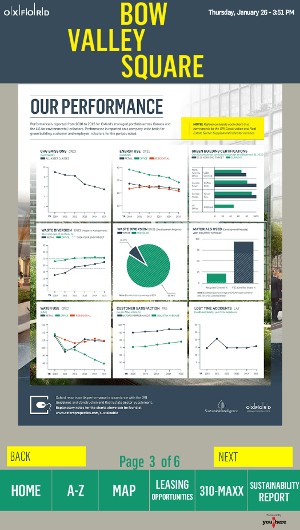
“A lot of people call our solution a digital directory, but the content that we put on our screens has evolved to be so much more,” says Scot Martin, President and CEO of youRhere.

Technology advancements such as the Internet of Things (IoT) now allow interactive information hubs to connect and pull data from many diverse sources, providing continually updated information to users.

“Think of these hubs as a virtual concierge or a one-stop shop for all information about the building, in a manner which is clear and helpful,” suggests Martin.

As we navigate a revolution into the digital age, buildings continue to look for ways to connect with multiple people quickly and with maximum engagement. This can also mean learning to communicate in a number of different languages, an especially critical factor, says Martin, in environments such as hospitals where timely access to information is essential.

“Canada is a very multi-cultural country. We have done some of our hubs in eight languages,” Martin explains, reflecting the demographics of the area served.

Before the introduction of flatscreen TVs, retailers would play advertising through looped video messaging on bulky analogue screens.

youRhere The term “digital signage” is still relatively new, and is a concept which evolved quickly throughout the 2000s as the cost of large-format flatscreen technology became increasingly affordable.

Displayed in prominent, accessible locations, youRhere’s interactive digital touchscreens require a small amount of space to deliver a large quantity of information. For those on the move, the screens include third-party data such as real-time transit schedules, making getting around the city easier, something which is “particularly helpful in our climate” considering Canadian winters, notes Martin.

Countdown to Net-Zero

As Canada moves towards 2050’s net-zero initiatives, there is also a favourable cost impact of digital messaging compared to traditional paper notices.

“Having information presented to people digitally is certainly more sustainable than having a large number of plastic signage or paper posters all over the building,” says Martin. “You’ll have people who will put up posters all over a building to advertise Earth Day only to tear them down and throw them in the trash right after. We can deliver that with a touch of a button on a computer which will download the information to multiple screens. They can talk about what they are doing as a company, as a building manager, or as a facility, to reduce their carbon footprint.”

Digital technology also works to accommodate those with accessibility needs: youRhere’s digital touchscreens are set up at a height comfortable for a person either in a wheelchair or someone standing.

“Our screens also allow the user the ability to raise or lower the height of the on-screen menu through the touch of a button,” says Martin. And while a poster on a wall cannot provide someone with visual impairments the information they need, audio and braille options help those with vision issues successfully navigate through the building and gain confidence in their environment.

Delivering Analytics

“Messaging your audience can be a powerful tool,” Martin explains. “Every time you touch one of our screens it generates a piece of information. We collect this information and provide analytics to the building so they know how many people used the touchscreen and what they looked for. Our content management system is intuitive and menu-driven, therefore, you can judge the success of your campaign.”

youRhere In a communal building setting, you have the briefest of times to entice your potential customer — mere milliseconds to engage as many senses as possible.
Building information hubs invite users to interact with their content using sight, sound and touch, and they are becoming more and more affordable

“Technology has enabled larger screens at lower prices,” says Martin. “We continually add features and functionality to our offering, and can put a tremendous amount of information in a small space — far more than if you put up a sign or a bulletin board.”

As advancements in technologies move towards gesture recognition and completely touchless screens, the trend upward will continue.

“Some buildings are very active — they are constantly refreshing the content on the screen and keep it engaging. It’s exciting to see people say, “Oh this is so much better than we thought it could be.”

Energy Conscious Messaging

With youRhere’s installed hardware focused on Energy Star certification, Martin encourages buildings to use the hubs to expand on the decarbonization initiatives each is taking.

youRhere “Some companies will put a QR code on the screen and invite the user to download their annual ESG report,” he says. “We can put a QR code on every screen you pull up so theoretically we can link to anything.”


As competition for modern and futuristic designs in architecture opens the floor for new building developments, commercial and office tower clients are leading the way in championing digital signage solutions.

“In office towers, we’ve now reached to point where our solution is pretty much a standard feature—certainly for newly constructed buildings as well as substantial lobby renovations,” says Martin, who also noted that mixed-use properties, whether condo/hotel or office/retail, were also taking advantage of the information hub’s ability to communicate messaging to multiple audiences.

“We deliver a full turnkey solution,” says Martin. “Companies and clients that care about sustainability can use our screens to message their tenants, staff, and visitors to the building — all three audiences — and they can talk about what they are doing as a company, as a building manager, as a facility, to reduce their carbon footprint.”

The future is digital, touchable and engaging. Visit www.youRhere.ca to find your building’s communication solution.

Scot Martin is the CEO of youRhere, a leading provider of digital signage solutions
for commercial, retail, healthcare, and educational properties across Canada. For
more information, visit www.youRhere.ca.

Proposed Barber Road apartment under review in Kelowna

A 161-unit apartment building proposed for the corner of Highway 33 and Barber Road in Kelowna, BC, is up for review by city council. If approved, the six-storey building would take over three lots at 135 and 155 Barber Rd, and 765 Hwy 33.

According to the application submitted by architecture firm MTA, the 161-unit residential development would feature townhouses at street level rather than the required retail component as per current zoning regulations. MTA is seeking an amendment to reduce the minimum amount of ground-floor commercial space along Highway 33 from the required 90 per cent to zero.

“The proposed development is focused on providing units that respond to the needs of affordable market housing in the area,” MTA wrote in its application letter. “The project has a specific focus of providing units that would be geared towards students and young couples.”

proposed apartment Kelowna MTAIf approved, vehicle and long-term bike parking would be located in a two-level underground parkade. The building would also include amenity space on the main floor and roof.


Kelowna mayor Tom Dyas said he commended staff for supporting the application to make that stretch of road more pedestrian friendly with the addition of residential units on the ground-floor.

The public is invited to address city council about the proposed Barber Road apartment at the next pubic hearing on May 9th, 2023. For more info, visit: Council meetings & public hearings | City of Kelowna


Killam announces sale of Halifax property

Killam Apartment REIT announced it has completed the disposition of “The James”, a 108-unit Halifax property, for gross proceeds of $33 million. Killam’s proceeds from the sale are $20.1 million, net of the previous mortgage associated with the property.

“We continue to explore accretive disposition opportunities as we make progress towards our strategic target of recycling over $100 million of non-core assets in 2023,” said said Philip Fraser, President and CEO. “We currently have an additional $100-150 million of dispositions under contract at various stages of due diligence, however, no assurance can be given that such transactions will be completed.”

The Halifax property is the second disposition announced by Killam in 2023. In March, it announced it had sold a “non-core” property located in Ottawa for gross proceeds of $9.8 million. At the time, Killam described the transaction as being the first of a number of proposed accretive, strategic dispositions that are expected to maximize value for our Unitholders and strengthen our balance sheet.

“We currently have an additional $125 million of dispositions under contract at various stages of due diligence, however, no assurance can be given that such transactions will be completed,” is said in an update.

The Halifax-based apartment REIT is one of Canada’s largest residential real estate investment trusts, owning, operating and developing a $4.8 billion portfolio of apartments and manufactured home communities.