Articles Archive - Page 222 of 928 - REMINET
REMI

First mass timber parkade planned in B.C.

The first mass timber underground parkade in Canada will be built in Gibsons, B.C. by Massive Canada Building Systems.

The Port Moody-based company specializes in fabricating mass timber materials and modular building manufacturing. It will design and build a single-level underground mass timber parkade at a 1.3-acre site located on 718 North Road.

“As part of Massive Canada’s goal to develop a better way to build, we decided to rethink the design of parking garages,” said Gaetan Royer, Massive Canada’s CEO. “The B.C. government is encouraging the industry to find new applications for engineered wood. As far as new applications go, this is a big one.”

Underground parkades are always assumed to be reinforced concrete structures. Massive Canada wants to challenge that assumption, stating that if mass timber structures can carry the weight of locomotives and freight trains on tall trestle bridges that still stand 100 years later, a mass timber parkade can support a six-storey building.

Preliminary estimates are that the engineered wood construction will cost less than a similar size concrete parkade.

The innovative structural system mimics traditional structures. Using proven mass timber technology, all supporting walls and posts inside the parkade will be engineered wood. The posts will support glue laminated beams and timber panels to form the podium.

The design takes into account a variety of loads that different portions of this structural system will have to support. The podium above the parkade consists of:

• a courtyard with lawn, landscaping, trees and walkways;
• light frame two-storey townhomes built above the parkade;
• a six-storey mass timber residential building built above the parkade; and
• a daycare and playground.

Although the fire resistance of mass timber has been demonstrated through many independent tests, Massive intends to use MgOSo4 boards (non-combustible), where additional fire protection is required.

A development permit application is expected to be submitted this summer.

What are “forever chemicals” and how do they affect your building?

As we move toward more environmentally conscious and health-focused practices in commercial cleaning and maintenance, it’s important to make choices that are in line with your values and your company’s mission, and that includes evaluating the products you use.

Polyfluoroalkyl substances (PFAS), also called “forever chemicals,” are a large family of man-made chemicals most commonly used in paints, stains, and other water repellants. They are called forever chemicals because of their long-term negative effects on humans and their resistance to breaking down in the environment. Often contained in paints, these chemicals present a risk to everyone exposed, from the people using the products to everyone in your building.

A study looked at 94 paint samples across brands, tiers, gloss, base, and colours, finding that 50 per cent contained levels of PFAS. How can you stop your building from containing these damaging ingredients?

Consider the sources

When buying your paint or hiring a contractor, be aware of the paint they are using. Choose paint that is environmentally responsible and better for human health. While these chemicals may be added by the manufacturer, it’s also possible that they are added throughout the supply chain, so be aware of where your paint is coming from and what may be added before you receive the product.

Look deeper

 Many times, the levels of these chemicals fall below the reporting regulations, so you may not even see this as an ingredient on the label. It’s important that your suppliers and distributors have transparency, so you can be sure about the products you are using.

Do the research

 While we have been focusing mostly on paint, PFAS have also been found in carpets, counters, cleaning supplies, and more. Become familiar with the ingredients you want to avoid and be diligent in choosing products that are safer and more responsible. This may seem like a daunting task but take it one step at a time to stop using products that don’t align with your goals.

Use resources like ECOLOGO®, a Canadian certification given to products with verified reduced environmental impact to help try and find products that are right for your business.

From PFAS to VOCs, there are many ingredients that could be threatening to the environment and the people in your building. Start by getting familiar with undesirable chemicals, look into your sources, and follow the trail to make sure that you are lowering your environmental impact and keeping the people in your building safe.

Planning Ahead: Roadmap to 2050 Calls For Drastic Reductions in Condos Using Fossil Fuels

Condominium buildings using fossil fuels should prepare for a rude awakening. By 2050, Canada’s legislated goal is to reduce our greenhouse gas (GHG) emissions to net-zero, a prospect it concedes is an ambitious but necessary measure to control climate change and sustain a livable future.

The next 25 years will be critical. According to Canada’s Green Building Strategy, the country’s built environment is responsible for 13% of its GHG emissions. The Canadian Net-Zero Emissions Accountability Act became law on June 29, 2021, and the building industry is a primary focus in reaching the 2050 net-zero goals and initiatives.

It begins with how new buildings are constructed, reducing emissions from the cement manufacturing industry through the Net-Zero Carbon Concrete roadmap, and the extensive and accelerated retrofit of existing buildings to make them as energy-efficient as possible.

According to the Department of Natural Resources, ‘Over 78% of operational building emissions come from space and water heating, the majority of which is due to equipment that runs on fossil fuels.’

Decarbonization of these systems is something Boards of Directors should be thinking about sooner rather than later, says Jeff Livingstone, Project Principal and Mechanical Practice Leader with Pretium Engineering. “Mechanical equipment installed today will still be in operation at the time when Government recommendations for net-zero building operation will be in effect. Ideally, at that time, we will not be relying on gas for heating in our buildings,” he says. “If we are aiming to be at net-zero for greenhouse gas emissions, then all gas-fired devices must be reviewed. The plan is to look at transitioning from gas to another energy form and generally, that is electricity.”

That’s where Pretium Engineering comes in. Although the targets don’t come into play until 2040, Livingstone, who has completed Building Condition Audits and Electrification Studies for clients such as the University of Waterloo and Dream Properties, stresses that this is only a few years away, and Boards of Directors and property managers should be considering the new targets when planning for replacements of existing equipment.

Livingstone advises that a switch to electric heat pumps will be at the heart of many building retrofits and will require an integrated approach for which Pretium Engineering is well-positioned to provide the necessary consulting services.

Based on historical data released by the Ontario Energy Board (OEB) and Enbridge Gas, electricity costs are estimated to rise by approximately 20% by 2030 while natural gas prices are expected to rise by approximately 36%. These cost increases coupled with the ability of electric heat pump systems to produce more heat for a given input amount (Coefficient of Performance (COP) of 2.5 or greater) means that heat pumps will become more economical in the future as relative operating costs are decreasing when compared with natural gas.

Livingstone stresses there is no one-size-fits-all solution to carbon reduction in buildings. “Equipment and building elements are all interrelated,” he says, “so you can’t necessarily change an aging boiler directly to a heat pump because hydronic systems in the building may not work as intended due to changes in system operating temperatures. We want our clients to understand that they need to look at the building holistically, as natural gas-fired equipment installed today will be in place at a time when it may no longer be compliant with the federal targets, and possibly mandates.”

Building envelope components are critical to the successful and cost-effective implementation of building carbon reduction strategies. An integrated approach allows for better use of resources and investment dollars for your assets, advises Livingstone. “If we take an existing gas boiler out of a building today, we have to design for a large and potentially oversized heat pump,” he says. “But if we can phase it in such a way that we upgrade windows to provide better insulation and air tightness, a smaller heat pump system can be used. The benefits to “right-sizing” equipment include reduced electrical demand, which is easier on the electrical grid for the province, and reducing or eliminating the need for building electrical upgrades.”

Although we don’t yet know what potential mandates or enforcement will look like in years and decades to come, according to the Green Buildings Canada Strategy, energy benchmarking will be used on all buildings to ‘help drive data transparency on energy costs and incentivize building investment decisions.’

This information will be made publicly available, a move which according to Natural Resources Canada, for residential buildings ‘could dramatically transform our real estate market.’

The Federal Government has created a roadmap for common building sectors which outlines the changes that will be required to meet national net-zero targets. These roadmaps do not take into account building lifecycle and budgeting limitations, which typically drive investment decisions for condominium owners.

With this in mind, Pretium Engineering is seeing some clients tackle the problem head-on. Combined with retrofits of windows, roofing, and lighting, astute Boards and condominium managers are including carbon reduction as a major consideration at their next building condition assessment. The Pretium Engineering team urges Boards to plan for integrated building upgrades, before replacing expensive mechanical systems with products that may not be suitable for future net-zero initiatives.

“If you are spending money on your building, take a long-range approach,” says Project Principal and Leader of Pretium’s Energy and Carbon Reduction Team, Jennifer Hogan. “If your building is using more energy or carbon than it’s supposed to be, you will be paying for it, as the cost for energy and carbon is projected to continue to rise. On the other side, there are ever-evolving incentives to complete projects that will reduce your energy and carbon consumption. Start the conversation now and find out what is out there.”

Each jurisdiction across Canada will be responsible for working with low-carbon solutions. The City of Vancouver made headway in 2022 by passing the Vancouver Building By-Law requiring zero emissions equipment for space and hot water heating in new builds. By 2025, Vancouver will require all replacement heating and hot water systems to have net-zero emissions. The City of Toronto’s strategy for net-zero emissions calls for the decarbonization of all privately-owned homes and buildings by 2040.

The zero-emissions building mandate is combined with the need for more climate-resilient buildings to counteract the imposing effects of climate warming such as increases in temperature and weather-related events.

The race to achieve zero-emissions buildings is on, and Pretium Engineering is at the forefront, providing integrated consulting solutions for Clients. Recognizing the urgent need for restructuring HVAC systems, Pretium Engineering now holds the advantage of having an in-house mechanical team.

“At Pretium Engineering, our teams work in mechanical engineering, building envelope, roofing, and energy audits. Each of these building elements is called out specifically in the Federal decarbonization roadmaps,” says Livingstone. “We are perfectly positioned to provide complete consulting and engineering services needed to meet net-zero targets.”

Jeff Livingstone, P.Eng., LEED® AP is Project Principal and Mechanical Practice Leader for Pretium Engineering. Jennifer Hogan is a Project Principal and the leader of the Energy and Carbon Reduction team. Pretium Engineering has offices in Toronto, Newmarket, Burlington, Kitchener/Waterloo, with satellite offices in Windsor and Ottawa. Connect at www.pretiumengineering.com.


Large building retrofits key to decarbonization

Achieving ambitious decarbonization targets will require the construction industry to accelerate deep carbon retrofits on the existing building stock across Canada.

“Here in B.C., the overwhelming majority of the carbon emissions from new buildings are directly linked to materials and construction,” said Aaron Knorr, senior associate with Perkins & Will at the Canada Green Building Council’s (CAGBC) Building Lasting Change conference.

“Retaining and improving existing buildings that we have really has to be a critical part of our strategy for decarbonizing our industry.”

A recent project the firm worked on involved a 1940s concrete warehouse in Vancouver that had an owner mandate to prioritize carbon reduction along with achieving CAGBC’s Zero Carbon Building standard certification.

Knorr explained that Perkins & Will prepares a lifecycle assessment on every project to come to a decision about whether to reuse an existing building or to undertake the more conventional approach of a teardown and rebuild.

“We were able to realize a significant potential carbon impact for the project just through this fundamental decision of preserving the building and the existing structure at the outset,” he said.

Material selection was a critical focus on this project with mass timber used to add four new storeys on top of the existing structure and specification of low carbon concrete and XPS insulation.

Through the firm’s reuse, reduce and specify strategy, the overall embodied carbon for the project sits at 339 kg CO2e/m2 (below CAGBC’s embodied carbon innovation credit of 350 kg CO2e/m2), which “represents a significant achievement,” said Knorr.

He stressed meaningful carbon reduction requires commitment and collaboration. “Achieving low carbon buildings really requires a collaborative approach and buy in from everyone on the project team from project kick off to project completion.”

“Finally, designing for low carbon requires a holistic approach to design. We need to build literacy and fluency with an understanding that the carbon impacts of design decisions we make into every aspect of our design,” he said, adding conversations with clients, trades, consultants are needed to move the industry forward towards low carbon solutions.

Collaboration was also cited by Stephen Montgomery, sustainability specialist at PCL Constructors, as being key to reaching decarbonization goals.

“We need to find a way to put design, construction and operation silos together and find out how we’re going to make this work,” he said. “We need to infuse these carbon roadmaps with actionable budgets, schedule and logistical insights.”

He cited that the International Energy Agency monitors clean energy progress and the agency has described the building sector as “not on track” for reaching the 2050 climate targets. New green building construction alone won’t reach Canada’s 2030 greenhouse gas reduction targets.

“We have to decarbonize Canada’s 482,000 commercial and public buildings by 2050,” said Montgomery. The buildings also need ongoing net zero operation with a shrinking workforce. “We’re handing over a more complex product to a shrinking industry of labour – a 30 per cent reduction in trained building operators.”

Low-rise multi-unit residential buildings and offices represent the largest building stock available for green retrofits. The CAGBC estimates large building retrofits could potentially reduce building-sector emissions by 51 per cent (21.2 million tonnes of CO2e).

“No one has a magic method but it’s time to get started – to push some of these first projects over the starting line” said Montgomery.

Cheryl Mah is managing editor of Construction Business.

Mayoral candidates talk housing in latest debate

Housing has been a dominant issue for Toronto’s mayoral candidates seeking election on June 26. From former MP and city councillor Olivia Chow to ex-police chief Mark Saunders, six prominent frontrunners gathered June 12th to reiterate their stances on housing-related challenges at a debate presented by the Urban Land Institute (ULI).

Moderated by Marivel Taruc, CBC journalist and TV host, the crux of the conversation centred on housing as a defining issue in both the ongoing election campaign – and for the incoming mayor who will play a pivotal role in aligning the city’s resources and programs with allies and government groups.

“One of the biggest issues right now is supply,” said Saunders. “The existing government sat on their hands and didn’t do anything, knowing the population is increasing rapidly [and] we are going to have 500,000 more people here in the years to come.”

While overall lack of housing supply was central to the discussion, student-focused housing, zoning and red tape, and the declining state of the city’s existing rental stock were all touched on by the candidates.

“I served on the Board of the United Way in Toronto, and when the vertical poverty report came out, it was definitely eye-opening to see the vulnerability and the risk in terms of keeping existing rental stock in good state of repair,” said Liberal MPP, Mitzie Hunter. “In my comprehensive plan for affordable housing, I want to protect those units from being sold and demolished, so we don’t lose that important rental stock.”

Hunter said that if elected, she would put $100 million toward the Multi-unit Acquisition Program to acquire and convert aging affordable rental units into non-profit land trusts or co-ops. The program, launched by the City in 2021, helps save apartment buildings and multi-tenant houses that are either vacant or at risk of being converted into more expensive properties.

Meanwhile, both Olivia Chow and Josh Matlow expressed concern over the growing trend of “renovictions,” with Matlow stating that “reform is needed to give tenants some protections when they are required to leave their homes.”

Below is a comparison of some of the housing policies and promises proposed by the six candidates who appeared in the June 12th debate:

Ana Bailão

“I’m running on a plan to build housing and make life more affordable. I believe there is nothing more important than affordable housing.”

  • Establish an Anti-Displacement and Evictions Prevention Unit with 30 staff members.
  • Temporarily freeze new proposals that would demolish rental buildings.
  • Encourage densification by rezoning avenues to allow eight to 10 storey apartment buildings as-of-right (i.e., no need for special permit), legalize walk-up apartments on some transit routes and relax rules around shadows.
  • Commit to ensuring 20 per cent of all new homes built by 2031 are purpose-built rental projects.
  • Make additional surplus municipal properties available for non-profit and co-operative housing to build new affordable homes and speed up construction readiness for these projects.
  • Lead an initiative on residential intensification to develop incentives and launch new policies to support the delivery of 285,000 new homes by 2031.

Brad Bradford  

“We need more housing options, more supply, to address the range of need.”

  • Increase housing supply by unlocking government-owned lands.
  • Aim to deliver more “missing middle” and mid-rise developments.
  • Streamline approvals and reduce delays by empowering the Development and Growth Division.
  • Expedite the conversion of empty offices into homes by providing as-of-right approvals if the building isn’t expanding and so long as the new development includes 20% affordable housing.

Olivia Chow 

“Affordable housing is defined as one third of your income, but this isn’t the case for many who live in Toronto.”

  • Invest in a $100-million Secure Affordable Homes Fund, which would help finance the purchase, repair and transfer of affordable rental apartment buildings to not-for-profit, community, and Indigenous housing providers.
  • Build 25,000 rent-controlled homes on city-owned land, with a minimum of 7,500 affordable units, including 2,500 rent-geared-to-income units.
  • Double the reach of Toronto’s Rent Bank and nearly triple the reach of the Eviction Prevention in the Community program for those with complex needs.
  • Strengthen the RentSafeTO program and scale up the Tenant Support Program.
  • Establish a Toronto Renters Action Committee to work on anti-renoviction bylaws, advocate for rent control, and review existing policies and programs related to renters.

Mitzie Hunter

“The reality is this city has become unaffordable for so many. Housing is a human right, and we need to make sure people can afford to live here.”

  • Increase eviction prevention services by expanding the Eviction Prevention in the Community (EPIC) Program and raising mental wellness by doubling support for street outreach services.
  • Unlock public lands to create more new affordable housing.
  • Speed up building approvals and construction.
  • Amp up multiplex development and aim to add rental apartments on major streets and near campuses.
  • Target homelessness by opening 24/7 warming and cooling centres and adding 400 new shelter beds.
  • Increase housing stability by creating 2,000 new supportive homes with permanent funding for supportive services for residents.
  • Establish five new Housing Outreach Program Collaboration (HOP-C) teams to support the mental wellness needs of marginalized youth for a total investment of $250,000 per team.

Mark Saunders  

“The number one issue is supply and the growth in population. People want to come [to Toronto], but if there is no place to call home, we will fail.”

  • Accelerate approvals by eliminating “silos” at city hall and digitizing more of the process.
  • Work with local unions as well as the federal and provincial governments to encourage more people to join the skilled trades.
  • Permit 1-2 more floors per rental or condo building, or up to 20 additional units where appropriate.
  • Change the current requirements for the Housing Now program, which make it very difficult for builders to get financing to build affordable housing.
  • Take the property tax off affordable housing units in future developments to help spur the rapid development of more homes.
  • Press the federal government to waive the HST on all new large-scale purpose-built rental housing projects.
  • Explore the possibility of tax and other incentives for purpose-built affordable rentals.
  • Review Toronto’s development charge framework to ensure that monies collected are being directed toward their intended purpose. If they are not, look at reallocating some funds to community improvements in underserved areas.

Josh Matlow  

“Too many people are relying on food banks. They can’t afford to make monthly rents and buy groceries.”

  • Invest $300 million in Public Build Toronto, a new agency to develop housing on city-owned land like TTC parking lots; the agency would hire builders and partner with non-profits to offer a mix of deeply affordable, rent-geared-to-income and affordable homes, and market-rate units with rent control.
  • Fast-track applications for affordable housing.
  • Approve nine-storey buildings as-of-right on designated roads.
  • Open doors to more affordable units by relooking some of the current rules.
  • Support tenants by cracking down on “shady renovictions” and “bad landlords.”

Assembly of First Nations updates school design standards

The Assembly of First Nations (AFN) and Indigenous Services Canada (ISC) updated its education infrastructure standards to further support equity for schools on-reserve.

The School Space Accommodation Standards (SSAS) policy outlines service standards for the construction and major renovation of First Nations schools that ISC funds through its capital facilities and maintenance program. The goal is to guide the development of First Nation learning environments that will support individual communities’ culture, language, and ways of knowing.

The policy review began in 2019, and used a two-phased approach to address issues with space standards of school facilities identified by First Nations and regional offices.

Changes resulting from the first phase of the review took effect in April 2021, and increased on-reserve school sizes and included new allocations for spaces to support full-day kindergarten, language and culture rooms, knowledge keeper offices, counselling rooms, and outdoor learning spaces.

The newly updated School Space Accommodation Standards policy:

  • ensures that First Nations can alleviate enrollment pressures and rising populations by developing design horizons up to 12 years after the opening of the school. This means less overcrowding, more culturally specific spaces, and more spaces for First Nations students to succeed in.
  • supports lifelong learning as First Nations adults are included in new school designs that supports education upgrading and language learning.
  • reflects First Nations students’ needs in language, culture, traditional ways of knowing, and enhances support of education programming.
  • improves space design for the most vulnerable students who require inclusive/special education services.This approach is the first of its kind in Canada, and will ensure that inclusive/special education spaces are never compromised and instead based on the needs of the students, professionals, and community.
  • These updates will also improve accuracy of enrolment projections, extend school design horizon, better accommodate inclusive or special needs students, provide more flexibility in policy guidance, better accommodate communities’ needs – especially those in remote areas – and make the SSAS more user-friendly.

“These are the best school standards in Canada, and First Nations continue to be a global leader in Indigenous-led school standards,” said Regional Chief Bobby Cameron, education portfolio holder for Assembly of First Nations. “With these changes, we will alleviate enrollment pressures in First Nations schools and improve class sizes and learning environments to ensure First Nations students have spaces that reflect their Treaty and Inherent Rights to education.”


B.C. requiring asbestos abatement license

Asbestos abatement contractors who operate in B.C. must be licensed by Jan. 1, 2024, making B.C. the first jurisdiction in Canada to implement a licensing requirement for this work.

To further ensure the safety of asbestos abatement workers, amendments to the Workers Compensation Act were made in spring 2022 to require contractors who perform this work to be licensed, and to ensure those contractors must only use trained and certified workers to perform asbestos abatement work.

Starting in September 2023, WorkSafeBC will begin to accept licence applications from contractors performing asbestos abatement work throughout the province. A registry of licensees will be published by the end of 2023.

Additionally, changes to the act provide WorkSafeBC with the authority to administer a certification program for people conducting asbestos abatement work. The required training for worker certification is scheduled to begin this summer.

Since the new protections were announced in spring 2022, WorkSafeBC has been developing its framework for the asbestos certification and licensing program and making policy and regulatory changes to align with the legislative changes. WorkSafeBC continues to meet with employer and worker groups to brief them on the new requirements.

Bringing in stricter laws and controls around asbestos abatement work is essential for protecting people and the environment from the dangers of asbestos. In 2022, asbestos exposure was a contributing factor in 61 of 181 workplace deaths.

Since 2000, asbestos has been the cause of more than 50 per cent of all work-related occupational disease deaths and approximately 33 per cent of all work-related deaths.

Asbestos was commonly used in construction in Canada until the late 1980s. There is a significant risk to workers involved in the renovation or demolition of older buildings.


Planning for Calgary’s Olympic Plaza underway

The Calgary Municipal Land Corporation (CMLC), the City of Calgary and Arts Commons have announced planning is underway for the $40 million Olympic Plaza Transformation project — a new city-building initiative to renew an important but aging downtown cultural space.

The Olympic Plaza Transformation will see a full redesign of the plaza as an innovative, flexible and active space in the downtown core. Its proximity to Arts Commons—currently undergoing its own $480M transformation—will allow for design synergies, construction efficiencies and coordinated leadership.

As development manager, CMLC is responsible for stewarding design and construction on behalf of its partners.

“As development manager for the expansion and modernization of Arts Commons, CMLC is perfectly positioned to lead the Olympic Plaza Transformation with a coordinated approach that dramatically elevates the entire block,” says Kate Thompson, CMLC’s president & CEO. “CMLC excels at visionary master-planning, and the opportunity to reimagine an entire block is very exciting—as are the benefits and opportunities for Calgarians. Leading three adjacent and concurrent projects in this block creates construction efficiencies and economies of scale.”

CMLC will be issuing an RFP for a qualified and visionary design team to lead the concept planning of the project. Following selection of the proponents, design is expected to take place through 2023 and 2024.

In developing a programmatic design for the Olympic Plaza Transformation, CMLC and the selected design team will explore the plaza’s historic elements and significance as a gathering place during the 1988 Winter Olympics.

“When Olympic Plaza and ACT are complete, the Arts Commons campus will be one of the largest contiguous arts-focused space in Canada. The potential for elevating Calgary’s reputation as an internationally important arts and cultural centre is tremendous,” said Alex Sarian, president & CEO of Arts Commons.

Construction timelines for the Olympic Plaza redevelopment will be defined as the project plan is refined.

Average annual rent increases cooled slightly in May 

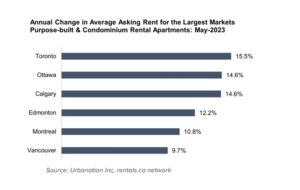
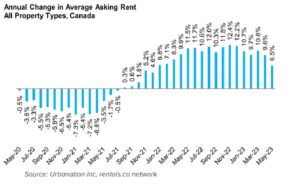
The average annual rent for vacated units in Canada rose 6.5 per cent in May, marking the lowest annual increase since December 2021, according to new data from Rentals.ca  and Urbanation. That said, rents are expected to continue to climb in 2023 to align with rising immigration, as Canada plans to welcome 465,000 new residents , and as buying a home becomes more expensive.

“Higher rents are on the horizon with interest rates at a 22-year high, rising home prices and record immigration,” said Matt Danison, CEO of Rentals.ca Network. “Gen Z could become the ‘Boomerang Generation’ moving back in with the parents or the ‘Roommate Generation’ splitting rent as it’s unaffordable for many Canadians to pay rent on their own. Governments at all levels need to come up with creative solutions to increase housing supply.”

“The rental market is expected to heat up further as it enters the seasonal peak for demand during the summer months, driven primarily by an incoming surge in international students and continued deterioration in homeownership affordability as interest rates move higher again,” added Shaun Hildebrand, president of Urbanation.

Vancouver once again topped the list of 35 cities for priciest rents in May, where one-bedroom homes averaged $2,831 and two-bedroom homes averaged $3,666. Year over year, average monthly rent in May for a one-bedroom in Vancouver was up 16 per cent and up 8.7 per cent for a two-bedroom.

Toronto finished second on the list of cities with highest rents for one-bedroom units ($2,538) and third for two-bedroom units at $3,286. Year over year, average monthly rent in May for a one-bedroom in Toronto was up 17.5 per cent and up 12.4 per cent for a two-bedroom.

Montreal came in 26th for one-bedroom homes at $1,657 and 20th for average monthly rent for a two-bedrooms at $2,172. Year over year, average monthly rent in Montreal in May for a one-bedroom was up 6.8 per cent and up 8.1 per cent for a two-bedroom.

annual rentsOther key takeaways

  • In Vancouver and Toronto, roommate rents were well above $1,000 in May, averaging $1,433 in Vancouver and $1,299 in Toronto. In Ottawa, the average roommate rental in May was $947; in Montreal; the average was $930; in Calgary, roommate rentals averaged $843 in May and in Edmonton, the average roommate rental was $712.
  • Year over year, average rents for purpose-built and condominium apartments slowed to 7.3 per cent in May from 10.1 per cent in April. For one-bedroom purpose-built and condo apartments, rents averaged $1,770 in May, and two-bedroom rents averaged $2,127.

For the full report, click here: Rentals.ca June 2023 Rent Report

Alberta’s new portfolios silent on housing

Housing is not referenced in the titles of any of the portfolios that Alberta’s 24 newly named cabinet ministers will lead. In unveiling her executive council earlier today, Premier Danielle Smith pledged that the new government will focus on the economy, affordability, health care reform, crime and defending Alberta’s interests.

“These are not just our government’s priorities, they are Albertans’ priorities,” she maintained. “The next four years start today, and I can’t wait to get back to work with each of my cabinet colleagues.”

The cabinet includes 20 men and five women (including Smith), described as “a mix of experienced and new ministers who represent Alberta’s diversity.” As yet, no directions from Smith have been publicly released to outline Ministers’ expected tasks, but there are three portfolios that could presumably cover responsibility for housing.

Nathan Neudorf will serve as the Minister of Affordability and Utilities. He is the member of the legislative assembly (MLA) for Lethbridge East, first elected in 2019, and was Deputy Premier and Minister of Infrastructure during the previous government term. He is a past president of the Lethbridge Construction Association, former board member of the Alberta Construction Association, Alberta Construction Safety Association and Worker’s Compensation Board, a red seal journeyman carpenter and a gold seal project manager.

Ric McIver has been appointed Minister of Municipal Affairs. He is the MLA for Calgary-Hays, first elected in 2012, and held four different cabinet posts in the previous government, including as Minister of Municipal Affairs. He is a former Calgary City Councillor and was chair of the Calgary Housing Company during that tenure.

Jason Nixon takes on the role of Minister of Seniors, Community and Social Services after serving as Minister of Environment and Parks, Minister of Finance and President of Treasury Board in the previous government. He is the MLA for Rimbey-Rocky Mountain House-Sundre, first elected in 2015. Prior to entering public life, he was an entrepreneur and the executive director of an addiction treatment facility.

Bathroom trends: personal touches

From its inception in modern homes, the bathroom has been a place of functionality — a place to take care of personal hygiene and store cleaning products and toiletries. But that approach to bathroom design is changing. Fueled by cutting edge trends, the prevalence of home improvement content across pop culture channels and a recent pandemic that forced everybody to spend more time in their homes, there is a growing focus on the bathroom as a personal retreat.

That is very much reflected in emerging trends in bathroom design.

“The modern bathroom is a personal oasis where you can get away and relax without having to leave your home,” says Harry Kandilas, director of showrooms with Wolseley Canada. “If there is any room in the house that should have a touch of luxury, it is the bathroom. As we shift our perspective of the bathroom and its role in the home, we are seeing more advanced accessories, more technology and more bold design ideas make their way into both renovations and new builds.”

Among the bathroom trends that Wolseley Canada is seeing in 2023:

Bold Colours — This is more than just the colour of the paint on the wall. Bold tiles bring new life to showers, backsplashes and floors. Even the bathroom fixtures. Kohler is re-introducing two heritage colours, as voted by fans of the brand, to help mark its 150th anniversary. Later this year, expect to see sinks, toilets and other elements in Spring Green — an original shade from Kohler’s introduction of colour in 1927 — and the 1930s-era Peachblow.

Big Showers — Home bathroom design in the late 1980s and early 1990s liked to incorporate an over-sized, built-in bathtub. In the 2020s, those tubs are coming out in favour of spacious walk-in showers. Shower panels give these a spa-like feel. They often incorporate rainfall showerheads, or multiple showerheads to add an element of romance to the shower.

Mix-and-Match Design — Matte black faucets with gold or chrome accents — or vice-versa — are showing well for this year. The mixing of hues on faucets adds a unique and stylish element to the sink area or in the shower.

Touchless ­— Post-pandemic, there is a hyper-awareness about cleanliness. Touchless faucets remove what was once a common touchpoint where germs could be spread. Operating with the wave of a hand, they combine innovative infrared technology with a futuristic look.

Technology — These aren’t your parents’ toilets. Intelligent toilets incorporate technology for heated seats, touchless flushing and lid-opening, bidet functionality and night lights built in. Enhanced electronics and use of UV and stainless wands ensure anti-microbial cleaning. Hand controls are customizable for up to four different users to customize the experience with heat selection and wand positioning.

Comfort — Modern bathrooms are re-creating the spa experience. Massaging hand showers, body sprays and steam systems are among the key pieces in the shower that invite relaxation. You can even work aromatherapy into your shower experience.

Sustainability — Environmental awareness is very trendy in 2023, and that extends to bathroom fixtures that conserve water. Look for faucets and showerheads that don’t compromise quality and water flow while still minimizing the water you use during your daily routines.

Ontario passes controversial Bill 97

The Ontario government has passed new legislation, known as Bill 97 or the Helping Homebuyers, Protecting Tenants Act, introducing a variety of changes the Province says will help it reach its goal of building 1.5 million homes.

Among the changes, two land use planning documents—the Provincial Planning Statement and A Plan to Grow: Growth Plan for the Greater Golden Horseshoe—have been merged “to support growth near transit stations and allow more homes to be built in rural areas.” Municipalities will also have “more flexibility” to expand their settlement area boundaries.

In terms of impacts to the landlord-tenant relationship, the bill includes new protections to limit “renovictions” and introduces changes to the “landlord’s own use” clause. Landlords will now be required to give tenants a 60-day grace period to move back in once renovations are complete at the same rent they were paying before. If a landlord fails to comply, the tenant will have two years after moving out, or six months after the renovations are completed, to file a complaint with the Landlord and Tenant Board (LTB).

Fines for offences under the Residential Tenancies Act (RTA) will double to $100,000 for individuals and $500,000 for corporations. For landlords intending to recoup the unit for “own use” purposes, there will now be a deadline for the move-in date (yet to be set). Vacating tenants will have the right of first refusal to re-enter a unit if a designated person does not move in within the prescribed time.

Bill 97 also amends the RTA to permit tenants to install and use AC units in their rental suites. According to Joe Hoffer, Partner at Cohen Highley LLP, a tenant can now install an in-suite AC unit subject to certain conditions, as set out in 36.1 (3) RTA.

“The tenant must notify the landlord in writing before installing the unit; must ensure the unit won’t damage the rental unit; must install the unit safely and securely; and must ensure the installation complies with applicable law,” he said. “The tenant must pay for increased hydro based on the use of the AC unit unless a tenancy agreement expressly states that the unit may be installed without an increase in rent.”

Landlords can only raise the tenant’s rent to reflect the actual cost of the increased hydro caused by the AC unit—so where hydro is included in the rent, unless the unit is sub-metered, Hoffer warns that the “actual cost” is bound to be the subject of numerous disputes at the LTB.

“It’s a recipe for conflict and financial loss to the landlord,” he said. “Landlords should inform themselves of the new rules to avoid issues that are sure to arise.”


BCIT launches pilot entry skills ACE program

BCIT has launched its first pilot of the Entry Skills for Architectural, Construction, and Engineering Fields (ACE) Microcredential program with more than 18 high school students enrolled to start this summer.

ACE is a pathway program aimed to provide eligible high school students, specifically recent graduates, with introductory design and technical skills in the fields of architecture, construction, and engineering. Students will spend the summer completing the curriculum portion of the program before they are placed with industry partners through two six-month paid internships. Throughout the internships, students gain real-world experience working on the job while continuing their studies in a part-time, online model.

With B.C. expected to have over one million job openings in the next 10 years based on the latest Labour Market Outlook Report, BCIT sees the ACE microcredential as a solution in supporting the province and industries to fulfill the workforce gap. The microcredential helps remove barriers to education for the youth by requiring less financial and time commitment, and encouraging students who are unsure if a particular program/field is right for them to try a variety of career paths before committing to further academic avenues.

“BCIT is excited to be spearheading this unique ACE initiative that offers motivated high school students a deeper understanding about career opportunities in Architecture, Construction, and Engineering,” said Wayne Hand, dean, School of Construction and the Environment. “Access to paid, industry work placements provide young learners the insight, experience, and connections needed to make informed decisions about their career and education pathways, while giving industry partners the opportunity to attract young people to their vibrant sectors.”

Graduates from the certificate program will then have the ability to pursue several pathways toward architecture, construction, and engineering credentials, such as the BCIT Architectural and Building Technology Diploma program.

“The ACE program is an opportunity for high school students to learn more about careers in the architecture, construction, and engineering fields while gaining paid, industry work experience,” said Laurie Therrien, manager, corporate Training and Industry Services, BCIT. “This also allows companies in those fields to introduce more young people to these exciting careers – all of which are a tremendous win for students, industry, and education. In fact, it’s long overdue.”


Construction starts on Edmonton footbridge

Construction has started on the $38.6 million Edmonton-Strathcona County Footbridge. When complete, the footbridge will connect 167 Avenue (on the west/Edmonton side of the river) to Township Road 540 (on the east/Strathcona County side of the river).

“To build a vibrant, healthy city, we need to ensure all residents have access to open spaces and recreational opportunities,” said Mayor Amarjeet Sohi. “We are pleased to partner with Strathcona County and the River Valley Alliance on this exciting project. The Edmonton-Strathcona County Footbridge will link two communities, and create even more opportunities for citizens to get outside, be active and enjoy our beautiful river valley.”

The design includes open spaces and improved trail connections on each side of the North Saskatchewan River. The design took into account feedback gathered from public engagements and from engagements with 31 Indigenous Nations and communities.

“The footbridge will be a favourite landmark for future generations, offering a close connection to nature and a glimpse into the valley’s history,” said Strathcona County Mayor Rod Frank. “It will provide a safe and convenient pathway, linking communities and promoting a healthier, more sustainable future.”

The trail, recently named Amisk Wacîw Mêskanaw (Beaver Hill Road) in nêhiyawêwin (the Cree language), will encourage active transportation, while creating opportunities for place-based information sharing that encourages residents and visitors to reflect upon history, culture and the surrounding environment.

“This new pedestrian bridge is an imperative connection toward the River Valley Alliance’s goal of creating the longest river valley pedestrian trail in North America,” said Kristine Archibald, executive director, River Valley Alliance. “Our partnerships with all levels of government are key to realizing this infrastructure that will become a lasting legacy for Albertans.”

Construction is expected to finish in 2025.


USGBC bell-ringers signal green capital momentum

The New York Stock Exchange recognized three decades of green building momentum across the United States and its capital markets as the U.S. Green Building Council (USGBC) opened the day’s trading on June 8. On hand to ring the bell, the USGBC’s president and chief executive officer, Peter Templeton, noted the surging ranks of publicly traded companies now focused on reducing greenhouse gas emissions (GHGs) and leveraging the opportunities of a low-carbon economy.

“This event represents the collective impact of all our members, partners and stakeholders who have worked tirelessly to drive sustainability and make a positive difference in communities worldwide,” he said. “We are proud of what we have achieved together and remain committed to our mission of creating a sustainable and regenerative future.”

The USGBC is marking its 30th anniversary this year.

Mercer to acquire Structurlam for $81M

Mercer International in Vancouver is acquiring all the assets of Structurlam and its subsidiaries for $81.1 million.

In April, Structurlam, headquartered in British Columbia, filed for bankruptcy and entered into a purchase agreement to sell all of its assets in B.C. and Arkansas.

As part of the deal, Mercer will acquire Structurlam’s production facility in Conway, Arkansas (the Conway facility), and its production facilities in British Columbia.

The Conway facility is a modern, state-of-the-art manufacturing facility built in 2021. It has an annual capacity of approximately 75,000 m3 (2.6 million cf); and can produce both glued-laminated timber (glulam) and cross-laminated timber (CLT).

The assets also include three facilities located in British Columbia with a combined annual capacity of approximately 40,000 m3 (1.4 million cf) of glulam and CLT.

The transaction will, among other things, add glulam production capability to Mercer’s existing mass timber offerings. The proposed acquisition will materially increase Mercer’s CLT capacity to approximately 210,000 m3 (7.4 million cf) and add 45,000 m3 (1.5 million cf) of glulam to its production capacity.

“The acquisition of the Structurlam assets is consistent with our strategy to expand and diversify our product mix in our solid wood segment and build out our existing mass timber business. The acquisition will materially increase our existing production capacity and cement our position as a leading producer of mass timber products. These assets complement our existing Mercer Mass Timber facility, located in Spokane Valley, Washington, and provide significant potential synergies on a combined basis,” said Juan Carlos Bueno, Mercer president and CEO. “We look forward to completing the acquisition and continuing to grow our contribution to a circular carbon economy, providing sustainable and carbon reducing alternatives through our innovative forest products.”

Structurlam has been a leader of the mass timber wood building boom, especially in British Columba. British Columbia government initiatives have supported the construction of mass timber buildings including the use of Structurlam products for building the 18-story Brock Commons at the University of British Columbia.

Switching your grounds equipment from gas to electric

Maintenance and facility managers are always looking to improve their operations and simplify their processes, so you may be looking at switching your equipment from gas to electric to save money and reduce emissions. As always, there are positives and negatives to the changeover, so consider the idea from all angles before making deciding what works best for your building.

The advantages

Environmental impact is at the forefront of making these adjustments; by reducing or eliminating your emissions, your carbon footprint becomes significantly reduced. Many companies are looking to become more eco-friendly, and starting with smaller equipment can be a less-daunting way to begin that process.

Some smaller equipment makes the transition relatively simple. Converting two-stroke equipment like weed-eaters, chainsaws, and backpack leaf blowers may be a way to take small steps toward large-scale conversion.

Things to consider

Converting your equipment has its challenges, of course, like cost, creating infrastructure, and possible performance decline. While initial costs are certainly more expensive than gas, you are essentially paying for your “gas” upfront when you purchase the batteries. When budgeting, stretch that initial cost over the projected battery life term to help compare apples to apples.

According to Jason Bowers, sports field supervisor for parks in Montgomery County in Maryland, some of the small equipment they’ve converted does not perform at the same level as the original gas versions, requiring more labour, more time, and more equipment to get the job done.

Battery life can also pose an issue, so getting educated is the key. Consult various manufacturers to get the most value for your money and to address performance standards for your needs. There may even be an experimental period where you try out a few options to see which suit your needs best before you commit to the switchover.

As well, setting up the infrastructure can be a costly and complex process when you need to upgrade your electrical capacity and add things like charging stations. These major expenditures may need to be multi-year endeavours, but getting started early can help with the planning and budgeting.

According to studies, there are over 500 towns and cities that have incorporated electric power into their programs as an alternative to gas. This shows that it may well be a viable and sustainable approach to your outdoor maintenance program. Plan ahead to make the switch on your own time, based on your budget, to successfully complete the switchover and say ahead of the competition.