



Articles Archive - Page 218 of 928 - REMINET
REMI

National office vacancy rate continues to climb

The national office vacancy rate surpassed 18 per cent in the second quarter of 2023, the highest level recorded since 1994. Newly released stats from CBRE Canada show an additional 1.6 million square feet of space emptied out over the spring months, which was a more moderate pace than the 4.8 million square feet of negative absorption over the previous two quarters. Class A net rent averaged $25.43 per square foot (psf) across the 10 major Canadian markets surveyed, while the downtown vacancy rate climbed 180 basis points (bps) above its suburban counterpart.

Downtown Class A office space continues to post the lowest vacancy rate (16.5 per cent) and command the highest net rent ($29.44 psf) with downtown Class B at the other end of the scale, recording a vacancy rate of 23 per cent for Q2. Canada-wide, average downtown Class A rents have inched up by 4.6 per cent since the first quarter of 2020 and average suburban Class A rents have risen by 7.8 per cent in the same period, while downtown Class B rents are alone in slipping below pre-pandemic levels.

“These differing performances reflect the priorities of tenants for high-quality, well-amenitized office buildings situated in office nodes that minimize commute times for their employee base,” CBRE analysts conclude.

“When you dig beyond the general vacancy numbers, a clear pattern of bifurcation is emerging. Not all markets and not all assets are equal,” concurs Paul Morassutti, chair of CBRE Canada.

Looking at some of those differentiations, Vancouver remains the tightest and priciest market, although average class A net rents fell slightly in Q2. The downtown Class A vacancy rate sits at 10.9 per cent with average net rents at $47.16 psf; the suburban Class A vacancy rate is still in the single digits, at 6.1 per cent, with average net rents at $29.99 psf. Vancouver is also one of the few markets (along with Calgary and Halifax) to record positive absorption for the quarter, at 132,000 square feet, despite the arrival of 550,000 square feet of new supply.

Toronto accounts for more than 50 per cent or about 818,000 square feet of Canada-wide negative absorption during the second quarter. In contrast to most other markets, the downtown Class A vacancy rate is significantly lower (980 bps) than its suburban equivalent, although that gap shrinks to 470 bps when Class B properties are added into the mix. Toronto’s total vacancy rate hovers just below 18 per cent, with sublet space making up a quarter of the tally. No new supply came onto to the market in Q2, but about 6.2 million square feet is still under construction, of which nearly 5.5 million square feet is downtown.

Class B buildings also bear the brunt of Montreal’s 60 bps uptick in office vacancy in Q2. The overall vacancy rate sits at 17.4 per cent, but is 14.5 per cent for downtown Class A space. Nevertheless, downtown saw more space returned to the market with 252,000 square feet of negative absorption versus 175,000 square feet in the suburbs. Class A rents exhibited growth for the quarter, with downtown Class A space commanding $26.10 psf. Like Toronto, no new space came onto the market in Q2, but roughly 1.9 million square feet is under construction with almost three quarters of that slated for the downtown market.

Although long plagued with Canada’s deepest vacancy rate, Calgary continued to post improvement in Q2. The downtown Class A vacancy rate has dropped 100 bps since Q4 2022, nudging down to 25.7 per cent this spring. That’s in step with three consecutive quarters of positive absorption downtown, including 158,000 square feet in Q2. CBRE analysts attribute much of the uptick in demand to “growth in the engineering, construction and education sectors”. Meanwhile, 390,500 square feet of space has been removed from the downtown office market since Q4.

“In addition to the several office building conversions underway, landlords are also getting creative by retaining previously vacant space and transforming it into additional building amenities,” CBRE analysts report.

The Class A vacancy rate in downtown Ottawa has jumped by 240 bps since Q4 2022 and now sits at 11.3 per cent following more than 291,000 square feet of negative absorption over the course of April, May and June. Average net rents for downtown Class A space has nevertheless been inching up, from $22.12 psf at year-end 2022 to $22.90 psf in Q2. Overall vacancy downtown is 270 bps higher than in the suburbs. However, downtown Class A space outperforms its suburban equivalent, which recorded a 13 per cent vacancy rate for the quarter.

Selecting the best hardwood floor finish

Are you refinishing your building’s hardwood floor? Do you know the right application for your business? It’s important to get it right when choosing your hardwood floor finish to lengthen the life of your flooring and reduce your maintenance time.

There are a few factors to consider when choosing the hardwood floor finish that works best for your business.

The finish

Matte or glossy is the first decision to make when considering the final look of your floor. Besides your visual preference, of course, you need to consider the wear and tear visibility that each finish allows. For example, satin and matte finishes may be a better choice for high-traffic areas that see a lot of wear, as they tend to camouflage it better than a shiny finish.

Next, choose an oil or water based. Water-based dries clear and typically keeps that natural look, while oil-based can dry with a tint and make your natural grain less visible.

The time

Another consideration is your timeline, and how fast you need the floors to be completed. If your building is going to remain open and you need to complete this job overnight, you may decide to go with water-based. This type of finish is easy to apply and is often ready for traffic in six to eight hours after completing the final coat.

Oil-based finishes tend to soak into the wood, too, so they will require re-applying, and that means more time and labour over the long term to keep them looking great.

The details

Generally, polyurethane finishes are durable, so for commercial use, they are often the best choice. As well, water-based finishes tend to be low VOC, so that may be an environmental (or odour) concern to factor into your decision-making.

RELATED: How to make your floor care greener

Should damage occur, it’s important to know how to repair or replace your floor, along with re-applying the finish. Maintaining your floor with sweeping and mopping is great for the day-to-day but consider your options if your floor gets damaged or severely worn in areas over time.

Hardwood flooring is a good choice that will last years in your building but be sure to choose the best finish option for your use, your maintenance plan, and your budget.

A safe approach to outdoor maintenance hazards

Safety isn’t necessarily something most people associate with groundskeeping, but outdoor maintenance comes with a list of hazards that need to be considered as part of your maintenance plan. In 2021, there were about 142 work-related fatalities associated with outdoor maintenance each year, so protecting your team and preventing injury is vital to your business.

Some of the most common risks to outdoor workers include exposure to chemicals and pesticides, air quality and extreme heat, operating heavy machinery, and contact with electrical power lines. Knowing how to mitigate these hazards will protect your team and keep your business operational.

According to the Occupational Health and Safety Administration, there are several steps you can take to stay safe as a landscaper, groundskeeper, or outdoor maintenance manager:

  • Wear visible clothing. Motor vehicle collisions are among the top causes of fatalities among outdoor workers, so be sure all workers can easily be seen by drivers as they complete their tasks.
  • Make sure all equipment and tools are in good working order. Things like dull blades mean workers have to exert more force, which could lead to repetitive stress injuries.
  • Train staff to know how to use the tools and machinery they are equipped with, so accidents don’t happen as a result of unqualified users.
  • Equip your workers with basic first aid necessities like a bee sting kit to help them address minor injuries on-site, quickly and efficiently.
  • Watch weather reports to be aware of risks like severe storms so you can plan for cover if the storm hits or schedule the work for another day in better weather.
  • In extreme heat, take precautions to protect workers from heat stroke or exposure with shade, frequent breaks, and scheduled times to hydrate.
  • When air quality is poor, provide proper PPE like masks, respirators, or any other protection to help filter particles and allow workers to breathe easier.
  • Make your team aware of any natural risks in the work area like ticks, poison ivy, or standing water which may carry disease. Wearing proper attire and avoiding these areas will help keep workers mindful and safe.

Outdoor work can be dangerous, but your workers can be protected with a proactive plan and protocols in place. Train your teams to know how to handle the risks in their jobs to provide a safe and healthy working environment for landscapers, groundskeepers, and outdoor maintenance workers.

Energy efficiency motivating new home buying

Energy efficiency is a highly prominent factor among people shopping for new homes in Ontario.

According to the 2023 Tarion New Home Buyers Report, 96 per cent of buyers interested in pre-construction and newly built homes rank energy efficiency as being almost equally important as the price, size and design of a home.

The report outlines what is top of mind for buyers based on feedback from an online survey conducted by Environics Research Group between November 21 and December 1, 2022.

Almost six in ten respondents said energy efficiency was the highest deciding factor between choosing a newer home versus an older one built more than five years ago. The majority of respondents who placed the most value on energy efficiency were 45 to 54 years old. They were also more interested in living in semi-detached or detached houses, in the exurbs or within small towns.

“Buyers’ interest in newly built and pre-construction homes is high relative to older homes,” says David MacDonald, Group VP, Financial Services at Environics Research Group who led the survey work. “For many, energy efficiency is a significant motivator. With many Ontarians working from home in an environment of high inflation and energy costs, both environmental and economic factors play into their decision calculus. New homes are associated with the latest building codes, better quality, and fewer problems.”

Based on Tarion’s data, in 2022, 53,704 homeowners officially took on the ownership of newly built freehold homes or condos. In this newest report, 50 per cent of respondents said a new home would give them “the greatest peace of mind,” followed by pre-builds.

Respondents prefer “move-in-ready” abodes with no immediate renovations or maintenance. For pre-builds, people are attracted to the idea of personal customization. The builder’s warranty that comes with new homes also figured as an important factor. In fact, 83 per cent of respondents are aware of it, although some awareness is still lacking that it’s a builder warranty.

Most buyers said they prefer fully detached homes, followed by semi-detached homes and townhomes. Condos figured lowest on the list for 32 per cent. The majority wish to live close to their current residence in the same town or city. Nearly half (49 per cent) aim to move within their current region in Ontario and 21 per cent would move to a different region in the province. Only 5 per cent plan to leave Ontario.

Most buyers (84 per cent) intend to use their new home as a primary residence, while about 58 per cent enjoy the option of renting all or part of their home. Another 15 per cent envision an investment property and 72 per cent value the possibility of working from home.

Who is buying new?

The majority of survey respondents are repeat buyers (mainly baby boomers) compared to one-third who are looking for their first home. Those who have never purchased are more likely to be millennials, single, considering a condo or townhome and newcomers to Canada who arrived in the past decade. Millennials are also more likely to consider pre-construction and homes located in urban areas.

More than one-third of Ontarians who intend to purchase new homes were born outside Canada and have already spent about 17 years in the country since immigrating. This is a stand-out insight of the new homes report, according to MacDonald. “It’s also interesting that, while intenders are a diverse group with many different journeys, the demographic getting into the new homes market is fairly young overall,” he noted.

To access the full report, visit: https://tarion.com/sites/default/files/2023-06/Tarion-New-Home-Buyer-Report.pdf.


Ontario announces 2024 rent increase guideline

The rent increase guideline will max out at 2.5 per cent for most of Ontario’s sitting residential tenants in 2024. In announcing the threshold for next year, Steve Clark, the provincial Minister of Municipal Affairs and Housing, notes that it is well below the current 5.9 per cent average inflation rate.

“Our government knows the cost of living continues to be a challenge for many Ontarians, including renters, which is why we are holding the rent increase guideline at 2.5 per cent,” he says. “This decision builds on the historic tenant protections contained in our recent Helping Homebuyers, Protecting Tenants plan, and demonstrates our commitment to help tenants across the province.”

That legislation: addresses the process for allowing tenants to re-occupy a unit following a renovation; imposes a deadline for prescribed tenants to occupy a unit following an eviction to accommodate the landlord’s own use; and gives tenants the right to install air conditioning at their own cost.

The rent increase guideline for 2024 applies for sitting tenants of privately supplied residential rental units that came onto the market for occupancy before November 15, 2018. The starting point for all rents, and subsequent rent increases, is reset when a unit turns over to a new tenant.

New Belleville Terminal moving forward

The British Columbia government has approved funding to build a new Belleville Terminal for U.S. ferry passengers in downtown Victoria.

With an approved budget of $303.9 million, the project is expected to be completed in time for the 2028 tourism season. The federal government has confirmed $41.6 million for the project.

“A modern pre-clearance terminal will make travel more convenient for tourists, while enhancing security and trade between Vancouver Island and Washington state, improving Vancouver Island’s tourism sector and boosting regional business investment,” said Minister of Transportation and Infrastructure Rob Fleming.

The upgrade will bring Belleville Terminal into compliance with the Canada-U.S. Land, Rail, Marine and Air Transport Preclearance Agreement. Using pre-clearance, travellers will complete the U.S. customs and immigration process in Victoria and enjoy the convenience of disembarking in the United States with no further delays.

The province is in discussions with ferry operators Black Ball Ferry Line and FRS Clipper to determine their respective involvement in the project. Procurement will begin in the coming weeks.

The project will incorporate the highest energy-efficiency and resiliency standards for a changing climate. The new all-electric terminal building will include mass-timber components and renewable materials to reduce greenhouse gas emissions and mitigate site contamination.

The building is also expected to meet LEED Gold standards and support the B.C. government’s CleanBC emission-reduction commitments.

The first phase of the project, anticipated to be complete in 2024, will build a temporary terminal in the Steamship Building and a new wharf to accommodate FRS Clipper and US Customs and Border Protection.

The Canada Border Services Agency and Black Ball ferry operations will continue to use the existing spaces, ramps and vehicle areas.

The second phase will demolish the existing FRS Clipper terminal infrastructure, replacing it with a LEED Gold pre-clearance terminal.

Belleville Terminal is located on the territory of the Lekwungen peoples and the Songhees and Esquimalt Nations.


WSP named for $1.3B Edmonton CCUS project

WSP has been named as the owner’s engineer for Heidelberg Materials North America’s Carbon Capture, Utilization, and Storage (CCUS) project in Edmonton.

The CCUS project will capture emissions from the Heidelberg Materials cement production facility as well as the associated combined heat and power plant that will be constructed, located in the northwest of the city. This project is the first of this scale for the cement industry worldwide.

“Carbon capture technologies can provide significant emissions reductions that help move Canada towards its goal of being net zero by 2050. Our team is proud to work on projects like this as we continue to deliver as a key service provider in the decarbonization of Western Canada,” said Daniel Matthews, vice-president, business development and strategic growth at WSP in Canada.

The Edmonton CCUS project represents a key milestone in Heidelberg Materials’ commitment to substantially reducing the company’s carbon footprint.

“We are thrilled to partner with WSP,” said Joerg Nixdorf, vice president of cement at Heidelberg Materials. “Their proven track record of delivering high-quality and sustainable engineering solutions aligns perfectly with our vision of driving decarbonization in the cement industry. Together, we will push the boundaries of what’s possible and create a truly transformative project.”

The Heidelberg Cement CCUS project, pending finalization of government funding, regulatory approvals and the award of carbon sequestration rights, could be in service as early as 2026.

The goal is for the project to capture, at full-scale, one million tonnes of CO2 annually.

Since 1993, Heidelberg Materials has been producing cement, aggregates, ready-mix concrete, asphalt and other downstream products. in B.C., Alberta and Ontario.


Human capital elusive for real estate employers

Human capital is proving challenging to procure across all functions of commercial real estate. Employers are pressed to fill new kinds of positions and to bolster tech savviness throughout their organizations, while facing labour shortages and a highly competitive market for certain skills.

Some industry insiders with career-long insight on hiring and staff development see opportunities in new recruiting methods that technology helps to enable, but also call for an “old school” approach of bringing aboard trainees and investing in on-the-job mentoring and learning. Speaking during the recent REMI Show in Toronto, Cheryl Gray, a retired senior executive and past president of the Institute of Real Estate Management (IREM) who now provides consulting services to industry clients, suggested that employers may have unrealistic or outdated perceptions of the pool of potential job candidates, particularly when the current market is unlikely to serve up a wealth of experienced applicants.

“It’s disconcerting when I hear, ‘We really can’t find someone for this position,’ and then I look at the criteria and it says they want five years’ experience,” Gray said. “If you can’t find experience, look for talent, look for attributes.”

“I know lots of people who are looking for building operators and eight months out from the opening, they still haven’t filled the position,” concurred Terry Flynn, another industry consultant who has recently retired from a managerial role with a large real estate company. “Bringing in apprentices or trainees might be more expensive for an organization initially, but they could be the future of your company.”

Joining the discussion from a facilities management perspective, Hilary Green, director of change management with Scotiabank’s workplace centre of excellence, explained how her department has tapped into the bank’s vast networks for recruitment and liaison with academic institutions. For years, thousands of students have cycled through its other business departments as interns or in co-op placements, with many later attaining permanent employment. However, corporate real estate, which is a small department in the context of the bank’s overall operations, was slower to participate in those programs.

“Now we have anywhere between 10 and 15 students a semester come in. They get to see and try out different aspects of real estate and that’s proven successful for us,” she recounted.

Skills deemed learnable, but values more entrenched

There has also been more emphasis on recruiting internally, from other bank departments, recognizing that many key skills are shared with other professional pursuits and/or can be fine-tuned for real estate project management through on-the-job learning. Extending that philosophy further, Scotiabank’s HR team has turned to “intake without resumes” in the recruitment of post-secondary students and others in their early career stages.

“There’s a tool they’re using that really just surveys for what kind of a person you are, what your values are and how that might align with the organization,” Green explained. “That’s presuming that, if you’re coming in at entry level, certain hard skills can truly be taught.”

Property management has traditionally been a career requiring flexibility, in which generalists with a range of organizational, budgeting and people skills can thrive. Meanwhile, building operations is increasingly demanding a comfort with technology and digital applications that an injection of younger workers could bring. The industry’s ongoing efforts to provide more opportunities for under-represented groups should fit well with companies’ needs for skills and their talent acquisition strategies.

Flynn urged more outreach to Indigenous youth in particular. “I don’t think our industry has done as well as it could have to help them see this could be a great career,” he reflected.

Gray applauded the concept of intake without resumes, and noted the evolving social dynamic that has made employers more aware of how they appear to prospective employees. “I think people place a lot of emphasis on what a company does and stands for,” she said.

That also flows through to the labour practices of suppliers and contractors. ESG (environmental, social, governance) mandates and regulatory requirements in countries like the United Kingdom are prompting building owners/managers to weigh this consideration in their procurement and contracting due diligence, including how it might factor into low bids.

“If you re-tender a janitorial contract, maybe you can find some cost efficiencies, but, certainly, the efficiency I wouldn’t recommend is for contractors to pay their people less,” Flynn reiterated. “They are at poverty levels now in some contracts.”

Growth pressure in ESG departments

Looking to other human resources challenges building owners/managers are encountering, Flynn underscored the need for expertise and training to keep smart and green buildings performing as designed. Similarly, a recent webinar sponsored by the Open Standards Consortium for Real Estate (OSCRE) International examined some of the staffing pressures arising from growing demands for ESG outcomes and data in the commercial real estate industry.

Ailey Roberts, principal, sustainable investing, with BentallGreenOak, described how ESG teams are navigating steep learning curves at high speed to keep pace with requirements for accurately tracking and consistently reporting on issues ranging from curbing greenhouse gas emissions to climate change adaptation to diversity, equity and inclusion (DEI). It’s a daunting data collection and management exercise with many fragmented components and still evolving methodologies.

“As it relates to data and the increased requirements around ESG, a lot of this stuff is not necessarily taught in school and certainly not within the lens of real estate. Things like greenhouse gas emissions accounting, for example; that is an incredibly complex package to unpack.” she advised. “Our ability to hire is not favourable with the way the market is right now so we need to do more with the people we have and upskill our teams.”

That’s a general trend across the commercial real estate industry. Companies that may have had a lone sustainability manager just a few years ago now need a range of expertise and a larger staff to respond to rapidly changing demands for reporting and transparency from investors and regulators. Within these nascent departments, there are likely to be few staffers with long-term experience in ESG-related roles.

“You can’t buy the skills. You can’t even buy a lot of the training because things are changing so fast. The training is often not developed yet,” reported Chris Lees, a technical director with OSCRE International. “Your best chance is to find people who are smart enough to learn, and those are the people who you want to hire anyway.”

Barbara Carss is editor-in-chief of Canadian Property Management.

Making your groundskeeping greener

Many maintenance managers and building operators are looking to lessen their carbon footprint, and as part of that endeavour, are considering getting greener with their groundskeeping. If you’re looking to improve your environmental efforts with a few new groundskeeping practices, start by looking at your emissions, lawn care, and water usage as part of your outdoor maintenance strategy.

Water

Is your irrigation system eco-friendly? Setting up sensors that go on and off when it’s driest is one way to make your irrigation more efficient. There are even soil sensors available that let you know the moisture content in the soil and whether it’s an optimal time to water, so you water when it makes sense.

If you are looking at upgrading or changing your irrigation system, consider switching to drip irrigation. This system aims the water directly at the roots, maximizing the effectiveness and lowering “waste” when water evaporates before the plants or grass get what they need.

Even simple tools like rain barrels can help you make the most of rainwater, allocating where and when you need it most, to increase the efficiency of your water usage.

Emissions

Rather than using gas-powered equipment, you might consider switching to battery-powered as part of your strategy to get more environmentally friendly. Things like lawnmowers may be something you can simply convert for a cost-effective start to this mandate.

Whether you have one maintenance vehicle or a whole fleet, you can lessen your environmental impact there, too. Things like limiting idling, adding solar panels, adopting EV options, and improving utilization can all help you get your maintenance vehicles performing in a way that harms the earth less.

RELATED: Switching your grounds equipment from gas to electric

Lawn care

Even making small changes to your lawncare can have a positive environmental effect. Things like simply raising your mowing heights slightly can lessen the frequency of your cutting, saving emissions and labour without even changing your equipment.

If you want to up the green factor on your fertilizing, ensure that you are doing it in the summer or early fall to minimize runoff, use organic fertilizer, and limit it to once per year.

As you strive to get more environmentally friendly with your groundskeeping, you can also enjoy the benefits of cost reduction, time savings, and extending the condition and lifetime of your equipment. It’s a win-win for the environment and your business when you focus on greener groundskeeping.

Kingside Residences launches in Cliffside Village

Future residents of a boutique 10-storey condo rising in Cliffside Village will have views of the surrounding Scarborough Bluffs as they ascend to their suites in a glass elevator.

That’s just one feature of the recently unveiled Kingside Residences by Altree Developments. Plans also call for a co-working area with a mix of private and communal spaces, a rooftop with lake views, dining areas and lounge seating, a fitness area with spots for pilates and yoga and a second-level party and private dining room.

Toronto-based firm U31 is leading the interior design with vaulted ceilings and natural stone finishes.  “With its relaxed lounge area and hotel-like ambiance, the lobby creates a cozy and comfortable space for residents to unwind,” explained Principal Kelly Cray. “The open-concept layout seamlessly connects the lobby entry to indoor amenity areas, emphasizing design flexibility and fostering a sense of community integration.”

In what is becoming a growing community, the building will contribute about 156 units, from studios to three-bedroom suites. “Cliffside Village embodies a unique combination of laid-back living and a vibrant sense of community, attracting families, professionals, and retirees alike,” said Zev Mandelbaum, founder and CEO of Altree Developments.

Cliffside Village

A view inside the suite at Kingside Residences.


Fast+Epp appoints new partners

Fast + Epp has announced the appointment of Robert Jackson and Tobias Fast as partners in the firm.

The expanded partnership broadens and diversifies the firm’s leadership and reflects the company’s desire to ensure a proficient and dynamic succession. The new partners, along with the founding partner Paul Fast and Germany partner Jochen Stahl, will leverage emerging technologies and lead the firm’s growth into new markets while ensuring business continuity.

Jackson, P.Eng, Stuct.Eng, P.E., S.E., C.Eng, MIStructE, has been a key figure in the development of several of the firm’s innovative timber projects including the 18-storey TallWood House at the University of British Columbia, The Hive, a 10-storey timber braced frame structure with state of the art seismic dampers, and Limberlost Place, a mass timber tower now under construction at Toronto’s George Brown College.

All these projects have been marked by significant research, development and structural testing – a true commitment to the firm’s core purpose of advancing structural design. Jackson is currently leading the design of the 350 ft. span timber Amphitheatre Roof at the Pacific National Exhibition in Vancouver and was recently awarded the 2023 SEABC Young Member Meritorious Achievement Award.

Tobias, P.Eng., P.E., Struct.Eng., has a strong international portfolio having worked for leading firms in London, New York, and Germany giving him a unique and global perspective on the structural engineering profession.

Tobias serves as director of digital practice where he leads the integration between engineering and design technology to advance optimization and automation at Fast + Epp. As engineer-of-record, he ensures a high quality of design and technical detailing at all stages of his projects, and places special emphasis on the incorporation of new technologies and workflows. Currently he leads the new $150 million Williams College Art Museum project in Williamstown, Massachusetts and Grosvenor America’s $750 million multi-tower development in Burnaby.

“It is with much joy and a good measure of quiet pride that I formally announce Robert Jackson and Tobias Fast as partners in the firm,” says Paul. “Both have distinguished themselves as highly competent and visionary designers that will ensure the Fast + Epp company ethos continues into the next generation. Together with Jochen Stahl and with our core team of principals and associates, I am confident our clients will experience the same design enthusiasm and skill that has accompanied us through our 37-year history.”


Get There On Time: Implementing Multilingual Digital Wayfinding Reduces Late or Missed Appointments

Whether it is for an annual appointment or an emergency, the average hospital patient feels a surge in anxiety as their visit approaches. There are many uncertainties, such as the cost of parking, how they will find their appointment location, and how long they will have to wait.

Especially in larger hospitals, navigational problems are a common complaint. Hygiene requirements mean furnishings and decor are kept to a minimum, and a labyrinth of corridors becomes a maze past stainless steel elevator banks. Everything looks the same.

Getting lost can be catastrophic. Studies have shown that arriving late or missing an appointment imposes huge costs on the system. Newcomers to Canada have the added barrier of language difficulty, and while most newly constructed hospitals incorporate digital signage into their construction budget, existing infrastructure is often left behind.

Older Hospitals in Need of Funding

As hospitals age, most will build additional wings and units to accommodate the changing needs of their community. Scarborough, Ontario, has three publicly funded hospitals that were built in 1985, 1967, and 1956. However, there have been no recent major infrastructure upgrades in any of them. The operating room at Centenary Hospital is one of the oldest in the province and has not seen an upgrade since being built in 1967.

According to the Love, Scarborough campaign launched by Scarborough Health Network (SHN) in 2022, ‘Scarborough’s population is made up of 73% visible minorities when compared to Toronto at 51%.’

Despite representing 25% of Toronto’s population, Scarborough receives just 1% of hospital donations.

Scot Martin, President & CEO of youRhere, believes that upgrading navigational services within older hospitals would significantly improve the patient/visitor experience. “We need investment in these older hospitals facilities even more than the new ones,” he explains.

As the campaign asks, “Is it fair that the newest to Canada are forced to go to the oldest hospitals with aging infrastructure?”

Digital Signage Breaks the Language Divide

With language barriers particularly evident in hospitals with minority populations, digital information hubs offer a multilingual beacon of light for those trying to find their way, and can visually modernize older, drab buildings. Screens have the advantage of constant availability and provide an alternative to staffed help desks which are often closed during overnight hours or overwhelmed during peak periods.

“We have new Canadians visiting the hospitals where all the signs are in English, and they don’t know where to go. It can be stressful,” advises Martin. “Clientele to hospitals will also include people with various disabilities—whether they are in wheelchairs or have visual impairment—which makes a stressful hospital visit more difficult.”

In the basement levels of a hospital where internet reception can be poor, wireless cellular modems are used to ensure connectivity. “There really isn’t any place in a hospital that we can’t get a signal to,” Martin asserts.

The most common locations for signage are, of course, in the main entrance lobbies, and many hospitals test the success-rate of digital information hubs in these areas. “That at least gets people pointed in the right direction,” he notes. “Later on, the facility will come back and put some on the upper levels.”

Martin expresses that modern digital signage is more affordable than many people think.

“Some people have an inflated view of what it really costs, so instead they’ll add an extra person to the help desk, which over the course of a year costs a lot more,” he says. “There are different financing options available. For a hospital which has room in their operating budget but a limited capital budget, the leasing option is something to consider,” he explains.

Purchasing multiple hubs amortizes the cost, and updates to information can be added without the need to purchase and install additional physical signage.

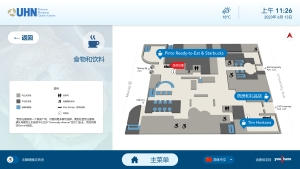
The digital information hubs take up little space; they can be affixed to walls, embedded in existing help desks, or be standalone units on pylons where the user interface can be lowered to accommodate the mobility impaired. A key feature is the multiple language options featured prominently on the screens. “For someone whose first language isn’t English, they may feel more comfortable approaching a screen,” explains Martin.

QR Code Makes for Easy Travel

Importantly, the screens offer a QR code specific to the area requested, which allows users to scan the information on their personal cell phones, allowing them to take the information with them as they begin travelling to their destination. A visual representation of their journey is more helpful than following relayed instructions, he remarks.

“Someone comes in and they get instructions, but halfway through they forget where they are going. With screens, up will come a map with a QR code. You scan your smart phone and take those directions with you.”

Information from a hospital’s website can be integrated with the screen’s mapping system, and all directions are orientated based on the location of the user making them easy to follow.

Whether you are a patient, a health worker, or a visitor, being able to access information quickly—no matter your first language—is key. For older infrastructure with a limited budget, upgrading wayfinding systems can modernize the navigational needs of patients and visitors and reduce the number of tardy or missed appointments.

Digital information hubs make it easier to get to the destination, to navigate the numerous wards and wings, and to get patients to their appointments on time.

Scot Martin is the CEO of youRhere, a leading provider of digital signage solutions for commercial, retail, healthcare, and educational properties across Canada. To find out how digital signage can help your hospital, visit www.youRhere.ca.


Why your mops might need an upgrade

As in all industries, commercial cleaning equipment and supplies are constantly evolving and advancing. From cleaning supplies to mops, it might be time to audit your products and practices to see where improvements can be made, and money can be saved.

Mops have come a long way, but if you’re still using the string variety, it’s time for an upgrade. Traditional string comes in two varieties: cotton and synthetic, and while the synthetic is better than cotton, both types pose a risk of cross-contamination and leaving dirt behind.

RELATED: Spring cleaning your floors

Flat vs. string 

Flat mops use long pads that do not necessarily require water in a bucket to do the job, often featuring disposable or reusable microfiber. These offer a more sanitary solution to the string mop because of the lack of water and bucket used. String mops get dipped into the water, clean the floors, and then head back into the water, often spreading dirt and germs across the cleaning surface. These types of mops can also increase the risk of water spilling and the risk of slip-and-falls on the wet floor.

In many cases, string mops are not regularly or properly laundered, so that also poses a health and safety risk, as germs accumulate and are moved from surface to surface.

Disposable vs. reusable flat 

If you are planning to switch to a flat version, you have the option of using either disposable or reusable mops. While disposable has a greater impact on the environment, it also means zero maintenance costs, whereas reusable mops need to be cared for and laundered.  If properly washed and maintained, some reusable mops can last up to 500 washings, so that will save you money in the long run, but the quality of the mop will deteriorate as time goes on. However, because the disposable options are single-use, they offer a consistent level of cleaning each time.

What you are using to clean your floors can have an impact on your time, your budget, and the safety of everyone in your building. As cleaning supplies and practices evolve, so, too, should your business. Take the time to assess your mops and determine if it’s time to go in another direction with your building’s cleaning program.

B.C. invests in water infrastructure

B.C. is investing $6 million for drinking water and wastewater treatment projects in Kelowna and Merritt.

In Kelowna, Turtle Lake dams will be strengthened and reinforced with earthworks, and wastewater management in the Rutland area will be improved by eliminating aging septic systems. Overall, the $3-million investment in these two projects will reduce the risk of water quality deterioration in groundwater sources and Okanagan Lake.

“These projects address an urgent infrastructure need in our community,” said Tom Dyas, mayor of Kelowna. “Local governments certainly have many infrastructure upgrade needs, so it’s good news to see this investment for some much-needed work to support health and safety in Kelowna.”

With $3 million in provincial support, new water meters with an automatic meter-reading system will be provided for residential connections in Merritt, reducing water consumption and supporting the sustainability of local ecosystems.

“The City of Merritt is grateful to the Ministry of Municipal Affairs for their continued support in helping to improve the city’s services and to implement good water conservation practices,” said Michael Goetz, mayor of Merritt. “This funding is an important first step towards protecting our future water resources.”

These projects are part of a $450-million provincial investment in critical community infrastructure to support clean drinking water, wastewater and solid waste treatment and greenhouse gas reduction through public infrastructure projects in communities provincewide.

This is in addition to the one-time $1-billion Growing Communities Fund, which was provided to all 188 B.C. municipalities and regional districts to support their unique infrastructure and amenities needs.

The Growing Communities Fund is the single biggest provincial allocation in municipalities and regional districts in the province’s history.


Refurbishing Fredericton’s Justice Building

Fredericton’s Justice Building will be refurbished into the University of New Brunswick Faculty of Law. A $62-million joint venture will turn one of the city’s most historic buildings into a LEED Gold-certified design that reduces greenhouse gas emissions by 30 per cent and makes space for 350 more students over the next five years.

Other plans unveiled recently cite new ventilation and communications systems, increased accessibility features, improved lighting, new occupancy sensors, a freshly constructed atrium, and reconfigured spaces for public and academic use.

The federal government is investing $24,870,000, New Brunswick is investing $20,722,928 and the University of New Brunswick is contributing $16,582,072.

“UNB Law is one of Canada’s premier law schools, and there is no more symbolic home for it than Fredericton’s Justice Building,” said Dominic LeBlanc, minister of intergovernmental affairs, infrastructure and communities. “After serving for decades as a landmark for New Brunswick’s legal community and as a physical representation of the legal system in our province, this investment injects renewed purpose into this iconic building.”

“This investment will refurbish one of the province’s most historic buildings so it can become a new home for the faculty of law which will grow to at least 350 students over the next five years. Transitioning the building into a site that provides legal services to the public while educating the next generation of New Brunswick leaders is a positive development for the future of our province.”


Sustainable cleaning matters

Sustainable cleaning is on almost everyone’s minds as we continue to strive to lower our environmental impact. As we evolve from “green cleaning” to longer, more meaningful practices, sustainability is becoming more important for cleaning companies and their customers.

If we look at Google Trends as a reference, which tells us how often a search term is used over time, we see that in January 2018 “sustainable goods” was only moderately searched, with Google Trends giving it a rating of “25.” By September 2020, however, that number had jumped to 55, and by January 2023, it was rated 100.

This tells us that in five years, the interest in sustainable goods jumped dramatically, and that shift has happened in the professional cleaning industry as well; over the past five years, interest in sustainable cleaning solutions has become a priority.

Before going further, we need to answer one question: are green cleaning products and sustainable cleaning products the same? The answer is yes – and no.

A green cleaning solution is manufactured specifically to have a reduced impact on people and the environment compared to other products used for the same or similar purpose.

Sustainable cleaning solutions, on the other hand, are often green (having a reduced impact on the environment), however, one of their primary goals is that they help reduce the use of natural resources by using readily available and readily renewable ingredients.

While not a cleaning product, a good example of a sustainable product is bamboo.  Bamboo is used in flooring, building materials, and furniture, among other products. It is very easy to grow, is grown worldwide, and is fast growing, making it very sustainable. As a bonus, it is resistant to many pests and diseases, so pesticides are often not needed.

Citric acid, now used in many residential and commercial cleaning solutions, is a good example of a sustainable product. According to Hannah Johannes, marketing director for ProNatural Brands, marketers of citric acid cleaning, sanitizing, and disinfecting solutions. “Typically, these [cleaners] are referred to as ‘citric-acid-based’ cleaning solutions, [because] the primary ingredients in these products are usually one or a combination of lemons, limes, oranges, and even pineapples, grown abundantly worldwide.”

She adds that these products have been used in cleaning solutions for centuries and during that time, have proven their value, their effectiveness, and safety.

Further, because they are naturally nontoxic and biodegradable, they are widely used in the food industry and various other industries such as pharmaceutical, biomedical, textile, and leather industries, according to a recent report.

RELATED: Evolving from green cleaning to sustainability

Why is sustainability so important in the cleaning industry?

While green cleaning took centre stage in the professional cleaning industry for the last part of the 20th century, in the 21st century, sustainable products made from readily renewable ingredients are now getting most of the attention.

The reasons for this are many, according to Johannes.  Among them are the facts that these products:

  • Help us reduce our impact on the environment.
  • Safeguard the natural resource needs of future generations.
  • Use resources more efficiently (there is less waste).
  • Protect human health.
  • Reduce costs and improve profits.
  • Increase our ability to withstand the negative impacts of climate change.

“In other words, the use of sustainable cleaning solutions has gone from a ‘nice to have’ to an essential business practice.”

The use of sustainable cleaning products has become a marketing tool for commercial cleaning companies. Most all facilities in Canada are now under pressure to operate more sustainably and are looking to their suppliers and contractors to support that approach.

This means, when hiring a cleaning contractor, instead of just focusing on price, facility owners and managers now want to know:

  1. What products will be used to clean their building?
  2. What ingredients or materials are used to make these products?
  3. Are these products renewable, sustainable, and biodegradable?
  4. Will they help us achieve our own sustainability goals?
  5. Are they high performing?
  6. Do they have a reduced impact on health and the environment?
  7. Will they help us reduce cleaning and operating costs?

“These are big questions that large cleaning contractors, as well as leading manufacturers in the professional cleaning industry, are already being asked,” says Johannes. “As we move forward, we can expect these questions to be asked by many more end-customers and potential customers.”

To be able to answer these questions, “your goal as a cleaning contractor is to use products that are not only safe and effective but also sustainable,” she adds.  “This is the future in the professional cleaning industry.”

Robert Kravitz is a frequent writer for the professional cleaning industry. He can be reached at [email protected].

Large share of ultimate BOMA TOBYs go to Canada

Canadian buildings have captured a large share of the 2023 Building Owners and Managers Association (BOMA) International TOBY Awards, representing the culmination of a three-step process to identify the year’s top achievers in 15 categories. Management teams in Toronto, Edmonton, Mississauga and Oakville claimed seven of those ultimate TOBYs last night as BOMA International’s annual conference and expo wrapped up in Kansas City, Missouri.

Joining the TOBY honourees, Don Fairgrieve-Park, a longtime BOMA stalwart based in western Canada, received the prestigious BOMA International Chair’s Award, while Elizabeth Han was named BOMA’s Canadian regional member of the year. Fairgrieve-Park is executive vice president, operational excellence, with QuadReal Property Group, a BOMA Fellow and a past chair of BOMA Canada. Han is director of property management with Warrington PCI Management in Vancouver.

“Canadian commercial real estate continues to thrive on the international stage,” says Benjamin Shinewald, president and chief executive officer of BOMA Canada.

Canadian buildings garnered three International TOBYs last year, seven in 2021 and three in 2020. Award recipients all emerged first at their local BOMA chapter level and then took honours at BOMA Canada’s national awards before advancing to the North American arena. The 2023 nominee field encompassed 63 buildings located in nine BOMA International regions in the United States, Canada and Mexico.

Menkes Developments was a multiple winner this year, taking awards in the Earth category for 25 York Street, Toronto, and the Industrial category for the Kennedy Matheson industrial complex in Mississauga.

The other Canadian winners are:

  • 85 Hanna Avenue, Toronto, in the category of Office buildings no greater than 100,000 square feet, owned by First Capital and managed by FCR Management Services;
  • 2265-2275 Upper Middle Road East, Oakville, in the category of Suburban midrise office, managed by Fengate Asset Management;
  • HSBC Place, Edmonton, in the category of Office buildings in the range of 250,000 to 499,999 square feet, owned by Alberta Investment Management Corporation and managed by Epic Investment Services;
  • North York Square, Toronto, in the Corporate Facility category, owned by Crown Realty III Limited Partnership and managed by Crown Property Management; and
  • Yonge Sheppard Centre, Toronto, in the Renovated building category, owned by RioCan REIT and managed by RioCan Management.

The conference and expo also marked the end of an active and successful year for another Canadian, with Randal Froebelius completing his term as BOMA International chair. He is the president and general manager of Toronto-based Equity ICI Real Estate Services and has held many prominent roles during a longstanding membership with BOMA Toronto and BOMA Canada.

“Of the many impressive and important accomplishments achieved under Randal’s leadership, none are more noteworthy than our new partnership with BOMA International to take our made-in-Canada BOMA BEST program into the United States and around the world,” Shinewald says.