Articles Archive - Page 209 of 928 - REMINET
REMI

In Toronto’s east end, The Riv condo will rise by the Don River

Three years after River & Fifth began its 37-storey ascent in the emerging downtown east side of Toronto, developer Broccolini is proposing to create a whole block-style community by building another mixed-use condo right beside it. The Riv will rise 34-storeys near the Don River, at the corner of River Street and Labatt Avenue.

The Riv will house 388 suites, starting in the mid-$500,000s, and back onto the Lower Don River Trail, which connects to Riverdale Park and Evergreen Brickworks to the north and Corktown Common to the south. A new pedestrian walkway to Bayview Avenue will boost access to those public spaces.

The RivThe building will also add widened, tree-lined streets to the neighbourhood, as well as boutique retail spaces designed for cafes, shops and other small businesses.

“Easy access to green spaces is extremely important and integral to the kind of communities we want to build in Toronto,” says Phil Brennen, vice-president of real estate development at Broccolini. “With two projects on River Street, we’re building a new community in the east end so it’s extremely important that our buildings create a compelling visual statement, like a beacon, on the east-end skyline.”

Architecture firm IBI Group envisions The Riv with a black-and-white exterior façade resembling a ship’s mast. The building design further evokes the movement of the nearby Don River through its angular podium and a pixelated gradient pattern on the building’s exterior.

“The Riv’s distinctive form and colour palette are intentionally of a piece with Broccolini’s other developments,” says Mansoor Kazerouni, global director of buildings, IBI Group. “But the building is also very much in conversation with its location, both natural and urban. For example, the mast-like beacon is a symbol of the resilience of the east end neighbourhood. We’re looking forward to spotting The Riv in future east-end skyline shots.”

The RivWith more than 18,000 square feet of indoor and outdoor spaces, The Riv brings a variety of amenities that appeal to evolving demographics: an outdoor terrace with eastern waterfront views, a co-working/business studio, a kid’s room, a speakeasy, a gym, a meditation room, a gaming lounge, a tool annex, and a pet spa.

“This area will become a major hub, and we’re proud to be a part of the exciting and smart urban growth in Toronto,” said CEO Anthony Broccolini. “It’s also this year’s most affordable downtown launch, making it ideal for those looking to enter the housing market.”

Toronto-based Patton Design Studio is creating a retro-Italian aesthetic that “evoke both mid-century Milan, as well as Downtown East’s industrial legacy.”  Layouts range from studio, one-bedroom, one-bedroom plus den, two-bedroom and three-bedroom suites.

The developer is also equipping the suites with its smart-home system that locks doors, grants access to amenity spaces, and allows visitor entry via a smartphone app or suite wall pad. The entire building will also be outfitted with high-speed internet.


Your fall maintenance checklist

As the kids get ready to go back to school, we look (not too far) ahead to fall’s arrival. With the cooler temperatures and winter on the horizon, fall maintenance is a must before the snow flies to protect your building and your business.

Create a checklist to make this process simple and consistent each year. Here are some of the elements that need to be included in your fall maintenance plan to get your building ready for winter:

  • Clean your gutters and roof drains. These get clogged through the summer and fall with leaves and debris. Cleaning them out will allow for proper drainage from your roof and help mitigate ice damming in the winter.
  • Take steps to remain pest-free through the winter. Often, critters like to make a home where it’s warm, so be sure to seal any entry points where they can access your facility or get into your building through your bay or warehouse.
  • Get your HVAC checked to make sure that you will be able to heat the building effectively when you need to. This is a good time to have the filters changed and adjust humidity settings to ensure that the system is working when the weather turns.
  • Avoid pipes bursting during the winter months by disconnecting outdoor hoses, draining outdoor spigots, and insulating them wherever you can, to keep them as warm as possible as the temperatures drop.
  • Assess your landscaping to determine whether it needs attention before winter comes. Now is the time to seed your sod to keep your lawn in good shape, trim your bushes and trees, and install protection like fencing or burlap to protect your landscaping from wind and snow, where needed.
  • Take a look at the equipment you may need during the winter and through next spring. Repairs, replacements, and tune-ups should be made to ensure that everything is in good working order. Now may be the time to look at alternative equipment, too. If you are considering going greener with your groundskeeping, fall is a good time to consider your options and add new equipment to your spring budget.
  • Get your snow plan in place. Whether you take care of snow removal in-house or use a third party, you need to have a plan for snow removal, storage, and ice prevention to keep your building accessible and safe.

Creating a fall checklist will ensure that you don’t miss anything, saving you time and money during the winter. Documenting the process each year can also help you plan for next year, diagnose potential issues, and address them before they become costly surprises. Taking a proactive approach to fall maintenance will help you get a head start on spring maintenance when the snow thaws.

New council formed to combat labour crisis

A new Skilled Trades Advisory Council (STAC) has been formed to combat the crisis facing skilled labour in the U.S. and Canada.

STAC’s founding advisors will leverage their resources, knowledge, and network to elevate the skilled trades as high-paying, honourable, and often heroic career paths, including electrical, plumbing, HVAC, janitorial, construction, and other essential jobs that require a rejuvenated workforce.

Founding STAC advisors include:

  • Rob Almond, CEO of NEST
  • Sara Angus, Director of Construction, Starbucks
  • Julie Starzynski, Director of Construction & Design, Floor & Decor
  • Andrew Brown, Founder and CEO of Toolfetch
  • Sarah Hammond, Owner and President of Atlas and Treasurer of Women in HVAC
  • Kam Washington, Owner of PMA Construction
  • Kate Cinnamo, Executive Director of Explore the Trades
  • Mónica Muñoz, Senior Director of Capital Programs at DaVita Kidney Care
  • Mary Gaffney, President of NAWIC Philadelphia Foundation and GEM Mechanical Services.

“I’m encouraged that so many others share my passion for growing the trades and ending the stigma that surrounds jobs in the industry,” said Almond, who spearheaded the council. “STAC is a way for many of us to work together and find ways to encourage youth to consider a career in the skilled trades. There are many viable, lucrative, and creative opportunities to explore.”

According to online recruiting platform Handshake, the application rate for young people seeking technical jobs dropped by 49 per cent in 2022 compared to 2020. Staffing firm PeopleReady estimate 40 per cent of the 12 million people in the skilled trades workforce are over the age of 45, with nearly half of those workers over the age of 55.

Associated Builders and Contractors reported that the construction industry will need to attract an estimated 546,000 additional workers on top of the normal pace of hiring in 2023 to meet the demand for labour.

“The U.S. and Canadian workforces are struggling to fill a massive gap in the skilled trades, and we need to unite as an industry to reverse the trend,” added Almond, who is based in the Philadelphia area. “This group of founding advisors shares that passion across many sectors that make up the industry.”


ASHRAE awards Canadian engineering students

Six Canadian engineering students will launch their upcoming school year with support from ASHRAE scholarships. For 2023-24, the Society has bestowed219 a total of USD $219,500 (CAD $298,500) to 40 recipients from post-secondary institutions in the United States, Canada and India.

To qualify, students must be enrolled in a recognized engineering or building performance technology program, have the endorsement of the campus or local ASHRAE chapter in the vicinity, and achieve at least a 3.0 academic grade point average on a 4-point scale. Recipients of two-year scholarships will also be expected to complete 10 weeks of industry-related employment through a summer job or internship prior to receiving the second installment.

Danielle Tessier, a sustainable and renewable energy engineering student at Ottawa’s Carleton University, has been awarded the Presidents Scholarship. The two-year scholarship is valued at USD $12,500 (CAD $17,000).

Michel Cherien has received the USD $10,000 (CAD $13,600) Gordon V.R. Holness Engineering Technology Scholarship toward his building system engineering technician studies at Toronto’s Seneca College. Dylan Ricard, a mechanical engineering student at University of Manitoba, and Heather Ritter, a mechanical engineering and business student at University of Calgary, have each been awarded the Reuben Trane Scholarship, which is also valued at USD $10,000.

Alyssa Bentsen, a mechanical engineering student at University of Victoria, is this year’s recipient of the Alwin B. Newton Scholarship, valued at USD $5,000 (CAD $6,800). Gabrielle Milburn, who is studying architectural conservation and sustainability engineering at Carleton University, has received the USD $3,000 (CAD $4,080) Ottawa Valley Chapter Scholarship.

“ASHRAE Society scholarships are investments in the future of our industry,” maintains Ginger Scoggins, 2023-24 ASHRAE president. “By supporting the development of talented students, we empower them to drive innovation, sustainability and progress in the built environment. Congratulations to this year’s recipients.”

RentFaster.ca offers free listings to aid wildfire victims

In the wake of recent wildfires that have forced thousands of Canadians to flee their homes, online rental platform RentFaster.ca has launched an initiative to support wildfire victims seeking temporary accommodations. The company announced it will be offering free listing services for landlords willing to make their rental properties available as emergency shelters to those in need.

“The wildfires have caused unparalleled disruption, displacing numerous families from their homes and leaving them in dire need of safe and comfortable shelter,” the company said. “Recognizing the urgency of the situation, we are taking proactive steps to facilitate the process of finding temporary accommodations, making it easier for those affected to quickly secure housing during these trying times.”

To participate in this initiative, landlords can simply visit help.rentfaster.ca and list their available rental units at no cost. This offer extends to both short-term and longer temporary accommodations.

RentFaster.ca says it encourages landlords across the impacted regions to join hands in this collective effort to support the community: “By making temporary accommodations readily accessible, we can help ease the burdens faced by wildfire victims and enable them to focus on rebuilding their lives.”

For more information about RentFaster.ca’s free listings for temporary accommodations in wildfire-affected areas, please rentfaster.ca or email [email protected].

Encouraging return to the office

What would motivate people to leave the comfort of their homes to return to the office? That was the challenge presented to Vancouver design firm Edit Studios, who was commissioned to lead the design for Trulioo’s new 35,000 sq. ft. headquarters.

A global company with offices worldwide, Trulioo is one of the world’s most trusted identity verification platforms. Their new HQ spans two floors, and the space revolves around a brightly painted, interconnected stair featuring a custom mural by local artist Rory Doyle, depicting Trulioo’s number one asset, their people. When entering in through reception, you can’t help but notice the abstract topographic continents of the world scribed to the wall. This piece is meant to communicate Trulioo’s global reach.

The priority was to unite all 300 staff into a collaborative, functional, and productive environment that would drive interaction and collaboration. Edit Studios utilized tools such as surveys and one-on-one interviews to uncover themes that reinforced the design direction for the space.

It became clear that acoustical privacy was necessary; open working environments would not work. Employees are on virtual calls daily and require more phone and small meeting rooms to conduct their work without disrupting neighbors. Clusters of phone rooms ranging in size break up the office work points and offer respite to concentrate. Open collaboration areas are positioned away from work points, limiting the number of interruptions in a day.

“We became comfortable with tech being a numbers game over the last ten years. How many open seats can you fit in one space? Through the pandemic, we saw a shift in sentiment towards having more control over private space. People want spaces with little distraction. The Trulioo space plan became an exercise not in the headcount, but in optimizing the number of private spaces teams can access without booking them,” says Janay Koldingnes of Edit Studios.

Trulioo’s space comprises amenity areas, collaboration, and meeting spaces, and open collaboration areas are centrally located around work points, each with a slightly different fit and feel. Edit designed a 1,500 sq. ft. library, created for heads-down focused work, and a “living room” that offers a more social setting to collaborate, watch the news, or play Xbox with a colleague. The café allows staff to meet weekly with state-of-the-art technology to host town halls. Within this space, Edit carved out “Arcade Alley”, home to various vintage arcade games. Discreetly tucked away behind wooden doors is Trulioo’s very own Irish pub, offering a bespoke nod to their satellite office in  Dublin. “Arcade Alley” is home to vintage arcade games, foosball, and ping pong.

Trulioo’s office design was intended to reflect a residential feel and home comforts, with the modern office’s amenities and technology. Resimercial became the anthem for the design incorporating a layered lighting approach, soft furnishings, and a warm colour palette. A corporate rebrand allowed Edit to use the concepts and colours to inform the office’s palette, signage, and wayfinding. Everything down to the wall coverings was custom designed, referencing shapes and colours from the Trulioo rebrand.

One of the most exciting features of the space is the plant libraries scattered around the office. During engagement, employees identified how important plant life is to their well-being. As a result, they can borrow a plant from the many plant libraries and take it back to their desk for the day.

From “library” settings that boast no zoom calls, to “living room” spaces that allow one to kick back and watch a game, there is something to motivate everyone to return to the office.


Photo credit: Ema Peter

New library breaks ground in Airdrie

The City of Airdrie has broken ground on the highly-anticipated Library and Multi-use Facility project.

“This is a significant step towards providing our residents with a state-of-the-art facility that will serve as a landmark destination to our residents and visitors. The addition of the new Multi-Use Facility & Library signifies not only a revitalization of our downtown but also the creation of a dynamic community hub,” said Airdrie Mayor Peter Brown. “Through this facility, we are sowing the seeds of learning, arts, culture and business development that will undoubtedly shape our city’s future.”

Earlier this year, council approved the schematic design for the project. With a total square footage of 73,000 sq ft, the new facility will include 53,000 sq ft of library space and 20,000 sq ft of multi-use space. Estimated to cost $65 million, the facility is envisioned as a hub for library programming for all-ages, services and collections and as a central gathering space for artists, businesses, residents and organizations.

The facility will have an underground parkade with approximately 100 stalls as well as ground-level parking.

“This new facility will offer a wide variety of opportunities, both indoor and outdoor, for residents and visitors to gather, connect and learn,” added Brown.

Located at 805 Main Street Southwest, the facility will offer both an opportunity for a highly active area along Main Street, as well as a parkland connection along Nose Creek. It will also include an underground parkade with close to 100 stalls as well as ground-level parking.

The new facility will be constructed on the site of Airdrie’s old fire hall with completion scheduled for 2025.


Fewer Canadians working from home permanently, report finds

More Canadians are seeing the benefits of a hybrid work model and say they’re enjoying the collaboration and social benefits of time spent with colleagues in the office, the 2023 Aviva How We Live Report reveals.

The research was conducted through a Leger-led online survey of 2,500 Canadians, between March 29 and April 15, 2023.

Findings show that fewer Canadians are now working from home permanently (19 per cent) than was the case in 2022 (27 per cent), while more people are working hybrid a few days each week, at 29 per cent currently compared to 25 per cent a year ago. More Canadians also say they are appreciating the ability to balance work and home priorities without compromising work culture.

Flexible working options remain highest and most popular among Canadians aged 35 or
younger.

When they do spend time in their workplace office, Canadians cited a collaborative environment as the more pressing reason to return in person, followed by the social atmosphere. Fifteen per cent said they were able to juggle work and home priorities more easily because of greater flexibility, up from 9 per cent who felt that way last year.

However, about 21 per cent are finding the commute to work expensive, while others, to a lesser degree, find the office a difficult place to concentrate in since working at home.

Great resignation trends may be easing, the report also found. Employees are opting for safety and stability as economic uncertainty continues, with the majority feeling stressed about inflation and a possible recession and others concerned about layoffs and how poor economic conditions could impact promotions and pay raises.

“It’s great to see the social benefits of hybrid work bringing enthusiasm back to office days, but it’s still very much a world of contradiction as people try to embrace the social benefits while managing commuting frustrations and their growing concern over the impact of the current economic outlook,” said Susan Penwarden, managing director, personal lines, at Aviva Canada.

“Cost of living and inflation worry is a sentiment widely expressed throughout this year’s report, reflecting how economic doubts have lingered post COVID, impacting Canadian decisions from housing to activities to leisure activities and even their decision to perhaps remain in their current roles.”

Toronto strives to find more cash

Commercial properties are central to Toronto’s efforts to find more cash as the city government considers how to address massive budget shortfalls projected for 2024 and into the future. A list of proposed measures was released last week to launch a consultation on approaches to procure $1.5 billion to plug the current operating deficit and an additional $46.5 billion to adequately cover Toronto’s forecasted operating and capital needs over the next 10 years.

“These targeted solutions are an important start, but we cannot do this alone. We need our partners — the Government of Canada and the Province of Ontario — to also meet this challenge and step up for people of Toronto, the region, province and country,” submits Toronto Mayor Olivia Chow.

A special levy on commercial parking spaces has been flagged as one of five initiatives recommended for the first round of action. However, in the coming weeks, Toronto councillors will be considering about 30 potential revenue sources and 10 operating cost reductions.

That package of proposals also includes the imposition of fines for non-compliance with building performance benchmarks and the cancellation of various business incentives, fee exemptions and property tax credits among mechanisms the City now has the authority to implement. Other contemplated measures that would likely have impacts for commercial ratepayers could only be possible if the Ontario government agrees and/or passes enabling legislation.

It’s estimated that revenue-generating mechanisms currently within Toronto Council’s control could generate from $289 million to $662 million annually, depending on the rates charged, while the full package of cost-reduction items could trim $479 million to $604 million from the annual operating budget. Another 22 revenue options that would first require provincial approval are touted to collectively garner between $2.6 billion and $6.1 billion annually.

All options for new revenue generation are identified in a third-party report, prepared by Ernst & Young LLP, which City staff has further refined into recommendations based on each option’s earning power, ease of implementation and fit with City priorities. The public will be given an opportunity to voice their opinions at a special meeting of Council’s executive committee on August 24, and the full Council will consider the measures and other potential updates to the long-term financial plan at a special meeting on September 6.

To begin, residential properties are identified as one of the most straightforward opportunities for additional revenue. City staff recommend introducing five gradients of incrementally higher land transfer tax rates on high-value transactions, climbing from 3.5 per cent of the purchase price on sales in the $3- to $4-million range to 7.5 per cent of the purchase price of homes trading for $20 million or more. If Council approves, it’s proposed this could be enacted beginning January 1, 2024.

An additional land transfer levy for homebuyers who are not permanent residents of Canada is also proposed as one of the initial five actions. However, it could not practically be collected until 2025 since current federal legislation prevents non-residents from purchasing single-family homes or condominium units in Canada during the period from January 1, 2023 to December 31, 2024. Toronto’s levy would be on top of the 25 per cent surcharge the Ontario government already imposes on foreign buyers through the provincial land transfer tax.

Commercial properties figure in two proposals for early, implementable actions

The Ernst & Young (EY) analysis estimates a new levy on commercial parking spaces could generate about $173 million per year at a low-end charge of $0.50 per parking space or up to about $490 million annually if the rate is set at $1.50 per space. This is based on the levy being applied on all paid and unpaid commercial parking spaces, including the parking lots that the Toronto Parking Authority and Toronto Transit Commission operate.

It would be collected on subject ratepayers’ property tax bills and is forecasted to cost about $2.5 million annually to administer. The levy could be imposed under existing municipal authority, and it is aligned with two of the City’s five stated key objectives — easing mobility and responding to climate change. However, the EY assessment foresees it will be time-consuming to enforce and will likely result in flow-through extra costs for parking consumers.

Two other major Canadian cities currently have commercial parking levies, but generate more modest revenue than Toronto is targeting. Montreal raises about $23 million annually through a tax that is applied per metre of parking space located in scoped geographical areas, while Vancouver employs a sales tax on commercial parking fees that garnered about $64 million last year. Nevertheless, the EY report points to other potential spinoff benefits.

“If Toronto implemented a variable parking tax similar to Montreal where the most expensive areas are in the central downtown core and financial district, this may encourage people to use other forms of environmentally sustainable transport on their commute to work,” it states.

If Toronto Council opts to explore the measure further, City staff will prepare a report on the implementation logistics, which would then be considered during the 2024 budget process and deliberations. It’s envisioned that the commercial parking levy could be implemented in 2025.

The other proposed revenue-generating measure with repercussions for commercial building owners/managers would require more preparatory work on the City’s part, but it’s categorized as feasible in the somewhat near term. The EY analysis estimates that monetary penalties attached to exceeding an allowable threshold for greenhouse gas (GHG) emissions could raise about $93 million annually. First, though, the City would need a bylaw to put those thresholds in place.

Under the proposed schedule, City staff will present Council with informed advice on a bylaw to mandate the reporting of building-level data on energy and water use and GHG emissions in the fall of 2023. That would be followed in 2024 with the framework for a bylaw to require existing buildings to meet specified GHG emissions standards.

It’s believed that the City should be able to levy fines for non-compliance once an enabling bylaw is enacted. “The City has legal authority to implement a bylaw requiring building owners to meet a performance standard; the permissibility of imposing a charge will depend on the specific design of the tool,” the EY analysis states.

In turn, it’s recommended that revenue collected through such a fine should be reinvested in supporting climate change resiliency in the buildings sector. “While the review of revenue tools has primarily focused on revenue generating opportunities to reduce the City’s fiscal pressures, there is also an opportunity to advance tools which align with the City’s corporate strategic priorities,” states the report and recommendations to Council’s executive committee.

Other proposed early actions projected to raise more modest levels of revenue

Looking at other revenue-generating measures recommended for the early rounds of Council action, it’s estimated that a monthly surcharge for access to 911 emergency calling could raise about $27 million annually. Such levies are already charged in all Canadian provinces except Ontario and Manitoba, and municipalities in British Columbia have flexibility to determine their own rates. The EY analysis deems it would be “relatively easy” to implement since telephone service providers would pass through the charge and remit it to the City.

Some of the contemplated operating cost reductions could also have impacts for commercial real estate. These include: withdrawing development charge exemptions, thus extracting an estimated extra $190 million to $210 million from the industry annually; suspending the yet-to-be-rolled-out Imagination, Manufacturing, Innovation and Technology property tax credit, which could save participating ratepayers up to $300 million in collective property taxes over the next 15 years; and reducing the Heritage Property Tax Rebate, equating to $500,000 to $1.4 million annually.

Meanwhile, the City will be scrutinizing its own real estate assets. “Staff are recommending further and ongoing review of City-wide surplus and underutilized real estate assets and will report back with any recommendations for disposition or change in use of specific assets in advance of the 2024 budget process as required, in order to ensure the greatest value for the City,” the report to the executive committee confirms.

New poll surveys Canadians on housing crisis

A recent poll by Leger surveyed nearly 1,600 Canadians about their perceptions of increasing rental costs, housing supply issues, and potential government actions to help improve the rental situation in Canada. From August 18 to 20, 2023, respondents aged 18 years and older completed the survey using Leger’s LEO online panel. The results were weighted according to age, gender, mother tongue, region, education and presence of children in the household in order to ensure a representative sample of the Canadian population.

Key takeaways:

• Throughout the past couple of months, 55% of respondents said they were worried about being able to pay their upcoming rent or mortgage. This proportion rose even higher among those between the ages of 18 and 34 (66%), Albertans (67%), and British Columbians (68%).

• 95% of respondents said they think increasing rental costs and the lack of affordable rental homes in Canada is a serious problem (66% said “very serious” and 28% said “somewhat serious”).

• 15% of the homeowner respondents said their primary residence does have rental space available that they are not currently renting; the same proportion said they could turn part of their space into something rentable but have not yet done so.

• 40% of all the respondents said they blame the federal government for the housing crisis, 32% said their provincial government, and 6% said their municipal government. Homeowners are more likely to blame the federal government (43% vs 35% among renters), while renters are more likely to blame their provincial government (37%).

The majority of respondents said they support all the initiatives mentioned in the survey that governments could implement to help address the rental situation. The strongest support among the six ideas tested went to:

  • providing incentives for developers (79%)
  • government-supplied affordable housing (79%)
  • tighter rent control (77%)

Disincentives for short-term rentals were least supported idea tested (56%) .

Click here for more: The Housing Crisis in Canada – Leger (leger360.com)

Highway projects coming to Cariboo

Two infrastructure projects to improve highway safety and reliability have been announced for the Cariboo region near Quesnel, B.C. Construction is scheduled to begin next year.

“Restoring safe and reliable highways and roads in the Cariboo supports vital services and connections for people in the region,” said Minister of Transportation and Infrastructure Rob Fleming. “With weather patterns changing as part of our new climate reality, building infrastructure that withstands extreme weather in the long term will keep people safe and maintain critical goods movement corridors across the province.”

On Highway 97 at Cottonwood Hill north of Quesnel, a segment of highway affected by a significant slow-moving landslide will be stabilized. Highway 97 is a north-south artery that provides crucial access between communities in the region and is vital to the province’s economy.

On Blackwater Road at Knickerbocker Road, a road segment affected by landslides will undergo realignment and reinforcement, as well as measures to help prevent future slides in the project area.

Crews at both sites are completing work, such as geotechnical investigations, which includes collecting soil and water samples to inform the project designs, and environmental investigations.

These are the first two projects within the Cariboo Road Recovery Projects program to move to construction. Both are being designed with a focus on resilience to changing weather patterns while addressing stability issues and building infrastructure for the long term.

The province has approved $538 million in funding for these projects. This includes $334.6 million for the Highway 97 at Cottonwood Hill project and $203.4 million for the Blackwater Road at Knickerbocker Road project.


Building better requires connected job sites

After many years of being under-served by technology, construction is achieving greater efficiency, safety and savings through digitization. Technologies such as IoT and drones are made possible by next-generation networks, which enable applications not possible before. But Canada still faces a decades-long housing crisis that only seems to get worse, even with the rollout of emerging technologies.

Between the labour shortage, supply chain woes and other pressures, the building sector is struggling to meet the demand for new housing. The country has seen double-digit price increases in recent years, with the problem spreading from major urban centres to areas that used to be comparatively affordable. No longer.

Canadian construction companies need to take advantage of all the technology at their disposal to make projects as efficient and fast as possible. Unfortunately, the sector has seen less digital investment than other industries, according to a report from BDC.

Reliable internet connections in the field are key. According to a recent State of the Connectivity survey by Cradlepoint, in cooperation with Censuswide, 92 per cent of Canadian respondents agreed that good connectivity would make their company more resilient to unexpected changes (economic, political or global pandemic).

Wireless networks make sense for field work

Construction projects are well known for going over budget and over time, and as a result, firms are under constant pressure to complete projects as efficiently as possible to keep their clients happy. They don’t have the time to build and work out of “fixed” sites, often setting up temporary trailers and offices in remote locations to operate their builds. Traditional wired networks, however, cannot keep up with the demands of these ever-moving office environments, often taking up to 120 working days to set up a new line.

These pop-up sites still need immediate, high-performance broadband connectivity for staff to access cloud-based applications through their laptops and tablets and for collaboration with headquarters, contractors, architects, and suppliers. This is where 5G and LTE connectivity can come in to help address these issues. By embracing mobile networks, construction sites will benefit from the exact same connection that their wired counterpart offers, but with the ability to have their connectivity infrastructure seamlessly move with them. And with highly sophisticated cloud management of these networks IT teams will be able to manage all remote sites and let the on-site personnel focus on the job at hand.

Armed with a ruggedized Wireless Wide-Area Network (WAN) router and a 5G or LTE-connected SIM card that provides ultra-low latency and high-bandwidth connection, builders will gain access to cloud-based applications. This is where the benefits truly come into play—with centralized connection management, and secure data transmission all available more quickly than if they were waiting for wired cables to be placed.

Enabling 24/7 video surveillance for greater safety

On-site video cameras are a staple on any construction site, helping companies deter theft, conduct inspections, and monitor safety compliance. These cameras run 24 hours a day, hence the high data usage. Luckily, wireless broadband solutions can withstand the high bandwidth and low latency needed for constant streaming.

A camera that loses its connection essentially becomes useless, as a single 20-minute lapse could be the space where something goes wrong on site, such as a flood, and not knowing the root cause could cost a company significantly.

Suppose a cloud-managed Wireless WAN router is deployed, and a camera does, in fact, go down due to a problem associated with its connection. In that case, the central IT team would be able to address the issue remotely. With one fewer thing to worry about, constructors can concentrate on producing buildings quickly, at a rate that coincides with the market.

AR applications need next-gen connectivity

One of the most exciting technological processes construction organizations have embraced is the ability to visualize design concepts. This comes in an array of forms, but augmented reality (AR), or the ability to visualize, for example, a building in a real-life environment, enables construction teams to deliver incredible results. One such result is the ability to reduce the need to rework a project once built, as building issues can be picked up in real time through this system, potentially saving massive amounts of time and capital. Empowering constructors to deliver outstanding projects quickly will only aid efforts to diminish the housing crisis.

Like on-site cameras, AR requires constant connectivity with ultra-low latency. Due to the high-performance connection and maneuverability needed to wear a set of goggles constantly feeding high levels of data, broadband-powered Wireless WAN routers with edge computing are really the only option, especially when adding in the ever-moving office factor.

Tracking performance with IoT devices

IoT devices also provide insights into how resources are performing, instantly flagging to construction teams if they detect a defect or if machines are starting to develop faults or issues. Armed with this information, workers can optimize processes and monitor equipment, and proactively take action if needed. For example, smart sensors can be affixed to rebar and embedded in concrete aggregate, which sends data to the cloud via a 5G router. This helps  companies determine if the concrete is poured correctly and track any shifting of the concrete, improving the overall outcome of projects and their safety.

Builders struggling to build sustainably

Building quickly is the goal, but construction organizations are also increasingly being called upon to make projects more sustainable. This is proving difficult to implement.

A robust cellular network can help firms step up sustainability initiatives early in the project life cycle. For example, drones can be used to capture data that can then develop aerial surveys, reducing the need for physical site visits and providing information on how to work with biodiversity and geographic features of a landscape. More smart technology means better-informed decision-making.

Four out of 10 Canadian respondents agreed that 5G will ensure greater environmental sustainability through improved energy efficiency and real-time control of consumption (domestic, business and smart city), improve bandwidth and improve security.

By embracing 5G and LTE and their ease of deployment, speed and low latency, Canadian construction firms have a chance to develop completely new use cases at every level of the construction cycle. It might not end Canada’s decades-in-the-making housing crisis, but it will put construction organizations in a better position to alter its course.


Jason Falovo is vice president and general manager, Canada at Cradlepoint, a global leader in cloud-delivered LTE and 5G wireless network edge solutions.




GTA new condo sales for July at lowest in 23 years 

The GTA new home market slowed down considerably in July, as rising interest rates left prospective buyers cautious during what is already typically a quiet month for new home sales, the Building Industry and Land Development Association (BILD) announced today.

There were 1,190 new home sales in July, which was down 18 per cent from July 2022 and 50 per cent below the 10-year average, according to Altus Group.

“The latest interest rate hikes have pushed many buyers to the sidelines again as affordability continues to deteriorate,” said Edward Jegg, research manager at Altus Group.

Condominium apartments, including units in low, medium and high-rise buildings, stacked townhouses and loft units, accounted for 828 units sold, down 39 per cent from July 2022 and 50 per cent below the 10-year average. It was the lowest number of condominium apartments sold in July in 23 years.

There were 362 single-family home sales in July, up 281 per cent from July 2022 but 51 per cent below the 10-year average. Single-family homes include detached, linked, and semi-detached houses and townhouses (excluding stacked townhouses).

Total new home remaining inventory inched up in July from the previous month’s total, to 16,683 units. Remaining inventory includes units in pre-construction projects, in projects currently under construction and in completed buildings.

With slowing sales and rising inventory, benchmark prices softened. The benchmark price for new condominium apartments was $1,084,768, which was down 9 per cent over the last 12 months. The benchmark price for new single-family homes was $1,673,696, which was down 13.5 per cent over the last 12 months.

“The measures within the government’s scope that can help with affordability and new housing supply include deferring HST on purpose-built rentals, helping municipalities financially to deliver infrastructure that supports housing, and indexing the thresholds for the GST/HST new housing rebate,” said Dave Wilkes, BILD President & CEO. We call on the federal government to act with the urgency the situation demands.”

Using autonomous cleaning equipment to attract younger talent

The cleaning industry continues to face high rates of employee turnover and an ongoing labour shortage. In fact, Canada’s cleaning industry saw an almost 145 per cent increase in job vacancies by the end of 2021. Today, prospective employees are searching for companies that value their skills and offer more fulfilling work. For cleaning companies, using innovative solutions to stay ahead of these challenges and encourage employee loyalty has never been more important – and one way to do this is by incorporating autonomous equipment into facility cleaning programs.

By embracing today’s technology, companies establish themselves as industry leaders, attract more specialized and dedicated cleaning professionals, and demonstrate their commitment to employee well-being.

Pioneering in the cleaning industry

Outdated technology and equipment are costing businesses their budget, productivity, and perception.

RELATED: Using AI to improve your cleaning business

The maintenance and upkeep of outdated equipment such as manual floor cleaners can take up a significant portion of the cleaning budget through frequent repairs and excessive consumption of cleaning products and chemistries – not to mention the time and labour that any maintenance requires.

Outdated equipment can also impede cleaning staff efficiency. Tasks like sweeping, mopping, and vacuuming, which can all be automated and made more efficient with modern technology, take time away from more technical and essential cleaning duties.

Investing in autonomous cleaning equipment not only improves productivity but appeals to potential customers and employees who value convenience, efficiency, and a comfortable work environment. For example, would you want to work with a company that still relied on floppy disks? Just as technology has found more efficient solutions to floppy disks, cleaning processes have also significantly advanced and improved, increasing productivity and efficiency. Embracing new technology to improve both the employee and customer experience positions a cleaning business as a true industry leader.

Attracting cleaning professionals

In today’s competitive job market, skilled and dedicated cleaning professionals are in high demand. More and more, prospective employees are aligning themselves with companies that value their expertise, care about their health and well-being, and provide them with the tools to succeed and grow.

Highly skilled cleaning professionals understand the benefits that equipment innovation can bring to their work. Equipment like autonomous floor scrubbers can significantly reduce the physical strain often associated with manual cleaning. Mundane and physically demanding cleaning tasks that don’t require expert oversight can be handed off to the autonomous equipment while cleaning professionals can apply their skills and expertise in more effective ways. That translates to a more efficient and satisfying work experience, also making your company more attractive to skilled candidates.

Autonomous floor care equipment can also reduce the margin of error and increase the effectiveness of cleaning tasks, providing an overall better experience for your customers. These machines are designed to consistently deliver high-quality results, appealing to cleaning professionals who take pride in their work and strive for quality.

Investing in employee well-being

The use of autonomous equipment not only demonstrates the company’s commitment to effective innovation but also to the health, safety, and overall well-being of current and prospective employees. Investing in these types of innovation shows current and prospective employees a willingness to invest in the betterment of the workforce and the processes they follow.

One of the most significant contributors to workplace dissatisfaction is stress. The Canadian Centre for Occupational Health and Safety lists workload, pace, and meaningfulness of work as the most common stressors in the workplace. To alleviate these, autonomous floor cleaning equipment is designed to significantly reduce the workload associated with manual cleaning tasks, such as floor care. Autonomous equipment also allows cleaning professionals to focus on more technical and specialized work, leading to a healthier working environment, increased loyalty, and reduced employee burnout and turnover.

As the cleaning industry continues to experience high rates of employee churn, it’s crucial to embrace innovation. Autonomous cleaning equipment provides the opportunity to position yourself as an innovative industry leader, focusing on better quality on behalf of both customers and employees. That in turn positions an employer to better attract specialized and dedicated cleaning professionals and retain them for longer periods of time.

Not familiar with what’s available in autonomous cleaning innovation? For more information on autonomous cleaning equipment options and the best ways to integrate this new technology into existing cleaning programs, it’s important to speak with a technical professional. Choose a company that has a background in facility cleaning so that they can assist in selecting the right equipment solution for your scope and facility cleaning requirements. In addition, look for onsite training and support to help effectively integrate new technology into your cleaning program.

With today’s labour shortage, cleaning companies need to employ innovative solutions to stand out in the market, attract new talent, and retain the talent they’ve already acquired. Using autonomous cleaning equipment to embrace innovation, focus on efficiency, and prioritize loyalty will help cleaning companies continue to thrive through these persistent challenges.

Keeping Decay at Bay

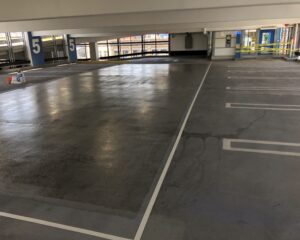
If your building includes a parkade, chances are you’ve witnessed the wear and tear that comes from steady usage and exposure to moisture and contaminants like road salts. Even if the parking area is located indoors, the traffic deck coating (TDC) used to protect concrete surfaces will deteriorate over time, reducing its ability to effectively do its job.

“Traffic deck coating plays a key role in preserving concrete’s structural integrity, so it’s important to ensure it performs as intended,” said Bryant Bortolotto-Freeman, Engineer-in-Training at RJC Engineers. “By understanding the causes of concrete deterioration and following certain best practices to maximize your TDC, costly repairs to your concrete may be averted.”

What is Traffic Deck Coating?

A TDC is a multi-coat system formulated to protect concrete structures and structural elements from contact with moisture and contaminants. Typically, they are made up of a primer (polyurethane or epoxy-based), a basecoat, and a topcoat that work together to provide waterproofing protection, traction enhancements, wayfinding and light reflection in parkades and other concrete enclosures. Although usage of TDCs is widespread in North American, Bortolotto-Freeman has seen all-too often what happens when maintenance is ignored, or improper application creates weaknesses in the system. Common failures include debonding of the coating from the underlying substrate (or between the layers), cracks and scrapes letting in moisture, and surface damage from abrasion due to wheel racking and traffic exposure.

To prevent a failure and prolong the service life of your TDC, Bortolotto-Freeman recommends the following 5 Layers of Success:

Layer 1 –Surface Prep

Thorough surface preparation is crucial for a successful TDC installation, whether it’s brand-new concrete or an existing slab undergoing repairs. As such, shot blasting is an effective way to remove any micro-fractures, laitance, and provide the sound, open-textured surface area required for sufficient coating adhesion. For an existing system, shot blasting also removes the top surface of concrete, which can contain grease, rubber from tires, or other contaminants that could interfere with bonding and curing.

Layer 2 – Special Project Considerations  

Service life conditions and project requirements should be considered during the design and material-selection phase. According to Bortolotto-Freeman, thicker wearing surfaces may be necessary for high-traffic areas, such as drive aisles and loading docks, possibly requiring a more robust wearing surface in lieu of typical aggregate. Turnaround times and curing temperatures should also be considered at this stage to prevent improper phasing of the work, which could negatively impact bond strength and durability. It’s also a good time to consider signage, barricades, and site presence, particularly if portions of the parking facility are to remain open.

Layer 3 – Monitoring and Testing

Verifying the product is being placed and applied in conformance with the manufacturer’s specifications is key to ensuring a long-lasting service life of your TDC. Given the coating forms a water barrier, Bortolotto-Freeman warns that any trapped moisture within the slab will create vapour drive with temperature fluctuations, potentially causing it to de-bond from the concrete substrate. Monitoring as you go, testing thickness and ensuing the product is being applied properly, will help minimize any negative outcomes down the road.

Layer 4 – Addressing “Tricky” Details

While placing a new coating in the centre of a concrete slab is relatively straightforward, perimeters during coating repairs are more susceptible to failures. These tricky areas require a little more attention to detail and may call for additional tools and techniques. For instance, rather than relying on a lap, Bortolotto-Freeman recommends using ground/saw cut reglets to provide mechanical adhesion along with a physical separation between the new coating and the existing one. He also recommends detailing at the cracks and upturns prior to large-scale TDC application to prevent moisture from gathering at the bases of columns, walls, and curbs, and migrating where it shouldn’t.

Layer 5 – Compatibility with Existing Surface

When repairing an existing coating, it’s important to know if the new product is polyurethane-based or bitumen-based to ensure compatibility with the existing TDC. While polyurethane alone is stable with bitumen, the plasticizers that make the TDC flexible and elastic are not. According to Bortolotto-Freeman, bitumen tends to attract the plasticizers within the TDC system, causing it to discolour and become brittle, and creating the potential for cracking. As the plasticizers interact with the bitumen-based product, the bitumen becomes soft and can bleed or run if in a vertical application. The best way to mitigate this is by a compatible intermediate layer like metal.

In conclusion, proper specification, design, application, and assessment of traffic deck coatings are necessary steps to ensure these systems perform as intended, and they should also be maintained throughout their service life. Annual condition reviews by a consultant, as recommended by CSA S413, can help identify and address typical wear and use items prior to them causing costly concrete and/or structural repairs.

For more information, visit www.RJC.ca or contact Bryant Bortolotto-Freeman directly at [email protected]


Non-profit child care centre opens in new North York condo 

The Macaulay Centres for Children – Tippett Child Care Centre opened today on the ground floor of a newly-built,14-storey residential condominium in North York.

The centre serves 49 children and families, from infant to age four, and occupies 9,061 square feet of indoor and outdoor space. Large windows in playrooms provide natural light, a naturalized-themed playground, with sand and water play areas and a tricycle track, are also on site.

This new location provides a reduced fee for all families through the Canada-Wide Early Learning and Child Care funding program and eligible families may also access a fee subsidy through the City of Toronto.

The City owns the site, while the Macaulay Centres for Children, a non-profit, community-based, multi-service and multi-site organization, leases and operates the child care centre.

Mayor Olivia Chow was on hand for the opening on August 22.  “This is a wonderful example of what happens when the City partners with other organizations to create much-needed services in growing neighbourhoods,” she said in a statement. “More families will now have access to affordable and high-quality child care programs in this community.”


New $1 coin features first female engineer

On August 1, 2023, the Royal Canadian Mint issued a new $1 commemorative circulation coin honouring Elsie MacGill, the country’s first woman professional engineer and a leading advocate of women’s rights.

“Through her dedication and an unshakeable belief that there was nothing women could not do, Elsie MacGill broke the glass ceiling for Canadian women pursuing careers in engineering, and made historic contributions to Canada’s efforts during the Second World War,” said The Honourable Chrystia Freeland, Deputy Prime Minister and Minister of Finance upon the launch of the new coin. “I am so pleased that this commemorative coin will honour the legacy of a remarkable champion of women’s rights, and will share her story with a new generation of Canadians.”

MacGill was the first Canadian woman to earn an electrical engineering degree and was the first woman in North America to earn a master’s degree in aerospace engineering. As the Chief Aeronautical Engineer at Canadian Car & Foundry (CC&F) during World War II, MacGill made Canada a powerhouse of aircraft construction. She was in charge of all the engineering work related to Canadian production of the Hawker Hurricane fighter plane and oversaw operations at CC&F as it expanded from 500 workers to 4,500, where it would produce three Hawkers per day and a total of 1,450 over the course of just two years. 60 per cent of air victories by the Royal Air Force during the war involved this single-seat fighter aircraft.

She was known as the “Queen of the Hurricanes” for that unique wartime contribution.

In the 1960s, MacGill dedicated a significant amount of her time to advancing women’s and children’s rights and was named to the Royal Commission for the Status of Women in 1967.

The artwork appearing on the reverse of the 2023 $1 circulation coin celebrating Elsie MacGill is the creation of Tofino, British Columbia artist Claire Watson. It features Elsie MacGill holding a pair of rolled-up blueprints. Flying above her is the Maple Leaf Trainer II that she designed and beside her appears one of the Canadian-made Hawker Hurricane fighter planes that she helped produce.