Articles Archive - Page 197 of 927 - REMINET
REMI

Province creating six transit-oriented communities in Toronto

Thousands of new homes will be rising near future transit stations along the Ontario Line subway and Scarborough Subway Extension in Toronto.

Ontario is proposing about 5,900 residential and affordable units overall. The mixed-use projects promise jobs, community amenities and more retail and office space. They include a first transit-oriented community (TOC) on the Scarborough Subway Extension, close to the Lawrence and McCowan Station. Plans call for 770 residential and affordable units, a new park and pedestrian connections to a transit plaza.

On the Ontario Line, the Eastern Avenue TOC would provide pedestrian and cyclist access to the future East Harbour Transit Hub—a new SmartTrack GO Station and interchange station.

The Cosburn TOC, near Cosburn Station, would add about 620 units, refreshed streetscapes and public spaces, and new landscaping and street furniture for people who gather along Pape Avenue. Near Pape Station, another TOC promises around 440 units with direct and accessible connections. Heading south, the proposed Gerrard-Carlaw South TOC, at the south side of future Gerrard Station, would create approximately 1,310 units. The design for a TOC at the future Thorncliffe Park Station envisions 2,660 units, enhanced public spaces and a transit plaza.

The City of Toronto is currently reviewing the plans before they funnel through a consultation process with Indigenous groups, stakeholders and the public.

Earlier this year, public engagement sessions took place for the proposed Gerrard-Carlaw North TOC, at the future Gerrard Station. This TOC would deliver an additional 1,080 residential units and approximately 225 new jobs, with enhanced greenspace, a grocery store and other public amenities.


Nova Scotia releases “Our Homes, Action for Housing” plan

The Nova Scotia government has just released its five-year “Our Homes, Action for Housing” plan, which represents a projected $1-billion investment. Informed by a provincewide housing needs assessment report, the plan captures feedback from 21,000 Nova Scotians, 115 employers, and more than 100 organizations in an effort to create the conditions needed to urgently develop more than 40,000 new housing units.

“Housing is a shared responsibility, and we need all levels of government, non-profits, developers and communities working together to solve these unprecedented housing challenges,” said John Lohr, Minister of Municipal Affairs and Housing. “This plan is a collection of action we’ve already taken and a road map of where we intend to go as we continue to work diligently with our partners. This plan was not built in a boardroom. It was crafted with input from the voices of thousands of Nova Scotians representing our province’s rich diversity. Our vision for the future is clear – more Nova Scotians will have access to safe and affordable housing, faster. Our future is bright.”

The needs assessment report by Turner Drake & Partners Ltd., estimates that at the current pace of construction, which brings about 6,000 units to market each year, there will be a shortage of 41,200 housing units by 2027-28 if aggressive action is not taken.

Our Homes, Action for Housing brings partners together to address the gap identified in the needs assessment by increasing housing supply; growing and sustaining affordable housing across the province; and delivering the programs people need. The plan highlights 12 key actions that will help departments reach the Province’s first housing targets, by helping people right now and into the future.

“This assessment is a significant information resource that will support the provincial government and communities across Nova Scotia in responding to housing issues.” said Andrew Scanlan Dickie, Manager, Planning Division, Turner Drake & Partners. “While the results of our analyses and the perspectives shared by so many fellow Nova Scotians help us understand how housing challenges vary from place to place, the overarching lessons must be that they are the result of both recent and long-running trends, they will not be resolved without sustained attention and investment, and the private, public, and non-profit sectors of the housing system all have crucial roles to play.

The needs assessment and Our Homes, Action for Housing are available at: https://novascotia.ca/action-for-housing/


Prince Rupert Port starts $750M expansion project

The Prince Rupert Port Authority (PRPA) has started construction on the $750 million Ridley Island Export Logistics Project (RIELP), an innovative large-scale logistics project that will provide expanded capacity and capabilities for rail-to-container transloading of multiple export products at the Port of Prince Rupert. The investment promises to deliver critical trade infrastructure that will improve supply chain resiliency, strategic market access and enhanced competitiveness for Canadian exports.

The project will consist of a 108-acre greenfield development on Ridley Island that will commence operation in Q3 2026. Ray-Mont Logistics will develop and operate facilities that provide transloading service capacity for 400,000 TEUs (twenty-foot equivalent units) for agricultural, forestry, and plastic resin products. Ray-Mont currently operates a successful multi-product transload facility on a temporary Ridley Island location that has proven the export transload concept in Prince Rupert.

“The development of this innovative project and its introduction of large-scale export logistics capabilities at the Port will fundamentally improve competitiveness for Canadian exporters, and marks the opening of a new chapter of Prince Rupert intermodal growth. It also demonstrates the strong alignment of our corporate, government and community partners with PRPA’s strategic vision for growing Canadian trade,” said Shaun Stevenson, president & CEO, Prince Rupert Port Authority.

The project will also include an expansion of the existing Ridley Island Road Rail Utility Corridor that will facilitate unit trains 10,000 feet in length with direct access to the site from the CN network. The transload facilities will be connected to Fairview Container Terminal by direct private road access, the 5-kilometer Fairview-Ridley Connector Corridor, ensuring all product movements will be within PRPA jurisdiction and fully avoid public infrastructure. The full electrification of transload facilities, optimization of rail, and the minimal truck drayage cumulatively represent a significant step forward in decarbonizing Canada’s export supply chains.

Local Indigenous partners will be active participants in the development and operation of RIELP. The primary contract for Ridley Island site development has been awarded to an Indigenous joint venture arrangement that includes Metlakatla First Nation, Lax Kw’alaams Band, Gitxaała Nation and IDL Projects Inc. Metlakatla and Lax Kw’alaams are also majority owners of Gat Leedm Logistics, which will be a primary service provider of truck drayage services.


Heritage designations to pale in worship space

Heritage designations could pose fewer complications for religious and Indigenous organizations in Ontario when they undertake repairs and alternations in places of worship and spiritual practices. Proposed amendments to the Ontario Heritage Act and an associated regulation would relax municipal oversight and ensure that projects meeting prescribed conditions could be approved to proceed within 30 days.

The measures are part of Bill 139, the Less Red Tape, More Common Sense Act, 2023, newly introduced omnibus legislation to amend 20 provincial statutes. The proposed changes have been posted on Ontario’s regulatory registry for public comment until December 3.

As proposed, proponents would submit an affidavit or sworn declaration along with their applications to declare that their planned project is slated for space where religious or spiritual practices occur, and involves alterations connected to and necessary for those practices. The application must contain a description of the proposed alterations and their impact on heritage attributes in the space.

Qualifying alterations could not include an addition to the building, and religious organizations would have to be registered charities in Ontario. If all parameters are met, municipalities could impose no further terms or conditions and would be required to issue a notice of consent within 30 days.

“The objective of the proposed changes is to provide certainty and shorter timelines for religious organizations, Indigenous communities and Indigenous organizations to move forward with proposed alterations required for religious practices, in situations where the requirements of the provision are met,” advises an accompanying statement. “The changes would ensure that they can continue their religious practices or Indigenous religious or spiritual practices with limited interruptions or complications should they need to alter a property designated under the Ontario Heritage Act.”

Municipalities, religious and Indigenous organizations are encouraged to participate in the consultation and respond to questions the Ministry of Citizenship and Multiculturalism poses. It’s expected the finalized amendments will come into force on January 1, 2024.

GTA rental construction declined in Q3

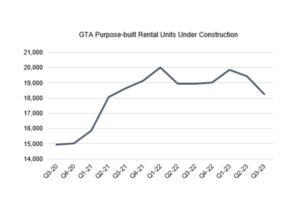
The number of purpose-built rentals under construction in the GTA fell to 18,267 units in Q3-2023, according to new data from Urbanation. This represents the lowest level of activity underway since Q2-2021.

“The recent GST announcement will provide a much-needed shot in the arm for new rental construction in the GTA, but it’s clear given recent trends that much more help is required to improve the economics of building rentals,” said Shaun Hildebrand, President of Urbanation. “The construction of new purpose-built rentals should be a primary policy objective in the battle to improve housing affordability in Canada.”

Compared to the multi-decade high of 19,994 rentals under construction in Q1-2022, when interest rates were just beginning to increase, the level of rental construction underway in the GTA has fallen by 9 per cent. The 2,938 new rental units that started construction during the first three quarters of 2023 represented a 54 per cent decline compared to the first three quarters of 2021 when rental construction was at a recent high.

According to Hildebrand, the decline in rental construction was focused on the most affordable parts of the GTA within the 905 Region. These projects have been most susceptible to increased costs as rents have generally not been high enough to make new development financially feasible. At 2,955 units in Q3-2023, the number of rentals under construction in the 905 Region dropped 42 per cent from its recent high in Q1-2022 (5,083 units).

Hildebrand says the elimination of GST on new rental development is expected to improve construction activity moving forward. As of Q3-2023, there was a total of 41,034 approved purpose-built rental units in the pipeline in the GTA that had not yet started construction, including 10,113 units in the 905 Region.

Rents continued to rise in Q3

The slowdown in rental construction came at the same time as rents reached record highs in the GTA. Condominium leases transacted in Q3-2023 had average rents of $2,937 ($4.21 psf), while units that became available for lease in purpose-built rental buildings completed since 2003 averaged rents of $3,143 ($4.25 psf). Rents in both market segments were up 9% annually in Q3-2023, a somewhat slower pace compared to recent quarters reporting double-digit growth but still well above historic averages.

Vacancy rates stay below 2 per cent  

The vacancy rate in purpose-built rental buildings completed in the GTA since 2003 was 1.8 per cent in Q3-2023, edging down from 1.8 per cent in Q2-2023 and remaining below 2 per cent for the seventh consecutive quarter. The market could see some short-term supply relief as 13 rental buildings totaling 2,639 units are scheduled to begin occupancy in Q4-2023, surpassing the 1,739 units completed in Q3-2023 and representing the highest quarterly total for new rental deliveries in 30 years.

For more info, visit: Latest Trends | Urbanation

EV charger funds directed outside big cities

Subsidies are now on offer for EV charger installations in small to mid-sized Ontario communities with populations no greater than 170,000. Businesses, not-for-profit organizations and broader public sector proponents like health care providers and educational institutions are eligible for up to 50 per cent of qualifying costs for EV chargers at publicly accessible sites. Municipal governments and Indigenous communities, organizations or businesses can secure up to 75 per cent of eligible costs through the provincial program.

Applications for EV ChargeON funding can be submitted until January 31, 2024. Subsidies will be allotted on a per charging port basis, ranging from $5,000 for each Level 2 port up to $100,000 for a Level 3 port with a 200+ kilowatt (kW) output. A maximum of $1 million is available, but successful candidates could combine these funds with grants from other government programs — thus allowing businesses and broader public sector entities to cover up to 75 per cent of their project costs, and municipalities, not-for-profits and Indigenous organizations to cover up to 90 per cent.

“The EV ChargeON program will help get more electric vehicles on the road by building the infrastructure needed to support them,” maintains Prabmeet Sarkaria, Ontario’s Minister of Transportation. “Building more public charging stations is part of our government’s plan to be a global leader in the electric vehicle industry and provide more travel options for commuters.”

Prospective applicants must either own the subject site or have written approval from the owner or Band Council for the installation and operation of charging stations for at least five years. The sites must be open for use 24 hours a day, seven days a week and provide a minimum of either: four Level 2 charging ports; two Level 3 ports; or one Level 2 and one Level 3 port.

With the exception of subsidies for Indigenous businesses and organizations, the funds will not be dispersed within 14 large Ontario municipalities, including Ottawa, Hamilton, Kitchener, London, Windsor and the most populous urban centres of the Greater Toronto Area. However, some of the GTA’s urban municipalities do qualify, including Ajax, Pickering, Aurora, Newmarket and Milton.

Mortgage holders feel squeeze from interest rates

More than half of Canadians, or 51 per cent, would miss mortgage payments within three months if they lost their primary source of income, according to a new survey conducted by Leger on behalf of online mortgage marketplace ratefilter.ca.

Other findings show that sixteen per cent of mortgage holders would fall behind on their payments within 30 days. Canadians spend an average 37 per cent of their pre-tax income on housing, with 62 per cent exceeding the Canadian Mortgage and Housing Corporation’s (CMHC) recommended guideline of spending no more than 30 per cent.

“These statistics corroborate what we’ve been hearing anecdotally from Canadians who are struggling to make ends meet due to higher interest rates,” said Andy Hill, co-founder of ratefilter.ca “Many Canadians feel like they’re at a breaking point due to higher interest rates. Even if the Bank of Canada pauses its rate hike, these borrowers will still be dealing with rates at a 20-year high.”

The online survey is based on results from a representative sample of 1,548 adult Canadians (including 1,028 homeowners and 650 mortgage holders) from October 13-16, 2023.

This news item has been updated

Vancouver begins Oak Street sewer upgrades

Crews have begun work on the first phase of the Oak Street Sewer separation upgrades in Vancouver.

The upgrade project is valued at $28.5 million and is one of the largest projects in the city’s current Capital Plan. The project is part of a neighbourhood utilities servicing plan developed to enable growth in this area.

When complete, the new higher capacity, separated pipe system will serve the growing Cambie Corridor where more than 50,000 new residents are expected to live by 2040. The Oak Street project will also advance the city’s regulatory requirement to eliminate combined sewer overflows (CSOs) by 2050.

“This project directly addresses the significant sewer infrastructure deficit we have inherited and is a demonstration of our commitment to do everything we can to get more homes built. It also makes the local sewer system more resilient to climate change and extreme weather, while contributing to improving water quality in the Fraser River,” says Mayor Ken Sim.

Funding for the Capital Plan comes from a variety of sources and includes private development contributions that support expanded infrastructure and amenities through the city’s financial growth policy. The majority of funding for this project will come from private development contributions through the Utilities Development Cost Levy, with additional support from local development projects. Work includes replacement of aging combined sewer infrastructure with separated pipes along Oak Street, West 70th Avenue and Fremlin Street.

Vancouver has a legacy of combined sewers that carry sewage and rainwater in the same pipe. The system was designed this way to prevent wastewater treatment plants and pipes from flooding.

The Cambie Corridor Plan was approved in 2018, making the Cambie Corridor the biggest growth area outside of downtown.


Going Places – Prioritizing interactive digital signage in Schools, Colleges and Universities

It’s no surprise that today’s generation expects instantaneous access to information. Finding answers to questions was once time-consuming and involved research methodologies. Maybe you had to go to the library or bookstore—maybe you even had to handwrite a letter. Now, finding information takes little effort. With a few simple clicks, results appear on screen.

Educational institutions have a tremendous amount of information to convey, and an audience with little time to spend reading it. Students, whether they’re in elementary school or doing graduate work at university, share a commonality. They are used to using their fingers to search for information using touchscreens, whether it’s their smartphone, laptops, or iPads.

It makes sense that the digital experience also extends into schools. With printing and paper costs becoming an increasingly analyzed budget line, streamlining communications is a valuable cost-savings tool. Using digital signage in schools is an eco-sustainable, effective solution to the many informational needs of those on campus.

Offering much more than a simple directory, youRhere’s interactive information hubs are limitless knowledge banks. Whether helping newcomers navigate their way to faculties and classes, or sharing photos of former alumni, digital interactive hubs have a past, present and future in education systems.

Identifying the multi-layered needs of communication within educational institutions, youRhere has developed software features which provide flexible and affordable signage solutions for schools, colleges and universities. Rotating messaging is displayed in an engaging format—everything happens in one space. Years of school photos can be digitized and celebrated in interactive displays, encouraging present-day students to engage with the school’s history, and digital signage is a clever way for schools to increase their brand awareness.

“If the school has been around for 50 years, you haven’t got room for that amount of class pictures,” explains Scot Martin, President and CEO of youRhere. “You can put up a touch screen that would allow someone interested in looking at a past class to find them quickly and easily on a single screen.”

Honouring alumni through multimedia photo displays is fantastic for sharing the wealth of graduation photos and historical information, without cluttering walls with aging photos. Awareness of benefactors and their historical influence on the school can also be raised in an engaging, visually appealing format.

“When alumni come back to visit, they are tremendously disappointed if they can’t find anything that helps them reminisce about the old days,” Martin says. “They’re delighted if they can pull up pictures of their team, their classmates, or their favourite teacher. All those things can be searched for and found quickly with interactive digital signage.”

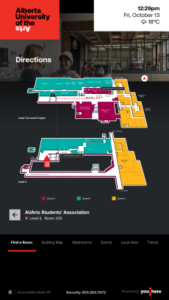
Wayfinding technology allows students to easily locate classrooms, lecture halls, the nearest elevator, and the cafeteria. Students can access maps for the full campus, rather than just for the building they are in, allowing them to better understand the campus layout, including parking facilities. QR codes offer students the opportunity to scan the directions to their phone, ensuring they have consistent guidance even after they leave the digital signage space.

Those with visual impairments can access text to voice options with headphones. Standalone units are virtually height-adjustable, ensuring accessibility is no barrier for anyone in a wheelchair. There are few limitations with digital signage.

After class, live transit information displayed on the interactive hubs makes it easy for students to get home safely without waiting around outside for the next bus, which could be 20 minutes away. Updates on potentially hazardous weather conditions can be clearly displayed on interactive digital signage. In the event of an emergency, displaying critical instructions to students can assist with evacuation efforts. Conveying important health and safety reminders is a valuable use of digital screens in education settings. When you need to inform people quickly, digital signage complements your communication tools.

Over in the student union building, interactive hubs can promote textbook sales, fundraising activities, happy hour and lunch specials. For sports fans, excitement and hype are generated through displays of future game schedules or last night’s game highlights.

youRhere’s digital screens are updated remotely through a simple content management system (CMS). The system is so easy to use, updates can even be completed from a smartphone. youRhere will also provide editable templates, making your latest communication a breeze to convey.

While youRhere’s digital signage offers mega messaging possibilities, the cost is surprisingly small. Screens can be purchased outright or leased and paid for over a contracted period. To offset costs, advertising space can be sold to local businesses, or to advertise local events.

Interactive digital hubs provide a green, sustainable solution to educational communication requirements. Scot Martin is the CEO of youRhere, a leading provider of digital signage solutions for commercial, retail, healthcare, and educational properties across Canada. To learn more, visit www.yourhere.ca

Canada praised as GRESB benchmark leader

National averages aren’t revealed in the recently released 2023 results of the GRESB benchmark for the environmental, social and governance (ESG) performance of commercial real estate portfolios. Nevertheless, during last week’s an online discussion of trends underpinning the macro-level numbers, Dan Winters, senior director of market development and strategic initiatives for GRESB, confirmed Canada’s high ranking among the 75 countries represented in the survey.

The Australia/New Zealand combo that comprises Oceania once again attained the highest score of the four global regions in the benchmark with an average of 94 out of 100 possible points across five management-related elements and 72 out of 100 across nine performance-related elements. Meanwhile, the 80 Canadian participants can be assumed to have generally exceeded the Americas region — which also includes respondents from the United States, Mexico, Brazil and Chile — averages of 88 for management and 66 for performance.

“Oceania, they are leaders, without a doubt. Canada is close at number two,” Winters reported. “In the Americas, the leadership is coming from Canada. What’s going on there? Decarbonization, electrification and on-site renewables.”

That’s in the context of surging participation rates in Canada and globally. This year, 2,084 real estate entities worldwide reported on their policies, practices and property-level outcomes, representing more than 170,000 individual assets collectively valued at USD $7.2 trillion. There was a 20 per cent year-over-year increase in total participation, up from 1,820 respondents last year, while Canada added 21 new respondents, continuing the expansion that has seen GRESB participation triple since 2019.

Newbies no drag on progress

Despite the sizable quotient of newbies with lower scores, the 2023 results show improvement, particularly in performance-related elements where the global average rose to 67 from 61 in 2022. That has a heightened flow-through impact in the final GRESB score, which is also plotted on a scale of 100, given the greater weighting tied to performance.

Some of the signs of progress include a reduction in greenhouse gas (GHG) emissions, more on-site generation of renewable energy, advancements in risk assessment and data monitoring and review, and more target setting. On the flipside, energy-use and water-use intensity were up year-over-year, reflective of post-pandemic increases in office occupancy.

The point spread for this year’s 5-star quintile, representing the top 20 per cent of scores, ranges from 97.43 to 87.46. First-year participants recorded an average score of 59.6 to heavily populate the 1-star quintile at the low end of the scale, where scores range from 64.98 down to 6.91. Participants with five or more years of GRESB experience typically attained scores upward of 80, giving them 3-star or 4-star standing for 2023.

“First year is a struggle to hunt for structured non-financial data and put together a program,” Winters acknowledged. “That’s okay. It’s all about benchmarking an improvement. If you’ve been in the GRESB benchmark for 10 or more years, (the averages indicate) you’ve got a score that’s pretty strong.”

Contributors to the online discussion identify investor demands, regulatory pressure and climate-related physical risks among the prominent drivers of GRESB uptake. In Asia, for example, Pooja Changani, manager of GRESB member relations for the region, tied the 900 per cent year-over-year jump in Taiwanese respondents (from 1 to 10) to new directives requiring all companies listed on the Taiwan and Taipei stock exchanges to submit sustainability reports. Similarly, the Securities & Exchange Board of India’s (SEBI) mandated environmental reporting for the top 1,000 publicly listed companies is linked to the 34 per cent increase in GRESB participation in that country, climbing from 23 to 31 entities this year.

Meanwhile, Europe’s leading push on environmental regulations has long been considered a factor in the dominant percentage of European respondents in the benchmark. That now includes the corporate sustainability reporting directive (CSRD) and sustainable finance disclosure regulation (SFDR) in European Union and sustainability disclosure requirements (SDR) in the United Kingdom. In 2023, another 106 entities joined in, pushing the region’s tally up to 1,013 participants — more than double since 2019.

Sharpening the net-zero focus

Looking across the Atlantic, Winters speculated that Canada’s carbon tax — currently at $65 per tonne of equivalent emissions, but slated to continue rising to $170/tonne by 2030 — influences its standout decarbonization commitments within the Americas region. Across the entire 2023 GRESB database, 56 per cent of participants have publicly committed to reduce greenhouse gas (GHG) emissions and 50 per cent have set targets aligned with the Paris Agreement goals for 45 per cent reduction in emissions by 2030 and net-zero emissions by 2050, but the largest share of target-setting is occurring in Oceania and Europe.

Nearly 80 per cent of respondents in Oceania (116 of 143) have set net-zero targets versus just 36 per cent (201 of 555) in the Americas. However, Winters revealed Canadian participants are much more likely to be implementing asset-level plans in pursuit of portfolio-wide decarbonization — also in step with prominent institutional investors that are setting net-zero targets.

“Every asset manager in Canada that’s part of the GRESB benchmark is on notice,” he suggested. “Watch for the ripple effects because Canadian pension plans are the top foreign investors in United States real estate.”

Representative of that trend, as one of three GRESB participants invited to present examples of innovation and action, Kit Milnes, vice president, sustainability and resilience, with KingSett Capital, explained how the target for his company’s core property fund was derived through the science-based targets methodology. To pursue a 67 per cent reduction in emissions by 2035, KingSett has developed a modelling tool for asset-level decarbonization that it is freely sharing with the commercial real estate industry. For new development, it’s specifying net-zero operational capability, reducing embodied carbon as much as possible and offsetting the remainder.

“We understand where the world needs to get to by 2050, but we want to metric, concise verifiable steps along the way in order to make sure that we are responsible with our investor money and we’re taking actions that are going to yield real results,” Milnes said. “We think it’s important for everyone to be able to understand where KingSett is in this race to decarbonize and what tools we’re using. We’re sharing that so others might gain on the success that we’ve had or improve what we’ve created so others can benefit as well.”


Construction economists calling for urgent reforms

Canada’s construction economists are calling attention to oversights by the federal government that have hindered housing development, highlighting the need for urgent reforms to address the housing affordability crisis.

At a press conference today, the Canadian Institute of Quantity Surveyors (CIQS), representing Professional Quantity Surveyors (PQS) and Construction Estimators Certified (CEC), pointed to the federal government’s gaps in ensuring Canada’s future infrastructure adheres to contemporary, cost-efficient, and eco-friendly standards.

Deficiencies, they say, stem primarily from the government’s limited engagement with industry professionals who are skilled in evaluating the effectiveness and sustainability of upcoming construction initiatives.

“While the federal government has pledged over $20 billion towards green infrastructure initiatives, they must also guarantee the cost-effectiveness of these projects and a net-zero focus for future Canadian infrastructure,” said Sheila Lennon, CAE and CEO of CIQS. “The expertise of construction economists is pivotal in bridging this developmental gap.”

“Our role is crucial in optimizing developers’ time, funds, and resources,” said Tammy Stockley, PQS(F) and CIQS Vice Chair. “Investments should assure costs and deliver maximum value to taxpayers. Now, as the focus shifts to major public infrastructure projects, Canadians deserve to see their tax money’s worth. We stand ready to bolster climate resilience, emissions reduction, economic greening, and the creation of quality middle-class employment opportunities.”

CIQS is also calling out the government for delaying the enactment of the Federal Prompt Payment for Construction Work Act, which was green-lit in 2019 and designed to ensure timely payments to contractors and subcontractors. The Act, the say, is crucial in upholding financial stability and fostering mutual trust in the ecosystem. A cornerstone of the nation’s economy, the construction industry contributes to over 7 per cent of the GDP and employs over 1.5 million Canadians.

CIQS is a self-regulatory, professional body and the gatekeeper of the ethics and standards for construction and infrastructure economics in Canada. It is a national professional organization that currently represents over 2,000 construction cost professionals.

Looking ahead to 2024’s commercial cleaning trends

As the commercial cleaning industry continues to grow and evolve, what are experts predicting to emerge as the top trends next year? Technology, sustainability, and service continue to dominate customer and cleaner priorities, but 2024’s trends take these standards to the next level.

Technology

Cleaning companies can use technology in so many ways to help streamline their business and save on labour. From invoicing to robotic cleaners to AI, technology can help improve cleaning operations and provide a better customer experience, so it is expected to continue to disrupt the industry as more adoption occurs.

Simply using apps to optimize routes means you can get to more buildings in a day. It also means that you can assign teams to jobs located close to each other to save time and cover all your customers. Automated reports can help you better serve your customers by assessing efficiency, spotting challenges, and improving service. These types of technologies help save time and more with improved operations and better allocated labour.

In the wake of the pandemic, many businesses are also upping their requests for more frequent deep cleans, and technology like UV-C is helping cleaners better address these demands from their customers. While not strictly new technology, these types of tools are growing in popularity and demand as cleaning companies address a greater need for deep cleaning, better efficiency, and accurate metrics.

Exceptional service

Technology helps the customer experience, but relationships are vital these days. Though business has always been built on relationships, with lower occupancy and tighter budgets, loyalty and relationship building are more important than ever. Studies show that 66 per cent of customers expect cleaners to know and understand their unique needs and expectations. Transparency, service, and communication are the keys to building trust and keeping those clients coming back for consistent revenues into next year and beyond.

Sustainability

Green cleaning and sustainability continue to be a top priority into 2024, but the stakes are even higher as more customers focus on lowering their environmental impact. Customers are looking for “green promises” from their cleaners, standing by their commitment to reduce their carbon footprint. Things like waste reduction, increased recycling, reduced energy and water use, and green cleaning supplies and practices are topping the list of requests from businesses.

RELATED: Getting started in decarbonization

Part of the communication and transparency that will be crucial to businesses and commercial cleaners, includes identifying and committing to sustainability goals will also help build trust and loyalty from like-minded companies.

As we head into 2024, consider these trends as ways to improve your cleaning business, better connect with your customers, and build your bottom line next year.

Final phase of Calgary Ring Road underway

The Government of Alberta announced the final push to complete the Calgary Ring Road project is underway.

Earlier this year, construction of the new West Bow River bridge and new interchanges at Old Banff Coach Road and Bow Trail opened for traffic. This is a milestone toward the overall completion of the entire Calgary Ring Road in 2024.

These openings have improved access for communities, cut travel times for drivers by up to 20 minutes and have vastly improved travel times for commercial carriers. When fully completed, the Calgary Ring Road will provide 101 kilometres of free-flow travel, create new travel options for drivers and reduce traffic congestion.

“I’m excited to announce the Calgary Ring Road is one step closer to being finished. We are delivering on making life better for Albertans through the completion of this section for this major project, which means faster commutes, less panic getting kids to school or practice, quicker trips for groceries and a whole lot less stress,” said Devin Dreeshen, minister of Transportation and Economic Corridors.

Construction of the West Calgary Ring Road is the final piece of the entire ring project, and the focus is now shifting to the final phase between Bow Trail and Highway 8, which is on track to be complete in 2024.

Transportation and Economic Corridors continues its work on the West Calgary Ring Road project, the final portion of the ring road. The interchange at the Trans-Canada Highway and Stoney Trail is nearing completion, along with the connection to Bow Trail, SW, which is scheduled for completion this fall. That will ease congestion for traffic, allow easier access to and from the Trans-Canada to Stoney Trail. Additional work to complete the roadway and interchanges at 17 Avenue and Highway 8 is expected to be completed by 2024.


Strategies to reduce fire risks on job sites

In April, fire broke out in a new subdivision under construction in the GTA, reducing 20 new homes to ash and damaging a number of additional homes.

A neighbourhood in Vancouver with multiple high-rises under construction saw thick smoke warning of fire in June. After nine fire trucks arrived on scene, the fire was put out quickly, before more extensive damage could be done.

Then, in August, a suspicious fire in Montreal damaged a transit station under construction.

Construction sites are hit by fire in unexpected ways, whether due to improperly stored construction materials that catch fire or a vandal intentionally setting a blaze. But for builders and building owners, there’s a wide gap between a total loss and a damaged structure. Those who adopt new materials and technologies, and also take steps to mitigate the risks, can lessen the threat of fire and prevent their projects from going up in flames.

Fire Prevention Technology

Buildings are most vulnerable to fire when they are under construction. Whether the structure is made of concrete, steel or wood, buildings in the process of being constructed lack the technology to slow the spread of fire, whether it’s active fire detection systems or passive systems such as walls and doors.

In addition, hot work such as welding, soldering and grinding are standard construction activities, but can be risky ones. Hours after these activities are performed, flames can still spark and smolder, leaving the building at risk of damage or total destruction.

Wood-framed structures are particularly vulnerable to fire risk. An exposed wooden skeleton can go up in flames in a matter of minutes, leaving the builder with a catastrophic loss.

Therefore, contractors who build wood-framed structures must be mindful of the risks and take steps beyond traditional fire mitigation strategies to protect their projects.

Best Practices For Risk Mitigation

Modern homes are equipped with smart technology that alerts residents when a stove has been left on or if smoke is detected in the room. Buildings that are under construction don’t have that technology in place, but builders can still work to reduce risk.

Consider these five strategies to reduce fire risk on a job site:

1. Start with the code. Whether your building is made of concrete, steel or wood, it’s always best to meet – or exceed – standard building guidelines. Although most builders know to consult the code for final specifications, few consider it for interim guidance. Yet the provincial and federal code is a great place to start when it comes to fire protection and mitigation strategies, since that is a major risk during construction. If you’re constructing a tall wooden structure, the National Building Code of Canada 2020 includes specific technical requirements for natural and engineered wood.

2. Consider alternative materials. In the last decade, Canada has seen the construction of nearly 500 mass timber structures – and more are going up every year. Mass timber is an engineered wood product made of multiple layers of wood that are glued or nailed together. Not only is mass timber strong enough to create structural load-bearing components such as columns and beams, but it also burns in a highly predictable way, charring the outside of the wood while protecting the inside. This is an attractive option for builders since these buildings are less likely to burn completely in the event of a fire on site.

3. Introduce specialty products. Wood is vulnerable to fire in any form, especially stick frame construction or unprotected engineered lumber. Yet introducing a fire-resistive coating to the wood used to construct a building’s frame can significantly lessen the risk of a catastrophic fire event during the most critical period: when the building is framed but before other fire protection systems have been set up. In addition, these products continue to provide fire-retardant capabilities even after the building has been completed – an attractive benefit for the building’s owner. Adding the coating is a simple process that happens to the wood before construction begins but doesn’t change the method of construction.

4. Augment site security. The risk of fire can come from many places, whether through vandals and other bad actors or even a simple accident. Protect against these risks with a fully secured job site, including proper fencing, signage, lighting and security cameras. High-tech options, such as alarms, ignition cut-off switches and GPS tracking devices, support the basics by alerting decision-makers when there is trouble on site. In addition, don’t underestimate the value of a security guard when it comes to deterrence of vandals. A lit, well-monitored job site is a much less attractive target than a dark, abandoned one.

5. Build a culture of safety. Everyone can do their part to lessen the risk of fire on site. Empower workers through formalized, clear processes and procedures. Start with the basics: introduce an approved hot works permit system and be sure all workers know where to report smoke or flames. Be sure any extra building materials, especially combustibles and flammables, are stored in pre-approved locations. In addition, maintain a strict no smoking policy outside of designated areas.

All it takes is one spark for an entire site to go up in flames – no matter how close the structure is to completion. An effective fire prevention strategy begins with safety policies and security features, but it’s greatly enhanced by the adoption of fire-retardant materials and other safety products.

Insurers, for their part, may offer more competitive insurance premiums and better conditions to builders who utilize these materials, a boost that benefits not only the builders but also the eventual building owners. Consult your broker or advisor about the best way to protect your building from the risk of fire both during construction and after completion.

Simon J. Fenn, CIP, is senior vice president at global insurance brokerage Hub International.


Ontario’s first accredited Fire Safety Certification program launches – Oct 2

Press Release

National Life Safety Group (NLSG), a trusted leader in providing Fire, Safety & Emergency Management solutions, is delighted to announce the launch of its new “Implementing Fire Safety Plans in Residential Buildings” training program, which recently received accreditation from the Institution of Fire Engineers (IFE) Canada Branch.

Now also recognized by the Condominium Management Regulatory Authority of Ontario for Professional Development Credits for Licensed Condominium Managers, these prestigious endorsements solidify NLSG’s commitment to providing top-quality training that meets industry standards and ensures compliance with Ontario’s rigorous regulations.

Condominiums and apartment buildings in Ontario are required to have fire safety plans as per the Ontario Fire Code, and that means licensed condominium and apartment managers, as well as key building staff, must undergo training – before taking on any fire safety responsibilities. This is a fire code requirement.

With Fire Prevention Week approaching on October 8th, now’s the time to implement Ontario’s only accredited, hands-on, and site-specific fire safety training program designed to meet and exceed the Fire Code and developed by fire & life safety educators recognized by NFPA, specifically for residential building managers, superintendents, and on-site concierge/security teams in Ontario.

“Implementing a Fire Safety Plan through training at your building is much more than a fire code requirement—your occupants’ safety depends on it,” says Jason Reid, Senior Advisor of Fire & Emergency Management with NLSG. “In fact, firefighters responding to an emergency at your building expect fully trained staff, and an implemented fire safety plan when they arrive; they also expect all systems to be functioning, tested, and recently inspected, and they highly depend on knowledgeable building staff in times of emergencies. Accredited and recognized training provides the skill set and confidence needed for building staff to effectively manage the life safety systems and respond to building emergencies at 2:00 AM.

So far this year, 60 fires across the province have resulted in 66 fatalities, and last year saw more than 133 fire related deaths—the highest in two decades. Through NLSG’s innovative three-hour, on-site training program, critical knowledge will be shared, ensuring that public and private organizations comply with the Fire Code and are able to effectively implement their fire safety plans to prevent tragedies.

Specific subject areas include:

  • Understanding & Operation of site-specific Life Safety Systems Fire Alarm, Sprinkler, Smoke Control, Emergency Lighting, Emergency Voice Communication systems, and more.
  • Roles & Responsibilities of Building Supervisory Staff; Managers, Superintendent, Concierge, and onsite Security teams.
  • Proactive and Reactive Emergency Communications to building occupants.
  • Managing “Persons Requiring Special Assistance During a Building Evacuation”
  • Understanding / scheduling of maintenance and inspections as detailed in the Ontario Fire Code.

Interested companies can see the Training Program 60 second Explainer Video Here, or visit the accredited course page or call 1-877-751-0508 for more info.

About

National Life Safety Group is a Toronto-based fire and emergency management consulting firm serving both the public and private sectors in Canada and internationally.

fire safety

SOURCE National Life Safety Group

Five industry leaders to be honoured with Achievement Awards at ISSA Show North America 2023

ISSA, the worldwide cleaning industry association, is proud to announce the 2023 ISSA Achievement Awards honorees. The annual achievement awards program recognizes cleaning industry professionals who are committed to driving the cleaning industry forward through their positive contributions in their business and beyond. These five honourees will be recognized November 14 during the Spotlight Event: Then, Now, Forever | Celebrating 100 Years of ISSA at ISSA Show North America 2023, which takes place November 13-16 at the Mandalay Bay Convention Center in Las Vegas.

“As ISSA celebrates its 100th anniversary, it’s important to recognize the dedicated and passionate individuals who have championed not only our association but the cleaning industry as a whole,” said ISSA 2023 Board President Matt Vonachen. “Congratulations to this year’s Achievement Award honorees. I look forward to celebrating their accomplishments with them in person next month in Las Vegas.”

The 2023 Achievement Awards and their recipients are:

  • The ISSA Honorary Lifetime Achievement Award honors an individual who, in the opinion of the ISSA board, deserves recognition for substantial contributions to the advancement of the industry and/or to ISSA over a significant period of time. This year’s recipient is former ISSA Executive Director John P. Garfinkel. For more than five decades, Garfinkel has been an influential force in the cleaning industry. As ISSA Executive Director from 1991 to 2015, he was instrumental in championing many of the initiatives that have bolstered membership and established ISSA as the leading association for the cleaning industry worldwide.
  • The Jack D. Ramaley Industry Distinguished Service Award, reserved for individuals with at least 10 years of outstanding service to the professional cleaning industry, will be presented to Ilham Kadri, founder of the ISSA Hygieia Network and current CEO of Solvay, a Belgian multinational chemical company. Inspired by her grandmother, Kadri has been a tireless promoter of women in the cleaning industry. She founded the ISSA Hygieia Network during her previous tenure as CEO of Diversey to develop a network to provide tools and support to help women achieve their full potential.
  • The Manufacturer Representatives’ Distinguished Service Award, which recognizes individuals who support manufacturer representatives, the industry, and ISSA, will be awarded to Keith Angel, former president of Angel Cotton Associates. Over the course of his 30-year career, Angel participated in countless manufacturer product and advisory committees, and led his agency to become one of the largest in the country. During his time as the ISSA Manufacturer Representative Council Chair, he was instrumental in developing the Manufacturer Representative Scholarship that continues to provide opportunities to the next generation of reps.
  • The ISSA NextGen Rising Star Award in Honor of Jimmy Core acknowledges emerging leaders who make positive contributions to their organizations and the industry. Travis Caldwell, director of sales, government at Imperial Dade, will be honored for his commitment to educating building service contractors and food service contractors engaged in government work on the intricacies of operating and maintaining proper compliance. In addition, Caldwell serves as an engineer in the U.S. Army National Guard, swiftly responding as one of the initial responders in the aftermath of significant national disasters.
  • The ISSA Hygieia Network Rising Star of the Year recognizes a woman who has made significant achievements and demonstrated consistent upward mobility in her career within the industry. Elizabeth Hawver, Essity Vice President of Omnichannel, Wholesale & Office Distribution, was chosen by her peers for her impressive career trajectory and outstanding achievements within the cleaning industry.

For more information and to register for the ISSA Show North America 2023 please visit this link.

B.C. making flush toilets on job sites mandatory

B.C. Premier David Eby announced the provincial government will legally require flush toilets on construction sites of 25 workers or more.

“If we want people to work in the trades, if we want to show people that this is a great way to support your family and build your community, the basic ability to go to a bathroom that doesn’t stink, that isn’t a mess, where you can flush a toilet, is a basic requirement for a decent job site,” said Eby.

While full details of the plan are in development, the BC Building Trades is celebrating the Premier’s promise to deliver flush toilets for construction workers.

“We are excited about the Premier’s responsiveness to this important issue,” said Brynn Bourke, executive director of the BC Building Trades Council, which represents more than 40,000 unionized construction workers.

“With the Premier’s help, construction workers across the province will have markedly better sanitary conditions on site. They’ll also be given the dignity they deserve at work.”

The BC Building Trades recently re-launched its ‘Get Flushed’ campaign to an onslaught of media coverage and far-reaching discussions on social media.

“The extent to which the flush toilet campaign was covered in the media and the intensity of the discussion that followed really proves that this is an important issue that requires action from government now, and clearly the Premier agrees.” said Bourke.

The BC Building Trades will continue to work with government to ensure the forthcoming requirements deliver the washrooms facilities construction workers deserve.