



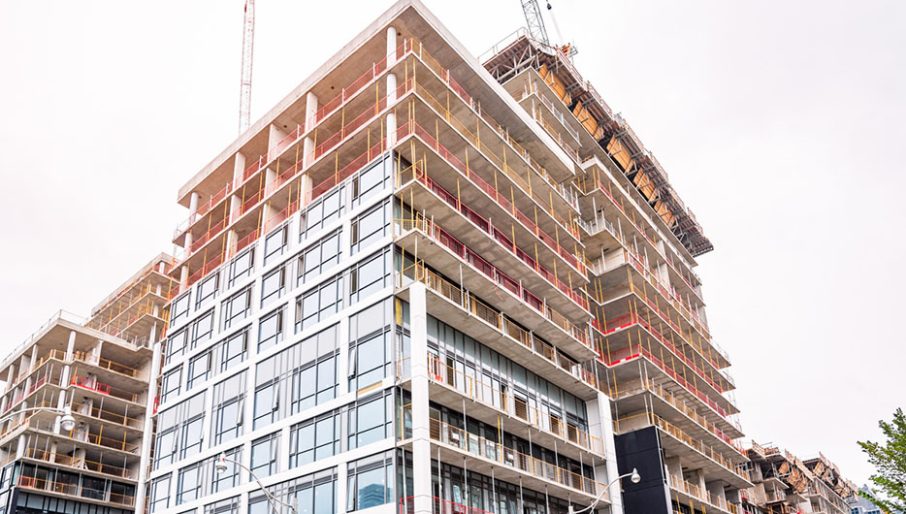
The construction industry has placed growing emphasis on the carbon impacts of building materials. Material selection decisions are now routinely informed by Environmental Product Declarations (EPDs), global warming potential (GWP), recycled content, transportation distances, and other indicators of embodied carbon. These considerations are important conversations, as Canadian buildings are designed to operate more efficiently and in doing so the embodied carbon represents a larger portion of their overall environmental impact.
There is another carbon cost that rarely enters the discussion: the carbon cost of replacement. When building materials or assemblies fail prematurely, the industry is forced to manufacture, transport, and install new materials long before they should be needed. The result is avoidable embodied carbon that can undermine the environmental benefits achieved elsewhere in a project’s design.
When a wall leaks, a roof experiences moisture damage, insulation becomes saturated, or a waterproofing system fails (and they will), the consequences are usually discussed in terms of repair costs, insurance claims, disruption to occupants, and occasionally litigation. What we rarely discuss is the environmental cost associated with removing materials, transporting them away from the site, manufacturing replacements, delivering those products back to the building, and repeating a portion of the original construction process.
Most embodied-carbon calculations begin with a reasonable assumption: the building will be constructed once and the materials installed will remain in service for approximately their anticipated service lives. The problem is that a relatively small enclosure failure can result in a surprisingly large amount of material replacement due to the failed component that is sitting conveniently on the surface where somebody can simply remove it and fix the problem.
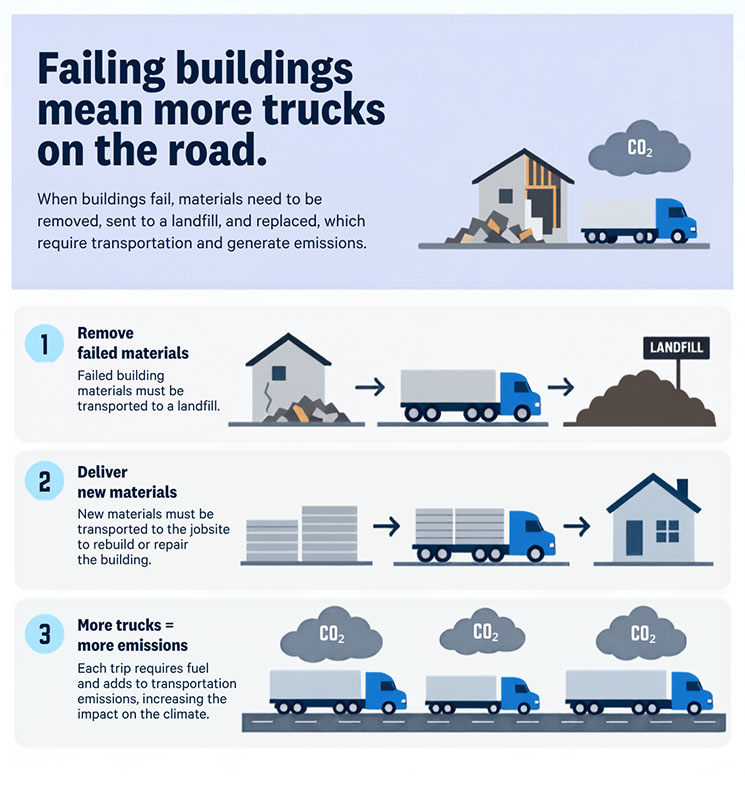
If an air barrier deficiency exists behind exterior insulation and/or cladding, accessing it may require removing portions of the cladding, attachment system, insulation, flashings, sealants, and other accessories before the actual problem can even be reached. Some materials may be reusable, but many will not, meaning the environmental impact of the repair can extend far beyond the material that originally failed. Essentially, we end up paying the embodied-carbon cost twice for something we intended to construct once.
A material with lower initial embodied carbon may appear to be the obvious environmental choice, but if the assembly containing that material experiences premature moisture damage and requires substantial repair after 15 years, while another assembly could reasonably remain in service for 50 years, the original comparison becomes considerably more complicated. Replacement insulation, membranes, sheathing, fasteners, finishes, transportation, equipment, and disposal can quickly erase an initial carbon advantage.
Durability therefore needs to be considered alongside the initial carbon numbers rather than treated as a separate conversation. Comparing two products only at the manufacturing stage can tell us something useful about their initial environmental impact, but it does not necessarily tell us which solution will have the lowest carbon impact over the life of the building. Buildings are expected to remain in service for decades, and the materials forming their enclosure need to survive repeated wetting and drying, temperature changes, wind, solar exposure, movement, and the inevitable imperfections that occur during construction.
Water is particularly good at turning a small construction deficiency into a large repair project, as moisture can travel through assemblies and damage materials well beyond the original defect. A poorly detailed window transition can allow water into an assembly for years before visible symptoms appear, while an air leakage pathway in a cold climate can transport warm, moisture-laden interior air into a wall or roof where condensation occurs against a cold surface.
Complexity can amplify this problem. Modern high-performance wall assemblies may include cladding, attachment systems, air spaces, exterior insulation, air and moisture barriers, sheathing, cavity insulation, vapour control layers, tapes, sealants, flashings, and fasteners. Most are installed for legitimate reasons, but every additional component introduces another interface, another installation sequence, and potentially another opportunity for something to go wrong.
There can also be an operational carbon penalty when a failed enclosure continues to perform poorly. Wet insulation may not provide the thermal resistance anticipated during design, uncontrolled air leakage can increase heating and cooling loads, and thermal discontinuities can force mechanical systems to compensate for deficiencies in the enclosure. In some buildings these problems can remain hidden for years, meaning the building may consume additional energy long before anyone opens the wall and discovers what has been happening.
Building failures can therefore create two carbon penalties at the same time: additional operational carbon while the enclosure performs below expectations and additional embodied carbon when damaged materials eventually need to be removed and replaced.
Taken together, these impacts highlight a critical point: embodied carbon, operational carbon, durability, and building science should not be considered in isolation. They are interconnected aspects of designing and constructing buildings that deliver lasting performance, minimize lifecycle emissions, and maximize service life.
This interconnected relationship is also why construction quality should be considered a carbon strategy. Proper sequencing, mock-ups, inspections, testing, commissioning, and contractor training can prevent enormous quantities of future material replacement. An air barrier may have excellent environmental credentials, but an EPD cannot tell us whether a window transition was properly detailed, a penetration was sealed, or the wall air barrier was continuously connected to the roof.
We should also think more carefully about repairability when designing assemblies. We already know that sealants will eventually require replacement, roofs have finite service lives, buildings move, penetrations change, and some components will need maintenance regardless of how well they were originally installed. Yet critical control layers are routinely buried behind multiple systems that can be difficult or destructive to remove.
Designing for accessibility, maintenance, replacement, and, where practical, disassembly can reduce the carbon consequences when work eventually becomes necessary. If one component can be repaired without throwing four perfectly functional materials into a dumpster, that should be considered a sustainability benefit even if it is difficult to capture on an EPD.
Ultimately, low-carbon construction cannot be reduced to choosing the product with the smallest number in a comparison table. Material selection matters, but so do enclosure design, continuity of the control layers, constructability, installation quality, durability, service life, and the ability to repair the building without unnecessarily dismantling everything around the problem. Those considerations may be difficult to quantify, but their environmental consequences are real.
The construction industry should continue improving how it measures embodied carbon, but sophisticated calculations should not distract us from one of the simplest sustainability strategies available: design it properly, install it properly, and try very hard not to build it twice.
When we look at carbon over 50, 75, or 100 years, durability ultimately stops being simply a building science issue and becomes an environmental one as well. Perhaps the lowest-carbon wall is not necessarily the wall with the smallest number on day one, but the wall that performs as intended for decades and only has to be built once.
Rockford Boyer, B. Arch. Sc., MBSc, BSS, is a building science leader at Elastochem Specialty Chemicals and brings more than 20 years of technical knowledge in sustainable building design. Regarded as an expert in the field of building performance, Rockford works closely with architects using energy modeling technology to implement sustainable design strategies.