




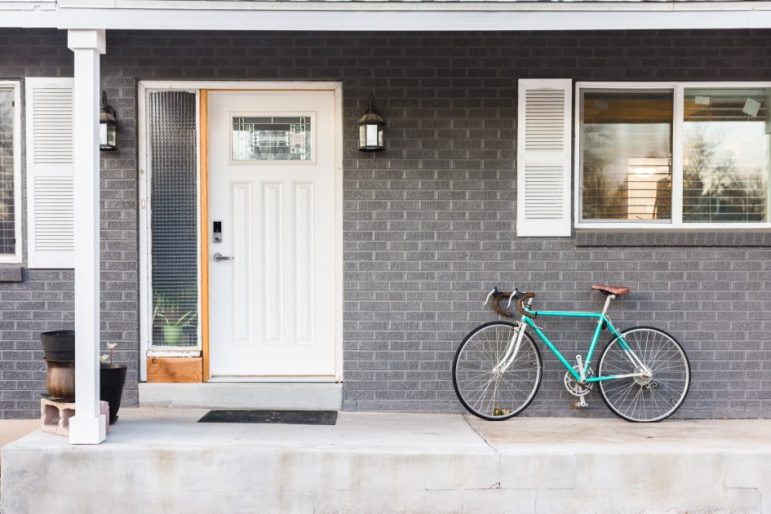
Millions of condo units have exterior-facing front doors. Until recently, none of them had a smart deadbolt that could handle the weather.
Not every condo unit sits behind a climate-controlled corridor. Garden-style complexes open directly onto landscaped courtyards. Walk-ups with exterior breezeways expose every landing and doorframe to the sky. Ground-floor units have patio entrances a few steps from the parking lot. Townhome-style stacked condos, bungalow clusters, casita communities, cabin-style resort properties. Across Canada, millions of residential front doors face the reality of harsh weather conditions. Rain hits the lock. Snow and ice freeze on it. Sun bakes it for months at a time.
These buildings are not niche. Garden-style apartments represent one of the fastest growing segments of new multiunit construction, favoured by developers for faster approvals and lower build costs, and by residents for ground-level access and private entries. Walk-up buildings of three and four stories dominate suburban rental corridors from the southeast United States through the Canadian prairies. In resort markets, casita and cabin-style layouts are standard.
What they share is an access control problem the industry has been working around for years.
The Gap at the Building Envelope
Inside these same properties, smart locks are everywhere. Lobbies, amenity rooms, mail centres, fitness areas, parking garages. Cloud-managed platforms issue and revoke credentials remotely, log every access event, and eliminate rekeying costs at turnover. The technology works and residents want it. NMHC reports that 67 per cent of renters now expect keyless entry.
 But most electronic deadbolts are engineered for interior conditions. Their temperature ranges assume a heated corridor. Their housings are not sealed against moisture. Install one on a door facing a parking lot in Edmonton or a courtyard in Houston and you are gambling on how long the electronics survive. Property managers who tried it found corroded circuit boards, frozen keypads, and warranty claims that went nowhere because the lock was never rated for outdoor use.
The result has been a split system: electronic credentials inside the building, brass keys outside. Residents carry two forms of access. Management runs two workflows. And the exterior door, often the most vulnerable to forced entry, remains the least monitored point on the property.
Why Outdoor Took So Long
Building a weather-resistant smart lock is not just a matter of adding a rubber gasket. The electronics have to function reliably from minus 35 to plus 60 degrees Celsius, a span that stresses batteries, displays, and wireless radios differently at each extreme. The housing needs an IP55 rating to resist dust and water from any angle. And the lock still has to meet fire door assembly standards, because many exterior-facing unit doors sit on rated openings. ANSI/BHMA Grade AAA certification and a UL 10C fire rating of 180 minutes on metal doors are code requirements in commercial multifamily, not optional upgrades.
The lock also has to fit. Condo retrofits do not get the luxury of reframing doors. Whatever goes on needs to drop into the existing deadbolt door prep, the standard bore and backset that mechanical deadbolts have used for decades. A product that requires new holes or hardwired power is a non-starter on a property with 80 exterior doors and residents living behind them.
A Lock That Fits the Hole and the Weather
Salto has addressed this challenge with the newly announced DBolt Touch Outdoor, a smart deadbolt built for exterior residential doors. It meets the benchmarks above: IP55, the full temperature range, BHMA AAA, UL 10C. It runs on three AA batteries rated for up to 85,000 operations and fits a standard deadbolt prep with no drilling or door modification. A maintenance tech can swap out a mechanical deadbolt with a screwdriver.
The touchpad accepts RFID cards and fobs, NFC credentials, Bluetooth digital keys, and PIN codes. That credential range ties the outdoor doors back into the rest of the building. A resident with a single card or phone can move from lobby to elevator to fitness room to their exterior-facing front door without carrying a separate key.
Closing the Last Gap
For property managers running garden-style communities, walk-ups, or any site where unit doors face the outdoors, the practical change is simple. The exterior door joins the same managed ecosystem as every other access point. Credential issuance, revocation, and audit logging happen in one platform. Rekeying disappears.
The less obvious change is to the resident experience. A condo owner in a bungalow style complex or a renter in a garden walk-up gets the same keyless convenience that a high-rise corridor resident has had for years. Their front door works the same way as the amenity room door and the lobby door. The fact that theirs faces a snowstorm instead of a hallway no longer matters.
For more information: www.saltosystems.ca