




Corporate and government commitments to sustainability and net zero targets have increased significantly over the years. Scaling sustainability and pushing the boundaries of energy-efficient, financially viable, and high-performance building design are important goals. But despite best intentions, claims of achieving net zero targets on projects are often false due to a misunderstanding of the underlying science or outright greenwashing.
According to Guido Wimmers, dean of BCIT School of Construction, there are many misconceptions of what is net-zero. During the 2010s, net zero and sustainability were not clearly defined and widely misunderstood.
“We’re using these terms very lightly, without a clear definition, and especially in the field of net zero, we are clearly contradicting the second law of thermodynamics, and we were claiming to do something which we weren’t. There are good projects, but there are also projects which completely misused these terms. I think that’s still ongoing…and that we have to be careful in how we use these words,” he said, arguing that buildings that have been celebrated for being net zero were far from being actually net zero.
He noted all the awards and certifications for those buildings “threw us back about a decade by not focusing seriously on what net zero or sustainability means.”
“Net zero doesn’t mean anything as long as it’s just a mathematical exercise,” he said, during a ULI BC webinar on shifting the narrative on sustainability. “In the past, specifically with energy and carbon, our accounting systems have been creative. Not necessarily being truthful.”
So what is actually net zero?
The lack of a consistent definition and substantial variation in standards set by industry certifications has meant confusion and misleading claims.
“There are so many different types of definitions possible. You can define it for carbon, you can define it for greenhouse gas emissions, for operational energy, for climate impact,” said Wimmers.
Misconceptions about net zero are slowing down decarbonization at scale and meaningful climate action. Wimmers identified four big misconceptions including: it is easy, it can be achieved by ignoring the basics of physics and it is cost prohibitive. One of the biggest misconceptions is that net zero means eliminating all emissions.
“Net zero does not equal energy efficient,” he stated. ”The net zero narrative, at least currently used in industry, doesn’t guarantee that you have a net zero building or anything physically in front of you, because we allow all kinds of different offsets…essentially making it less transparent.”
To make net zero targets viable, there needs to be a fundamental shift – a different approach from the construction industry as well as the education system.
“Construction is operating in silos, so is the education system,” he said. “We need to create a far more integrated approach. We have to change how we teach and what we teach.”
Wimmers believes there is a better understanding of net zero today but the question is: how to achieve it in a meaningful way.
Redefining Sustainability
Marpole Community Centre
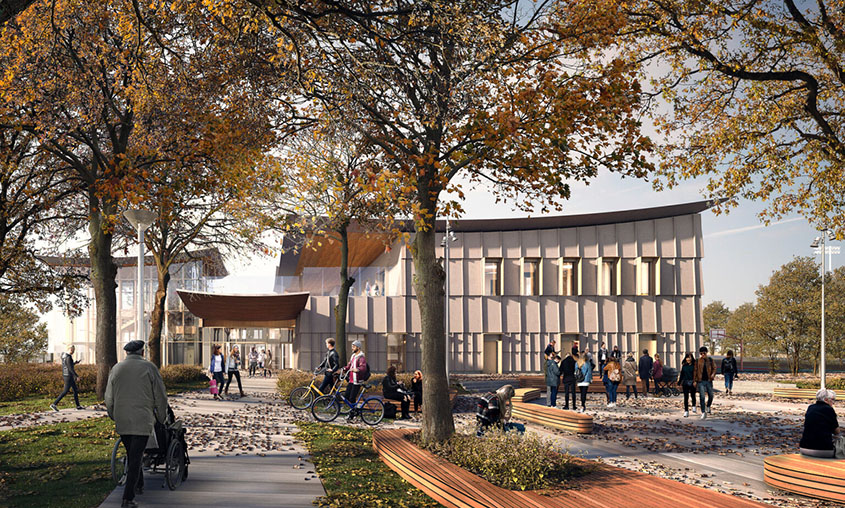
A Vancouver project that aims to change the narrative on sustainability is the new Marpole Community Centre. Vancouver city planner Forest Borch discussed the city’s approach to net zero civic buildings and the ambitious goals set for the centre.
The new 42,000 square foot centre will be “the most inclusive, forward-thinking, and high-performing facility that the city has ever built,” said Borch. The design aims for near-zero operational emissions, significant embodied carbon reduction, and high accessibility.
For this project, the city is applying a holistic approach to emissions reductions, targeting a 40 per cent reduction in embodied carbon. The centre will get close to net zero on the operations side by using a 100 per cent electric design and achieving Passive House certification for high energy efficiency, and LEED Gold certification. It will also be the first city-owned community centre built to achieve Rick Hansen Foundation Accessibility Certification (RHFAC) Gold.
“This project is set to achieve the 2030 embodied carbon target of the City of Vancouver of 40 per cent, showing that it’s possible to do that today, and it can do that pairing cost savings,” said Borch.
He spoke about the economic, social, and environmental trade-offs that were made throughout the project. Keeping the project within budget required phasing the project and reducing parking.
“By phasing this project and delaying the pool construction, we were able to support delivering a community centre that was not compromised on program or size,” he said. “We reduced the parking from around 210 stalls to 98 stalls…which had impacts on the project’s embodied carbon, and also saved the project $3.5 million.”
The project is designed for a 100-year life cycle with consideration for maintenance and operations. “We know how to get to very close to net zero on the operations side,” said Borch.
Sen̓áḵw
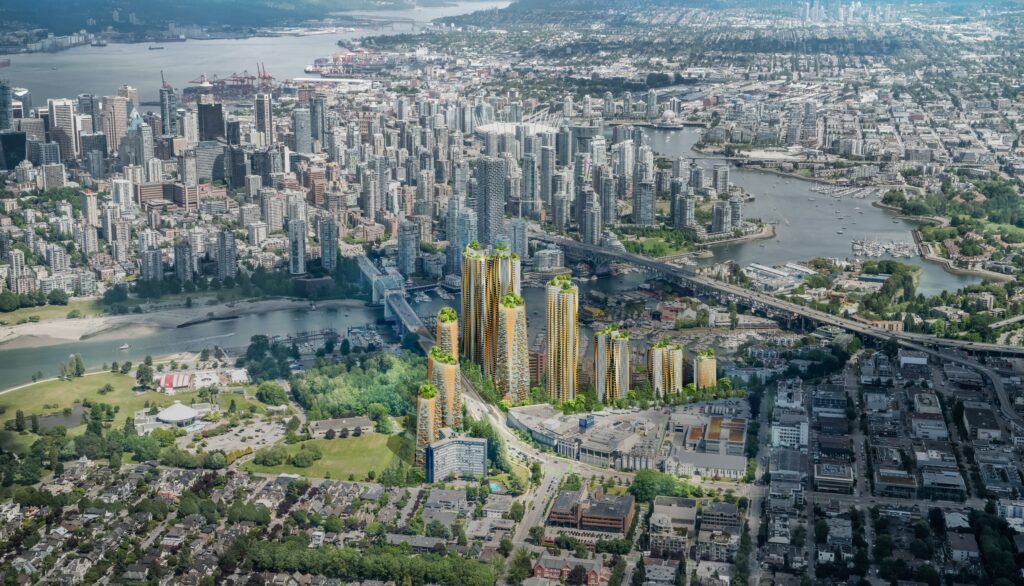
Another transformative Vancouver project that has lofty sustainability goals is the Sen̓áḵw multi-phased development, located on 10.5-acres of Squamish Nation land. It is the “largest net zero operational carbon residential project in Canada.”
“It’s a very complex project. Lots of complex partnerships, complex financial arrangements, complex construction, a difficult site,” said Graeme Silvera, principal of G. Silvera & Associates. “We’re just wrapping up Phase 1 right now with the first tower approaching occupancy in December.”
The four phase development will feature 11 towers, providing approximately 6,000 housing units and more than 1,200 affordable units.
“Sen̓áḵw is more than just about low carbon, more than just about energy efficiency and using sustainable materials. It’s really a broader definition of sustainability, and it’s built on the foundation of the nation, bringing the historic village of Sen̓áḵw back to life,” said Silvera.
He highlighted how the project is about a broader definition of sustainability that focuses on four key pillars: the built environment, carbon footprint, transportation and culture.
For example, heating and cooling will be produced by a new 10MW district energy system fed by waste heat from Metro Vancouver’s adjacent sewer infrastructure.
“We are extracting heat out of that sewer line, and using it to heat the buildings, and chilling the buildings using electric chillers, for an overall net-zero operational carbon development,” he explained.
Other carbon reduction initiatives include: integrated bike share program, a design to adapt to sea level rise, and use of mass timber.
For Silvera, the biggest misconception is that net zero is all about using less carbon.
“Net zero is future proofing your asset against future energy shocks,” he said. “Carbon is going to have to be priced properly at some point on the worldwide market. And when that happens, if you do not have a project that is future-proof to lose less carbon, you’re going to have a massive shock to the system in terms of operational costs.”
Cheryl Mah is managing editor of Construction Business.