





In any commercial building, unexpected water leaks are a costly, invisible threat. Lurking behind walls and ceilings is aging water infrastructure such as corroded piping and fittings, while pressure-relief valves may be deteriorating in the basement or penthouse mechanical areas. Bursts of water on upper levels can result in flooding across multiple floors, while over a weekend, a seemingly small leak can waste enough water to make a big impact.
Water rates across Canada have risen steadily over the last 20 years (3-5%), driven primarily by aging treatment facilities and much-needed infrastructure renewal. Commercial buildings are full of water-using appliances and mechanical fixtures that are prone to sudden, undetected failure. Toilets, trap seal primers, faucets, urinals, and cooling towers can fail at any time. While a major pipe burst is immediately visible, minor fixture failures often cause equal or greater harm when left unattended for long periods.

For most people, the analysis of water consumption often begins and ends with the monthly utility bill. But given that the bill arrives up to 30 days after the water is consumed, this method allows no opportunity to address waste before the bill arrives. Far too often, hidden water waste is embedded in the bill.
“Water intelligence” can be defined as the use of tech to measure water consumption, then comparing that usage against expected performance standards. Water intelligence allows for real-time detection of operational anomalies, resulting in a vastly quicker reaction time.
Smart or “intelligent” water management is a shift from reactive to proactive management by using strategically placed sensors and technology deployed inside buildings to measure the rate of water flow.
Chris Le Conte founded SMART Watering Systems in 2007, making use of the tech available at the time to help clients reduce irrigation and landscape watering costs. As technology advanced, Le Conte brought the tech inside the buildings, using it to detect faulty fixtures such as toilets and urinals. That’s when the full potential of water savings grew clearer.
“Water is a precious resource and it’s too expensive not to manage it,” explains Le Conte. “Having a meter on a building that gets read once a month is not water intelligence; it’s reacting to the last 30 days of what’s happened in the building. Identifying issues while they’re small — before they become a risk or a major loss — that’s water intelligence.”
Beyond operational efficiency, water intelligence supports asset protection and insurance risk mitigation. Water damage is still one of the leading causes of commercial property loss, contributing to higher insurance premiums.
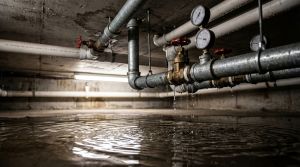 “The key is rapid detection and response. The sooner you can respond to a 10-litre per minute water leak, the greater the potential savings. Asset and risk managers are always trying to navigate risk and minimize their exposure,” Le Conte emphasizes. “Early leak detection gives them that advantage.”
Transitioning a building to smart water monitoring no longer requires invasive plumbing overhauls or complex IT networks. Modern systems rely on non-invasive, clamp-on flow sensors paired with cloud-based cellular communication. Once installed, pattern-recognition algorithms evaluate flow data on a minute-by-minute basis. By analyzing usage curves, the system establishes a baseline pattern for normal building operations, expected operational surges, then flags anomalies.
For sensitive environments such as data centres, medical facilities, vacant units, or facilities dependent on septic capacity, continuous remote monitoring is paired with point-of-use sensors and automatic shut-off valves, helping prevent further losses.
Because every property carries distinct operational demands, Le Conte stresses there’s no one-size-fits-all approach when it comes to water management. However, data analysis helps narrow the focus and guides strategy.
“We use data points to help people manage their water footprint. We’re talking about millions of litres of water across a portfolio,” he says.
Connecting the drops
Although water scarcity isn’t currently an issue in Ontario, growing demand on infrastructure and its impact on water sources is concerning. In 2026, Metro Vancouver saw Stage 2 water restrictions implemented partially due to strain on infrastructure and construction on the Stanley Park Water Supply Tunnel. In Calgary, a Stage 4 outdoor water restriction was issued, driven by critical repairs to the Bearspaw south water feeder main and infrastructure maintenance. Residential water rates in Calgary are now forecast to increase by 74 per cent in the next 4 years after city council voted in favour of a hike to water rates. In the same period, business rates will see an increase of 86 per cent.
Increasingly, water management is intersecting with corporate sustainability goals and carbon reduction strategies. Because significant electrical energy is required to treat and pump municipal drinking water, every litre of water saved directly reduces carbon emissions.
“There is an embedded carbon cost in our drinking water because of the cost to pump and treat that water,” Le Conte observes.
The financial payback for deploying water intelligence hardware is often less than two years — sometimes, much faster.
Even still, hardware and software alone cannot deliver long-term savings without continuous operational support. SMART Watering Systems structures its service model around three distinct pillars: Measure, Manage, and Monitor.
The company’s monitoring capabilities ensure continuous sensor coverage and deployment of dedicated human analysts who review portfolio data. By tracking water intensity (consumption per square foot) against benchmark properties and auditing operational response times to alerts, the monitoring team ensures that water intelligence persists long after initial equipment installation.
“We can’t guarantee you a 24-month ROI, but at some stage in the life of a real estate asset, there will be a problem with water. Technology can help you minimize that loss.”
Chris Le Conte is the founder and president of SMART Watering Systems. To learn how leak detection sensors and flow monitoring can protect your properties, contact SMART Watering Systems today at 888.444.1530 or by visiting www.smartwateringsystems.ca.