Articles Archive - Page 91 of 928 - REMINET
REMI

Two Marriott hotel brands break ground

Developer Paul Y. Construction (B.C) Ltd. has broken ground on a new 30-storey tower  in downtown Vancouver, which will bring together two Marriott International brands: Moxy Hotels and Element by Westin.

Set to open in summer 2028, the dual-branded hotel at 848–850 Seymour Street will offer guests a choice between Moxy’s bold, social energy and Element’s relaxed, residential-inspired comfort.

“We’re proud to collaborate with Marriott to bring this bold, dual-branded vision to life in downtown Vancouver,” said Gary Tso, managing director, Paul Y. Construction (B.C) Ltd. “Moxy and Element deliver distinct experiences, but together, they form one cohesive destination. One skyline. Two hotels. Connected by Marriott.”

On the ground floor and podium level, Moxy Hotels will feature its signature Bar Moxy lobby bar that doubles as the check-in area, a lively social lounge, and a hidden speakeasy bar offering an exclusive late-night escape. Higher up, Element by Westin will cater to longer stays with a mix of studios and suites, fully equipped kitchenettes, and a focus on wellness and sustainability. There is a sky lobby lounge and open-air rooftop retreat, designed as a calm oasis above the city.

“This exciting project marks an exciting milestone in Marriott’s growth across Western Canada,” says Duncan Chiu, vice-president, Lodging Development – Western Canada, Marriott International. “Pairing Moxy and Element in one urban tower reflects the evolving needs of today’s traveller — whether in town for a quick night out or an extended stay. It’s a unique blend of playful design and purposeful hospitality in the heart of the city.”

Designed by architectural firm Perkins&Will, the 390 thoughtfully designed rooms, vibrant street-level activation, and a strong focus on guest experience reflects a bold statement about the next generation of hospitality in the city.


Construction begins on SFU student residence

Construction has begun on a new eight-storey student residence at Simon Fraser University (SFU) in Burnaby. The new residence will provide an additional 445 beds for students at the Burnaby campus. It will include a mix of studio and four-bedroom apartments, as well as two- and four-bedroom townhouses.

“A safe and secure place to live and conveniently located child care can be transformative for students and parents working or studying on campus,” said Minister of Infrastructure Bowinn Ma. “These new facilities will provide shorter commute times, allow students to focus on their studies and help ease pressure on the local rental market.  Projects like this are one way we are investing in infrastructure that supports people in B.C.”

Construction is also expected to start in fall 2025 on a stand-alone child care centre, which will add 160 new child care spaces to more than 410 existing spaces in the Burnaby campus and at SFU’s Sapperton location. With these new spaces, more than 570 child care spaces will provide support to the SFU community.

Once complete, the residence will bring the total number of student beds on the SFU Burnaby campus to more than 3,000.

Construction is expected to be completed on the student-housing residence and child care facility in fall 2027. The total capital cost of the project is $196.6 million, shared between the province and SFU.

This project is Phase 3 of SFU’s ongoing student-housing expansion. Phases 1 and 2 added a combined 856 new beds for students, with funding for Phase 2 provided by the province.

“I look forward to continued growth of SFU’s resident student community on Burnaby Mountain and to continued partnership with the provincial government as we move forward. The post-secondary sector is united in our efforts to support British Columbians in tackling shared challenges, from housing to health care and beyond, as we make a difference for students and for communities across B.C.,” said Joy Johnson, president, Simon Fraser University.


CCA launches new Gold Seal portal and directory

The Canadian Construction Association (CCA) has launched a new online portal and directory for current and future Gold Seal Certified industry professionals.

The directory allows employers and industry partners to verify and identify accredited professionals across Canada, supporting the program’s credibility and visibility.

“This portal and directory have been a very important project for our Gold Seal team over the last year as part of our ongoing commitment to digitize first,” said Rodrigue Gilbert, president of the CCA.

CCA’s Gold Seal Certification is a nationally recognized standard of excellence for construction management professionals. Earned through industry experience, education, and examination, Gold Seal Certification enhances professional development, improves job mobility, and demonstrates skills, competence, and experience. 

“In our industry, we have to keep raising the bar – and that is exactly what our Gold Seal Certified workers and Gold Seal Employers do each and every day,” added Gilbert. “We will continue to make it easier for construction professionals to become Gold Seal Certified and encourage them to continue leading with the highest standard of excellence so our industry can continue to build a stronger Canada.”

Employees who enroll and complete Gold Seal Certification take pride in their work and expertise. Programs like Gold Seal help to not only ensure confidence in the industry, but to set a standard to which new workers can model during the early stages of their career.


Algorithmic rent-setting under scrutiny

In recent years, apartment owners and property managers have increasingly relied on algorithmic platforms to set rental prices across their portfolios, drawing the ire of critics who say the practice facilitates price-fixing. A proposed class-action lawsuit in Canada, launched in December 2024, alleges that more than a dozen landlords conspired to artificially inflate rents using the YieldStar rent recommendation software. Although it’s still early in the litigation process, the plaintiffs are seeking financial compensation for tenants who may have overpaid rent dating back as far as 2009.

The scrutiny around algorithmic rent-setting here in Canada coincides with similar activity in the U.S., where nine states and the U.S. Department of Justice recently filed a lawsuit against RealPage Inc., the Texas-based company responsible for YieldStar. The litigants allege that several large U.S. landlords have been using the platform’s algorithm to artificially keep rents high and share potentially private, sensitive information. On May 6, 2025, Colorado lawmakers passed a bill banning landlords from using AI platforms to set rent prices, claiming the practice cost renters in Denver an additional $136 per month in 2023; several U.S. cities, including San Francisco, Philadelphia, Minneapolis, and Berkeley, have also banned algorithmic rent-setting tools.

Joe Hoffer, Partner at Cohen Highley LLP, suggests that landlords found guilty of unlawfully using the AI rent-setting software in Canada may face more severe consequences than their U.S. counterparts given the “activist nature” of Canadian courts.

“There will likely be more tolerance in the U.S. for the use of AI and algorithms in pricing rent than here in Canada,” he said. “However, it should be recognized that landlords and property managers have always used a basic appraisal methodology to determine market rents, including surveying rental rates at comparable buildings. It would be difficult to argue that the use of AI itself for determining rents should be illegal; rather, it is the subscription to a platform where confidential rent information is exchanged that is most likely to produce an adverse outcome for landlords.”

In February, the Competition Bureau of Canada announced it had commenced an investigation into the potential unlawful use of AI-driven pricing algorithms to manipulate rental markets. As of yet, no legal action has been taken but officials have promised to act if they find evidence of anti-competitive behaviour.

“Protecting competition in the real estate industry is a priority for the Bureau, and we are committed to taking appropriate action whenever we find evidence of conduct that contravenes the Competition Act,” said Geneviève Chassé, Communications Advisor, Public Affairs and Outreach Directorate, Competition Bureau. “I can confirm that the Bureau’s investigation into algorithmic pricing in the Canadian real estate rental market is ongoing. The Bureau must conduct a thorough and complete examination of the facts regarding any issue before reaching any conclusion as to whether the Competition Act has been contravened. While the Bureau endeavours to complete its investigations as expeditiously as possible, it would be inappropriate to speculate as to when the Bureau will reach any conclusion.”

Reportedly, several prominent Canadian property managers identified in the lawsuit  have since discontinued using the AI-tool, or in some cases, instructed their third-party property managers to return to more traditional methods. The list includes GWL Realty Advisers, Tricon Residential, Choice Property Real Estate, CAPREIT, and Dream Unlimited among others.

The polarizing benefits of AI

The controversy surrounding Artificial Intelligence—and rent-setting algorithms in particular—highlights the growing intersection between technology and real estate. While AI-driven pricing tools offer numerous advantages for rental property owners, drawing from vast amounts of data to advise on pricing strategies, concerns about fairness and competition have put them under major scrutiny. Critics argue that when multiple landlords in a market use the same software, the algorithms can lead to artificially inflated rents, thereby diminishing competition. Allegedly, some platforms such as YieldStar use proprietary data from landlords and property managers to coordinate pricing decisions, resulting in a form of “algorithmic collusion.”

As the legal storm continues, Hoffer advises Canadian apartment owners to stay informed about the latest developments in both Canada and the U.S.

“If the lawsuits succeed, landlords who have used algorithmic pricing tools could face financial penalties and be required to compensate tenants for overpaid rent,” he said. “Additionally, regulatory changes could restrict or ban the use of AI-driven rent-setting platforms in the future.”

Lastly, he recommends that landlords review their pricing strategies to ensure they comply with competition laws; they may also want to consult legal experts and monitor updates from the Competition Bureau while navigating this evolving landscape.

Addendum (May 27, 2025): Underscoring Hoffer’s point about potential for lenience in U.S. compared to Canada, the Wall Street Journal reports that a provision in the House Republicans’ Mega Tax Bill aims to block state and local regulation of AI and automated systems for 10 years. If passed, the bill wouldn’t stop the class-action suits against RealPage for antitrust and consumer-protection violations; however, it would offer RealPage legal relief by halting efforts to ban algorithmic pricing systems for the next decade.

Study delves into inequities of aging in place

A new study at McGill University is spotlighting the social factors that influence whether older adults are able to remain in their homes and communities.

“The main takeaway from our research is that aging in place is not equally accessible to everyone,” said Amélie Quesnel-Vallée, the senior author on the paper and the Inaugural Chair and Professor in the Department of Equity, Ethics and Policy and the Canada Research Chair in Policies and Health Inequalities. “What we wanted to do was highlight the fact that there’s an enormous potential for inequity even here in Canada, despite the existence of universal health care.”

Researchers found that people with higher levels of education are less likely to age in place.

“This is surprising because higher education is usually linked with having more resources, which could support aging in place,” said Clara Bolster-Foucault, a PhD candidate in the Department of Epidemiology, Biostatistics, and Occupational Health at McGill University who is the first author of the study, published in Age and Ageing.

“This could be because of how education influences family structure, as people with more education tend to have children later in life and have fewer children as a result,” Bolster-Foucault said. “All these factors make it less likely for people with more education to receive care if they need support to age in place. People with more education also tend to live longer and may need more care in later life.”

Researchers examined data from higher-income countries and looked at 55 studies that focused on aging populations in North America, Europe, Australia and the United Kingdom.

They found that those with greater socio-economic resources and/or stronger social connections were more likely than others to age in place.

People living in rural areas, as well those who were members of racial or ethnic minorities or who were immigrants were also more likely than urbanites, non-minorities and non-immigrants to age in the community. This could be due to lack of access to long-term care, stronger community ties and/or cultural values that prioritize family caregiving, the researchers suggested.

The study aims to inform the development of policies, programs and services to help ensure that all older adults can remain in their homes and communities for as long as they wish and are able, the researchers said.

Next steps will be to look at social inequities in aging in place in Quebec, by examining disparities in admissions to residential long-term care facilities as well as potentially avoidable hospitalizations and emergency-department use.

The study: “Social inequity in ageing in place among older adults in Organisation for Economic Cooperation and Development countries: a mixed studies systematic review” by Clara Bolster-Foucault et al was published in Age and Ageing.

New tax twist for affordable rental housing

The prospect of two different property tax rates applying on the same multifamily building looms for the 2026 tax year in Ontario. The newly released 2025 provincial budget signals the pending introduction of an optional property tax subclass that would allow municipalities to reduce the property tax rate on qualifying affordable rental units by up to 35 per cent.

“Eligible properties could be either existing or newly built and would be required to meet the definition of affordable rental units in the Development Charges Act, 1997,” the budget document states.

Thus far, there are few other details, but the Development Charges Act defines affordable rents as no more than 30 per cent of income for residents at the 60th percentile of all renter households’ gross annual income within a given municipality. In private rental accommodations, those might be units that are reserved for low-income tenants through an agreement with social agencies, or they might be units that have not turned over in several years, with allowable annual increases still pegged to tenants’ initial rent.

The announcement follows hints in the Ontario government’s 2024 fall economic statement, which identified a new optional property tax for affordable rental housing as one of three priorities emerging from an ongoing review of the property tax and assessment system. Advocates for the rental housing industry commend the initiative.

“Lower property taxes on affordable rental units will mean more affordable living for families across Ontario. This will make a difference in keeping down the cost of living, which is something everyone can support,” maintains Tony Irwin, president and chief executive officer of the Federation of Rental-housing Providers of Ontario (FRPO). “FRPO supports the proposed optional property tax subclass contained in the Ontario Budget.”

Property tax rates are applied on the assessed value of multifamily buildings, which the Municipal Property Assessment Corporation (MPAC) determines based on factors such as overall rental income and operating expenses. It would presumably be up to municipalities to determine which units qualify as affordable and how to apply the discount.

“There are still unknowns on implementation, but this does address existing affordable housing where most other programs have focused on newly developed units,” observes Ryan Fagan, principal and the lead on complex property tax with the consulting firm, Ryan ULC. “There are existing programs in Toronto and Vancouver that fully exempt affordable housing, but it is not uniform across all units and not found in the majority of municipalities across Ontario.”

This would be the third optional property tax subclass the Ontario government has created in recent years. The small business subclass, introduced for the 2022 tax year, allows an up to 35 per cent discount on the commercial property tax rate for ratepayers who meet criteria that adopting municipalities specify. The subclass for new multifamily rental development, authorized in a 2024 regulation, allows municipalities to set the tax rate on new multifamily rental developments, with seven or more units, as much as 35 per cent lower than the residential property tax rate for a period of up to 35 years.

Several Ontario municipalities have now enacted the small business subclass, while Toronto, Mississauga and York Region (encompassing municipalities at the northern end of the Greater Toronto Area), are among the earliest adopters of the optional subclass for new multifamily rental developments. Toronto will convey a 15 per cent property tax reduction to new multifamily rental, which is on par with the 15 per cent discount that ratepayers in its small business subclass receive. Mississauga and York Region have opted to aim for the full 35 per cent reduction, but have built in flexibility for Councils to adjust that during annual budget deliberations.

Regardless, the municipalities won’t be collecting or foregoing any revenue from specified landlords for awhile. Under provincial rules, the subclass comes into force for building permits issued after a municipality has passed a bylaw to adopt it. No eligible buildings have yet been built and occupied.

The Ontario government has also addressed two other priorities for assessment reform — related to student housing and demand for improved access to MPAC’s trove of information — highlighted in the 2024 fall economic statement.

An amendment to the Assessment Act to clarify that land that accommodates university-operated student housing is exempt from property taxation even if it is located separately from that university’s main campus, was passed as part of the Budget Measures Act (Bill 216) in November. The new budget bill (Bill 24) includes proposed amendments to allow MPAC to convey notices electronically to consenting property owners, and to set up a framework for how municipalities, school boards and roads and local services boards can use assessment information for operational planning or other research.

The budget document does not indicate when a province-wide property reassessment may occur, but does highlight two more initiatives in progress.

“Potential tools are being evaluated to help municipalities manage their assessment base,” it reports. “Work is also underway with MPAC on plans to enable them to provide centralized online access to assessment roll information rather than requiring on-site viewing in municipal offices.”

Saskatoon approves multi-unit organics program

Saskatoon City Council approved the implementation of a city-wide organics collection program for multi-unit residential properties.

The move builds on the curbside green cart program for single-family homes.

A yearlong pilot study explored the most effective ways to provide organics diversion to multi-unit residential properties including apartments, condos and townhouse complexes. A report to the May 6, 2025 meeting of the standing policy committee on environment, utilities and corporate services provided a detailed analysis of the options available to the city.

Engagement with pilot participants, including residents, property managers and condo boards, showed a preference for a city-led organics program. It is also projected to be the most cost efficient when compared to current market alternatives. Organic material gathered through the program would be handled at the city’s organic processing facility, which begins construction this July.

The city-wide program is aiming to be fully operational in 2028.

Plans for new Campbellford Memorial Hospital

The Ontario government is planning to redevelop Campbellford Memorial Hospital on a new site. Construction will create more capacity in Trent Hills and across Northumberland, Peterborough and Hastings Counties.

The facility will expand programs and services to meet the needs of the growing community. Some of these include a modernized emergency department and new inpatient medical wing, enhanced infection prevention and control measures, and more inpatient capacity.

As a next step, the ministry of health is working with Campbellford Memorial Hospital to complete early planning for this project, including determining bed numbers and square footage.

“The approval of this planning grant represents a once in a generation opportunity,” said Jeff Hohenkerk, the hospital’s president and CEO. “We are not just building a new hospital, we’re building a modern, rural integrated health care campus to support both current and future patients throughout our region for decades to come.”


Single-family rentals outpace multifamily growth

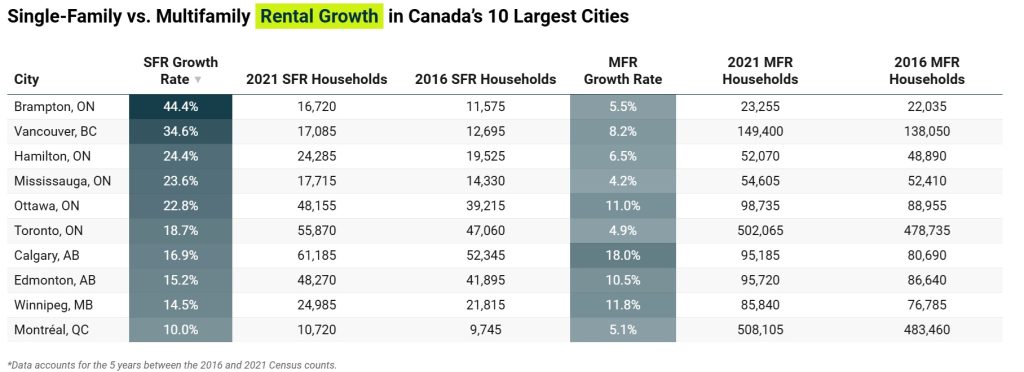
Canada’s rental housing landscape is shifting, with single-family rental (SFR) households growing at a faster rate than multifamily rentals. According to new research from Pointe2Homes, SFR households increased by nearly 15 per cent nationwide, surpassing the 9.4 per cent growth seen in multifamily rentals.

Comparing data from Statistics Canada in 2016 and 2021, analysts for the study speculate that the rise in SFR occupancy was driven by affordability challenges, rising mortgage costs, and shifting lifestyle preferences. Many Canadians are opting for rental homes that offer more space and flexibility without the commitment of homeownership.

The study also notes solo renters are playing a significant role in this shift, with one-person households in single-family rentals increasing by 19.6 per cent, nearly double the growth rate of solo apartment renters.

“The historical trend in Canada has been that people want to form independent households,” said Dr. Nathanael Lauster, associate professor of sociology at the University of British Columbia. “But when housing is scarce and expensive, they adapt by living in ways they wouldn’t otherwise choose.”

Ontario and Québec are leading the charge, with eight Ontario cities and two Québec cities experiencing over 50 per cent growth in SFR households. Markham, Mirabel, and Richmond Hill have seen the largest increases, with Markham’s SFR households surging by nearly 70 per cent. Even major urban centres like Toronto, Ottawa, and Calgary recorded significant gains, each adding over 8,800 new single-family renter households.

The study highlights that newly constructed homes are increasingly being rented rather than purchased. For instance, 55.1 per cent of homes built in Montréal between 2016 and 2021 were rented by 2021, with Toronto and Vancouver following closely at over 42 per cent.

For the full results and methodology, visit: Canada’s Growth in Single-Family Renter Households Outpaces Multifamily


Status certificates 101

One of the most important documents in a condo transaction is the status certificate—and its price may be set for a sharp increase. The Association of Condominium Managers of Ontario has formally asked the Minister of Public and Business Service Delivery and Procurement to raise the fee to $500. Since the cap has remained at $100 since 2001, this 400% jump might seem extreme at first glance, but when broken down as a 7% compounded annual increase, it appears more reasonable—though still well above inflation. Do the condo boards and managers that prepare them deserve such an increase?

This package provides a snapshot of the condominium corporation’s financial health, the status of any legal matters, and lifestyle restrictions. Preparation requires multiple data sources to be consulted, and errors can lead to liability, so there is certainly justification for a material increase in price. And it has real value for buyers; a careful review can identify potential issues, save a buyer from unexpected expenses, or even encourage them to walk away – so long as it wasn’t an unconditional offer.

Here are the key sections of a status certificate, what to watch for, and the risks of not paying close attention.

What Is a Status Certificate?

A status certificate is a set of documents provided by the condominium corporation’s board or management that offers detailed insight into the operations and overall condition of the corporation. It covers aspects such as financial status, building insurance, management practices, and legal issues, giving a true picture of what is being purchased—not just the physical unit, but the entire community’s health. In Ontario, the package typically includes several important documents; however, there are additional items a potential buyer should request to gain a complete understanding, and which should likely become part of the package if a significant increase in price goes forward:

Meeting minutes: In many provinces, sellers are required to provide 12 to 24 months of meeting minutes. These minutes offer valuable insights into the community’s ongoing issues, such as security concerns, elevator maintenance, or leak problems, which may not be fully detailed in the standard package.

Reserve fund study: The status certificate includes a financial summary, but it is wise to request the full report. Updated at least every three years by an engineer, the complete reserve fund study reveals the health and long-term plan for major repairs and replacements.

Key Sections of the Status Certificate

Unit Information and Common Expenses: This section outlines the specifics of the unit, including legal descriptions, additional components like parking spaces or storage lockers, and the common interest share. It also details the current monthly condo fees and any arrears owed by the seller. It is important to verify what is included in the purchase and to assess if any outstanding balances or unusually high fees could signal financial mismanagement.

Financial Information: Financial health is central to understanding the viability of the condominium corporation. This section includes the budget, financial statements, reserve fund balance, and any details regarding condo fees and special assessments. A well-funded reserve fund indicates that the condo is prepared for future repairs and maintenance. Conversely, rising fees or a history of special assessments might suggest upcoming major projects or financial instability, potentially increasing costs after purchase.

Legal Matters and Litigation: Here, the status certificate reveals any pending or ongoing litigation, as well as unresolved insurance claims or liabilities. Active legal disputes can be a red flag for mismanagement, while unresolved insurance issues may lead to significant future costs. Reviewing this section is essential to avoid inheriting legal challenges that could affect both the investment and the condominium corporation’s stability.

Governance and Board Practices: Good governance is key to a well-managed condo community. Frequent changes in management or board disputes might indicate internal issues that could affect policy consistency and decision-making. It could also be an indicator of deadlock over major projects. Look for transparency in meeting minutes and clear, proactive communication from the board, as these are indicators of a healthy governance structure.

Bylaws, Rules, and Restrictions: The bylaws and rules govern the day-to-day living in the condominium. They cover everything from renovation guidelines and pet policies to other restrictions that might affect one’s lifestyle. It is important to ensure that these rules align with the buyer’s own needs and plans. For example, if anticipating renovating, renting out the unit, or keeping pets, the buyer should confirm that these activities are permitted under the current bylaws. Overly restrictive or unusual rules could limit enjoyment or future use of the property.

Physical Condition and Maintenance Issues: Details of upcoming capital projects are vital considerations, as high expenditures in the near future could reflect the condition of common areas and the overall community.

Pending major repairs could lead to additional special assessments or increased fees, while a history of regular maintenance suggests a proactive approach to property care. Understanding these details helps gauge future costs and assess the investment.

Other Red Flags to Consider

Additional factors to watch for include recent changes in the management company, which might be a sign of underlying issues, and rapid increases in reserve fund contributions. A switch in management can trigger a new engineering firm, potentially resulting in more critical assessments of the building’s condition and higher fees.

Similarly, a sudden spike in reserve fund contributions might indicate that the condominium is trying to catch-up on neglected repairs, which could mean higher costs for going forward. In this example, the reserve portion of condo fees increase by more than 60% in three years:

Year Percentage Increase in Recommended Annual Contribution
1 20%
2 18%
3 14%
4+ 3.7%

Based on the current level of reserve contributions, analysis indicates that more than 10% of Ontario condo corporations could require a special assessment over the next five years, amounting to roughly $10,000 per unit. However, because Ontario requires a plan for how much to contribute to the reserve fund each year, the more likely scenario will be rapid increases in reserve contributions for those communities with a much smaller percentage of special assessments.

Best Practices for Reviewing a Status Certificate

Engaging a real estate lawyer who specializes in status certificate reviews is highly recommended. Their expertise can help interpret the details and spot any potential red flags. Additionally, there are condo document review tools available that simplify the process, making it easier to understand the key elements. Regardless of the chosen method, potential owners should take time to read the document thoroughly, ask questions about any unclear points, and compare the findings with their personal needs and long-term goals.

A Critical Tool

The status certificate is more than a doorstop—it is a critical tool that provides deep insights into the financial, legal, and operational aspects of a condominium. Carefully reviewing each section helps make well-informed decisions and protects from unforeseen liabilities. Investing in professional advice and taking the time to understand this document not only safeguards the financial investment but also ensures that a new home aligns with lifestyle and future plans.

Do boards and managers deserve to be compensated for preparing this document and assuming liability? Absolutely. The real question is how much—and whether attaching meeting minutes and the full reserve fund study should become the standard rather than the exception.

Thomas Beattie is CEO of OctoAI Technologies, a condo intelligence company that provides reports and data to buyers, owners, property managers, Realtors and businesses that serve condo communities. The company has delivered over 25,000 Eli Reports since 2020, helping thousands of people understand what matters about their property, and recently launched the Annual Benchmark Report to help owners save money. Thomas is a CFA Charterholder, an entrepreneur and former investment banker. Contact him at [email protected]



Performance audits: what new condo board members need to know

When condo owners join the board of a newly registered condominium project, they’ll often face a lot of new processes and terminology that they’re not familiar with. One of the most significant is a performance audit.

The performance audit is a key part of the warranty on the common elements of a project, which the directors on the board will need to manage. The audit occurs in the first year after registration of the condo so it’s important that the condo board members learn as soon as possible about its purpose, what’s involved, and what role the board plays.

What is a Performance Audit?

A requirement under Section 44 of the Condominium Act, the performance audit is a comprehensive inspection of a project’s common elements to identify any construction deficiencies that need to be addressed, such as water penetration or fire safety issues.

The first-year performance audit must be conducted between six and ten months from the date of registration of the project, and the resulting report is then submitted to Tarion, the non-profit consumer protection organization that administers the Ontario new home warranty, before the end of the 11th month following registration.

The individual who conducts the performance audit for the condominium corporation is referred to as the performance auditor who must hold a certificate of authorization under the Professional Engineers Act or hold a certificate of practice under the Architects Act. It is up to the condominium corporation to hire and pay for the performance auditor.

What Happens During and After the Performance Audit?

During the performance audit, all major components of the building are reviewed, including, but not limited to, the foundation, parking garage, elevators and mechanical, electrical and fire protection systems.

On some condominiums, Tarion requires the builder to provide third-party reporting, referred to as the B19 Final Report. If this is required to be completed, the performance auditor will also review this documentation. Additionally, they will conduct a survey of unit owners to determine if there are any concerns that unit owners have that may relate to a deficiency in the common elements.

Along with the performance audit report, the performance auditor will submit a performance audit tracking summary (or PATS) to Tarion and the builder. The PATS, which lists all items identified in the performance audit, is a tool used to track the progress of repairs and allows communication to take place between the condo corporation and the builder; they both are expected to update the PATS every 90 days.

The builder will have an 18-month repair period from the first anniversary of the registration date of the condo project to repair or resolve all items listed on the PATS that are covered by the warranty.

Appointing a Designate and Using MyHome

Around the time the performance audit is submitted, the condominium corporation must select a “designate.” The designate is the individual (e.g., a board member, property manager or performance auditor) who will act as a point of contact between the corporation and Tarion. The designate is responsible for overseeing the resolution of warranty items, managing timelines, and making the required regular updates to the PATS.

The name of the designate must be communicated using the appointment of designate form. As soon as Tarion receives the form, the designate can use MyHome and CEPATS, digital tools that make managing the common elements warranty a lot easier.

For example, MyHome allows the designate to submit warranty forms, upload documents to support a warranty claim, and update the PATS. Email reminders are sent important warranty dates.

Additional Tips for Condo Boards

1. Review the declaration and description to have a clear understanding of unit and common element boundaries. Include unit questionnaires with the performance audit.

2. Keep track of warranty timelines. Know when a warranty claim can be submitted.

3. It’s important to keep the lines of communication open with your builder. Work with the builder to resolve the claim items. Update the performance audit tracking summary every 90 days.

4. Keep unit owners informed about concerns and repairs related to the condo’s common elements.

5. Maintain the condo building. Keep in mind that improper maintenance can affect warranty coverage on the common elements.

Condo boards with questions about performance audits, the common elements warranty or their responsibilities can visit Tarion to learn more or email [email protected].

Ryan Haley has worked at Tarion since 2008 and is the director of common elements. He works closely with vendors, builders, municipalities, consultants, and owners across Ontario to help ensure condominiums are constructed as required under warranty. Ryan graduated from George Brown College with a Diploma in Architectural Technology and has since obtained a Certificate in Building Science from the University of Toronto. He has been a member of the Building Science Association of Ontario (BSAO) and has held the designation of Building Science Specialist (BSS) since 2016

Stantec designing multiple AI data centres in Alberta

A data centre development company has embarked on a multi-year program to build AI data centres across five municipalities in Alberta to help meet capacity demand in the province. Beacon AI Centers, backed by Nadia Partners, has enlisted Stantec to oversee the project’s design and engineering.

Each of the six campuses will span hundreds of acres that include multiple facilities. The program is expected to generate thousands of construction jobs and about 1,200 permanent jobs.

Design and permitting began in 2024 and construction will commence this year.

“With our 70-year history in the province, we are proud to play a critical role in helping position Alberta as a leading global hub for data-driven AI innovation,” said Leonard Castro, Stantec’s executive vice president for buildings. “Our team will combine global expertise with regional knowledge to help Beacon realize their initial program and meet the growing capacity demand.”

The integrated team has been working on other such projects, ranging from cage deployments to full hyperscale data centre campuses, as well as other historic endeavours in the province.

“Beacon AI is redefining the data center development industry to meet the growing demands of the AI era,” said Josh Schertzer, CEO of Beacon AI Centers. “By working with exceptional partners like Stantec, we can deliver ambitious projects quickly, at the scope and scale hyperscaler demand requires.”


Ontario heeds logistics sector maintenance

Ontario is encouraging a state of good repair in the logistics sector with a temporary refundable tax credit for short-line railway operators. The newly released 2025 provincial budget forecasts a $23 million payout over the next three years for the rebate of up to $8,500 per track mile on qualifying maintenance and upgrade expenditures.

“Ontario’s short-line railways play an integral role in connecting shippers to national railway lines by providing critical ‘first and last mile’ service to rail customers. During this period of global economic uncertainty, the government is taking steps to protect businesses that rely on a unified rail network for transporting goods and raw materials to customers,” the budget document states.

Licensed railway operators will be eligible for a refund of 50 per cent of maintenance and improvement costs for track and related bridges and tunnels, including labour and supplies, undertaken between May 15, 2025 and Dec. 31, 2029. This will apply on both leased and owned property.

As well, investors in Ontario industrial facilities can now claim enhanced tax credits for construction and equipment costs. The 2025 budget increases the refund on eligible costs for building and outfitting manufacturing or processing facilities to a maximum of $3 million annually, and expands the pool of potential beneficiaries beyond Canadian-controlled private companies (CCPC).

The refundable tax credit was introduced in the 2023 Ontario budget to provide qualifying CCPCs with a 10 per cent rebate on up to $20 million of qualifying investment per taxation year. That could include capital costs for a building that accommodates manufacturing/processing or for machinery and equipment used for manufacturing/processing purposes.

This refund has now been increased to 15 per cent on up to $20 million of qualifying investment per year that comes into use between May 15, 2025 and Dec. 31, 2029. As well, a 15 per cent non-refundable tax credit has been introduced for foreign controlled companies with a fixed place of business in Ontario that invest in industrial facilities located in the province.

The latter also applies on qualifying expenditures between May 15, 2025 and Dec. 31, 2029, but comes with additional conditions to ensure that benefits stay in Ontario. Recipients would be required to repay either part or the total value of the credit if they sell qualifying assets, convert facilities to a non-industrial use and/or remove equipment or machinery from Ontario within five years of receiving the tax credit.

The enhanced credit is forecast to translate into $1.3 billion in support for claimants over three years. “In the wake of U.S. tariffs and the impacts they may have on Ontario’s manufacturing sector, this additional support would help increase the competitiveness and resilience of the sector, helping to protect and create good-paying manufacturing jobs,” the budget document states.

CMHC reports increased housing starts for April

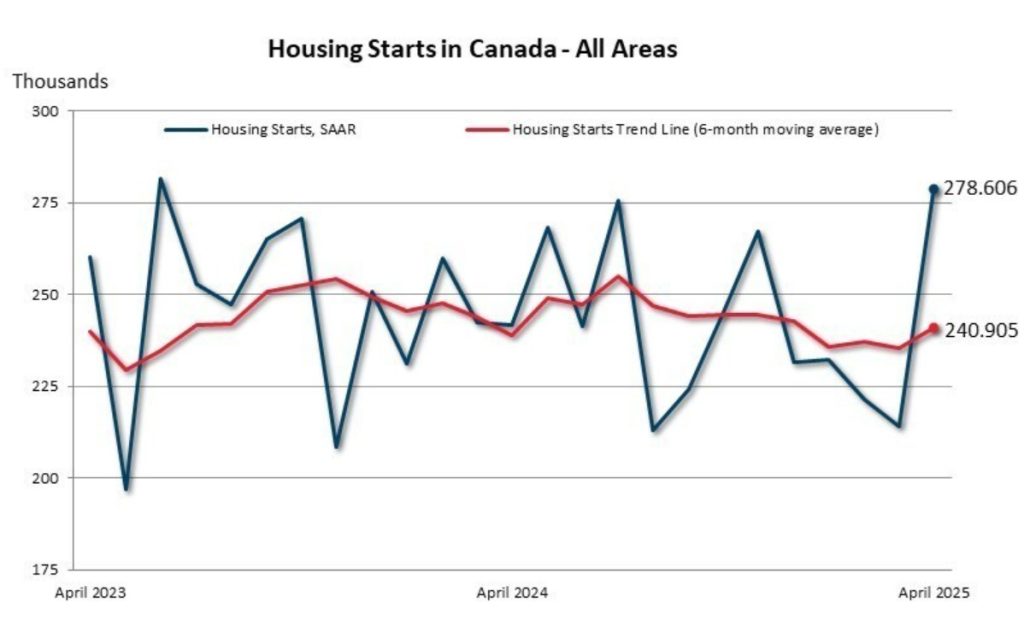
Canada Mortgage and Housing Corporation (CMHC) reported a notable rise in housing starts in April, marking a 2.4 per cent increase to 240,905 units. The trend measure, a six-month moving average, reflects heightened activity in Quebec and the Prairie provinces, while Ontario and British Columbia both saw declines.

“The increased starts activity in April was driven by increases across all housing types in Québec and the Prairie provinces, while starts in Ontario and British Columbia declined on a year-over-year basis again this month,” said Kevin Hughes, CMHC’s Deputy Chief Economist. The current economic uncertainty will have consequences for the supply and demand of new housing. CMHC will be monitoring these effects closely over the coming months.”

Key statistics include a 30 per cent monthly SAAR increase in April, amounting to 278,606 units. Actual housing starts in centres with populations above 10,000 reached 21,720 units, a 17 per cent year-over-year rise, setting a record for April.

Notably, Montreal experienced a 64 per cent increase in starts, driven by multi-unit projects, while Vancouver saw a 6 per cent rise. Conversely, Toronto reported a 25 per cent decline in housing starts compared to April 2024.

For more information on monthly housing starts in Canada visit: Monthly Housing Starts and Other Construction Data Tables | CMHC


Surrey approves secondary suites in townhouses

Surrey City Council approved bylaw changes to allow secondary suites in townhouses to boost family-friendly affordable housing. This will be permitted in areas zoned for new developments, within transit-oriented areas and places with frequent bus stops.

“With the housing crisis we are faced with, it makes good sense to permit secondary suites in townhouses,” said Mayor Brenda Locke. “The added benefits of these ‘lock-off suites’ are it gives homeowners a stream of revenue to help with the mortgage, increases affordable rental housing stock, and facilitates new rental units come to market quickly. It is also important to note that the changes are targeted at neighbourhoods that are accessible to frequent transit service in order to give residents a viable alternative to owning a car.”

Surrey’s zoning bylaw currently permits secondary suites in single-family dwellings, duplexes, and semi-detached residential buildings. This latest decision will allow lock-off suites in three different multi-unit residential zones: RM-15, RM-23, and RM-30.

Staff also recommended suites be a minimum of 323 square feet and occupy less than 40 per cent of the habitable floor area of the larger principal unit. Development cost charges and community amenity contributions will continue to be charged based on floor area, which would include the area of lock-off suites. Staff also recommend the updated bylaw applies only to new construction that has building permits issued after the approval of these proposed amendments.

“Staff are pleased to bring forward these amendments to our Zoning Bylaw to permit lock off suites in new townhouse developments that are well served by transit,” said Ron Gill, General Manager of Planning & Development.

“The proposed changes will provide developers constructing new townhouse projects in transit supported neighbourhoods the flexibility to include lock off suites as part of their townhouse project design,” said Ron Gill, general manager of planning and development. “These units will contribute to greater housing choice and affordability in our City. ”

Reimagining a traditional Calgary residence

What does it mean to design a residence without a specific client in mind, yet have every detail feel personal, lived-in, and intentional?

That was the challenge for Calgary-based studio Lush Interiors in their recent West Hillhurst renovation. Working in partnership with Katra Construction, the design team reimagined a traditional residence into a refined, functional space grounded in real-life needs, versatile enough to suit a wide range of lifestyles, and compelling enough to sell within 24 hours of hitting the market.

With no named end-user, the firm approached this project the way they always do, by imagining how the right family would want to live. What resulted was a home that feels intentional at every turn. 

“Even without a specific client, we designed with people in mind,” says Charlene Threatful, principal designer of Lush Interiors. “We asked ourselves: what would it mean to live beautifully here?”

The main floor centres around a large open kitchen and family room. Anchoring it all is a 12-foot Taj Mahal quartz island, sourced specifically to avoid seams. “It’s a small decision that carries big impact,” says Threatful. “It speaks to our belief that you can express luxury through one well-chosen moment, rather than layering on excess.”

Around this focal point, durable hardwood floors, considered sightlines, and multifunctional cabinetry reflect the firm’s signature approach: subtle, tailored, and lasting.

The home also includes a guest-ready main floor suite, a dedicated office with architectural mouldings, and a dining room featuring custom millwork and wallpaper that balances sophistication with warmth.

“These spaces feel complete, not staged,” says Threatful. “They’re designed to support connection.”

Upstairs, the second level offers a peaceful contrast to the active main floor. The primary suite includes a serene ensuite with added storage and elevated finishes, a walk-in closet, and proximity to an upstairs laundry room, which is an increasingly essential feature for modern families.

Children’s rooms were designed with flexibility and growth in mind, each one equipped with thoughtful walk-in closets and smart zones for study or relaxation.

What distinguishes the West Hillhurst renovation project is its polished practicality. Adapted existing architectural elements help to keep the design grounded – focusing on reimagining rather than replacing. The original fireplace was retained, modernized, and reframed to become a meaningful feature, reducing waste and reinforcing the firm’s commitment to sustainability.

Even with a defined footprint, the home flows intuitively. The natural and layered lighting plays a pivotal role in how each room adapts from task to rest.

“When design and construction are aligned early and consistently throughout the entire process, it shows”, says Tana Wheatcroft, founder and lead project manager of Katra Construction. “This project is a testament to that.”

The residence sold the day it went on the market. But more importantly, the feedback from buyers and agents echoed what Lush Interiors always aims to deliver: interior design that supports real life, feels intentional, and never overwhelms.

“We believe good design is always a smart investment,” adds Threatful. “You feel the difference from the moment you walk in the door.”


Photo Credit for West Hillhurst Renovation: KM Photography Interiors