Articles Archive - Page 83 of 928 - REMINET
REMI

CIB commits $50M towards retrofit projects

The Canada Infrastructure Bank (CIB) formed a $50-million partnership with Creative Energy to roll out retrofit projects focused on deep decarbonization through district energy systems.

The first building retrofit project under the partnership will be at Thompson Rivers University, upgrading 12 buildings and providing heating capacity to one new building across its Kamloops, British Columbia campus. The campus will transition from decentralized natural gas heating to a high-efficiency electrified heat source using a centralized air-source and water-source heat pump strategy.

The technology will reduce emissions from the heating systems in the connected building by 95 per cent, creating a more sustainable campus for students and moving the university very close to its 2030 zero carbon goal.

With buildings accounting for around 18 per cent of Canada’s total emissions, the CIB’s retrofit investments aim to enhance building sustainability while reducing energy consumption and associated capital costs.

“Sustainability is a core value at Thompson Rivers University, and our Low-Carbon District Energy System (LCDES) project marks our most ambitious effort yet to minimize our climate footprint,” said Dr. Brett Fairbairn, president and vice-chancellor, TRU. “With the invaluable support of CIB financing, institutions like TRU can undertake crucial initiatives fostering a greener future. The LCDES will function as an educational cornerstone, serving as a ‘living lab’ within the Sustainability Powerhouse to highlight cutting-edge energy technologies. This initiative not only promises a more sustainable campus but also invigorates sustainability initiatives that actively involve and benefit students.”

Deep retrofit supports climate and asset value

Residential and commercial tenants at Yellowknife’s Denendeh Manor can look forward to improved comfort once a pending deep retrofit enhances energy performance and ends the building’s reliance on heating oil. The work will be undertaken with a newly announced $2.3 million grant from the Indigenous leadership stream of the Canadian government’s Low Carbon Economy Fund.

“Every year, for the life of our building, this investment will eliminate our dependence on 30,000 litres of heating oil, reduce our carbon footprint by 85 tonnes of greenhouse gases and save us over $40,000 in energy costs for heat and electricity,” advises Darrell Beaulieu, chief executive officer of Denendeh Manor GP Ltd..

Denendeh Manor is wholly owned by Denendeh Investments Limited Partnership (DILP), the investment arm of Denendeh Development Corporation. The upgrades at the four-storey apartment buildings will include: a new wood pellet biomass heating system; a rooftop solar array coupled with sewage heat recovery to preheat hot water; energy-efficient windows and doors; fire-smart cladding; air sealing and insulation improvements; and LED lighting.

The Indigenous leadership fund has an allocation of up to $180 million for climate action projects and was co-developed with three national Indigenous organizations, First Nations, Inuit and Metis governments and Indigenous clean energy experts. To qualify, projects must be Indigenous owned and led, and deliver climate, social and economic outcomes that support self-determination.

“Whether it’s wildfires, rising temperatures or extreme weather, the North faces the harsh realities of climate change every day,” acknowledges Rebecca Alty, Canada’s Minister of Crown-Indigenous Relations.

Hospital coming to Kingston’s west end

Up to 95 acres of undeveloped municipal land in Kingston’s west end is being re-envisioned as the site of a future hospital. Kingston Health Sciences Centre (KHSC) has been developing plans for the new complex to meet current and long-term regional health care needs.

KHSC explored the possibility of redeveloping and expanding its current Kingston General and Hotel Dieu sites, but that option was not feasible, considering the region’s growing need for increasingly complex acute care services, and the structural obstacles on the existing sites.

“Kingston Health Sciences Centre has steadily grown since our 2017 integration,” stated David Pichora, president and CEO. We are fortunate to be able to provide more specialized and tertiary care services to the growing population of Kingston and Southeastern Ontario. Consequently, we have outgrown our current facilities – Canada’s two oldest hospitals, which are increasingly more expensive to maintain.”

The site is located in the Clogg’s Road Business Park Area near Highway 401. KHSC identified this site as a strategic location to provide easier and faster regional hospital access, as well as opportunities for future expansion.

KHSC is developing a master site plan for this property as directed by the Ministry. The timeline for construction is still unknown as development depends on the confirmation and timing of Ministry funding.

Community partners, including the City, are committed to working with KHSC to identify opportunities for services and businesses that could complement the future complex. The City is comprehensively reviewing long-term growth and land use city-wide through the official plan and integrated mobility plan, including the location of a new hospital on this identified site.

City staff will work on securing employment lands in other parts of the city to replace the inventory of land being committed for hospital development.


New Ontario grant targets accessibility projects

The Ontario government launched the Enhancing Access to Spaces for Everyone (EASE) Grant, which awards up to $60,000 for projects that improve accessibility and help older adults and people with disabilities participate in community life.

The overall funding amounts to $2.2 million. Municipalities, non-profit organizations and Indigenous governing bodies can apply for capital projects and retrofits. Examples include installing charging stations for mobility devices, installing mobility mats at beaches and building accessible washrooms at parks.

To protect seniors, the Ontario government is investing in a historic number of community programs and active living centres. This includes an additional $1 million designated for programs dedicated to improving the quality of life for senior veterans and expanding Seniors Active Living Centres to more than 400 sites to increase access to services that connect seniors to activities and programs close to home.

Eligible organizations have until August 14, 2025, to submit their applications at: Ontario.ca/GetFunding

Attracting attention to your cleaning company

Today’s businesses are not looking for a one-size-fits-all approach to cleaning; they value personalization and a commitment to shared goals. Priorities like ESG, technology, data-driven practices, and wellness are at the top of the list for many companies, and cleaners that address these priorities can differentiate themselves and get ahead.

Whether it’s because of flexible work hours, rising costs, or any number of reasons, business requirements have changed, and many companies are looking for cleaners that can tailor their services to suit their needs. Shifting your focus or promoting your company values may help commercial cleaners become more appealing to potential clients.

Sustainability

While many companies are focused on ESG goals and green cleaning, often they rely on the cleaning experts to execute their vision to lower their carbon footprint with more environmentally friendly products and practices. Using organic, low- or no-VOC products, along with chemical-free products can help companies achieve higher sustainability. Another way to increase sustainability is to examine water use and how specific tools, scheduling, and products can help lower water use.

But cleaning companies don’t have to stop there. If you want to connect with your customers, as well as move forward with your own ESG goals, you will need to stay informed, do your research, and strive to improve your own green initiatives. Do you have multiple crews? Looking at optimizing your fleet management to lower emissions with better scheduling or cleaner vehicles may be an option for your company. Explore all the ways, from your supply chain to your inventory management, that sustainability can be added to your business practices to connect with your customers and get greener.

Technology

Investing in technology like automation, robotics, or IoT can assure your customers that you are ahead of the curve, along with making valuable data accessible for responsible decision-making. Tools like robotic cleaners can mean that your labour is allocated where it’s best suited. Installing sensors allows your customers to track inventory and traffic patterns, so that labour and materials can be allocated best. Implementing online logbooks documenting the cleaning schedule means that your company is interested in efficient management and transparency. Many of today’s tools offer insight to businesses to help them streamline operations, increase efficiency, and reduce costs.

These tools are not always in the hands of the cleaners, but communicating with your customers can mean improved working conditions as well as better service going forward. Consider today’s technology as a way to improve your practices and better deliver on your customers’ expectations.

Employee health

Employee wellness, work-life balance, and safety are high on the list for many companies, and cleaners who lead by example are likely to attract like-minded customers.  Create schedules that work for your teams, offer training and incentives, and allow your teams to interact with your clients to be able to build those crucial customer relationships. These are all ways that your customers can see that you value your employees and their hard work, and that’s a way that you share your mission and can connect with your clients.

RELATED: Creating a positive company culture for cleaners

Focusing on sustainability and adopting technology are other ways to prioritize your employees by making their working conditions safer and by lessening the workload. This also shows a commitment to your employees, and when your employees are happy, they are their most productive. Studies show that on a scale of one to 10, each unit an employee feels happier equals 12 per cent more productivity, so culture can strongly affect your staff and their efforts. More productivity improves the customer experience, setting your company apart, and demonstrating your high standards to your clients.

Once upon a time, cleaning companies were unseen, working into the night while everyone else had left the office. But today, cleaners have the opportunity to connect with their customers with a shared vision and commitment to delivering the services they need. Better labour management, cutting-edge technology, greener practices, and happier employees can help cleaning companies offer the tailored services customers are looking for, while boosting the bottom line.

Waterloo unveils major affordable housing project

The City of Waterloo has officially transferred city-owned land at 2025 University Avenue East to Habitat for Humanity Waterloo Region and BUILD NOW, paving the way for one of the largest affordable housing developments in Canadian history. Backed by the federal government’s Housing Accelerator Fund, the project will deliver over 1,000 new homes that are affordable, attainable, and sustainable.

Mayor Dorothy McCabe hailed the initiative as a “once-in-a-generation, transformational project” that addresses the region’s housing crisis. “This is not just about buildings—it’s about partnerships, leadership, and reimagining how we create the housing people need,” she said. “It will deliver hope, stability, and a blueprint for others to follow.”

The development will feature a mix of ownership and rental units, with a 70/30 split favouring ownership. A strong emphasis will be placed on family-sized homes, including three- and four-bedroom units.

The site will be transformed into a vibrant “urban village,” designed as a complete, inclusive, and sustainable community. Plans include residential and mixed-use buildings, public transit-friendly roads, cycling infrastructure, parks, plazas, commercial spaces, and community gardens. Rental units will be managed by trusted non-profit and co-operative housing organizations.

Federal MP Bardish Chagger emphasized the importance of collaboration in making housing more accessible. “Through the Housing Accelerator Fund, we’re partnering with innovative cities like Waterloo to boost housing supply and strengthen communities,” she said.

Construction on the multi-sector collaboration is set to begin in early 2026, with phased occupancy expected by early to mid-2027. The project aims to support a diverse population, including families, seniors, and newcomers, while setting a national example for inclusive, community-focused housing.

UBC state-of-the-art Rec North opens

The University of British Columbia (UBC) has tripled indoor fitness and recreation space at its Vancouver campus with the opening of the new state-of-the-art Recreation Centre North (Rec North).

“Recreation Centre North is a vital addition to our campus and community,” said Ainsley Carry, Vice-President, Students. “It will serve as a space where students and the wider university community can prioritize both their physical and mental health while studying, living and working on the Vancouver campus.”

Construction began in 2022 to support UBC’s commitment to wellbeing by providing for the growing need for recreation fitness and gymnasium space.

The facility contains an indoor floor area of 101,000 square feet spread over four levels. It includes three gymnasium courts, an indoor run-roll-walk track, cardio and weightlifting areas, and multipurpose studio space. It also features the largest universal change facilities on campus.

Designed by SHAPE Architecture, Rec North is a LEED Gold-certified green building, adding to UBC’s list of 31 LEED Gold or higher standard buildings. Rec North is also Rick Hansen Foundation-certified, which recognizes accessibility.

Rec North is located immediately north of the UBC Life Building and at the west end of Student Union Boulevard at the centre of campus. The centre is integrated with the UBC Life Building, and includes an outdoor walkway corridor at ground level to allow foot traffic to readily flow through the area.

“Seeing this project completed is incredibly rewarding,” said Kavie Toor, managing director of UBC Athletics and Recreation. “We’re excited to see this space become the hub for health and wellbeing on campus.”


Dedicated floor care can help stop the spread of germs

Cleaning for safety and sanitization remains top priority for janitorial teams, as well as maintenance and facility managers. While restrooms, eating areas, and high-touch surfaces receive a lot of attention, floor care is vital in helping to keep employees safe and facilities germ-free. Studies show that there is an average of over 421,000 units of bacteria on the sole of a single shoe, and over 98 per cent of bacteria on bathroom floors was tracked in from outside. Germs collect on the floor and are spread throughout the facility without proper attention to sanitization.

RELATED: Are you disinfecting effectively?

Ensuring that your facility is as clean, hygienic, and safe as possible means staying vigilant with focused floor care:

  • Choose effective tools to clean for hygiene. For example, cotton mops typically move the germs across the surface area, whereas microfibre mops attract up to 99 per cent of dirt and bacteria, allowing you to trap the germs and stop them from being tracked throughout your building.
  • Similarly, using vacuums with HEPA filters can help improve air quality, making it harder for any airborne germs and bacteria to settle on the floors in the first place.
  • Cross-contamination can be a risk when cleaning multiple rooms, so consider implementing systems to designate products and tools to certain areas so that dirt and germs stay confined to a single space, rather than spreading throughout the building. For example, colour coding bathroom tools and products will help keep them from being used in the kitchen.
  • Consider installing matting outside and inside the front entrance to help trap dirt and debris before it travels from room to room.
  • Follow product instructions for best use. Use the correct products, with the correct dilution on the correct surfaces (as directed by the manufacturer) to ensure maximum performance for sanitization.
  • Staff training is also a crucial step in helping prevent the spread of germs. Misapplication or misuse of cleaning products and practices can increase the risk of cross-contamination and diminish your sanitization efforts.

Remaining vigilant with your floor care means keeping staff and visitors safe, while enforcing strict cleaning protocols, and maintaining a hygienic environment.

Ontario reorients electricity grid access

Data centre development that aligns with Ontario’s economic development priorities has been promised a preferential place in the queue to connect to the electricity grid. The recently released provincial energy plan sets out the new policy, which is coupled with proposed amendments to Ontario’s Electricity Act introduced shortly before the legislative assembly began its summer recess in mid-June.

As proposed, grid connection requests for new data centres and other designated energy-intensive loads made after June 3, 2025 would be subject to an approvals process that considers both the merits of the new venture and its likely impact on electricity capacity and other consumers in the vicinity. This would replace the existing automatic approval for applicants that has each new candidate joining at the back of the line.

“As we experience increasing energy demands — not only from our energy-intensive industries, but also from the pressures of attracting new investment to the province — we have to ensure we are taking action to prioritize projects that create good jobs and get these projects connected to the energy they need,” says Sam Oosterhoff, Ontario’s Associate Minister of Energy-Intensive Industries. “This policy will protect and promote data centres, while also protecting our ability to attract large manufacturing facilities to our province.”

Province-wide electricity demand is projected to increase by 75 per cent by 2050 to keep up with growth and the ongoing transition to electric vehicles, heating sources and industrial processes. Data centres are expected to be a significant chunk of that, accounting for 13 per cent of new electricity demand over the next ten years. Already, requests for grid connections to serve data centres currently in the development stage amount to 6,500 megawatts (MW) or the equivalent of the Bruce nuclear generating station’s output.

At the same time, economic development strategists are striving to capture soaring worldwide investment in data centres and the smart technologies they enable. Northern Ontario and rural communities are particularly identified in the new energy plan as areas where data centres would be welcome to potentially “anchor new high-tech ecosystems”, create jobs and diversify the economic base. The plan also places a priority on “domestic data hosting”.

The proposed legislation generally sets out the intent of the new approvals process, but leaves much of the details for still-to-be-developed regulations. The latter will establish the criteria for when the approvals process is required, the steps that must be taken and the entities that will be authorized to make the decisions.

“These measures will ensure we’re not just plugging in servers — we’re powering Canadian opportunity, protecting Canadian data and jobs, and making sure energy is used where it delivers real value to our country,” maintains Stephen Lecce, Ontario’s Minister of Energy and Mines.

IFMA names new global board of directors

The International Facility Management Association (IFMA) announced the member-elected executive committee and appointees to the global board of directors for the 2025-26 fiscal year (July 1, 2025 – June 30, 2026).

Christa Dodoo, CFM, FMP, CIWFM, CMQ-OE begins her term as board chair. She is joined by First Vice Chair Luis R. Viña and Second Vice Chair Wayne Whitzell, CFM, FMP, SFP, LEED AP, BEP, GBO, IFMA Fellow. Members of the executive committee serve one-year terms.

“A strong and compassionate leader, Christa will ensure IFMA remains both a dependable source of information and support, and a beacon to guide and inspire facility managers as they steer their organizations toward sustainable, resilient practices,” said IFMA President and CEO Michael V. Geary, CAE. “With years of experience managing multidisciplinary teams and global real estate portfolios, as well as speaking on FM and business trends around the world, she is devoted to elevating knowledge and opportunities for industry professionals.”

Based in Rome, Italy, Dodoo is chief of infrastructure and facilities at the United Nations World Food Programme.

“I am grateful to IFMA’s membership for entrusting me with the role of leading association strategies and encouraging innovation in support of FM’s essential work,” said Dodoo. “World events have a direct impact on our work. It’s more important than ever that FM professionals continue to rise, adapt and thrive, creating safe, inclusive, resilient and inspiring spaces for everyone.”

Returning board members Nick Heibein, MCR, FMP, SFP (Canada), and Bobby R. LaRon, MScM, CFM, FMP (USA), are joined by newly appointed board members Darin Rose, CFM, SFP, GGP, CRFP, IFMA Fellow (USA), Tariq Chauhan (UAE), Ted Cohen, CFM (Canada), Giselle Holder, PMP, CFM, FMP, SFP (Trinidad and Tobago) and Frank Ngoh, CFM, FMP, SFP, CFME Tier 1 (Singapore). These individuals bring a broad range of subject matter expertise to the organization, including emerging technologies, real estate and accommodations, change management, tactical execution, stakeholder management and client relations.

Outgoing Chair Lynn Baez, FMP, SFP, IFMA Fellow, will remain involved with the board as Immediate Past Chair. During her term, IFMA welcomed 10 countries to IFMA’s global map; hosted new events in Africa, the Middle East and Latin America; saw record-breaking numbers in education and credentialing, including 20,000 Facility Management Professional credential holders worldwide; launched IFMA’s FMJ as an open-source digital magazine; published 14 research and benchmarking reports; redesigned the Connected FM Podcast web page; introduced IFMA’s Mentor Match program; and reduced event-related carbon emissions year-over-year by 10 per cent.

“Christa is a highly accomplished, gifted and inspiring industry leader; and with Luis Viña as first vice chair, and Wayne Whitzell joining the executive committee as second vice chair, I’m certain that the next fiscal year will see even more innovation and engagement,” said Baez. “Thank you for a wonderful year – let’s keep the momentum going!”

Funding for construction opioid free pain clinics

The Government of B.C. is providing further funding to support two pain clinics in Burnaby and Langford that offer the construction industry with ongoing access to opioid-free pain-management options.

“People in the construction industry need specialized supports with mental-health and substance-use challenges,” said Minister of Health Josie Osborne. “By continuing to fund the Opioid-Free Pain Clinics by Construction Industry Rehabilitation Plan, we are expanding access to safer pain-treatment options that support recovery from injuries, reduce harm and improve overall well-being.”

In spring 2025, the Ministry of Health provided $160,000 to the Construction Industry Rehabilitation Plan (CIRP) for its Opioid-Free Pain Clinics, which provide pain-management options for construction workers and offer evidence-based approaches to pain relief without pharmacological interventions.

“The Opioid-Free Pain Clinic offers a groundbreaking solution to a serious problem facing construction workers, managing pain without the risk of opioid dependency,” said Vicky Waldron, executive director of the Construction Industry Rehabilitation Plan. “This innovative program is already delivering powerful results and we’re deeply grateful to the Ministry of Health for supporting a new path forward for workers who need effective, safe and long-term pain relief.”

This funding will support the continued operation of the two clinics that provide pain-relief services to people working in the construction industry. Services include myoActivation, an evidence-based trigger-point therapy approach, which focuses on needling therapy and counsellor-led self-management sessions.

The Burnaby clinic has been open to patients since 2020 and has supported more than 120 patients attending more than 1,500 appointments, with opioid-free pain-management options. Following its success, a second clinic in Langford was opened in fall 2024.


Eau Claire Plaza reopens with new public spaces

The revitalized Eau Claire Plaza, a signature public space in downtown Calgary, is now open.

The $47 million redesign is a key part of Calgary’s Downtown Strategy and will be a vibrant, all season public space for community gatherings, festivals and everyday connections. Honouring its past while looking ahead, the plaza offers a re-energized destination for Calgarians to gather, celebrate, and connect.

The City of Calgary engaged Dialog for the plaza’s revitalization, who led the project’s landscape architecture scope. Dialog coordinated with civil, structural, lighting, and cultural advisors to deliver a contemporary civic plaza rooted in place, memory, and public experience.

Located at the heart of Eau Claire, the updated plaza features flexible event space, a new misting water feature, and infrastructure to support year-round programming and events. The redesign is part of a broader effort to revitalize downtown and create a more livable and active city core.

“Eau Claire Plaza is a symbol of what’s possible when we invest in public spaces that put people first,” said Mayor Jyoti Gondek. “It’s a gathering place where festivals, performances, and everyday moments come together, inviting Calgarians and visitors to share in the true spirit of our city. This project strengthens our downtown and connects everyone to the vibrant heart of Calgary.”

The new plaza serves as a transition from downtown to the natural area of the Riverwalk, and was designed as a place to gather, a place to reflect, a place to connect, and a place to explore.

Design highlights include:

  • A civic canvas for gathering
    The restructured Podium Plaza creates space for festivals, performances, and passive use, framed by generous seating, flexible infrastructure, and wide circulation routes that support thousands of visitors throughout the year.
  • Fog as feature, comfort, and play
    A custom misting water feature activates the plaza with theatrical fog, inviting interaction while offering shade and cooling. Inspired by best-in-class fog systems, the feature supports thermal comfort and transforms the space with changing light and weather.
  • Everyday joy, year-round
    A bespoke Play Plaza, integrated Market Street, and a new urban beach offer layered experiences for all ages, drawing all Calgarians into the space, whether they’re commuting, playing, or pausing by the river.
  • Heritage and reconciliation
    The plaza preserves and repositions the original Olympic monument and rings, honouring the site’s legacy while making space for new stories. Early and ongoing Indigenous engagement helped shape the design principles, ensuring space for cultural presence and future programming.
  • Collaborative design
    From lighting to drainage, every element of the plaza was coordinated across disciplines to deliver a cohesive, buildable public realm that balances durability, comfort, and character.


Report examines growing rental supply shortfall

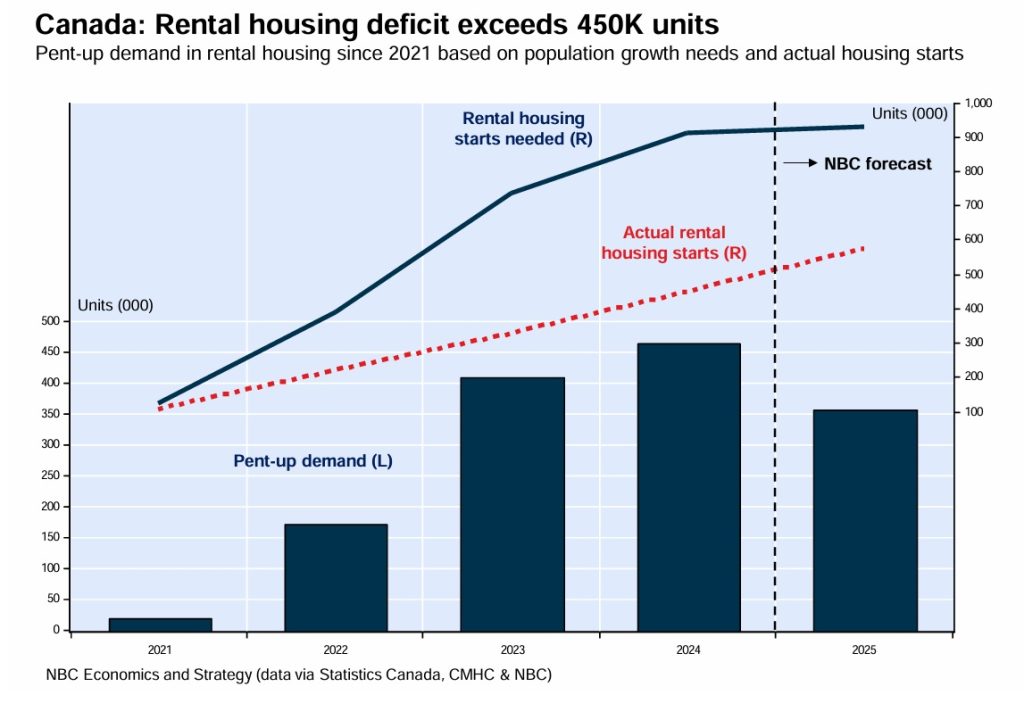
Canada’s rental housing market is facing a severe shortfall, according to a recent report by National Bank of Canada Financial Markets. The study, which analyzed 2021 census data alongside population growth trends, reveals that despite increased construction efforts by developers, the country is still falling behind rising demand.

In 2021, the rental housing gap was relatively modest—just a few thousand units. However, as immigration surged over the next three years, the demand for rental units skyrocketed. By the end of 2024, the rental shortfall had ballooned to over 450,000 units, even though Canada was adding more than 450,000 new rental units annually. The problem? Demand had outpaced supply, with total rental needs exceeding 900,000 units.

While construction of purpose-built rentals has accelerated, it hasn’t been enough to close the gap. The report emphasizes that even with this upward trajectory, the pace of building must remain high for years to come to catch up with demand, noting that zoning restrictions, labour shortages, and financing hurdles aren’t helping.

“Fortunately, faced with a supply problem that will certainly take years to resolve, the federal government has decided to tackle demand by drastically changing its immigration policy from 2025 to 2027,” analysts wrote. “Combined with a pace of construction that is expected to continue throughout the year, we estimate that the catch-up will begin as early as 2025.”

Looking ahead

National Bank forecasts that rental construction will continue to rise, driven by the persistent shortfall. However, even with scaled-back immigration and increased building, it warns that Canada’s rental market won’t reach equilibrium anytime soon. The mismatch between supply and demand has already pushed rents higher in major cities, and affordability remains a pressing concern.

In short, the report underscores the need for sustained investment, smarter urban planning, and innovative housing solutions to help push the rate of development.

Order of Canada appointees have CRE credentials

Two of the newest appointees to the Order of Canada are tied to the commercial real estate and development sectors. Governor General Mary Simon announced the honours for Chris Tambakis, chief executive officer of Adgar Canada, and Rod Senft, chairman of Tricor Pacific Capital, just ahead of Canada Day 2025.

They join 81 other meritorious Canadians to be recognized for exemplary contributions to their communities and the country. The Order of Canada is one of the highest national honours awarded to civilians and carries the motto DESIDERANTES MELIOREM PATRIAM, which translates to: They desire a better country.

“We proudly recognize each of these individuals whose dedication and passion for service not only enrich our communities but also help shape the fabric of our nation,” Governor General Simon affirms. “They inspire us to strive for greatness and to foster a future filled with hope and possibility.”

The citation accompanying Tambakis’ appointment commends him as “a recognized leader in Canadian commercial real estate” and “a passionate philanthropist and active volunteer” who applies his business acumen to support the economy and society. Adgar Canada is a Toronto-based real estate company with a portfolio of 27 office buildings encompassing approximately 3 million square feet of space. The company has a stated commitment to ESG and has been a longstanding backer of numerous public foundations, including CAMH, the North York General Hospital, the Heart & Stroke Foundation and the Canadian Cancer Society.

Tambakis is a graduate of the Ivey School of Business at Western University and a member of its advisory board. He also serves on the board of Heart & Stroke Canada, the Ontario Science Centre and the Toronto Santa Claus Parade.

“It’s great to see Chris recognized for his charitable and philanthropic efforts through this award,” says Michael Brooks, chief executive officer of the Real Property Association of Canada (REALPAC). “Chris is a well-liked and highly regarded member of the commercial real estate community in Canada, many of whom also give freely of their time to similar causes to make Canada a better place.”

The citation accompanying Senft’s appointment commends him as “a prominent Canadian business leader and philanthropist” who oversees a diverse portfolio of companies and supports health, education, arts and sports initiatives through the Senft Family Foundation. Tricor Pacific’s real estate related endeavours include Tricor Property Partners, which develops, owns and manages purpose-built industrial properties throughout North America, and Areva Living, a developer of condominium and purpose-built rental housing in the Greater Vancouver region.

Senft holds Bachelor of Commerce and Bachelor of Law degrees from the University of Manitoba, and has been a strong advocate for family businesses and entrepreneurship. That includes sponsorship of the annual Rod Senft Family Business Conference at University of Manitoba.

Ontario caps 2026 rent increase at 2.1%

The Ontario government has announced a 2.1 per cent cap on residential rent increases for 2026, a move it says will help protect tenants amid ongoing economic challenges and rising costs. The guideline, which is based on the province’s Consumer Price Index as calculated by Statistics Canada, represents the lowest rent cap in four years.

“Our government knows tariffs and economic uncertainty are creating challenges for many people in Ontario, including renters, which is why we are capping rent increases for 2026 at 2.1 per cent,” said Rob Flack, Minister of Municipal Affairs and Housing. “This cap demonstrates our commitment to protecting tenants across our province as we continue searching for ways to keep costs down.”

The 2.1 per cent cap on rent increases applies to approximately 1.4 million rental households covered by Ontario’s Residential Tenancies Act, including tenants living in rented houses, apartments, basement units and condos. Exceptions include units first occupied after November 15, 2018, vacant properties, community housing, long-term care homes, and commercial rentals.

Rent increases are not automatic; landlords must provide tenants with 90 days’ written notice using the official government form. Tenants in financial hardship are encouraged to reach out to local service managers to access available housing supports.

To learn more about the rules for increasing residential rents in Ontario, including guidelines and resolving issues about rent control, visit: Residential rent increases | ontario.ca

Canadian excellence earns international acclaim

Canadian excellence in commercial real estate management and leadership has again been called out on the international stage. The Canadian delegation is returning from the annual Building Owners and Managers Association (BOMA) International conference and expo, held in Boston this year, with five prestigious awards and additional honours for longstanding industry contributors.

Four Canadian buildings have secured 2025 BOMA International TOBY awards, representing the ultimate achievement in the three-step journey to identify the best performers in a range of categories. As well, Neil Lacheur, current chair of BOMA Canada and executive vice president, real estate management services, for Avison Young’s Canadian operations, is the inaugural recipient of BOMA International’s new Henry H. Chamberlain Award for Leadership.

The TOBY winners include:

  • Renfrew Business Centre, 2889 East 12th Avenue, Vancouver, in the category of office buildings of 100,000 to 249,999 square feet. The building is jointly owned by Renfrew Properties Ltd. and Alberta Investment Management Corporation (AIMco) and managed by Epic Investment Services;
  • Broadway Tech Centre, 2955 Virtual Way, Vancouver, in the low-rise suburban office park category. The building is owned by 2725312 Canada Inc. and Broadway Tech Centre Holdings Inc. and managed by QuadReal Property Group;
  • Northgate Village Shopping Centre, 3433 North Road, Burnaby, B.C., in the category of enclosed malls less than 1 million square feet. The centre is owned by 0813212 B.C. Ltd. and managed by GWL Realty Advisors; and
  • 1015 Lakeshore Boulevard East, Toronto, in the open air/strip mall category. The mall is owned and managed by CT Real Estate Investment Trust.

All four winners previously won 2024 BOMA Canada national awards and regional TOBYs from their home BOMA chapters.

BOMA International’s new leadership award is named in tribute to the associations longtime president and chief operating officer, who retired last year. The first recipient has a similar track record of commitment and industry accomplishments. In addition to his current BOMA Canada position, Lacheur is a past chair of BOMA Toronto and has served on numerous committees at the local and national level.

“BOMA International’s bestowing Neil Lacheur with the new Henry H. Chamberlain Award is a fitting tribute to a volunteer who has had outsize impact on BOMA and on our industry,” says Benjamin Shinewald, president and chief executive officer of BOMA Canada. “Neil’s winning of this Award also recognizes the growing partnership between BOMA International and BOMA Canada — something which Neil himself has championed.”

Erin White, general manager of BentallGreenOak’s office and industrial portfolio in the Edmonton region, was recognized as the Canadian regional member of the year. White is a BOMA Edmonton member and BOMA Canada’s 2024 recipient of the Randall Froebelius Member of the Year Award.

Anne Marie Guèvremont and Keith Major have joined the ranks of BOMA International life members. The designation honours individuals, now retired from the industry, who have played a significant role over the course of at least 20 years of BOMA membership. BOMA Canada likewise salutes the two honourees for their service and leadership.

“Anne Marie has made outstanding and sustained contributions to the commercial real estate industry, the community and to BOMA at the local, national, and international levels,” it reiterates. “As a long-serving and highly impactful volunteer with BOMA Toronto, BOMA Canada, and BOMA International, Keith has helped shape the direction of the organization and inspire others through his dedication.”

Inside the new vision for 250 Dundas West

Located at the northwest corner of Dundas and Simcoe within Toronto’s vibrant Grange Park neighbourhood, 250 Dundas Street West is anticipated to stand out as an exceptional mixed-use purpose-built rental tower. The site is a stone’s throw from prominent landmarks including City Hall, Nathan Phillips Square, the Art Gallery of Ontario (AGO), OCAD University, and the University of Toronto.

Arcadis, the design, engineering, and architectural firm behind the design of Dream Unlimited’s project, is optimistic the building will move forward soon following years meticulous planning. The project faced several setbacks since it was first proposed in 2018 due to delays caused by COVID, followed by a decline in demand for office space as hybrid work models gained traction. The original plan featured a significant office component, which has since been eliminated in favour of expanding residential and parkland.

“250 Dundas Street offers a unique blend of location, innovative design, and community integration,” says Aamer Shirazie, Associate Principal at Arcadis Canada. ‘The development is poised to elevate the residential landscape in one of Toronto’s most dynamic and cosmopolitan areas, placing rental density where it belongs, with immediate access to numerous transit options, including both St. Patrick TTC station and the Dundas Street streetcar line.”

Offering a mix of unit sizes, from studio to three bedrooms, the proposal also includes 34 affordable rental units, at-grade retail space fronting Dundas Street, and an 8,000-square-foot park that will comprise over 30 per cent of the site area.

Shirazie explains that 250 Dundas Street was envisioned to encourage long-term tenancies—hence a design that features unique spaces and characteristics that typically aren’t associated with apartment buildings.

“Purpose-built rentals naturally see more unit ‘churn’, or turnover, than condos,” he says. “Our goal is to minimize that turnover and attract long-term residents, which is better from a community growth and development perspective, as well as for operations.”

This is achieved in a few ways. For instance, architecturally Arcadis aims higher with elevated aesthetics, large hotel-style lobbies and curated amenity spaces to facilitate more connection between residents. According to Shirazie, purpose-built rental buildings also require more “functional design sensitivity” compared to condominiums, demanding additional considerations such as strategically located and visible leasing offices that can be accessed off a main street, larger service bays, and wider corridors built with more durable materials to respond to higher unit turnover rates.

“For these developments, we devote a great deal of time to understanding client and project needs to create units that maximise views and access to light while also responding to typical rental-specific requirements,” he says. “This includes increased storage and split bedrooms in multi-bedroom units.”

Low-carbon construction

As part of the company’s overriding sustainability efforts, Arcadis is focused on managing the amount of embodied energy required to construct buildings. It achieves this in a variety of ways:

1) by working closely with structural engineers to minimize the number of structural transfers used;

2) by working collaboratively with local sub-trades to better detail buildings to reduce material wastage through modularization;

and 3) where possible, by specifying high-performing locally sourced materials.

“Also, by designing buildings with low window-to-wall ratios and no balconies—or fewer, strategically located balconies—we can mitigate operational emissions and reduce energy usage tremendously,” he points out.  “We typically work closely with the consultant team to combine envelope design strategies with the use of energy-efficient mechanical systems and appliances in units, green roofs, bird-friendly glass, EV parking stalls and other details to create more sustainable buildings.”

As end-users increasingly prioritize sustainability, as do developers, Arcadis’ multifamily properties are integrating more energy-efficient systems and smart home technologies as standard features, including high-efficiency HVAC systems, LED lighting, smart metering, and renewable energy solutions like solar panels. From its transit-oriented  location, to design and a greener, more eco-conscious living environment, 250 Dundas aims to deliver it all.

For more information, visit www.arcadis.com/en-ca