Articles Archive - Page 664 of 929 - REMINET
REMI

GTA condo markets tighten in Q4

Condominium apartment sales in the Greater Toronto Area (GTA) climbed 22.3 per cent year-over-year to 6,831 in the fourth quarter of 2016, according to the Toronto Real Estate Board (TREB). Over that one-year period, new listings also fell by 13.4 per cent, causing market conditions to tighten substantially over the past year.

“Gone are the days when we were concerned about a potential glut in inventory in the condominium apartment market. The supply concerns that have been top-of-mind for ground-oriented home types are also now a reality for the condo market segment,” said Larry Cerqua, TREB president, in a press release. “Regardless of the price measure considered, heightened competition between condo buyers has resulted in double-digit price inflation.”

At the end of the fourth quarter, the MLS Home Price Index benchmark price for a condominium apartment was up by 15.2 per cent. The average condominium apartment selling price for the fourth quarter was up by 14.5 per cent to $437,281.

“First-time buyers represent an important component of home ownership demand,” added Jason Mercer, TREB’s director of market analysis. “Many households looking to purchase their first home will consider a condominium apartment. Interest in this market segment has continued to grow as prices for low-rise home types have increased on a sustained basis.”

The condominium apartment rental market also tightened in the fourth quarter of 2016. There were 5,717 condominium apartment rental transactions through TREB’s MLS System during the final three months of 2016, which is a 5.8 per cent decline compared to the same period in 2015. However, rental transactions were down because of a lack of units available for rent, not because of dwindling demand. The number of condominium apartments listed for rent during the fourth quarter of 2016 dropped by more than 14 per cent to 9,545.

“We have talked a lot over the past year about a lack of inventory for ownership housing. What is less well known is the fact that rental market conditions also tightened over the past year,” said Cerqua. “Competition between renters has increased, leading to very strong year-over-year growth in average rents.”

The average one-bedroom condo apartment rent was $1,776 at the end of 2016, which was an annual increase of 7.4 per cent compared to Q4-2015. Over the same period, the rent of a two-bedroom condo increased by eight per cent to $2,415.

“The demand for rental accommodation has increased in the GTA. The condominium apartment vacancy rate dropped markedly between 2015 and 2016. In many parts of the GTA, investor-owned condo apartments are the only option for renters looking for new, modern units in sought-after neighbourhoods,” added Mercer. “In the absence of more units coming available, expect above-inflation rent growth to continue.”

TREB report predicts another strong year for home sales

The Toronto Real Estate Board (TREB) recently released its annual Market Year in Review & Outlook Report at its Economic Summit, which was held at Toronto’s Parkview Manor on January 31.

The report provides a look into the future of the 2017 housing market and addresses current issues, including consumer intentions, foreign buying activity in the Greater Toronto Area (GTA), impact of transportation infrastructure on housing affordability, and the lack of housing supply.

“This report will be extremely useful to anyone with an interest in the housing market in the Greater Golden Horseshoe, including realtors and their clients, housing industry stakeholders, and all levels of government,” said Larry Cerqua, TREB president, in a press release.

TREB’s 2017 outlook indicates another strong year for home sales through its MLS System, with over 100,000 sales forecast for the third consecutive year. TREB estimates between 104,500 and 115,500 home sales will be completed this year, with a point forecast of 110,000, which is down slightly from 113,133 sales reported in 2016.

On behalf of TREB, Ipsos undertook a survey of home buyers in November 2016, focusing on consumer buying intentions in 2017. Compared to a similar survey conducted at the end of 2015, the number of potential buyers had dropped slightly. However, GTA households still had a positive outlook on ownership housing. This included first-time buyers, whose share of overall buying intentions climbed to 53 per cent from 49 per cent one year earlier.

“While changes to federal mortgage lending guidelines and higher borrowing costs may impact some would-be home buyers, the big impediment will be the lack of inventory,” said Jason Mercer, TREB’s director of market analysis. “Active listings at the end of December were at their lowest point since before the year 2000. It is unlikely that the shortage of listings will improve to any great degree over the course of the next year. This will put a ceiling on sales growth.”

Due to very strong demand for ownership housing up against a limited supply of listings in 2017, annual rates of price growth are expected to remain in the double digits for most home types across the GTA. The growth rate for the average selling price is expected to be between 10 and 16 per cent with an average price range between $800,000 and $850,000. TREB’s point forecast for the average selling price is $825,000.

Low-rise home types, including detached and semi-detached houses and townhomes, are predicted to experience the strongest annual rates of price growth, but the condominium apartment segment should remain tight as well.

The Ipsos home buyers survey confirmed that potential home buyers are expecting to see strong home price increases in 2017. However, Ipsos data also found that the average home buyer will make a sizable down payment: 27.6 per cent for all recent home buyers combined and 23.9 per cent for first-time home buyers. Those down payments were sourced in various ways, including savings within and outside an RRSP, gifts from friends or family and equity built up in their current home.

TREB also commissioned Ipsos to survey its members who acted on behalf of home buyers from November 2015 to November 2016 in an effort to shine light on foreign buying activity in the GTA. The survey found that only an estimated 4.9 per cent of GTA transactions, in which TREB members acted on behalf of a buyer, involved a foreign purchaser. Of those transactions, 40 per cent involved a foreign buyer purchasing a home as a primary residence, while 25 per cent purchased a home to rent out to tenants and 15 per cent purchased a home for another family member to live in.

TREB warns that an additional land transfer tax on foreign buyers could have unintentional consequences, including tighter market conditions and stronger price growth in neighbouring regions without a tax; less rental supply, because the number of investors looking to purchase and rent out a property may decline; and a potential negative impact on immigration.

“Housing affordability, and affordable home ownership in particular, is a growing concern. Home prices will increase well above the rate of inflation and income growth in 2017, as the supply of listings remains very constrained,” said TREB CEO John DiMichele. “While governments have been focusing their policy solutions on allaying demand, what is needed are policies that focus on the lack of available homes for sale and for rent. The public, private and not-for-profit sectors need to come together to focus on innovative solutions to the housing supply issue.”

In addition, TREB commissioned the Canadian Centre for Economic Analysis (CANCEA) to undertake a study on how improved transit infrastructure can impact housing affordability. In the case of the Metrolinx Regional Express Rail plan, the study found the impact on affordability is largely positive, especially if residents switch their method of commuting, taking advantage of the new infrastructure. However, improved transit in a region can also add price premiums of up to 12 per cent to a home’s value.

New B.C. landlord registry tool

A registry for landlords designed to professionalize the rental industry throughout B.C. is now available. The registry developed by LandlordBC will allow tenants to screen their potential landlords to ensure they are familiar with the basics of the Residential Tenancy Act – the guideline for rental agreements in B.C.

“It’s time that landlords start to treat the rental unit they manage like a business,” said David Hutniak, CEO LandlordBC. “This registry gives renters a tool to see if the person they are renting from has credibility and knowledge.”

More than 30 per cent of B.C. uses rental housing, about 550,000 units. Research shows currently that too many landlords don’t treat their rental property like a business leaving them open to having a tenant take legal action against them that costs money and time.

“This registry will raise the playing field for both landlords and tenants,” said Victoria landlord Derek Pinto. “If landlords understand the do’s and don’ts of landlording they will be better landlords. After completing ‘basic training’ with LandlordBC I feel more confident fulfilling my job description of providing the best service to my tenants while following the rules set out in the Residential Tenancy Act.”

Landlords throughout the province complete a two-hour online course which familiarizes them with the Residential Tenancy Act. Following the course work, landlords complete a test and once they achieve an 80 per cent grade they are registered and receive a ‘I Rent It Right’ certificate. Registered landlords will be part of a database renters can search when they are looking for a landlord. For landlords, the certification is a marketing tool – recognition of competency.

“This registry is good for both landlords and tenants because training like this puts balance in the rental market,” said Russ Godfrey, tenant advocate. “It will help tenants find a fair person to rent from and that is a step in the right direction.”

Participation in the Landlord Registry is available for $39 plus GST. The nominal fee is intended to remove a financial barrier to access the program and reinforces LandlordBC’s commitment to the Registry’s educational component.

With more than 3,300 members, LandlordBC is the largest professional rental housing industry association in the province. Visit: landlordregistry.ca

Condo boards can rely on business judgment rule

A recent Ontario Court of Appeal decision confirmed for the first time that the “business judgment rule” applies to decisions made by condominium boards. The business judgment rule “recognizes the autonomy and integrity of corporations, and the fact that directors and officers are in a far better position to make decisions affecting their corporations than a court reviewing a matter after the fact.”

In confirming that this rule applies to condominiums, the Court of Appeal set out the test for reviewing decisions made by condominium boards. The test is to confirm that the directors acted honestly and in good faith, and that the board acted reasonably in coming to its decision. But in determining whether a board acted reasonably, the question is not whether the reviewing court would have made the same decision, but rather whether the board’s decision falls on the spectrum of reasonable possibilities.

If a court concludes that the board did act reasonably (given the circumstances), honestly and in good faith, the court will defer to the board’s decision. In other words, where the test is met, it would be inappropriate for a court to interfere.

The landmark case

The precedent-setting case, Carleton Condominium Corporation No. 375 v. 3716724 Canada Inc., started with an owner’s request to make changes to the common elements. It then evolved into an oppression claim by that owner under Section 135 of the current Condominium Act (1998).

The owner possesses a number of commercial parking spaces located on the first level of the parking garage of CCC 375, which is a mixed-use condominium corporation. The commercial owner wanted to convert the use of the commercial parking spaces from monthly rentals to 24/7 pay-and-display use. This change in use required certain related changes to the common elements, which raised security concerns about the parking garage. In order to make the contemplated changes to the common elements, the commercial owner had to apply to the board for approval, pursuant to section 98 of the act.

As a condition of approving the contemplated common element changes, the board advised the owner that it required a full-time security guard to be hired at the owner’s expense. The owner refused, on the basis that this additional cost would render the parking operation less profitable. The owner instead commenced its court application, alleging that the board had acted oppressively, by favouring the security interests of the residential owners over the financial interests of the commercial owner.

The application judge agreed with the commercial owner, and found that the board had acted oppressively by requiring the commercial owner to hire a “prohibitively expensive” security guard. The application judge found that because there were cheaper security options available to the board, which would, in the judge’s opinion, adequately address the board’s security concerns, the board had acted improperly by insisting on a full-time security guard.

On appeal, CCC 375 took the position that its board had acted honestly and in good faith by requiring a full-time security guard, and that the board’s decision to require a full-time security guard was within the range of reasonable decisions in the circumstances. In overturning the application judge’s decision, the Court of Appeal agreed with CCC 375’s position, and in so doing the Court confirmed that decisions made by condominium boards must be given deference.

What it means

Prior to the CCC 375 case, there was little judicial direction as to the decision-making authority of condominium directors. In particular, it was unclear under what circumstances it would be appropriate for a Court to interfere with a board’s decision.

By confirming that the business judgment rule applies to condominiums, and by articulating the court’s test for reviewing condominium board decisions, the Court of Appeal has provided the condominium industry with much-needed guidance. The court clarified what requirements condominium boards must meet as they exercise their discretion under the act.

The Court’s decision in CCC 375 should give condominium directors some degree of confidence that as long as they act reasonably, honestly and in good faith, their decision will not be overturned.

The decision effectively confirms that dissatisfied unit owners cannot get a “second kick at the can” by bringing their grievance to court on grounds of alleged oppression. Provided the board has met the above-noted requirements, such applications will not be successful. This is particularly relevant today, as the number of claims of unfair treatment made by unit owners against their condominium boards are on the rise.

The CCC 375 decision is also important for all condominium residents because it ensures that their boards understand their decision-making obligations. In particular, it confirms that boards must give fair, reasoned, consideration to all relevant factors surrounding a decision, including competing interests within a specific condominium.

Christy Allen is a condominium lawyer with Davidson Houle Allen LLP, and represented CCC 375 in this matter, both at the Superior Court level and at the Court of Appeal.

GTA new homes market set new records in 2016

In the GTA new homes market, 2016 set new records for low inventory, high prices and high-rise condo sales, according to a report from the Building Industry and Land Development Association (BILD).

There were 29,186 new high-rise condominium units sold across the GTA in 2016, which is more than in any previous year on record and an increase of 30 per cent year-over-year, according to Altus Group’s 2017 GTA Flash Report, which provides a comprehensive look at the GTA’s real estate market based on 2016 Altus Group data. Sales were up in every region of the GTA, especially in Durham, where sales were more than double 2015 levels.

In 2016, there were a total of 47,161 new homes sold in the GTA, 62 per cent of which were high-rise units and 38 per cent (17,975 units) were low-rise homes. This number is up 12 per cent compared to 2015. The most homes ever sold in the GTA in one year was 53,660 units (72 per cent low-rise and 28 per cent high-rise), which occurred in 2002.

“The decline in low-rise sales in 2016 was due to the lack of product available to purchase, not softer demand,” said Patricia Arsenault, executive vice president of research consulting services at Altus Group, in a press release. “The fact that new product is being quickly absorbed, despite rising prices, shows there is continued buyer interest in purchasing new ground-oriented homes in the GTA.”

The number of new homes available in builders’ inventory across the GTA reached an unprecedented new low at the end of December 2016, while prices for all types of new homes in the GTA broke records. At the end of December 2016, there were 13,670 new homes available for purchase, which is less than half the number of homes available in builders’ inventories a decade ago.

New high-rise supply reached a 10-year low, dropping to 11,792 units last month. At the same time, low-rise supply was 1,878 homes, of which 742 were single-family detached homes. Ten years ago, the supply was much greater with 12,871 high-rise units available for purchase and 17,529 low-rise units (11,602 of which were single-family detached homes).

“We have a shortage of housing supply in the GTA that is approaching crisis levels,” said Brian Tuckey, BILD president and CEO. “Housing is selling as quickly as the industry can bring it to market and the lack of developable land that is serviced with infrastructure, excessive red tape, out-of-date zoning and NIMBYism are hindering our ability to bring more to the market.”

The lack of supply is forcing prices up everywhere, according to BILD. The average price of available new low-rise homes, which includes detached and semi-detached houses and townhomes, was $995,116 in December 2016, and for new single-family detached homes in the GTA, that price climbed to $1,264,604. The average price of new detached homes increased by more than $273,000 over the past year.

Prices for new high-rise homes also reached an all-time high last year. In December, the average price of condo units in the GTA sat at $507,128, up 12 per cent year-over-year. Ten years before, it was $321,353. The average size of a condominium unit in the GTA grew to 826 square feet last month, while the average price per square foot increased to $614. One year ago, the average price was $584 per square foot, while the size of an average suite was 775 square feet.

Investment property sales such as office, retail, industrial, hotel and rental apartment properties, as well as land sales, reached a total of $17.2 billion in 2016, up 12 per cent from one year before and a record for the sixth consecutive year. Residential land sales accounted for a record $5.7 billion of the total, up $640 million compared to 2015. Sales of rental apartment buildings dropped 29 per cent in 2016, the only investment asset class to post a decline in dollar volumes.

According to the 2017 GTA Flash Report, total investment property sales volumes were relatively equally split between the City of Toronto and the 905 regions. In addition, the number of foreign investors in the GTA seem to be declining, as only one in 10 renters living in condominium units reported the unit owner was located outside of Canada.

The report also stated that home buying intentions in the GTA showed no moderation despite tighter mortgage insurance rules introduced in late 2016. Brampton was the top municipality to purchase a new low-rise home in 2016, followed by Vaughan and Milton. In high-rise homes, the top three submarkets in 2016 were Downtown West, Downtown East and the Sheppard Corridor.

ACMO confirms condo residents eligible for hydro rebate

In September, the Association of Condominium Managers of Ontario (ACMO) advised its members of a Hydro Rebate program that would come into effect on January 1, 2017, but some questions remained surrounding the eligibility of residents to receive the rebate.

The issue of the Hydro Rebate began following a speech from Ontario Premier Kathleen Wynne in September that promised a reduction in the cost of electricity bills. According to the Premier’s speech, starting January 1, 2017, residences and small businesses would be able to take advantage of a rebate offer in an amount equal to the eight per cent provincial portion of the HST on their hydro bills.

At the time, some questions surrounded how condominium residents and corporations could track and claim the rebate. In response, ACMO consulted with the government to answer those questions. According to the association, condominium residents are eligible for the rebate, and the process by which the rebate is claimed is automatic and should be seamless.

“The rebate will automatically be applied to resident bills and your bill statements and there is no action needed on your part,” said Dean McCabe, a member of ACMO’s Board of Directors, in a press release. “Condominiums who use third party billing services and sub-metering providers should review your bills to ensure that the local electricity utility implements the provincial rebate by the July 1, 2017 deadline set by the Ontario Energy Board.”

Montreal ice making innovation captures award

Montreal ice making innovation has garnered industry recognition at a fitting time of year. Claude Dumas, an engineer with the city of Montreal’s Direction des stratégies et transactions immobilières, received honours at ASHRAE’s winter conference earlier this week for spearheading the conversion of 47 municipal skating/hockey rinks from hydrofluorocarbon (HCFC) to ammonia refrigerant.

The ongoing switchover, expected to be complete by 2020, earned him the Milton W. Garland Commemorative Award, recognizing innovation and/or new technologies for refrigeration in a non-comfort cooling application. The system design employed in the Montreal rink retrofits meets that criteria by operating with less ammonia and at reduced pressure compared to conventional ammonia-based refrigeration plants.

In a paper written for the International Institute of Ammonia Refrigeration last year, Dumas and his co-authors noted the city’s twin goals to phase out dependence on HCFC-22, which has global warming potential (GWP) 1,760 times greater than carbon dioxide, and maximize safety in handling ammonia, which has zero GWP and ozone depleting potential, but is highly toxic and mildly flammable.

The design process focused on refrigeration components that either use or collect large concentrations of ammonia and then explored other options. The resulting design incorporates ammonia-to-glycol heat exchange in place of an evaporative condenser and a u-tube separator in place of the conventional surge drum.

“The innovation in this project is the use of the an equilibrium vessel designed to simplify the refrigeration system, minimize refrigerant charge, minimize controls and avoid the need for a refrigerant operating level control and a high-pressure receiver,” the paper states. “Our focus was always to reduce the risks through prudent design and implementation aimed at minimizing the ammonia refrigeration charge, surpassing industry standards and never compromising safety and performance.”

The 2016 paper draws findings from the 14 ice rink conversions that were complete at that time. Another 11 are now underway. Montreal was also a participant in a 2013 techno-commercial comparative study of refrigeration systems for ice rinks, conducted at Natural Resources Canada’s CanmetENERGY research facility in Varennes, Quebec.

Edmonton Federal Building achieves LEED Gold

The Edmonton Federal Building (EFB), Parkade and Plaza project has achieved LEED Gold Certification under the Canada Green Building Council’s LEED Version 1.0 for New Construction. Designed by Kasian Architecture Interior Design and Planning Ltd., this project includes the extensive renovation and addition to the EFB and the construction of the Centennial Public Plaza.

The preservation of the existing heritage building has been one of the main design drivers for the project. The project has been dedicated to creating healthy, attractive, and contemporary office spaces for Government of Alberta officials by utilizing the challenging floor plates of the historic building.

The project also involves new public spaces to activate the plaza and serve building employees through the renovation of the main floor which includes a restaurant, café, gift shop, seating areas, visitor centre, and exhibition, theatre and gallery space.

The Government of Alberta has also committed to various LEED and sustainable practices and strategies throughout the project. Features include the living wall and water feature housed in the pavilion which is directly integrated into the mechanical system for the Federal Building, as well as modern heating and cooling systems, new energy efficient windows and excellent access to natural light throughout the upper floors.

Additionally, other sustainable strategies at the operation level include healthy workspace environments, green power, a green housekeeping plan and policy, educational outreach through electronic displays in public areas, and the protection of open space.

Together, these elements contribute to making the EFB an outstanding example of reuse and rejuvenation as it will have a profound impact on the functionality and cohesiveness of the Legislature compound as a whole.

GTA supply shortage limits 2016 multi-res sales

Avison Young released its fourth-quarter 2016 Real Estate Investment Review of the Greater Toronto Area, reporting that 2016 multi-res sales declined by 39 per cent. More broadly, the GTA saw office, industrial, retail, multi-residential and ICI land property sales decline by 12 per cent quarter-over-quarter to $2.8 billion, as the office and land sectors delivered lower sales volumes. However, propelled by marquee office sales that provided stand-out results in the second and third quarters of the year, GTA-wide sales increased 12 per cent year-over-year in 2016 to $11.8 billion – an all-time record-high result.

According to the report, foreign investor interest was prominent in 2016 and will endure in 2017, putting pressure on established domestic buyers, while demand will likely continue to outpace supply, keeping yields at historic lows.

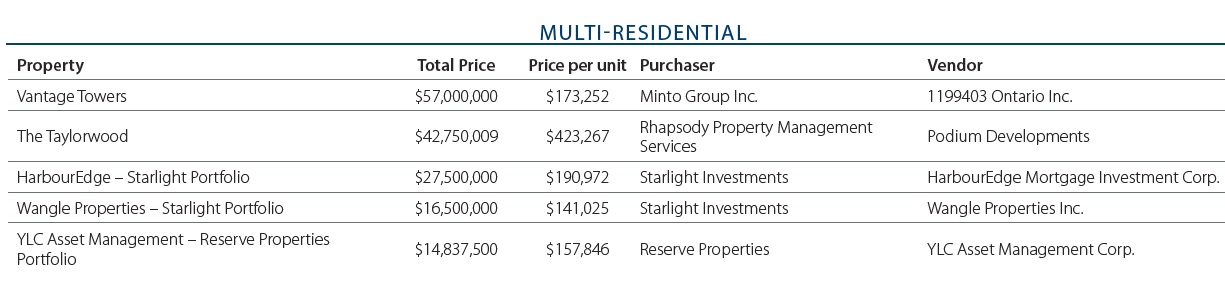
Commanding the lowest yields, multi-residential sales increased 93 per cent quarter-over-quarter to $290 million (10  per cent share). However, the annual total of nearly $1.2 billion represented a 39 per cent decline compared with 2015’s $1.9-billion high-water mark for the decade to date, as investors were held back by an inadequate supply of product. Nonetheless, the $57-million purchase of Vantage Towers (a 329-unit complex in North York) by Minto Group was the largest transaction of the quarter and year in this sector.

Top 2016 multi-res sales in the GTA included the following:

GTA multi-res sales


Green Hospital Scorecard results to roll out soon

The Canadian Coalition for Green Health Care (The Coalition) will soon compile data from the Green Hospital Scorecard, a benchmarking tool that measures a facility’s sustainable initiatives, such as energy and water conservation, and waste management, to name a few. Participants can then benchmark their hospital’s environmental performance against itself and its peers.

Ontario-based hospitals are currently filling out the survey ahead of the February 3 deadline. Results will be revealed in March.

The Coalition took over program administration from the Ontario Hospital Association. Since then, there have been some revisions and forecasted updates to the four-year-old survey.

Notably, while the program is only available for Ontario-based hospitals, it is now being piloted in every other province across Canada. The Coalition is hoping to take the program nationally in the next couple years.

At the moment, while the survey has been translated into French, this is still in pilot stage and available to those who request it. The survey will be fully available in complete bilingual form next year. Improved survey software has also been implemented.

Another key change is that the Coalition has developed a modified scoring system, the Green Hospital Scorecard Lite, to accommodate smaller hospitals and those in rural and northern regions where certain amenities may not be available. Under the modified scorecard, small, northern and rural hospitals will not be penalized if they do not have access to blue bin recycling.

About half the hospitals in Ontario have participated in the survey in the past and The Coalition is expecting that number to increase this year.

“There are a lot of really small initiatives around hospitals to reduce waste and pollution and often times we do not hear about them,” says Samantha Putos, who works with sustainable health care programs at The Coalition. “This is an opportunity for hospitals to be recognized for those achievements and also contribute to a larger database of resources for other hospitals.”

Besides understanding how a facility stacks up against its peers, facilities are eligible for a Green Health Cares Awards, which offers recognition.

“It’s also a really great way to recognize an opportunity for savings,” Putos adds. “If they see they are using more natural gas or more electricity relative to their peers, this is an opportunity for them to look at how they can bring down cost and be more environmentally friendly.”


Laurels for Canadian engineering programs

Students and faculty of Canadian engineering programs have been honoured at ASHRAE’s 2017 winter conference. Teams from the University of British Columbia and University of Regina were officially recognized for their first place efforts in last year’s student design and applied engineering challenges, while professors from Polytechnique Montréal and University of Saskatchewan were among 22 ASHRAE members worldwide to attain the grade of Fellow.

Michel Bernier and Carey Simonson — both professional engineers and professors of mechanical engineering — join the roster of ASHRAE Fellows who have gained distinction for the advancement of HVAC and refrigeration through research, professional service and mentoring.

Six UBC students contributed to the winning HVAC design calculations in the 2016 student design competition. Team members include Alexander Brosky, Samarth Joshi, Aubrey McNeill, Silvia Odaya, Cheng Yang and Ziran Yu, drawing on advice from faculty members, Nima Atabaki and Steven Rogak, and industry mentor, Ali Nazari of Integral Group. Teams from California State Polytechnic University and University of Central Florida received top honours in the competition’s other two categories, system selection and integrated sustainable building design.

A focus on sustainability issues in their own locale secured top standing in the 2015-2016 applied engineering challenge for Bradley Lulik, Eva Rennie and Brent Yeske of University of Regina. Their faculty advisor was Adisorn Aroonwilas.

The Canadian students and professors were acknowledged among 55 award recipients celebrated at the winter conference in Las Vegas, including winners of the 35th annual ASHRAE Technology Awards and six other awards for industry achievement.


Community Associations Institute forms Canadian chapter

Community Associations Institute (CAI), a non-profit organization that specializes in community association governance, education and management, has announced the introduction of a Canadian chapter headquartered in Toronto that will be known as CAI Canada.

One in eight households in Canada, especially those located in major urban centres such as Toronto, Montreal and Vancouver, are located in condominium communities. This number is expected to increase along with the number of Canadian condominium associations.

“Through this new chapter, community managers and homeowners, as well as business partners, will have access to unparalleled networking opportunities,” said Crystal Wallace, vice president of membership and chapter relations for CAI, in a press release. “And all CAI members receive invaluable access to educational resources, publications and industry events.”

For over 40 years, CAI has offered education and guidance for community association homeowners, volunteer board members, and businesses serving these communities in countries around the world. With the inauguration of CAI Canada, the local business community, government, university students, and others can benefit from CAI resources and training, including its education and credentialing programs. In addition, the CAI Canada chapter will provide its members with the opportunity to attend networking and social events.

“CAI Canada will work to promote industry best practices as well as foster collaboration among local professionals and with other CAI chapters,” said Denise Lash, new committee member of CAI Canada.

“This is one more step in establishing CAI as an international network of professional managers and community leaders,” said Thomas M. Skiba, CAI’s chief executive officer. “And in establishing this new chapter, CAI can provide community managers in Canada with access to industry credentials and professional designations that are recognized throughout the world.”

CAI Canada’s inaugural committee members include Denise Lash of Lash Condo Law; Shawn Pulver of Macdonald Sager Manis LLP; Yasmeen Nurmohamed of Royale Grande Property Management Ltd.; Vanessa Van Dette of Whitehill Residential; Roger Thompson of FirstService Residential; Michael LePage of Maple Ridge Community Management Ltd.; and Michael Kalisperas of Royale Grande Property Management Ltd.

CHBA pres to talk housing affordability with feds

Bob Finnigan, president of the Canadian Home Builders’ Association, or CHBA, heads to Ottawa this week to talk to the federal finance committee about housing affordability. Of particular concern for the group is one of the latest changes to mortgage rules, which expanded an existing stress test from a limited pool of prospective home buyers to all insured borrowers.

The stress test raises loan eligibility rules by requiring prospective home buyers to qualify for mortgages at a higher interest rate than what they will actually pay, as a way to gauge their ability to absorb interest-rate hikes. In some cases, the move disqualified prospective home buyers who qualified for mortgages under the old rules, said Finnigan, and it has adversely affected markets outside of active regions such as Toronto and Vancouver.

“People in Calgary and people in St. John’s saw their traffic stop or slow down substantially for new homes,” he said. “We’re hoping to have some input into hopefully regionalizing those amounts.”

Finnigan, who is also COO of Herity Group of Companies, represents 8,500 companies across the country that are involved in all aspects of residential construction as president of the CHBA. The federal government pressed ahead with the recent change to mortgage rules despite the opposition of the home builders, he said.

“It was tempered a little bit, but it’s definitely having an effect on the ability of young people getting into their first home,” said Finnigan.

In hot markets such as Toronto and Vancouver, average house prices have risen dramatically and disproportionately to median millennial incomes, according to a CHBA report. As planning policies have restricted land supply in certain regions, the shift from producing more low-rise homes to producing more high-rise homes has not been matched by a shift in consumer preferences, Finnigan said.

Consumers still overwhelmingly want low-rise homes, the CHBA has found, and the competition over their shrinking supply is believed to be a major factor in escalating prices. What’s more, demand for housing in popular urban centres such as Toronto is only going to grow, as roughly one-third of the 300,000 immigrants who arrive in Canada every year locate to the Golden Horseshoe, Finnigan said.

In these markets, where there may be the temptation to stretch budgets, the CHBA president allowed that there is room for rules to prevent prospective home buyers from taking on mortgages they can’t afford. But he pointed out that the debt-to-income ratio, 1.65, has remained fairly static and mortgage defaults are relatively rare at 0.3 per cent.

The CHBA is also advocating that the federal government bring back 30-year amortization rates for well-qualified first-time home buyers looking to purchase properties for less than $500,000.

Finnigan returns to Ottawa this week fresh off of an important win for home builders in the western provinces. The Canadian International Trade Tribunal recently issued a report calling for a temporary freeze and scaling back of drywall duties imposed on U.S. imports last September in response to an anti-dumping complaint. The federal government expedited the report at the urging of the CHBA, whose members mobilized within days of learning that duties would raise their drywall costs by two to three times what they were paying at the time.

“When they (the Canadian Border Services Agency) put up the tariff on drywall, they looked at the drywall industry,” explained Finnigan. “They didn’t look at the end users, or the home builder or buyer.”

Another recent gain for the Canadian home building industry was the federal government’s commitment in its 2016 infrastructure programs to fund up to 50 per cent of eligible projects. That’s an increase from the 33.3 per cent that lower levels of government had to match in the past. And lack of infrastructure has contributed to delays in the delivery of new homes, which has constrained the supply of low-rise homes further still, Finnigan noted.

“Theoretically, that should provide more cash, take a little bit of burden off municipalities and provinces and expedite that land,” he said. “Now we need to make sure the growth policy acknowledges that that money’s available and expedites projects.”

The suspicion that developers are simply sitting on pieces of land as housing prices increase is unfounded, the CHBA president added, because the business of building homes hinges on being able to turn over inventory. The longer a developer has a piece of land languishing on their books, the more it costs them, he said, and buyers eventually see those additional expenses reflected in their purchase prices.

Labour is one of the costs subject to increases, inching upward with inflation. This cost is also increasing due to shortages in the low-rise homes segment, which is losing skilled workers such as carpenters to the high-rise homes segment, Finnigan said. The CHBA is asking various levels of government for assistance in attracting replacements for the 125,000 skilled workers expected to retire in the next 10 years, for whom the industry will help set up apprentice and training programs.

Other issues on the CHBA’s radar include the national building code, which serves as a model for provincial buildings codes. Politicians musing about moving to net zero homes ahead of a 2031 deadline for making homes net zero ready have raised concerns for home builders, Finnigan said. There is a major distinction between making homes net zero and making homes net zero ready, he clarified, the former being more expensive, with additional costs for features such heat pumps and solar panels.

The CHBA’s position is that new homes are far more energy efficient than they once were, up 37 per cent from 1990 and 47 per cent from 1985, and that money invested in conservation strategies would be best spent on existing homes, where it generates greater energy savings. The home builders are recommending that the federal government make permanent the home renovation tax credit, using it to promote energy efficiency improvements in those existing homes.

As the industry prepares to produce net zero-ready homes on the current timeline, perhaps earlier, the CHBA would like to see new building code standards limited to safety and technology issues. All the small costs associated with each of those requirements add up, Finnigan said, which ultimately affects housing affordability. It will become cheaper to get to net zero as technology advances and gains traction, he predicted.

“We’ve got a crisis already in terms of housing prices,” he said. “Right now, to go to net zero would cost somewhere between $50,000 and $70,000 a house, which nobody can afford.”

Michelle Ervin is the editor CondoBusiness.

Design and construction skill shortages noted

Revit specialists and estimators have a commanding position in the labour market as the design professions actively embrace building information modelling (BIM) and the construction bid process grows more complex. Newly released survey results charting the demand for human resources in major Canadian markets and business sectors identify the two roles among highly sought expertise in the development industry.

Nearly 40 per cent of surveyed employers in the construction sector expect to hire more permanent staff in 2017. This follows a year when 48 per cent of them reported an increase in business from 2015.

Meanwhile, architecture firms generally anticipate a bounce-back from 2016 — when 36 per cent of surveyed employers suffered a decline in business — along with the need to augment staff. More than half indicate they will add permanent staff, while another 40 per cent may find their goal to retain their existing roster almost as challenging.

“There is a good deal of movement between companies, as some lose projects while others gain projects, and staff retention and turnover has come more into focus for many firms,” states analysis from Hays Canada, accompanying its annual survey results. “The more senior the architect, the harder it tends to be to attract them away from their current employer. Good technologists or architects proficient in Revit are highly sought after, and best efforts are made to retain successful employees.”

Construction employers are similarly facing an “experience gap” as a large cohort of skilled trades nears or reaches retirement.

“Competition is tight for experienced workers and managers,” the report notes. “The estimator shortage nationwide continues to be a challenge, especially since the bid process has become more complex and the construction models have changed with the introduction of P3 and other new models.”

Other occupations deemed to be in demand include: project managers; project architects; specification writers; civil construction workers; and multifamily and commercial construction professionals. Design and construction skill shortages also have flow-through impacts on the timing for staffing up projects.

Across the entire survey base, more than 50 per cent of employers now budget a two- to six-month timeline to fill a “candidate-short” position, while less challenging hires are typically accomplished in two weeks to a month. Specifically in the construction sector, 35 per cent of survey respondents reported it was “significantly to extremely difficult” to recruit top talent.

TREB against LTT increase for repeat home buyers

The Toronto Real Estate Board (TREB) has released a statement following the City of Toronto’s Budget Committee decision not to currently move forward with proposed Land Transfer Tax (LTT) increases for first-time home buyers. In the statement, TREB expressed encouragement at the decision, however it remains concerned about a proposal to increase the LTT by $750 for all other buyers, and is also calling for changes that will assist first-time buyers.

“The City’s Budget Committee has done the right thing by taking proposals to hike the Land Transfer Tax on first-time buyers off the table,” said Larry Cerqua, TREB president, in the statement. “TREB has been voicing its concern on these proposals since they were first announced late last year, and we are glad to see that City Hall is listening. We believe that Mayor Tory understands the importance of keeping Toronto affordable for everyone, especially first-time buyers, and we applaud his leadership in this regard.”

The City’s Budget Committee was initially considering the recommendation to increase the Land Transfer Tax by $475 for all first-time home buyers, and by as much as $4,475 for some first-time buyers. Staff also recommended increasing the LTT by $750 for repeat home buyers.

The Budget Committee decided not to move forward with any increases for first-time buyers by increasing the rebate from $3,725 to $4,475 to offset the $750 which other buyers will face. TREB has been voicing its concerns about the proposed increases and recently launched a campaign to bring about public awareness of the proposal, encouraging home buyers let Councillors know their opinions on the subject.

“We are glad that the Budget Committee has addressed some of the concerns that home buyers have with these proposals, but City Council needs to go further. A proposal to hike the Land Transfer Tax by $750, or seven per cent, for all repeat buyers is still on the table,” said Von Palmer, TREB chief communications and government affairs officer, in the statement. “City Hall’s take from this tax has increased by 200 per cent since 2008, from $3,725 to over $11,000 on an average priced property. Hasn’t City Hall already taken enough from home buyers?”

Although TREB is encouraged that the Budget Committee is not following through with the proposed increase for first-time buyers, TREB said in the statement that it believes City Council should go further by providing new relief for first-time home buyers. Currently, they are allowed a rebate of the LTT that is payable on a maximum purchase price of $400,000, which was the average price when this tax was implemented in 2008. The average price in 2016 was over $700,000, meaning first-time home buyers have lost significant ground on the rebate. The provincial government recently acknowledged this concern by doubling the provincial LTT rebate. TREB wants City Council to make similar adjustments to the City’s Land Transfer Tax rebate to account for climbing home prices.

“When the Land Transfer Tax was implemented, City Council put in place a rebate that essentially meant first-time buyers purchasing an average-priced home paid zero City Land Transfer Tax,” added Palmer. “Today, that purchaser would pay over $6,000 in Land Transfer Tax. City Council should follow the provincial government’s lead and give first-time buyers the relief that they deserve.”

GTA home prices have spillover effect in surrounding cities

Due to increasing home prices in the Greater Toronto Area (GTA), prices in surrounding urban centres, especially those within commuting distance, are also climbing, according to the latest Housing Market Insight from Canada Mortgage and Housing Corporation (CMHC).

Although most housing markets in Ontario have seen significant home price increases over the past two decades due to favourable economic conditions, more recently, CMHC detected moderate or elevated evidence of overvaluation in Hamilton and the GTA, suggesting home price increases in those regions are partly driven by other factors.

According to the report, home prices in the GTA have increased disproportionately compared to other Ontario CMAs (Census Metropolitan Areas). These prices are motivating buyers to purchase more affordable homes in nearby urban centres, causing prices to rise in those regions. Historically, house price spillovers from the GTA were seen in Hamilton, Barrie and Guelph.

“Our evidence supports that increasing single-family home prices in the GTA are persuading buyers to make purchases in nearby communities like Hamilton, Barrie and Guelph, where home prices are more affordable than within the city,” said Jean-Sébastien Michel, principal at CMHC’s Market Analysis Centre, in a press release. “In turn, this is driving up house prices in these neighbouring markets.”

The report finds that recently, home price spillovers have begun to occur farther away from the GTA, especially in St. Catharines-Niagara, driven by the price of low-rise homes in the GTA.

In order to further explain the spillover effect, CMHC’s report also considers the potential impact that a positive and negative shock to GTA home prices may have on nearby regions. While they are not predictions, these scenarios demonstrate that a rise or fall in GTA home prices in one quarter could leave to similar effects in nearby Hamilton within a year. The report states that in both cases, the impact would moderate over time and be less pronounced in other areas nearby.

National home price growth remains inflated: CMHC

Strong evidence of problematic housing market conditions on a national scale have been detected for the second quarter due to overvaluation and price acceleration in housing markets across the country, according to Canada Mortgage and Housing Corporation (CMHC). This is largely due to market conditions in Vancouver and Toronto where strong price growth has been spreading to neighbouring regions such as Victoria and Hamilton.

“We continue to detect strong evidence of problematic conditions in Canada,” said Bob Dugan, chief economist at CMHC, in a press release. “Price acceleration in Vancouver, Victoria, Toronto and Hamilton indicates that home price growth may be driven by speculation as it is outpacing what economic fundamentals like migration, employment and income can support. For this reason, home buyers should ensure that their purchases are aligned with their needs as well as the long-term market outlook.”

According to CMHC’s latest Housing Market Assessment (HMA), national home prices grew by seven per cent year-over-year at the end of the third quarter of 2016 after adjusting for inflation. However, Ontario’s impact on the growth was so high that if it were removed from the calculation, home prices would have remained flat through to the third quarter.

The HMA also found that overvaluation and overbuilding remain the most widespread problematic conditions impacting the housing market, affecting the 15 urban centres covered by the HMA. Of these 15 regions, overvaluation and overbuilding were detected in eight.

Evidence of problematic conditions has increased in Victoria since the last quarterly HMA due to moderate evidence of price acceleration and overvaluation. Meanwhile, in Calgary, evidence of problematic conditions has decreased since the previous report as some housing markets in oil-dependent urban centres are now rebalancing.

“As Calgary home prices have become more in-line with economic and demographic fundamentals, our overall assessment posted an improvement from strong to moderate evidence of problematic conditions,” said Richard Cho, CMHC market analyst in Calgary. “However, overbuilding is still a concern as Calgary’s rental apartment vacancy rate remains at an elevated level.”

Elsewhere, strong evidence of problematic conditions continues to impact housing markets in Vancouver, Toronto, Regina, Saskatoon and Hamilton. In Ottawa and Atlantic Canada, however, evidence of problematic conditions remains weak.