Articles Archive - Page 655 of 929 - REMINET
REMI

milliCare offers grants to CFM credential-seekers

Commercial floor and textile care expert milliCare is offering grants to professionals interested in attaining the Certified Facility Manager (CFM) credential from the International Facility Management Association (IFMA).

milliCare is committed to helping facility management (FM) industry professionals advance their careers by pledging to assist 13 individuals that meet the requirements to prepare for the CFM credential exam. This is the third year milliCare is offering this professional development program to the industry.

“milliCare has been working with IFMA and facilities managers on both the national and local levels for decades,” said Geoff Snavely, vice president and general manager for milliCare by EBC Carpet Services, a franchisee. “We are passionate about the idea of finding ways to help our customers – not only through the services that milliCare can provide, but also by providing resources that can drive career development with our key contacts.”

“Helping facility managers earn their CFM credential is a powerful way to support this critical community,” continued Snavely. “It feels great to work closely with the IFMA team in an effort to help advance the facilities management profession.”

The program brings professionals together for a relationship-building experience that includes a seat in a one-day CFM Exam Prep Workshop; a networking roundtable discussion and reception with peers and members of the milliCare franchise network; a tour of the Roger Milliken Centre; travel to and from Spartanburg, South Carolina; and lodging, airfare, all transfers and meals.

“Facility management credentials like the Certified Facility Manager are more valuable than ever, both for the individual FM professionals who hold them and for the organizations they serve,” said Tony Keane, IFMA’s president and CEO. “I congratulate milliCare for their forward-thinking investment in the development of a unified global FM industry and encourage FM professionals to take full advantage of this exciting opportunity to advance their own careers while better serving the men and women who occupy their facilities.”

To enroll for the 2017 grant program, send in your application by August 4. Honourees will be notified by September 6, with the event to be held from November 9 to 10. To be considered for a grant, candidates must complete the CFM application, in addition to a short online application for milliCare.

Ontario realtors support tax fairness bill

Ontario realtors recently launched a campaign in support of Bill 104, the Tax Fairness for Realtors Act, 2017. If passed, Bill 104 would allow realtors to form personal real estate corporations. The Ontario Real Estate Association (OREA) also launched a website, RealtorTaxFairness.ca, and is encouraging realtors to write to their MPP in support of the Tax Fairness for Realtors Act.

“Realtors are pillars of their communities and hard-working small business owners,” said Tim Hudak, CEO of the OREA, in a press release. “Personal real estate corporations will help them offer more services to clients, invest in new technology and create jobs in their community.”

A 2015 study by the Centre for Spatial Economics (C4SE) found that personal real estate corporations would provide a positive economic benefit for the province, creating between 33 and 89 net new jobs and contributing from $9 to $25 million to Ontario’s GDP annually.

At this time, realtors are not allowed to form personal real estate corporations due to a technicality in the Real Estate Business Brokers Act, 2002. Meanwhile, other regulated professions in Ontario, including accountants, lawyers, health professionals, mortgage brokers, insurance agents, architects and engineers can all form personal corporations. Ontario is also behind British Columbia, Alberta, Saskatchewan, Manitoba, Quebec and Nova Scotia, where realtors can form personal real estate corporations.

“OREA is working to make sure Ontario realtors are treated fairly,” said Ettore Cardarelli, president of OREA. “Most professions in Ontario have the ability to form personal corporations, but not realtors. This legislation is about giving realtors the same business rights as everybody else.”

The bill was reintroduced last week by PC MPP Todd Smith and was co-sponsored by NDP MPP Catherine Fife and Liberal MPP Mike Colle. Bill 104 will be voted on by the Legislature at second reading on March 23. OREA is coordinating a call for action to realtors to contact their local MPP prior to the vote. Realtors can contact their MPP through email by visiting RealtorTaxFairness.ca.

HDR|CEI Architecture promotes Mary Chow to associate VP

HDR | CEI Architecture Associates, Inc. has promoted architect Mary Chow to associate vice president.

mary-chow

Chow joined the firm in 2004 (then CEI Architecture), and has led the design of a variety of award-winning and successful projects throughout the Lower Mainland of B.C., with an emphasis on community recreation facilities, including community centres, and aquatics, ice and fitness facilities.

She was the lead architect of the Edmonds Community Centre and Fred Randall Pool in Burnaby, which was named 2015 Facility of the Year by the BC Recreation and Parks Association.

She also led the design of the City Centre Community Centre in Richmond, B.C.; Wedgewood Park Aquatic Centre in St. John’s, Newfoundland; NexSource Centre in Sylvan Lake, Alberta; the Oliver Woods Community Recreation Centre in Nanaimo, B.C.; and the Poirier Sport and Leisure Complex in Coquitlam, B.C.

“Mary is a talented architect, outstanding project manager, and inspiring leader at HDR | CEI Architecture,” says Mark Hentze, vice president at HDR | CEI.

“She has proven again and again her ability to lead projects of significance and size, helping bring outstanding facilities to communities throughout the province, and beyond. This promotion recognizes her talent and long-term dedication to the highest standards of design excellence and project delivery.”

A LEED Accredited architect, Chow has been invited to speak at various conferences and events on issues related to sports, recreation and community facility design. Topics included how the architectural process can use social media to engage communities to create facilities that accommodate local interests and priorities, and the future of recreational facilities.

In the past few years Chow has spoken at the Recreation Foundation of BC Conference in Harrison Hot Springs, the Athletic Business Conference in New Orleans, the IAKS (International Association for Sports and Leisure Facilities) Congress in Germany, and the TAFISA (The Association for International Sport for All) World Congress in The Netherlands.

Five Alberta parks to become accessible by summer

Five Alberta parks will be refurbished by this summer as part of a $3-million plan to create accessible experiences in 15 provincial parks by 2020. Alberta Parks will also create a barrier-free fishing experience at Castle Wildland Provincial Park in 2018.

The parks to be refurbished are Writing-on-Stone Provincial Park, Bow Valley Provincial Park – Mount Lorette Pond, Pigeon Lake Provincial Park, Sir Winston Churchill Provincial Park and Lesser Slave Lake Provincial Park.

Castle Wildland Provincial Park’s accessible fishing venue will feature a boardwalk around Bathing Lake. Over the next four years, more than $20 million will be spent on access routes, inclusion projects, camping, signage, picnic areas and hiking trails in the Castle parks.

“Being immersed in nature for a day or a week can be a life-changing experience for persons isolated by four walls,” said Ross Wein, president of Alberta Abilities Lodges Society, in a press release. “I commend Alberta Parks for breaking down barriers facing one in every 10 Albertans.”

The 15 accessibility projects will be called the Cecile Buhl One-Kilometre Experience, ensuring accessible access of at least one kilometre, as well as parking and accessible restrooms. Buhl was an educator and advocate for accessibility who volunteered on audits of Alberta provincial parks. She passed away in November 2016.

Alberta Parks continues to implement accessibility and inclusion as part of its “Everyone Belongs Outside” strategy. This year, the province will also begin construction on two additional replacement cabins at William Watson Lodge in Peter Lougheed Provincial Park, scheduled to open in 2018. The $2.8-million project comes following the completion of two other replacement cabins at the park, which supports seniors and people with mobility challenges.

Ontario contractors expect growth in 2017: survey

Ontario’s construction industry has a positive economic outlook for 2017 and confidence is up, according to the results of the Ontario Construction Secretariat (OCS)’s annual survey, the Construction Confidence Indicator. With a score of 60 out of 100, this year’s survey found that a majority of Ontario’s construction firms expect more business this year than in 2016.

“Increased construction activity is always a good sign for the overall economy and things are decidedly looking better for Ontario in 2017,” said Sean Strickland, CEO of the OCS, in a press release. “We’re seeing a couple of possible explanations for the boost in optimism like investments in major infrastructure projects across the province and an improved economy south of the border.”

According to regional data, Central Ontario had the highest confidence score of 62, followed by the GTA with a score of 61. Northern Ontario respondents had the lowest confidence rating in the province at 57, however optimism has still improved since 2016. Significant investment is being made at some of Northern Ontario’s post-secondary education facilities, including projects at Laurentian University, Canadore and Confederation College.

“Ontario’s economy beat the national average increase in real GDP growth in both 2015 and 2016 and we expect 2017 will mark the year Ontario was the fastest-growing province,” said Dawn Desjardins, deputy chief economist at RBC. “Fiscal stimulus and consumer spending will be key supports in 2017 and will likely lead business to pick up the pace of investment activity as the year progresses.”

The Construction Confidence Indicator analyzes growth expectations across five construction sectors: industrial, commercial, engineering/civil, institutional and high-rise residential. Results show that across the province in the non-residential sector, contractors expect to see the most growth in engineering/civil projects with 43 per cent of respondents expecting significant growth in 2017. Expectations for significant growth in this sector are highest in Eastern Ontario (57 per cent).

Contractors expect the high-rise residential sector to perform better in 2017. Across Ontario, 45 per cent of contractors expect significant growth in this sector. In Kitchener-Waterloo, 63 per cent of those surveyed anticipating significant growth, likely due to the construction of a new light-rail transit system in the region.

Despite the boost in overall confidence, almost half of the 500 contractors surveyed say they expect the Trump Presidency to have a negative effect on Ontario’s economy and the construction industry. This feeling was most common in Windsor-Sarnia, where 59 per cent of contractors believe President Trump’s government will negatively impact Ontario’s economy.

In Hamilton-Niagara, however, 40 per cent of firms say they expect the Trump Presidency will have a positive impact on the province’s economy, while 44 per cent predict negative effects. Three areas of concern include increased costs on construction materials, negative impact on the manufacturing industry and decreased investment in projects due to economic uncertainty.

Another subject of the Construction Confidence Indicator is employment trends. According to the survey, there has been an 11 per cent increase in apprenticeship employment in the unionized construction sector over the past two years, but in the non-unionized sector, there was only a three per cent increase over the last two years. Eighty-three per cent of unionized firms employ apprentices, while only 49 per cent of non-unionized firms do the same.

More information about the Construction Confidence Indicator can be found at http://iciconstruction.com/2016/11/03/state-of-the-industry-outlook-conference-2017/.

Saskatchewan moves to privatize janitorial services

Earlier this week, Saskatchewan said it will privatize janitorial services at all its government buildings.

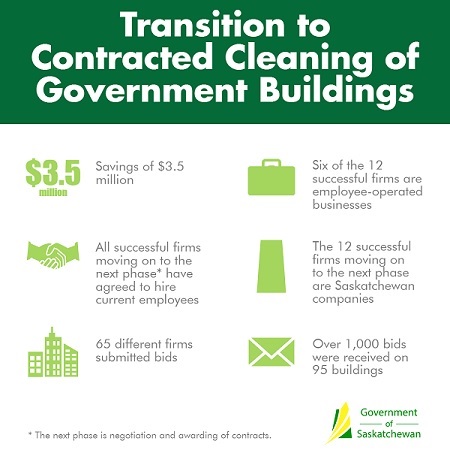
The province says it will save $3.5 million every year once it transitions to 12 contracted cleaning companies.

Earlier this year, 230 workers in 17 communities across Saskatchewan were told they would be laid off at the end of June. The Saskatchewan Government and General Employees’ Union (SGEU) called the move “ideologically-driven and mean-spirited.”

“My heart goes out to these workers, and their loved ones, who are under enormous stress, wondering how they’re going to pay their bills come June,” said SGEU President Bob Bymoen. “It’s shameful for government to be making its lowest-paid, most vulnerable employees pay the price for its own financial mismanagement.”

Six of the firms set to receive contracts are employee-owned companies that have all agreed to hire existing government cleaning employees.

“We understand there are employees affected by this decision,” Central Services Minister Christine Tell said. “The Ministry of Central Services is committed to working with these employees and their union, within the terms of their collective bargaining agreement.”

More than 1,000 bids from 65 companies were received on the 95 buildings offered to suppliers through a Request for Services process that closed February 10, 2017. The Ministry of Central Services has thoroughly analyzed and scored the submissions over the last several weeks. The evaluation process is being monitored by an independent fairness advisor from Meyers Norris Penny.

Next up, the ministry will negotiate janitorial contracts and anticipates the firms will start cleaning government-owned buildings by July 1, 2017.

janitorial services

Ice technology intends to change industrial cleaning industry

An innovative ice technology developed by a company in B.C. aims to change the industrial cleaning industry and stop millions of gallons of water from being wasted each year on cleaning applications.

Instead of using liquid water Coulson Ice Blast is now using crushed ice. Coulson Ice Blast is an industrial cleaning tech division of Coulson Group known for its aerial firefighting operations, The company says its new IceStorm unit cleans better while using 90 per cent less water, and eliminates the need for other cleaning technologies, such as dry ice and abrasive blasting.

The IceStorm uses regular ice as a blast media for cleaning, made from tap water or purchased from an international network of ice cube distributors.

With zero airborne contaminates, the product is also finely tuned to increase life cycle and efficiency. It can be used in a number of ice blast applications from building restoration and remediation to the food and beverage industry, aerospace and general maintenance.

To spearhead this advancement, the company in partnership with their ice cube distributors, is offering 1,000,000 pounds of free ice media, delivered as needed, to their customers. Conditions apply.


Can Clean show postponed, ‘more critical than ever’

Can Clean 2017, Canada’s largest trade show for the Canadian cleaning industry, has been postponed until April 2018.

The executive board of the Canadian Sanitation Supply Association (CSSA) confirmed in a recent press release that various elements of the show were struggling in terms of booth sales, sponsorships, the innovation showcase area and overall progress.

Looking ahead, a recent CSSA membership vote shows overwhelming support to form ISSA Canada. According to CSSA, the board feels that “a successful Can Clean show is more critical than ever to our industry, it’s members and the exhibiting trade show stake holders who invest heavily in the event.”

A Can Clean committee will be formed to develop a robust strategy for the 2018 show, which will include re-visiting items, such as distribution being omitted as exhibitors from the show and a more defined educational program. They will also be able to draw on the vast experience of the ISSA who also believe that a Canadian trade show is of the utmost importance to the industry.

Vancouver firm wins Emerging Architectural Practice Award

The 2017 Emerging Architectural Practice Award by the Royal Architectural Institute of Canada (RAIC) has been given to a Vancouver firm, known for thoughtful, efficient and modern design, in both renovations and new building.

D’Arcy Jones Architecture (DJA), a nine-person studio, was founded in 2005 by D’Arcy Jones, MRAIC. A graduate of the University of Manitoba in Winnipeg, and Dalhousie University in Halifax, Jones previously worked on his own from 2000 to 2005. Largely residential, the firm’s projects include housing, commercial spaces, art galleries, renovations, and interiors.

“The body of work is consistently outstanding and innovative,” said the six-member selection jury. “The skillful integration of interior and exterior spaces is particularly well executed, resulting in an architecture that is poetic.”

The Emerging Architectural Practice Award recognizes the principals of an emerging architectural practice that has consistently produced distinguished architecture. The award recognizes the quality of built work, service to clients, innovations in practice and public recognition.

“The work demonstrates a thorough understanding of construction,” said the jury. “The projects are carefully and intensely detailed. They show thoughtful attention to creating spatial variety.”

The award will be presented at the RAIC/OAA Festival of Architecture, which takes place in Ottawa May 24 to 27. “This national award from the RAIC is a big honour, and our studio is pleased to be recognized by our peers,” said Jones.  “We are thankful for our clients who support and encourage us to make artful buildings.”

Funding for new $700m wastewater plant

The governments of Canada and British Columbia have announced joint funding of up to $405 million toward the construction of the new Lions Gate Secondary Wastewater Treatment Plant. The new facility, estimated to cost approximately $700 million, will be relocated from the Squamish Nation Reserve to a new Metro Vancouver-owned site in the District of North Vancouver.

This treatment system will employ best practices for wastewater treatment and resource recovery and reduce the plant’s carbon footprint. Water will be conserved and reclaimed within the plant, and rainwater harvested outside the plant for reuse. Both indoor and outdoor spaces will be created to support various types of community activities such as education programs, outreach activities and public meetings.

“With considerable funding from all levels of government, we can move ahead with this new robust and sustainable treatment plant, which will replace the primary facility that has served the North Shore for the past 55 years,” said Greg Moore, Metro Vancouver board chair and mayor of Port Coquitlam. “At an estimated cost of $700 million, the Lions Gate Secondary Wastewater Treatment Plant will incorporate leading-edge technologies in integrated resource recovery, greenhouse-gas reductions and energy use, while serving as a critical community asset for the next generation of residents and businesses on the growing North Shore.”

The Government of Canada is providing up to $212,300,000 for this project under the Provincial-Territorial Infrastructure Component – National and Regional Projects, representing one-third of the estimated $636.9 million in total eligible project cost. The Government of British Columbia is providing up to $193 million for the project. Metro Vancouver is responsible for any remaining project costs.

Once completed, the districts of West and North Vancouver, the City of North Vancouver, and the Squamish Nation will be able to depend on an improved, modern, reliable wastewater system that will improve environmental outcomes and also accommodate future growth and economic development throughout the area.

Construction is expected to be completed by 2020.

A healthy case for maintaining synthetic grass

Some say the grass isn’t always greener when it’s artificial, but new plant-based innovations are showing that it can be, both literally and in a sustainable way. Forces in the market are also renewing the case for synthetic turf, and maintenance is just one area experiencing its positive attributes.

Changing weather patterns, health and wellness in the built environment, space utilization and accessibility requirements are just a few trends buttering facilities into investing in this product. Natural grass smells fresh, cools the air, removes carbon dioxide from the atmosphere, absorbs rainwater and reduces noise levels; but according to some industry members, synthetic grass, which makes sense in certain instances, has many of these benefits. And maintaining it is often less costly, especially in areas where floods and drought are of increasing concern.

Here are some reasons facilities are sourcing synthetic grass and tips for optimal cleaning and maintenance.

Changing weather patterns

Extreme to minor rainfall events are becoming more common due to the warming planet, inflicting damage on cities across North America. Meanwhile, dry weather has prompted towns to tighten water restrictions and implement tiered water systems. For example, in summer 2015, Metro Vancouver moved to a Stage 3 water restriction for the first time in 12 years, which banned all non-residential lawn sprinkling with treated drinking water – water that normally comes from the region’s hoses and taps. In cases like this, water availability is scarce.

“If you’re using extra water to irrigate natural grass, that pushes your building into a higher tier of water costs,” says Mike Holdenried, national sales manager for SYNLawn, North America’s largest manufacturer and installer of synthetic landscape grass. “In some areas, you can’t water or can only water for maybe 45 minutes per week, which is not enough to sustain what people want a commercial facility to look like – lush and green.”

Natural grass can get quite dry during water restrictions, and when it becomes dry, this is a fire hazard, especially in locations that generate a lot of heat; rooftops for example. Cities with water programs in place provide incentives like tax and credit rebates to build with artificial turf, while the LEED program awards points to buildings that incorporate products that are water efficient and made from recycled and renewable materials.

Proponents of the environment are concerned about filtration and storm water management, water quality runoff and the heat-island effect. Overall, the synthetic grass industry has made strides to address these concerns in an innovative and sustainable way. For example, SYNLawn, which has been around for more than 40 years, is just one company pushing industry to be green in the face of climate change. In January 2017, the company introduced a new bio-based and environmentally renewable product made from Brazilian sugar cane that is sustainably grown under strict industrial and environmental practices that don’t rely on the carbon heavy petroleum industry. Seen as innovative to the industry, the grass also replaces Polyethylene with soy beans, so the backing is also green.

“It’s green on the top and green on the bottom, green all the way through,” adds Holdenried, who has seen a huge upswing in the market. “We stitch the product into a recycled component made from recycled pop bottles, which are 100 per cent recyclable.

Overall, their turf minimizes the heat island effect by using infrared reflectors that keep grass much cooler than artificial field products. Plus, the grass is 100 per cent permeable and capable of moving massive amounts of water through the surface – about 120 litres per square metre per hour. Water that is drained through synthetic grass can also be harvested and used for other purposes in a building.

“It drains faster than the water Mother Nature can provide,” Holdenried says. “On a rooftop, you may want a drainage pad or something underneath to move water away from wherever it is. For example, if the product is placed right on concrete, there is no real drainage happening – it’s moving off.”

synthetic grass

Health and wellbeing

New generation artificial turf is chemical free and more real looking, not the indoor-outdoor kind from 15 years ago. It also has inherent health and wellbeing benefits that support the way the built environment is becoming more human-centric.

This more human approach is evident in programs like the WELL Building Standard, which is seeing a gradual uptake across the country. The program focuses on the health and wellbeing of occupants by addressing seven areas, from water and fitness to air quality. As facilities and office environments look for ways to incorporate healthy elements that attract and retain occupants, artificial grass can come in handy; for example, putting greens and yoga areas to address the fitness and comfort component of the standard. Synthetic turf also limits dependence on noisy carbon-emitting lawn equipment.

synlawn 3

Photo courtesy of SYNLawn

Space utilization

Besides the obvious health benefits, engaging and retaining tenants has also led to utilizing space more efficiently. SYNLawn recently installed its artificial grass on the 8,000-square-foot rooftop of the Okanagan Centre for Innovation in Kelowna, B.C. The facility is targeting LEED and desired a green space for people to eat lunch and commune. Rooftops, parkades, shady areas that don’t get much sun and cannot sustain natural grass, spots where buildings are too close together and pet-friendly areas all have the potential to be utilized for such green space.

synthetic grass

Okanagan Centre for Innovation. Photo courtesy of Colliers International

Accessibility

Liability is another reason facilities are opting for synthetic grass. Most products are now compliant with regulations, such as the Accessibility for Ontarians with Disabilities Act or even the Americans with Disabilities Act, which can be even more stringent.

“Especially with something like a playground, which may be built with sand or wood chips, you cannot access these areas with a wheelchair,” Holdenried emphasizes. “Synthetic grass is stable and drains well, whereas natural grass can get wet, making it less accessible to transition through in a wheelchair.”

How to clean and maintain synthetic grass

Cleaning is the biggest part of maintaining synthetic grass. A good strategy can enhance aging and aesthetics, so it’s important to keep this grass clean, brush it periodically and not abuse it.

Cleaning

For dust, pollen and airborne pollutants, rainfall is the optimal cleaner, but an occasional water flush is beneficial in areas where rainfall is scare. For lightly soiled areas, use a sponge mop with a five per cent solution of a low sudsing household detergent in hot water, followed by a thorough rinsing with hot water. For heavily soiled areas, Holdenried suggests a user repeat the procedure above and follow with sponge mopping using a three per cent solution of household ammonia in hot water, then thoroughly rinsing with hot water.

As for stains, SYNLawn suggests removing any solid or paste-like deposits with a spatula or table knife, then blot excess liquids with paper towels, a clean cloth or dry absorbent. Synthetic fibres can resist stains, but since they are only one part of various components, cleaning agents safe for some fibres aren’t safe for others. Cleaning agents are grouped into two sets, one which can be used liberally and the other which should only be applied by rubbing a cleaner-soaked cloth to minimize penetration on the turf surface.

Most products are pet friendly, but maintenance is needed to reduce odours from animal waste. Allow waste to dry and then dispose. When rain is scarce, hose the area to clean and promote drainage of urine.

Chewing gum can be removed by freezing. Aerosol packs of refrigerant are available from most carpet cleaning suppliers. After freezing, scrape with a knife. Fungus or mould spots can be combated with a solution of one per cent hydrogen peroxide in water, sponged and then flushed with clean water.

Brushing

The amount of brushing depends on the amount of foot traffic. In high traffic areas (play areas, multiple dogs, commercial applications) matting may occur, particularly if fibres become soiled with dirt. Users should never use a brush with metal or wire bristles as this alters the fibres. Periodic cross brushing, which goes against the grain, nap or sweep of the turf, is recommended, using a brush with synthetic fibres or a Grandi Groomer.


Top photo courtesy of SYNLawn

Why co-working spaces are on the rise

The market demand for co-working space in Toronto is relatively new, but has been growing steadily over the past 10 years, spurring an increase in supply.

Co-working space refers to a shared work environment that a group of people from different employers share. Users of co-working space are often self-employed, frequent travellers, and work in either small start-up companies or with smaller non-profit organizations. The individuals and organizations who rent co-working space also vary across numerous industries.

Most co-working spaces come complete with office furniture, phones, IT requirements, an assortment of meeting spaces, boardrooms, copy and print areas, and kitchen furnishings. Both private and open office areas are often shared by a number of people within an organization. Other attributes typically featured within co-working environments are dedicated desks, virtual offices, presentation spaces, shared common spaces and event space.

So, why has the demand for co-working spaces been on the rise?

The main benefit of co-working office space is the opportunity to share the financial costs of physical amenities such as meeting rooms, reception, kitchen areas, IT infrastructure and electronic equipment. Doing so means minimal set-up costs, which allows companies to dedicate capital to the growth of their business or organization.

Another powerful benefit of co-working space is the potential to uncover creative ideas and knowledge in a collaborative environment where occupants get to mingle with like-minded individuals and organizations.

Medium and large organizations appreciate the flexibility that these centres provide for special projects. Depending on availability, some spaces can be ready for use in as little as 24 hours’ notice. Plus, the commitment required to use co-working centres tends to start as low as six months, and may even run month-to-month beyond the initial term.

Likewise, non-profit organizations benefit from the low time commitment required to use the space, all at little-to-no upfront costs. Many non-profits like the flexibility of being able to expand or contract based on special projects to keep overhead low.

Rental rates vary depending on amenities offered, frequency of use, organization, term commitment and location.

Colliers International recently surveyed and analyzed the co-working community in the City of Toronto. The research showed that Toronto has 39 co-working office space companies with a total of 80 locations spread across the city’s submarkets.

The highest concentrations of co-working offices (30 per cent of the city’s total combined) are in the Toronto West and Downtown West office submarkets. The remaining Downtown submarkets — Downtown North, East and the Financial Core — follow with 13.8 per cent, 11.3 per cent and 10 per cent, respectively.

The increase in co-working space coincides with recent findings in Colliers Not-for-Profit Advisory Group’s Office Trends Benchmarking Survey, which demonstrated that the desire to work within a collaborative workspace is on the rise. Open spaces such as meeting areas, cafés, and kitchens promote engagement, productivity and culture, and ultimately can drive an increase in organizational capacity.

Shawn Gilligan ([email protected]) is a senior analyst at Colliers International. Peter Davies ([email protected]) and Matt Johnson ([email protected]) are co-chairs of Colliers Not-for-Profit Advisory Group.

Pictured above: A map of co-working spaces in Toronto.

GTA activity drives increase in national home sales

National home sales climbed 5.2 per cent month-over-month in February 2017, reaching its highest level since April 2016, according to statistics released by the Canadian Real Estate Association (CREA). Although monthly sales increases were seen in about 70 per cent of all local markets, the bump in sales was mostly driven by an increase in activity across the Greater Toronto Area (GTA) and surrounding regions.

Actual (not seasonally adjusted) activity dropped 2.6 per cent year-over-year in February. This decline reflects slowing sales in the Lower Mainland of British Columbia compared to the elevated levels seen one year ago.

“In and around Toronto, many potential move-up buyers find themselves outbid in multiple-offer situations amid a short supply of listings,” said Gregory Klump, CREA chief economist, in a press release. “As a result, they aren’t putting their current home on the market. It’s something of a vicious circle from the standpoint of a supply shortage and a challenge for first-time and move-up home buyers alike. By contrast, housing markets in urban markets elsewhere in Canada are either balanced or are amply supplied. Because housing market conditions vary by region, further tightening of mortgage regulations aimed at cooling the housing market in one region may destabilize it elsewhere.”

The number of newly listed homes increased 4.8 per cent month-over-month in February 2017, led by activity in the GTA and nearby markets, following a steep decline in January. More than one-third of all local housing markets saw new listings decline from January levels, including those in the Prairies, northern Ontario and the Atlantic region. Meanwhile, new listings in the Greater Vancouver area fell nearly 25 per cent month-over-month, reaching its lowest level since 2001.

The national sales-to-new listings ratio was 69 per cent, up slightly from January’s 68.7 per cent, indicating a sellers’ market. The ratio was above 60 per cent in more than half of all local housing markets in February, the majority if which are in British Columbia, in and around the GTA and across southwestern Ontario.

The Aggregate Composite MLS HPI climbed 16 per cent year-over-year in February 2017. This was up from January’s increase, reflecting an acceleration in home price increases, especially for single family homes in and around Toronto.

Prices for two-storey single family homes rose 17.9 per cent year-over-year, while townhouse units saw increases of 16 per cent. One-storey single family homes experienced price increases of 15 per cent year-over-year, while apartment units had the smallest gains at 13.7 per cent.

Benchmark home prices were up from year-ago levels in 11 of 13 housing markets tracked by the MLS HPI, but Calgary and Saskatoon saw year-over-year declines, at 1.9 per cent and 1.2 per cent, respectively. Prices in these two markets are now 5.6 per cent and 5.1 per cent below their respective peaks reached in 2015.

The actual (not seasonally adjusted) national average price for homes sold in February 2017 was $519,521, an increase of 3.5 per cent year-over-year. This figure continues to be inflated due to sales activity in Greater Vancouver and Greater Toronto. When those two regions are removed from calculations, the national average price drops nearly $150,000 to $369,728.

TREB opposes possible Ontario foreign buyer tax

The Toronto Real Estate Board (TREB) is strongly against imposing a provincial tax on foreign buyers that would be in addition to existing provincial taxes on home buyers, including the land transfer tax that is already in effect. The TREB says an additional foreign buyer tax will not go far in addressing the real issue plaguing the GTA housing market: a supply shortage which is at more than a 15-year low.

The consideration of this tax follows a statement made last year by the Ontario Finance Minister stating Ontario would not be following the lead of British Columbia, which imposed a 15 per cent land transfer tax surcharge on foreign buyers in July 2016.

“When the idea of introducing a foreign buyer tax in Ontario surfaced last year, TREB cautioned it would be a knee-jerk reaction before knowing whether a problem existed. There was little in the way of reliable data on the issue,” said Larry Cerqua, TREB president, in a press release. “To better understand the foreign buyer issue, TREB commissioned an Ipsos survey on foreign buying activity in the GTA, the results of which show that concerns about the effect of foreign buyers on the GTA market are widely overblown.”

The survey, which was conducted in fall 2016, found that only about 4.9 per cent of GTA home sale transactions, in which TREB realtor members acted on behalf of a buyer, involved a foreign purchaser. In addition, 80 per cent of foreign buyers purchased a home as a residence, a home for another family member, or as an investment to rent out to a tenant.

“The fact that most foreign buyers are looking to purchase a home for their family, for personal use, or to provide a tight rental market with much needed supply is something to be encouraged, as these actions are essential to Ontario’s economic success,” added Cerqua. “We can’t forget that immigration is the key driver of population growth in the GTA and, therefore, a key driver of economic growth as well. Imposing a tax on foreign buyers will not have the desired effect of cooling the housing market and could create adverse effects on the national, provincial and GTA economies. It will do little to correct the real issue impacting housing affordability, which is the lack of available housing supply.”

Demand for ownership housing has increased over the past year, partly due to a shortage of listings. New listings in February 2017 were down 12.5 per cent year-over-year. In addition, TREB’s average months of inventory trend for February was one month, while in some GTA neighbourhoods, inventory only stood at a few weeks.

“We can’t lose sight of the fact that we have experienced a persistent decline in the inventory of homes available for sale in the GTA,” said Jason Mercer, TREB’s director of market analysis. “This issue has been acknowledged by provincial and local governments in Ontario, but now policy action is required. Demand-focused policy changes will not provide long-term solutions for an affordable housing market.”

“The provincial government should work with municipalities and related industry stakeholders to look at ways in which the supply of housing could be increased, including potentially revisiting land use designations in built-up areas to allow for a broader array of home types to be built, streamlining the development approvals process, streamlining the permit process, and examining ways to incentivize land owners to develop,” said Cerqua.

Largest wind facility complete in B.C.

The largest wind facility in B.C. is now complete. The 184.6 megawatt (MW) Meikle Wind power project, located approximately 33 km north of Tumbler Ridge, is utilizing 61 GE wind turbines and has the capacity to generate clean energy for up to 54,000 homes in the province.

“Meikle Wind is now the largest wind facility in British Columbia, increasing the installed wind power capacity in the province by 37%,” said Mike Garland, CEO of Pattern Development. “Located in a mountainous region, this project was unique for its construction, design and weather challenges, as well as for our discovery of rare dinosaur tracks during construction, which we donated to the Tumbler Ridge Museum.”

Garland thanked the participating First Nations, the communities of Tumbler Ridge and Chetwynd, BC Hydro, as well as the general contractor Borea Construction and turbine supplier GE, for their collaboration on making this project a great success.”

The facility has a 25-year power purchase agreement with BC Hydro. Meikle Wind utilized more than 500,000 person-hours of labor during construction, with in excess of 30 per cent of the value of contracts awarded to First Nation-affiliated contractors and other regional firms. Going forward, the facility will be managed by 16 operations and maintenance personnel, and will also utilize a variety of local subcontractors.

The Meikle Wind facility was thoughtfully designed and planned, incorporating input from First Nations, the Tumbler Ridge and Chetwynd communities, and the provincial government. The project’s innovative layout, developed in collaboration with GE, incorporates two different turbine models consisting of varying rotor sizes and hub heights.  This design was developed to capture the most energy from the ridgelines, accounting for varying wind speeds, wind shear, turbulence and inflow angles. Meikle Wind is located within an area that was significantly impacted by pine beetle kill and previous forestry activity, reducing the overall environmental impact of the project.

According to the company, Meikle Wind is generating strong benefits for the province with an estimated $70 million in payments for property taxes, Crown lease payments, wind participation rent, and community benefits over the first 25 years of operations.

The 184.6 MW Meikle Wind facility expanded British Columbia’s total installed wind capacity to 673.6 MW, according to the Canadian Wind Energy Association (CanWEA).

Hospital-acquired infection control market reaches $16 billion

The global hospital-acquired infection (HAI) control market was worth about $16 billion (U.S.) in 2016, according to a new report by healthcare market research firm Kalorama Information.

Hospital Acquired Infection (HAI) Control Markets, provides market analysis for the prevention, diagnosis, and treatment segments of infections the HAI market focuses on, specifically nosocomial infections, infections that develop in patients during hospitalization or during stays at health facilities. The market figure includes testing products, device sterilization, specific cleaning products, and HAI treatments.

“The infection control market is a probable growth market for some time,” said Bruce Carlson, publisher of Kalorama Information. “There will always be a need to control these infections, as many of the bacteria that cause infection evolve and develop resistance to antimicrobials. New approaches to preventing, diagnosing, and treating such infections will be required for the long-term.”

The prevention segment of the HAI control market encompasses both sterilization and disinfection equipment. There is a growing trend for department-wide treatments and a revolving replacement rate is continuing to generate market stability. The rate of replacement for typical steam, heat or chemical sterilizers is between 8 and 11 years, which offers a stable replacement sales base. New technologies are a driving factor for growth, with increasing interest in wide-area sterilizing and disinfecting programs.

The report states that diagnosis – testing for nosocomial infections – is a fast-growing market segment. The increased awareness of infections is improving sales for the segment; admission screening and susceptibility testing are become popular choices for reducing infection risks.

As for the treatment side, the HAI control market has struggled to maintain growth with a weak development pipeline, growing generic product introductions, and growing resistance problems. However, more advanced products effective at treating serious infections demand a higher price, which is continuing to offset some market challenges.

South of the border, the U.S. Department of Health and Human Services (HHS) is committed to reducing the national rate of HAIs by demonstrating significant, quantitative, and measurable reductions in Catheter-Associated Urinary Tract Infection (CAUTI), Central Line-associated Bloodstream Infections (CLABSI), Clostridium difficile (“C. diff”), methicillin-resistant Staphylococcus aureus (MRSA), and surgical site infections.

The report provides market estimates and forecasts of the markets for the prevention, testing, and treatment of infections in healthcare surroundings, including the world revenues for 2010-2021 for hospital infection control, for hospital infection treatment, and for hospital infection prevention equipment and consumables (sterilization/disinfection). Sales information is also provided for the different market segments by primary geographic region and leading manufacturers’ shares.

Nobu Toronto to merge condos, hotel and restaurant

Nobu Toronto, a new development integrating condominium residences, a hotel and a restaurant, is coming to Toronto.

The project, which will be developed and sold by the Madison Group in partnership with Westdale Properties and Nobu Hospitality, will be Canada’s first Nobu Hotel and Nobu Restaurant, as well as the world’s first Nobu branded high-rise residences. The development will anchor a revitalized Mercer Street in downtown Toronto’s Entertainment District. Pre-construction sales of Nobu Residences Toronto will begin this summer.

Nobu Residences Toronto will be designed by Teeple Architects, with interior work by design firm Studio Munge. It will feature historical facades from the Pilkington Glass Factory, maintaining the integrity of those elements while incorporating contemporary architectural details.

The residences will feature 700 condominium suites in two 49-storey towers, as well as a podium for indoor and outdoor amenities, including ground floor commercial retail space, flexible social function and meeting space, a state-of-the-art fitness centre and ‘Zen Garden’ outdoor terrace.

Nobu, founded by Chef Nobu Matsuhisa, actor Robert De Niro and producer Meir Teper, is a luxury hospitality brand of restaurants and hotels located around the world. Nobu Hotel Toronto will be located at the top of the development’s west tower. As a cornerstone of the hotel, Nobu Restaurant Toronto will offer 15,000 square feet of dining space across two levels, including a signature bar lounge, outdoor seating and private dining rooms.

“Our partners at Madison Group have an extraordinary vision for the first Nobu Residences, and share our passion to build a truly special integrated residences, hotel and restaurant destination,” said Trevor Horwell, CEO of Nobu Hospitality.