Articles Archive - Page 648 of 929 - REMINET
REMI

Aircuity platform used in NRC building retrofit

Aircuity’s airside efficiency platform was used in the major retrofit project at the National Research Council of Canada (NRC)’s building in Saskatoon, Saskatchewan. The building is now using two Aircuity Sensor Suites (SSTs) in its laboratory spaces and one SST for exhaust fan control.

“Over the last decade, airside efficiency has proved to be the biggest single energy efficiency conservation measure available for laboratory spaces,” said Dan Diehl, CEO at Aircuity, in a press release.

“Implementing energy retrofit projects in a lab environment is challenging,” added Mark Newman, energy management officer at the National Research Council. “But these same challenges also present the NRC with significant opportunities to conserve energy, reduce its environmental footprint and yield substantial savings on operating costs.”

The smart platform saves energy, gives building users access to intelligent data about their spaces and enables a healthier environment for those that work in the building. The system improves cognitive function and productivity, reduces environmental health and safety risks and promotes sustainability initiatives as part of a smart building strategy.

Google’s Kitchener office earns LEED v4

Google’s new office in the Breithaupt Block, a redeveloped historic building in the warehouse district of downtown Kitchener, Ontario, has earned LEED v4 Silver for Interior Design + Construction (ID+C). The new project will save 500,000 litres of water per year, while maximizing health and wellness through other initiatives.

Google Phase 1 is also the fourth project in Canada to earn LEED v4. While looking to build its new office the company chose to target this certification because it is a globally-recognized leadership standard that encourages project teams to think outside the box and embrace innovation. Google Office Phase 2 will also target LEED v4.

“The pursuit of LEED v4 pushed the project team to create a better space, and the experience has honed everyone’s ability to solve problems and adapt,” says Ben Campbell, Service Area Manager of Sustainability for WSP, who were the LEED Consultants on the project.

Transforming the work environment

The 100,000-square-foot office is close to various transit opportunities and bicycle paths in a dense and well-developed business area, minimizing the impacts of vehicle use.

The project prioritized indoor air quality, with high levels of outdoor air ventilation provided, achieving 30 per cent over the ASHRAE 62 standard. Comprehensive sub-metering was also used to understand building energy use and uncover opportunities for future improvements. The project team also engaged the landlord and reduced the flush volumes of the building’s toilets and urinals.

Healthy materials are also a priority. For this project, every product and material went through a stringent selection process with the goal of eliminating the presence of toxicants in the space. The project earned many of its LEED credits through materials selection, including 20 products with Health Product Declarations (HPDs) and 20 products with Environmental Product Declarations (EPDs)

“We are very pleased to see a global innovator such as Google putting words into action,” said Thomas Mueller, president and chief executive officer of the CaGBC. “This project demonstrates how green buildings transform traditional work environments, in a way that reduces carbon impact and water usage, and improves employee health and wellness.”

Google further promotes wellbeing to its staff on-site through initiatives like their green cleaning program, health and nutrition programs, and a full service managed gym facility complete with climbing wall for occupants.

North York Women’s Shelter to be rebuilt

The federal and Ontario governments are working together to rebuild the North York Women’s Shelter. The province has committed up to $3 million for the project, while the federal government is contributing up to $5.8 million. The new shelter will replace the current aging building that has been serving women who are survivors of domestic violence and their children since 1984.

North York Women’s Shelter has provided help to an average of 127 women and children each year over the past three years. The new facility will provide women and children with multiple services in one location. It will offer more private and quiet space, housing, counselling and administrative services as well as legal, mental health and harm reduction supports. It will also feature fully accessible rooms.

“For women who have experienced violence, a shelter is often the first step to rebuilding their lives,” said Dr. Helena Jaczek, Minister of Community and Social Services, in a press release. “This investment in North York Women’s Shelter is another example that illustrates the Ontario government’s commitment to investing in services that help women and their children that have experienced domestic violence.”

“In the last 33 years, NYWS has provided a place of safety and support for over 11,000 women and children,” added Mohini Datta-Ray, executive director of the North York Women’s Shelter. “As our understanding of violence against women continues to evolve, we recognize that our response as both an organization and a society must become more complex, evidence-based and holistic. This significant investment means that this critical dream can be reality.”

Infection control downplayed in surface selection

Housekeeping staff continue to face many challenges with cleaning and disinfecting healthcare facilities because many environmental surfaces that are purchased don’t meet best practice recommendations under the Provincial Infectious Diseases Advisory Committee (PIDAC).

However, PIDAC’s 3rd edition of Best Practices for Environmental Cleaning for Prevention and Control of Infections in All Health Care Settings, to be released in 2017, will place more stringent guidelines on the selection of environmental surfaces in healthcare settings.

These updates are in response to research indicating that microbes live on surfaces for days, weeks and even months. Meanwhile, industry is learning that various surfaces play an active role in the transmission of organisms through direct and indirect contact with the environment and people.

According to the Coalition of Healthcare Acquired Infection Reduction (CHAIR), “hospital acquired infections are a devastating health crisis that must be resolved.” More than 200,000 people in Canada will contract an infection each year and more than 10,000 will die.

Although it is not known how many hospital acquired infections (HAIs) are directly related to environmental surfaces, it is believed that industry can reduce the staggering numbers of HAIs with effective cleaning and disinfecting. But it is also evident that some surfaces are not compatible with hospital grade disinfectants and break down when exposed to cleaning products and harsh disinfectants, such as sporicidal disinfectants. Surface damage may result in cracks and crevices, which may habour microbes and cause repair or replacement costs to a facility.

New money is coming to healthcare facilities across Canada through the recently announced federal budget and particular provincial budgets. For instance, the Saskatchewan government announced it will maintain prior year funding of $50 million to invest in health facility maintenance and equipment. Such investments create more opportunities to select proper environmental surfaces, so tax dollars aren’t wasted and healthcare facility occupants are kept safe.

Clean Oversights

PIDAC’s 2nd edition of Best Practices for Environmental Cleaning for the Prevention Control of Infections in All Health Care Settings was first published in 2009 and revised in 2012. A statement highlighted under section C, “Selection of Finishes and Surfaces in the Healthcare Setting in Areas Where Care is Delivered,” reads, “If you can’t clean it, don’t buy it.”

At the time, the PIDAC committee wanted to emphasize this point, to ensure healthcare purchasing practices consider the importance of selecting finishes that are cleanable and stand up to hospital grade disinfectants.

But even with such clear guidelines for environmental surface selection, infection prevention and cleanability still isn’t at the forefront of purchasing decisions. Also, staff working at all levels of the healthcare facility sometimes create a modified version of clinical equipment when these items are not available to meet clinical needs. Perhaps, the PIDAC document should include a statement “If you can’t clean it don’t create it.”

Unfortunately, some interior designers, healthcare leaders and decision makers are not educated on the importance of surface selection and select surfaces based on aesthetics and design alone.

Design and aesthetics are important, but if materials cannot be cleaned or disinfected, the risk of HAI’s through environmental microbial transmission increases.

Clean Selection

In order to address the balance of design, aesthetics and cleanability, it is recommended that environmental services and occupational health and infection prevention professionals be part of the selection process for finishes and surfaces. These key stakeholders need to work collaboratively within their healthcare system to stop items from arriving in clinical settings that cannot be cleaned and disinfected.

If facilities haven’t done so already, they should implement a product evaluation and product standardization committee with these key stakeholders as active members, ones who can help educate decision makers on the impact environmental surfaces have with regards to cleaning, disinfecting and HAIs.

Clear purchasing policy statements will also ensure that hard-to-clean items do not arrive in healthcare facilities. Some facilities reference the PIDAC document on environmental surfaces section in their RFPs for new furniture and other required environmental surfaces, but, unfortunately, not all facilities involve key stakeholders in environmental surfaces selection or have policies and/or a product evaluation committee.

Unclean Cases

A new Ontario-based facility recently announced the development of a new labour, delivery and post-partum room, featuring warm and natural wood accents.

Wood is an example of an organic material that contains moisture and should be avoided in clinical areas. Because of its porous nature, industry cannot be certain that hard surface disinfectants will effectively disinfect the wood surface. Creating an environment of warmth and comfort in such spaces is important; however aesthetics should not supersede infection prevention and cleanabilty. In such cases, it is hoped that selection committees involve an environmental services manager, an infection prevention professional and/or an occupational health nurse.

On a recent visit to a large acute care emergency department in Ontario, there were many items of infection concern in the isolation room. These items included cracked vinyl seating, a rusted IV pole, wood items, and a creative disposable waxed paper roll, which was tied together with gauze bandage at the foot of the stretcher bed. This was a modified version of a disposable wax paper dispenser commonly used on examination tables. All of these items have potential reservoirs to harbour microbes and are difficult or impossible to clean and disinfect.
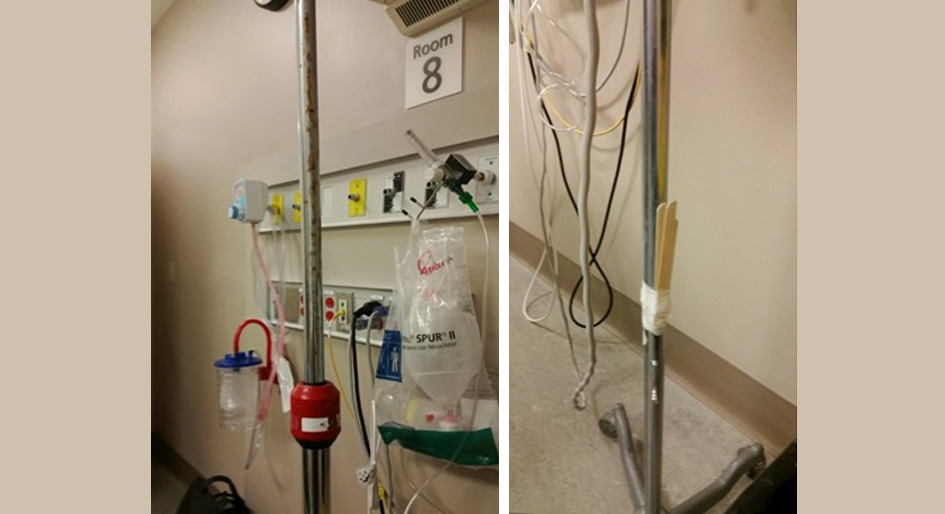
Rusted IV pole with modified Foley holder at base (wood tongue compressors wrapped in tape). Seen in isolation room of large acute care emergency department in Ontario. Photo by Keith Sopha.

Rusted IV pole with modified Foley holder at base (wood tongue compressors wrapped in tape). Seen in isolation room of large acute care emergency department in Ontario. Photo by Keith Sopha.

This was an isolation area of an emergency room. Isolation rooms are designed to house patients with infectious diseases, with the objective of preventing the spread of infections.  Items that cannot be cleaned and disinfected have no purpose in isolation rooms, clinical areas and any area where immunocompromised patients are present.

Come Clean

Routine environmental audits will identify these issues in healthcare and position a facility to work towards replacing items; however, many facilities struggle with funding replacement and repair costs.

Perhaps these funds would not be as needed if decision makers made more informed choices and purchased items that performed well with routine cleaning and disinfection.

Such is the case with cloth furnishings that harbour a higher concentration of fungi than non-porous furnishings. Bacteria cannot be effectively removed from upholstered furniture. PIDAC recommends that an alternative to cloth surfaces must be used in care areas. When using upholstered furniture, it is recommended to cover it with fluid-resistant, non-porous fabric that stands up to hospital grade disinfectants.

Seams in hospital furniture can harbour pathogens even after being cleaning and disinfected in accordance with proper cleaning standards. In 2014, an independent laboratory study was conducted by healtHcentric, a divison of ergoCentric, a North American designer and manufacturer of high-quality ergonomic chairs, proving that a piece of seamed, healthcare-grade vinyl, cleaned and disinfected with a hospital grade disinfectant, only achieved 58.08 per cent removal of microorganisms—equivalent to a 0.4 log reduction.

This same study demonstrated that a piece of seamless IC+ Upholstery Solution by healtHcentric achieved a 98.68 per cent removal of the microorganisms—equivalent to a 3 log reduction. Findings pointed out that seamless non-porous surfaces are easier to clean and disinfect. Furnishings with removable parts, such as seats on chairs, should be considered in the selection process, as well as removable seats to enhance cleaning and disinfection ability.

Seamless surfaces and removable seats improve cleanabilty and infection prevention.

Seamless surfaces and removable seats improve cleanability and infection prevention. Photo by healthHcentric.

Environmental surfaces that are easy to clean and disinfect will assist housekeeping staff in maintaining a clean safe environment for all occupants and visitors within Canada’s healthcare facilities.

More information on environmental surface selection will be discussed at the Canadian Association of Environmental Management‘s  2017 Conference and Trade Show, taking place from September 27-29 at Blue Mountain Resort in Collingwood, Ontario. This year’s theme is “Collaboration,” and will feature InfectionControl.tips: Top innovations of 2017.

Keith Sopha is president of the Canadian Association of Environmental Management and founder of CleanLearning. He is responsible for business development for healtHcentric – a division of ergoCentric Seating Systems, and provides environmental services consulting on best practice cleaning and disinfection. For more information, contact Keith at [email protected]



Nova Scotia changes Occupational Health and Safety Act

The Nova Scotia government is making changes to the Occupational Health and Safety Act that will help keep employees safe at work.

Beginning June 12, the amendments will better define when, how, and what injuries and incidents must be reported. Government will be given additional tools and authority to enforce safety requirements for those who put people at risk of serious injury or death.

“Most employers operate safe workplaces, but there are some who repeatedly break serious safety laws and put people at risk of injury or death,” said Kelly Regan, labour and advanced education minister. “We need to hold them more accountable.”

The occupational health and safety director now has the authority to deal with repeat offenders and can issue stop-work orders at all their sites, and apply to the Supreme Court of Nova Scotia for an injunction to prohibit them from working in an industry. Authorities will also be able to require offenders to advise them of future work locations and activities.

Government will continue to work with stakeholders between now and June to encourage further awareness and understanding of the changes.


Occupational Health and Safety Act changes are part of the government’s overall efforts to improve workplace safety which also include Nova Scotia’s Workplace Safety Strategy, enhanced education and outreach efforts, more targeted inspections and the hiring of a dedicated occupational health and safety prosecutor.

Making bins more convenient boosts recycling rates

Researchers at The University of British Columbia (UBC) released a new study showing that placing bins 1.5 metres away from suite doors drastically boosts recycling and composting rates by 141 per cent. The findings, published this month in the Journal of Environmental Planning and Management, highlights how small changes in convenience can have a big impact on performance.

“We know people care about the environment but having the desire to recycle and compost doesn’t always translate into behaviour changes,” Alessandra DiGiacomo, the study’s lead author and a PhD student in the UBC department of psychology, said in a recent release. “Perhaps unsurprisingly, we found that people composted and recycled much more when we made it more convenient.”

To test their theory, they placed bins in three different locations: a garbage disposal area (the least convenient option), at the base of an elevator in a building (a more convenient option), and by elevator doors on each floor (the most convenient option). The experiments were carried out at three multi-family apartment buildings in Vancouver’s west side neighbourhood and in two student residence buildings at UBC.

For 10 weeks, the researchers examined and weighed the waste. They found that when recycling stations were placed just 1.5 meters from suites in student residences, instead of in the basement, recycling and composting increased by an average of 141 per cent, diverting an average of nearly 20 kilograms of waste from the landfill per person per year. When compost bins were placed on each floor in the apartment buildings, instead of on the ground floor, composting rates increased by 70 per cent, diverting 27 kilograms of compost from the landfill per unit per year.

“The findings show a minor change in the environment can have a huge impact on behaviour,” said study co-author Jiaying Zhao, professor in the UBC department of psychology and the Institute for Resources, Environment and Sustainability. “Traditional views are that we have to educate people about the importance of recycling and composting, but we believe that’s the wrong model because people already know. Simple factors, such as convenience, can be key to helping us become more environmentally friendly.”

Study co-authors include David Wu, Peter Lenkic and Alan Kingstone in the UBC department of psychology, and Bud Fraser of UBC Campus and Community Planning.

ASHRAE forges stronger ties with Institute of Refrigeration

ASHRAE and the Institute of Refrigeration (IOR) signed a new Memorandum of Understanding (MoU) earlier this month, which outlines how the two groups will work closer together to promote the advancements of cooling and heating related technologies.

On the agenda are goals like joint conferences and meetings, training and education programs, publication distribution and chapter collaboration.

“Both organizations are committed to harnessing and adapting new technologies and research to create a future where the built environment is healthier, more comfortable and more energy efficient,” says ASHRAE President Tim Wentz, Fellow ASHRAE, HBDP. “The strides our organizations are making to produce a more sustainable world are exciting, and both ASHRAE and IOR are well poised to support each other’s objectives immediately and moving into the future.”

As part of the agreement, ASHRAE and IOU will explore ways to make technical information more accessible to both memberships. The MoU additionally places special focus on continuing to build and strengthen the organizations’ global networks. As ASHRAE and IOR continue growing their memberships internationally, the possibility of joint events would benefit both groups, such as co-hosting a conference or meeting that would directly support global collaboration.

“ASHRAE and IOR already share much of common interest in that both organizations represent a network of dedicated individuals who have a strong commitment to the advancement of our industry,” said IOR President Stephen. “We look forward to continuing to work closely together in the future, particularly in areas such as improving education and skills, disseminating technical publications and encouragement of improved standards – especially in refrigeration, air conditioning and heat pump areas of expertise.”

Catherine Karakatsanis earns prestigious engineering honour

Catherine Karakatsanis, P.Eng., FEC, FCAE, chief operating officer of Morrison Hershfield, has been named a Companion of the Professional Engineers Ontario (PEO) Order of Honour, and was inducted into the Order at an April 21 gala in Thunder Bay.

An admired leader and champion of diversity, she has overseen major Canadian engineering advocacy and regulatory bodies. She is the only engineer in Canada to have led a provincial regulator (PEO), the provincial engineering advocacy body (Ontario Society of Professional Engineers [OSPE]) and the national engineering body (Engineers Canada).

The Order of Honour pays tribute to individuals who have rendered conspicuous service to the engineering profession. The Order of Honour’s highest distinction, the rank of Companion, recognizes contributions that exceed those of Officer. It is reserved exclusively for individuals whose distinguished service has profoundly influenced the profession.

And Karakatsanis has greatly influenced the profession as a devoted advocate for creating a more diverse profession. She worked hard to promote engineering to young people and increase the number of women engineers during her tenure as president and chair of the Ontario Society of Professional Engineers in 2002-2003.

She then went on to lead or serve on dozens of PEO committees and task forces, ultimately guiding the association in the 2009-2010 council term as the fourth woman to be elected president.

During her presidency, she inspired PEO to become a world leader in self-regulation—a vision the current council continues to live up to. She also influenced the most significant changes to the Professional Engineers Act since 1984. These changes harmonized PEO requirements with national requirements, made the act and PEO’s processes clearer and more transparent, and eliminated the Canadian citizenship or permanent residency requirement for licensure.

As president of Engineers Canada, she worked closely with the provincial regulators to deliver national programs that continue to have a positive impact on the profession and its public profile. She urges all engineers to get involved as volunteers to help further the profession.

“You will also get back much more than you give,” she says. “Besides the satisfaction, the more involved you get, the bigger your network grows, the more skills you will obtain, and the more opportunities will present themselves.”


Five highlights of the new ISSA Canada

Industry is applauding the creation of ISSA Canada, a merger between ISSA and the Canadian Sanitation Supply Association (CSSA), which was formed earlier this month to better serve the Canadian cleaning and janitorial community.

Going forward, the CSSA will now be known as ISSA Canada. All CSSA members will see their dues automatically transferred to the new ISSA Canada membership category, and will have all the access and benefits of current ISSA members. Membership kits are being prepared for ISSA Canada members and will be shipped as soon as completed. For now, here are some highlights of the merger and what industry can expect.

Stronger Resources

Under the ISSA umbrella, members can expect greater access to many more educational programs, services, networking opportunities, market exposure, benefits, business tools and data offered by ISSA, along with privileges and programs CSSA already offers, such as Canpar Freight, Petro Canada Points and national car programs. The merger also enhances the ability for cleaning industry professionals to promote the value of clean on a global level.

During its first month of operation, ISSA Canada Director Mike Nosko, formally known as executive director of the CSSA, says ISSA Canada staff have been in meetings with ISSA staff headquartered in Chicago to begin the process of understanding each other’s programs and operations in order to build a blueprint for Canada.

“We will move at a methodical pace as there is much to learn about the products and services that will be available to us in Canada, and we want to make sure this is done in a correct manner,” says Nosko.

Canadian Identity

After a year-long process to form an integration plan, Nosko says that maintaining a Canadian identity was their most important element in reaching an agreement between the two parties. He says ISSA Canada will heavily invest in its operations and infrastructure “to help ‘Canadianize’ these programs and services.”

“In this the 60th year of being in existence, it was felt that it was very important to continue to serve Canadians as we have in the past,” he says. “The difference is we will now have the resources and tools to offer our members more value than ever before.”

Since Canada has two official languages, ISSA Canada feels it is important to help initiate and deliver education programs and services to the French speaking population, something Nosko says will take time to fully develop, but will be an ongoing priority.

Future of ISSA Canada

Over the next several years, the vision of ISSA Canada will be to increase not only its membership base, but also its market outreach.

“By expanding our footprint in Canada through partnerships with overlapping industries, we hope to share knowledge through education, programs, services and certifications to continue to deliver the message of changing the way the world views cleaning,” Nosko emphasizes.

ISSA Canada Council and Leadership

The CSSA executive board of directors will become the ISSA Canada Council and continue to offer direction and oversight of Canadian programs and benefits.

The Canadian council, headed by Nosko, has been assembled to help with the transition and to make recommendations on growing the ISSA brand in Canada. Council members include Al McCabe, partner at Riches & Associates, Ken Hilder, president of Coldstream Marketing, Brad Fraser, district sales manager at SCA Tissue, Central Canada, and Peter Farrell, president and chief executive officer at Citron Hygiene and ISSA Director Canada.

The former structure of CSSA has been changed, and there will be no executive board or chapter chairs moving forward. ISSA Canada will develop a network of communication with volunteers from each province to help share opportunities, such as webinars, educational symposiums and social networking.

Provinces wishing to hold ISSA Canada meetings and social events, such golf tournaments, are encouraged to continue doing so. Chapter members can reach out to the ISSA Canada office for assistance. The ISSA Canada office will also develop a network of trainers and instructors to help with the demand for programs and certifications.

ISSA

To date, ISSA has merged with the National Cleaning Suppliers Association of Australia and the Association of Residential Cleaners International, and will be announcing other mergers and acquisitions in the near future.

“ISSA’s continued vision is to change the way the world views cleaning,” noted ISSA Executive Director John Barrett in a previous press release. “The creation of ISSA Canada allows ISSA to increase its membership and expand the association’s geographical footprint in North America, while spreading our message that cleaning is an investment in human health, the environment and an improved bottom line.”

In the same press release, ISSA underlined more key benefits ISSA Canada members can look forward to, such as access to member registration and networking during ISSA/INTERCLEAN shows in North America, Amsterdam, Mexico and Turkey. During the North American show, ISSA Canada will continue to host the popular Canada Night.

Other tools include, access to all ISSA member complimentary webinars and discounts at events, access to promotional items such as the member logo and Power of Clean video, discounts on all educational programs in the ISSA Professional Development Center and access to ISSA Clean Standards for measuring the effectiveness of cleaning.

An array of industry publications will also be available, such as the bimonthly online magazine ISSA Today, monthly ISSA Times e-newsletter and customer-focused information from ISSA’s Cleaning & Maintenance Magazine and website.

For further information contact the ISSA Canada office at (905) 665-8001.


National home sales edge higher in March

Canadian home sales rose 1.1 per cent from February to March 2017, surpassing the previous monthly record set in April 2016, according to statistics released by the Canadian Real Estate Association (CREA).

Home sales in March were up on a month-over-month basis in over half of all local markets, led by the Lower Mainland of British Columbia, London & St. Thomas and Montreal.

Actual (not seasonally adjusted) sales activity in March rose 6.6 per cent year-over-year, with increases in nearly 75 per cent of all local markets. Sales in the Greater Toronto Area (GTA) experienced the largest increase, which offset the decline in Greater Vancouver’s home sales.

“The current strength in national home sales mainly speaks to what’s going on in and around Toronto,” said Andrew Peck, CREA president, in a press release. “Elsewhere, sales either remain slow or well below previous heights.”

“The latest Canadian housing market statistics suggest that the drum-tight housing market balance in Toronto and nearby cities stands in contrast to housing market trends elsewhere in Ontario and other provinces,” added Gregory Klump, CREA’s chief economist. “Because housing market balance varies by location, federal or provincial policy measures aimed at cooling demand in Toronto risk destabilizing housing markets elsewhere.”

The number of newly-listed homes climbed 2.5 per cent month-over-month in March 2017, led by increases in the GTA, Calgary, Edmonton and the Lower Mainland of British Columbia. As new listings climbed more than sales, the national sales-to-new listings ratio fell to 67.4 per cent, indicating sellers’ market conditions. Sellers’ market conditions were present in about 60 per cent of all local housing markets during the month of March, the majority of which are located in British Columbia, in and around the GTA and across southwestern Ontario.

Nationally, there were 4.1 months of inventory at the end of March 2017, down from 4.2 months in February, representing the lowest level for this measure in nearly a decade. However, this figure stood at or below one month in the GTA, Hamilton-Burlington, Oakville-Milton, Kitchener-Waterloo, Cambridge, Brantford, Guelph, Barrie & District, parts of the Niagara Region and parts of cottage country.

The MLS Home Price Index (HPI) climbed 18.6 per cent year-over-year in March 2017, with steep increases seen across all housing categories tracked by the index. Two-storey single family homes saw the largest year-over-year price increase at 21 per cent, while the price of a townhome climbed 17.9 per cent. One-storey single family homes saw prices climb 16.6 per cent year-over-year, while apartment units saw the slowest increase at 16.3 per cent. Although benchmark home prices were up on a year-over-year basis in 11 of 13 housing markets, price trends varied widely between regions.

The actual (not seasonally adjusted) national average price for homes sold in March was $548,517, an increase of 8.2 per cent compared to year-ago levels. This number continues to be pulled upward by sales in the Greater Vancouver and Greater Toronto areas, which continue to be two of Canada’s tightest, most active and expensive housing markets.

Greater Vancouver’s share of national sales activity has faltered considerably over the last year, causing it to impact the national average price less. However, if Greater Toronto and Greater Vancouver are excluded from calculations, the national average price drops by more than $150,000 to a reasonable $389,726.

Average condo prices climb in Ontario and B.C.

The average price of condominium units has jumped significantly during the past year in many Ontario cities, new data from RE/MAX reveals. A just-released Spring 2017 overview of 23 markets across Canada shows an upward trend in British Columbia and Ontario with modest declines in Alberta and Atlantic Canada.

The most dramatic increases have been registered in the Greater Toronto Area and surrounding centres of Barrie, Hamilton and Kitchener-Waterloo. The greatest year-over-year surge also positions the GTA city of Oakville as the most expensive condo market among those surveyed — as the average price rose 38 per cent, from $437,837 in the spring of 2016 to $606,169 this year.

Other GTA markets experienced average price jumps ranging from 28 per cent in Mississauga to 35 per cent in Brampton. Kitchener-Waterloo, where condo prices rose by 21 per cent, is the only market in the GTA or surrounding vicinities where the average price remains below $300,000.

Price gains have been more restrained in cities more distant from Toronto, such as Ottawa, where the average price has risen by 7 per cent, and Windsor, where the average price is up 5 per cent. Windsor likewise offers the most affordable stock among the 12 reported Ontario markets, with an average price of $189,476.

Looking west, the neighbouring provinces of B.C. and Alberta present differing pictures. The average condo price increased by 9 per cent in Greater Vancouver, making it the second priciest surveyed market after Oakville, with an average price of $592,784. However, price climbs were even steeper in the Fraser Valley (17 per cent) Victoria and Kelowna (both 18 per cent).

Slight dips of 1 per cent in Edmonton and 1.5 per cent in Calgary reduced the average price in those cities to $240,131 and $292,354 respectively. Elsewhere on the prairies, the average price in Winnipeg rose 8% to hit an average of $244,406.

Average condo prices in Halifax have fallen 8 per cent since last year to rest at $233,824. That’s the biggest drop in percentage terms among four surveyed Atlantic markets, but Saint John, New Brunswick, recorded the lowest average price by a sizeable margin among all surveyed markets, at $96,843.

Average condo prices are universally lower than average residential prices, which reflect the soaring trajectory of single-family housing markets around the GTA in particular. RE/MAX analysts point to the influence of so-called “move-over” buyers who are leaving the downtown core in search of more affordable choices elsewhere. “In turn, they are driving price appreciation in Mississauga, Brampton, Durham, Barrie, Hamilton-Burlington, Windsor and as far away as Kingston,” the report concludes.

CN Tower awarded 2017 Prix du XXe siècle

The CN Tower, one of WZMH Architects’ most celebrated and iconic designs, is the 2017 recipient of the Prix du XXe siècle, joining a short list of just 17 structures to ever receive this honour.

The Royal Architectural Institute of Canada (RAIC) and National Trust for Canada bestow the award to promote public awareness of outstanding Canadian architecture and landmark buildings of the 20th century. The CN Tower is recognized for its enduring excellence and national significance to the country’s architectural legacy.

Piercing the Toronto skyline at 553.33 metres, the CN Tower held the title of the world’s tallest free-standing structure for more than 30 years. Completed in 1976, the Tower was originally conceived as a telecommunications facility to serve Toronto and the surrounding region. WZMH Architects (then named Webb Zerafa Menkes Housden Architects) and John Andrews Architects International worked with engineers and contractors to design and build the structure.

According to the written jury citation, “the CN Tower is an incredible achievement of Canadian engineering and construction that pushed the boundaries of concrete technology.”

The Prix will be presented at the RAIC/OAA Festival of Architecture taking place May 24 to 27 in Ottawa. Recipients will also be acknowledged at the National Trust for Canada’s national conference and awards in Ottawa on October 13.

RAIC announces 2017 Prix du XXe siècle recipients

The Ontario Place Cinesphere and Pods and the CN Tower has been honoured by the Royal Architectural Institute of Canada (RAIC), in partnership with The National Trust for Canada, as recipients of the 2017 Prix du XXe siècle. The award recognizes projects for their enduring excellence and national significance to Canada’s architectural legacy.

Ontario Place’s dramatic structures by Toronto architect Eberhard Zeidler made the waterfront park an instant landmark.  Completed in 1971, the Cinesphere (known as “the Bubble”) is a 35-metre-wide dome made from steel and aluminum tubes that housed the world’s first permanent theatre for IMAX technology. A bridge-like suspension structure elevates the five inter-connected Pods over Lake Ontario. The Pods were first used to host a multimedia exhibition but were designed to be flexible and accommodate different functions. At the most basic level, each Pod is a three-storey box, encompassing 743 square metres.

Piercing the Toronto skyline at 553.33 metres, the CN Tower held the title of the world’s tallest free-standing structure for more than 30 years. Completed in 1976, the Tower was originally conceived as a telecommunications facility to serve Toronto and the surrounding region. Webb Zerafa Menkes Housden Architects and John Andrews Architects International worked with engineers and contractors to design and build the structure.

The jury citation noted the Tower is one of Canada’s most iconic structures and wrote, “The CN Tower is an incredible achievement of Canadian engineering and construction that pushed the boundaries of concrete technology.”

The Prix will be presented at the RAIC/OAA Festival of Architecture taking place May 24 to 27 in Ottawa. Recipients will also be acknowledged at the National Trust for Canada’s national conference and awards in Ottawa on October 13.

“This year the Prix du XXe Siècle celebrates combined achievements in both architecture and engineering design quality,” said RAIC president Ewa Bieniecka, FIRAC. “Both these projects deserve accolades for innovation. For the past four decades, these iconic places have captured the imagination and provided joy to their visitors”.

The RAIC and National Trust bestow the Prix du XXe siècle to promote public awareness of outstanding Canadian architecture and landmark buildings of the 20th century.


CVA-related tax increases still levied unevenly

More than 9,200 commercial, industrial and multi-residential properties in Toronto are still officially overtaxed nearly 20 years after interim measures were introduced to ease tax shifts related to Ontario’s 1998 adoption of current value assessment (CVA). Under the rules of the intervention program, CVA-related tax increases for benefiting properties have been limited to capped annual increments, while prospective tax decreases are clawed back from other properties to make up for that loss of revenue.

“After all this time, I think owners see it as just another issue they have to deal with,” observes Stephen Longo, a property tax specialist and partner with Walker West Longo LLP. “It’s one of those crazy transitional things that continues.”

However, later this week Toronto Council will consider mechanisms to pick up the pace of the program that is otherwise projected to take another 19 years to run its course. A city staff report outlines how caps and clawbacks could be phased out 10 years earlier than previously foreseen if Council takes advantage of the extra manoeuvring room the provincial government now offers. Several other Ontario municipalities already adopted these measures for the 2016 tax year when Toronto kept allowable CVA-related tax increases capped at 5 per cent of the previous year’s CVA-level taxes.

Last year, 4,955 or 15 per cent of Toronto’s commercial properties were still under the cap, which 7,107 or 22 per cent of commercial properties funded via clawbacks. In the multi-residential class, only 55 or 2 per cent of properties were beneficiaries of the cap, while 850 or 24 per cent of properties paid toward it.

The staff report recommends lifting the cap to 10 per cent of the previous year’s CVA taxes and simply removing the cap and requiring full payment from any property that is within $500 of its CVA taxes. If implemented for the 2017 tax year, this could cut the number of capped properties by 57 per cent by 2020.

“If no other options are subsequently applied, the implementation of a 10 per cent cap and a $500 threshold will allow for industrial properties to be out of the capping and clawback system by 2025 and commercial and multi-residential properties by 2026, barring adjustments resulting from the 2020 and 2024 assessment cycle,” the report notes.

Last year, the Ministry of Finance projected that all but 14 Ontario municipalities should be able to phase out caps and clawbacks by 2020, but even property tax experts express surprise at the number of Toronto properties still enmeshed. “After 19 years, I would have guessed there would be about half that many,” says David Gibson, a director with Yeoman and Company Paralegal Professional Corporation.

“Most of the properties I have been looking at do not have a lot of capping left on them,” Longo concurs.

Yet, the lengthy timeline makes mathematical sense given the phase-in of sometimes multi-million-dollar impacts in relatively modest increments. “The 1998 assessment was the first reassessment since 1954, updating from a 1940 base, so the swings in value were tremendous throughout most of the province,” Gibson recalls.

Caps and clawbacks were a provincially instituted counterbalance that municipal governments have subsequently had to administer. Toronto Council is expected to pass the annual by-law fixing the 2017 clawback rate later this week.

Keeping the dirtiest pests out of foodservice areas

Pests are a year-round threat to foodservice establishments, which provide an endless supply of food, water and shelter. Local news outlets often report poor health inspection scores; diners can easily share pest sightings on social media and many restaurant health inspection reports are posted online. Because the presence of pests is considered high risk during a restaurant health inspection, managers must be diligent in maintaining a pest free environment by instituting an effective pest management program.

To avoid negative publicity, it’s important to be aware of the dirtiest and most loathed pests that are the greatest risk to your restaurant area – rodents, cockroaches and flies.

Rodents can sneak into your building through openings as small as a dime or hitch a ride on incoming food deliveries. Besides structural damage, once inside, rodents threaten your employees’ and diners’ health. Rats and mice can carry and transmit disease causing pathogens through their bites, saliva, urine and droppings. They also carry pathogen-transmitting eco-parasites such as fleas, lice and mites on their bodies. Some of the most common rodent-borne diseases are salmonellosis (food poisoning), lymphocytic chorio-meningitis (LCM) and Hantavirus, which can cause headaches, fever, chills, nausea, vomiting and muscle aches. Spotting even one dropping or gnaw mark can be the first sign of a rodent introduction.

Cockroaches can enter your foodservice area through openings as small as 1/16 of an inch, and they’re more likely to stay when the weather cools down. Any holes or cracks in your building, as well as damaged door seals or sweeps, can provide a welcome entrance. These unpleasant pests can carry more than 30 kinds of bacteria, trigger allergies and cause food poisoning and pneumonia. Since cockroaches are great hiders, infestation indicators include cast skins (the skin they shed as they grow), sputum (a dark material cockroaches spit up) and droppings, which can range in size depending on the type of cockroach (some droppings look like pepper).

Flies are the most common and dirtiest of restaurant pests. These filth insects can carry billions of harmful microorganisms including E. coli and Salmonella, which can lead to serious illnesses in humans. Without a proper pest management program in place, flies will have no trouble slipping into your restaurant, and they thrive on the food and trash found inside. Unfortunately, the presence of flies is quite obvious to your patrons.

So how do you keep these pests from eating up your bottom line? Consider implementing an Integrated Pest Management (IPM) plan – a proactive approach to pest management customized to your individual needs. IPM focuses on reducing conditions conducive to pests through a three-step approach:

Assess the situation

Your pest management provider should conduct a comprehensive assessment of your restaurant and surrounding property to identify pest pressure points such as sanitation or structural deficiencies that could allow pests entry.

Implement corrective actions

Work with your pest management provider to develop a customized plan that includes proactive techniques such as monitoring, physical exclusion, sanitation and non-chemical treatments.

Monitor effectiveness

Ensure your pest management partner conducts regular inspections to monitor your plan’s effectiveness and make updates as needed.

IPM is an ongoing cycle that emphasizes a partnership between your pest management provider and your team. Restaurant staff should focus their efforts on proactive sanitation and maintenance of the restaurant. Here are tips for your staff to use during routine cleaning:

  • Keep your patio clean. Patios offer the perfect pest habitat, so be careful not to let your cleaning efforts become lax. Patios should be cleaned vigorously, just like the inside of your restaurant.
  • Take care of trash ASAP. It’s no secret pests are attracted to the odours coming from trash cans. Reduce odours by covering trash cans with tightly sealed lids, emptying them at least daily, washing them down regularly and lining them to avoid debris buildup.
  • Maintain a spotless kitchen. One of the chief causes of back-of-house pests is a dirty kitchen. Clean up spills, fix leaks immediately, scrub floor drains and never leave full trash cans or unwashed dishes overnight.
  • Inspect exterior of building. To help keep pests out, seal any holes or cracks in your building or around utility penetrations with weather-resistant sealant. Check door seals and door sweeps monthly and replace them as soon as wear is noted.
  • Inspect food shipments. Pests can enter your establishment on food, on equipment or in boxes. Use a UV black light to inspect for rodent urine on shipments, in delivery trucks and in loading areas. Propping a door open for a delivery welcomes pests into your restaurant, so ensure doors remain closed whenever possible.

IPM requires you to stay diligent, but the hard work will be well worth it not having to read a health inspection headline about pest problems in your restaurant.

Alice Sinia, Ph.D. is Quality Assurance Manager – Regulatory/Lab Services for Orkin Canada focusing on government regulations pertaining to the pest control industry. With more than 10 years of experience, she manages the Quality Assurance Laboratory for Orkin Canada and performs analytical entomology as well as provides technical support in pest/insect identification to branch offices and clients. For more information, email Alice Sinia at [email protected] or visit www.orkincanada.com.

This article was modified and reposted from the original on RestoBiz


Busch Systems launches free recycling, waste collection analytics software program

After two years in production, Busch Systems, a leading manufacturer of recycling, waste and compost containers, is launching the Resource Center, a free waste and recycling analytics software program designed to track waste management efforts at the station level.

The Resource Center is said to be user-friendly, and its primary function is to provide statistics on diversion rates and showcase the breakdown of the users recycling streams, the amount of money saved, and more data on the positive impact recycling efforts are making on the environment, all in real-time.

“Our passion is helping organizations reach their sustainability goals and this new software offers all of the tools to help make this happen,” says Marketing Manager Mike Baxter. “The Resource Center is effective for all levels of sustainability programs across all verticals. It is suitable for the beginner to advanced user as it provides analytic display options for both introductory and sophisticated tracking and analytics.”

Beyond providing analytics, the Resource Center provides additional resources such as how-to guides, modern marketing materials, educational resources and an exclusive choropleth mapping tool, which provides visuals of sustainability from county, regional and state/provincial levels.

“Most of the algorithms were designed solely for this software and the fact that we’re offering this service complementary is unprecedented as far as we know,” Baxter notes. “We’re continuing to prepare additional upgrades and phases to the Resource Center so there will always be something new to discover for the user.”

The Resource Center, powered by Busch Systems, goes live on Wednesday, April 26 at 11:00 a.m. ET.

Meeting held on GTA housing affordability

Federal Finance Minister Bill Morneau, Ontario Finance Minister Charles Sousa and Toronto Mayor John Tory convened on April 18 to discuss their shared concern over housing affordability in the Greater Toronto Area (GTA).

This was the first in a series of agreed quarterly meetings on the topic of GTA housing issues and affordability. The meetings signal increased collaboration by the three levels of government, including immediately taking action to address data gaps and support the proper functioning of the housing market.

“Our meeting is an important step forward in addressing Torontonians’ concern about growing household debt, rapidly rising house prices and their ability to afford a home of their own,” said Minister Morneau, in a press release. “Our Government has already taken action to deal with pockets of risk, but we remain concerned with the housing price increases in the GTA, the implications for the market, and the impact on middle class families. I look forward to continuing to work closely with Minister Sousa and Mayor Tory to coordinate our actions to address this ongoing challenge.”

In a statement, Minister Sousa added that the provincial government is aware that a response is needed now to address recent dramatic increases in rents and home prices. He noted that the government would be announcing a suite of measures designed to increase supply and address demand, making housing more affordable for Ontarians.

In addition, the Canada Revenue Agency plans to dedicate resources to ensuring the compliance of the GTA’s real estate sector with tax laws. Through the Financial Transactions and Reports Analysis Centre of Canada (FINTRAC), the federal government is also working to ensure compliance with anti-money laundering rules.

Short term, all three levels of government agreed to refrain from introducing new measures for buyers which would impact housing prices in the GTA by boosting demand. Minister Morneau also plans to share relevant housing data more frequently between governments to enhance understanding of the Ontario housing market and to help all levels of government determine whether new measures may be needed to boost housing affordability and market stability.