




Articles Archive - Page 517 of 929 - REMINET
REMI

Ontario spurns unpaid building code advisors

Technical and policy specialists who provide unpaid guidance on energy and water conservation requirements in the Ontario Building Code have caught the attention of government cost-cutters. The newly released 2019 Ontario budget lists the Building Code Conservation Advisory Council (BCCAC) among 10 provincial agencies deemed to be unnecessary or imprudent expenditures.

The budget document lumps the 10 agencies with two that have already been dismantled — including GreenON, the entity that oversaw disbursement of funds from the cancelled cap-and-trade program — and projects collective savings of more than $125 million over five years from their dissolution. Meanwhile, as mandated, BCCAC members’ claimed expenses are posted on the Ontario government’s website and reveal peak spending of $1,345 to cover travel costs in 2015, dropping to $1,136 in 2016.

“The Building and Development branch (of the Ministry of Municipal Affairs and Housing) provides us with coffee and lunch,” adds the council’s vice chair, Bob Bach, an engineer who has been a gratis consultant on the intricate nuances of energy performance in buildings for the past nine years.

Although the cost-effectiveness of that free advice is now under scrutiny, the Made-In-Ontario Environment Plan, released in November 2018, reflects admiringly on the Building Code and identifies it as an action area for introducing measures that could reduce both greenhouse gas emissions and electricity and natural gas costs for building owners.

“Ontario is currently a leading jurisdiction in Canada when it comes to energy efficiency standards in the Building Code,” the Environment Plan states. “Today, Ontario’s Building Code ensures new homes built after 2017 use 50 per cent less energy to heat and cool than houses built before 2005, resulting in a much lower carbon footprint than older homes.”

Resource to back complex energy efficiency regulations

That’s no accident since successive iterations of the code have set increasingly stringent performance benchmarks along with scheduled dates for incremental improvements. Most recently, buildings designed and constructed after January 1, 2017 must be at least 13 per cent more energy-efficient than previously required.

Expectations are stated in Section 12 of the code, relating to “resource conservation and environmental integrity in design and construction of buildings”, but two Supplementary Standards — SB-10 for Part 3 buildings or SB-12 for Part 9 low-rise housing — outline the approaches building designers can take to comply. This is where the BCCAC’s unpaid building code advisors have made key contributions.

Beyond evaluating the costs and paybacks of technically feasible energy performance, they’ve considered how designers and modellers can test and verify designs, and how building officials will assess designs and enforce code requirements. They’ve also tackled a range of emerging issues during their regular meetings — recently, for example, related to electric vehicle charging stations in multifamily buildings.

“The bottom line is that energy efficiency regulations are very complex,” observes Bach, who was approached to be a founding member of the advisory council in part due to his 1990s’ era professional involvement when the ASHRAE 90.1, Energy Standard for Buildings Except Low-Rise Residential Buildings, was first introduced as a reference in the Ontario Building Code. “We have a diverse group of people on the council, and our role has been to advise the Minister on energy efficiency and water conservation in the Building Code.”

That’s premised on the Minister’s willingness to listen.

“I am worried that the dismantling of the Building Code Conservation Advisory Council is a step towards abandoning the progress Ontario has made on our Building Code,” says Mark Lucuik, a LEED Fellow, who is a principal and the director of sustainability with the engineering consulting firm, Morrison Hershfield. “I have encouraged the Minister of Municipal Affairs and Housing to consider these changes holistically in order to make informed choices that are in the best interest of Ontario residents.”

Axe aligned with fiscal review

The recommendation to dissolve the BCCAC comes from the five-member Agency Review Task Force, composed of five Conservative Members of Provincial Parliament, and is affiliated with the government’s promised line-by-line review of provincial spending to promote transparency and uncover opportunities for cost savings. The budget’s hit list is drawn from 60 entities reviewed thus far, while another 130 are yet to be examined.

The task force has recommended axing 10 agencies deemed to “have become unnecessary, or because there are more cost-effective ways of achieving those goals”. To that end, the budget states: “The Ministry could seek expert advice on conservation matters of the Building Code from working groups rather than through a provincial agency.”

Yet, the working definition of an advisory agency, posted on the government of Ontario’s website, does not seem unduly odious. “Advisory agencies are composed of one or more individuals appointed by the government. These provincial agencies are established for more than three years. Advisory agencies’ administrative functions are carried out by the responsible ministry,” it states.

The 12-member BCCAC has fulfilled a different function than other advisory committees struck to support Building Code development. However, some of the BCCAC members, including Bach, have also served on other kinds of code-related committees in Ontario and for Canada’s model national codes.

“There is a process for reviewing proposed changes in the building code, in general, for which they convene Technical Advisory Committees. That occurs every five years when they are preparing for the next Building Code, but they don’t look at the supplementary standards, which is really where energy and water conservation is dealt with,” Bach explains. “Technical Advisory Committees are the resource for new building code proposals. We’re actually upstream from that and we are only focused on energy and water efficiency.”

The cost-effectiveness of continuing to develop an Ontario code parallel to the National building and energy codes is not addressed in the budget. As highlighted in the Made-In-Ontario Environment Plan, Ontario’s code has traditionally enforced some different and sometimes more stringent requirements than the national code. BCCAC member David Potter, chief building official for the town of Newmarket, points to energy efficiency and accessibility as two of the most prominent divergences.

However, national code developers have now tackled the ambitious multi-year task of revising the national codes to respond to climate change. “The national code is catching up to the province,” Potter says.

One week after the Ontario budget’s release, at least three BCCAC members report they have received no official notification from the Ontario government of any change in the council’s status. Nor could the Ministry of Municipal Affairs and Housing provide an estimate of the portion of the projected $125 million in savings that is attributable to the BCCAC’s dissolution.

Barbara Carss is editor-in-chief of Canadian Property Management.

Toronto Region Board of Trade relocating to Queens Quay

After 45 years in the financial district, the Toronto Region Board of Trade (the Board) announces that 100 Queens Quay East will be its new home.

In partnership with Menkes Developments Ltd. (Menkes), TD Greystone Asset Management and CBRE Ltd, the 25-storey office building which features approximately 690,000 square feet of Class “AAA” space, is the first phase of Menkes’, 4.6 million square foot mixed-use community on the waterfront – Sugar Wharf.

The Board is taking approximately 90,000 square feet in this tower that will not only be the future home of the Board but its trade services arm, the World Trade Centre Toronto (WTC-T) too.

“Toronto Region Board of Trade’s city-building mission and history of advocacy are continuing drivers of our City’s success on the global stage,” said Peter Menkes, president, commercial/industrial at Menkes in the press release.

“We are humbled that Jan De Silva and her team share our vision for both 100 Queens Quay East and the emerging technology, arts and business ecosystems on the waterfront.”

Designed by B+H Architects, the building will feature an enlarged, corporate event space with an outdoor terrace overlooking the city, as well as an enhanced workspace for Board members.

The move is scheduled to take place in 2022.

When it rains, it pours

On August 7, 2018, 45-minutes of torrential rain caused extensive flooring within the Greater Toronto Area and, in particular, the downtown Toronto core. With stormwater systems overwhelmed and property damages climbing, FirstOnSite Restoration was soon called to action.

“When got a lot of calls that night from a lot of concerned clients who recognized this was more than your average rainstorm, but instead a natural event that could severely impact their operations if not addressed quickly and appropriately” recalls Bill Fender, Senior Vice President, Commercial Property Portfolios, with FirstOnSite.

Indeed, the downpour had impacted numerous downtown businesses and properties; most notably within their parking garages, sub-level infrastructure, and mechanical rooms. The situation required immediate emergency responses and restoration work to prevent further damage and minimize business interruptions.

FirstOnSite was at the scene within 55 minutes of receiving its first call to assess the damage and begin water extraction operations.

“It’s always a ticking clock in these situations,” says Fender. “As soon as we get the call, the countdown is on, and our main goal is to mitigate the damage to our clients. Of course, that’s where working with them proactively to design emergency response and business continuity plans are critical to what we do because that enables our clients to begin helping themselves before we get on site.”

TorontoRain1945x514

Delivering relief
It was a demanding night on many fronts. At its peak, FirstOnSite’s crew swelled to 450 restoration specialists who collectively attended to 63 critical assignments. Each job required a thorough, in-person walkthrough with the client to assess their property’s damage, determine business continuity priorities, and plan the best path to recovery.

“For every one of the assignments, the privacy of sensitive information was an utmost priority,” notes Fender. “That was one of the biggest challenges, and it meant utilizing security cleared resources while adhering to client confidentiality standards at all times.”

The scope and complexity of the event also required FirstOnSite to call in its Commercial Large Loss Unit, a team comprised of highly-skilled project managers who focus on managing the restoration of complex losses and the most critical infrastructure. Together, FirstOnSite’s teams completed a majority of its restoration projects within 30 days, allowing its GTA clients to get back to business.

Back to work
All told, it was FirstOnSite’s combined expertise and ability to mobilize expert resources that ensured the mitigation of significant losses while maintaining regular service for its GTA clients. When the work was done, the company was commended by all their affected customers for their speed, know-how, and commitment to bringing critical systems and infrastructure back from the brink.

Adds Fender: “FirstOnSite’s two-pronged approach helped quickly restore the damaged subterranean spaces and helped all customers avoid extensive financial losses. Commercial clients were quickly restored with minimal disruption to their businesses, and ongoing customers received the service they rely upon.”

FirstOnSite Restoration is a leading Canadian-based disaster restoration company providing remediation, restoration, and reconstruction services nationwide, as well as for the US large loss and commercial market. For more information, visit www.firstonsite.ca.

firstonsite

Cascadia launches fiberglass framed window wall

Cascadia Windows & Doors has launched the world’s first fiberglass-framed window wall system. The Universal Series Window Wall marks an innovative step forward in energy efficient building technology, allowing architects and specifiers to substantially improve the overall thermal performance of commercial and high-rise buildings, without sacrificing windows size or glass area.

The Universal Series Window Wall can improve a building’s thermal performance by 50 to 150 per cent, compared to traditional aluminum, largely due to the inherent thermal efficiency of the window wall’s fiberglass frame.

Available with both double and tripled paned glass, the window wall delivers R4 & R7 thermal performance, respectively, and leverages similar technology as the company’s Passive House Certified (U.S. and International) series of windows and doors. This designed-in-North-America system arrives at an opportune time for the construction industry.

“Jurisdiction across North America are aggressively outlining better energy efficiency requirements for commercial buildings,” explains Cascadia Windows & Doors president Mike Battistel. “Over the last 20 years, traditional commercial windows haven’t improved as much as other building products, but they represent a very significant part of the building envelope. The efficiency levels of windows impact everything from the sizing of heating and cooling systems to general comfort and livability of the space.”

As more aggressive building codes come into effect across Canada and the U.S., the Cascadia team recognized architects and specifiers were finding themselves having to trade natural light and a more livable buildings for energy efficiency.

“Our Window Walls provide architects and specifiers the best of both worlds,” says Battistel. “They can design exciting, engaging buildings that people want to live and work in, all while delivering better building efficiency. They don’t have to choose between the two. In almost all cases our window walls exceed the most stringent code requirements.”


Photo: Spandrel at slab bypass of new Aluminum-Fiberglass hybrid window wall by Cascadia Windows.

Canada’s Greenest Employers named for 2019

Winners of the 12th annual Canada’s Greenest Employers competition presented by Mediacorp Canada Inc., feature companies that create a culture of environmental awareness in their organizations.

This year’s list recognizes a varied group of winners in provinces across the country, including real estate industry leaders Cadillac Fairview,  Minto Group Inc., Triovest Realty Advisors Inc., and Ivanhoé Cambridge Inc.

Schools such as The University of Toronto and Wilfrid Laurier University, facilities such as YMCA of Greater Toronto and municipalities, such as The City of Vancouver also made the cut. Diamond Schmitt Architects has been selected for the fourth year in a row.

“As more young people enter the workforce, more employers are realizing the importance of having sustainable workplaces,” says Richard Yerema, managing editor of Canada’s Top 100 Employers project. “Young employees ask themselves ‘what will my world look like in 20 years?’ – and they expect their employers to do things differently for a better future.  As editors, we now see deep support for sustainability across almost every industry – you can see it in the variety of employers on this year’s list.”

Canada’s Greenest Employers share four major traits: unique environmental initiatives or programs, involving employees in these programs, success in reducing their environmental footprint and linking environmental initiatives to its public identity and attracting new people.

For a full list of the winners, and to learn more about their initiatives, and the reasons they were selected by editors click here.

The competition’s 2020 application is now available.

Ken McCormack joins CLR as president, CEO

Ken McCormack joined the Construction Labour Relations Association of BC (CLR) on April 8 as president and CEO. He will be replacing Clyde Scollan, who is retiring this September.

Scollan has served the association for 30 years. He will work with McCormack to ensure a smooth and seamless transition.

McCormack most recently provided services as president and CEO of the Automotive Retailers Association (ARA of BC).  A strategic professional and seasoned executive leader with more than 25 years of management experience at the highest levels, he has worked in the government, consulting, agriculture and automotive sectors, representing associations similar in size and scope to CLR.

A strategic professional, McCormack will work with the board and staff to establish a vision and develop sound strategies to address the future needs and expectations of CLR and its membership.

In addition to a degree in economics from the University of Alberta, McCormack has invested further in his own passion of being an effective negotiator and mediator through advanced training and education from the Alberta Arbitration and Mediation Society (the equivalent of the BC Justice Institute).

McCormack is excited for the opportunity to bring his experience and dedication to bear on the needs of CLR and its members, and to be working with the CLR staff, board and partners in growing the value and engagement of the unionized construction sector in B.C.

He sees his new role as president and CEO as a great challenge and opportunity to apply his experience and knowledge to advance the needs of the association and its membership.


B2Gold selects Vancouver Centre II as its new HQ

B2Gold will occupy 37,000 square feet across three floors in the new Vancouver Centre II office tower. With this latest announcement by GWL Realty Advisors, VCII is now 38 per cent leased.

Headquartered in Vancouver, B2Gold Corp. is one of the world’s largest gold producers. They’ve selected one of VCII’s premiere spaces, which includes an exclusive portion of the building’s Skyline Rooftop Deck.

“GWL Realty Advisors is thrilled to welcome B2Gold Corp. to Vancouver Centre II,” says Geoff Heu, vice president, development – Western Canada, GWL Realty Advisors. “Given the tower’s premier location in the centre of downtown and its direct connection to two transit lines, it’s not surprising VCII is generating a lot of interest from top-tier companies like B2Gold. We are pleased with the progress of VCII’s leasing so far.”

The project also recently marked a construction milestone. With excavation complete, the project’s first concrete pour moved forward. The tower will now begin to rise at 733 Seymour, which puts it on track for completion in 2021. VCII will be the first office tower completed in the current cycle of downtown office development.

VCII offers its tenants access to first-class amenities, including the 29th Floor Skyline Rooftop Deck; a state-of-the-art fitness facility and yoga studio; and end-of-trip cycling facilities. The project is targeting LEED Platinum certification and is registered with the International WELL Building Institute. VCII’s Wired Certification will ensure it has the digital infrastructure to address the advanced technology needs of today and the capacity to upgrade to meet future needs.

When complete, VCII will sit squarely in the middle of Vancouver’s central business district, which has been shifting east in recent years. GWL Realty Advisors is developing VCII on behalf of owners: Healthcare of Ontario Pension Plan, The Great-West Life Canadian Real Estate Investment Fund No.1, and London Life Real Estate Fund.

B.C. honours construction leadership

B.C.’s construction community honoured six companies and individuals for their leadership and contributions at the annual Construction Leadership Dinner held in Victoria and hosted by the BC Construction Association (BCCA). The gala dinner is one of the many festivities and events celebrating Construction and Skilled Trades Month in BC.

“These awards and BC Construction Month are a chance to showcase individual industry success stories like tonight’s winners and how they’re using innovation and best practices to grow their businesses, diversify our workforce, and support our communities,” said Chris Atchison, president, BCCA.

The Construction Leadership Award winners are:

Mike Maierle is an Under-40 leader on the rise in the construction industry. He started ETRO Construction in 2015 as a one-man operation and has grown the company to nearly 50 employees for 2018. Examples of ETRO’s innovative approach to success include: leveraging systems, programs and construction methods such as Passive House, Zero Emissions Building, Green Built, and CLT construction; using technology such as 3D BIM, REVIT in pre-fabrications and virtual and augmented reality technologies; and going paperless by 2020.

Gold Seal certified Brandon Ponopoulos joined TKI Construction in 2010 as a partner and became its sole owner in 2017. With a head office in Kelowna, TKI’s full-service building operation supports commercial, institutional, light civil and residential projects throughout B.C. At TKI, Brandon has created a workplace that is supportive of women and diversity, and free of harassment and bullying.

Iain Elder began his career in construction in 1978 and he has worked in many levels of the industry since then. In 2007, Iain was hired by ARMTEC as their technical support manager. Over the past 12 years, Iain’s leadership has focused on critical opportunities in the area of trades training, advocacy, and Women In Trades. Along the way, his commitment to the construction sector and his community has been recognized by Prince George’s mayor and city council as well as other community and business leaders.

Victoria-based Knappett Projects is one of Vancouver Island’s premier construction companies. Their impressive experience includes 35 plus years of construction management and general contracting work. Not only are they very active with the boards of both the Vancouver Island Construction Association and the BC Construction Association, Knappett Projects is also a strong supporter and promoter of apprenticeships, gold seal credentials and best-in-class fair, open and transparent procurement practices.

The STEP Award goes to DenMar Electric who are champions for apprenticeships. DenMar has worked closely with STEP for several years and sourced many electricians through the program. The company is committed to providing equal opportunity employment in the trades. Owned by Rick Bayko and Chris Turnbull, Denmar has been a “Best of the City” recipient every year since 2009.

The BidCentral Award goes to Farmer Construction. BidCentral is B.C.’s largest online marketplace for construction projects. Farmer Construction has always been ahead of the curve in its use of technology for construction procurement and has set the standard for simplifying the intention to bid process.

Smart building retrofits: What’s holding you back?

There are many reasons to consider retrofitting an older commercial asset into a “smart building.” Often, for many commercial building owners and facility operators, the first priority is to reduce the energy footprint of older buildings. Retrofitting a building into a smart building can help in achieving sustainability goals but also improve the lives of people who live, work, and play inside your space.

The competitive advantage of smart buildings is well documented — not only are these buildings better able to meet sustainability goals, but the available data from a fully IoT-enabled building can deliver more complex use cases like intelligent space optimization. Smarter buildings are smart for business. Retrofitting into a smart building can optimize the efficiency of operations, give facility managers greater command and control of the space, and deliver a frictionless workplace experience. All leading indicators for premium lease rates with longer terms and happier tenants.

So, if retrofitting is so great then why isn’t every building “smart”? Well, the answer lies with the myriad of challenges organizations face when considering an upgrade to their building. Will implementing “smart” features actually help my bottom line? How long will it be before there is a monetary value? And so on.

In our conversations with commercial real estate owners, we’ve found a few common challenges exist when executing on a retrofit project. We’ve outlined a few to illustrate the pitfalls to avoid when considering a retrofit project.

#1 The fear of a costly project and long payback period 
Status quo is often the enemy in these situations. The fear of a costly upgrade that may not deliver the intended results in a timely fashion often stalls progress on retrofit projects. These concerns are valid but are driven by a lack of strong leadership and alignment on why the retrofit is necessary and how the project will get completed. The focus often shifts to more near-term, low-cost band-aid solutions that won’t disrupt the status quo or the budget. This tendency can often lead to costly replacements down the line or a missed opportunity for transformative performance improvements.

Suggestion: Create a strong framework for why this project is important. Ask questions to get the most robust understanding of what this project means for broader business objectives. Is it driven by corporate social responsibility? A promise to be more “green”? How do the potential costs translate over the lifetime of the asset? Will this retrofit enable us to do more with what we have today?

#2 Lack of awareness for key performance indicators
Many decision-makers along the value chain may not have a clear picture of what upgrades will be necessary in order to enable some of the more complex efficiency or workplace experience-oriented use cases. Organizations may not have consensus on key performance indicators (KPIs), have selected too many that potentially compete, or others that are not within the scope of the planned building upgrades. For example, perhaps there is a KPI for how window shades impact energy usage but you have not planned investment in smart glass or intelligent shades.

Suggestion: Start with a thorough data analysis to understand what KPIs matter in achieving your broader business objectives. If you are the champion of the project get buy-in on these metrics early on and try not to course correct, it may have downstream impacts on the work your retrofit partners may be planning.

#3 Lack of supporting incentive structure between tenants and landlords
Commercial leases can put a wrench in your retrofit initiatives if they are solely focused on energy savings. When a tenant pays directly for their energy consumption there is little incentive for landlords to invest in energy efficiency where the tenant would gain all of the cost benefits. This scenario creates a longer payback period for the landlord.

Suggestion: Get buy-in by broadening your use case for retrofit beyond energy efficiency. Think about energy in the context of workplace satisfaction and making occupants happier in their space. Look at the data and see how many temperature complaints your team receives on a daily basis. A retrofit conversation can then move beyond energy savings to tenant retention — a more attractive reason for the landlord to consider the investment.

Remo Di Fronzo is a director of Smart Buildings at ThoughtWire. This article was reprinted with permission by Remo and FacilityExecutive.com, where it first appeared. 

Ottawa-Gatineau tapped for value-add potential

Greybrook Realty Partners and Marlin Spring have jointly acquired a portfolio of 520 multifamily units in Ottawa and Gatineau, Quebec. The partners will invest in in-suite and common area upgrades with the aim of generating more revenue from the units, which are located in the downtown cores on both sides of the Ottawa River.

“The Ottawa-Gatineau region is benefiting from accelerating population and labour market growth, while the strong demand for rental has driven down the region’s vacancy rate over the past few years,” observes Ben Bakst, chief executive officer of Marlin Spring. “This acquisition, at a price below replacement value, is in line with our principled acquisition protocol and accretive to our growing diversified portfolio.”

With the deal, Marlin Spring’s portfolio will number more than 7,000 residential units in Canada and the United States.

Canada Mortgage and Housing Corporation reported a vacancy rate of 1.6 per cent in Ottawa last fall and an even lower 1.2 per cent rate on the Quebec side of the river. Average rents for two-bedroom units were $1,300 in Ottawa and $794 in Gatineau.

“Greybrook is very pleased to add these two properties to our growing multifamily investment portfolio and we look forward to executing on a value-add program that will improve the quality of the apartments and facilities for the tenants,” says Sasha Cucuz, chief executive officer of Greybrook Securities Inc.

Municipalities could lose clout on MPAC board

A new government means a new round of scrutiny for Ontario’s property assessment agency. The 2019 provincial budget, released last week, hints looming restructuring at the Municipal Property Assessment Corporation (MPAC), the arms-length not-for-profit entity responsible for evaluating more than 5 million properties province-wide.

“The Province is developing an action plan to further improve the accuracy, transparency and stability of property assessments,” the budget document reports.

That includes an apparent endorsement of a recently introduced private member’s bill, which calls for three additional positions to give taxpayer representatives equal clout with the seven municipal government representatives on the MPAC board. Along with the somewhat unusual shout-out for Member of Provincial Parliament Paul Calandra, who introduced the bill on March 20, the new budget confirms that the government will be consulting with municipalities, residential and non-residential ratepayers to “explore opportunities” to “support a competitive business environment” and “provide relief to residents”.

Municipalities provide MPAC’s operating funds and currently hold the majority on the 13-member board of directors. The 16-member configuration proposed in Calandra’s private member’s bill would effectively give the balance of power to the board’s two provincial representatives.

“This rebalancing would ensure better representation for Ontario taxpayers while still maintaining a strong voice for municipalities,” the budget states.

Improve cash flow strategies in construction

The construction industry is the leading industry when it comes to late payments. Getting paid for work rendered, especially in huge and complex construction projects, is rarely direct and straightforward. Working with a negative cash flow most of the time is a reality that contractors face.

One of the most common issues in cash flow for construction companies is poor accounts receivable management. Losing grip of your receivables can bleed any company dry, leaving business owners to depend on cash reserves to stay afloat.

Importance of Proper Accounts Receivable Management

Construction business owners may not see the urgency of optimizing the efficiency of the collections process. After all, closing sales and starting construction projects get the most focus, resulting in contractors setting accounts receivable management aside. If you’re guilty of A/R mismanagement, sooner or later, you’ll feel the cash crunch. Taking a closer look at accounts receivable will help you identify opportunities for improving your cash flow.

Since the construction industry involves spending significant capital on equipment and materials, the risk of working with a negative working capital and negative cash flow is high. In an industry where the period between billing and collection is lengthy, it’s important to look into effective cash flow strategies to avoid payroll issues, bad debts, and stunted business growth. One such strategy is managing accounts receivable well.

Prioritizing accounts receivable management benefits your company in several ways. It reduces the instances of delinquent accounts and the risk of negative cash flow. In turn, you are less reliant on cash reserves, improving liquidity and allowing more opportunities for growth.

Actionable Accounts Receivable Management Practices

Accounts receivable management involves more than simply reminding customers when payment is due. It also involves identifying patterns of bad debts, determining customer reasons for non-payment, and optimizing the entire process for efficiency.

Here are some of the best practices for accounts receivable management in the construction industry.

1. Examine your client’s credit rating before closing the deal
Vetting your clients through their credit rating should be a part of your business process early on. Closing a lot of deals could amount to nothing if you did not research your customers’ credit history. If some of your potential clients are not known for paying dues on time, your company may not be able to collect for your hard work.

Extend credit only to individuals and businesses that you’re confident will be able to pay. In addition, researching your clients’ credit history and credit rating will let you make reliable and realistic credit terms and payment plans for them. This reduces the risk of bad debts and improves your collection rate.

2. Practice good record-keeping and documentation
Proper documentation and record-keeping is the foundation of accounts receivable management. Creating a centralized location for your accounts receivable data ensures the accuracy of all pertinent information needed for the payment collection process.

For instance, wrong physical or email addresses can lead your invoices to be sent to the wrong recipient, causing delays on your customer payments.

You also need a regular audit of your customer accounts. This includes the credit payment terms as well as documentation of the communication between you and the client. Analyzing this data, especially those that refer to issues regarding payment, allows you to refine your credit policy and pinpoint problems before they arise

3. Automate your accounts receivable process
Managing several customer accounts using spreadsheets is not the most efficient way to work on accounts receivable. If you are dealing with several clients and construction projects, handling multiple spreadsheets makes you prone to outdated information or data entry mistakes. Automation removes these issues entirely and eliminates this time-consuming manual activity.

There are several parts of the accounts receivable process that you can automate. For example, you can use a dedicated software that connects to your accounting system to automatically identify at-risk invoices. You can also automate sending invoices, payment demands, preliminary notices, and follow-up emails when the due date has passed.

Another way to improve your accounts receivable management is the use of online bill pay options. This allows your customers to pay through a method most convenient to them, reducing friction in the payment process.

The construction industry may be marred by payment delays, but that doesn’t mean you can’t protect your business from the risks of working with a negative working capital. Prioritize accounts receivable management and you will see significant improvement in your cash flow.


Aki Merced is the content manager at Handle.com, where they build software that helps construction businesses get paid faster by automating the collection process of unpaid construction invoices.


GTA rental completions reach 25-year high

With 1,849 new rental units beginning occupancy since January, GTA rental completions have reached a 25-year high according to a new report from leading real estate consulting firm, Urbanation. Since 2005, just 13,520 purpose-built rental units have been brought to market, underscoring the significance of this growth.

“The latest data shows that market conditions remain tight for rentals in the GTA, with continued upward pressure on rents,” commented Shaun Hildebrand, President of Urbanation. “However, we are starting to see the early signs of some relief emerging as more supply enters the market from both new purpose-built rentals and condo rentals.”

As the year progresses, Hildebrand predicts that deliveries of both forms of rentals will continue to grow, which should create even more balance in the market and lead to a slower rate of rent increase than we’ve been seeing over the past three years.

“As rents have risen to new highs and population inflows into the GTA have surged, there has been a strong shift in demand to smaller units,” he said. “It’s pretty clear that rentals of all types are needed, but some projects have also experienced really good success with larger units that cater to couples, families and downsizers. Condo rentals tend to be on the smaller side, so this growing market segment represents a solid opportunity for differentiated product in the purpose-built market.”

Rental report highlights

  • The demand for newly completed rental buildings was strong in Q1, with several new projects reporting they’d leased close to half of their total units by the end of the first quarter.
  • Vacancy rates surveyed within purpose-built projects completed since 2005 remained extremely low at an average of 0.6 per cent.
  • Cost of rent only grew by 5 per cent year-over-year on a same-building basis, slowing from a 9 per cent annual pace at the end of last year. As of Q1-2019, purpose-built rents in buildings completed since 2005 averaged $2,398, or $3.25 per square foot based on an average size of 738 square feet.
  • Monthly condominium rents grew by 7.7 per cent per square foot on a same-building basis compared to a 9.2 per cent annual increase in Q4-2018. Rents in these properties averaged $2,376 ($3.28 per square foot) across the GTA—which is 7.8 per cent higher than a year ago.
  • In the Central Toronto market (excluding North York, Scarborough, and Etobicoke), average condominium rents increased by 4.5 per cent annually to $2,542 ($3.71 per square foot), the slowest rate of rent growth for the central market area in two years.

“Condominium rent growth is heading towards a more moderate pace relative to the past couple of years as rental affordability challenges have become greater and more supply is entering the market from projects finishing construction,” the report stated. “Although the volume of condominiums leased through MLS grew by 13 per cent year-over-year in Q1-2019 to 6,005 units, supply grew faster than demand last quarter, pushing down the ratio of leases-to-listings to 73% — the lowest level in four years.”

As of the end of the quarter, there were 2,059 active condominium rental listings on MLS, representing a 44 per cent increase from a year ago, but still equal to less than one month of supply. Furthermore, the average time on market of 20 days in Q1-2019 was at its highest level in three years, indicating that units are taking a bit longer to rent.

Purpose-built rental applications continue to grow

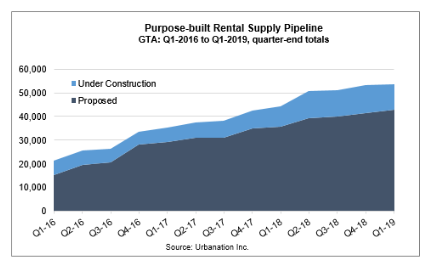
A total of 42,841 purpose-built rental apartments were proposed for development but had not yet started construction as of Q1-2019, which is 20 per cent higher than the total proposed inventory of 35,834 units as of Q1-2018 and nearly 50 per cent higher than the 28,841 units proposed as of the end of Q1-2017.

The rise in completions in the first quarter brought down the number of purpose-built rentals under construction to 10,694 units from its recent high of 11,905 units in Q4-2018, but still remained above the level from a year ago (8,510) and substantially higher than two years ago (5,894).

“The increase in rental completions in early 2019, which is coinciding with more condominium projects finishing construction, has shown that growth in new supply can have a direct impact on the rate of rent growth,” Hildebrand said. “The challenge going forward will be keeping rental construction numbers rising to a level that meets growth in demand.”

Purpose-built rental suplly Q1-2019


Haskayne students win real estate case competition

Students enrolled in the real estate studies program at the University of Calgary’s Haskayne School of Business won first place in the 2019 University of Guelph Undergraduate Real Estate Case Competition (URECC).

The annual competition is designed to attract a collection of the sharpest, most proactive minds in the real estate industry. Each year, delegates are challenged to rethink an iconic development site in the Toronto real estate market.

This year, the Haskayne team – made up of  Albert Han, post-doctoral research fellow/lecturer Metropolitan Growth and Change (Coach), Youngdoo You, Taya Vale, Davis Lougheed, Hugh Taylor and Jody Sick – was tasked with drafting a development proposal for a four-acre site located in a high growth area in the Studio District of Toronto.

“I’m really proud of the students for their dedication, hard work and enthusiasm. For a relatively new real estate studies program like ours to compete against top North American universities and win is an incredible accomplishment,” said Jessica Abt, director, Westman Centre for Real Estate Studies in a Linkedin post.

Team Haskayne went head-to-head with 16 other schools from across Canada and the United States.

Photo courtesy of Haskayne School of Business, University of Calgary.

Success in property management energy savings

It was a mix of energy insights, incentives, and advanced controls that helped Briarlane Rental Property Management Inc. optimize its natural gas consumption and increase occupant comfort across selected buildings in its portfolio.

In 2017, the Canadian firm participated in Enbridge Gas Inc.’s Commercial Energy Efficiency Program on a project to seek energy saving solutions for a number of buildings in its care.The project began with an inspection alongside an Enbridge Energy Solutions Consultant to identify ways in which energy saving practices could benefit its properties.

“We recognized there was an opportunity to install smarter heat controls within several of its properties,” explains George Hantzis, Commercial Energy Solutions Manager at Enbridge. “To keep residents cozy throughout the winter, heating equipment is turned on at the onset of colder temperatures and stays on throughout the entire season.

Although ideal temperatures are maintained on cold winter days, without the proper temperature controls in place, many buildings become overheated on milder days,” Added Hantzis. To address this, Briarlane installed advanced heating control systems at seven of its rental properties. The new controls connect directly to each building’s gas meter to provide real-time energy consumption feedback.

The system then applies this feedback to optimize the heating system’s output to deliver only the specific amount of energy needed to maintain the desired indoor temperature given outdoor conditions.

Immediate results

After one year, the retrofit paid off. In that time, buildings with the new system used less natural gas and eliminated nearly 1,100 tonnes of carbon emissions (the equivalent of planting over 18,000 trees).

Funding support from Enbridge’s energy efficiency incentive programs helped Briarlane clients receive over $98,784 in financial incentives.

“The benefits of the new system were realized immediately,” reports Pat Brawn, Vice President and General Manager and Principal at Briarlane Rental Property Management Inc. “It prevented overheating, reduced energy consumption and associated costs, and improved resident comfort.”

At last count, savings from the project are estimated to pay for the retrofit in little over three years.

Paying it forward

Embedding data-driven heating controls in several of its properties has given Briarlane’s properties the ability to adopt a more proactive and flexible approach to occupant comfort.

“The success of engagement has driven home the value of exploring energy-saving technologies and techniques,” says Hantzis. “We have seen many successful applications of advanced control systems in multi-residential buildings built before 1990.

Even the most efficient buildings in the portfolio realized energy savings by optimizing controls.”

Get with the program

Enbridge’s energy efficiency programs are available to property stakeholders, like Briarlane, at no cost. Program participants receive technical support from an Enbridge Energy Solutions Consultant to help identify and quantify energy efficiency opportunities. Financial incentives are also available to cover up to 50 per cent of eligible project costs.

George Hantzis is Commercial Energy Solutions Manager at Enbridge Gas Inc (operating as Enbridge Gas Distribution). For more information on Enbridge’s energy saving programs, incentives and services visit enbridgesmartsavings.com/business, call 1-866-844-9994, or email [email protected].

BOMA BC introduces recommissioning program

The Building Owners and Managers Association of British Columbia (BOMA BC), with support from Natural Resources Canada, has launched a new service for buildings to identify low-cost energy and emissions savings through recommissioning.

The BOMA BC Building Tune-Up Program provides a free detailed assessment of operational energy conservation measures, a fixed value amount to implement the identified measures, along with the full cost to verify the measures after implementation.

“We are supporting BOMA members’ efforts to make their buildings more efficient and show our industry’s commitment to reducing emissions,” said Damian Stathonikos, BOMA BC’s President in the release. “Efficient buildings are a key element of the CleanBC and Federal Sustainable Development strategies, and BOMA members are leading the way.”

BOMA BC endorses recommissioning as a tool to analyze building equipment and control systems to ensure they perform together effectively and efficiently.

The program is geared towards Class B and C buildings that are older than five years, a market segment with significant opportunities for energy savings. ESC Automation, a long-time BOMA BC member, was selected to conduct the assessments after a competitive bidding process.

“Energy efficiency saves money, creates jobs and reduces pollution,” said Canada’s Minister of Natural Resources Amarjeet Sohi in the release.

“‎It also improves the comfort of our living and workspaces. We are proud to support BOMA BC’s efforts to help building owners save energy and support our energy system transformation.”

Ontario budget promises support, new beds for long-term care

The Ontario Government is planning to eliminate “hallway healthcare” by adding and upgrading long-term care beds throughout the province.

This April, the PC government released its 2019 Ontario Budget with aims to create 15,000 new-long term beds and enhance an additional 15,000 long-term beds to meet modern design standards.

“Today, too many patients are kept in hospital while waiting for space in a long‐term care home,” the budget states. “The creation of 15,000 new long‐term care beds over the next five years will help the government address hallway health care and move patients to a more comfortable care setting.”

The initiative represents a total investment of approximately $1.75 billion over the next five years. What’s more, in addition to the over 6,000 new beds previously allocated, the government is moving forward immediately with the allocation of an additional 1,157 new long-term care beds through 16 projects across the province.

“Over the coming months, additional proposals for new long-term care beds will be evaluated and new beds will be allocated in locations where services are most needed now and will be in the future, and to projects that will offer specialized services to meet the complex needs of people who may be waiting in a hospital for more appropriate care,” the budget states.

Beyond increasing long-term care capacity, the Province will also be making it easier to locate land for new long-term care home developments. It will do so by reducing red tape and streamlining the processes to sell buildings and properties, making it easier to evaluate properties prior to sale to determine if they are appropriate for long-term care spaces.

“We appreciate the government for its commitment to invest in long-term care beds and funding for mental health, addictions, and housing,” said Ron Noble, CEO of the Catholic Health Association of Ontario. “These are significant commitments that will go a long way to prove the system and end hallway medicine.”