Articles Archive - Page 491 of 929 - REMINET
REMI

Advancing women engineers initiative launched

The engineering and technology professions in B.C. are launching a new initiative to increase the number of women in science and technology-related occupations.

The Association of Consulting Engineering Companies BC (ACEC-BC), in partnership with the Applied Science Technologists and Technicians of BC (ASTTBC) and Engineers and Geoscientists BC (EGBC), has announced the launch of the Advancing Women in Engineering and Technology Project.

The two-year effort will implement diverse and inclusive strategies to recruit, retain, and support career development for women in these professions. This will be accomplished through the creation of a provincial network of stakeholders to implement diversity and inclusion strategies leading to a system level cultural shift of increased female representation within the applied science and engineering sector.

The associations cited the average for newly registered female engineers in Canada is currently 17.4 per cent, a rate that has not increased over the last three years. As of Dec 31, 2017, B.C. ranked as having the third lowest participation rate in the country with 15.2 per cent, 2.2 per cent below the national average of 17.4 per cent for newly licenced female engineers.

The gap between supply and demand in B.C.’s workforce is a problem, and a key part of the solution is to increase the number of women and other under-represented groups in the applied science and engineering sector, states ACEC-BC.

A broad range of engagement activities will be offered, including workshops, employer hosted lunch-and-learn sessions, webinars, virtual career fairs, networking and celebratory events, and development of other resources to support diversity and inclusive practices in the workplace.


To learn more about upcoming events and activities, visit womeninengtech.ca.

Quebec’s HFC prohibition dates called untimely

Proposed revisions to Quebec’s halocarbon regulation could sideline some commonly used refrigerants before alternatives with lower global warming potential (GWP) can feasibly be in place. The Heating Refrigeration and Air Conditioning Institute (HRAI) of Canada and the U.S. Air-conditioning, Heating and Refrigeration Institute (AHRI) are urging the Quebec government to delay contemplated prohibition dates until mildly flammable replacements for hydrofluorocarbons (HFCs) are adopted into safety standards and building codes.

The HVAC industry advocates are also asking for more flexibility for food refrigeration systems in existing commercial and industrial facilities and assurances that Quebec-based manufacturers can continue to supply markets outside the province. The 45-day public consultation for the draft regulation, which was posted in the Gazette du Québec on July 17, has now closed, but HRAI and AHRI have offered technical input for the next stages of process.

“Due to the significant potential economic losses that our members would face should this regulation pass as written, we are very keen to meet with the Minister and participate in a working committee to assist your team,” Sandy McLeod, HRAI president and CEO, and Helen Walter-Terrinoni, AHRI vice president, regulatory affairs, wrote in an Aug. 31 joint submission to Quebec’s Ministère de l’Environnement.

They warn the proposed new rules will be out of sync with other regulatory steps that must occur so that flammable refrigerants with lower GWP ratings can be introduced into HVAC systems and the facilities that house them. The draft regulation sets a January 1, 2021 deadline to cease the manufacture, sale, distribution or installation of air-conditioning equipment that relies on HFCs with GWP greater than 1,500 (meaning 1,500 times greater than carbon dioxide) and a January 1, 2025 deadline for chillers that use HFCs with GWP in excess of 750.

McLeod and Walter-Terrinoni suggest the first deadline is particularly problematic since there is currently no non-flammable replacement for the “nearly universally used” R-410A HFC refrigerant that would be targeted. That could also have consequences for energy consumption and greenhouse gas (GHG) emissions.

“Adoption of highly efficient HVAC technology, such as ductless units and variable refrigerant flow systems, with 30 to 40 per cent annual energy savings offered over baseline technologies, would also be negatively challenged by the proposed refrigerant transition timeline of 2021,” they maintain. Meanwhile, the lower-GWP refrigerants expected to be the most effective replacements in chillers are flammable and still undergoing necessary due diligence before they can be authorized in safety standards and building codes.

Turning from cooling to refrigeration, McLeod and Walter-Terrinoni call for further clarification that a proposed Jan. 1, 2021 prohibition on installing new HFC-charged units to refrigerate food in commercial or industrial facilities would apply only to newly constructed grocery stores and food production venues. They argue that space and/or ventilation constraints could complicate and increase the cost of introducing new types of equipment into existing facilities, such as hospitals, restaurants, supermarkets and convenience stores. It would also result in multiple refrigerant technologies within a single site, which could undermine operational and energy performance.

McLeod and Walter-Terrinoni point to Canada’s federal halocarbon regulations, which exempt some specialized refrigeration applications, and recommend that Quebec follow suit. “There are unique and custom applications for very low temperature refrigeration for cryogenic cooling, blood bank and other uses that may not be able to effectively meet societal needs with lower GWP refrigerants,” they note.

Quebec’s proposed HFC prohibition dates would apply sweepingly to the manufacture, sale, distribution and installation of designated HVAC equipment. Federal regulations solely target manufacturing, thus allowing the sale and installation of existing inventory — an approach HVAC industry advocates endorse in Quebec to avoid stranding suppliers with unmarketable product.

Another proposed rule for idle equipment is predicted to increase costs for facility owners/managers. A requirement to remove refrigerant from larger units (those with a charge of 30+ kilograms) if they are idle for more than a month would particularly affect the recreational sector where summer shutdowns of ice arenas are common. McLeod and Walter-Terrinoni suggest it should apply only to systems with open compressors.

“HRAI and AHRI fully support the Minister’s efforts to reduce emissions from idled equipment,” they affirm. “However, sealed systems are not emissive and the process to remove refrigerant from these systems and to purge them would result in unnecessary emissions.”

Environmental Responsibility for Apartment Operators

Membership in the Certified Rental Building Program (CRBP) is an effective means of maintaining a high standard of quality when managing your building or working with tenants. When prospective or existing tenants see the familiar green CRB Program logo and checkmark on your property, they will immediately know that they can Rent With Confidence.

The CRB Program, North America’s only multi-residential certification program, was founded under six disciplines which all affiliated property managers must comply with in order to receive the certification for their buildings. In this six-part series, we will examine each of the disciplines in detail and explain their importance to the program.

Discipline 5 – Environmental Responsibility

The Cost Equation

As the concerns about global warming and climate change continue to grow in stature, so equally does the need for every industry, and their members, to do their part as proactive environmentally responsible corporate citizens. For Canada’s multi-res industry, this has never been more important than present, as all levels of government seek, penalize (tax) those industries that are considered major producers of carbon emissions. Recent studies indicate that the multi-res industry is considered to be a key contributor to Canada’s carbon-emissions output, contributing somewhere between six to 13 per cent annually. This make us a prime point for governments to focus on in their quest to meet their carbon-emission targets.

However, one thing sets our industry apart from other business sectors – it is largely not our buildings on their own that use energy, water, and create waste – it is the residents living in them! In most communities across Canada, as the growing cost of utilities increase and carbon taxes that are being placed on business, the multi-res industry has only limited options/opportunities to pass those costs onto the end user.

The Resident (Customer) Equation

Over the past 25 years, we have all learned the importance of being environmentally responsible citizens. With that in mind, so has the next generation of Canadian renters. In a 2009 new resident survey study conducted by J.D. Power, the importance of an apartment building (property manager) being green (environmentally responsible) was well down their reasons for selecting a building, ranking at 19 on their list. Recent U.S. renter studies (2017) now demonstrate that prospective renters have prioritized green/sustainable property managers between fifth to seventh on their reasons selection list when looking for an apartment home.It is fair to state that your company’s environmental reputation is a key decision maker for many prospective tenants.

CRB’s environmental discipline is an integral part of the CRBP quality assurance commitment to renters. In fact, CRBP viewed this discipline as so critical to our industry that we established a separate brand certification within CRBP called Living GREEN Together.

The environmental discipline is based on the two realities.

  1. Conserving resources makes good business and economic sense.
  2. Conserving resources makes environmental sense.

The standards are pragmatic, proactive, and participatory. The latter focused on involving residents (tenants) in proactive energy/water conservation measures, and waste diversion practices. The more we can commit our residents to good conservation practices/measures, the lower the operating costs of an apartment building and the better for the environment.

The environmental discipline consists of 10 standards covering policy, environmental performance areas, and education/engagement. They include the following and much more:

Policy

  • Documented environmental policy
  • Environmental preferred purchasing policy
  • Environmental performance monitoring

Environmental Performance Areas

  • Electrical standards
  • Water standards
  • HVAC standards
  • Waste diversion standards
  • Air quality standards

Education/Engagement

  • Employee awareness education
  • Resident engagement practices

At the heart of the reason why FRPO introduced its CRBP certification initiative was the opportunity to demonstrate to all stakeholder groups our ability to self-regulate, and our commitment to be a socially responsible and sustainable industry. The latter point includes demonstrating our caring for employees, the customers (renters) that live with us, and promoting safe, healthy, and greener apartment communities across Ontario – we call it Living GREEN Together.

It makes good corporate business sense for all professional property management companies to be a part of CRBP’s environmental discipline. At the corporate governance level, it provides investors and unitholders/shareholders with peace of mind and sense that their investments are contributing to overall social good and environmental betterment.

For further information about the CRBP and how to apply for the certification, please contact the Federation of Rental-housing Providers of Ontario (FRPO) – Ted Whitehead, Director of Certification, or visit our website today at www.frpo.org.

Funding announced for Canadian cultural facilities

The Government of Canada has announced funding for a number of recreational and cultural facilities across the country.

This September, Pablo Rodriguez, Minister of Canadian Heritage and Multiculturalism, revealed plans to dedicate $3.2M of the country’s Canada Cultural Spaces Fund to upgrade several provincial venues. The funds will be split between renovations and retrofits for the Nia Centre for the Arts in Toronto, the development of new programming and exhibition space at Science North in Sudbury, and key upgrades to the Toronto Dance Foundation’s Winchester Street Theatre.

“Arts and heritage organizations like the Nia Centre for the Arts, Science North, and the Toronto Dance Foundation are key to the vitality of their communities,” said Rodriguez. “By supporting the renovation of cultural infrastructure, our government is strengthening communities and helping make the arts, culture, and heritage more accessible for all Canadians.”

Elsewhere in New Brunswick, the Government of Canada is earmarking $2M from the Canada Cultural Spaces Fund to support the expansion of Fredericton’s Beaverbrook Art Gallery, as well as enable improvements for the Fredericton Playhouse, the New Brunswick Sports Hall of Fame, and the York Sunbury Historical Society (Fredericton Region Museum).

Support is also coming to British Columbia by way of more than $16.1M in funding via the Community, Culture, and Recreation Infrastructure stream of the Investing in Canada plan. The money will be used to develop a new community youth and cultural centre for members of the Tsawwassen First Nation, an Indigenous Cultural Centre in Lake Country, a field house for the Sportsplex in North Cowichan, and fuel renovations and retrofits to the Juan de Fuca Arena in Colwood. The T’exelcemc Indian Band will also receive portions of the funding to build a new community building in Williams Lake, and the Sumas First Nation will build a new “culturally specialized multi-purpose community and recreation facility” for on-reserve residents and other members of the public.

“Culture and recreation centres are the backbones of our communities and important focal points for activities that bring people together and help them thrive and grow,” said Carla Qualtrough, Minister of Public Services and Procurement and Accessibility and Member of Parliament for Delta, speaking on behalf of the François-Philippe Champagne, Minister of Infrastructure and Communities. “These six projects will provide people from Williams Lake to Tsawwassen with the modern, accessible and culturally adapted facilities they need to nurture healthy lifestyles, promote their cultures, learn new things and flourish for generations to come.”

New York has the world’s tallest residential building

Central Park Tower in New York has topped out at 1,550 feet, making it the tallest residential building in the world. Located on West 57th Street, along the corridor known as “Billionaire’s Row,” Central Park Tower is the definitive New York skyscraper, offering endless views, exquisite architecture, gracious layouts and an unprecedented level of service.

“Central Park Tower is the pinnacle of development in New York and around the world,” said Gary Barnett, founder and chairman of Extell Development Company. “We would not be able to offer this level of design, quality and service without the contributions from the world’s most talented architects, engineers and designers.”

Designed by top architectural firm Adrian Smith + Gordon Gill Architecture (AS+GG), Central Park Tower’s beautiful facade features combined elements of glass, satin-finished stainless steel, and light-catching vertical and horizontal details that accentuate the interplay of texture and light. At a height of 300 feet from the street, the tower cantilevers to the east, creating Central Park views for all north-facing residences.

The grand residential interiors are designed by Rottet Studio, whose projects include the St. Regis Hotel in Aspen and the Loews Regency Hotel in New York. Rottet Studio’s trademark level of detail and unique custom finishes throughout Central Park Tower create a highly sophisticated environment. The 179 ultra-luxury two-to-eight-bedroom residences begin on the 32nd floor of the building and range in size from 1,435 square feet to over 17,500 square feet.

Located within the tallest residential tower ever built will be one of the world’s most exclusive private clubs, Central Park Club. At ground level will be Nordstrom’s first full-line 300,000 square foot department store.

Lendlease, one of the world’s largest property, infrastructure, development and construction management firms, served as construction manager for Central Park Tower. The project is scheduled to complete in 2020.

Upper Skeena Recreation Centre officially opens

The Upper Skeena Recreation Centre in Hazelton, B.C. officially opened on September 14, 2019. The new recreation centre, also known as the Heart of the Hazeltons, features a new professional-sized indoor ice rink with heated seating for 500 spectators, plus a multi-purpose gym, fitness centre and meeting and social areas, including kitchen space, a seniors-oriented walking area, and an art area featuring Gitxsan art.

Designed by Hemsworth Architecture, the new state-of-the-art recreation centre showcases locally sourced wood and other custom touches. The 54,000 square foot facility will serve as the region’s centre for sport and cultural activities, offering programs and services for all ages and abilities to support the educational, health and social needs of the surrounding communities.

The new centre replaces the old Hazelton ice rink, which was deemed unsafe in 2015, leaving a serious gap in the recreational sports community in the Upper Skeena district.

The $20.1-million project was made possible through government and First Nations investments and donations by local businesses, philanthropic agencies and individual donors.

The Province of B.C. invested $4.5 million, including $500,000 through the BC Rural Dividend program.

“We are deeply grateful to the donors and supporters who have seen and responded to the needs and challenges in our community. Staying true to our vision, the Upper Skeena Recreation Centre will provide healthy activity, education, career and economic opportunities, and has the potential to be transformative for the people in our region,” said Peter Newbery, chair, Heart of the Hazeltons Fundraising Campaign.

IoT and building energy management

What, exactly, is the Internet of Things (IoT)? And how does it relate to building energy management? The IoT is the concept of connecting any device with an on/off switch to the Internet and/or to each other. IoT uses one common Internet Protocol (IP) to connect devices, which include everything from smartphones, tablets and digital assistants to various types of sensors and systems such as HVAC, lighting, and security. In other words, the IoT is a fast-expanding digital ecosystem of connected devices. In 2015, there were about 10 billion connected devices; by 2020, that number will more than triple to 34 billion. This growth is not surprising given the current environment where broadband Internet is widely available, technology costs are decreasing, smartphone use is becoming ubiquitous, and more and more devices are designed with built-in sensors and Wi-Fi capabilities.

So, how does the IoT enable smarter buildings? The IoT helps create dynamic, and intelligent cloud-based interoperable networks by connecting electrical, mechanical, and electro-mechanical systems and platforms. By communicating with each other, these systems can help monitor themselves and act when necessary (e.g. turn down air-conditioning or heating needs in a little-used area) to provide the data and analytics needed for facility managers to intelligently optimize performance and create smarter buildings.

The technology to enable this competitive edge is already at hand. The Internet and significant price reductions on IT components such as wireless sensors have made smart building technologies much more affordable, creating a strong business case for owners and investors to invest in more intelligent technologies to increase building performance. For example, advanced smart-energy sensors – a market whose revenue will almost triple between 2016 and 2025, from $1.2 million to $3.2 million, according to Navigant Research – can play a critical role in BEMS. These devices contain “sensing” technology that captures and sends digital data to a BEMS to enable analysis and support actionable insight. Sensors that measure and provide continuous feedback on temperature, carbon dioxide level, humidity, and air pressure, for example, can deliver valuable information. Controllers, gateways, and sensors can also increase energy efficiency and help cut costs.

All at once, these devices, systems, and platforms connect to a central, open IP backbone to provide a holistic view of building performance. This backbone not only integrates all the data generated by the devices, but also presents it via a friendly user interface displays (desktop, tablet and mobile) that use powerful graphics, data-rich reports, and trend visualizations. Most importantly, this central backbone helps facility managers make strategic decisions through data analysis and actionable insights to ensure buildings are working smarter and running at maximum efficiency. Data analysis can also include artificial intelligence and machine learning algorithms that help buildings self-diagnose and optimize. In turn, this creates more comfortable environments that drive productivity by increasing employee engagement and satisfaction. With the right IoT platform in place, buildings are ripe for improved energy management by easily integrating technology. An open, secure, and scalable platform that delivers deep and actionable insights can significantly increase operational efficiency within buildings. Additionally, correlation and analysis of data across historically disconnected systems can yield unexpected insights. In short, IoT is creating enormous opportunities for information gathering and sharing that will have an astounding impact on the way buildings are managed and operated. By using a collaborative smart building IoT platform, devices are connected with software and services to realize these opportunities.

This article was created by Schneider Electric and first appeared at FacilityExecutive.com.

RFQ for Kicking Horse Canyon final phase issued

The province of British Columbia has issued an invitation for bidders to submit their qualifications to design and build the fourth and final phase of the Highway 1 Kicking Horse Canyon project.

A request for qualifications (RFQ) includes realigning and widening the final 4.8 kilometres through the canyon from West Portal to Yoho Bridge to four lanes and installing median barrier, snow avalanche and rock fall hazard protection.

“People need to feel safe on our highways, and we need to keep goods moving across the province and to the rest of Canada,” said Claire Trevena, B.C.’s Minister of Transportation and Infrastructure. “Once this final section of Kicking Horse Canyon is wider and realigned, people will have a much safer experience travelling through this beautiful corridor.”

The total estimated project of $601 million is cost shared. The Government of Canada is contributing up to $215.2 million through the provincial-territorial infrastructure component of the New Building Canada Fund. The province is providing the remaining $385.8 million.

The project budget has increased by $151 million from 2016, reflecting the re-allocation of $23 million of interest during construction from a general capital budget and a $128 million increase in project costs.

The Highway 1 Kicking Horse Canyon project will be built using the CBA. The estimated costs for the application of the CBA is $35 million. This represents 5.8 per cent of the project’s total budget.

According to the government, using the CBA will ensure all workers receive competitive, equal, transparent wages and benefits, enabling greater employment and training opportunities for people traditionally underrepresented in the trades, including women, Indigenous peoples, apprentices and people with disabilities.

The RFQ will establish a short list of qualified proponents. The request for proposals will be issued later this fall. The contract will be awarded in 2020. Construction is expected to begin in summer 2020.

PROREIT completes $49.3-mill acquisition

PRO Real Estate Investment Trust (PROREIT) to purchase six properties – five light industrial buildings in Halifax and one boutique office tower in Ottawa – for $49.3 million.

“We are pleased to have successfully closed these six properties, which represent slightly over 50% of the total purchase price of the seven acquisitions announced last month, with the remaining mixed-used industrial property located in Kanata, Ontario, expected to close in the coming weeks,” said Jim Beckerleg, President and CEO, PROREIT in the REIT’s press release.

Located in Burnside Industrial Park, the portfolio of five light industrial buildings in Halifax was acquired for an aggregate purchase price of $28.1 million from a domestic institution. The portfolio consists of 357,824 square feet of gross leasable area (GLA).

The Ottawa property is an institutionally-owned and managed 11-storey boutique office tower situated in the heart of Ottawa’s central business district, acquired for $21.2 million. The building, which features 58,203 square feet of premium office and ground floor retail space, occupies a valuable corner location that benefits from excellent visibility and accessibility.

“Our financial position has never been stronger. Our recent successful equity raise and exceptional mortgage offerings allow us to finance these purchases on a accretive basis to our AFFO per unit, while also reducing our leverage,” Beckerleg added. “The focus will now be on integrating these new assets, and on continuing to build and diversify our high-quality portfolio.”

Realtors lobby to reduce home ownership barriers

Canada’s real estate community has rallied to urge all levels of government to make home ownership more accessible for people across the country. This September, The REALTORS Association of Edmonton (RAE) joined the Quebec Professional Association of Real Estate Brokers (QPAREB), the Nova Scotia Association of REALTORS® (NSAR) and Toronto, Calgary and Vancouver real estate boards to urge the federal political parties to “commit to policies that will help remove barriers and reduce the cost of home ownership” in advance of the federal election in October.

“Home ownership is a key component of the national economic fabric and its role in creating economic diversity cannot be overlooked,” said Michael Brodrick, Chair of RAE. “To help Canadians, the real estate market must have liquidity, but the federal government’s anti-homeownership policies have made it difficult for Millennials to purchase their first home, difficult for families to upsize or downsize as their needs change and difficult for seniors to exit the market.”

For example, he continued, the mortgage stress test has had a significant downward impact on the price point at which buyers can qualify and purchase. “This has lowered prices and stolen equity from homeowners. Home equity is a substantial asset for many Canadians, and this equity will not be easily or quickly rebuilt.”

To correct course, the group has put forward several housing affordability recommendations, including:

  • Revise the Office of the Superintendent of Financial Institutions’ (OSFI) mortgage stress test to take into account its impact on different real estate markets across the country. The federal government should view the stress test as a flexible policy and adjust it based on changing economic trends and interest rates.
  • Replace the $750 First-Time Home Buyers Tax Credit with a $2,500 non-refundable tax credit for first-time home buyers.
  • Reintroduce 30-year mortgage amortizations.
  • Consider regional differences when implementing nation-wide measures that affect home buyers.

“No two real estate markets are the same. The one-size-fits-all housing policies, like the mortgage stress test, are simply not solutions that will work across our diverse country,” explained Matt Honsberger, president of NRAB, adding, “In Nova Scotia, transactions through the NSAR MLS® System generated an estimated $513 million in spin-off spending last year. This economic impact is recognized by all levels of government, who we encourage to continue working with real estate brokers to ensure that policies encourage growth in our market and make home ownership more affordable and accessible.”

Alan Tennant, Chief Executive Officer with the Calgary Real Estate Board (CREB), also expressed the need for greater unity on housing initiatives, noting, “The time has come for Canada to have a clearly articulated housing strategy that brings all government agencies onto the same page. We are supportive of initiatives that facilitate Canadians in achieving their dream of home ownership. Leadership in government is needed to bring an end to ad-hoc policy changes that make tough economic conditions harder in some markets or introduce measures too late.”

The combined real estate associations and boards represent over 92,000 real estate brokers throughout Canada, who account for 70% of the industry and an estimated $31B in transactions annually.

Timber adds class to schools

As students returned to school, they settled in to educational environments made warmer and more comfortable through the use of wood in building design.

People spend the vast majority of their life inside buildings. For children and young adults, many of those hours are spent inside educational institutions.

Having wood visible in learning spaces has been shown to lower stress and improve concentration and test performance.

Along with health and wellness benefits, wood construction is cost effective and often faster than other methods.

School principal Rob Comeau sees the benefits and beauty of B.C. forest products every day with students and staff at Abbotsford Senior Secondary School. The school has an intricate and impressive rotunda roof built of exposed glue-laminated timber (glulam) and wood decking.

“Open spaces and light are some of the best design qualities in a school,” said Comeau, adding the craftmanship of wood is perfect for a natural feel. “That’s B.C. architecture — light, wood, and space.”

Abby-Senior2

Wood is featured in schools and educational institutions all over B.C.

Seabird Island Community School, Lalme’ Iwesawtexw, is often described as a bird preparing for flight. The design draws inspiration from traditional Indigenous loghouses. The parallel-frame post-and-beam structure is wrapped almost entirely in western red cedar-shingle cladding.

Wood is used throughout Southern Okanagan Secondary School. Its impressive double-height multi-purpose room is elegantly built with glulam. Birch plywood paneling is used in high-impact spaces, including the gym, for a durable and aesthetic finish.

The University of British Columbia’s Forest Sciences Centre in Vancouver showcases what’s possible using B.C. forest products. The impressive atrium takes the form of a five-storey galleria, its glass roof supported on 13-metre parallel strand lumber “tree” columns, creating the feel of a forest canopy.

At Thompson Rivers University in Kamloops, the sweeping serpentine roof added during the revitalization of the “Old Main” building looks like a floating ribbon of wood, with exterior soffits made of smooth western red cedar cladding. The panelized roof structure was prefabricated off-site from glulam beams, wood joists and plywood sheathing. It took only seven weeks to install, with the panels locking into place like a puzzle. Its lighter wood hybrid design minimized the additional load on the original 1960s structure.

B.C. schools place a high value on natural materials and environmental performance, providing innovative and durable community facilities that contribute to quality of life while still being economical to build. Wood from B.C.’s sustainably managed forests is a home-grown solution.

“Each of us needs to adjust our carbon footprint and as a naturally renewable material, wood has a role to play,” said Comeau. “Any time you can get quality product right in your backyard, why not use it?”

These projects and others are featured in a newly released book, Naturally Wood, which showcases British Columbia’s cutting‐edge wood architecture and design. The beautifully illustrated, 160-page publication contains more than 65 innovative wood buildings and projects, including how wood is being used in education and school.

Download Naturally Wood digital copy here.


Toronto Community Housing announces restructuring plans

Toronto Community Housing Corporation (TCHC) announced plans to restructure the organization in an effort to deliver better, faster service to its 110,000 tenants. According to the press release, the improvements will be implemented over the next six months.

“Our plan is about recognizing that the best service is provided by staff on the ground who know our tenants and understand their needs,” said TCHC President and CEO Kevin Marshman. “That’s why we are empowering our local teams to make more decisions on-site, and deliver the quality service our tenants deserve.”

Approved by the TCHC Board, with the intent of redirecting resources to frontline teams, the plan includes:

• Decentralizing decision-making away from head office and into all buildings and communities, and hiring more superintendents, cleaners and support staff;

• Creating 134 local service hubs across the city, where the prime point of contact for tenants will be the building superintendent, supported by a local team focused on building services, tenancy management and community supports;

• Investing $5 million a year to expand hours of service to cover evenings and weekends based on community needs and bring more services into buildings and local hubs;

• Empowering superintendents to make service decisions at the local level, so that tenants can have meaningful conversations about their homes that don’t get lost in process.

Toronto Community Housing restructuring plans

To support these changes, TCHC is creating three new regional offices across the city each led by a General Manager with responsibility for the complete spectrum of tenant services.

Integrated tenant services  
In the past, TCHC’s service delivery model has been organized into two distinct divisions. The new plan merges both groups together to close service gaps and establish clear, common lines of accountability.

Under the new structure, the former Asset Management and Tenant and Community Services groups have been merged together under the leadership of a Chief Operating Officer. This new unified team is now responsible for delivering the full spectrum of tenant services, including building services, tenancy management and community supports.

Building and community teams 
Moving forward, tenant-facing staff will be part of local teams based in 134 buildings and community hubs. These local teams will be empowered to make more customer service decisions on-site, instead of being caught up in lengthy process.

The building superintendent of each service hub, already an integral part of the service we provide to tenants, will function as their prime point of contact. Superintendents will be supported by a team fully equipped to provide the quality services tenants deserve.

Three regional offices 
To further its commitment to bring services and decision-making closer to tenants, TCHC will decentralize many service functions currently based at head office, into three regional offices across the city. Each regional office will be led by a General Manager reporting to the newly appointed Chief Operating Officer, Sheila Penny. Each General Manager will oversee teams that support and manage service hub staff across their region.

New Chief Operating Officer
Toronto Community Housing has appointed Sheila Penny as its new Chief Operating Officer. In re-establishing the role of Chief Operating Officer, TCHC says it is “bringing together all elements of tenant service under a common structure to ensure that service to tenants is delivered consistently, efficiently and with accountability.”

Ms. Penny is described as a highly experienced executive leader, with a track record of guiding diverse teams to deliver capital construction and facilities operations. She brings more than 20 years of public sector experience to the role, in operations, design and construction, energy management, real estate, planning, sustainability and redevelopment

Gen Z friendly cities foster a rising cohort

Toronto, Vancouver and Montreal rank among the world’s most Gen Z friendly cities, analysis from Nestpick, a global database for furnished apartment and room rentals, concludes. The recently released study assesses and scores 110 cities on 22 indicators — broadly falling into the categories of digital infrastructure, societal openness, leisure pursuits and business culture — deemed to support and/or influence the age cohort born between 1997 and 2012.

Toronto emerges as the fourth most welcoming locale after London, Stockholm and Los Angeles, and one notch above New York. Vancouver takes the number 10 position, sandwiched between Amsterdam and Paris, while Montreal occupies the 15th slot and is the second most affordable city in the top-15 after 12th-ranked Manchester, U.K.. Ottawa, placed 42nd, and Quebec City, placed 54th, round out Canadian representation on the list defined as “prominent international cities … selected based on their reputation as destinations to pursue work and education”.

Although pre-teens may not yet be contemplating such moves, the young adults at Gen Z’s leading edge largely fill post-secondary labs and lecture halls and are steadily entering the workforce. Nestpick’s founder and chief executive officer, Ömer Kücükdere, notes they’ve grown up in a digitally connected world fraught with economic and environmental turmoil, giving them inherently different reference points than Millennials or Generation X before them.

“Despite the vast amount of livability indexes, there has been no study focusing on Generation Z with their ideals and values in mind, until now,” he maintains. “Taking a values-centric approach to this study, we looked into which cities around the world best understand, advocate and embody the principles Gen Z-ers prioritize.”

In addition to topping Nestpick’s list of best cities for Generation Z, London is also where the online marketing platform does the most business. As of Sept 16, it offered more than 10,200 listings of accommodations in the city versus a combined total of about 7,000 listings in the other top-5 cities. Stockholm, with 394 listings, and Toronto, with 767 listings, trail London’s tally most significantly, while there are 2,510 listings in Los Angeles and 3,330 listings in New York.

This perhaps underpins Kücükdere’s enthusiasm. “London has shown how it is at the forefront of digitalization, advocacy, entertainment and business. Brexit or not, London has shown it has the foundations to continue magnetizing Generation Z for the long-term,” he submits.

The 22 indicators cover a range of practical and lifestyle considerations, from affordability to the prevalence of E-sports, in an effort to gauge each city’s ability to support health, safety, personal freedoms, convenience and human interaction. The city with the highest score for each indicator is automatically assigned 100 points. The same practice is used for the total score, somewhat obscuring the actual gap between London and Stockholm’s second highest total score of 89.88.

Toronto’s total score is 86.20; Vancouver’s is 82.48; and Montreal’s is 80. Farther down the rankings, Ottawa scores 71.88 and Quebec City scores 66.58.

National data is used to determine scores for eight of the indicators with some state-level differentiation applied for cities in the United States. As a result, cities in the same country have identical or largely similar scores for more than a third of the indicators.

Fulfilling basic needs and lifestyle preferences

Canadian cities do not achieve the top scores for any of the 22 indicators, but are highly placed for access to healthcare, safety, environmental quality, right to protest and start-ups targeting “social satisfaction” over profit. Canada likewise makes a strong showing across most of the seven indicators in the digital infrastructure category.

All five cities are tied for fourth (based on national level data) for digital payment options. Also based on national level data, Canadian cities fall behind several European countries, but ahead of the U.S. for online security and user privacy, whereas as digital social habits are deemed less ingrained in Canada than in the U.S.

Ottawa, Montreal and Toronto make the top 20 for connectivity and high-speed communications, with Vancouver and Quebec City also cracking the top 30. Vancouver is ranked ninth for digital peer-to-peer networks such as bike-sharing and ride-hailing, while Toronto is 28th and Montreal is 35th. Toronto is ranked 10th, Montreal 19th and Vancouver 21st for technology-based education programs.

The study’s sponsors note that 14 of the 20 cities deemed to offer the best fit for Gen Z are also found among the 50 least affordable cities. Montreal, ranked 42nd for affordability, is the only North American exception. Manchester, Berlin and Frankfurt in Germany, and Gothenburg and Malmo in Sweden round out the group of six.

Rankings for the indicator are based on the monthly cost of living in the city — a scale that appears to peg Toronto as the fifth costliest in the top 20 after New York, San Francisco, Copenhagen and Paris. Across all 110 cities, the Swiss cities of Zurich, Geneva and Bern, and Oslo, Norway, are rated less affordable than New York. The most affordable North American city is Mexico City, ranked fifth for affordability and 87th overall, while the most affordable European city is Bucharest, Romania, ranked ninth for affordability and 86th overall.

Quebec City is the only Canadian city to receive the automatic one-point score, assigned to the city with the lowest score for each indicator, for its quotient of businesses involved in artificial intelligence. In contrast, Toronto scores 70.37 for the indicator and is ranked 7th among the 110 cities.

Meanwhile, Quebec City significantly outdistances Canadian counterparts for entrepreneurial spirit and innovation. With a score of 73.4, Quebec’s capital places 13th for the indicator, which measures the number of start-ups, costs and time expenditure to incorporate a business and local logistics. Vancouver follows in 46th with a score of 56.77 then Toronto in 48th with a score of 54.54.

With the exception of Quebec City, Canadian cities post their lowest scores for the E-sports indicator. That’s also a common pattern across the entire database, in which 45 cities register scores of less than five. Toronto’s score of 23 is the lowest in the top five, but is still good enough to rank 20th out of the 110 cities. Vancouver is Canada’s next highest ranking E-sports centre with a score of 18.8.

Canadian performance is better for the other measured leisure pursuit — concerts. Toronto, Montreal and Vancouver rank in the top 40 cities, but well behind the five leaders: London, Tokyo, New York, Los Angeles and Paris.


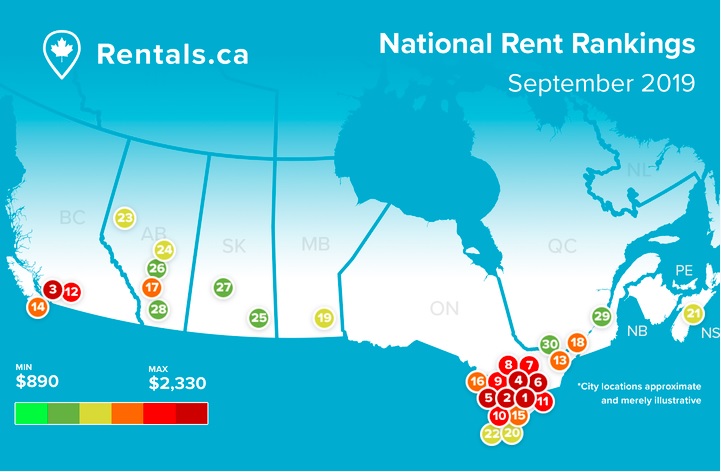
Rental rates in Canada 8% higher than last year

The latest report from Rentals.ca and Bullpen Research & Consulting reveals that although rental rates have declined across Canada for the second month in a row, overall they are up 8 per cent from the end of 2018.

Despite August being one of the busiest months for moving in Canada, that didn’t result in an increase in rental rates month over month, as the average rent for all property types on Rentals.ca declined by 0.7 per cent to $1,914 per month.

This follows a decline of 1.3 per cent in July. The median asking rent in August of $1,800 per month is also down from July ($1,825).

Survey says…

Many landlords have been upgrading and repositioning their multi-residential buildings to capture some of renters’ willingness to pay for better amenities.

Citing preliminary results of the fourth annual Canadian Multi-Res Tenant Rental Survey by Avison Young and Informa, the report indicates that just over one third of the responding 18,000 tenants said they would be willing to pay more rent for a renovated kitchen and bathroom. Fewer than half indicated they are happy with their rental unit as is.

With more apartment renovations and rising rental apartment completions in the pipeline, the report predicts we could see double-digit annual rent increases in Canada for 2019, and considerable movement over the final months of the year.

Affordability

Survey data also shows that tenants in Toronto are spending 42 per cent of their income on rent, while tenants in Vancouver are spending 34 per cent.

“Part of the explanation for this gap are the smaller apartment sizes in Vancouver versus Toronto, but a potential factor could be an increase in the number of households with roommates,” said Ben Myers, president of Bullpen Research & Consulting.

At the bottom of the list, cities with the most affordable average monthly rents are: Gatineau, Quebec City, Lethbridge, Saskatoon and Red Deer.

Ten of the top 11 cities on the list for highest monthly average rent for a one-bedroom home are in Ontario, with Vancouver sitting at number 3 (after Etobicoke).

With many Ontario cities in the high rent category, the province remains the most expensive market for rental apartment over the past three months with an average rent of $2.57 per square foot. Rent has increased significantly in British Columbia from late last year to $2.49 per square foot, up from $2.01 per square foot in Q4-2018.

rental rates September 2019

Other takeaways from the September National Rent Report include:

  • Part of the decline in the national rental rate in August can be attributed to a decline in the percentage of higher-priced condominium apartments and single-family home listings in August, and an increase in the less expensive rental apartments. The chart below shows the monthly breakdown of Rentals.ca listings since October 2018.
  • The Tenant Preferences Survey shows that Toronto renters under 30 are spending 49% of their income on rent. The CMHC recommends no more than a 30% rent-to-income ratio. Also, from the data on Rentals.ca, there is a clear preference among prospective tenants for downtown Toronto.
  • In Halifax, rental rates have been rising quickly in 2019 with the average rent increasing by over $300 per month from early 2019 for all property types.
  • The median rental apartment unit listed on Rentals.ca in Halifax has grown significantly over the last six months from under 1,000 square feet to 1,400 square feet. With almost 4,000 new rental apartments completed from 2016 to 2018 in Halifax, and another 877 in 2019, there are a lot of new units leasing, plus the popularity of Rentals.ca in the province is attracting new landlords with older and larger product.

“Despite affordability concerns, tenants continue to seek out larger apartments,” said Rentals.ca CEO Matt Danison. “The Rentals.ca data shows higher rental growth for two- and three-bedroom condo and rental apartments in Canada in 2019 versus studio and one-bedroom suites.”


QMD-Ménard Consortium breaks ground on Solstice Montréal

Construction of Solstice Montréal has officially started. Designed by award-winning NEUF architect(e)s, the 44-storey, 339-unit development will be located on the prestigious de la Montagne Street, south of René-Lévesque.

“This official groundbreaking constitutes the first step of building an ambitious and memorable project in the heart of a unique and remarkable city,” said Michel Guilbault, vice-president of development of the QMD-Ménard Consortium.

According to the press release Solstice Montréal will have a distinctive contemporary design – its red brick base, inspired by and incorporated within the fabric of Montréal’s urban heritage, will be dominated by a tapered glass tower elegantly surmounted by a unique architectural crown overlooking the St. Lawrence River.

Solstice Montréal will feature communal living areas infused with the finesse of the city’s traditional luxury residences. Three major art pieces will be featured by world-renowned artists Pascale Girardin, Vanessa Harden and David Gardener.

“Not only are we revitalizing a piece of land, but [we are also] building something utterly beautiful and as unique as a fingerprint,” said Benjamin Sternthal, development manager of Solstice Montréal and president and founder of Kodem.

QMD-Ménard Consortium also announced that $100million worth of units has been sold. Furthermore, by the end of the month, prestigious units and Penthouse Collection, that occupy the 32nd floor upward will be launched.

Dealing with mould in air ducts

Noticing signs of mould in your air ducts? Here are some signs to watch for and tips for dealing with this important health and safety consideration.

Red flags

Odours. An unusual or musty odor is often the first sign of mould in air ducts. In many cases, you’ll smell it before you can see it. If you notice a musty smell that goes away when you are not using your air conditioning or heating (if they share ducts), that can narrow the cause down to some part of your HVAC system. Mould can smell wet, rotten, or stale. If you notice a recurring problem, particularly in areas with poor ventilation or a lot of moisture, get it checked out right away.

Visible mould. Look for the first signs of mould around AC vents, in the ducts and in the drip pans. Condenser coils pull moisture out of the air and into drip pans, and if these become clogged they create the perfect environment for mould to grow.

Keep in mind that mould spreads through spores, which are tiny particles that are invisible to the naked eye. That means you won’t necessarily see actual patches of mould growth right away. By the time you do see a noticeable amount of mould, infestation can be quite serious. At that point, you need professional help to get rid of the mould and make sure it doesn’t come back.

Symptoms. If people or pets in your home start exhibiting symptoms whenever the AC is on, mould in air ducts might be the cause. If there’s enough mould in or around the vents, it can spread in the air, causing allergy like symptoms such as headaches, nausea, irritated nose and throat, and itchy eyes.

What causes mould to grow in air ducts?

Mould grows in ductwork when two things are present: moisture and warm temperatures. A warm, humid environment has the ideal conditions for mould to form. A humid climate along with poor ventilation, or anything that traps moisture in your walls and causes condensation, can lead to mould in air ducts.

Here are some of the HVAC problems that can contribute to these conditions and ultimately mould growth:

If your AC unit is oversized for the space you have, one of the problems that it can cause is mould in air ducts. Larger units can cool small spaces too quickly and turn off before dehumidifying the air, leading to excess moisture. This moisture can build up in your rooms and ductwork. If you see mould shortly after a new installation, check to make sure you’ve got the proper sized equipment for the space you have.

Setting your AC on a very low temperature can sometimes lead to mould around the vents. When the cool air from the vents meets the warm air in the room, the temperature difference can cause moisture in the air to condense on surfaces in and around the vents. If that moisture builds up and never gets a chance to dry out, it can lead to mould growth. This is called the temperature differential and usually takes about 20 degrees of difference for moisture to form. If you don’t notice it for a while, the moisture can make its way into your air ducts.

However, if your ducts have leaks that let in warm air, this temperature differential can cause the same kind of problem. The difference between the cold air in the ducts and warm air in the walls can cause moisture to condense on the ducts, giving mould a perfect environment to grow. In this case, you’ll need extensive duct cleaning with mould remediation, and you’ll want to make sure to seal up the leaks in the ducts to prevent the problem from returning.

Why you need a professional to remove mould
Hiring a professional to clean may seem like an unnecessary expense, but technicians can take care of mould and help prevent it from coming back more effectively and safely than you can do yourself.

First of all, scrubbing mould with ordinary cleaners won’t make it go away. Regular cleaning products will leave behind enough mould for it to easily grow back. Professionals have the proper equipment to protect themselves and your home or business from not only the mould, but the chemicals they use to clean it.

More importantly, you can accidentally damage your HVAC system if you try to clean mould in air ducts yourself. Professionals know what to look for and how to treat your AC with care. Professional ductwork cleaners have HVAC training, so they’ll be familiar with your system and know how to clean it without damaging it. They also use the correct mould growth inhibitor products to prevent it from coming back, and they know how to properly dispose of tools to prevent contaminating other areas.

This article was reprinted with permission from Arista.

BOMA Canada announces top CRE achievers of 2019

The Building Owners and Managers Association of Canada (BOMA Canada) hosted its annual National Awards Gala on September 11, 2019, marking the end of another successful three-day BOMEX Summit.

Held at the St. John’s Convention Centre in Newfoundland & Labrador, the 29th National Awards Gala was well-attended by representatives of Canada’s Commercial Real Estate (CRE) sector, where a total of 27 awards were presented, recognizing outstanding contributions to the industry.

TOBY Awards
Top honours for Outstanding Building of the Year went to 13 properties that best demonstrated overall quality and excellence. Judging criteria included: building standards, community impact, tenant relations, energy conservation, environmental performance, regulatory compliance, sustainability, emergency preparedness, security standards, and personnel training. Only BOMA BEST certified buildings were eligible to enter.

In the Office Category, Colliers International was the recipient of two TOBY awards—the first for Desjardin-owned 95 St. Clair West in Toronto (250,000 – 499, 999 Sq. Ft.) and the second for 175 Hargrave Street in Winnipeg (under 100,000 Sq. Ft.). Other award recipients in the Office Category included: Crombie REIT for Scotia Square in Halifax, NS, (over 1 Million Sq. Ft.); Menkes Property Management Services for 25 York Street, Toronto, ON, (500,000 – 1 Million Sq. Ft.); and East Port Properties Limited for 351 WATER in St. John’s, N.L. (100,000 – 249,999 Sq. Ft.).

Oxford Properties Group also scooped up two awards—one for 9050 Airport Road in Brampton in the Industrial Category, and another for Yorkdale Shopping Centre in Toronto (Retail).

Other winners included: MaRS Real Estate in the Mixed-use Category for MaRS West Tower in Toronto; Desjardin for its Corporate Facility located at 150 rue des commandeurs in Lévis, Quebec; QuadReal Property Group in the Historical Building Category for Commerce Court North in Toronto; Halifax Regional Municipality in the Public Assembly Category for Halifax Central Library, Halifax; Crown Property Management in the Renovated Category for 101 McNabb Street in Markham, Ontario; and Morguard Investments for Mississauga City Centre in the mid-rise Suburban Office Category.

National Earth Awards
BOMA Canada’s three National Earth awards recognized excellence in resource preservation and environmentally sound commercial building management. Innovation Place was presented the award for 2 Research Drive in Regina in the Office Category, while Menkes Property Management Services won for the Kennedy Matheson industrial complex in Mississauga, ON. The top prize in the Universal Category was won by RioCan REIT for RioCan Yonge Eglinton Centre in Toronto.

Pinnacle Awards
BOMA Canada’s Pinnacle awards recognized role model companies that demonstrate standards of excellence while acknowledging innovation, teamwork, outstanding customer service and commitment to clients. This year’s Above & Beyond award went to Toronto-based Hallmark Housekeeping Services. Triovest Realty Advisors’ 11025 Jasper Ave. of Edmonton won the award for Innovation. In the Customer Service Category, Oxford Properties Group’s MetroCentre in Toronto was awarded.

Net Zero Challenge Awards
BOMA Canada presented Net Zero Challenge awards in three categories: Most Improved, Innovation and Best in Class. Supported by Natural Resources Canada and sponsored by Bullfrog Power, the awards recognize the leadership of owners, developers, designers, and/or managers of buildings that demonstrate significant progress along the path towards net-zero energy and/or carbon.

In the Most Improved category, Manulife Real Estate was honoured for Toronto’s York Mills Centre. The Innovation award went to the Cadillac Fairview Corporation for 777 Dunsmuir St. in Vancouver. In the Best in Class Category, there was a tie, with one award going to Triovest Realty Advisers for 11 Prologis Boulevard in Mississauga and another to Colliers International for the City of Burnaby’s Deer Lake Centre ll.

BOMA Canada’s newest award was presented in partnership with the Rick Hansen Foundation in recognition of the highest-rated Rick Hansen Foundation Accessibility Certification program building and tenant. Conference keynote speaker Rick Hansen, who spoke the day before the Gala, appeared via video to make the announcement.

Husky Energy’s office at 351 Water Street in St. John’s, Newfoundland and Labrador was recognized in the Tenant Category. In the Building category, 351 WATER, managed by East Port Properties Ltd., tied with Triovest Realty Advisors Inc.’s Marine Gateway, 450 Southwest Marine Dr. in Vancouver, B.C. Husky Energy and 351 WATER were acknowledged for being the first BOMA members rated for accessibility in Newfoundland and Labrador, both having received Gold certifications the day prior from Rick Hansen during a tour of the property.

This year’s BOMI Vyetta Sunderland Scholarship went to Keisha Tanner, Milliken Co-Operative Homes Inc. of Toronto.

Chair’s Award
To round out the evening, BOMA Canada Chair Darren Klassen presented the BOMA Canada Chair’s Award to Stephen Taylor, Vice President Real Estate for the Healthcare of Ontario Pension Plan (HOOPP). Presented annually, this award recognizes an individual who has made valuable and long-lasting contributions to BOMA while supporting the industry in a meaningful way.

The gala closed with the announcement of next year’s BOMEX, which will take place September 22 to 24, 2020 in Vancouver, B.C.

View all of 2019 BOMA Canada National Award winners here.