Articles Archive - Page 387 of 928 - REMINET
REMI

Rapid Housing Initiative exceeds target of 3,000 new homes

Since launching in October 2020, the $1 billion Rapid Housing Initiative (RHI) has exceeded its initial target of creating up to 3,000 new affordable homes for vulnerable Canadians, according to the latest update from the federal government.

“The Rapid Housing Initiative is perhaps the boldest move in a generation to end chronic homelessness,” said Adam Vaughan, Parliamentary Secretary to the Minister of Families, Children and Social Development (Housing). “It not only finds permanent shelter for people in need, but it is a crucial public health measure to keep individuals and communities safe during the pandemic, while also saving cities and communities across Canada money as we work together to provide safe, secure and affordable housing in precarious environments. There is more to do, and there is more to come.”  

Over the past year, the COVID-19 pandemic has put a harsh spotlight on the affordable housing crisis as thousands of Canadians lost their jobs or experienced income loss due to emergency restrictions. RHI will now support the construction of more than 4,700 permanent affordable units for Canadian families, including 1,806 units for Indigenous peoples, from coast to coast to coast.

Through its Projects Stream, the RHI will provide $500 million in funding for 179 priority projects. These projects will help quickly build 2,951 safe and affordable new homes for vulnerable populations across Canada.

Under the Major Cities Stream, $500 million was immediately provided to municipalities with the most severe housing needs and the highest rates of homelessness. Investments made under the RHI are expected to support thousands of construction-related jobs for Canadians as the pandemic surges on.

“Our government wants to ensure that every Canadian has a safe and affordable place to call home,” said the Hon Ahmed Hussen, Minister of Families, Children and Social Development and Minister responsible for CMHC. “The Rapid Housing Initiative will go a long way to supporting those who need it most by quickly providing 4,777 new affordable housing units to vulnerable individuals and families to keep them safe.

Delivered by CMHC, RHI provides capital contributions to develop new, permanent affordable housing by covering costs associated with modular multi-unit rental construction; conversion of non-residential to affordable multi-residential homes; and, rehabilitation of buildings in disrepair and/or abandoned to affordable multi-residential homes.

As of today, The RHI has exceeded its initial target by 1,777 units thanks to the support of the provincial, territorial and municipal governments as well as Indigenous governing bodies. The RHI has received significant interest from Indigenous groups, which resulted in nearly 40 per cent of all units created under the program to be targeted to Indigenous peoples.

To find out more about the application process, click here: Rapid Housing Initiative (cmhc-schl.gc.ca)

Richmond adds new hybrid trucks to fleet

The City of Richmond is the first B.C. municipality to incorporate the new Ford F150 PowerBoost Hybrid—the first full hybrid truck—into its growing sustainable fleet.

“This is the first truck of its kind in Canada and the city is proud to be leading the charge for more environmentally friendly work vehicles,” said Mayor Malcolm Brodie. “The city worked with Ford Canada to develop requirements for hybrid and electric vehicles that meet the realistic needs for work trucks in municipal environments, and we are pleased to see progress in this area and introduce them to our fleet.”

Richmond has received two streamlined hybrid trucks, which will replace current fleet vehicles with fuel engines. The battery is charged by both the regenerative braking system, which recaptures energy normally lost during coasting or braking, and the gas engine. When the truck comes to a complete stop, everything from the radio to the heat runs off the hybrid battery, which means zero emissions.

Powered by a 3.5L PowerBoost V6 430 HP engine, the trucks have a 5,445 kg (12,000 lb) towing capacity so they can haul work equipment trailers, as well as be used as a mobile generator to power equipment.

Richmond has been implementing sustainable fleet management initiatives for more than 10 years through its Green Fleet Action Plan. The city has targeted its vehicle fleet to expand on this ongoing shift towards green operations, which includes acquiring vehicles that have lower emissions and cutting fuel consumption and greenhouse gases.

Hybrid, plug-in and electric vehicles in Richmond’s fleet have helped the city achieve a Platinum rating from the Fraser Basin Council for excellence in fleet management and environmental performance. This is the highest ranking available under this program. The city is also recognized as a leading fleet by Government Fleet magazine and the American Public Works Association.

Design team selected for Laboratories Canada

Laboratories Canada has selected a joint venture team, known as Canada FIRST, to design scientific infrastructure as part of the Ontario Regional Projects bundle.

Canada FIRST, comprised of Architecture49, HOK, and WSP, is supporting Laboratories Canada in its mandate to modernize existing and build new laboratory facilities with the target of establishing a world-class national network of modern and multipurpose federal science and technology laboratories that support collaboration, multidisciplinary research, and innovation.

“Laboratory buildings are designed with sophisticated infrastructure that help drive scientific achievement. We are fueled by resolving the complex interplay of building components and space to support the advancement of our Canadian scientists,” said Kevin Humeniuk, national director science & technology for A49. “Working alongside HOK and WSP, we are committed to the design and delivery of world class laboratories for Canada.

The joint venture team brings together globally recognized architecture and engineering firms with significant experience in delivering design for major science facility modernization projects. Its members have worked extensively together on both science mandates and large-scale program execution around the world.

“As this last year has made even more clear, the future health and well-being of our society is intimately linked to scientific research,” said Randy Kray, HOK director of science + technology. “We are excited and proud to work with Laboratories Canada to help create a national infrastructure of the highest order that aspires to put Canada on the international research map and improve the lives of all Canadians.”

ASHRAE & IAPMO unite on water efficiency document

ASHRAE and the International Association of Plumbing and Mechanical Officials (IAMPO) have announced an agreement to co-publish a document to address water efficiency in buildings.

The comprehensive document will combine ASHRAE”s Standard for the Efficient Use of Water in Building Mechanical Systems with IAPMO’s Water Efficiency and Sanitation Standard to offer complimentary water efficiency guidance and references in one publication.

ASHRAE’s standard provides minimum requirements for the design of building mechanical systems that limit the volume of water required to operate HVAC systems. IAPMO’s focuses on achieving safe and efficient water use in both residential and non-residential buildings.

“Water efficiency and energy conservation are major considerations in the design and operation of HVAC systems in high-performance buildings,” said 2020-21 ASHRAE President Charles E. Gulledge III, P.E. “Escalating costs and concerns regarding availability have brought much-needed attention to the issue of water use in the built environment. We are pleased to collaborate with IAPMO to provide a balanced resource to the water-energy nexus as the demand for sustainable strategies grows.”

“We’re excited to coordinate our development efforts with ASHRAE,” said Dan Cole, IAPMO senior director of technical services. “With the development cycle for 2020 now finalized, we will look forward to ensuring that both standards eliminate any conflicts toward achieving high levels of water efficiency for both mechanical and premise plumbing systems.”

The co-published document will be available upon the conclusion of IAPMO’s 2023 Water Efficiency and Sanitation Standard development process, which is on a three-year cycle.

IAPMO works in combination with governments and the industry for safe, sanitary plumbing and mechanical systems. Learn more about IAPMO at www.iapmo.org.

Founded in 1894, ASHRAE is a global professional society committed to serving humanity by advancing the arts and sciences of HVAC, refrigeration, and allied fields. It and its members are dedicated to promoting a healthy and sustainable built environment for all, through strategic partnerships with organizations in the HVAC&R community and across related industries.

The Society is showcasing integrated building solutions and sustainability in action through the opening of the ASHRAE Global Headquarters building in metro-Atlanta, Georgia. The state-of-the-art, high-performing net-zero-energy efficient global headquarters building is a destination venue for industry representatives, visiting from around the world, who are looking to experience cutting-edge engineering and architectural interventions.

Real estate listing draws U.S. and Irish ire

Regulatory hurdles are forewarned before any new owner can take possession of the 120-year-old Beaux-Arts mansion housing the American Irish Historical Society. New York State Attorney General Letitia James chose St. Patrick’s Day to remind the current proprietor of the landmark site that she is empowered to intervene when not-for-profit organizations attempt to sell property.

“I want to reassure Irish communities here and abroad that any potential transaction would not move forward without consent from my office or consent from the courts,” she reiterated in a statement released today. “I take the recent concerns regarding the future of the building seriously. We are vigilantly monitoring the situation.”

The prominent Fifth Avenue address, located on the edge of Central Park, was listed for sale with an asking price of USD $52 million (CAD $64.5 million) earlier this winter — generating protest within the United States and from the Irish government. The six-storey heritage building has housed the American Irish Historical Society’s cultural centre, library, archives and museum since 1939. The Society itself was established in 1897 and counts former U.S. president Theodore Roosevelt among its historic slate of notable members.

To date, just four successive owners have held title to the property, beginning with the widowed heiress Mary Augustus King. Subsequent owners include the banker David Crawford Clark and William Ellis Corey, an early 20th century president of Carnegie Steel Corporation. Meanwhile, initial neighbouring mansions, including one inhabited by the Woolworth family, were demolished more than 95 years ago.

“Buying a house located directly on Fifth Avenue is like acquiring the Holy Grail because such a limited number remain,” states the real estate listing from Brown Harris Stevens. “Simply put, this opportunity to acquire a building of this caliber directly on Fifth Avenue is one that may never occur again.”

James reports that her office is yet to receive a formal request to enable any such acquisition, and notes that the sale of New York property owned by not-for-profit organizations is contingent on approval from either the Office of the Attorney General or the State Supreme Court.

Average rent in Canada down 6% since February 2020

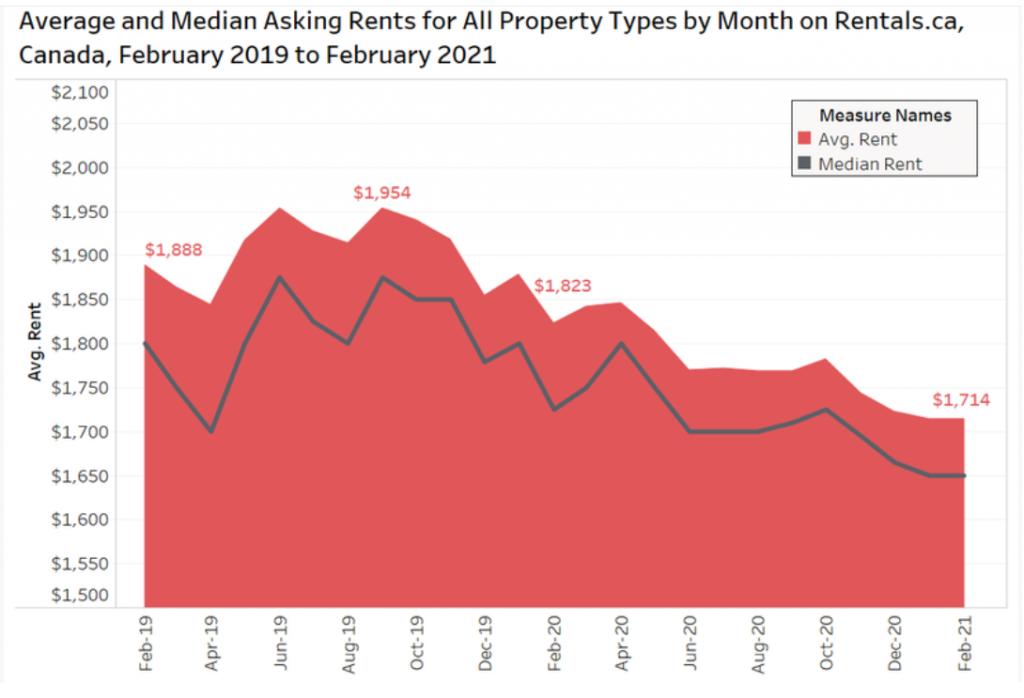
The average rent for all Canadian properties listed on Rentals.ca in February was $1,714 per month, down 6 per cent from $1,823 in February of last year. For landlords, that could be a positive sign given it is the lowest annual decrease reported in the past nine months. From June 2020 through January 2021, rental rates have been down on average between 7 per cent and 9.5 per cent.

More encouraging news is that after a year of pandemic restrictions leading to average rental rates in Canada hitting bottom, rates for single-family, townhouse, and rental apartment properties all increased in February. Vancouver remains the most expensive city for renters looking for one- and two-bedroom homes on the list of 35 cities ($1,891 and $2,568 respectively) while Toronto finished second ($1,808 and $2,388).

Vancouver and Toronto are also the top two priciest cities for condominium rentals and apartments, which didn’t fair so well compared to other housing types.

“The condominium apartment market continues to weigh down the overall rental market in Canada, with huge year-over-year declines in average rental rates in BC, Quebec and Ontario, especially for tiny studio apartments,” said Ben Myers, president of Bullpen Research & Consulting. “Investors have been in a race to the bottom for several months, whereas the more institutional owners of the mostly cheaper rental apartments have been more patient in reducing rent, often using this opportunity to renovate vacated suites.”

Meanwhile, purpose-built rental apartments in Quebec and British Columbia recorded annual increases in their average monthly rental rate across the board, with three-bedroom rental apartments in British Columbia showing an annual increase of 28 per cent.

On a provincial level, British Columbia had the highest average monthly rental rate for all property types in February at $1,954. Ontario had the second highest average rental rate at $1,919 per month. Newfoundland had the lowest average monthly rental rate at $988.

The average monthly rental rates in Ontario decreased 13 per cent year over year in February for all property types. Quebec rents were also down, and average rents in Alberta and Saskatchewan were slightly down. Average monthly rents in British Columbia, Manitoba, and Newfoundland were up year over year.

All 20 of the Canadian neighbourhoods with the biggest declines in average rent levels over the last year for all property types were in the Greater Toronto Area.

Other key takeaways:

  • Pageviews on Rentals.ca are up 48 per cent in the first two months of 2021 over the final two months of 2020. Fear of COVID-19 might have prevented some would-be renters from thinking about a move. Now, many tenants are considering moving and taking advantage of the cheaper rental rates.
  • Condo apartments have experienced significant declines in 2021 with average monthly rent down 18.1 per cent in February.
  • Units listed on Rentals.ca in the $1,600 price range so far this year are double the rate of the last two years. Among the reasons for this are average rents going down for more expensive units — especially pricey condo rentals — and the bottom of the market getting more expensive, as there are fewer $800-to-$1,000-per-month rentals.
  • Condo apartments and single-family homes in Canada’s priciest cities — Toronto and Vancouver — both experienced steep declines in the average monthly rental rates year over year. Exacerbating the rental market decline in Toronto recently has been the addition of 2,254 new rental apartments completed over the final four months of 2020.
  • St. John’s had the least expensive average monthly rent in February of the 35 cities on the list for a one-bedroom home at $865, and Red Deer had the least expensive average monthly rent for a two-bedroom at $995.

See the completer report here: https://rentals.ca/national-rent-report

B.C. extends state of emergency, marking one year

The Province of British Columbia has formally extended the provincial state of emergency for the 26th time, marking a year since this declaration was issued in response to COVID-19.

This unprecedented, continued state of emergency allows health and emergency management officials to continue to use extraordinary powers under the Emergency Program Act (EPA) to support the province’s COVID-19 pandemic response.

The state of emergency is extended through the end of the day on March 30, 2021, to allow staff to take the necessary actions to keep British Columbians safe and manage immediate concerns and COVID-19 outbreaks.

“British Columbians have been living with the challenges of COVID-19 for more than a year, and while our lives have changed, our resolve has not,” said Premier John Horgan. “This is a sobering occasion, but with vaccinations ongoing in B.C., it’s also one for hope and optimism. Let’s continue to follow public health orders and advice to ensure we can be healthy and safe as we look forward to better days ahead.”

This week, the province marks a year since Dr. Bonnie Henry, the provincial health officer (PHO), declared a public health emergency in response to COVID-19. The extension of the provincial state of emergency is based on recommendations from B.C.’s health and emergency management officials. The original declaration was made on March 18, 2020, the day after Henry declared a public health emergency.

“Although this has been a challenging year, the best is still before us. If we continue to focus on keeping ourselves and our communities safe by following the orders and restrictions in place, we will end this state of emergency,” said Mike Farnworth, Minister of Public Safety and Solicitor General. “I want to thank the majority of people in B.C. who are following the rules. For those who don’t, our compliance and enforcement officers have the tools they need to enforce the orders. Know that if you break the rules, you will face consequences.”

The province continues, with the support of police and other enforcement officials, to use measures under the EPA to limit the spread of COVID-19, including issuing tickets for owners, operators and event organizers who host an event or gathering contravening the PHO’s orders.

On July 10, 2020, the COVID-19 Related Measures Act came into force, enabling provisions created for citizens and businesses in response to the COVID-19 pandemic to continue as needed should the provincial state of emergency end.

Tailgate Toolkit Project addresses overdose crisis

The Tailgate Toolkit Project launched by the Vancouver Island Construction Association (VICA) aims to address the ongoing overdose crisis on Vancouver Island.

“Workers in construction, the trades, and transportation have been hit particularly hard by this crisis,” says Sheila Malcolmson, Minister of Mental Health and Addictions. “We want people to feel comfortable talking about mental health and substance use.  This project will go a long way to reducing the stigma that still stops people from reaching out for the help they need and deserve.”

The Ministry of Mental Health and Addictions is investing nearly a quarter million dollars with Island Health into the Tailgate Toolkit Project which is an innovative new harm-reduction strategy, targeted to reach those who primarily work in the trades. The BC Coroners Service reported in 2018 that of those who lost their lives, 81 per cent were men, 44 per cent of people who died of overdose were employed, and more than half worked in trades or transport.

“The ongoing overdose crisis cannot be overshadowed by the COVID pandemic,” states Rory Kulmala, CEO of the Vancouver Island Construction Association.  “We are eager to work with Island Heath and all our various stakeholders to develop an innovative harm-reduction strategy to assist at-risk workers from a variety of industries.”

The Tailgate Toolkit Project will consist of a three-phased approach, stakeholder engagement, development and implementation of training curriculum, and refinement of training based on feedback.

Phase one of The Tailgate Toolkit Project is underway. VICA will be holding focus groups for supervisors, managers, owners, union reps, and educators in construction to share their ideas and experiences of how drug use effects construction. VICA will also be holding confidential one-on-one interviews with anyone who has worked in construction within the last five years and uses or has used drugs. The interviews will be used to develop a training curriculum and resources for employers and employees, and will guide recommendations to reduce drug harms in the trades sector.

What the new Construction Act means for condos

Construction is a billion-dollar industry in Canada. While most large projects at condominiums proceed relatively smoothly, there is always risk of friction for contractors and owners alike. Recently, changes were made to modernize the Construction Lien Act with regard to lien and holdback rules to make it easier and more likely that contractors get paid for their work in a timely manner and to improve the resolution of disputes. Here are some key takeaways for condominium boards, managers and owners.

After a long period of consultation with stakeholders, the Construction Lien Act became the Construction Act on July 1, 2018. At that time, new amendments to the construction lien and holdback regulations came into effect. Prime contracts signed after July 1, 2018 (and before October 1, 2019) must comply with these new regulations. On October 1, 2019, additional new rules regarding prompt payment and the adjudication process also came into effect. Contracts signed after this date must comply with all the new rules.

Quick Reminder

A lien is a form of security given or taken over an item of property to secure the payment of a debt or performance of some other obligation. In the case of construction, liens can be placed against titles of properties by constructors to allow them to get compensated for completed work.

A holdback is a statutory requirement in Ontario that an owner hold back 10 per cent of an invoice payment as a means of security to ensure all parties working on a contract are paid (eg. sub-contractors). The holdback can be released once the lien period has expired.

Lien Period Increases from 45 to 60 Days

Previously, the contractor had 45 days to register a lien. The new provision in the Act ups this to 60 days. Additionally, the lien perfection period is up from 45 days to 90 days after the last day to file a lien, which means the contractor has 90 days to start a lawsuit and register the action with the owner. Both of these make it easier for the contractor to make a claim against the title of the property, so extra diligence is required on the part of owners, managers and consultants to limit the risk.

Definition of Substantial Performance Revised

A project is “substantially performed” by definition after the majority of the work required under contract has been completed, and the “improvement is ready for use, being used for the intended purpose, and when the improvement is capable of completion…” Previously, substantial performance could be claimed when the work remaining was three per cent of the first $500,000, two per cent of the next $500,000 and one per cent of the contract balance. These have been revised to: Three per cent of the first $1 million and two per cent of the next $1 million. One per cent of the contract balance remains the same.

The net effect of this is to make it slightly easier for the contractor to claim that the project is substantially complete and should not materially impact the corporation and the engineer providing project oversight.

Calculation of Completion Revised

A project has to be deemed “complete” in order for the contractor to request holdback. Prior to July 2018, the calculation for completeness was “the lesser of $1,000 or one per cent of the contract value.” This has been revised to “the lesser of $5,000 or one per cent of the contract value.”

The impact of this is relatively minimal for the corporation, but fairer to the constructor who can now rightfully apply for release of holdback sooner. On a large project, $5,000 is a more just approximation of “minor” work remaining.

Prompt Payment Rules

For prime contracts struck after October 19, the Act introduces a 28-day time limit to pay the contractor on receipt of a “proper” invoice (a “proper” invoice has a specific definition in the Act, outlining exactly what an invoice must include). This enshrines fair payment for approved work for the contractor, and the deadline cannot be modified in the Supplemental Conditions of the contract. Significantly, the 28-day period includes the time required for the corporation’s engineer to process the invoice and CFP. This benefits the contractor and corporation as it requires the consultant to process CFPs almost immediately.

The Act also defaults to a monthly invoicing schedule if not specified in the contract. Corporations that wish to control the billing can choose to include a milestone payment schedule in the contract.

What happens if the owner disputes an invoice? The Act specifies provisions that work to protect the contractor: any party who wishes to dispute an invoice must issue a notice of non-payment within 14 days from receipt of a proper invoice; unpaid invoices are subject to interest; and the contractor has the right to suspend work on site.

As always, it is preferable to negotiate with the parties to avoid formal disputes, but non-payment of a progress invoice does not mean that work must stop.

Mandatory Adjudication

In large projects, disagreements between parties will arise. The corporation’s engineer can often act to smooth them over, but some are inevitable. To facilitate and accelerate the resolution of disputes, the new Act mandates that the parties enter binding (temporarily) adjudication. The adjudicator can be chosen or is assigned.

Adjudication services are available for on-going projects for disputes that may include valuation of services or materials, payments including change orders, and notice of non-payment under the new prompt payment rules.

A party who wishes to file a dispute must deliver a written notice of adjudication. The adjudicator must file a decision within 30 days of receiving the documents. The adjudicator’s decision is binding on the parties unless and until the issue goes to court or the parties settle. This mechanism could have a major impact on construction activity and imposes short timelines on all parties, so diligent and organized project management is even more essential to forestall and respond to disputes.

It is clear that these updates to the Construction Act will impact how construction projects are administered and managed in Ontario. For condominiums and their consultants, it will require additional oversight and likely some advance planning, particularly around the prompt payment rules—to get procedures in place before the work starts in order to ensure the major repair progresses smoothly and their hard-earned reserve fund savings are protected.

Gerard Gransaull, P. Eng. is Director, Building Science – Building Condition Assessment, for WSP in Canada.

NOTE: The material and information contained in this article does not constitute legal advice in any way. Condos needing more in-depth information should consult their counsel.


Vancouver mass timber schools receive funding  

The Vancouver School Board has received $1.4 million in federal funding for two pilot mass timber schools: Bayview Elementary School and Sir Mathew Begbie Elementary School. This investment will enable the construction of two local schools as part of recent seismic upgrades to make B.C. schools safer.

The original structure of Bayview Elementary School was demolished, making way for a new school to be built over the existing footprint with a greater resistance against earthquakes. The building consists of two-storeys of classrooms and teaching areas, as well as a gymnasium and Neighbourhood Learning Centre.

Sir Mathew Begbie Elementary School will be a completely new, 34,000-square-foot modern design with open learning spaces. With the use of mass timber as the primary building material, the total carbon benefit is approximately 1,400 tonnes of carbon dioxide, the equivalent of removing hundreds of cars from the road for a year.

Funding for the project is provided through Natural Resources Canada’s Green Construction through Wood (GCWood) Program, which encourages the use of wood in non-traditional construction projects, such as tall wood buildings, low-rise non-residential buildings and bridges. The program aims to position Canada as a world leader in innovative wood construction technologies and the low-carbon economy.

Projects like this help Canada achieve its 2030 climate change goals by finding effective ways of building sustainably using Canadian wood products, reducing greenhouse gas emissions and improving seismic performance.

“These two schools serve as a great example of the potential that can be realized with mass timber construction. In addition to meeting the demands of the seismic mitigation program, the timber framing systems used in these buildings provide warm, inviting spaces for the school community as well as help the school board meet their sustainability objectives,” said Nick Bevilacqua, principal, Fast + Epp structural engineers.

Mass timber use in public buildings, such as schools, reduces greenhouse gas emissions, promotes innovation and supports local value-added manufacturing.


Will heightened cleaning habits remain post-COVID-19?

As we reach the anniversary of the onset of the COVID-19 pandemic in North America, a prominent question is whether the enhanced cleaning habits that have developed over the last 12 months will remain once the pandemic is over.

According to an American Cleaning Institute (ACI) survey, the answer is yes.

Data collected by the survey suggests cleaning practices are still front and centre for a large majority of Americans.

A national online consumer survey conducted by Ipsos on behalf of ACI shows that 85 percent of respondents are very or somewhat likely to maintain the same level of cleaning practices initially adopted in March 2020 when the pandemic has passed.

Proper cleaning and disinfecting practices like increased sanitization and accordance to disinfectant dwell times are proven to help protect against the spread of germs and viruses, according to the ACI.

As schools and communities across North America begin to reopen, and while new variants of the virus continue to spread, experts maintain the cleaning and hygiene habits adopted at the onset of the pandemic will continue to play a crucial role in helping prevent the spread of illness.

Results from ACI’s national survey shed light on how and why Americans plan to continue their cleaning and disinfecting behaviours.

Key findings include:

  • Cleaning Products Usage Continues: Americans reported an increase in the use of key adopted cleaning, disinfecting and hygiene habits since March 2020: hand sanitizer (72 per cent now vs. 59 per cent pre-COVID-19), disinfectant wipes (55 per cent vs. 44 per cent) and spray disinfectant (42 per cent vs. 36 per cent).
  • Heightened Hand Hygiene: More than 75 per cent of respondents plan to continue to wash their hands frequently with soap and water and 57 per cent report plans to continue using hand sanitizer frequently in the future.
  • The Reason to Clean: 73 per cent say that protecting their own health and wellness is a reason to continue their COVID-19 cleaning habits, and 62 per cent cite protecting the health and wellness of others as a motviation.

RELATED: COVID-19 is bringing common sense back to cleaning

“The survey results and trends highlighted are encouraging for broader adoption and potential long-term behavioural changes in Americans’ cleaning habits for their health,” said Melissa Hockstad, ACI President & CEO. “While we continue to fight against the spread of COVID-19, Americans must stay vigilant to help protect themselves and the places where they live and work. That’s why smart, targeted hygiene and cleaning practices are so important in our homes and communities every single day.”

From small business owners and school faculty to general consumers, ACI has a variety of resources available on effective cleaning, disinfecting and hygiene protocols. For more information, visit www.cleaninginstitute.org/Coronavirus.

These are the findings from an Ipsos poll conducted February 16-17, 2021 on behalf of the American Cleaning Institute. For the survey, a sample of 1,005 adults ages 18 and over from the continental U.S., Alaska, and Hawaii was interviewed online in English. The poll has a credibility interval of plus or minus 3.5 percentage points.

Mobile health unit takes shape at Sunnybrook

Sunnybrook Hospital is currently assembling a mobile health unit in one of its large parking lots as Toronto remains one of Ontario’s hardest hit regions during the pandemic.

The hospital began accommodating for the space in February, with help from the federal and provincial governments. Equipment has arrived for the set-up and the structures are being built and configured for 84 beds, with room for 100 if needed.

Each pod of eight to ten beds is self-contained and is equipped with the necessary medical support system as well as washroom facilities. A number of large generators provide power for the mobile health unit.  Expected completion is sometime next month.

Last month, Ontario Health Minister Christine Elliott said the province is doing as much as possible to support hospitals as they respond to COVID-19.

“As Ontario continues to add more hospital beds and build capacity in our health care system, these new mobile health units will further help us alleviate the strain on our hospitals and intensive care units.” she stated. “We will continue to work with the federal government and our health care partners to support our hospitals and care for patients affected by this deadly virus.”

Sunnybrook will be working with its partners in the healthcare system and the province to staff the facility. The facility will also receive support from the Wellspring house located adjacent to the parking lot. In the event of an increase in the demand for beds, the facility will most likely be used to provide space for patients who are awaiting placement in other facilities, and low acuity recovering patients, which will free up acute and critical care beds in the hospital.


CUI report reflects on impact of COVID-19

A new report from the Canadian Urban Institute (CUI) confirms that how Canadians experienced the impacts of COVID-19 throughout the past year depended very much on where they live, whether or not they have children, and whether they are racialized or white.

COVID Signpost 365 provides a seminal report on the year since the World Health Organization declared a global pandemic, and illustrates that Canada’s 20 largest cities, home to 42 per cent of the population, were hit disproportionately experiencing 62 per cent of COVID cases and 64 per cent of deaths.

Drawn from public health data, community leaders and opinion research involving 180,000 Canadians over the past year, COVID Signpost 365 found the impact of the virus has profoundly shaped people’s attitudes and concerns about virtually every aspect of their lives, with racialized and lower income residents reporting far greater impacts virtually across the board.  

From personal finances, work and socialization, to travel, public transportation and the way we care for children and elderly family members, COVID-19 affected not only the way we live, but our perceptions and thoughts about the future.

Exploring aspects of COVID-19 that changed how we live, work, move, care and thrive, COVID Signpost 365 also reveals profound differences in how these changes were experienced depending on gender, age, people living with or without children and among racialized and lower income residents of Canada.

The report also compiles more than 100 examples of community leadership that emerged across the country, and reveals how Canada’s largest cities banded together to tackle their most pressing problems.

“Over the past year, COVID has wreaked havoc on our world. We have lost more than 22,000 Canadians, with more than 893,000 people sick with confirmed cases of the virus. For the lucky among us who did not contract COVID, the impacts have still been severe,” says Mary W. Rowe, president and CEO, Canadian Urban Institute. “For racialized communities, people living in poverty and others who already faced significant barriers in their lives, the COVID

experience has been even more difficult. This report tells the story of the past year by sharing the thoughts and opinions of thousands of Canadians, and the inspiration provided through remarkable examples of local leadership. It closes a chapter on a year unlike any other and tells us just how much work we have to do to build back cities that are more just, equitable, livable and vibrant for everyone.”

Brokerages to merge Montreal operations

Avison Young and Devencore have announced plans to merge Montreal operations and offices. The deal, which is expected to be finalized this spring, will bring the two real estate brokerage and advisory firms together under the Avison Young banner to deliver occupier and corporate services, lease administration, tenant representation and a range of associated professional expertise in project management and consulting.

“The complementary strengths of our teams will provide significant value to clients in the form of expanded professional and corporate services as well as access to technology, data and insights,” promises Mark Fieder, Principal and President of Avison Young in Canada.

Devencore was established in 1972 and has since become one of Canada’s largest privately owned corporate real estate brokerages. Avison Young is a private company with a 100+ offices in 15 countries, and which counts Caisse de dépôt et placement du Québec as a key investor. The new partnership with Devencore adds Montreal to a Canadian slate that also covers Toronto, Ottawa, Halifax, Winnipeg, Regina, Edmonton, Calgary, Lethbridge and Vancouver.

“In forming one of the largest commercial real estate presence in Montreal, we will bring the next level of technology, data and insight to help clients achieve their business goals,” says Jean Laurin, chief executive officer of Devencore, who will transition to Avison Young’s president and managing director for Quebec.

Ontario bestows land for community hub in Jane and Finch area

Ontario is donating 2.174 acres of land to the City of Toronto to build a much-needed community hub and centre for the arts in the Jane and Finch community. The land is adjacent to the future Finch West LRT Maintenance and Storage Facility and is being transferred at no cost.

The land contribution will allow the city to continue design-related work and establish partnerships to construct a new 65,000-square-foot centre to help serve the larger goals of community collaboration.

“We need to acknowledge the tremendous effort and work of the Jane Finch community, a diverse and vibrant neighbourhood, towards securing this land, stated the Jane-Finch Community Hub Organizing Committee. “We look forward to continuing our stewardship of this process with the province, City of Toronto and Metrolinx, and securing the necessary sustainable funding to build and operate the hub that our community has envisioned over many years.”

The province and its partners are also exploring how a future community centre could align with the Black Youth Action Plan as part of the land transfer agreement. The Black Youth Action Plan was released in 2017 as a four-year $47 million investment to help address persistent outcomes disparities for Black Ontarians. If supported, this community space could also offer economic empowerment programming, among other services, to support local youth in achieving social and economic success.

“We are dedicated to ensuring that our vital transit projects provide strong links so that there is a seamless connection to the communities in which they are being built,” said Kinga Surma, associate minister of transportation (GTA). “We are so proud to take this first step to enable this transformative community space that will help improve opportunities for today’s youth and future generations in the Jane and Finch community.”

Metrolinx President and CEO Phil Verster echoed the sentiment, adding they’ll “make good” on the next commitment, which is to bring “great transit” to the community with the Finch LRT.

West Kelowna awards treatment plant contract

The City of West Kelowna has awarded the $45 million contract for construction of the Rose Valley Water Treatment Plant to Maple Reinders Constructors Ltd.

Site and civil construction began in spring 2020 and the project completion is scheduled for 2022. When operational in 2022, the plant will serve over 18,000 residents representing more than half of West Kelowna’s population. It will also create hundreds of local jobs and supports continued investments in infrastructure and the local economy. 

The three-storey, 5,100-square-metre plant is being built on a 9.7 hectare City-owned property at 2010 Bartley Road, accessed via the end of Rosewood Drive, and will have capacity to provide up to 70 million litres of treated water per day, with future expansion capacity of 115 million litres.  

“This next phase of major construction will begin in the coming weeks for the Rose Valley Water Treatment Plant with the award of this contract to Maple Reinders. Local jobs will be created that will help keep workers and their families supported, especially during this unprecedented COVID-19 pandemic,” said Gord Milsom, Mayor of the City of West Kelowna. 

The Government of Canada and the Province of British Columbia awarded the City of West Kelowna a funding contribution of $41 million toward construction of the $75 million Rose Valley Water Treatment Plant under the Clean Water and Wastewater Fund.

“Our government is committed to helping B.C. communities thrive by supporting the core infrastructure that people depend on in their daily lives. This new facility, funded through the Clean Water and Wastewater Fund, will provide residents and businesses in West Kelowna with safe, clean drinking water that will sustain one of B.C.’s fastest growing communities well into the future,” said Hon. Josie Osborne, British Columbia’s Minister of Municipal Affairs.

Sensors to monitor air pollution on UBC campus

UBC’s Rapid Air Improvement Network (RAIN) is installing a network of air quality sensors on the campus this summer, with plans to also use mobile monitoring and sophisticated analysis instruments to locate and study air pollutants.

The goal is to gather necessary details for fast and effective interventions. Air pollution is linked to as many as nine million deaths per year worldwide and 14,000 annually in Canada.

The team plans to leverage the university’s traffic, population and operations data, which can be quickly tuned to improve air quality. The mobile monitoring station will be used further away, including communities affected by wildfires and other areas in urgent need.

The data will be translated into effective interventions, including control strategies for engines, traffic flow and building ventilation.

“Air pollution is chemically and physically complex, and concentrations outdoors and indoors can vary dramatically with location and over time,” said principal investigator Dr. Steven Rogak, a professor of mechanical engineering in the faculty of applied science. “With RAIN, we are looking to produce meaningful information that can help the public, industry and governments take smarter actions on health and climate around the world.”

The RAIN team includes experts in health, chemistry, meteorology, engineering and environmental policy, working with academic, government and industry partners. The project is receiving $2 million in new infrastructure funding from the federal government through the Canada Foundation for Innovation (CFI).

Rogak, an aerosols expert, adds that air quality has become even more important in the midst of the ongoing COVID-19 crisis.

“We are looking for solutions that improve air quality and promote healthy homes and workplaces through the current pandemic, and after,” he said. “And they should be relevant not only in Canada but also beyond, including in lower-income countries.”