





Articles Archive - Page 385 of 928 - REMINET
REMI

The traditional office is dead

The pandemic has prompted many questions about the future of the office. Is it dead? Is remote work here to stay? Will we go back to our old ways as soon as a vaccine arrives? Such questions have ignited a fierce debate among experts and society at large. The news cycle is dominated with stories of companies shedding space or shifting to remote work as a permanent option.

To those who ask me about the traditional office being dead, my response is clear and unequivocal: Yes, the office as we know it is dead, but that doesn’t mean it won’t be reborn in a new and better way. It is, in a way, experiencing a renaissance.

Change can be daunting, and for many, the option to just “wait it out” is an attractive one, but there’s one thing we know for sure: The scale, severity and duration of the pandemic has formed new working habits, set new expectations, and cemented strong beliefs among employees that will forever alter the purpose of the physical office.

For many companies, instead of a place where employees come to perform individual and task-oriented work for over eight hours a day, the office shifts to a resilient and adaptable space. A place where employees come as needed to touch down, interact, collaborate and ideate before transitioning back to remote work and individual tasks. This blended workplace also requires a digital work environment that integrates team culture and connects people both in and outside the physical workspace. In contrast to one centralized location, a blended workplace operates as an ecosystem of remote and communal settings, all connected digitally.

The office as we knew it is a thing of the past. Here’s why.

The need for human connection

At its core, the office serves one irreplaceable function – connecting people. While some of that is purely social, the physical workspace also drives innovation by enabling collaboration and the spontaneous cross-pollination of ideas. Experience has shown that bouncing ideas around, riffing off one another, exploring possibilities and developing plans is substantially limited in digital settings. Discussions are often hindered by challenges in bringing energy to a group setting, reducing conversations to the tactical level, falling short of the visionary and conceptual.

The physical workplace also plays a critical role in nurturing brand, culture and a collective sense of purpose among employees. Creating a feeling of inclusiveness, sharing vision and direction, mentoring, and making meaningful connections all contribute to an employee’s sense of belonging and safety, which contributes to a company’s success. And they all happen more organically when face-to-face. With coming to the office now a conscious choice instead of a default mode, we don’t come together just because we have to, we come together intentionally and for a purpose. We might even be more focused and productive when we do.
office

Rethinking the office footprint

There is no doubt that many companies are rethinking the size of their real estate footprint. But without strategically thinking about the right composition and focusing largely on reduction, organizations risk missing the opportunity to elevate their spaces to meet employee needs and enhance their performance.

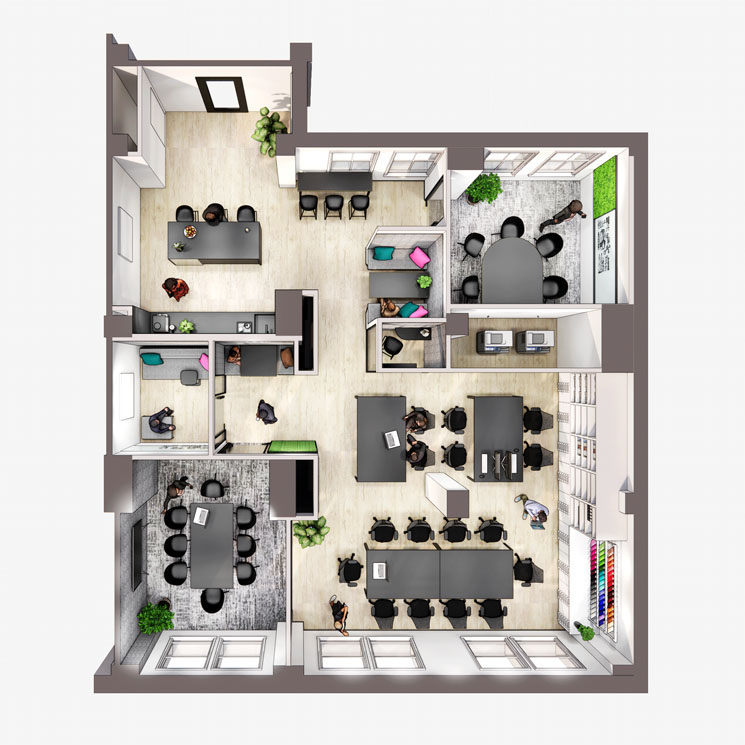
With a new focus on human interaction, companies should consider repurposing space from individual assigned workstations to environments that accommodate a variety of needs. From appropriately spaced group settings to shared heads-down focus space for those who need, office design in our new normal cannot be rigid. It must provide built in flexibility and modularity to support and encourage a business and its employees to tailor the space to meet the needs of the day.

For some companies, this re-composition of office space introduces possibilities for a reduced footprint, while for others it allows a reallocation of a portion of the office portfolio. As an example, at our Vancouver office, we were able to support a distributed workforce through a smaller space composed to support the full team headcount and all their workplace needs. Flexible schedules, new workflows and seamless technology empower a smooth transition between in-office and remote work. Space reservation technology along with versatile and multi-purpose work settings, allow the team to book and reconfigure the space as needed to support their workflow.

Organizations looking to fully harness the potential of the post-COVID work environment must shift to behaviour-based design principles. This process begins by understanding people, defining personas, and outlining the behaviors that contribute to their best work. The results will guide the various space types required and provide a path to a long-term solutions, as opposed to blindly downsizing the office space to save money.

Transforming how we measure performance and impact

Changing the space alone is not enough. Hand-in-hand with the re-composition of space is a necessary transformation in how we assess work and performance. For example, performance measures must shift to focus more on “outputs” rather than traditional “inputs” such as attendance, hours spent working, presence in meetings, etc. This readjustment places the value on what we achieve more than the process of getting there. Working independently and autonomously will also become the norm as leaders empower their teams to make decisions and perform tasks with less direct oversight. Adaptive and collaborative work requires the right environments matched with the right workflows and technologies.

We must break old norms and push through to new ecosystems that build resiliency, foster human connections and nurture culture, purpose, and innovation. The blended workplace provides a vehicle for companies and their employees to embrace new ways of working and the renaissance the office needs to take on this new world.

Nabil Sabet is group director at M Moser Associates in Vancouver.
Conspiracy charges laid after years-long bid-rigging inquiry

A years-long inquiry into allegations of bid-rigging and conspiracy in the supply of condo refurbishment services has finally wrapped up as the Competition Bureau laid multiple criminal charges against four companies and three individuals in the Greater Toronto Area.

As previously reported in 2016, in a story for CondoBusiness, “bid-rigging is when, in response to a call for bids or tenders, two or more parties agree, unbeknownst to the organization issuing the call, that one or more of them will withdraw or withhold a bid, or make submissions based on an arrangement with competing bidders. Conspiracy deals with an agreement between competitors to fix the price or restrict the supply of a product or services, or to allocate customers or markets.”

The following companies and individuals have each been charged under the Criminal Code with conspiracy to rig bids, conspiracy to commit fraud, and fraud over $5,000: TRI-CAN Contract Incorporated and owner Bob Vlahopoulos; JCO & Associates (912547 Ontario Inc.) and owner Jose De Oliveira; as well as LAR Condominium Refurbishment Specialists (Lidio Romanin Construction Company Limited) and owner Tony Romanin. A fourth company, CPL Interiors Ltd., was charged under the conspiracy provision of the Competition Act for its role in the alleged scheme.

The Competition Bureau alleges that the accused conspired to commit fraud and rig bids for refurbishment contracts issued by private condo corporations in the GTA between 2009 and 2014. The condo corporations and the condo owners who fund them are the alleged victims who may be entitled to pursue the recovery of any associated damages.

“Criminal conspiracies that undermine competitive markets can cause extreme damage to our economy,” Commissioner of Competition Matthew Boswell said in a press release. “The message should be loud and clear: if you enter into criminal agreements with your competitors, we will do everything in our power to uncover the facts and bring the evidence to court.”

Information about bid-rigging awareness and prevention is available on the Competition Bureau’s website.

Quebec cuts small business corporate tax rate

Quebec’s small business corporate tax rate has been aligned with Ontario’s. The new 20 per cent reduction for taxpayers eligible for the small business deduction — taking the rate down to 3.2 per cent on the first $500,000 of taxable earnings — was announced in the 2021 provincial budget last week.

“Small and medium-sized business play a key role in the economic fabric of all of Québec’s regions,” Finance Minister Éric Girard noted in the budget speech. “The government would like to see local small businesses become medium-sized businesses, and local medium-sized businesses become large businesses. We are lending businesses a helping hand in this regard.”

The Quebec government estimates the new measure, which went into effect as of budget day on March 25, will translate into about $70 million in collective annual tax savings for approximately 70,000 qualifying businesses. This is the second corporate tax reduction they’ve seen since January 1, when a 4 per cent rate on the first $500,000 of taxable earnings was introduced.

The 2021 budget also pledges a temporary doubling of the C3i tax credit for expenditures on computer hardware, management software or manufacturing and processing equipment. Introduced in the 2020 budget, small and medium-sized businesses are eligible for a refundable tax credit on costs greater than $5,000 when they purchase computer hardware and/or management software, or costs in excess of $12,500 for the purchase of manufacturing and processing equipment. Large corporations can claim non-refundable tax credits for the same expenditures.

The tax credit is prorated to regional economic vitality and will increase from 10 to 20 per cent for claimants in the Montreal and Quebec City metropolitan areas for purchases made between March 25 and December 31, 2022. Taxpayers in most other urban centres of the province will see the tax credit rise from 15 to 30 per cent, while it will jump from 20 to 40 per cent in a small number of more remote regions.

“This temporary increase will encourage more than 10,000 businesses in all sectors of activity to accelerate their plans for purchasing new technologies,” Girard maintained.

The Quebec government has budgeted about $290 million for the top-up measure. As of January 1, 2023, the tax credit will remain in place at the original rate scale for purchases made until December 31, 2024.

Fossil fuel fortunes burn Calgary

Fossil fuel fortunes continue to hold predominant sway in the Calgary office market. Reflecting on a year in which a global pandemic unsettled fundamentals to the east and to the west, Calgary-based analysts focus more on tangential circumstances than the COVID-19 outbreak itself.

During last week’s online commercial real estate review and forecast, executives with CBRE Calgary’s investment and advisory services fingered an economy tied to oil and gas for sinking the hesitant recovery that had appeared underway as 2020 began. They’re now projecting that more than a third of the downtown office inventory will be vacant by the time 2021 comes to a close.

Angus Fraser, executive vice president of office leasing, noted that few Canadian producers could viably compete as world oil prices plummeted to about $15 a barrel in sync with the early days of the COVID-19 pandemic, and weaker players have been relatively easy prey as prices recovered to the current $65/barrel range. He tallied the departure of three foreign firms — Devon Energy, Murphy Oil and Equinor — over the past 12 months and an uptick in mergers and acquisitions (M&A), such as Cenovus Energy’s recent takeover of Husky Energy. That further aggravates a five-year trend of downsizing in the sector’s office footprint.

“Our first quarter results are going to show a vacancy rate of 32.3 per cent and that’s on the back of negative absorption of 1.25 million square feet,” Fraser revealed. “Negative absorption was driven primarily by that M&A activity in the energy sector. In almost all cases, all of the office space of the acquired entity was put back on the market. The Cenovus acquisition of Husky Energy was certainly a large contributor to that number with the expected redundancy of all of Western Canadian Place.”

With downtown office space continuing to empty out in the coming months, he taps the vacancy rate to hit 34.5 per cent by end of the fourth quarter. Looking to the suburbs, Stuart Watson, a senior vice president with CBRE Calgary, outlined a similar energy-related history, albeit with the hollowing out of a slightly different tenant base.

A flourishing engineering services sector largely underpinned the construction spree that that doubled suburban inventory from 13 million to 26 million square feet in the years between 2005 and 2015. Likewise, the sector’s doldrums ripple through now.

“A lot of the space that was built over that cycle was A Class space with big expansive floorplates,” Watson advised. “The problem that we’ve faced, really from 2015 onwards, is the disappearance of big energy projects, the consolidation of that (engineering) sector and, as we come out of this pandemic, the new embracement of new workplace strategies.”

Tech sector contributes to change-related activity

Both Watson and Fraser see some promise in the tech sector, which has been a focus of the city of Calgary’s economic development strategy. There’s evidence of more local capital going into the sector as wary investors shift away from energy and — ironically — real estate; a planned downtown SAIT (Southern Alberta Institute of Technology) campus will accommodate the new school of advanced technology; and downtown tech tenants have absorbed about 500,000 square feet of space since 2016 with much of that filled during the past two years.

“Relative to the retreat of oil and gas, this is small potatoes, but, nonetheless, this is a source of growth that previously didn’t exist here,” Fraser acknowledged.

For companies favouring a return to formal office settings after the prolonged pandemic interlude, he also suggests downtown Calgary offers an attractive combination of low rents, a paucity of dense open-plan formats that would require overhauls to accommodate social distancing, and shorter commuting times than downtown workers may encounter in other large cities. Turning to the suburbs, Watson urges landlords to pivot to capture tech sector players that have been more inclined to build their own facilities.

“In the short-term, a lot of the activity in the market is going to be change-related not growth-related,” Watson hypothesized. “There’s a new challenge for the supply side of the market. Owners are going to have to find a way to innovate their properties in order to capture demand in what’s really going to be a win-lose market.”

National supply chains link industrial market to better prospects

For a contrasting supply dilemma, Iain Ferguson, CBRE’s vice chair, industrial properties, calculates that there will be no large blocks of 100,000+ square feet available for lease within 30 to 90 days. Logistics firms and national supply chain operators stymied in the tight Vancouver, Toronto and Montreal markets have been central to the past year’s activity, also priming conditions for new development.

Among factors in the Calgary market’s favour, Ferguson explains that most major consumer products companies already have a presence in the city. Meanwhile, CN and CP intermodal connections to British Columbia’s ports arguably make Calgary the best available alternative option to the lower mainland.

“We ran into a lot of circumstances in 2020 with corporate clients of ours, where they just couldn’t find the space in any of those (big three) markets and they started doing what we’re calling overweighting into Calgary,” he recounted. “Where as they might have done something smaller in Calgary or preferred to have done a deal in Toronto, they ended up doing that bigger deal in Calgary.”

Even with current supply constraints for large blocks of industrial space, Ferguson contends new product can be more quickly and cost-effectively built in Calgary.

“Due to the fact that there is a lot of vacant land available for construction, it’s a market where economics are still in line with fundamentals,” he submitted. “If you came in and said “I’d like to have a facility built in 12 or 18 months,” this is probably the only place in Canada where you could do that and where there’s a ready supply of land and a competitive field of developers and a fairly robust amount of capital to support development of these facilities.”

Private buyers more conspicuous in investment transactions

For now, capital is more circumspect about other kinds of investment property. CBRE senior vice president Duncan MacLean confirmed that 2020 was a near-low year for sales volume — “only slightly beaten to the downside by 1999” — in which private buyers accounted for 61 per cent of the deals by dollar volume as institutional investors “abstained from participating on the purchase side”. That’s a buyer profile he expects will continue in the short term, but with all investors showing more appetite in 2021.

“We’re expecting that transaction volumes for almost all asset classes will increase. It is difficult to go the other way,” MacLean said.

At least one major investment manager indicates he and his peers haven’t stepped away indefinitely. Participating in a panel discussion in conjunction with the release of the results of the Canada Annual Property Index earlier this winter, Peter Cuthbert, president and head of global real estate with Fiera Real Estate Investments, sketched out a scenario for the city and its real estate market to recapture lost standing.

“Calgary has a very innovative, very smart, very young workforce. I think they’ll re-emerge. They are going to continue to diversify their economy with a continued emphasis on energy, but it’s going to be renewable and sustainable energy,” he predicted. “If we have any leadership through our political side, maybe we start investing in clean energy because the demand for energy is not diminishing.”

HCMA Architecture announces new associates

Vancouver HCMA Architecture + Design announces five new associates: Federica Piccone, Corey Grobe, Jessika MacDonald, Vanessa Konn, and Rob Wilson.

Each have displayed exemplary leadership, not just on projects, but also in helping the firm to navigate the complexities brought on by the past year.

The new associates:

Federica Piccone is intrigued by the creative and investigative nature of architecture. She’s passionate about creating interactive, but environmentally conscious designs. Federica has been an integral part of the team since 2012, playing a key role on projects such as the Townline East Loop and the Vancouver Firehall No. 17 redevelopment.

Corey Grobe excels in providing high quality design, with thorough construction documentation. With a decade of experience, he’s well versed in both the creative and technical side of architecture, working on major projects such as the Minoru Centre for Active Living and the Harry Jerome Community Recreation Centre.

Jessika MacDonald is intrigued by spaces that foster human connection. She’s moved all over Canada to pursue her passion and since joining HCMA in 2014, has focused her talents on designing public facilities, such as the Clayton Community Centre and Grandview Heights Aquatic Centre.

Vanessa Konn applies the perfect balance of creativity and logic to her work. Her enthusiasm for design, and passion for visual art, are evident in all of her projects, such as the Coronation Community Sports Centre, our own Edmonton office, and LOT 185.

Rob Wilson is motivated by seeing projects come to life. He’s taken the technical lead on many large institutional projects, such as the New Westminister Aquatic Centre, R.E. Mountain Secondary, and the South Burnaby Ice Arena. Rob was chosen to represent BCIT at the World Student Environmental Summit in Kyoto, Japan. Protecting the environment is at the forefront of his design process.


SAPL launches second design ideas competition

The School of Architecture, Planning and Landscape (SAPL) at the University of Calgary has launched its second international design ideas competition, asking: How can designers intervene in borders?

The program describes borders as a spaces of transition, whether political and imposed through human agency, or natural and made manifest through geographical features — borders are associated with civilization’s greatest challenges.

The competition asks entrants to consider the opportunities, challenges, and complexities latent within borders and propose new paradigms. Participants can choose any type of border, define a friction that presents a programmatic opportunity, and propose a design that impacts the agents (human or otherwise) that are affected, influenced, or in proximity to that border.

“As humanity wakes from the immobility that has been imposed by the pandemic, the relationships that govern our world will look much different than those of just one year ago. In this transitionary phase to new tomorrows, borderlands hold immense potential as microcosms of civilization. This competition tackles a timely topic that seeks to examine urgent questions,” says Alberto de Salvatierra, assistant professor with the School of Architecture, Planning, and Landscape and CBDX chair.

Converging crises over the past year including the global pandemic, racial divides, geopolitical conflict, and the climate emergency demand a clear focus on society’s challenges and vulnerabilities.

“Confronted with an unprecedented number of calamities and injustices, we need to reconsider how design can challenge the nature of borders and participate in their reconsideration. We have a responsibility to understand and shepherd positive future change that questions and potentially bridges these lines of division. We’re pleased with the ideas generated from our previous competition, CITIES FOR ALL, which speculated on new approaches for equitable, diverse, and inclusive cities; we challenge everyone — including designers, planners, policy-makers, humanitarians, and social scientists — to respond to the global condition of borderlands.” – Dr. John L. Brown, Ph.D., dean of the School of Architecture, Planning, and Landscape.

The competition offers $6000 in prizes and the deadline for submissions is June 21, 2021. The international, interdisciplinary jury will announce the winning entries on September 8, 2021.

The CBDX Series is made possible through the support of Stantec, a global design and delivery firm. Selected entries will be exhibited in September 2021 and published in Fall 2021. CBDX is organized, in part, by the Center for Civilization.

B.C districts receive additional COVID support

Regional districts in B.C. will receive $10 million to support local services and operations, building on the historic COVID-19 relief and recovery supports provided to communities.

“The COVID-19 pandemic has changed all our lives and local governments are on the front line, which is why we have already delivered hundreds of millions directly to communities to support them through restart and recovery,” said Josie Osborne, Minister of Municipal Affairs. “We’ve partnered with communities to deliver the critical services people count on, and now we’re further boosting support to regional districts to make sure we continue to reach people in every corner of British Columbia.”

The safe restart funding is part of the province’s ongoing work to give local governments the tools they need to provide the essential services people count on in their communities.

The COVID-19 Safe Restart operating grants will deliver an additional $10 million in funding shared among the 27 regional districts in the province by the end of March 2021. The funding will assist regional districts with the delivery of regional and local services that have been impacted by COVID-19.

The COVID-19 Safe Restart Agreement is providing $540 million in direct support to B.C. local governments to help communities manage the impacts of the pandemic. The province distributed $415 million in COVID-19 Safe Restart grants to all 188 local governments in B.C. in November 2020 to help with operating costs and respond to pressures caused by the pandemic.

Since then, the provincial government has continued to provide funding to local governments, including a $100-million program to support people experiencing homelessness and strengthen communities, and a $15-million program to improve the efficiency of development approvals to get the housing people need built faster in communities throughout the province. Applications for those programs are open through the Union of B.C. Municipalities.

The Safe Restart Agreement is funded equally by the governments of B.C. and Canada.

Graham DB to deliver new Fort St. James hospital

Graham Design Builders LP has been selected as the successful proponent to deliver a new hospital in Fort St. James.

Northern Health requested and received proposals from three shortlisted proponents for this stage of the procurement process, the design-early works agreement (DEWA). Those teams were Clark Builders, Graham Design Builders LP and SBW Wright Construction JV.

A DEWA is a contractual agreement between the design builder and Northern Health, which gets the design phase underway. The next step includes issuing a draft design-build request for proposals and draft design-build agreement to the preferred proponent.

“The selection of a proponent for the DEWA is an important step in the development of a new hospital and primary care centre for Fort St. James and area,” said Colleen Nyce, board chair, Northern Health. “We look forward to the health service improvements this development will provide for people living in Fort St. James and the surrounding First Nations communities.”

The new hospital is expected to be three times larger in building size than the current facility with 27 beds, including 18 long-term care beds. There will be an emergency department with two treatment rooms, a trauma bay and ambulance bay. A laboratory and diagnostic imaging will be part of the new facility.

The hospital will include a primary care centre to consolidate services offered in Fort St. James at one location, reducing the distance patients and staff need to go for medical appointments, community health services, diagnostic imaging and lab services.

“This investment announcement within our region is tremendous news for the community of Fort St. James and the surrounding rural and First Nations populations that rely on the invaluable local health services provided from this facility, not only today, but now secured for the future,” said Jerry Petersen, chair, Stuart Nechako Regional Hospital District.

New rental housing coming to Laval, Quebec

The Government of Canada announced it is investing $66.3 million toward the construction of a 193-unit rental building in Laval, Quebec, in the form of a low-cost loan. This investment will provide new rental housing options close to public transit, schools and services for families in the Laval area.

The 18-storey residential building is receiving the loan through Canada’s Rental Construction Financing initiative (RCFi), a National Housing Strategy program delivered by CMHC. The program encourages a stable supply of rental housing to support middle-class families facing expensive housing markets.

“Our government is committed to ensuring that our investments meet the housing needs of residents here in Laval and across the country,” said the Hon. Ahmed Hussen, Minister of Families, Children and Social Development and Minister responsible Canada Mortgage and Housing Corporation (CMHC). “We will continue to increase the supply of rental units, while creating well-paying middle-class jobs and strengthening our economy

“Current events remind us that nothing is more important than a home,” added Annie Koutrakis, Member of Parliament for Vimy. “By supporting this new project, we are providing housing options that are closer to jobs, services and amenities for Laval families. We believe that every Canadian deserves a safe and affordable place to call home and through the National Housing Strategy, investments like the one we are announcing today bring us closer to achieving this goal.” 

The Government of Canada acknowledges Central Park Laval is located on the traditional and unceded territory of the Kanienʼkehá꞉ka (Mohawk).

Annual rents of 106 of the 193 units in the building will be well below 30 per cent of the median household income in the area. These affordable rent levels will be maintained for a minimum of 16 years from the date of first occupancy.

The 193 units will serve to meet the strong demand for rental in an area where the vacancy rate is currently around 2 percent. The project has barrier-free access, with at least 22 of the units offering universal design and meet local accessibility standards. The building is also designed to achieve a minimum 22 per cent decrease in energy- intensity and a 15.6 percent reduction in greenhouse gas emissions, relative to the requirements in the 2015 National Energy Code for Buildings.

Find about the RCFi program here: Rental Construction Financing | CMHC (cmhc-schl.gc.ca)

Strong housing market to power through 2021

Will Canadians continue working from home after the pandemic winds down? No one knows for sure, and especially to what extent people will return to traditional office settings, but it may impact the housing market for some time.

In its annual report on the State of the Residential Mortgage Market, Mortgage Professionals Canada (MPC) reiterates what many market-observers are thinking: a strong 2020 housing market will likely power through this year.

The report incorporates data collected through an online survey of 1,957 Canadians conducted between January 18 and February 9, 2021 by Bond Brand Loyalty for Mortgage Professionals Canada. It also refrains from forecasting within the context of much uncertainty.

Findings show about 4.5 to 5 per cent of Canadians usually buy a new or existing home in any given year, but this number might rise to about 5.5 to 6 percent this year.

“There has been a quite small rise in the percentage of Canadians buying homes, but in proportional terms, this is a very large increase, and it is overwhelming the available supply,” explained Will Dunning, chief economist for MPC and report author. “It is possible, but far from certain, that this could continue for some time – that a small rise in the percentage of Canadians who buy homes could result in sustained very strong demand.”

As the report outlines, about six of the overall 10-million owner-occupied dwellings in Canada have mortgages. Some analysts predicted that mortgage defaults would rise during the pandemic, but this hasn’t been the case.

“Since June, Canada has experienced eight consecutive months of record-breaking real estate transaction figures,” saiid Paul Taylor, president & CEO of MPC. “Through the uncertainty, our collective desire for the stability and security that home ownership provides seems to have significantly buoyed the market. And while mortgage indebtedness has increased, so too has prudent repayment activity.”

Last year, he said, many Canadians decided to voluntarily increase their payments to shorten their mortgage amortization periods, amounting to $5.2 billion (annualized) in payments. “Further, lump sum payments totalled $28 billion and an additional $7 billion was paid to fully pay out mortgages. Canadians continue to exercise sound judgment in taking on mortgages and repaying mortgage debt.”

Forecasting post-pandemic demand for mortgages remains challenging amid the many powerful factors at play. such as work-from-home options and how that will affect housing choices.

“While interest rates have recently increased from record lows, and house prices have increased sharply, calculations of affordability continue to show that mortgage costs are still positive for home buying”, said Dunning. “Low interest rates have created ‘affordability space’ in which prices might rise. Unfortunately, the imbalance between demand and supply has allowed for extreme price growth to fill a lot of that space.”

Ontario looks to stabilize and revive tourism

The Ontario government will uncork a $350-million tonic to help stabilize and revive tourism and hospitality ventures. That will be poured out as direct aid for small operators, support programs for larger attractions, and inducements for consumers, following a year of COVID-19-related business losses.

The newly released 2021 provincial budget pledges about $100 million to deliver one-time grants of $10,000 to $20,000 for small businesses including hotels, motels, amusement parks, recreational and vacation camps, and hunting and fishing lodges. Further details and an application portal are yet to be available on the government’s webpages for COVID-19 support programs. However, eligibility requirements will be aligned with those for the existing grant program for a range of small businesses forced to shut down or restrict operations due to public health controls.

Tourism/hospitality operators will have to demonstrate revenue declines of at least 20 per cent compared to the pre-pandemic period and employ fewer than 100 people. Applicants will not qualify if they have already been approved for grants under the existing small business relief program.

Additionally, a $100-million Ontario Tourism Recovery Program is promised to help subsidize marketing costs and other reopening logistics for larger ventures and attractions. “This initiative will provide support for historically successful businesses that have helped to drive employment and visitation in their regions,” the budget document states.

Ontarians can also expect some encouragement to vacation in the province via a future tax credit. The budget reports $150 million has been earmarked for that purpose and enabling legislation will be introduced “when public health experts advise that it is safe to travel”.

In the interim, staycationers will have an economical option for outings since entry fees to Ontario provincial parks will be waived for day use, Mondays to Thursdays from May 1 to September 2.

“Parks and conservation reserves have been places of safe recreation during the pandemic,” the budget document observes. “This will help more people and families enjoy outdoor activities such as canoeing, hiking and bike riding in provincial parks.”

Focusing on best cleaning practices for public transit

While public transit passenger volumes plummeted during the early weeks and months of the COVID-19 pandemic, they have rebounded significantly by this point, one year on.

Now, the International Association of Public Transport (UITP) has partnered with the Global Biorisk Advisory Council (GBAC) to provide transit service providers with cleaning and disinfecting best practices.

UITP members will also be offered discounted rates to achieve GBAC STAR accreditation, the cleaning industry’s standard for prepared facilities and the only outbreak prevention, response, and recovery accreditation for facilities.

In the United States, only two transit agencies, the Central Ohio Transit Authority and Anaheim Transportation Network, have so far earned accreditation.

UITP and GBAC conducted a survey of UITP members to identify “dos and don’ts” for cleaning and disinfection in a transit environment and the survey results will be put into a report, which is expected to be released in April.

UITP says the collaboration will “continue to strengthen our responses to the ongoing international situation.”

While public transport providers have enhanced their cleaning practices from the initial spread of the pandemic, costs associated with these procedures have had an impact on service providers globally. UITP says it will be important for the transit sector to review and adapt current practices, maximize the safety of public transport networks, and keep costs under control.

“Public transportation is a vital service in society that people must rely on as they return to their routines after COVID-19 lockdowns. It is our duty to help passengers and employees develop assurance in their safety as ridership levels increase. Part of that confidence-building comes from validating your protocols and communicating the many steps you are taking to protect people…now is a time when multiple disciplines must work together to protect public health and help local economies recover, making your infection prevention programs vital to a faster, safer recovery,” said GBAC Executive Director Patricia Olinger.

“Working with our international membership on how best to react to the ongoing global pandemic continues to be a top priority for UITP. By collaborating with leading voices, such as the expertise at ISSA, we can expand our knowledge and output even further. Sharing research and insight allows us to take a closer look at how to best adapt cleaning and disinfection to ensure the highest level of safety for public transport employees and passengers and strengthen the response of the sector to the coronavirus pandemic,” said UITP Deputy Director of Knowledge and Innovation Karine Sbirrazzuoli.

The GBAC STAR accreditation was developed to work with the framework of local or national jurisdictions and includes 20 key elements every plan should have, such as worker safety programs, cleaning and disinfecting, personal protective equipment, infection prevention strategies, and more.

Ontario doubles tax credit in tertiary markets

Investors, landlords and developers could see a refundable tax credit of up to $90,000 if they build, acquire or renovate a commercial or industrial building in southwest, eastern or northern Ontario during the next 21 months. The newly released 2021 Ontario budget announces a temporary doubling of the Regional Opportunities Investment Tax Credit, which came into effect in March 2020, resetting the rebate rate at 20 per cent for up to $450,000 worth of eligible investment.

“At a critical time when many businesses are looking to re‐open or transition their operations, enhancing the Regional Opportunities Investment Tax Credit would provide opportunities for economic growth and job creation,” the budget document maintains.

The tax credit is available for Canadian-controlled private corporations making expenditures within 34 counties or regional districts where employment growth lagged the provincial average during the decade from 2009 to 2019. This covers most of the province outside of Ottawa, the Greater Toronto Area and surrounding regions encompassing Barrie, Hamilton, Niagara, Kitchener-Waterloo and Guelph.

For investors interested in secondary and tertiary markets, the tax credit is available in several prominent mid-sized cities including London, Windsor, Kingston, Peterborough, Greater Sudbury and Thunder Bay. To qualify, a building must be purchased, renovated or completed and ready for occupancy between March 24, 2021 and December 31, 2022. The same undertakings are eligible for a 10 per cent refundable tax credit in the period between March 2020 and March 23, 2021.

The credit applies on capital investment in excess of $50,000 to a maximum of $500,000. The Ontario government has budgeted about $61 million for the program to the end of the 2022-23 tax year.

New home for world’s largest Inuit art collection

A 10-day expedition through the small communities of Nunavut. Visiting the homes and studios of Indigenous artists and elders. Taking in the Arctic landscapes of Cape Dorset, Rankin Inlet and Pangniqtuuq. It was a trip that helped inspire Qaumajuq, the new centre for Inuit art at the Winnipeg Art Gallery (WAG).

Qaumajuq, meaning “it is bright” or “it is lit” in Inuktitut, opens this week. The 40,000-square-foot addition has been almost a decade in the making. Back in 2013, the project team including WAG’s Director and CEO Stephen D. Borys and architect Michael Maltzan, who won the contract through an international competition of 125 submissions, travelled to the Arctic to gather ideas. The design evolved from there, grounded in the land, light and peoples of the North.

“Their relationship to the landscape, the dynamic of the seasons, it all kept feeling to me like it wasn’t a constrained, linear culture, but one that had a great deal of fluidity in it,” says Maltzan. “The building is trying to capture some of that spirit.”

Forms of contemporary Inuit art are constantly evolving in scale and medium, from paper and weaving to video art. Maltzan, who is based in Los Angeles, intended to disrupt the typical ways in which art of the North is displayed, creating spaces that will serve a new generation of Inuit artists. “There’s been an argument that art looks the best and feels most alive in a space that is similar to the studio space in which the art was created,” he says. “For Inuit art the studio has been the North itself, in its vastness, scale and light.”

This idea plays out through small intimate galleries and a main exhibition space named Qilak, meaning “sky”—a 8,000-square-foot gallery with 34-foot ceilings, twenty-two skylights and monumental, sculptural white walls that evoke Arctic landscapes.

“It doesn’t have the traditional four silos and four corners of a gallery,” Maltzan observes. “It feels much more fluid and is likely going to give each of the subsequent shows that happen their own personality.”

Together, the interior spaces, the natural light, the vistas within, complement the scalloped fluidity of the white granite façade, which was intended to “engage playfully” with the Winnipeg daylight and connect seamlessly to the original WAG building, designed in 1971 by Gustavo De Rosa.

Much time was spent searching for a design that would be a strong presence on its own, in contrast to the sharper, prismatic forms of the WAG. “The two buildings together form a more complete assemblage with a strong urban public front on every side of the block,” Maltzan adds.

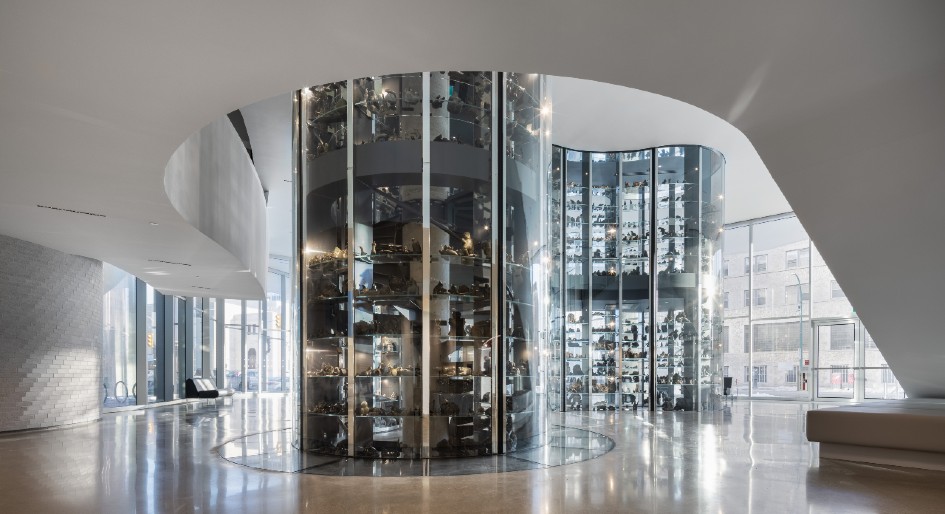
Upon approaching the building, the public is pulled into the life happening inside. A goal for the new gallery was to create a more transparent and accessible experience, which is partly fulfilled with the addition of a three-storey visible vault that holds close to 5,000 Inuit sculptures, located on the ground floor entrance hall.

It’s the largest of its kind in the world. Unlike other museum vaults that are tucked away in basements, off-site and secured, patrons get to observe and digitally engage with the artifacts.

“This is a very secure space; it’s climate controlled but very visually accessible, and the way we can do that is because a large chunk of the Inuit collection is stone and stone is resilient with light,”says Borys. “It’s a way for the audience not just to see thousands of artworks, but you can also see curators working within the space.”

There’s been an increasing trend in making hidden collections more a part of the visitors’ experience, that plausibly started in the 1970s with Arthur Erickson’s Museum of Anthropology in Vancouver, notes Maltzan. “I think the most forceful, most dynamic presentations of a collection are [presenting] them right at the front door of the museums,” he says. “The visible vault space you can see from the outside; you don’t even have to enter the centre to get a sense of the art.”

Inuit art

The visible vault rises two floors above the entrance hall and one floor below ground where a storage facility is located. Photo by Lindsay Reid

The WAG houses the largest public art collection of Inuit art in the world, with close to 14,000 objects and another 7,400 on long-term loan from the Nunavut government. But before the $55-million addition, at any given time, less than 10 per cent of the collection was ever on view and exhibited within a more colonial-formed structure. “When you’re able to dismantle some of the structure and ideas and formats in which you presented a culture, it’s kind of liberating,” says Borys.

Qaumajuq is a cultural venue for Inuit in Canada and a platform for their voices. As the design project evolved, it became a response to the 2015 Truth and Reconciliation Commission’s calls to action, with guidance and decolonization work from the WAG’s Indigenous advisors. The name is bestowed by an Indigenous Language Keeper Circle that was inspired by the light pouring into the new centre.

Qaumajuq programming bridges the South to the North, with an 85-seat Learning Steps Theatre in the main hall. The smart classroom will connect kids in Winnipeg to those in Rankin Inlet and other communities in Nunavut for lectures and performances.

A research library and archives is another feature. New sun-filled art studios and classrooms on the penthouse level and rooftop move beyond standard studio programming. Spaces there include a clay studio, digital media studio, kiln room, and two exterior studios for summer and winter activities, such as stone carving and ice sculpting.

“Every once in a while, I find it’s a perfect kind of storm, where you have a designer and an architect; you have a patron or owner and a project, and they come together and there’s a synergy; there’s a way we work together that’s much greater than what we would have done separately,” says Borys.

“This design really reflects many, many visions and voices, which is exciting, and clearly the Inuit had a very strong voice and input.”

Qaumajuq is located on Treaty 1, the original lands of Anishinaabe, Ininiwak, Anishininiwak, Dakota, and Dene peoples, and the homeland of the Métis Nation.

Photos by Lindsay Reid

AMO designation marks diamond anniversary

This is a diamond anniversary year for the Accredited Management Organization (AMO) designation. Although the Institute of Real Estate Management (IREM) unveiled its then novel certification program for real estate management firms in September 1945, the first credentials to signify a company adhered to the newly defined business practice standards were conferred about six months later.

“For 75 years, IREM has recognized the commitment to ethical business practices, financial responsibility and professional management demonstrated by an elite group of real estate management companies,” observes Chip Watts, IREM president for 2021, and president of Watts Realty Company, an AMO-certified company based in Birmingham, Alabama. “Achieving AMO certification subjects a firm to intense scrutiny, but rewards them by opening doors to new business opportunities, and the recognition that comes with being the best in our business.”

From an initial 162 designations for U.S. based companies, AMO has become a globally recognized indicator of reputable real estate management practices, also proudly upheld by Canadian companies. IREM has likewise broadened its certification scope, providing professional development opportunities for real estate management practitioners and assurance to their clients through its CPM (certified property manager), ARM (residential property manager) and ACoM (commercial property manager) programs.

B.C. construction lunchbox supports restaurants

B.C.’s construction industry is celebrating its fourth annual Construction and Skilled Trades Month by offering 100 grants totalling $37,500 to encourage construction employers to treat their crews to a free lunch from a local restaurant. Sponsors hope this will kick off a pass-it-on type challenge and spur lunchtime events on construction sites across B.C. during April.

The initiative, known as the #lunchboxchallenge, was introduced by Scott Construction last spring. The BC Construction Association, initiators of Construction Month and platinum sponsors along with LNG Canada, jumped on board to support Scott Construction’s initiative. This year it is a big part of the official Construction Month activities.

“Our industry was declared essential throughout the pandemic, and while it’s been a tough year, we’re proud of how well we’ve done and keen to give the workforce a bit of recognition,” says Chris Atchison, BCCA president. “We’re grateful that we were able to keep working. The restaurant industry hasn’t been so fortunate, so it’s good do a little something to help the local restaurants who are also working hard in every community.”

Last year, more than 200 employers participated in the #lunchboxchallenge. This year, with the added incentive of 100 starter grants ($250 or $500 maximums depending on size of crew) to kick things off, the sponsors of Construction Month are hoping to see even more lunchtime celebrations across BC.

“It’s wonderful to see B.C.’s construction industry go out of its way to support the wider community and reach out to local restaurants that may be struggling to get through the COVID-19 pandemic intact,” said Ian Tostenson, president and CEO of the BC Restaurant and Foodservices Association. “It’s a generous idea and we’re thrilled to support it by making posters available to all our members so they can put them up in the window or even visit the construction sites near them and make sure they’re aware of the grants and the #lunchboxchallenge.”

In non-COVID times, 35,000 businesses across the two industries employ nearly 400,000 British Columbians and contribute over 10 per cent of the provincial GDP. While construction has been deemed essential and kept working throughout the pandemic, the restauranteurs have been harder hit.

To find out more about Construction Month, access the grant applications, and download a #lunchtimechallenge poster, go to www.constructionmonth.ca


ISSA Show Canada Goes Virtual in 2021

The annual ISSA Show Canada is going virtual for 2021.

After the 2020 edition of the show was postponed due to the effects of COVID-19 and governmental restrictions on large gatherings, the ISSA Show Canada will reconvene virtually on June 17, 2021 with a focus on educating and inspiring the cleaning industry.

The theme of the show will be Facing the Future TOGETHER, recognizing the cleaning industry’s position today, and where we may go from here. As such, the virtual show will feature keynote presentations, education sessions, supplier technology sessions, and virtual networking receptions.

The Show is Canada’s leading trade show and conference for property, facility, and operations managers and facility service providers. The unique trade show and conference creates a platform for informed insight on best practices, industry certifications and training, educational programming that touches upon relevant and emerging topics within the Canadian facility and cleaning markets, and peer-to-peer networking.

A large and well-represented selection of industry manufacturers, service providers and professional services organizations are represented at ISSA Show Canada.

Key decision-makers involved in the commercial, retail, industrial, educational, healthcare, government, multi-unit residential and hospitality sectors will find the show relevant.

For more information and to register, visit canadashow.issa.com.

While the Canada show will be going virtual in June, ISSA is currently planning to hold the ISSA Show North America as a live, in-person event once again from November 15-18 at the new Las Vegas Convention Center West Hall in Las Vegas, COVID-19 and restrictions permitting.

