Articles Archive - Page 31 of 928 - REMINET
REMI

Alberta allocates $22M for school safety upgrades

The government of Alberta is providing a one-time grant of $20 million to upgrade school security infrastructure and $2 million for safety-related training for school staff.

“In response to the tragedy in Tumbler Ridge, we are taking decisive action to strengthen school security and ensure staff are better prepared to respond in critical moments,” said Demetrios Nicolaides, minister of education and childcare. “Safety cannot be an afterthought, and we will continue working closely with school boards to make sure they have the infrastructure, tools and training needed to protect students and staff when it matters most.”

The funding allocated for building security improvements will be distributed to eligible school boards based on student enrollment and will support upgrades such as locks, doors, security cameras, window coverings and other related measures.

Funding for safety training will help school authorities strengthen their preparedness and response capacity to various safety incidents. Of the $2 million in funding earmarked, a one-time grant of $1.75 million will be distributed among public school authorities based on the number of student enrollments. The remaining $250,000 will be awarded to the Association of Independent Schools & Colleges in Alberta to provide training to eligible leaders from independent schools.

Schools will determine the best way to use this funding. Eligible training may include trauma-informed practices, emergency preparedness, multidisciplinary approaches to intervention, or critical incident response.

School authorities will be required to report on the use of funds, by means of an interim report due in November 2026 and a final report due in November 2027.

Over the next few months, the government will also implement uniform provincial standards that will support the safety of students and schools across all public, separate, French-language and chartered school authorities, as well as accredited independent school authorities.

Sq’éwqel Community School wins Prix du XXe siècle

The Sq’éwqel Community School (formerly Seabird Island School), located on the Seabird Island First Nation near Agassiz, British Columbia, has been named a 2026 winner of the Prix du XXe siècle by the Royal Architectural Institute of Canada (RAIC).

The Prix du XXe Siècle celebrates design quality and enduring excellence, recognizing the design of the original architects and/or firms and the on-going stewardship of the building’s owners.

The Sq’éwqel Community School, designed by Patkau Architects and completed in 1991, is a celebrated work of wood architecture recognized for integrating Salish cultural traditions with environmental design.

By making the school a part of the village common space, interaction between the school and the community is encouraged. At the same time, the extreme winter winds which are funnelled between the mountains down the river valley from the north are mediated by the large mass of the school.

In mediating between the extreme winter winds from the north and the favourable exposure toward the south, the mass and scale of the school undergo a transformation. On the north, large sculptural volumes are closed diverting the winds much like the mountains which surround the site. To the south the scale is small, the building open under generous eaves. A complex, more tectonic quality not present in the sculptural forms of the north is introduced here through the use of a variety of struts, beams and trellises.

Today, the school remains a touchstone in discussions of socially responsive architecture in Canada. It illustrates how built form can participate in reconciliation—not as a symbolic gesture alone, but as a lived, daily environment shaped by and for the community it serves.


Staying Ahead of the Seasons: Practical Maintenance, Landscaping, and Tools to Keep Managers Grounded

Seasonal change is one of the few constants in condominium management. With each shift in weather comes a predictable set of maintenance demands, landscaping considerations, and operational pressures. While experienced managers know the rhythm well, the cumulative impact of seasonal transitions: tight timelines, vendor coordination, budget constraints, and resident expectations can create significant stress.

The good news? A proactive, organized approach—supported by the right tools and education—can turn seasonal maintenance from a source of strain into a manageable, even confidence-building, part of the job.

Start with a Seasonal Maintenance Mindset

Effective seasonal maintenance begins long before the first heat wave or snowfall. The most successful condominium managers think in cycles, not emergencies.

A high-level seasonal maintenance framework typically includes annualized tasks tracked for each site and may include:

  • Spring: Post-winter inspections, roofing and envelope checks, landscaping restoration, irrigation start-up, and mechanical system assessments.
  • Summer: Preventive HVAC maintenance, cooling system monitoring, exterior cleaning, pavement repairs, and garden upkeep.
  • Fall: Boiler and heating system servicing, gutter and drainage clearing, leaf management, and winter readiness planning.
  • Winter: Snow and ice management, emergency preparedness, monitoring of heating systems, and ongoing safety inspections.

By mapping these activities in advance, managers can better align vendor availability, manage budgets more predictably, and reduce the risk of reactive decision-making when issues arise.

Landscaping: More Than Curb Appeal

Seasonal landscaping is often viewed primarily through an aesthetic lens, but its operational importance should not be underestimated. Healthy landscapes support drainage, protect building foundations, and contribute to resident satisfaction—particularly during peak spring and summer months.

Key considerations include:

  • Coordinating seasonal planting and pruning schedules;
  • Monitoring irrigation systems for leaks or inefficiencies;
  • Planning for fall leaf removal to protect drains and walkways;
  • Selecting plantings that balance appearance with long-term maintenance requirements; and
  • Clear landscaping scopes and timelines also make it easier to manage contractor expectations and communicate effectively with boards and residents.

Organization as a Stress-Reduction Strategy

One of the most common stressors for condominium managers is the feeling of being “behind” the season. Organization is one of the most effective antidotes.

Tools such as maintenance calendars, standardized inspection checklists, and recurring taskmaintenance reminders can significantly reduce mental load. When expectations are documented and timelines are visible, managers spend less time reacting and more time overseeing.

This is where shared resources and industry-specific tools can make a meaningful difference.

Additional mindfulness management strategies are available from ACMO and include an advanced program to assist managers in staying grounded.

Leveraging ACMO Resources to Support Seasonal Planning

ACMO has continued to expand its library of practical tools and educational resources designed specifically for the lived reality of condominium managers.

One example is ACMO Tech, which has evolved into a continually updated resource hub offering concise, real-world content on technical and operational topics relevant to condominium management. These short presentations, checklists, and videos are designed for “need-it-now” moments—when managers are preparing for seasonal system changes, troubleshooting issues, or refreshing their knowledge ahead of inspections.

In addition to technical resources, ACMO’s broader education programs support managers in building confidence across core competency areas, including building systems, planning, communication, and risk management. By strengthening foundational knowledge, managers are better equipped to anticipate seasonal challenges rather than respond under pressure.

Education That Reduces Pressure, Not Adds to It

Continuing education is often framed as a regulatory requirement, but its real value lies in stress reduction. Knowing what to look for during a seasonal transition—and understanding when to escalate, delegate, or seek expert input—reduces uncertainty and decision fatigue.

ACMO’s educational offerings are designed to be practical, relevant, and respectful of time constraints. Whether through structured courses or short-form resources, the goal is to support managers with information that is immediately applicable to their day-to-day responsibilities.

Supporting Manager Well-Being Through Better Systems

Seasonal maintenance will always require effort, coordination, and vigilance. However, it does not have to come at the expense of well-being.

By:

  • Planning seasonally rather than reactively;
  • Using standardized tools and checklists;
  • Leveraging trusted educational resources; and
  • Sharing knowledge within the professional community

Managers can reduce unnecessary stress and focus on what matters most: maintaining safe, functional, and well-run communities.

ACMO remains committed to supporting condominium managers with tools, education, and resources that help them stay organized, informed, and grounded—no matter what the season brings.

ACMO

BCCA survey calls for more government action

Construction is showing strength and resilience but requires government action to ensure delivery of infrastructure commitments, according to the British Columbia Construction Association’s (BCCA) industry survey and 2026 Spring Stat Pack.

BCCA is calling on the provincial government, including its agencies, to take concrete steps that will make it easier to build in B.C. That means committing to a multi-year capital plan that gives industry the long-term visibility it needs to function; modernizing and committing to fair, open and transparent public procurement; developing a clear federal-provincial strategy to align on large-scale infrastructure; and prioritizing the enactment of the Construction Prompt Payment Act.

The survey included business owners reporting several frustrations, including disputes, non-payment, economic uncertainty, and high overhead costs. According to the survey, 89 per cent reported being paid late for work at least one time this past year, while 61 per cent report being paid late for work completed over 25 per cent of the time.

“Across British Columbia, our industry is consistently being asked to do more with less,” said Chris Atchison, president of BCCA. “The industry has shown incredible resilience, especially in light of ongoing economic, global, and supply chain instability and uncertainty, but resilience cannot be mistaken for invincibility.”

When asked how much of a risk premium contractors will build into a bid, the average response was 14.5 per cent, with 43 per cent reporting the number one reason they do not bid on a public project to be onerous contract clauses.

Measures like the addition of PST to architectural, engineering, and related professional services introduced in Budget 2026 add additional cost pressures that impact project viability and competitiveness locally, nationally, and internationally. Until the provincial government addresses these challenges, B.C. risks higher costs while falling critically short on its infrastructure commitments.

“British Columbia depends on builders,” emphasized Atchison. “But high costs, risks, and uncertainty have created an environment that makes it harder for our sector to deliver at the level this province requires. With $173 billion in proposed construction projects on the books, our province can’t afford to move forward without adequate support for industry.”


14-storey Vibe breaks ground in Calgary

Construction is underway on Vibe, a mixed-use residential building in Slokker Homes’ new East Village development in Calgary.

The 14-storey project will feature 218 rental homes and six commercial units, designed to foster a strong sense of place through thoughtful architecture, livable spaces, and an engaging streetscape. Residents will benefit from practical amenities including a dog wash and bike wash on the main floor, while the second floor features indoor and outdoor amenity spaces designed for working from home, hosting barbecues, or small gatherings. A rooftop amenity level will offer both indoor and outdoor seating areas, including a lounge space surrounding an outdoor water feature and BBQ area, with views overlooking the Calgary skyline and the Bow River.

Vibe is considered the second phase of Slokker Homes Q Block investment, the first being Verve, which was completed in 2019. The two buildings sit on either side of the Riff, East Village’s signature pedestrian corridor that will connect the community’s southeast corner directly to Jack and Jean Leslie RiverWalk.

“We are proud to build on our commitment to East Village with our second project in the neighbourhood,” said Milad Kondori, project manager VIBE. “Vibe is a contemporary residential community designed to bring energy, connectivity, and modern living together in a vibrant setting.

The project is being delivered in partnership with GPA, the architectural firm behind the building’s carefully considered design, which complements the evolving character of East Village. A portion of the Vibe parkade is already constructed along with the first phase tower (Verve) up to the main floor and will connect through P1 and P2 to the Vibe parkade.

Construction is expected to be completed in early 2028.


NB Residential Tenancies Act under discussion

The New Brunswick government is gathering opinions about the provincial Residential Tenancies Act as it prepares to update the legislation. Rental housing providers, tenants and other interested parties have until May 8 to answer survey questions and submit suggestions for improving the rental housing system.

This is characterized as an effort to identify details that may still need to be addressed before the government introduces amendments to the Act during its 2026 fall legislative session. The new outreach process is occurring in step with ongoing stakeholder consultations the New Brunswick Housing Corporation’s tenant and landlord relations office (TLRO) launched last year

“It’s clear from these consultations that the Residential Tenancies Act needs to be brought up to date, and that people want to stay involved in shaping those changes,” says David Hickey, the Minister responsible for the NB Housing Corporation.

Thus far, TLRO officials involved in the work have explored issues such as affordability, rules and enforcement related to evictions, repairs and maintenance, rights and responsibilities of landlords and tenants, and dispute resolution. Respondents to the online survey are asked to:

  • rate the current Act’s effectiveness in balancing the concerns of landlords and tenants;
  • report whether they have experienced a “challenge or issue” related to rental housing;
  • indicate their level of concern and/or experience with evictions arising from landlords’ renovation plans; and
  • rank their top two priorities for where improvement or more clarity is needed within the Act.

Comments can also be submitted via email.

Ontario tweaks rules enabling evictions

The Ontario government is seeking input on a package of tweaks to the Residential Tenancies Act (RTA) to establish various timelines and conditions for allowing or disallowing evictions. Authority for these new rules has already been established through earlier adopted legislation, but they won’t go into effect until enabling regulations are finalized. The public can comment on the proposed regulations until May 1, 2026.

Nearly three years have elapsed since the provincial government revised the RTA to impose a maximum period in which owners or their family members must occupy a dwelling that a tenant has been forced to vacate to make way for the landlord’s use. However, that period has not yet been defined in a regulation. It’s now proposed that permissible occupants take residency within 60 days of the tenant’s departure or the notice of eviction, whichever is later.

If that condition is not met, the tenant could apply to the Landlord and Tenant Board (LTB) and it would be presumed the landlord had acted in bad faith. It’s also proposed that the LTB would retain flexibility to make exceptions, depending on the circumstances.

RTA amendments adopted in November 2025 require tenants to pay landlords at least 50 per cent of the funds in question before they have leeway to challenge an eviction order or an order to collect arrears based on arguments about maintenance deficiencies and/or illegal rent charges. The proposed regulation specifies that the payment to landlords must occur at least seven days before an LTB hearing can consider the matter.

Another regulation would define what qualifies as “persistent late payment” for the purposes of triggering eviction orders to tenants of either private rental accommodations or a non-profit housing cooperative. It’s proposed that the LTB should interpret “persistent” as at least three late rent payments within a six-month period.

Two other proposed regulations address the LTB’s abilites to:

  • set aside eviction orders that flow from an initial landlord-tenant consensus about the tenant’s departure; and
  • postpone the enforcement of an eviction.

The RTA currently negates the requirement for an eviction hearing, known as an ex parte eviction order, in cases where tenants give notice that they wish to end their tenancies or the landlord-tenant have agreed to the departure, but the Act also allows tenants to subsequently appeal to the LTB for cancellation of the eviction order. The proposed regulation specifies that the LTB cannot consider “a change in the tenant’s circumstances” as grounds for doing so, and can only set aside an eviction order if it “would not be unfair” in regard to all the circumstances of the case.

Similarly, it’s proposed that the LTB must consider fairness to the landlord and/or other tenants when determining whether an eviction can be postponed. That would apply for both no-fault evictions related to the landlord’s renovation, demolition or own use plans, and at-fault evictions for non-payment or persistent late rent payment or other criminal, destructive or aggressively hostile behaviour.

However, the LTB could still postpone an at-fault eviction if it found “compelling grounds” after weighing all the circumstances. As well, evictions could be postponed with the landlord’s consent.

Construction begins on B.C.’s Highway 11 interchange

Major work has begun on the construction of the Highway 11 interchange project. The work is part of the Fraser Valley Highway 1 Corridor Improvement Program, which includes widening Highway 1.

The project is the feature of Phase 3B of the overall widening program, with $2.65 billion in provincial funding, and is expected to be complete in 2031.

The replacement of the interchange at Highway 11 will accommodate increased traffic volumes by adding an additional lane in each direction, making travel easier throughout the region.

Work on Highway 1 will include widening 2.1 kilometres of the highway from McKenzie Road to just east of the Highway 11 Interchange. That work includes new HOV/EV lanes, as well as bus-on-shoulder lanes and an extension of the westbound truck climbing lane, improving traffic flow and transit efficiency.

Improvements will also be made to the intersections at Highway 11/Marshall Road and Highway 11/Delair Road. In addition, the project will enhance active-transportation connections, including multi-use paths, sidewalks and bike lanes.

The province announced in December 2025 the $242-million award for the design-build contract to Metro Vancouver (Infrastructure) Partnership, a joint venture between Hall Constructors, Jacob Bros. and EBC Inc.

As work on the corridor continues, two additional major-works contracts in Phase 3B will advance this year, including the contract for work on Mainline East. This contract has recently been awarded to Jakes Construction, based out of Chilliwack, for $118 million. The project will widen approximately 4.6 kilometres of Highway 1 and add HOV/EV and bus-on-shoulder lanes. Construction updates will be released later in the spring.


Losing ground on climate resilience

Living rooftops—once dismissed as an architectural novelty—have become a proven tool for cooling cities, reducing emissions, and managing stormwater. Yet in 2025, the Government of Ontario repealed Toronto’s Green Roof Bylaw, raising concerns among sustainability experts who warn the city could lose hard‑won environmental gains. Few people understand those stakes better than Steven Peck, who has spent more than two decades advancing green roof policy and research across North America. Peck has long argued that green roofs are “critical urban infrastructure”—not decorative add‑ons—because they deliver measurable environmental and economic value.

“Green roofs help manage stormwater, reduce building energy use, improve air quality, and create much‑needed green space in dense cities,” he said, adding that healthy vegetation is central to these benefits, improving water quality, reducing runoff, and providing cooling effects that counteract the urban heat island.

He also warned that without mandatory standards, adoption is known to slow—even when the business case is strong. Toronto’s green roof bylaw, introduced in 2009, helped transform the city into a global leader, with more than 1,000 living systems installed over 15 years and supporting more than 1,600 jobs in Ontario.

“Policy drives market transformation,” he said. “When requirements disappear, progress can stall.”

Cooling, absorption, and biodiversity

Multiple studies have shown that conventional black roofs can reach 70–80°C on a hot summer day, while green roofs under the same conditions often stay around 30–40°C. This temperature difference reduces cooling demand and lowers emissions. Green roofs also act as natural stormwater management systems, absorbing rainfall that would otherwise overwhelm aging sewer networks. In cities like Toronto, where heavy downpours are becoming more frequent, this function is critical. A well‑designed green roof can retain up to 70 per cent of annual precipitation, easing pressure on municipal infrastructure and reducing flood risk.

Another overlooked benefit, according to Peck, is that green roofs support biodiversity by creating habitat for pollinators, birds, and insects that struggle to survive in concrete‑dominated environments. For multi‑unit housing developers, these ecological gains translate into human benefits. When designed as accessible public spaces, green roofs become places where residents can reconnect with nature, support their mental well‑being, and enjoy outdoor areas that traditional rooftops simply can’t offer.

Longer life, lower costs

On the investment front, while installation costs can be higher than those of conventional roofs, green roofs last significantly longer because vegetation protects the underlying membrane from UV radiation and extreme temperature swings. Lower energy bills, reduced maintenance, and extended roof lifespan all contribute to long‑term savings.

“A green roof is one of the few building investments that pays back environmentally, socially, and financially,” Peck said.

And new research is reinforcing these claims. A major Canadian study, Nature Cities, published in 2025, used very high‑resolution airborne remote sensing to analyze more than 1,300 green roofs across Toronto. The study demonstrates that cities can now monitor green roof performance at scale, tracking plant health, identifying maintenance needs, and revealing which design factors—such as roof size, height, and vegetation type—most influence long‑term success. This kind of data gives municipalities a powerful new framework for evaluating and optimizing green roofs with far greater accuracy than traditional on‑site inspections.

A call to stay the course

Despite mounting evidence in favour of these systems, the repeal of Toronto’s Green Roof Bylaw—once the first mandatory green roof requirement in North America—marks a step back at a time when climate pressures are intensifying.

Peck and other sustainability leaders argue that this moment should sharpen, not dull, the city’s focus. As Canada works to modernize its building stock and strengthen climate resilience, living systems remain one of the smartest investments available—whether or not they’re required by law.

green roof Vancouver

Green roof policies across Canada

Toronto’s 2025 repeal ended the country’s only comprehensive green‑roof requirement for private development. Still, several municipalities promote green roofs through voluntary guidelines, incentives, and density bonuses, including Vancouver, Montreal, and Edmonton.

 Learn more about the benefits of green roofs at: www.greenroofs.org

 

Science World unveils B.C.’s first vertical solar array

Science World is undergoing a major energy overhaul that is reshaping the landmark for a low‑carbon future. In partnership with BC Hydro, the non-profit is undergoing a $39‑million retrofit designed to reduce the building’s energy use by more than 40 per cent and greenhouse gas emissions by about 75 per cent.

Science World’s retrofit includes three solar arrays – the first-of-its kind vertical installation system in B.C. These 76 panels, in addition to the 298 solar photovoltaic panels, have been added to the roof and will start generating energy before summer. Additionally, aging fixtures are being swapped with LED lighting, new air‑source heat pumps and electric chillers are replacing older heating and cooling systems, and the windows and insulation are also being upgraded to improve efficiency.

“Science World has long been a symbol of innovation in B.C., and now it’s becoming a model for how existing buildings can be transformed for a clean energy future,” said Minister of Energy and Climate Solutions Adrian Dix. “These upgrades will reduce emissions, lower energy and operating costs, and showcase what’s possible when we invest in energy efficiency.”

Inside the dome, a new digital display will track solar power generation, building energy use, and – once installed – how battery storage systems are charging and discharging.

“It’s an exciting time for Science World – and for the province as a whole,” said Tracy Redies, president and CEO of Science World. “With these new upgrades, we’re signalling to our community that we’re invested in building a greener future and that Science World will be here for many more years to come. Together with BC Hydro, we’re showcasing the role of clean energy in a growing British Columbia and inviting visitors to learn more about green technology.”

Some of the most complex work is happening now, as crews install five inches of insulation inside the dome – a massive undertaking that requires specialized scaffolding and a temporary closure of the 400‑seat theatre. Other upgrades, like the LED lighting installed in 2022, have already delivered big results. Despite triple the number of lights, the dome now uses less energy than before.


Cannabis retailing hours up for adjustment

The Ontario government may extend permissible retailing hours for licensed cannabis stores to help them compete with the illicit market. A newly launched public consultation asks for feedback on allowing retailers to open for sales at 7 a.m.. Licensed beer, wine and cider retailers already have that flexibility in Ontario.

Currently, licensed cannabis retailers can operate from their storefronts between 9 a.m. and 11 p.m. and provide delivery service during the same hours. As proposed, delivery service would continue to begin at 9 a.m., which is also the same start-time to which alcohol retailers must adhere.

“Expanded retail store hours may help legal retailers capture sales currently diverted to the illicit market, thereby supporting the government’s efforts to combat illegal cannabis activity,” states the accompanying explanation on the provincial regulatory registry.

It’s also suggested that expanded retail hours “could create operational efficiencies” for the Alcohol and Gaming Commission’s inspectors who could be beginning their workdays at 7 a.m. to attend at the premises of alcohol retailers. However, cannabis retailers will have the option to choose their own operational hours within that longer 16-hour window.

The public can comment on the proposal until April 24, 2026.

U.S. Senate passes WIPPES Act

In a major legislative victory for the cleaning and facility solutions industry and ISSA, the U.S. Senate passed the Wastewater Infrastructure Pollution Prevention and Environmental Safety (WIPPES) Act (S. 1092) under unanimous consent on March 22, 2026.

Due to the lack of consistent and clear disposal packaging instructions, pre-moistened, woven, non-flushable wipes are often flushed down the toilet. These often include baby wipes, cleaning wipes, and personal care wipes. Since these types of wipes are not designed to be flushed, they can clog and damage pipes, pumps, and treatment equipment, resulting in increased operation and maintenance costs for clean-water utilities. The WIPPES Act’s “Do Not Flush” labeling requirement establishes a simple solution through consistent on-package consumer education, and the Federal Trade Commission must enforce these requirements, possibly issuing regulations to implement the bill.

“The WIPPES Act is a straightforward and practical approach to addressing the preventable challenges caused by the improper disposal of non-flushable wipes in the nation’s wastewater system,” said John Nothdurft, Vice President of Government and Public Affairs for ISSA. “Enacting this legislation will meaningfully protect public infrastructure and the environment. The association looks forward to continuing to work with its coalition partners to achieve similarly swift passage of the act in the U.S. House of Representative and the subsequent signing of the bill into law.” 

Senator Jeff Merkley (D-OR), who introduced the legislation with Senator Susan Collins (R-ME), announced Senate passage of the WIPPES Act as part of the inaugural ISSA International Cleaning Week Awards Dinner on March 23 in Washington, DC.

For more information regarding the WIPPES Act and ISSA Advocacy, contact ISSA’s Senior Government Affairs Manager Stacy Seiden.

FCM welcomes Build Communities Strong Fund launch

The Federation of Canadian Municipalities (FCM) is welcoming the federal government’s launch of the Build Communities Strong Fund (BCSF), which signals a growing recognition that local infrastructure is essential to delivering for Canadians.

BCSF is positioned as the primary vehicle for delivering much-needed infrastructure funding across Canada. It also shows what can be accomplished when federal and local governments work together to deliver results for Canadians this construction season.

“Municipal infrastructure is where people feel progress first,” said FCM president Rebecca Bligh. “It is clean water when you turn on the tap, safer roads on the way to work, and the capacity a neighbourhood needs to support new homes. Municipalities are working with the federal government to deliver infrastructure projects this construction season. We stand ready to ramp up delivery in partnership with the federal government.”

Municipalities maintain the majority of the infrastructure Canadians rely on every day, including roads, bridges, and water and wastewater systems that support businesses, enable homebuilding, and keep communities safe and healthy.

The direct delivery stream of the BCSF will allow shovel-ready projects to move quickly this construction season, but more is needed in the long run to address the infrastructure gap. The BCSF will deliver $51 billion over 10 years, starting in 2026-27, and $3 billion per year ongoing.

In B.C., the first project to receive funding is the Marpole Community Centre. With an investment of more than $2.16 million, the new community centre will provide a wide range of services and amenities for residents of all ages, including families with children, seniors, renters, and low-income residents. The facility will include a childcare centre, after-school care, a gymnasium, a sensory room, and versatile multi-purpose spaces for sports, arts, and cultural activities.


Air conditioner giveaway prizes cool relief

The City of Toronto is expanding its air conditioner giveaway, following last year’s pilot program to provide cool relief to low-income residents of multifamily buildings. The 2026 City budget allocates $1 million for the purchase, delivery and installation of 1,000 portable air conditioners for qualifying households of seniors and/or young families, but private donors are also encouraged to contribute to the fund over the next six weeks.

Recipients of the air conditioners will be chosen in a random draw. Candidates are invited to apply by April 21 if they meet specified income and demographic criteria, and live in an apartment building that does not provide in-suite cooling and is at least three storeys in height.

A member of the applicant’s household must be:

  • at least 65 years old with a health condition, or
  • pregnant; or
  • an infant less than one-year-old when the application is submitted.

Eligible net household annual income thresholds are set at no greater than: $30,255 for a single individual; $42,787 for two people; $52,402 for three people; or $60,510 for four people.

Applications can be submitted online, in person or via phone. Recipients will be notified in May.

“Last year’s historic heat waves were a reminder of the impact extreme weather events have. These air conditioners will be a necessary support for Toronto residents,” says Toronto Mayor Olivia Chow.

New Brunswick boosts inspection and permit fees

The New Brunswick government is anticipating an estimated 171 per cent boost in the revenue it generates from elevator inspections, installation permits and mechanic licences, with the adoption of fee increases on July 1, 2026. It’s also projecting a 67 per cent increase in fees collected for electrical inspections and special wiring permits, and a 56 per cent gain from fees for plumbing permits and inspections.

The new costs for building owners, facility operators and developers are part of a package of looming increases in fees authorized through 12 different provincial statutes related to public safety and judicial services. Once all are enacted, the New Brunswick government anticipates $45 million in additional annual revenue.

“Many of these fees have not been updated in years — over 20 in some cases,” says Robert Gauvin, New Brunswick’s Public Safety Minister. “This step helps ensure we can continue delivering the quality services people rely on every day.”

“We are making sure fees better reflect the cost of delivering services, are comparable to other Atlantic provinces and limit the impact on New Brunswickers,” adds Rob McKee, the provincial Justice Minister and Attorney General.

Currently, the Province raises about $200,000 annually from elevator inspections, permits and licences. That’s expected to climb to $543,000 once the new fee schedule is in place for a full fiscal year.

Costs for an inspection tied to an elevator’s initial operating permit and other required special inspections will jump from $100 per hour to $300/hour. Permits for installations will cost $500, up from the $300; and elevator mechanics will be charged an extra $10 for licence issuance or renewal, bumping the annual fee up to $50.

Special inspections for plumbing and electrical installations will also increase from $100/hour to $300/hour. The base fee for a plumbing permit will double, to $100, along with a 50 per cent increase in the additional per-fixture fee, which will rise to $30. Permit fees for the electrical wiring needed for carnivals, exhibitions and tradeshows will increase at varying amounts, depending on the equipment required.

Permit fees for the wiring of illuminated signs will also increase. The permit for a first installation at a location will jump to $125 from the current $75, while the fee for each additional sign rises to $15 from the current $10.

The New Brunswick government expects the new fees will generate an additional $1.7 million from electrical permits and inspections, and an extra $694,000 from plumbing permits and inspections annually. They are set to take effect July 1, 2026.

Architecture49 names Pauline Thimm as principal

Architecture49 has named Pauline Thimm as the new managing principal for the Prairie region. She steps into this role with more than 25 years of architectural experience and a proven record of leadership across local, regional, and national practice settings.

Thimm has worked across a wide range of project types and delivery contexts with clients and stakeholder groups across Canada and the United States, bringing a thoughtful, collaborative approach to projects that support communities, institutions, and the public realm. Her work is informed by strong design leadership, meaningful engagement, and a clear understanding of how architecture responds to social, cultural, and operational priorities.

In her new role, Thimm will focus on strengthening the Prairie region by building and growing connections – to clients, communities and each other. She will support teams through mentorship and collaboration, help align regional priorities with broader firm goals, and foster an environment where people can do their best work. Her leadership will be centred on thoughtful decision making, inclusive engagement, and long-term practice growth across the region.

“I’m deeply honoured to step into this role, and I truly believe the Prairie region has everything it needs to shape an extraordinary future—deep roots, talented people, and a strong legacy to build from. I’m proud to be here, committed to listening, leading, and serving our clients and communities as we build what comes next, together,” said Thimm.


Canada’s average rent drops to three‑year low

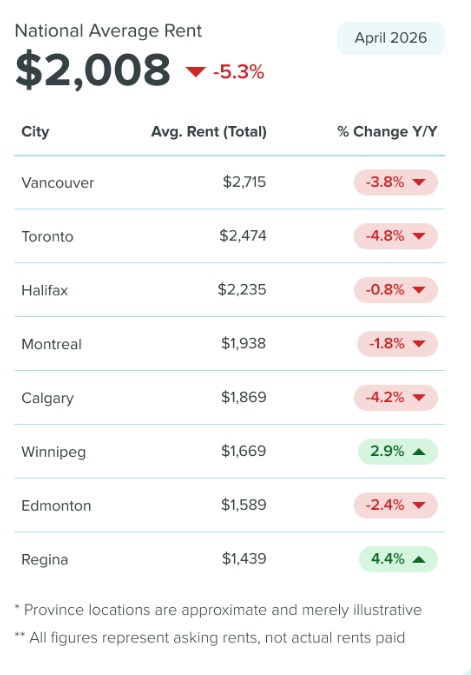
Canada’s rental market continued its downward slide in March, with the average asking rent falling for the 18th straight month to $2,008—the lowest level in nearly three years. According to the latest National Rent Report from Rentals.ca and Urbanation, this marks a 5.3 per cent year-over-year decline, the sharpest annual drop since the early months of the COVID‑19 pandemic.

“The Canadian rental market downturn has deepened, with rents in March falling at their fastest pace since COVID,” said Shaun Hildebrand, President of Urbanation. “This shows in real-time the market impact from the declining population, coupled with ongoing affordability issues, heightened economic uncertainty, and record high apartment completions.”

The report shows that rents have now fallen 7.9 per cent compared to two years ago, and are roughly in line with levels seen three years ago. Month-over-month, asking rents dipped another 1.1 per cent, following a 1.3 per cent decline in February. Since the market peak in May 2024, average monthly rents have dropped by $194, or 8.8 per cent.

Secondary market hit hardest

All major housing categories saw declines, but the secondary market—condos, houses, and townhomes—experienced the most pronounced drops. Condo rents fell 6.9 per cent year-over-year to $2,077, while houses and townhomes slid 9.0 per cent to $1,990. Purpose-built rentals remained comparatively stable, easing 3.9 per cent to $2,005.

Smaller units also continued to dominate new supply. The average rental size shrank to 831 square feet, while per‑square‑foot rents dipped 1.2 per cent to $2.49. One‑bedroom units saw the steepest annual decline at 5.1 per cent, falling to $1,763.

Provincial and city-level trends

Canada’s largest provinces led the national downturn. Apartment rents fell 4.8 per cent in British Columbia, 4.6 per cent in Alberta, and 4.4 per cent in Ontario, while Quebec posted a more modest 2.1 per cent decline. Meanwhile, rents climbed in Nova Scotia, Saskatchewan, and Manitoba, with Saskatchewan continuing to show the strongest long-term growth.

Among the country’s six biggest cities, every market recorded an annual decline. Calgary led with a 5.0 per cent drop, while Montreal saw the smallest decrease at 1.6 per cent. Toronto rents hit a 46‑month low, and Vancouver rents remained below early‑2022 levels despite recent monthly gains.

Shared accommodations also saw notable softening, with average asking rents across B.C., Alberta, Ontario, and Quebec falling 6.3 per cent to $899, dipping below $900 for the first time in three years.