




Articles Archive - Page 302 of 928 - REMINET
REMI

Greening Ontario’s housing sector

Ontario’s housing sector emits more greenhouse gas emissions than any other province, primarily due to its high population rate. In the province, residential buildings are a leading driver of overall building emissions, accounting for 22.4 megatons (Mt) in 2018.

A newly released report from the Ontario Real Estate Association (OREA) and StrategyCorp. Institute of Public Policy and Economy called, Accelerating Ontario’s Green Future: New Approaches to Housing and Climate Change, recommends policies that will reduce GHG emissions in the resale market, fight the threat of catastrophic weather events like flooding, and support homeowners in reducing their energy use and saving costs on monthly bills.

The federal government recently set new targets for the country to reduce GHG emissions by 40 to 45 per cent below 2005 levels by 2030, instead of the previous 30 per cent target. The buildings sector overall is undeniably a key focus as the second largest contributor in Ontario, emitting 40 Mt in 2018.

“Climate change is a major threat to our way of life and the residential housing sector has to do its part to lower emissions and mitigate risks,” said Tim Hudak, OREA CEO. “Through these recommendations, Ontario can help homeowners reduce their carbon footprint, safeguard their homes against climate change, and keep more money in their pockets.”

Here are some proposed solutions from the report:

On-bill financing

Building envelope improvements through utility-provided on-bill financing is among eight policy options. This would allow Ontarians to bypass the upfront costs that accompany a major renovation. The costs of green retrofits would be rolled into monthly utility bill payments, resulting in lower household energy bills.

“On-bill financing is a great way to provide homeowners with upfront help to do a green renovation, which they can then pay off using the savings on their energy bills,” said Hudak. “The planet gets lower GHG emissions from homes, jobs get created in the renovation sector and homeowners get long term savings – it’s a win-win.”

In 2017, Ontario’s Ministry of Municipal Affairs and Housing consulted on proposed energy-efficiency requirements for renovations to existing homes more than five years old, including requiring material alterations or repairs to meet up-to-date energy-efficiency requirements for building envelope related improvements.

As the Environmental Commissioner of Ontario (ECO) stated in the 2019 Energy Conservation Progress Report, more than 80 per cent of the consultation respondents supported these requirements, but there has been no progress since 2017 due to rising home prices and a shift in government priorities.

OREA suggests the government build on this 2017 consultation and work with building industry partners to amend the Ontario Building Code to include energy-efficiency requirements for residential renovations in homes built before 2010.

Green home renovation tax

Gas-fueled single-detached and single-attached older homes, built before 2010 and found mostly in rural and remote communities, are the largest sources of residential emissions in Ontario. They also run on inefficient home heating due to leaky building envelopes and larger square footage.

A proposed solution in this case is creating a targeted green home renovation tax credit, specifically for green renovations—including those that enable a commute-free work-from-home setup. This credit should only apply to homes built before 2010 and include an income cap, to help focus on improving existing middle-class homes.

It would build off the success of the federal subsidy program to encourage energy-efficient upgrades to things like insulation, furnaces and drafty windows and doors. Energy-efficient buildings and homes experience higher resale values and lower utility bills, which will result in improved affordability for Ontario’s current and aspiring homeowners.

In the 2019 Energy Conservation Progress Report, the ECO noted that the longer these residences remain inefficient, the more difficult it will be for the province to meet its current and future climate targets.

“Without action to address emissions in Ontario’s residential building space, it will be difficult for Ontario to meet its existing targets and even harder to meet its future targets,” said Stacey Evoy, OREA President. “In order to do so, the Ontario Government must also consider improving the climate resiliency of Ontario homes. Akin to GHG reduction improvements, increasing a home’s climate change adaptation protection will only increase the value of the home.”

Flood mapping

Flooding is the most expensive climate event in Canada when it comes to insurable losses, according to the Intact Centre on Climate Adaptation report, Treading Water: Impact of Flooding on Canada’s Residential Housing Market, compiled in February 2022.

The report found, in the past eight years, catastrophic flooding in communities
resulted in an average 8.2 per cent reduction in the final sale price of houses, 44.3 per cent reduction in the number of houses listed for sale, and 19.8 per cent more days on market to sell a house.

OREA purposes the government develop a user-friendly system that establishes the flood risk of residential properties across the province to fill in gaps in existing flood mapping.

Electric vehicle infrastructure

In 2018, Ontario released a new set of regulations regarding the installation of electric vehicle charging stations (EVCs) in existing condo corporations, including that no less than 20 per cent of parking spaces must have some form of Electrical Vehicle Supply Equipment (EVSE) that are in compliance with the Condo Act and the relevant electrical codes and legislation.

Adoption barriers to EV uptake include the cost of charging station installations and existing residential builds that are unequipped with EV charging stations.

“To support the adoption of EVs in Ontario, the government could amend the building code to make electric vehicle charging port stations mandatory in new builds and remove HST on charging infrastructure sales to lower costs for consumers to support adoption among residents living in older builds,” the report suggests.

One million home energy audits by 2035

A home energy audit program, with a target of completing one million audits
by 2035 (or at least 20 per cent of existing housing stock), would establish a coordinated effort across levels of government in home energy-efficiency and climate mitigation.

“The home energy audit program should be encouraged by a subsidy program to support Ontario residents,” the report states. “In order to foster uptake of
home energy audits, OREA will work closely with the province and industry to encourage the creation of a home energy audit field in MLS systems. This will create additional ratings and home value information across the province, as
they relate to home energy-efficiency.”

Included in this policy, home energy audits should have a ten-year validity period to ensure that home energy emissions and residential construction remain energy-efficient throughout the full lifecycle of a home. The program would also include the licensing and regulation of home energy auditors.

Producing more renewable natural gas

Renewable natural gas (RNG) a carbon-neutral fuel created by capturing methane emissions from organic waste, landfills, and farms.

Scaling the production and adoption of renewable natural gas (RHG)—a carbon-neutral fuel created by capturing methane emissions from organic waste, landfills, and farms. The $42-million RNG facility in Niagara is expected to produce enough energy to heat 8,750 households.

“The Government of Ontario should continue to invest in research and development of RNG and fund additional projects like the one in Niagara to broaden Ontario’s RNG network,” states the report.

Ontario has about five million homes, of which the majority are heated using natural gas. The province would require upwards of 500 more Niagara-like facilities to supply enough RNG.

Repurposing the Ontario Carbon Trust

Other proposed policies include repurposing the $400 million Ontario Carbon Trust that is no longer necessary due to the introduction of the carbon tax. OREA suggest using that money to fund initiatives that help Ontario’s economy recover
from the COVID-19 pandemic. “Measures introduced under the Ontario Carbon Trust should be environmentally friendly policies or drive further environmental benefits that would not be achieved by a rising carbon tax alone.”

The full report, Accelerating Ontario’s Green Future: New Approaches to Housing and Climate Change, can be accessed here.




Ventilation has become a recognized priority for infection control

With the worst of the COVID-19 pandemic now seemingly and hopefully behind us, and with many public health restrictions like proof of vaccination, strict social distancing, and mask mandates dropped in many jurisdictions, facility owners and operators will need to ensure they maintain ventilation as a priority moving forward.

The increased recognition of the importance of air quality control is one likely lasting positive that has come out of the last two years of pandemic challenges. It has been known for years that good ventilation can reduce the spread of respiratory diseases, but the notion of improved ventilation as a frontline weapon in itself is relatively new out of the pandemic landscape. Experts say that ventilation will be key to the fight against future viruses.

“The science is airtight,” Joseph Allen, director of the Healthy Buildings program at Harvard University’s T.H. Chan School of Public Health, told CNN. “The evidence is overwhelming.”

If broadly embraced, experts say, the attention to indoor air quality will safeguard beyond COVID-19, suppressing the spread of other diseases and as well as incidents of asthma and allergy attacks.

While investments into ventilation can go a long way, the best results are seen when combined with other infection control measures. A simulation by the Centers for Disease Control and Prevention (CDC) found that combining mask-wearing and the use of portable air cleaners with high-efficiency particulate air (HEPA) filters could reduce coronavirus transmission by 90 per cent.

In fact, there is a school of thought that ventilation should be one of a triple-strategy approach along with vaccination and high-quality, well-fitted masks, which can reduce a person’s exposure to viral particles by 95 per cent, reports CNN.

Improved airflow adds a supplementary layer of protection, replacing stale recycled air with fresh or efficiently filtered air. This is one area where facilities still have some catching up to do: while exchanging the air five times an hour cuts the risk of coronavirus transmission in half, according to research cited by the White House Office of Science and Technology Policy, most buildings exchange the air only once or twice an hour.

This is partly because the industry standards drawn up by the American Society of Heating, Refrigerating and Air-Conditioning Engineers (ASHRAE) are voluntary, and the Occupational Safety and Health Administration (OSHA) enforces indoor air quality requirements only in healthcare facilities. ASHRAE has recommended upgrades, but has no power to enforce their implementation.

While epidemiologists in the U.S. are calling for a federal standard for ventilation and indoor air quality, it’s unclear how forthcoming that will be. However, in the meantime, many facilities have taken a proactive approach.

“In the first year of the pandemic, it felt like we were the only ones talking about ventilation, and it was falling on deaf ears,” said Allen. “But there are definitely, without a doubt, many companies that have taken airborne spread seriously. It’s no longer just a handful of people… This is a massive shift that is, quite honestly, 30 years overdue.”

Firm must divulge Trump appraisal information

Cushman & Wakefield has been compelled to release appraisal information related to three of former U.S. President Donald Trump’s properties. An order issued from the New York County State Supreme Court gives the real estate brokerage and advisory firm until May 27 to turn over documents that New York State Attorney General Letitia James had earlier sought to obtain through subpoenas. She contends the appraisals and other information about Cushman & Wakefield’s business relationship with the Trump Organization are relevant to an ongoing investigation.

The inquiries in question focus on three properties:

  • Seven Springs Estate, the 230-acre site of a 50,000-square-foot, 15-bedroom mansion in Westchester County, New York, and an appraisal prepared for donation of a conservation easement, for which the Trump Organization received a tax benefit
  • Trump National Golf Club – Los Angeles, and an appraisal prepared for donation of a conservation easement, for which the Trump Organization received a tax benefit
  • 40 Wall Street in New York City, and multiple appraisals and valuations of the 72-storey office, 1.3 million-square-foot office complex

The court order arises from James’ April 8 motion, which argued that Cushman & Wakefield had no grounds to defy the subpoenas.

“Cushman’s burden — to show that those matters are utterly irrelevant to any proper inquiry, or that it is inevitable that their production will not lead to anything relevant to a proper inquiry — is an impossible one, given the presentation in these motion papers and the copious record with which the Court already is familiar,” it maintains.

The motion also argued that the Office of the Attorney General has the authority to investigate appraisals and determine if they comply with the Uniform Standards of Professional Appraisal Practice.

“Cushman & Wakefield’s work for Donald J. Trump and the Trump Organization is clearly relevant to our investigation, and we are pleased that has now been confirmed by the court,” James stated following the April 25 issuance of the order.

New design guide for zero energy multifamily buildings

A new advanced energy design guide is now available to help contractors and designers develop a viable plan for attaining zero energy multifamily buildings.

Advanced Energy Design Guide for Multifamily Buildings-Achieving Zero Energy (AEDG) is the third in the AEDG zero energy guide series. The guide outlines strategies for achieving energy targets such as setting measurable goals, hiring design teams committed to those goals, using simulation throughout the design and construction processes and being aware of how process decisions affect energy usage. In this edition, content has been included on renovation and resiliency along with expanded guidance on hot water and high load in multifamily buildings.

A zero energy building is defined as a building that, on an annual basis, draws from outside resources equal or less energy than it provides using on-site renewable energy sources.

“The design guide can be directly applied to helping set energy goals and achieve those targets by implementing practical how-to tips,” said Paul Torcellini, project committee chair and principal engineer at the National Renewable Energy Laboratory. “In addition, readers can use this as a training guide for design staff to learn about zero energy buildings. The intent of this guide is to provide insights and perspectives that fall within typical construction budgets, while demonstrating technologies used in real-world applications.”

Valuable chapters focus on process points like building effective teams, leveraging analysis to bring the right decisions to the project at the right time, and almost 200 techniques and tips to successfully create a zero energy multifamily building.

“This guide comes at a critical time as DOE and our partners continue to find and share pathways to decarbonize buildings in an equitable and affordable way,” said Sarah Zaleski, senior advisor at the U.S. Department of Energy Building Technologies Office.

The design guide was developed in partnership by the following organizations: the U.S. Department of Energy’s (DOE) Building Technologies Office, ASHRAE, the American Institute of Architects (AIA), the Illuminating Engineering Society (IES) and the U.S. Green Building Council (USGBC).

To learn more and download Advanced Energy Design Guide for Multifamily Buildings-Achieving Zero Energy, visit ashrae.org/freeaedg.

Ukrainian evacuees arrive to housing scarcity

A combination of short-term and long-term housing and other community-based facilities will be required to accommodate upwards of 70,000 Ukrainian evacuees expected to arrive this spring on Canada’s expedited three-year visa for those who have been displaced or endangered due to the Russian invasion. Groups leading the effort to receive and settle these embattled newcomers are coming together with the commercial real estate industry to mobilize supports.

“We’re all bridges to homes. We’re all bridges to jobs,” Michael Brooks, chief executive officer of REALPAC, observed earlier this month during an industry-organized online discussion to garner insight from the Ukrainian Canadian Congress (UCC), the League of Ukrainian Canadians and other agencies providing services for immigrants.

Members of the webinar’s sponsoring organizations — REALPAC, Building Owners and Managers Association (BOMA) of Greater Toronto, Urban Land Institute (ULI) Toronto, NAIOP Toronto, Federation of Rental-housing Providers of Ontario (FRPO), Toronto CREW, Canadian Urban Institute, Toronto Region Board of Trade, and the Ontario Professional Planners Institute (OPPI) — were briefed on the needs and invited to contribute.

While other conventional avenues for harbourage in Canada will also be available, including as refugee claimants or through family reunification, it’s expected that the majority of imminent arrivals from Ukraine will be via the three-year visa. This conveys transitory status for visitors who will either later return to the Ukraine or apply for permanent residency. Visa-holders will be immediately eligible to work in Canada, but will receive no government-level income or housing support.

Priority on supportive environments with employment possibilities

Olenka Bulat, co-chair of the UCC’s displaced persons settlement committee, noted that mother-led, single-parent households will comprise a large share of arrivals since men between the ages of 18 and 60 have been directed to stay in Ukraine. Newcomers will be confronting Canada’s affordable housing shortage, while also dealing with potential trauma, language barriers and the general culture shock of unfamiliar surroundings.

“There will be a lot of vulnerable people coming. There are no organized airlifts in place for this at this point so they will all be coming in, in dribs and drabs,” she advised. “All the Ukrainians that are coming in, whether they have any funds or not, are going to require some support in terms of shelter and housing.”

Placements in private homes and/or temporary lodgings such as university residences and hotels are seen as key for short-term, transitory housing. Longer term, UCC and other support agencies are looking to the private rental housing sector for concessions and logistical insight to help match apartment-seekers to markets that could provide community supports, but would be less competitive than Canada’s largest cities.

Toronto was the entry portal for about 80 per cent of the roughly 11,700 Ukrainians who landed in Canada during March. However, UCC chief executive officer Ihor Michalchyshyn reports that the organization’s branches in cities like St. Catharines, Winnipeg and Saskatoon are drawing on local cultural affinities and assembling networks of resources that should exert a strong pull as newcomers prepare to settle in. There is also evidence that Canada’s three-year visa is eliciting comparative research as prospective applicants assess potential destinations and gauge how far they can stretch their funds before they begin earning income.

“We’re seeing that our branches are getting questions from people in Europe asking: What is the rent? What do I get? What kinds of jobs are available?” Michalchyshyn affirmed. “People are making decisions on where to end up based on the job vacancies they see.”

“People are savvy enough to screen this in advance from wherever they are in Europe before coming over here to Canada,” Brooks reiterated. “So maybe there’s a landlord’s association in some of those smaller cities that we can reach out to and say: If you’ve got any vacancies, you should connect with X or Y. That would also be useful for the industry to know.”

Carving out space in a low inventory environment

Turning to other industry efforts, Mark Kenney, president and chief executive officer of Canadian Apartment Properties Real Estate Investment Trust (CAPREIT), was on hand to talk about his company’s initiatives, individually and with peers in the rental housing sector. A group of seven companies — CAPREIT, Boardwalk REIT, Hazelview Properties, Homestead, InterRent REIT, Minto REIT and Starlight Investments — has committed to provide 400 units, Canada-wide, with either free or reduced rents and a variety of other supportive measures, such as waiving of damage deposits, credit approvals and references. CAPREIT is also supplying 10 fully furnished suites, rent-free for six months, for displaced Ukrainian families with a child receiving cancer treatment in Toronto.

“We have incredible low inventory of (available) apartment rental in the city of Toronto so even finding 10 units was not easy,” Kenney recounted.

Given the low vacancy rates almost everywhere, he suggests it will be challenging for prospective tenants who lack Canadian credit ratings and other documentation to compete for available accommodations. Yet, landlords also view the newcomers as a potential labour pool.

“I think with the employment situation in this country, a lot of employers are stepping forward wanting to offer opportunities. CAPREIT and our peers are doing exactly that also,” Kenney said.

Elsewhere, Nathan Rotman, manager of public policy for Airbnb in Canada, outlined the short-term rental platform’s earlier work through its charity arm, Airbnb.org, to find accommodations for Afghan refugees and other displaced nationals. He typically places his company’s resources at the front end of the settlement process when new arrivals need short-term housing.

“These are individuals who are stepping up to try to help by giving space in their homes or an accessory dwelling unit of some kind that can be made available for a period of time,” he explained. “We’re currently working with the International Organization for Migration, primarily in Europe, to make our listings on the platform more available to individuals who are seeking housing. We’ll continue to work with the UCC or the federal government as the need continues to grow to support those folks.”

“We’re doing our best to try to figure out how to make use of all the goodwill because there will be more people coming than we can handle in residential apartments,” Michalchyshyn concurred.

Beyond housing, there is also a need for warehouse, storefront and recreational space to support Ukrainian evacuees. Nadia Gereliouk, managing director of the League of Ukrainian Canadians sketched out demands for a network of reception centres where newcomers could gather, pickup welcome packages and other supplies and be directed to services. Given the high percentage of lone-parent households, she also prioritizes “community infrastructure” such as space for summer camps and venues for youth and cultural activities.

Toronto janitors & cleaners receive pay rise

UPDATE: SEIU Local 2 janitors in Toronto, who had repeatedly said they were willing to strike if their companies did not provide wage increases that kept up with the cost of living, will not strike as scheduled on April 30. Instead, the cleaners ratified a three-year deal by a majority vote after the employers presented a new offer on April 29.

PREVIOUSLY: Thousands of cleaning and maintenance staff in Toronto were set to hold a strike vote on Saturday, April 30. The Toronto janitors, members of the Service Employees International Union Local 2, say they have been working hard to get a fair contract from the cleaning companies they work for, but the employers are refusing to provide wage increases that keep up with the cost of living.

The coalition of janitors, most of whom a news release notes have worked tirelessly through the pandemic without any kind of pandemic pay, include those who clean healthcare facilities, public transportation systems, courthouses, morgues, parcel delivery facilities, police stations, commercial office buildings, shopping malls, food courts, post-secondary institutions, private schools, airports, and more.

The release notes that most earn around $15.70, although some earn a top rate of $16.45 and some make an additional 50 cents per hour for overnight shifts or lead hand premiums.

At a time when Canadian inflation has reached a 31-year high of 6.7 per cent, SEIU Local 2, which represents over 4,000 cleaners in the Greater Toronto Area, stresses that these low-wage workers are being hit the hardest by the steep rise in the cost of living and basic necessities are getting out of reach. While the essential frontline health and safety role played by cleaners has received more recognition and appreciation over the last two years of the pandemic, in most cases that has not been reflected in an adjustment of pay.

“Not only did we not get any pandemic pay, our workloads also increased as deeper cleaning was required,” says Mark Dayao, who works for Best Service Pros at Humber College.

“Most of my co-workers are working two jobs to be able to pay the bills now,” says Erna Bearneza, who works for GDI Integrated Facility Services at a facility owned by one of the major banks and has been cleaning the facility for 10 years.

“We need to show the companies that we are prepared to fight united to protect all our families,” says Gloria Pozo, who works for Amphora Maintenance Services and has been cleaning near Bay Street and Richmond for 16 years. “If it’s necessary to vote for a strike, we will vote to strike.”

The release adds that property owners and managers, both governmental and private, have created a competitive bidding model that puts downward pressure on wages and pushes janitors to do more and more, often with less staff and less time.

Building a foolproof green cleaning checklist

Green cleaning is a vital strategy for ensuring the health and safety of a facility while also preserving the future of the planet.

Perry Shimanoff, a Certified Master Custodial Trainer with ISSA’s Cleaning Management Institute, recently outlined for CMM a basic six-step green cleaning checklist that facility operators and staff can follow to ensure they are doing their part.

It all starts, he says, with identifying the soil, before picking it up, containing and removing it, and disposing of it. Then, the work done should be inspected and evaluated and the results measured, whether through an adenosine triphosphate (ATP) meter or another method.

Shimanoff notes the importance of having a thorough checklist for ensuring that workers know exactly what to look for and how to respond without missing a step. It’s vital that the checklist not be too long or convoluted; ideally between five and nine steps to remain easily memorable and implementable.

This checklist can be carried around by staff either on their person or on their cleaning cart or other equipment. Workers can then tick off these tasks as they go, ensuring no vital step is missed and protocol is followed at all times and allowing for easy review by a supervisor.

Checklists have other uses than just ticking off tasks as you go, though, says Shimanoff.

For instance, they can also:

  • Help schedule and itemize training for workers
  • Identify topics to discuss with customers (e.g., dusting, vacuuming, washroom cleaning) to determine satisfaction levels
  • Assign task quality ratings for each job done
  • List steps to prevent slips and falls as well as other injuries 
  • Quantify key aspects of your cleaning policy, plan, and training programs
  • Outline and track improvements, safety, and savings
  • Help with onboarding new workers by simplifying and standardizing procedures

“Checklists prompt a disciplined approach by management to help ensure the right things are done properly and on time by listing essentials, standardizing processes, eliminating waste, and streamlining labour,” concludes Shimanoff.

Average price of GTA condos up 20%

According to the Toronto Regional Real Estate Board (TRREB), Greater Toronto Area realtors reported 7,932 condo sales in Q1 2022, representing a decrease of 15.6 per cent compared to the record 9,399 sales in Q1 2021.

While first quarter sales were down, new listings were basically flat, meaning condo buyers had some relief in terms of market conditions. However, market conditions remained tight enough to support double-digit annual average price gains.

Year-over-year, the average selling price increased by 22.5 per cent to $790,398. From January to March of 2021, the average price rounded out to $645,303.

“The GTA population will grow at or near record levels over the next few years, supported by a strong regional economy,” said TRREB Chief Market Analyst Jason Mercer. “The condominium apartment segment will be an important source of housing, both for people looking to purchase a home and also those looking to rent. This will continue to support price growth, but the pace of price appreciation may moderate as the market becomes more balanced over the next year.”

In summary, Halton Region—Oakville, Milton, Burlington and Halton Hills—saw the greatest growth, with the average price now a $805,859 compared to the Durham Region at $658,860. In the City of Toronto, the average price still remains highest at $809,853.

In the expensive downtown Toronto core, the average selling price for a bachelor unit now costs about $500,000; a two-bedroom costs around $900,000. In North York City Centre, the price decreases to an average of $300,00 for a bachelor and upwards of $800,000 for a two-bedroom unit.

The full TRREB report can be found here.


Fengate earns WELL Health-Safety Rating for entire office portfolio

Fengate Asset Management earned the International WELL Building Institute’s WELL Health-Safety Rating for its entire 1.7 million square foot office portfolio, managed on behalf of its investors including the LiUNA Pension Fund of Central and Eastern Canada.

“To meet IWBI’s high standards and rigorous criteria, our team reviewed and implemented enhanced building protocols, including management plans to improve air and water quality, control mould and moisture, and inhibit the spread of contaminants on high-touch surfaces,” said said Scott Caverley, senior vice president, leasing and asset management, Fengate. “All these initiatives are geared towards making people feel safe and confident when they enter the buildings.”

Fengate is also pursuing BOMA BEST certification. To date, 2265 and 2275 Upper Middle Road East and 1315 North Service Road East in Oakville, and 1 and 3 Concorde Gate and 12 Concorde Place, collectively known as Concorde Corporate Centre, in Toronto, have been awarded BOMA BEST Gold certification.

The firm is actively working on attaining certification for the rest of its office portfolio, located at 1835 Yonge Street in Toronto; 1111 and 1122 International Boulevard in Burlington; and 2010, 2020 and 2060 Winston Park Drive in Oakville.

“Participating in these programs, both of which require recurrent qualification, underscores our commitment to look beyond singular milestones and focus on the long-term and ongoing integration of ESG practices to all aspects of our business,” said Jaime McKenna, managing director and group head of real estate.

The WELL Health-Safety Rating is an evidence-based, third-party verified rating for all new and existing building and space types focusing on operational policies, maintenance protocols, stakeholder engagement and emergency plans to address a post-COVID-19 environment now and into the future.

Design revealed for Ontario’s first net-zero community centre 

New renderings of Ontario’s first ever net-zero operational carbon community centre offer a look at some of the programming coming to the cultural hub in Toronto.

The North East Scarborough Community and Child Care Centre is a joint venture between the City of Toronto and Perkins&Will. Set for completion in 2023, the 95,000-square-foot facility will achieve net zero status through energy efficient design and renewable energy systems.

Located on a restricted site in a growing neighbourhood that demands more social and recreational programming, l incorporated vertical stacking into the building’s layout. Through layering various amenities atop one another, the facility maximizes its capacity to serve the community while also serving as a new building model for future community centres across Canada.

community centre

“Toronto is one of the most inclusive cities in the world, and with that comes significant responsibility to create dynamic spaces that reflect every community’s needs for culturally relevant and diverse programming,” says Phil Fenech, principal in Perkins&Will’s Toronto studio.

The recreation and aquatic centre is targeting net-zero energy and carbon emissions through mechanical efficiencies, such as air source heat pumps, an enhanced building envelope, and innovative renewable energy systems.

“Our design approach throughout was underpinned by Perkins&Will’s Living Design principles, resulting in a civic centre that not only promotes human and ecological well-being, but fosters community resilience, as well,” adds Fenech.

Perkins&Will undertook a rigorous analysis to develop a comprehensive strategy, integrating various energy reduction strategies into the design, including air source heat pumps and photovoltaic thermal (PVT) hybrid panels that generate electricity and heat. Outdoors, bifacial photovoltaic (PV) parking lot canopies increase the renewable energy generation of each PV panel when compared to more traditional PV systems.

As part of the holistic carbon reduction approach, Perkins&Will considered the embodied carbon of the envelope and structure with an estimated 16 per cent embodied carbon[RR1] reduction upon completion. The embodied carbon will be assessed at the end of construction to evaluate further improvements that may have been achieved during construction.

“With our climate crisis top of mind, it’s no longer sufficient for community centres to provide quality public space; they must also serve as beacons for resilience,” says Zeina Elali, senior sustainability advisor with Perkins&Will. “Our strategies for the North East Scarborough Community and Child Care Centre prove you can feasibly achieve net-zero carbon goals that will create holistic, healthy environments.

Over a multi-year process, there were community consultations with the Scarborough community, 50 per cent of which comprises people of immigrant descent. Discussions identified an unmet demand for inclusive community infrastructure and a collective need for amenities, programming, and green space that far exceeds what is typical in most community centres across the city.

The design team worked closely with the community to accommodate a specific set of cultural, social, and economic needs. For example, the community used the site—parkland before design development—as a central spot for pick-up cricket games. The gym was expanded to include the city’s first purpose-built practice cricket pitch, reflecting the wishes of the predominately South Asian community in the area.

community centre

The team also created gender-neutral changerooms and strategically located the pool away from public view for Muslim women and women-only swims.

community centre

The surrounding parkland was preserved through a series of interconnected pathways and public gathering spaces around the building, including an urban skateboard park, an outdoor playground, a basketball court, and a splash pad.

The lower level hosts both a lap pool and leisure pool with double-vaulted ceilings that reveal the pools to a spectatorship above. The main floor connects various atria, allowing the public to see how all the building’s functions work in harmony. Common areas and childcare facilities make up the bulk of the main floor, creating a welcoming hub of activity.

community centre

The second floor plays host to the fitness centre and multipurpose studios encased in curtain wall windows that invite an abundance of natural light. Opening above to the upper level is a running track and access to an outdoor green roof.

The façade mirrors the interior program through three distinct material layers with variations in colour and texture. The masonry base is inspired by the landmark escarpment nearby, the Scarborough Bluffs, and provides a robust presence along the streetscape. Level two features a ribbon of windows to reflect the watershed, and the top level is wrapped in a bold gold corrugated metal ribbon, mimicking both the colour and texture found in the dense forest of the nearby Rouge National Urban Park.

Outdoor terraces help define the building’s various rooms, create visual breaks in the three-storey building, and bring light and park views well into the interior spaces.

“As land becomes increasingly scarce in dense urban centres, there is an opportunity to rethink the typical community centre typology.

“Our approach to Northeast Scarborough Community Centre proves we no longer need large swaths of land to create meaningful community hubs,” adds Elali.. “While stacking programming, such as a gym on top of a pool, is rare, it can prove to be a viable new approach that will reduce a building’s carbon footprint while bringing programming that meets communities’ needs.”

TCHC, Tridel request rezoning of Regent Park

Toronto Community Housing Corporation (TCHC) and Tridel Builders Inc. have filed a rezoning submission with the City of Toronto, requesting an increase in the density of development in the Regent Park Phases 4 and 5 lands. The increased density will enable TCHC and Tridel to build 1,000 more units of housing than previously planned for, and add thousands of square metres of gardens, retail and community space.

In addition to creating more affordable homes and new community spaces, TCHC and Tridel believe the increased density will enhance the value of these public assets for the residents of Regent Park, Cabbagetown, Moss Park and St. James Town while strengthening the Downtown East neighbourhood as a whole.

“Tridel is excited to be a strategic partner for such an important initiative. We are thrilled to be working closely with both Toronto Community Housing and the City of Toronto to support the need to build housing throughout the city,” said Dino Carmel, CEO, Tridel Group. “The Regent Park revitalization of Phases 4 and 5 is a long-term partnership focused on providing innovative, actionable solutions to affordable housing. We look forward to continue engaging with the community to bring their vision of Regent Park to life. As a homebuilder, the rezoning application is an important milestone that aligns with our commitment to deliver quality, sustainable homes to Toronto residents and families.”

This rezoning submission was developed in close consultation with community members. In more than 1,500 resident interactions, TCHC and Tridel used surveys, virtual community meetings, focus groups and engagement with community organizations to develop a plan based on their collective vision. Repeatedly, residents expressed strong support for more homes, urban green spaces and amenities, which TCHC and Tridel believe the new plan will deliver.

The Phases 4 and 5 lands are bordered by Gerrard Street and Oak Street to the north and south, and River Street and Dreamers Way to the east and west. In 2014, a plan was approved that included 564 rent-geared-to-income (RGI) units as part of the plan to replace 2,083 TCHC-operated RGI units in Regent Park. Also included were 3,465 square metres of commercial space for businesses and 1,353 market units.
“There’s tremendous excitement and expectation in the local community as the iconic Regent Park Revitalization moves into the final stage of planning,” said Councillor Kristyn Wong-Tam, Ward 13 Toronto Centre. “An independent rezoning process informed by strong community input will ensure additional public and private investments continue to flow into this award-winning neighbourhood. I look forward to the opportunities for collaboration and the continued public consultation in the days ahead.”

The rezoning submission comes on the heels of the government announcing plans to support new affordable housing. If approved, the rezoning could add the following:

  • More than 500 additional TCHC-operated RGI or affordable units
  • 1,792 additional market units
  • 4,454 square metres of additional commercial and retail space
  • 3,525 square metres of new community and cultural space
  • A new Toronto Public Library


Construction starts on Water Street by the Park

Construction of Kelowna’s largest and tallest development has officially begun. At 24, 28 and 42 storeys, the three-tower, Water Street by the Park development will redefine the city’ skyline with the tallest tower in B.C.’s interior (442 ft./132.7 m) and expansive views of Okanagan Lake, as well as mountain and valley views.

“I want to congratulate Orchard Park Properties for their vision and perseverance and wish them all the best as construction begins,” said Deputy Mayor Gail Given. “Water Street by the Park is an impressive example of their commitment to this city and this community and I’m sure that, once completed, this development and the families that will call it home, will make an important contribution to Kelowna’s stature as one of Canada’s most livable cities.”

The 650-unit project is also expected to help enliven and energize the downtown area surrounding the site in the heart of downtown Kelowna. At street level, the podium of each tower will provide several levels (45,000 sq. ft.) of street-facing commercial space, which will become home to numerous boutiques, cafes, and other retailers and service providers. The influx of residents and retailers will add further momentum to the growing vibrancy and diversity of Kelowna’s downtown core.

“This truly is a landmark development for the city that we are proud to represent,” said Orchard Park Properties Co-Founders Apriano Meola. “Just a few years ago, we fell in love with this site and its incredible potential. It’s been exciting to share our vision with the home buyers that have made Water Street by the Park the fastest selling development in Kelowna history and one of the hottest real estate offerings in Canada.”

Only 1 in 5 Canadian households use smart home tech

In a new study about Canadian homeowners’ attitudes towards sustainability, four in five respondents said that the issue of climate change is important to them and that they are concerned how it could affect future generations.

The study, commissioned by Schneider Electric Canada, also reveals 73 per cent of homeowners have seen an increase in their electrical bills in the past year and less than one in five currently use energy-efficient appliances or devices in their homes to help combat that rise.

“Our study found 9 in 10 (89 per cent) Canadian homeowners say it’s important to have energy efficient appliances or devices when buying, building, or renovating a home,” said David O’Reilly, vice-president of home and distribution at Schneider Electric Canada. “Encouraging further adoption of smart home technology will not only help households reduce their individual carbon emissions, but also encourage them to reimagine what it means to live sustainably.”

Homes and buildings continue to be a significant source of greenhouse gas emissions. After accounting for the electricity used for heating, cooling, lighting, and appliances, they total 18 per cent of national greenhouse gas (GHG) emissions.


Vancouver average rents up almost 30%

Vancouver average rents continue to outpace other Canadian cities with Bullpen Reasearch & Consulting and Rentals.ca reporting a 29.9 per cent increase across all property types since March 2021. Nationally, the average rent increased by 6.6 per cent, while London, Hamilton, and Toronto also saw significant increases to the tune of 18.3 per cent, 15.9 per cent and 14.3 per cent respectively.

According the the latest National Rent Report, average rents will likely keep rising as the country readjusts to its new normal. That said, it remains to be seen how inflation, supply chain issues, the effects of BA.2 and other COVID subvariants, and the recent Bank of Canada rate changes will impact the economy and the rental market.

“On an annual basis, tenants are looking at rent that is over $100 more on average in March, compared to a year earlier, when the rental market was close to its lowest point during the pandemic,” said Ben Myers, president of Bullpen Research & Consulting. “However, the pace of growth has cooled, with relatively flat rents over the last four months. Higher interest rates and a cooling ownership housing market could push more demand into the rental market this spring.”

Other cities with year-over-year average rent increases in March include: Etobicoke, up 9.5 per cent; York, up 9.3 per cent; Calgary, up 8.5 per cent; Mississauga, up 7.8 per cent; Saskatoon, up 7.6 per cent; East York, up 5.3 per cent; North York, up 4.4 per cent; Montreal, up 3.5 per cent; Edmonton up 3.5 per cent; Brampton, up 2.1 per cent; Ottawa, up 1.8 per cent; and Scarborough, up 0.6 per cent.

Average rents in Regina, Winnipeg and Nepean decreased year over year in March by 4.7 per cent, 1.1 per cent and 0.2 per cent respectively.

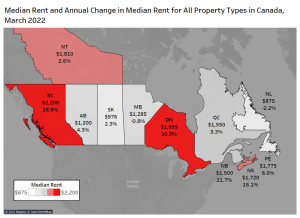
At the provincial level, British Columbia and Ontario remain the most expensive provinces for median rent for all property types, with British Columbia rents up 18.9 per cent to $2,200 per month in March and Ontario rents up 10.8 per cent to $1,995 per month.

Median rents in Nova Scotia were up 15.1 per cent in March to $1,720; Quebec rents were up 3.3 per cent to $1,550; Alberta rents were up 4.3 per cent to 41,200; Saskatchewan rents were up 2.3 per cent to $976 and Manitoba median rents were down in March 0.8 per cent to $1,285.

Other takeaways from the April National Rent Report:


  • The median rent for a studio unit in March for all property types in Canada was $1,346 per month, a month-over-month increase of 3.5 per cent. The median rent for a one-bedroom unit was $1,581, a monthly decline of 0.4 per cent. The median rent for a two-bedroom unit was $1,850 per month, which is the same as February. Three-bedroom units had a median rent of $2,273 per month, a minimal decline of 0.1 per cent. Four-bedroom units had a median rent of $2,899 per month, which is also the same as the previous month.
  • Studio units and one-bedroom units in British Columbia and studio units in Ontario are among the most expensive in terms of average rent per-square-foot. Studio units in British Columbia and Ontario had an average rent per-square-foot of $3.74 and $3.72 respectively in the first quarter of 2022, while one-bedroom units in British Columbia had an average rent of $3.28. Four bedroom units in Alberta and Nova Scotia are among the least expensive at $1.23 per square foot and $1.27 per square foot respectively.
  • Toronto was greatly affected by the pandemic with many consecutive months of decline in rents throughout 2020 and the start of 2021. The average rent was $2,326 per month in March 2022, remaining below pre-pandemic levels.

For more on Vancouver average rents and other key rental data, visit: www.Rentals.ca 

Safely using UV-C light to disinfect indoor spaces

With the spread of SARS-Cov-2, the virus that causes COVID-19, many options claim to be capable of addressing airborne pathogens, including devices like ionizers, ozone and hydrogen peroxide emitters, but none of those technologies has been proven, tested, and used to inactivate pathogens for over a century.

The long-term effects of these technologies are unknown and may come with serious risks, calling into question their use in schools, hospitals, and locations with vulnerable populations. There exists one area of technology that has been tested thoroughly and proven to be effective at ensuring safety: ultraviolet-C light disinfection.

How UV-C light disinfection works

On the most basic level, UV light is broken down into three categories, UVA and UVB which create your tan when you visit the beach, and UVC which is mostly filtered out by the upper atmosphere. Very little UVC (100-280 nanometers) light reaches the earth’s surface. As people began to realize the efficacy of UV-C light and looked to harness the power of UV-C light disinfection, which is capable of inactivating 99.9 per cent of pathogens, they turned to the easiest way available to produce UV-C light, which was with mercury lamps.

Unfortunately, mercury is a neurotoxin and because of this, mercury lamps need to be handled with extreme care. If one breaks, the area needs to undergo serious clean-up and all the people near it must follow strict safety protocols to ensure their health and wellbeing.

Furthermore, the 254 nm wavelength of UVC light produced by mercury lamps effectively penetrates the eyes and skin of people and is known to cause acute and chronic eye and skin damage such as photokeratitis, erythema, cataracts, and cancer. As a result, UV-C disinfection systems that use 254 nm light must do so in such a way that humans are not exposed to the UV-C energy. A great example of employing such a strategy is when 254 nm light is used to disinfect dental tools, which must be done inside a self-contained UV-C oven.

Another example of this during the pandemic has been the use of 254 nm light to disinfect subway cars, but only between operations or at night to ensure the cars are unoccupied. Sadly, when the people return to the space, they bring with them the pathogens we are trying to keep out of the space. Due to the exposure issues, the use of UVC light disinfection in occupied spaces has been limited, until now.

Using UV-C light to disinfect occupied spaces

Historically, there have been two strategies to address the safety concerns with using UV-C light to disinfect air in occupied spaces: The first is upper room UV, which involves deploying high power UV-C light into the space above people’s heads, far enough away that they are not being affected by it. The second strategy is in-duct systems, which involves placing a UV-C lamp into the HVAC ductwork, but this method does not address spaces with insufficient air ventilation.

Both upper room UV and in-duct systems typically use hazardous 254nm mercury lamps and only target air disinfection and do not provide any surface pathogen mitigation. Enter Columbia University, where in 2012, a team led by physicist Dr. David Brenner discovered that another wavelength of light within the UVC spectrum – 222 nm – had a similar ability to inactivate pathogens as the traditionally-used 254 nm wavelength, but without the harmful effects on humans.

Through their research, Dr. Brenner and his team found the 222 nm wavelength was being absorbed by the dead skin layer on the body and the tear layer in the eye in a manner that showed no adverse effects to people, yet still effectively inactivated pathogens just as effectively as the 254 nm wavelength. Finally, we have a UV-C light to disinfect occupied indoor spaces, and today there exist products on the market that harness this.

What to look for in a UV-C light disinfection product

With the full potential of UV-C light disinfection now available to the facilities managers who are entrusted with keeping vital spaces safe, what should these professionals be looking for in a UV-C light disinfection product as they aim to leverage the technology? It all comes down to safety, and there are three main factors when deciding which UV-C product to buy. First, any product being considered for a facility should include 222 nm light as it has the advantage of supporting surface disinfection.

Second, ensure that any 222 nm light entering occupied spaces has a tested filter which attenuates the harmful longer wavelengths of 230 nm and greater. And third, it is vital to check that a product has passed all three types of safety regulations required by UL8802, which include:

● Electrical Safety: As a standard for any electronic device, this safety certification is put forward as a demonstration that the device is safe. But this alone isn’t sufficient when it comes to UVC light products.

● Photobiological Compliance: This ensures that products comply with currently accepted maximum allowable exposure limits.

● Control Safety Testing: This ensures that if a fault in the system occurs, the system will fail safely and occupants within the space will not be overexposed to higher than currently accepted levels.

With those safety requirements met, facilities managers can leverage the immense disinfection power of 222nm UV-C light to keep their facilities and everybody who comes through them safer.

Brent Peckover, P. Eng., is the Director of Industrial Applications at Christie Digital, focusing on launching innovative ideas outside of traditional markets and applications.

While spearheading the design and development activities for commercial ultraviolet disinfection products at Christie, Brent has gained insight into how UV-C light disinfects surfaces and air, in addition to understanding the process in which UV-C light inactivates bacteria and viruses at a generic level.

He has more than 20 years of experience designing, building, and installing a variety of systems for clients around the world. As an aerospace engineer by training, he is used to working in a variety of technical disciplines on projects that benefit from numerical modeling.

BCCA survey shows increased construction activity

The B.C. construction industry is busy and need more skilled workers. According to the annual BC Construction Association (BCCA) Industry Survey, the industry is experiencing a 79 per cent increase in the value of current projects from five years ago, and a 17 per cent increase from pre-pandemic levels, even as labour shortages continue, and cost of goods are at all-time highs.

Despite an increase in project spending to $134B and a sustained increase in the number of construction companies in B.C. (now at 26,262), the number of employees in the industry has dropped across all trend milestones: a 2 per cent decrease year-over-year, a 9 per cent decrease compared to pre-pandemic (2019) levels, and a 5 per cent decrease against the five-year marker.  The average company size has decreased 7 per cent over the last five years to an average of 6.53 workers.  Approximately 90 per cent of companies in the industry employ less than 20 workers.

While COVID-19 is no longer a top issue of concern, lack of prompt payment, workforce shortages, and eroding public sector procurement standards are keeping stress levels high.

“Construction is an essential and highly dynamic industry that is affected by events next door and around the world” says Chris Atchison, BCCA president. “Whether its pandemic, floods, fires, war, supply chain, or government policy, our industry adapts to reflect those challenges.  With the unprecedented commitment of tax dollars to infrastructure spending and a boom in large private projects, employers are looking for leadership from government on two major issues that will improve industry conditions for all contractors and workers regardless of labour affiliation: prompt payment legislation and mandatory public sector procurement best practices.”

Visit BCCA for the full survey results.

OSHA boosts heat protection for workers

Recurring incidents and the ongoing effects of climate change have caused a deeper assessment of the heat-related risks that workers face, and the U.S. Department of Labor’s Occupational Safety and Health Administration (OSHA) has moved to offer more protection.

OSHA has launched a new National Emphasis Program (NEP) to protect workers from heat illness and injuries after months of gathering input from experts and industry personnel on how to monitor and combat extreme heat in the workplace. The OSHA program will focus on reducing the threat that indoor and outdoor workers face from exposure to heat.

Through the program, OSHA investigators will conduct workplace inspections to identify where employees face risks of suffering heat exhaustion, heat stroke, or other illnesses caused by extreme temperatures. These inspections will take place at indoor and outdoor work settings in high-risk industries when the U.S. National Weather Service has issued a heat warning or advisory for a local area.

In addition, when the heat index is 80 degrees Fahrenheit (26.7 degrees Celsius) or higher, inspectors will offer technical assistance to help employers keep their workers safe.

In addition, OSHA’s area offices will engage in outreach to unions, employers in target industries, and other organizations and its On-Site Consultation Program will assist employers in developing strategic approaches for addressing heat-related illnesses and injuries in workplaces.

Reducing workplace heat-related illnesses and injuries has been a priority for OSHA as the three-year average number of workplace deaths caused by heat has doubled since the early 1990s.