Articles Archive - Page 300 of 928 - REMINET
REMI

Ontario invests in public sector co-working spaces

In Ontario’s 2022 budget, released last week, the province announced plans to design, test and implement co-working spaces in smaller cities and towns for Ontario Public Service employees, as well as optimize more government-owned offices.

To help people live and work in their communities, the OPS will examine how best to design hybrid workplace environments that help reduce transportation congestion, contribute to environmental conservation and reduce future real estate costs while also maintaining excellence in the delivery of services.

Touchdown co-working spaces for OPS employees will roll out in North York, Hamilton, London, Sudbury and Ottawa, and expand to other regional locations to support the future of work as needed and boost accessibility.

As the budget states, “these are important elements in the design of hybrid workplaces that will help to attract the best and the brightest talent, while also demonstrating to the public the ability for government to improve and advance the delivery of services and productivity.”

More focus on maximizing government-owned offices 

Ontario is also accelerating its office optimization plan, which has already begun in Toronto and Sudbury and will soon begin in London.  The enterprise‐wide approach to space planning and delivery will help unlock and increase the value of real estate assets across the province and reduce third-party leased space.

Ontario has one of the largest and most complex real estate portfolios in Canada, from schools to courthouses.

“Recognizing the unique needs of each community, the government can help public‐sector organizations work together to use property for what communities need the most,” the budget states. “This may include using public‐sector real estate and other spending to stimulate local economies or moving out of expensive leased office space.”


VICA Awards recognize industry excellence

The VICA Awards were held virtually on April 29th. The awards recognize the work of members across Vancouver Island, the Gulf Islands, and coastal British Columbia.

The awards are open to all VICA members in good standing at time of submission and are judged by a panel of esteemed industry professionals from across the industrial, commercial, institutional, civil and multi-family residential construction sectors.

“In what has been a turbulent past two years, I am proud of the resilience and dedication that VICA Members have displayed,” says Rory Kulmala, CEO of the Vancouver Island Construction Association (VICA). “Our VICA Awards recognize their efforts, showcasing the best work being done on Vancouver Island. The construction industry continues to be one of the largest economic drivers on the island, we could not be more pleased to celebrate the great work our members are doing throughout our communities”.

The 2022 VICA Awards winners are:

GENERAL CONTRACTOR AWARD OVER $20 MILLION
Knappett Projects Inc.
CRD 200 RSCL
(Pump Stations, Bridge Crossings and Valve Chambers)

GENERAL CONTRACTOR AWARD $10 TO $20 MILLION
Kinetic Construction
Port Hardy Airport Expansion

GENERAL CONTRACTOR AWARD $5 TO $10 MILLION
IWCD, Sooke Library

GENERAL CONTRACTOR AWARD UNDER $5 MILLION
MKM Projects, Cumberland Fire Hall

SUBCONTRACTOR AWARD OVER $5 MILLION
Banyan Group of Companies – Victoria Customs House

SUBCONTRACTOR UNDER $2 MILLION
Houle Electric – Nanaimo Airport Expansion

Individual winners are:

VICA MEMBER OF THE YEAR
(1-20 Employees): MKM Projects
(21-50): AllTerra Construction
(51+): Island West Coast Development (IWCD)

EMPLOYER OF THE YEAR
Mazzei Electric

EMPLOYEE OF THE YEAR
Sean Wallace, Knappett Projects Inc.

WOMAN IN CONSTRUCTION OF THE YEAR
Leslie Myers, Number TEN Architectural Group

EDUCATION LEADERSHIP AWARD
Sidney Reist, EllisDon Corp.

U40 PERSON OF THE YEAR
AJ Winters – Wilson M Beck Insurance Services Victoria

All the VICA Awards winners will be showcased in the Construction Business May issue. 

New critical care tower coming to Sunnybrook 

Plans for a new critical care tower at Toronto’s Sunnybrook Health Sciences Centre will bring the hospital’s critical care units together under one roof. The Ontario government is investing $5 million into the project

The tower will have a total of about 260 patient beds, including more than 100 critical care beds and over 100 medical and surgical beds to make it easier and more convenient for families to access high-quality, integrated care.

As part of the redevelopment, the hospital is also planning to modernize its existing infrastructure and enhance health services. This includes expanding its malignant hematology program to add stem cell transplant services and increasing radiation therapy so that more patients have access to cancer treatment. The redevelopment will be the starting point of future projects to renovate existing spaces, enhance more programs and services and build capacity.

Ontario is working with Sunnybrook on the early stages of the planning process, which include identifying programming, operational and space requirements and assessing how the project can meet the health care needs of patients and families in the region.

“Sunnybrook is one of the largest sources of critical care capacity in the province and this investment will help ensure the province’s safety net is there when people need it most,” said Dr. Andy Smith, President and CEO of Sunnybrook Health Sciences Centre. “We are incredibly grateful for this grant and look forward to move from planning to building this tremendous resource for all Ontarians.”

Photo by JHVEPhoto.

First-time positions anchor accessibility agenda

Two key first-time positions to support Canada’s accessibility legislation launch this month. Stephanie Cadieux has just begun a four-year term as the first national Chief Accessibility Officer, tasked with monitoring and reporting annually on progress in advancing inclusion for people with disabilities. On May 9, Michael Gottheil will begin a five-year term as the first Accessibility Commissioner to the Canadian Human Rights Commission, taking a lead on compliance and enforcement activities legislated in the Accessible Canada Act.

Cadieux will serve as an independent special advisor to the Minister of Employment, Workforce Development and Disability Inclusion. Gottheil will likewise advise and prepare an annual report for the Minister, while reporting directly to the Chief Commissioner of the Human Rights Commission. The new roles also complement the Canadian Accessibility Standards Development Organization.

“Stephanie Cadieux will help identify and address issues related to accessibility and disability inclusion, working with the disability community. She brings both professional expertise and lived experience to the role,” says Carla Qualtrough, Canada’s Minister of Employment, Workforce Development and Disability Inclusion. “Michael Gottheil’s leadership will ensure that the rights and measures outlined in the landmark Act are not just declarations, but that they become a lived reality for persons with disabilities in Canada.”

Cadieux comes to the new role after 12 years as an elected representative in British Columbia and serving as a Minister in the province’s former Liberal government. Previously she was the director of marketing and public relations for the British Columbia Paraplegic Association. She has used a wheelchair since the age of 18.

Gottheil, who is blind, has most recently served as chief of the commission and tribunals at the Alberta Human Rights Commission following a 13-year tenure with Ontario tribunals. Previously, he was managing partner an Ottawa law-based firm specializing in labour, employment and human rights.

More EV chargers coming to Canada’s multi-res properties

As part of the continuing goal to reduce pollution from the transportation sector, the Government of Canada announced plans to invest $899,000 toward the installation 188 Level 2 EV chargers at various Broadstreet Properties multi-unit residential buildings across Canada.

Funded through Natural Resources Canada’s Zero-Emission Vehicle Infrastructure Program, all chargers will be available to residents by November 30, 2022. Broadstreet Properties also contributed more than $993,000 to the project, bringing the total cost to approx. $1,893,000.

“With a commitment to becoming a more sustainable company, it’s important for us to stay up to date with current trends, opportunities and advances in technology,” said Kris D. Mailman, CEO, Broadstreet Properties and Seymour Pacific Developments. “We are excited about this opportunity to partner with the Government of Canada to build a greener, more eco-friendly rental experience for our tenants and to support the transition to a more sustainable future for all Canadians.”

Since 2015, Canada has invested $1 billion toward making electric vehicles more affordable and EV chargers more accessible. Budget 2022 proposes to invest an additional $1.7 billion to extend the government’s purchase incentive program until March 2025 and to expand the types of vehicle models eligible under the program, which would include more vans, trucks and SUVs.

“We’re making electric vehicles more affordable and charging more accessible where Canadians live, work and play,” said the Hon. Jonathan Wilkinson, Minister of Natural Resources. “Investing in more EV chargers, like the ones announced today, will put more Canadians in the driver’s seat on the road to a net-zero future and help achieve our climate goals.”

In support of the government’s objective of adding 50,000 ZEV chargers to Canada’s network, Budget 2022 also provides an additional $400 million to NRCan for deploying zero-emission vehicle infrastructure complemented by $500 million that Canada’s Infrastructure Bank will invest in large-scale ZEV charging and refuelling infrastructure that is revenue generating and in the public interest.

Additional quick facts:

  • Transportation accounts for 25 percent of total greenhouse gas emissions in Canada.
  • Investments in charging infrastructure made so far will result in more than 25,000 new chargers coast to coast.
  • To date, over 136,000 Canadians and Canadian businesses have taken advantage of the federal incentive to purchase a zero-emission vehicle.

The impacts of BC’s increased housing supply

The British Columbia Real Estate Association (BCREA) has released a new Market Intelligence report estimating the potential impacts of increased housing supply on BC’s housing market. The report, Bigger, Faster…More Affordable? Evaluating the Impact of Supply-Side Policies on the BC Housing Market, finds that policies designed to streamline the development cycle are effective at mitigating demand shocks and corresponding price increases.

“Rising housing prices continue to be a concern for British Columbians despite many attempts by both the provincial and federal governments over the years to slow price growth,” says Brendon Ogmundson, BCREA’s Chief Economist and one of the report’s authors. “While demand-side mechanisms have often been the policy of choice, it is now widely accepted that increasing supply can have a longer-lasting impact. That is what we try and quantify in this report.”

Using an economic model under development at BCREA, the report explores the linkages between the new home construction market and the re-sale market. This allows the authors to quantify how policies to build more homes faster could impact housing prices and the market’s ability to absorb new demand.

Looking at three scenarios ranging from building homes faster, building more housing, supply and doing so in an environment with a significantly streamlined development cycle, the results show that increasing supply and getting it to market faster would have a positive impact.

“If we can better match supply and demand in a timely fashion, the housing market is able to better withstand the impact of demand shocks and mitigate price appreciation,” Ogmundson adds, “There is a lot that needs to happen to make these types of scenarios a reality, but the most important takeaway is that increasing supply can have a lasting impact on market affordability.”

Multifamily cap rate movement unremarkable in Q1

Vancouver is the rare exception where market analysts foresee upward cap rate movement in the multifamily sector for the second quarter of 2022. However, that’s in the context of taking claim to Canada’s lowest cap rates yet again during the first three months of the year.

Elsewhere, cap rates are mostly expected to hold steady this spring, but push downward in Halifax, Waterloo and Winnipeg. The latter market presented investors with Canada’s highest cap rates, in the range of 5 to 6 per cent for both high-rise and low-rise acquisitions, during the first quarter.

Colliers Canada pegs Vancouver’s Q1 cap rates in the range of 2.25 to 3.5 per cent for high-rise product and 2.5 to 4 per cent for low-rise. Toronto posted the next low rates among the 10 markets Colliers surveys at 3 to 3.75 per cent for high-rise and 2.75 to 3.75 for low-rise buildings.

Canada-wide, multifamily again registered the lowest average cap rate — at 4.1 per cent — of any property type. That compares to a national cap rate average of 5.33 per cent across all first quarter investment. Colliers analysts foresee other factors will keep investors interested in the coming months.

“The interest rate and inflation issues will hurt consumers most as the era of cheap financing ends,” they maintain. “Prospective first-home buyers may remain renters as their purchasing power diminishes, leading to strong fundamental growth prospects for the multifamily sector looking ahead.”

Colliers’ executive director for Toronto, Tim Loch, points to the robust price-per-unit vendors are now attaining, which was notably seen in Q1’s biggest deal. Hazelview Investment paid more than $154 million for a three-building portfolio comprising 382 units, equating to more than $403,000 per unit.

Q1 cap rates also settled below the national average in nearby Waterloo — ranging from 3.25 per cent to 4 per cent for high-rise and 3.5 to 4.25 per cent for low-rise. Karl Innanen, Colliers executive director for Waterloo, projects vendors will be able to entertain multiple offers as rising rents further drive down cap rates into the future.

Oliver Tighe, Colliers executive director in Ottawa, notes compressing cap rates have not frightened off investors who perceive upside potential to increase rents either through upgrades or infill development on existing sites. A lack of available institutional-grade product in the city has also weighed in that decision-making. Colliers pegs Q1 cap rates at 4 to 4.75 per cent for high-rise and 3.75 to 4.75 for low-rise product.

“There are a number of new stabilized multi-family buildings expected to come to market in the first half of 2022, which should set a benchmark for what investors are willing to pay for a new stabilized asset in Ottawa,” Tighe observes.

Looking west, Rob Preteau, a Colliers senior associate in Winnipeg, suggests investors are likewise “taking a buy/renovate approach to increase rental rates”, while Perry Gereluk, Colliers vice president in Edmonton, underscores rebounding economic activity and provincial in-migration trends that should bode well for rental housing demand. He predicts cap rates “may edge lower” toward the end of 2022.

Calgary and Edmonton registered cap rates in a somewhat similar range — at 4 to 4.25 per cent at the low end and 5.25 to 5.5 per cent at the high end — during the first three months of this year. That’s predicted to remain stable for Q2.

On the west coast, the quarter’s largest deal in Vancouver saw Centurion Apartment REIT acquire a four-building, 514-unit portfolio for $81.7 million or approximately $159,000 per unit. A notable deal in Victoria was the $28-million sale of 93-unit building, equating to $301,000 per unit and a cap rate nearing 3 per cent.

BCCA Leadership Awards winners announced

The BC Construction Association (BCCA) presented three awards for exceptional leadership to cap the fifth Annual Construction and Skilled Trades Month celebrations. The Leadership Awards are an annual opportunity for industry to acknowledge its outstanding people, and this year the awards recognize those who helped others through the impacts of recent extreme weather events and the ongoing COVID-19 pandemic.

“We get through challenging times when we stick together and rise to the level that the situation calls for. These awards celebrate just a few of the thousands of leaders that kept our industry going through flood, fire and pandemic this past year, and we thank them for everything they do to keep our workforce safe and productive,” said BCCA president Chris Atchison.

Philip Robinson of Pitt Meadows Plumbing and Mechanical (PMP) won an award due to his work to help properties damaged in Abbotsford after devastating flooding hit the region in November 2021. Robinson brought PMP’s emergency response trailer to Abbotsford for farmers to use and his efforts motivated the company to donate to the Red Cross.

Scott Construction was given a Company Award for their work on a 60-bed homeless shelter in Vancouver. The Klahowya Tillicum Lalum shelter is operated by the Lu’ma Native Housing Society and is funded by BC Housing. The fast-tracked project went from being an empty warehouse with no drawings or permits, to a fully functioning emergency shelter in just six months.

Acres Enterprises Ltd. HSE adviser Tammy Olsen won an award for her efforts during the historic heatwave in June 2021. She kept employees safe by quickly rescheduling work to avoid the hottest times of day and provide cooling towels and electrolyte products to help hydrate staff during B.C.’s historic 2021 heatwave.

She also supported staff near wildfire areas and during the November flooding, she  coordinated emergency procedures for the evacuation of projects.


Calgary names downtown conversion projects

The City of Calgary has named the first three successful applicants to the Downtown Calgary Development Incentive Program. These program is aimed at infusing life into largely empty or underutilized office buildings by converting empty office space to new residential units.

The first three approved projects are: Palliser One (125 9 Avenue SE) – Aspen Properties; HAT @ Arts Common (205 9 Avenue SE) – Cidex Group of Companies; and 909 5 Avenue SW – Peoplefirst Developments.

“Calgary’s success relies on our downtown shifting to a place where people want to live, and where businesses want to set up shop, now and for decades to come,” said Mayor Jyoti Gondek. “These three projects are supporting the shift to move beyond the traditional office-based central business district to becoming a dynamic centre of our city with welcoming neighbourhoods, active streets, and well-used public spaces.”

The three conversion projects have a mix of residential units ranging from studio suites to three bedroom, plus den suites, helping to diversify the residential stock in Calgary’s downtown.

These three projects are expected to remove approximately 414,000 square feet of office space from the market and create an estimated 401 homes. The estimated grant amounts are all based upon $75 per square foot of office space being converted to living space with final amounts to be confirmed and disbursed at project completion.

The Palliser One and HAT @ Arts Common projects are located across the street from each other, and will create the beginnings of a residential ‘hub’ at a critical intersection of 9 Avenue SE and 1 Street SE within the Civic District.

The 909 5 Avenue SW project will bring life to an office building, which has sat vacant for nearly 10 years. The project will provide attainable, family-oriented housing options in Calgary’s downtown core, with the majority of homes being two and three-bedroom layouts.

Two other projects are in the final stages of approval as part of the first round of applicants, and it is anticipated further announcements will be made in the coming weeks.

Inside a Passive House first in Surrey, B.C.

Designing the ​​Clayton Community Centre to become Passive House certified for ultra-low energy use was no easy feat, especially since the international standard had never been pursued for this type of facility in North America.

Also the largest non-residential project on the continent to achieve the designation, architects behind the 76,000-square-foot building in the Clayton Heights neighbourhood of Surrey, British Columbia, came to realize there were no precedents to refer to when faced with design challenges.

Most Passive House-certified buildings to date—1,965 globally and 124 in North America—are living spaces. This has been the reality ever since the standard was formalized in Germany in the 1990s and rolled out in Canada in 2010.

Melissa Higgs, principal at hcma, the lead firm on the project, explains that determining energy usage and related electrical loads was a daunting task, as this data is more predictable in a home environment. The Clayton Community Centre operates daily diverse programming for long hours, including music studios, a community rehearsal hall, a gym and fitness centre, a tool shop, a community kitchen and a branch library.

“It was very challenging to ask the client in the early design stage what classes they were going to offer in this building; all the things they were going to plug into the wall, how much equipment in the fitness centre,” she says. “Every hour of the day had to be understood.”

In B.C., a climate-related issue with residential applications is retaining heat inside a home through insulation. But due to the high number of people using the community centre, cooling became the larger, unexpected obstacle. “The heat of people’s bodies alone was enough to heat the building all year round,” says Higgs. “All of a sudden, we had all this energy that was required to cool it.”

Motorized clerestory windows open up to release the heat at night and bring essential cooling. During the day, natural light is filtered through for a dappled effect— like sunlight through trees—while reducing reliance on electricity.

The centre, which officially opened in October 2021 on a budget of $42 million, ultimately reduced energy consumption by 72 per cent compared to the average performance of similar existing buildings in the province, and cut carbon emissions by 98 per cent compared to others like it built to ASHRAE code.

Passive House

The main entrance of the Passive House facility. Image by doublespace.

Motorized clerestory windows on the exterior bring in natural light and open in the evening to cool the building. Image by doublespace.

Envelope efficacy and quality control

Making the external envelope of a building as airtight as possible is crucial to Passive House success and is a component that long-term owners and operators should carefully consider, says Higgs. “Mechanical systems fail and change. It makes a lot of intuitive sense to be investing the money into the envelope.”

The rigorous air tightness requirement that comes with Passive House also requires a high level of on-site quality assurance and control. For this project, all trades were expected to understand every step of constructing the envelope.

As Higgs explains, ”you can’t pop a screw through the air barrier.” That causes a leak; too many leaks could mean not achieving the air tightness requirement. Contractor Ellis Don created a one-to-one scale mock-up of a section of the building to test drive how each trade would finish its task before the next trade arrived.

This higher level of on-site quality control is one reason why green building advocates praise Passive House, with many forecasting more uptake among institutional users.

“It’s a huge and valuable tool in the arsenal to address climate change,” says Higgs. “I’m hopeful we’ll start to see it embedded in code requirements, but I think public institutions need to be the leader with things like this. The City of Surrey paved the way for others to say that this is possible.”

Designing for social impact

The Clayton Community Centre is the first building to test hcma’s homegrown social impact framework, which is based on principles of equity, social inclusion, sustainability and adaptability.

“We know there are all kinds of ways we can measure the technical environmental performance of buildings, but especially in community facilities, for a long time, we’ve been interested in measuring social outcomes related to facilities,” says Higgs.

The framework informed how deeply the community was engaged, leading to extensive conversations around inclusivity that strives beyond building codes.

“The reality is the building code is the absolute minimum requirement that we have to meet, so in some ways, we look at it as the absolute worst we can do,” says Higgs. “Anything above and beyond that is better, and for us that means learning from our mistakes, learning from others’ mistakes and talking to people with lived experience so we can understand the barriers they face.”

More than half of Canadians though have not participated in any community development consultations. A study released in April from the non-profit Angus Reid Institute—in partnership with Rise For Architecture—found this absence is due to lack of information, cynicism, or Canadians feeling their voice would not make a difference.

The same survey revealed the vast majority of Canadians believe new buildings should be accessible to people with disabilities, and this matters slightly more than aesthetics.

Accessible design at the Clayton Community Centre considers all levels of visual impairment, intuitive wayfinding and gender diversity. For instance, door widths and wheelchair radius’ carefully consider vertical circulation. To make the user experience similar for elevators and stairs, the start and end points for both modes of transportation are as close together as possible.

Upon entering, the facility’s sole reception desk offers a clear visual so patrons understand where to approach for questions, while contrasting surfaces and well-located signage improve navigability.

Better change room experiences

For a long time, hcma has been designing universal change facilities in aquatic centres, but doing so for a washroom facility at a community centre was a new experience.

“We did quite a bit of work trying to figure out what were precedents in North America and there really weren’t any,” says Higgs. To shepherd other architects through similar projects, the firm compiled a 36-page best practices document called, “Designing for Inclusivity: Strategies for Universal Washrooms and Change Rooms in Community and Recreation Facilities,” with advice from TransFocus Consulting.

A guiding principle is reducing barriers to access for vulnerable populations ultimately improves access for everyone. There is much confusion about using and designing universal change rooms; many people assume they look the same as gender-designated ones.

“The best design processes involve consultation with a variety of user and advisory groups in order to mitigate concerns, while design strategies can help increase comfort for as many users as possible,” the document states.

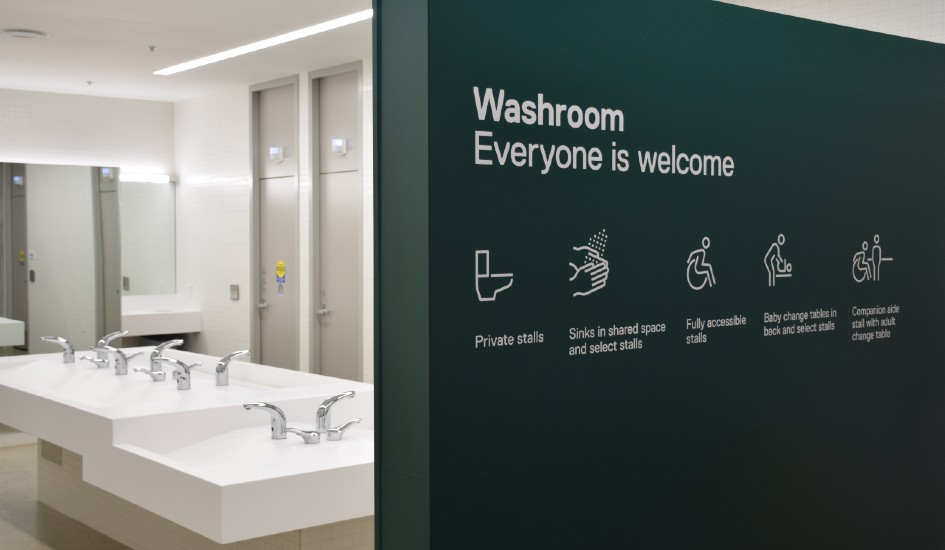
For instance, designing stalls to a higher standard of privacy than found in most gender-designated washrooms and change rooms helps achieve comfort, while creating openness in adjacent areas promotes safety and visibility.

Gender-designated spaces should also be improved upon, rather than offering transgender and non-binary people only a universal option. Including ‘Trans people welcome’ on signage in these spaces helps alleviate the stigma.
Passive House

Inclusive washrooms. Image by hcma.

Integrating four distinct client groups

The end result brought together four distinct clients from the city—recreation, library, arts and parks— all accustomed to operating out of their own separate buildings. The library, for instance, has its own funding stream, reports to a separate board of directors, and holds different operating hours.

Passive House

Inside the library. Image by doublespace.

Each client expected to co-locate and deliver their services separately, but quickly realized there wasn’t enough funding available to meet all needs.

“We worked with them to move away from this idea of siloed operational services to something more integrated and shared,” says Higgs. “It was a huge difference for this project, which was a surprising amount of work, both in the design and now in terms of thinking about the governance and operational structure of the building.”

The community’s desire for a large, non-programmed social space was one vision that pushed the clients to pool space and resources and relinquish some of their individual areas.

One of the largest barriers at community centres is being able to provide free space, says Higgs. “Libraries are fantastic at that, but for many community facilities there’s a lot of programming that exists behind a pay point.”

 

The main entrance to the library. Image by doublespace.

Mimicking a clearing in a forest, this atrium space is the first visual patrons see when they enter the building, inviting users to spend unlimited time, without pressure to engage in any programs.

In a fast-growing city where trees are disappearing, saving the forest on the facility’s land was a larger concern among community members. One of the most striking features of the building is the two-way glulam roof design, Higgs describes.

Resembling the veins of a leaf, the heavy timber structure mimics a tree canopy as a series of large-scale modular interlocking pinwheel units create a two-way wood structure spanning across large spaces.

Beneath the canopy, the civic centre brings forth visions from a suburban community that is uniquely dense and devoid of home garages and other spaces for making and fixing things, like a woodworking studio and community kitchen.

“The fact we could ask questions and see the building change in response to what we heard from the community was really exciting,” says Higgs. “That’s one of the ways of being inclusive—it’s not just getting them into the building physically, but what are the things in the building that allow them to be their best selves.”


World’s tallest passive house planned for Vancouver

A 60-storey residential development is planned for downtown Vancouver. According to developer Brivia Group, it will be the world’s tallest passive house building and will set the record in the category of low-carbon, energy efficient buildings.

“The realization of Curv reinforces the narrative that Brivia Group is at the forefront of sustainable building design,” said Kheng Ly, president and CEO of Brivia Group. “Designed to harness its own energy, deliver ultra-filtered air and attenuate noise from outside, Curv will be the most energy efficient structure of its type ever built. We hope it will quickly become a blueprint for future towers around the world as cities push for a more sustainable future. The idea of a super-tall passive house tower is especially fitting in a city with such high environmental aspirations. Curv will be an eco-friendly landmark, contributing to Vancouver’s iconic skyline.”

Inspired by nature, the architecture of Curv takes on the curved form of a new shoot, a symbol of regrowth and environmental hope. The tower represents a shift in direction for building design – delivering on environmental promises while maintaining architectural boldness and stunning aesthetic.

The design team includes architect Tom Wright of WKK Architects and interior designer Andres Escobar of New York-based Lemay + Escobar. This will be WKK Architects first building in North America.

“It was a pleasure collaborating with Brivia Group to deliver on a building as important as Curv that will raise the bar for developers,” said Wright. “At WKK, sustainability is now embedded in our culture. Superior design, with consideration and thought into the long-term impacts on our communities and environment, can truly improve our quality of life and enrich our experiences, today and for generations to come.”

Located between Burrard and Thurlow Streets, the tower will contain 501 residential units and sales will begin in the fall.

Security deposit reimbursement set to go digital

Alberta landlords could have the option of returning tenants’ security deposits through electronic channels if a proposed amendment to the provincial Residential Tenancies Act (RTA) is adopted. The enabling legislation is part of a package of changes to 14 provincial statutes recently introduced in Bill 21, the Red Tape Reduction Statutes Amendment Act.

The RTA dictates that landlords are to make applicable security deposit reimbursement and provide related documentation within 10 days of a tenant giving up possession of a unit. This is currently prescribed to be delivered personally, through an agent or sent through regular or registered mail.

Reflective of the growing use of e-commerce, the proposed amendment would provide flexibility to “deliver in any other manner agreed to in writing by the landlord and tenant”.

Accompanying rationale for the amendment maintains that electronic delivery will eliminate potential costs and delays of returning the security deposits through the traditional means. It also aligns with the Alberta government’s stated policy of supporting digital solutions.

Putative budget promises tax credit extension

Ontario’s putative budget promises to extend an enhanced tax credit for investors who build, acquire or renovate commercial or industrial buildings in areas outside the province’s most economically flourishing markets. The government lacks time in its current mandate to table and pass a budget bill, but the newly released 2022 provincial budget plan earmarks approximately $40 million to offer the Regional Opportunities Investment Tax Credit until December 31, 2023.

The refundable tax credit was initially introduced at a 10 per cent rate for qualifying expenditures made after March 25, 2020 and was then increased to 20 per cent for the period from March 24, 2021 to December 31, 2022. During that time, Canadian-controlled private corporations can claim the rebate on up to $450,000 of eligible costs to a maximum of $90,000.

The proposed one-year extension to December 31, 2023 is framed in the budget document as “giving businesses more time to make use of the enhanced support”. The tax credit applies on eligible capital expenditures made in most areas of the province outside Ottawa, the Greater Toronto and Hamilton Area and nearby regions encompassing Barrie, Niagara, Kitchener-Waterloo and Guelph. Some of the urban centres falling within the eligibility zone include London, Windsor, Kingston, Peterborough, Greater Sudbury and Thunder Bay.

The budget plan also confirms a two-year extension, to December 31, 2024, of tax relief on the sale of municipal electricity utilities to private sector operators. This measure — which, depending on the size of the utility’s customer base, reduces or eliminates a transfer tax equivalent to 33 per cent of the market value of the transacted assets — has been in place since 2016. The government has enacted the extension through regulation, and the budget plan presumes no revenue impact for the ongoing tax relief.

GTA rents continue to trend up

GTA rents continued to trend up in March 2022, with Bullpen Research & Consulting and TorontoRentals.com reporting an increase of 10 per cent versus a year ago. Since the height of COVID-19 in August 2021, average GTA rents have been steadily rising – as have interest rates, which will likely keep some prospective buyers in the rental market for longer. Moving forward, analysts predict that new housing completions will rise, adding more supply throughout the year as persistent inflation keeps driving up the costs for landlords. As a result, rents are expected to continue to increase, but not at the same pace experienced in Q3 and Q4 of 2021.

“After very strong growth in the second half of 2021, average rental rates in the GTA have flattened out, with this trend consistent across property types, bedroom types and geographic areas,” said Ben Myers, president of Bullpen Research & Consulting. “[We] still expect rents to increase in 2022, but at a slower pace than previously forecasted.”

According to the report, a majority of the municipalities in the GTA had slight declines in average monthly rents for condo rentals and apartments. Toronto rents saw a month-over-month decline of 0.4 per cent; Mississauga had a monthly decline of 0.9 per cent; Etobicoke average monthly rents declined by 2.6 per cent; Scarborough experienced a monthly decline of 3.8 per cent and Brampton monthly rents were down 5.4 per cent.

The spring market should see increased tenant demand, and with condo premiums rising from 15 per cent to 35 per cent in the major municipalities, the high end of the rental market is strong again and that could pull up rents in the near future.

GTA rents in condos vs. apartments

In general, the price growth of condominiums has outpaced apartments over the past year. In Mississauga, the average rent for condos ($2,627) in the first quarter of 2022 was 34 per cent higher than the average rent for apartments ($1,955).

In Scarborough, the margin of rents for condos over apartments in the first quarter was 27 per cent; in Etobicoke, the difference was 26 per cent, and in Toronto where the condo premium is lower, the average rent for condos still outpaced the average rent for apartments by 15 per cent.

While condos consistently rent for higher prices than apartments because they are newer and typcially offer more amenities, this premium declined during the pandemic as demand for expensive prime condo projects close to employment plummeted. But rents for condos have risen again as employees return to downtown offices and their places of employment.

Unit sizes

Average rents for condominium rentals for studios, one-, two- and three-bedroom units have risen significantly in March from January 2021.

Average monthly rent for three-bedroom condo rentals was $3,534 in March, up 30 per cent from $2,716 in January 2021. Average rent for a two-bedroom condo in March was $2,819, up from $2,440 in January 2021; average rent for a one-bedroom in March was $2,161, up from $1,869 in January 2021 and average rent for a studio went from $1,552 in January 2021 to $1,719 in March.

For apartments, two-bedroom units saw the most notable increase, where the average rent in March was $2,306, up 10 per cent from $2,098 in January 2021.

Other key takeaways from the report:

  • The average rent for condo apartments was $2,480 per month in the first quarter of 2020, declining significantly over the next year by 17 per cent before increasing to $2,457 per month in the first quarter of this year. The average rent for single-family homes was $2,793 per month in the first quarter of 2020, before also experiencing a significant decline in the latter half of 2020 and the start of 2021 before rising 21 per cent to $2,980 per month in the first quarter of 2022.
  • Listings for condo apartments on TorontoRentals.com are concentrated by the waterfront, the downtown core, and downtown west areas of Toronto, with other areas of high density north on Yonge Street to Eglinton. Available apartments are more dispersed, with areas of high density slightly to the east of the downtown core in the St. Jamestown area as well as to the west in the Parkdale area.
  • Average rents per-square-foot for 14 new condominium projects in Scarborough so far this year have surpassed pre-pandemic levels at $3.15, which is 4.3 per cent higher than 2019, and up 10 per cent over 2021.

Click here for more rental market data.


Rize Properties launches Hovercraft Builders

Rize Properties has launched its standalone, full-service construction division, Hovercraft Builders. Hovercraft will provide construction management services as well as access to a suite of development support services, including customer care and financial services, to other progressive developers in the region.

“In the current environment of ever-increasing construction costs, having an experienced construction team has never been more important for a developer,” says Simone Mandarino, VP of construction at Hovercraft. “Hovercraft will provide a streamlined approach to the construction process and help our partners build lighter.”

Hovercraft has helped build three million square feet of completed, active or planned construction for Rize which includes 3,200 homes and more than 370,000 square feet of commercial retail space. The division is also launching with four new construction projects for other developer partners: 

  • CIBT’s Global Education Mega Centre, a mixed-use 50-storey commercial, residential condo and rental housing for the academic sector, southeast of Surrey City Centre SkyTrain Station.
  • UBC’s Carey College, a four-storey mixed-use institutional and residential building and a seven-storey residential building, providing more student housing and amenity spaces on campus.
  • Averra Development’s 1551 Grant Street project, a five-storey, 35-unit secured market rental building slated for the 1500-block of Grant Street near Commercial Drive.
  • 810 Kingsway, a six-storey, 108-unit purpose-built rental project developed by Rize in partnership with and managed by Minto Properties located in Kensington-Cedar Cottage.

“We are looking to partner with other like-minded developers who want to build meaningful projects that benefit our communities,” says Mandarino. “Collaborations with progressive development groups can only bring more vibrancy to our cities, and with the expertise of the Hovercraft team, we are well-positioned to deliver high quality projects at scale.”

The team’s expertise includes multi-unit residential, commercial retail, commercial office, and institutional projects with a diversity of construction methods including concrete, wood frame, steel and mass timber.

“Our team has produced a portfolio of industry-leading residential and commercial projects across Metro Vancouver,” continues Mandarino. “Given Rize’s 30-year tenure as a developer of residential and commercial projects, we know what developers need, and what they don’t.”

The abuse of disinfection: Why zeal can be as harmful as negligence

At the outset, it is important to stress that disinfection is necessary and important. I am a microbiologist and have been developing training courses on hygiene and sanitation for many years, so I am biased in favour of anything that has to do with disinfection. However, I am an advocate of thoughtful disinfection and the judicious use of our battle weapons. There is no need to use a bazooka to kill a fly.

With the continuation of COVID-19, we need to take into consideration the evolving scientific findings, face the facts, and change our preconceptions; surface disinfection has its place, but is not the chief weapon in the fight against the transmission of the virus.

At the very beginning of the pandemic, we firmly believed that COVID-19 was transmitted primarily through surfaces. It was legitimate and entirely sensible and reasonable, at that time, to adhere to that belief. It was also the most common preventive position in the world to ensure that the transmission of a previously unknown infection was limited.

As the months passed, more and more studies were done on the survival time of COVID-19 on surfaces. Three hours, 12 hours, three days – there were some suggestions it could even last up to 17 days on surfaces. However, the survival time of a germ on a surface does not necessarily mean that it is still infectious.

In more recent pandemic times, it has become apparent and accepted that COVID-19 is generally more likely to be transmitted by droplets, close contact, and even by aerosols that would remain airborne than by surface contacts. Few recent case studies report probable transmission through a freshly contaminated surface, but this remains difficult to prove definitively as it is impossible to exclude respiratory transmission. But numerous reports show that hand hygiene is a more effective barrier to virus transmission than surface disinfection. That was echoed by the CDC in the US, which clearly stated last year that this virus is very poorly transmitted through surfaces and the risk of contracting COVID-19 on an object and becoming contaminated is very low. They even suggested a one-in-10,000 chance.

Why is surface disinfection so overly promoted?

Surface disinfection is effective and recommended to prevent infection if you live in the same house as someone who has contracted COVID-19, but disinfection of indoor and outdoor public areas does not seem to be as effective.

It is important to note that studies show that the extensive use of disinfectants has already caused a significant increase in respiratory problems, such as asthma, in the population. There are also many more incidents of poisoning from disinfectant chemicals as reported by an increase in calls to poison control centres across the country.

On the other hand, disinfection has a major advantage. By eliminating all other surface-borne infections such as colds, flu, gastroenteritis, and others, it makes it easier to identify people who are infected with COVID-19 since virtually no other infections are currently circulating. Now so deeply anchored in our habits, disinfection is closely linked to the safety of public environments and will henceforth be required and highly valued by the population. Disinfection must absolutely be maintained as part of a sanitation program, not only for its effects on public health but also for its contribution to alleviating people’s concerns.

In short, without putting a stop to disinfection, the time has come to revisit your disinfection practices, because over-disinfecting can cost you a lot of money. Don’t let your guard down, but ensure you have the right battle weapons. Overzealousness can be as bad as negligence, so the first thing to do is to check whether you are disinfecting too much, too little, or just enough. Assess the risks associated with your environment and adjust your disinfection frequencies accordingly while respecting the standards in effect in your area.

Ultimately, fair and thoughtful disinfection is crucial. Please do not eliminate this step from your protocols, but you should not be afraid to change your protocols, nor should you do what everyone else is doing just to comply. Being adaptable and adjustable does not mean you are influenceable or indecisive, it simply shows you are keeping up with the latest information and making well-thought-out decisions. Adapt your disinfection protocols to your own situation.

Nathalie Thibault is the Training Director of ValkarTech, a Canadian consulting firm that guides, supports, and advises its clients on ways to optimize the operational performance of their organizations in terms of building hygiene and sanitation.