Articles Archive - Page 297 of 928 - REMINET
REMI

Keith Major a BOMA Fellow inductee for 2022

Keith Major, head of Canadian real estate management with BentallGreenOak, has achieved one of the top honours that the Building Owners and Managers Association (BOMA) International bestows in being named a BOMA Fellow. The designation recognizes members of at least 10 years standing who have been exemplary contributors to BOMA, the commercial real estate industry and the wider community.

Major is one of just three inductees for 2022, who will be formally recognized at BOMA International’s annual conference, set for June 25-28 in Nashville, Tennessee. He joins a select contingent of 61 Fellows named since 2011. Drawn from the United States, Canada and Australia, they are looked to for leadership and wise counsel as the industry navigates emerging issues and welcomes new generations.

“Keith has been a long-serving, high impact volunteer leader with BOMA Toronto, BOMA Canada and BOMA International, most recently having completed a double term as BOMA International’s treasurer,” observes Benjamin Shinewald, president and chief executive officer of BOMA Canada. “We congratulate him on this well deserved recognition and thank him for his amazing service to BOMA.”

Inconvenience largely to blame for lack of hand hygiene

Hand hygiene has dropped off since the early days of the pandemic, and it seems that inconvenience may to be blame.

That’s the key conclusion of a recent study from GP PRO which found that five common factors, all related to inconvenience, tend to prevent healthcare workers from properly following a facility’s hand hygiene protocols.

Late last year, GP PRO conducted proprietary research with health care clinicians on the hand hygiene compliance rate within their organization’s protocols for using alcohol-based hand sanitizer.

The study found that the top five ranked reasons why workers didn’t follow protocols were:

  • Emergencies requiring immediate attention (66 per cent of respondents)
  • A busy schedule or full workload (also 66 per cent)
  • Malfunctioning, broken, or empty hand sanitizer dispensers (51 per cent)
  • Hands being full and, therefore, unable to access a dispenser (50 per cent)
  • Difficulty sanitizing hands during glove-on/glove-off process (50 per cent).

“Lack of hand hygiene compliance primarily comes down to inconvenience,” said Ronnie Phillips, Ph.D., GP PRO’s healthcare division senior director of innovation.

“These healthcare workers know their facility’s policy, and they want to follow that policy; but our research shows that the very nature of their jobs in combination with the nature of how hand sanitizer is made available to them prevents them from doing so.”

There are some evident conclusions to draw from this research.

While not much can be done about the distraction of emergencies in hospitals and care facilities, employers can look to avoid over-burdening employees with their schedules or workloads to allow for more time to follow important hand hygiene protocols.

Perhaps most importantly and easily, ensure that hand sanitizers are plentifully distributed around facilities and are well-maintained and checked frequently to avoid breakage or inadequate supply of sanitizer would go a long way to easing this issue.

Vancouver takes further steps for zero emissions

City of Vancouver has taken new steps to advance zero emissions buildings. The steps are taken from four reports aimed at collectively removing more than 50,000 tonnes of carbon pollution in Vancouver annually.

“The latest Intergovernmental Panel on Climate Change report states it is ‘now or never’, to avoid the worst of climate breakdown. Vancouver has the tools and ability to act,” said Mayor Kennedy Stewart. “Tackling emissions from existing buildings, shifting our construction practices and prioritizing residents’ safety, health and comfort is a win-win.”

The four Climate Emergency Action Plan reports include the following actions:

  • Requiring cooling and air filtration in new buildings to protect residents from air pollution and heatwaves.
  • Reducing carbon pollution from large existing office and retail buildings by 40 per cent by 2030 and requiring zero emissions by 2040.
  • Cutting carbon pollution from all new buildings to nearly zero by 2025, a 90 per cent reduction compared to 2007 levels.
  • Creating first-of-their-kind requirements in North America to limit carbon pollution from building materials and reduce waste.
  • Exploring options to remove gas for cooking and fireplaces in new residential buildings.
  • Prioritizing electrification over renewable gas in new and existing buildings.
  • Streamlining existing regulations to make renovations easier.
  • Pioneering processes to track and cap emissions from large existing commercial buildings.
  • Providing supports for owners of existing multifamily buildings, detached houses, and commercial buildings to access energy coaching and rebates for heat pumps.
  • Delivering a roadmap of future regulations to support industry and resident readiness.
  • Funding existing non-market housing to make these options more climate-resilient.

The city has prioritized eliminating carbon pollution from large commercial buildings, which have the best opportunities and resources to make energy-efficiency retrofits and switch to renewable energy.

The four building emissions reduction reports are part of the city’s Climate Emergency Action Plan, which analyzed the sources of Vancouver’s carbon pollution and committed to cutting these emissions in half by 2030.


Keeping water at bay with proptech

Water damage is among the most common (and costly) issues in property management. From leaky pipes to foundation cracks, roofing tears to envelope holes, there are plenty of opportunities for water to wreak havoc. However, like many

property management challenges, a mix of modern tech and proactive strategies can turn the tide.

First Onsite“Water damage affects buildings on so many levels and can happen anytime,” says Brendan Murphy, Director of Client Solutions with First Onsite Property Restoration.

“In fact, nearly 70 per cent of the emergencies we respond to are a result of property damage caused by water-related events.”

Those events can be large-scale weather events, such as floods, thunderstorms, and hurricanes. They can also be hidden or “easy to miss” leaks that cause extensive damage to properties over a period of time. Moreover, untreated water damage can trigger the growth of harmful mould that puts building occupants at risk.

Tech to the rescue
As with any property management risk, prevention is key. Herein, advances in water monitoring and leak detection systems give building management teams the ability to spot and respond to water damage risks the moment they begin to form. This proactive approach is critical for reducing losses and giving tenants a heads up. “The sooner you can respond to water damage, the better,” says Murphy. “That’s why the best systems are those that alert the right people to problem areas quickly so that you can avoid costly remediation, longer disruption to services, and increased
operational costs and efforts.”

First OnsiteFor its part, First Onsite has formed partnerships in the tech community to offer solutions for 24/7, real-time water monitoring and analytics. This includes devices that can be installed in strategic locations to detect leaks the moment they occur and send alerts via text, e-mail, or phone call to the appropriate internal and external responders. Solutions also include smart sensor technologies that monitor when water consumption patterns or humidity levels fall outside of acceptable ranges.

The data collected from these technologies can also be used to generate automatic graphs and reports that can then be used to identify areas for improved efficiency, spot abnormal trends, or even benchmark water consumption across an entire portfolio.

“The technology does more than bring attention to potential emergencies; it provides that continuous fl ow of real-time water usage data that enables building teams to see where they’re using the most water and take appropriate steps,” adds Murphy.

The conservation advantage
Properties of all kinds are always prone to water damage. The good news is that property teams have access to the technologies and expertise to catch issues at their source and practice smarter consumption at the same time.
First Onsite logo
First Onsite Property Restoration is one of the largest and fastest-growing emergency response planning, mitigation, and restoration service providers in North America. To learn more about water monitoring proptech, contact Brendan Murphy, Director of Client Solutions, at bmurphy@firstonsite.ca. For more, visit firstonsite.ca.

Continued dysfunction mars progress at LTB

It’s been a long, weary road to resolution for landlords and tenants caught in the evictions backlog that was exacerbated in 2020 when the pandemic forced the Landlord Tenant Board (LTB) into a five-month hiatus. Though online hearings have since resumed via the Tribunals Ontario Portal, technical difficulties, prolonged waits, and complaints of biases abound.

“Our paralegals are frustrated with the process, so I expect landlords are too,” says Joe Hoffer, a lawyer and partner with Cohen Highley LLP. “I think of the opening of Dickens’ novel Bleak House where the inscription outside the courthouse door reads, “Suffer any wrong that can be done you rather than come here!” because the delays, the cost, and the dysfunction result in daily miscarriages of justice for both landlords and tenants.”

Hoffer isn’t alone in his exasperation with the LTB, where problems have persisted for years. In fact, the sluggish pace of proceedings became the subject of an investigation by Ontario Ombudsman Paul Dubé before the State of Emergency was declared. According to his 2019-2020 annual report, Tribunals Ontario ranked fourth for most prevalent topic of complaint — and tellingly, 74 per cent of the 1,051 complaints about the Tribunal were specifically related to the LTB.

In the two years prior to COVID, the LTB received approximately 80,000 applications per year, 90 per cent of which were filed by landlords seeking to end a tenancy or collect money owed. In 2020, that number dropped to about 48,000 applications due to the five-month LTB closure. As many feared, this created a surge in cases once the eviction moratorium lifted, and despite efforts to chip away at that backlog via online hearings and mediation, the board continues to struggle.

Acknowledging this is a real problem, the Ontario government recently earmarked $19 million over three years to help the Ontario Land Tribunal (OLT) and the Landlord and Tenant Board reduce their respective backlogs. The Province says the funding is intended to help both tribunals appoint new adjudicators, have resources on hand for mediation, improve IT platforms, and resolve disputes faster.

Though it’s still early on, Hoffer says he has yet to see any evidence of improved efficiencies at the LTB — and, if anything, matters for landlords seem to have gotten worse.

“Board members are facing a deluge of applications, and apparently they have no time assigned to writing orders because it can take months to receive them,” he reports. “In many cases following a hearing, we’ve found that the board member’s appointment may have expired, or that the board member resigned prior to issuing orders, and we then receive directions that we have to come back and have another hearing. You can imagine how well that goes over for the parties who thought they finally had their day in court, only to have to go back and start over.”

Adding more to the list of grievances, Hoffer says landlord applications for arrears have been held up since December due to a dysfunctional computer system. Meanwhile, tenant applications have been processed in a matter of weeks. In short, he says, “I cannot recall a time over the past 35 years of my practice when the adjudicative system for landlord and tenant matters has been as dysfunctional as it is now.“

The good news is, according to an operational update posted May 5 to the Tribunals Ontario website, users who experienced technical issues filing their “Applications to End a Tenancy” and “Evict a Tenant or Collect Money” (L2 applications) through the portal will not be required to start the process over again.

“Applicants who filed an L2 application affected by this issue will be receiving a letter from the LTB asking that they complete a new L2 application using our PDF forms and upload it to their Tribunals Ontario Portal file,” the post reads. “This will not have an impact on the affected application’s place in the queue with respect to hearing dates and legislative deadlines, and any supplementary filings such as the Request to Extend or Shorten Time will also be unaffected. The original filing date will be preserved.”

Comparative energy scores reset apartment hunt

Access to comparative energy scores could sway prospective renters’ evaluation of available apartments. Newly released study findings from the American Council for an Energy-Efficient Economy (ACEEE) show a 21 per cent increase in traffic to the most energy-efficient units when scores appear on all rental listings, whereas there is little discernible uptick in interest when information is displayed only for the best-performing units with no comparative context.

Results of the controlled experiment, involving 2,455 participants considered to be roughly representative of the U.S. population, also indicate prospective renters were more willing to consider units with higher rents if they were attached to better energy scores. That trend was most noted among those younger than 45 and/or who lived in the country’s hottest or coldest climate zones. Meanwhile, there was no significant difference in prospective tenants’ preferences related to income or education levels.

“Our experiment showed that if renters have that (comparative) energy cost or efficiency rating, it’s absolutely going to affect their choices,” submits Reuven Sussman, lead author of the accompanying report and director of the ACEEE’s behaviour and human dimensions program. “It may also nudge landlords to make their buildings more efficient.”

The study, known as a discrete choice experiment (DCE), used a mock website that generated listings in response to participants’ specifications about rent range and other amenities. These were presented in various formats, including: with no energy scores; with scores only for the best performing units, which is reflective of the general experience of voluntary energy-use reporting; and with minimal to greater context for interpreting scores and their meaning for energy costs.

In doing so, researchers aimed to glean evidence to help determine:

  • whether energy-efficient units get more attention when information about energy efficiency is available;
  • which formats for imparting information increase prospective renters’ willingness to pay for energy efficiency;
  • which renter demographics place greater value on energy efficiency; and
  • how renters’ responses compare to previous research findings about homebuyers.

As a qualifier, researchers acknowledge the mock website’s limited number of choices versus the wider and more detailed selections apartment-seekers would typically find in real rental listings. However, they conclude energy scores are particularly effective when they are presented in tandem with the unit’s monthly energy costs, and along with a continuum of average energy costs for comparable units in the geographic region pegged to a range of energy scores.

In such cases, prospective renters were willing to entertain rents that were more than 2 per cent higher for each increment of improved energy score. Even with fewer details, on average, prospective renters were willing to pay an extra 1.8 per cent in rent per increment of improved energy score. Based on a current average rent of USD $1,877, ACEEE researchers hypothesize landlords could realize a revenue gain of USD $405 per unit for each gradient of improved energy performance on a 10-point scale.

“This value could go up to as much as $520 with some labels,” they observe. “Furthermore, many cities have older buildings that could likely increase their scores by two or three points with existing retrofit technologies, thus earning $800 – $1,200 additional revenue per year.”

Lobby installation illuminates Kitchener’s shift to digital economy

An art installation bedazzles the lobby atrium of a new office building on King Street, in Kitchener-Waterloo’s growing tech community, near the offices of Yahoo and Google.

Made of 8,000 translucent discs on 650 cables, the piece was created by Dubbeldam Architecture + Design for Perimeter Development Corporation to express Kitchener’s industrial shift from manufacturing to digital economy leader.

installation

When viewed from various perspectives, new patterns and shifts in geometry emerge. When looking straight through from the upper floors, the installation’s red-and-blue binary gradient is revealed. Photo by Riley Snelling.

“Binary Spectrum explores the yin-yang relationship of tangible fabricated object (manufacturing) with a representation of the intangible digital realm,” says architect Heather Dubbeldam. “The repetitive discs suggest digital processes and fractal patterns found in science, and are used to create a spatial effect with a human scale.”

Visitors can experience the installation’s kinetic properties. As people move in and around the space on two levels, the vertical cables softly sway, bringing the sculpture to life and reflecting the buzzing energy of the building’s inhabitants.

installation

Second floor visitors find themselves immersed in a matrix of gently undulating colourful discs. Photo by Riley Snelling.

Myriad patterns can be viewed from different perspectives and provide a new sensory experience with each angle. Visitors can engage with the installation in unique ways. The suspended circular coloured acrylic discs fill the space and draw people in from the street.

The contrast created by two ends of the colour spectrum is softened through the gradient between them: warm red and cool blues merge and resonate with the lobby furniture, specifically sourced to coordinate with the installation’s bluish tones.

installation

The porous installation breaks the triple-height lobby into a thousand different interstitial spaces, creating a more immersive experience for visitors. Photo by Riley Snelling.

How to ensure safe work in a confined space

Working in the janitorial industry can involve working in a confined space, and that certainly comes with its own risks.

A confined space is fully or partially enclosed and not primarily designed or intended for continuous human occupancy. It has a limited or restricted entrance or exit, or a configuration that can complicate first aid, rescue, evacuation, or other emergency response activities.

The major risk factors in a confined space tend to be its design, construction, location or atmosphere, the materials or substances in it, the work activities being carried out in it, or the mechanical process and safety hazards present.

Confined spaces can be below or above ground – you can find them in almost any workplace. And, despite the name, they aren’t necessarily small.

There are examples of confined spaces in many different industries. In agriculture, for example, there are silos, vats, hoppers, utility vaults, tanks, manure pits, and water supply towers. Municipal waterworks have sewers, pipes, access shafts, boilers, and pump stations. In transport, think of truck or rail tank cars, barges, shipping containers and aircraft wings. A ditch, well, or trench may also be a confined space when access or exiting is limited, although they are open to the air above.

Identifying and controlling hazards

Any hazard found in a regular workspace can also be found in a confined space. But in a confined space, workers are more at risk. There is often an insufficient amount of oxygen for a worker to breathe or toxic gases that could make the worker ill or cause them to lose consciousness.

Simple asphyxiants, including argon, nitrogen, or carbon monoxide, are gases which can displace oxygen in the air. Low oxygen levels (19.5 per cent or less) can cause symptoms such as rapid breathing, rapid heart rate, clumsiness, emotional upset, and fatigue. As less oxygen becomes available, nausea and vomiting, collapse, convulsions, coma and death can occur. Unconsciousness or death could happen within minutes of exposure to a simple asphyxiant.

Confined spaces are also at an increased risk of an explosive or flammable atmosphere due to flammable liquids and gases and combustible dusts which, if ignited, would lead to fire or explosion.

Other hazards that might be present include process-related hazards such as residual chemicals or the release of contents of a supply line. Workplaces also need to consider physical hazards like noise, heat and cold, radiation, vibration, electrical, and inadequate lighting.

In addition, there are many safety hazards, ranging from moving equipment parts to structural hazards that could lead to engulfment, entanglement, slips, or falls. A barrier failure could result in a flood or release of free-flowing solids or liquids. Biological hazards include viruses, bacteria from fecal matter and sludge, fungi, and moulds.

An error in identifying or evaluating potential hazards in a confined space can have more serious consequences, as their conditions are often extremely dangerous or life-threatening.

For example, the entrance might not allow the worker to get out easily should there be a flood or collapse of free-flowing solid. Self-rescue may not be possible, and rescue of the worker could be difficult. An estimated 60% of fatalities that happen in confined spaces are would-be rescuers. The interior configuration of a confined space does not typically allow easy movement of the people or equipment within it. Conditions can change very quickly, and natural ventilation alone will often not be sufficient to maintain breathable quality air.

Preparing to enter a confined space

Before a worker enters any workspace, employers should determine if it is a confined space. The next question to ask is: Is it absolutely necessary that the work be performed inside the confined space? In many cases where there have been deaths in confined spaces, the work could have been done outside of it.

A trained person should identify and evaluate all the existing and potential hazards within the confined space before any workers enter it. Evaluate activities both inside and outside, including testing the air from outside, before entering. Care should be taken to ensure that air is tested throughout the confined space – side-to-side and top to bottom.

Continuous air monitoring may also be needed, especially in situations where a worker is in a space where atmospheric conditions have the potential to change (e.g., broken or leaking pipes or vessels, work activities creating a hazardous environment, or when isolation of a substance is not possible). A qualified worker using detection equipment that is appropriate and calibrated according to the manufacturer’s instructions should test the air quality. Sampling should show that oxygen content is within safe limits, a hazardous atmosphere is not present, and ventilation equipment is operating properly. The opening for entry into and exit from the confined space must be large enough to allow the passage of a person using protective equipment.

Because of the elevated risk of injuries and fatalities, it is absolutely crucial that organizations have a well-developed confined space program. This program should outline requirements for risk assessments and hazard control, safe work procedures, worker training, entry permitting process, air testing, emergency response, record keeping, and program review. There should also be a description of the roles and responsibilities of each person or party, including the employer, supervisor, workers, attendants, and emergency response team.

Requirements for entering confined spaces can vary by jurisdiction, so be sure to review the applicable legislation before proceeding.

Source: Canadian Centre for Occupational Health and Safety

Going fully hybrid at HSBC’s new Toronto office

On a Friday morning, in HSBC Bank’s new corporate office at 16 York in downtown Toronto, sit-stand desks and meeting rooms are dotted with workers who have returned from pandemic lockdowns.

Over the past two years, the global bank has considered what post-COVID life should look like for their employees and recently rebooted into a fully-hybrid work model ahead of a March opening in the brand new 33-storey tower.

Occupying floors two to six and more than 5,200 square feet of retail on the main floor, the office suits a revamped collaborative approach for the 1,500 employees who call the office home base. There’s flexible work spaces, no assigned seating, and innovative technology to support teams working around the globe.

One could find Zoom-ready meeting rooms, quiet corners with high-back seating and ventilated booths that automatically close-in for private conversations. Digital white boards at team tables allow multiple users to collaborate in real time from any location, and there is a desk-to-person ratio of 1:3.3, with sit-stand or non-adjustable options.

To make office life easier, an employee experience ambassador is on hand, both in Toronto and the recently renovated national headquarters in Vancouver. They oversee a rainbow of tasks. A typical day could involve arranging events, fixing IT glitches and assisting with HSBC’s global app, by which employees can book meeting rooms, see when their colleagues plan to be in the office, view building alerts and indoor floor plans, and navigate maps of the local neighbourhood.

Kim Toews, executive vice president and head of human resources, describes the ambassador role as people whose sole job is to “make the office a positive experience,” similar to hotel concierges.

“We wanted to make sure employees felt we are really focused on them and it’s not just about the business and being productive and cost-effective; this is very much about the employee experience,” she says, over a Zoom chat from one of HSBC’s meeting rooms in Toronto. “It’s also practical. You can’t expect managers to know all the ins and outs, so centralizing that to one person is very efficient.”

One of the many collaborative work spaces. All floors are themed around Eastern provinces.
HSBC

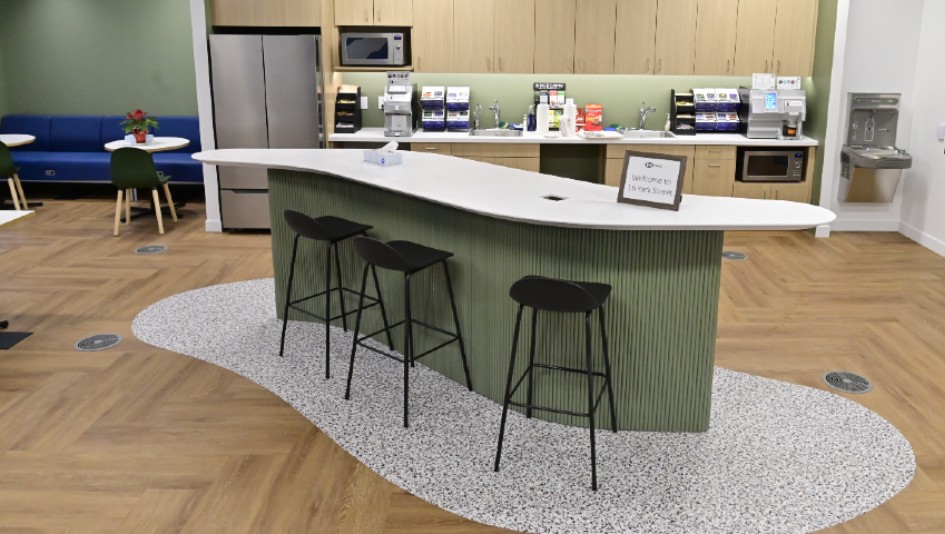
Upon entering each floor, communal cafes support worker interactions across the whole office.

The company has long embraced a flexible work policy that the pandemic has since magnified to unexpected levels. Many workers had never spent all five days in the office. There wasn’t a 1:1 desk ratio for every person, as vacations, illness, training, and travel all impacted desk space. As Toews says, “in a cost conscious environment you’re always trying to maximize every dollar spent.”

There’s more choice now, with four work styles based on internal employee surveys: full-time in office; full-time at home; flexible home; and flexible office. Going to the office also has more purpose. Employees revealed they wanted to return to “the stuff they were missing most” like connectivity and creativity.

“It’s not just about coming to the office, sitting down and working; it’s what are you going to do in the office,” says Toews. “We wanted people to tell us how often they think they are going to come in, but the more we talked about it, the more we started working out the kind of spaces and designs we need.”

“This is our best guess of what is going to work. A lot of spaces are flexible, so we can adjust as we see how people are using the space and the demand for different types of styles.”

Space planning has been a hurdle for many companies configuring return-to-office layouts that fit hybrid work models.

In B.C., HSBC’s Vancouver team contracted with WeWork for alternative offices to relieve overflow at other locations, where a lack of space could be a barrier to productivity. “We are actually trying to dedicate more people to spaces there,” says Toews. “That gives us some additional flexibility, where in leases you don’t have that as much.”

The move to 123,000 square feet at 16 York, a designated LEED Platinum, WELL-certified tower designed by architectsAlliance and B+H Architects, was announced in September 2018.

Back then, the glass tower had yet to fully rise on the southwest corner of York Street and Bremner Boulevard, south of Union Station. It had only broken ground in 2017, during a time when the vacancy rate in Toronto was 4 per cent and 1.5 per cent in the south core.

Relocating from 70 York brought opportunities to turn technology up a notch. “The goal was to look at the latest and greatest, not necessarily cutting edge, but to retain the best details about remote working, while still getting the benefits of being face-to-face,” says Toews. “It is very hard if you’re not in a room to feel that connectivity. That was one of the biggest objectives of the technology; to make everyone feel as equal as possible.”

Equity is central to the conversation around hybrid work modes that bring with them a new etiquette of sorts. One tip—not signing off immediately when a meeting ends. A remote participant who can ‘join in the after conversation’ helps with that connectivity, suggests Toews.

It’s also a small way of supporting workers’ psychological well-being, which the pandemic has intensified. Workplaces have traditionally focused on protecting employees from physical harm, but there is strong scientific evidence that depressed mood, anxiety, and burnout can affect their mental health, according to the Canadian Centre for Occupational Health and Safety.

“I cannot emphasize the importance of manager training when it comes to this,” says Toews. “Everyone’s stress levels have gone up significantly. The degradation of our mental health is significant and continues.”

Managers must now oversee staff who are experiencing less patience and rational, cognitive thinking, she explains. The human brain has adapted to high levels of anxiety and stress during the years-long pandemic.

“It has the greatest and most direct impact on employees if a manager knows how to spot someone who is struggling or knows how to alleviate some of that stress,” she says.”We haven’t given managers the right tools in the past; it was more in a crisis moment, as opposed to that ongoing attention to it.”

The company has a wealth of resources like the online LifeSpeak platform for mental health and well-being education and skill-building tools via HSBC University, which help managers create psychologically healthy environments.

Last year, the company boosted mental-health coverage under its employee assistance program to 18 fully-covered counselling sessions per year.

“If a company does not have any kind of employee assistance program, that is job number one because people often don’t want to talk to someone at work about what they’re struggling with,” says Toews. “We also try to destigmatize it as a free service and encourage people to use it, not just when they feel they are having a breakdown.”

There’s a lot to smooth out for any company surfacing from the throes of the pandemic and mental health awareness figures prominently into the equation, as is rolling out a fully-enabled hybrid workforce.

“We’ve proven we can all work remotely. . . we had really great results last year from a business perspective,” says Toews. “As the organization truly buys into it, and as employees are really forgiving while we all try to figure this out, I think this will result in a much better place.”

16 York. Looking north on York Street, with a green roof. Photo via Cadillac Fairview.


AIBC dispels myths about PGA transition

As work continues on the transition to the Professional Governance Act (PGA) in B.C., AIBC is addressing several myths about the transition to keep architects informed.

1. MYTH: Once under the PGA, the AIBC will undergo a name change, and will no longer be the body responsible for regulating the profession of architecture.

FACT
The PGA transition does not change the AIBC’s core function, mandate, or operations – the AIBC will continue to exist as the “Architectural Institute of British Columbia”, and will continue to regulate the profession of architecture in British Columbia in the interest of the public.

It is important to note that the oversight role of the Office of the Superintendent of Professional Governance is intended to promote regulatory excellence and accountability to the public. The AIBC will continue to: establish standards for admission to the profession and for professional practice and ethics; assist registrants to meet these standards; and conduct investigations into complaints against registrants and those practising architecture unlawfully.

2. MYTH: AIBC registrants will not be able to actively engage with the Institute or participate in bylaw consultation under the PGA .

FACT
Registrants will still have many opportunities to be active participants in matters impacting Institute governance and the architectural profession under the PGA. For example:

  • While bylaw establishment resides with AIBC Council under the PGA, there will still be a registrant consultation process, whereby registrants will be able to share their comments and feedback. The Bylaw Review Committee continues to advise and support the development of bylaws and professional standards of competency and ethics under the PGA. The AIBC welcomes and appreciates all responses from registrants.
  • The AIBC relies upon expert volunteers to accomplish the important work of the Institute, and this will not change under the PGA. We encourage registrants to contribute their knowledge and expertise through volunteerism.
  • The AIBC will continue to offer its core regulatory services and programs. From practice advice to professional development series and the Annual Meeting, AIBC registrants will still have many ways to engage with the AIBC.

3. MYTH: There are going to be sweeping changes that affect regulatory requirements, and AIBC registrants will not be given adequate notice.

FACT
The AIBC’s transition to the PGA will not be a sudden upheaval. The AIBC continues to review and update all regulatory documents (such as the Code of Ethics and Professional Conduct, Bylaws, Council Rules, Bulletins, etc.) to ensure they are aligned with PGA requirements, and will share details with registrants as soon as they’re available. Any new or changed requirements will be communicated to registrants well in advance, via a variety of media (Notice, newsletter, website, and information sessions, if appropriate). The AIBC does not anticipate substantive changes to professional standards or how firms and individual registrants are regulated under the PGA.

4. MYTH: There are no resources available regarding Professional Governance Act.

FACT
While several specific details regarding the AIBC’s transition to the PGA are still being finalized, there are many resources available to registrants to learn more about the Professional Governance Act, as well as presentations, background information briefs, and governmental websites. Several of the resources have been linked below:

PGA Resources

The AIBC encourages registrants to attend the upcoming Annual Meeting on May 31, which will include updates on the PGA transition. Additional presentations and Town Hall sessions will also be held.

An industrial touch for Corktown condo in Hamilton

The design for Slate Asset Management’s two-tower project in the Corktown community of Hamilton, which will include a 27-storey condo and a 14-storey mid-rise building with ground-floor retail, will rise with a modern industrial vibe.

Slate co-founders Blair and Brady Welch have roots in the area. This project will be their first in Hamilton.

“Hamilton has cultivated a reputation for a vibrant arts scene and entrepreneurial culture, which resonates with our wholistic approach to developing new communities,” says Brandon Donnelly, managing Director of development at Slate. “We seek city-building opportunities and invest in areas to realize long-term value and this starts with investments in great places and elevated design.”

Brick from the existing buildings on site will be folded into the new Corktown East development as a nod to the bricklayers and Irish past of the area.

“The design is intended to pick up on the natural characteristics of Hamilton—from the red-brick houses on the ground level to modern high rises in the downtown,” says Deni Poletti, principal, CORE Architects. “We are using the same grid pattern and language across both buildings to create a cohesive expression while differentiating them with unique palettes and materials.”

Amenities are designed to capture the city’s community feel and entrepreneurial spirit. Display windows and a bar area with shelving have been incorporated into the lobby to facilitate pop–ups by local artisans, makers, and other businesses.

A rooftop terrace with an illuminated canopy will overlook Lake Ontario and the Niagara Escarpment. Inside, studios to two-bedroom plus-den suites, ranging from 340 to 851 square feet, will blend with a health and fitness centre, party room, social lounges, co-working spaces, a guest suite, and an outdoor pool.

Interiors, by Mason Studio, will blend steel, aluminum, and concrete finishes with a refined application to offer a sense of warmth and character. “We want people to be proud to live at Corktown, and we want them to be able to celebrate the city they call home,” says Mason Studio Partner Stanley Sun. “Something as a simple as incorporating displays featuring local products in the lobby, turns what can be a passive space into an opportunity for civic pride.”

The condo is expected to launch this fall.

Corktown

Slate Asset Management is entering the Hamilton market with a new, two-building condominium community. Rendering by JORG

Feds seek input on climate change adaptation

The Canadian government is seeking public input to help finalize a national climate change adaptation strategy, scheduled for release this fall. A newly launched consultation process presents five action areas — disaster resilience, infrastructure, natural environment, economy, and health and wellbeing — identifies pressing priorities, sets objectives for 2030 and 2050, and summarizes the resources and expertise that have already been mobilized.

“The national adaptation strategy is central to our work in preparing for climate emergencies,” maintains Bill Blair, Canada’s Minister of Emergency Preparedness. “It will allow us to better assess the risks as we monitor, respond to and recover from extreme weather events, while building resiliency in communities right across the country.”

The public is urged to respond to a number of questions posed in a discussion paper, which sets out underlying principles and a proposed framework for the strategy. Individuals and organizations have until July 15 to submit comments via email or directly through an online portal, and they are also invited to send descriptions, photos and/or videos of their own efforts to prepare for, or adapt to, climate volatility.

“Adapting to the many impacts of our changing climate feels like fighting a two-front war,” says Steven Guilbeault, Canada’s Minister of Environment and Climate Change. “We can and we must do both mitigation and adaptation — play both offence and defence — for a complete effort.”

While extreme events — such as 2021’s notorious trifecta of record-breaking heat, forest fires and flooding in British Columbia — arise quickly, the discussion paper also tallies a spate of chronic climate-related conditions that undermine the strength and durability of natural systems, human and species health, infrastructure and key economic sectors. For example, melting permafrost destabilizes infrastructure in the north; retreating glaciers deplete water resources in western Canada; and warmer seasons succour insect populations that damage crops and infiltrate the built environment.

Effective adaptation begins with recognizing this is occurring, then evading and finding ways to surmount impacts where possible, while preparing for those that cannot be avoided. The discussion paper extolls a systems-based approach to the five action areas, which brings a wide range of players together for collaborative problem-solving and incorporates learnings from academic, professional, technical and lived experience. Proposed objectives draw on insight and recommendations from five expert advisory panels aligned with each of the identified action areas.

Data is central to the exercise. Adaptation strategists will rely on up-to-date scientific information about climate behaviour, risk assessment tools and ongoing monitoring of emerging applicable information. Objectives will be tied to reporting and evaluation measures in order to monitor progress, and to identify successful practices and processes that could be replicated as well as outcomes that indicate that more support or a different approach is warranted.

Many of the proposed initial priorities reflect needs for baseline information, guiding regulations, human and technical resources and increased professional awareness. That includes: continued development and sharing of information to advise communities of risks of climate-related disasters; integrating resilience considerations into building codes, standards and certifications; and promoting climate-related risk assessment and disclosure in strategic planning and financial decision-making. Also tapped for quick rollout is an expanded network of trained responders and equipment for emergency situations, including climate events.

Discussion paper questions prompt readers to reveal their own priorities for climate response over the next five years, divulge how climate-related events and threats have affected them, and gauge their own safety, economic and health vulnerabilities, as well as potential access to supports.

Sienna Senior Living acquires 50% interest in large portfolio

Sienna Senior Living announced it has finalized the acquisition of a 50 per cent ownership interest in a portfolio of 11 assets located in Ontario and Saskatchewan consisting of 1,048 suites. Sienna acquired the portfolio in partnership with Sabra Health Care REIT.

“We are adding quality residences to our retirement platform and in doing so, have seized a rare opportunity to enhance the growth prospects of our retirement operations, achieve immediate scale in Saskatchewan and expand our portfolio in key locations in Ontario,” said Nitin Jain, President and Chief Executive Officer of Sienna Senior Living. “We are excited to welcome the residents, their families and over 800 team members at our new locations and look forward to offering them a compelling resident and team member experience and a purpose-driven culture.”

Sienna’s share of the purchase price for the portfolio is $153.75 million. The company says it expects the acquisition to generate an approximate 6 per cent unlevered yield in the first twelve months following closing of the transaction. As of April 30, 2022, the occupancy of the portfolio was approximately 87.5 per cent, excluding one property in lease-up that opened in 2019.

The acquisition and related transaction costs were financed through a combination of net proceeds from the company’s March 23, 2022 equity raise; net proceeds from recent dispositions; a one-time drawdown of $90 million on the acquisition term loan;  and the assumption of two CMHC-insured property-level mortgages at a weighted-average interest rate of 2.24 per cent.

For more information, please visit www.siennaliving.ca.

Metro Vancouver finalizes plant contract with PCL

Metro Vancouver and PCL Constructors Westcoast Inc have signed a contract to take the next steps to complete the North Shore Wastewater Treatment Plant.

“The North Shore Wastewater Treatment Plant is a critical piece of infrastructure required to improve the quality of treated wastewater released into Burrard Inlet and to protect the environment,” said Jerry Dobrovolny, commissioner and CAO of Metro Vancouver. “We are committed to creating and maintaining strong collaborative partnerships to deliver our critical infrastructure, and look forward to working with PCL to complete this project as quickly as possible, in the best interests of the region.”

With the contract finalized, Metro Vancouver and PCL will work together over the next year to develop a new plan to complete the project, including developing a revised project budget and schedule. Some construction work is expected to resume under PCL this summer, ensuring that the project continues to progress.

“PCL is excited to collaborate with Metro Vancouver for the delivery of the North Shore Wastewater Treatment Plant,” said Sean Hamelin, senior vice president and district manager of PCL Constructors Westcoast Inc. “We thoroughly understand the task at hand, and we will complete this project safely and efficiently so that Metro Vancouver can provide a new treatment facility that will significantly improve the environment, reuse energy, and provide opportunities for educational and community engagement.”

The contract approach adopted by Metro Vancouver with PCL will allow for design of the plant to be completed and for construction to move forward in the quickest timeframe possible, while maintaining competitive costs for the region. Once the new plan to complete the project is ready, it will be reviewed by the Metro Vancouver board of directors, and there will be opportunities for additional sub-contracting.

When complete, the North Shore Wastewater Treatment Plant will serve more than 250,000 residents of the District of West Vancouver, District of North Vancouver, the City of North Vancouver and the Squamish and Tsleil-Waututh Nations, and provide tertiary treatment to better protect the environment.

Metro Vancouver terminated the contract with Acciona Wastewater Solutions LP in 2021, citing failure by the company to meet its contractual obligations.

Becoming a successful female mentor in the cleaning supplies industry

There are countless articles published talking about the importance and value of mentorship, and we recently saw many of these voices during Women’s History Month in March. Many of these articles strike home at the essence and reasons why mentorship is especially critical for professional women in the workforce.

However, for professional women in a male-dominated industry such as cleaning supplies, these articles go beyond simple inspiration. They can be the difference between a short-lived career or an enduring one where you can truly leave a lasting impression on not only women – but the industry as a whole.

I immigrated to the U.S. when I was 10 years old from the Czech Republic, not knowing a word of English, working two jobs in high school to help my mother make ends meet and three jobs while attending college full-time on an academic scholarship. I spent a lot of time in the cleaning supplies industry, working on the weekends and holidays, envious of guests on the other side of the table. Sheer determination played a big role in getting me to where I am now, being a wife and mother and gaining knowledge and experience from many male-dominated industries.

But, along the way, it has been clear to me the importance of finding opportunities to help other women advance.

How mentors can support professional growth

According to a recent survey, 56 per cent of American workers have had a professional mentor, while 76 per cent believe that mentorship is important.

Previously working in male-dominated industries including construction and motorcycle equipment, I am passionate about helping other women as they pursue careers in cleaning supplies operations. I have experienced the difference hard-working women can make, not only through mentoring other women but also by bridging the gap with men in the cleaning supplies industry to help them understand gender differences as well as the varying values women can offer their companies.

At the start of my career, I felt the right thing to do was to become “one of the guys”, understanding the language and learning their way of communicating with one another. I was passionate about my work and projects, intensely focused on client service, and was certainly growing confidence within the industries I worked. But along this journey, I began to grow more confident and I realized the importance of stepping outside this mould and understanding the distinct differences between men and women – particularly in the areas of communication. I was fortunate to work in a company environment where these diverse voices were encouraged – even within a male-dominated industry.

Other women are not so lucky. Many do not have the fortune I’ve had with supportive senior management. This is where mentorship becomes so critically important.

I know this because I’ve seen it first-hand, through my involvement with cleaning supplies associations and organizations where I’ve had the luxury of meeting hundreds of other professional women. Learning from these women has been instrumental in furthering my own professional career, as well as shaping the type of mentor I’ve now become to other professional women – of all career levels – inside my own very organization. I’ve also made it a priority to focus on nominating women colleagues for industry awards and speaking engagements inside my organization so they can shine under their own spotlight, and it was also important that I encourage them to attend the Women’s Forums from various associations for additional growth opportunities.

It’s ok to not be ‘just one of the guys’ 

I wanted to become a strong female mentor who could demonstrate to others how to be successful without having to just be one of the guys. It has been important to be strong and show how to make it okay to be female, even feminine, in the industry and serve as a leading example to others.

It is important for women to mentor other women, provide opportunities and lift each other up. The professional direction women receive from other women is essential. Consider the things female professionals need to be successful. Outside of professional talent and hard work, sometimes women need support from others to champion their ideas and goals, which studies continue to show, may not always receive the same amount of direction and prioritization as those of male colleagues.

The right mentorship goes beyond emotional support and advice. It can be imperative in helping growing female leaders understand and successfully navigate the political minefields that every organization encounters, male-dominated or otherwise.

Best practices for finding mentors 

Finding mentors can be challenging for professional women, particularly younger women. Mentors, like portfolios, should be very diversified. You should seek mentors with similar interests, and with dissimilar interests. Mentorship should not just be a popularity club. You should seek mentors of various age groups, as long as they have sincere wisdom to share. You should also choose mentors who can support you in difficult times, but also challenge you and push you to be even better than you ever expect to be. Mentors are special people who have the ability to see potential and help you reach that potential even when there are difficult situations to navigate.

With this insight, professional women of all ages can have a better understanding of what to look for in a mentor, and how to grow their professional relationship to achieve great potential – in cleaning supplies or any other industry.

Katerina Jones is Vice President of Marketing and Business Development at Fleet Advantage, a leading innovator in truck fleet business analytics, equipment financing, and life cycle cost management.

CPP Investments in global real estate top 10

Canada Pension Plan Investment Board (CPP Investments) continues to hold one of the world’s most valuable real estate portfolios — positioned 10th in IPE Real Assets’ recently released 2022 rankings of global real estate investors. However, with roughly USD $38.75 billion (CAD $49 billion) in real estate assets under management (AUM), it has slipped two notches from 8th place status in 2021.

Real estate accounts for about 9 per cent of CPP Investment’s total asset value, which is pegged at USD $430.6 billion (CAD $544.3 billion), and represents about 6.6 per cent of the real estate value that the top ten investors hold. IPE, a European based investment analyst and news service, reports the 150 global investors it surveyed collectively hold about USD $1.83 trillion in real estate assets, while the top 10 boast a 44 per cent share of that, or approximately USD $583.6 billion in real estate AUM.

This year’s leaders include five sovereign wealth funds, three pension funds and two global investment managers. Seven of the investors also made the top 10 in 2021.

The German-based international investment manager, Allianz, continues in the number one spot this year, with nearly USD $91.5 billion in real estate assets under management. That equates to about 7 per cent of Allianz’ total assets and 15.6 per cent of the top 10’s real estate AUM.

Norway’s Government Pension Fund Global ranks second with USD $65 billion in real estate AUM, followed closely by the Dutch pension fund, APG, which has approximately USD $64.8 in real estate AUM, and China Investment Corporation with USD $64.5 billion in real estate AUM.

The remainder of the list, from the 6th to 9th rankings, includes: Abu Dhabi Investment Authority (ADIA); Singapore’s sovereign wealth fund, GIC; Qatar Investment Authority (QIA); France-based global investment manger, AXA; and California State Teachers Retirement System (CalSTRS).

Swiss Life, the U.S. Teachers Insurance & Annuity Association (TIAA) and California Public Employees Retirement System (CalPERS have slipped from the top 10 this year after counting among them in 2020 and 2021.

Government Pension Fund Global and GIC are new to the top 10 for this decade, while Qatar Investment Authority returns from a one-year absence after previously ranking 10th in 2020. In 2022, QIA rises to the sixth spot, with USD $48 billion in real estate AUM, equating to 16.3 per cent of the total value of its holdings.

Historic investment to build new Royal BC Museum

The B.C. government is investing $789 million for a new state-of-the-art and seismically safe Royal BC Museum in Victoria. The new 23,000-square-metre museum is focused on making the Royal BC Museum a world-leading museum and gathering place.

“We are making this historic investment to build a safer, more inclusive and accessible modern building. Once complete, the new museum will be a flagship destination for tourism and a place where generations to come will learn about the richness and diversity of B.C.’s history,” said Premier John Horgan.

Like the Royal BC Museum’s collections and research building in Colwood, the new museum will be built to achieve high efficiency for all its HVAC systems. Both buildings will incorporate mass timber construction to leverage B.C.’s strengths in building innovation and support good jobs. These approaches will deliver significant reductions in greenhouse gas emissions and energy costs.

The new museum will also be one of the first government projects of this size that partners with local First Nations on the project team, participating in both project development and delivery, including design influence to reflect the Lekwungen peoples, and members of the Songhees Nation and Esquimalt Nation.

The new museum will bring significant economic and social benefits to the region, supporting more than 1,950 direct construction jobs, as well as more than 1,050 associated jobs, which will all contribute to B.C.’s COVID-19 economic recovery.

The Royal BC Museum has been at its current location since 1967 and has not been substantially renovated in more than 50 years. The Royal BC Museum site encompasses seven buildings over 2.7 hectares. The buildings include the exhibitions building, BC Archives, Imax Victoria, Fannin Building, Wawadit’la Mungo Martin House and Thunderbird Park, St. Ann’s Schoolhouse and Helmcken House.

Modernizing the Royal BC Museum will be the largest cultural investment in B.C. history and will take seven and a half years to complete. An RFQ is expected to be issued this fall.

The new modernized provincial museum is expected to open in 2030.