Articles Archive - Page 292 of 928 - REMINET
REMI

$77M funding for new resilient buildings in Lytton

The federal government announced funding of more than $77 million to support resilient rebuild of infrastructure, homes and businesses in Lytton, B.C.

Last June, devastating wildfires tore through the Village of Lytton, causing catastrophic damage to the community, including tragic loss of life.

The funding will provide:

  • $64 million, through Infrastructure Canada, to support the rebuilding of Lytton through the construction of net-zero, fire-resistant public buildings.
  • $6 million for the new Lytton Homeowner Resilient Rebuild program to support insured homeowners who will rebuild to net-zero and fire-resistant standards; and
  • $7.2 million to create the Lytton Business Restart program to help small- and medium-sized businesses get back on their feet. This funding, delivered by PacifiCan, will include support for Indigenous businesses and those operated by women, youth and other underrepresented groups.

“The people of Lytton suffered a devastating loss in the 2021 wildfire. The strength and hope they have shown is inspiring. This funding that we announced today will help rebuild Lytton and the businesses that are at its core. With this investment, Lytton will be positioned to become a leader in resilient, net-zero design that will support the community for today and tomorrow alike,” said Harjit S. Sajjan, minister of international development and minister responsible for the Pacific Economic Development Agency of Canada.

The funding announced by Minister Sajjan recognizes that rebuilding requires focusing on community infrastructure, housing for people, and restarting businesses that provide jobs and goods and services to the community.  With a focus on building back a community even stronger and more resilient than before, this funding will ensure the community becomes a model for recovery after a climate change related disaster.

“We have worked long and hard for the past 11 months to recover and get to the rebuilding of our community. Council has envisioned being a leader when building back Lytton. We have supported a vision to build to net zero by introducing a new building bylaw(s) to address this and to become a fire resilient community. These funds will go a long way to supporting our residents, businesses and our neighbours to rebuild,” said Mayor Jan Polderman, Village of Lytton.

Cintas opens search for EVS superstars

Environmental services (EVS) staff are essential in providing a clean and safe environment for staff, patients, and visitors at healthcare facilities. Their crucial role includes cleaning and sanitizing public and private areas to eliminate viruses, germs, and hospital-acquired infections.

Every day, EVS personnel across the country work on the frontlines to create a healthy and safe environment for patients, residents, staff, volunteers, and visitors. However, even now, after two years of a pandemic, these unsung heroes are often overlooked.

Cintas is once again recognizing these healthcare heroes with the Cintas C.A.P.E. Award (Cleaning to Advance the Patient Experience), which aims to identify acute and long-term care EVS techs who display kindness and courage, and spend countless hours maintaining facilities to prevent infection.

Healthcare professionals, family members, and others are invited to nominate acute and long-term care EVS technicians with inspiring stories for the chance to win a cash prize and a donation to their healthcare institution. Nominees must be 18 years or older, a legal resident of Canada (excluding Quebec and Saskatchewan) or the U.S, and have been employed for a minimum of one year with the same acute or long-term care healthcare facility (e.g., hospital, home health care).

Ten winners will receive a $2,500 cash prize and a $2,500 donation on their behalf to their healthcare institution or charity of choice. Winners will also receive a Rubbermaid charging bucket with products inside. Cintas, in partnership with The Association for the Healthcare Environment (AHE), will provide one scholarship to the designated trainer of their institution (typically an EVS director, manager, or supervisor) to attend one of AHE’s signature series Train the Trainer programs (T-CHEST, T-CSCT, T-CNACC), plus the technician will receive a scholarship to be trained and certified in the AHE program (CHEST, CSCT, CNACC) at their facility.

Nominations for the 2022 Cintas C.A.P.E. Award are open now through August 8.

Hybrid workplaces give rise to legal dilemmas

Almost two-thirds of Canadian workers indicated they prefer hybrid or remote workplaces in an Accenture survey last year. A more recent Ipsos poll in May 2022 found one-in-three workers would change jobs if their employers mandated an exclusive return to the office. Organizations are fashioning work models that reflect flexible and remote preferences. Along with this culture shift comes new legal considerations and best practices for safe, equitable spaces.

Some employees may need additional support to succeed in a hybrid workplace, whether it’s because of protected grounds under human rights legislation or performance needs, says Maddie Axelrod, a labour and employment lawyer with Borden Ladner Gervais LLP. She was speaking in April during a webinar on the topic.

Companies may likely field various concerns around inclusivity. There could be animosity from workers who are required in the office versus their teleworking colleagues. Employees who’ve gone remote might also feel detached from the physical workplace.

“Equitable treatment on the team is important for obvious reasons like team morale,” says Axelrod. “We also know there’s a challenge with recruitment and retention right now. People may not want to return to work and join an office where they feel they’re not part of a cohesive team.”

She advises employers to listen and survey for input and develop policies and practices that account for various types of work—for instance, building a hybrid model into promotion decisions.

“If you have more traditional markers of success or commitment and you’re shifting into a hybrid workplace, give some thoughts as to whether you need to adjust those metrics to match,” says Axelrod. “Have you traditionally been rewarding people who spent most time in the office and are you no longer going to be doing that?”

Managing changes to terms of employment, overtime and employee attendance

In the context of flexibility, the request for alternative arrangements is growing.  If a change to terms of employment occurs as a result, companies should secure their workers’ written consent prior to reduced hours or wages, and changes in responsibility, says Melissa Eldridge, labour and employment lawyer with Borden Ladner Gervais.

She references Hagholm v. Coreio Inc., 2018 ONCA 633, in which the recall of an employee previously permitted to work from home three days a week amounted to constructive dismissal. The employer had changed the terms of employment without the worker’s consent.

A commute-free, remote office culture is also prodding more people to work extra hours at home due to choice or losing track of time. “In terms of a role, what they are paid and their contract, they may be entitled to more pay for that time,” says Axelrod. “When people are working remotely, it is important to develop policies to ensure everyone is clear about the parameters around working longer hours and overtime, and the obligation to track and record those hours.”

Employers are encouraged to set boundaries for when the work day begins and ends—whether that means logging in and out on a traditional 9-to-5 schedule or working within flexible hours.

Privacy and confidentiality in the home office

As of June 2, employers who employ 25 or more workers must now have a written policy in place on electronic monitoring. The new legislation is part of Bill 88, the Working for Workers Act, 2022, which became law in April.

Although the policy doesn’t give workers a right-to-disconnect, many employers are taking the opportunity to review expectations around disconnecting, which is harder to accomplish with remote arrangements, says Axelrod.

“Home offices are still in the home and work is being conducted there,” she adds. “There is a limited expectation of privacy even with a work computer.”

The policy must identify whether an employer electronically monitors employees and, if so, describe how and in what circumstances employees are electronically monitored and identify the purposes for which electronic monitoring may be used and how.

Even if companies don’t engage in e-monitoring, Eldridge suggests doing a “quick sweep” to determine whether contracts, collective agreements or policies touch upon this practice. Due to Bill 88, as well as new considerations with the hybrid workplace, she also advises updating an acceptable use policy, which establishes rules that a user must agree to for network access.

“If e-surveillance is happening, for example—to keep track of vehicles used in the workplace, mileage or locations visited on any given day, there is a justifiable use that could be a pre-existing arrangement that exists,” she says. “The rationale for monitoring is often a very important point and goes a long way in terms of your efforts to be transparent with your employees.”

On another level, the security of employers’ information that will be accessed remotely is also a key privacy consideration, whether work is being conducted on home or company networks.

Protecting health and wellbeing in remote workplaces

Under provincial labour laws, such as Ontario’s Occupational Health and Safety Act (OHSA), employers must take every precaution reasonable in the circumstances to protect the health and safety of workers. The OHSA has an exception for private establishments.

“It is not entirely clear if this will apply in the context of people working from home, but our best advice is to assume that it does and this obligation to protect your workers is still going to apply even when they are working remotely,” says Axelrod.

As she further explains, decisions from the Workplace Safety and Insurance Board (WSIB) show their coverage generally extends to employees “performing job duties in the course of employment”— on the road, in other remote places or in the office.

“Another best practice is creating a risk assessment checklist that offers employees a step-by step review of their working environment at home or in the office,” Eldridge recommends. “It promotes a culture of safety for each and every employee.”

She advises asking employees to “sign back” to show they’ve scanned for hazards—for instance, loose cables and back-friendly ergonomic equipment.

‘The duty to accommodate applies at home’

Hybrid or remote work models must also reflect the duty of employers to reasonably accommodate employees who fall into groups protected by human rights legislation to the point of undue hardship.

In what will likely be a “very case-by-case and fact-specific” situation, high-risk employees may continue requesting remote work or a tweaked hybrid model.

“If an employee has a legitimate substantiating document for human rights-related reasons and can’t fit into the hybrid work model the way you thought, then you need to go through an accommodation process,” says Axelrod. “There may be various other non-COVID reasons that people can’t fit into a hybrid workplace as planned. Flexibility and creativity are going to be key here.”

Companies may also need to provide special office equipment for these home-working employees.

Meeting accommodation needs isn’t a one-size-fits all solution. Potential outcomes could mean modifying or bundling job duties, alternative assignments, disability leave for strictly in-office roles, or full-time or part-time remote work. A flexible schedule for work-life balance is yet another option many companies are exploring—even if the statue doesn’t apply.

Close to half (45 per cent) of Canadians say the pandemic has negatively impacted their mental health, according to LifeWorks Inc.’s mental-health index in May.

“They are not the same employees who existed prior to the pandemic,” Eldridge observes. “We are seeing employees who can feel drained or bored because their life has been infiltrated.”

In other instances, workers may feel anxious to connect with colleagues or exhausted from video calls. The lawyers offer a spate of strategies for tackling declining mental health: combat digital exhaustion with acceptable in-person arrangements; invest in better benefit plans and allowances, such as food delivery; change traditional working hours for balance; focus on active engagement; and set clear expectations.

As more people ditched urban life for small towns and other provinces, bringing their home office along for the move, companies are encouraged to proactively clarify jurisdictional issues that come from teleworking across any border.

Employees may require working permits or visas. Companies may need to “carry on business” in that jurisdiction with corporate filings and paying taxes, as well as registering for workers compensation and reviewing applicable local employment laws.

Tips for hybrid and remote work policies

As a form of legal protection, a hybrid or remote work policy outlines when and how employees can work outside the office, and should include all leaders within an organization. This is a document that companies can convey as fluid—with potential future modifications,

The lawyers advise this policy reminds employees of work obligations, such as attendance, performance and confidentiality, and reiterates the code of conduct as workplace harassment can also transpire in remote set-ups.

On top of that, companies can clarify expectations for a safe workplace, procedures for hours of work and overtime, and equipment reimbursement, with room to vary the policy for human rights accommodation purposes

“Policies aren’t going to anticipate every single possible situation that is going to arise, especially as we venture into this new area of hybrid working,” says Axelrod. “But if you set out guidelines and general principles— that more-or-less expected conduct you have for your employees, it will put you in a good position to have a strong, effective, cohesive hybrid workplace.”




Retrofit aggregator tapped for GTHA region

Efficiency Capital will serve as a retrofit aggregator for Canada Infrastructure Bank’s $2-billion Commercial Building Retrofit Initiative. A newly announced commitment of $50 million in federal funding along with the service provider’s 20 per cent equity capital stake will create a $62.5 million pool to devise and implement projects to reduce greenhouse gas (GHG) emissions.

Ehren Corey, chief executive officer of the Canada Infrastructure Bank (CIB) commends Efficiency Capital’s business model, which provides clients in the buildings sector with upfront capital to undertake required work in turn for a share of end-of-project utility cost savings. The company is an offshoot of The Atmospheric Fund (TAF), a non-profit agency funded through endowments with a 30-year track record of testing and advancing programs to underwrite energy and sustainability improvements.

Initially launched within the City of Toronto, TAF’s mandate now stretches across the Greater Toronto and Hamilton area (GTHA). Efficiency Capital was incorporated in 2015 as a single-source provider of engineering, finance, installation and monitoring and verification services. Last year, it was ranked 31st in the Report on Business’ list of top growing Canadian companies.

“Canadian businesses and building owners are starting to make serious commitments to reduce their GHG emissions, but often struggle with the allocation of sufficient capital to implement their projects at scale or across multiple sites,” observes Chandra Ramadurai, the chief executive officer. “EC brings specialized capital and diverse expert teams to deliver projects that otherwise would fail to meet the internal hurdle rates of our clients.”

Under the requirements of the Commercial Building Retrofit Initiative, project proponents will have to achieve a 30 per cent reduction in GHG emissions, with no less than a 25 per cent reduction in any one asset across a portfolio of buildings. Those efforts are projected to be underway later this year once financial arrangements between CIB and Efficiency Capital are finalized.

“Retrofitting commercial buildings is and will continue to be an important tool to enable Canada to get to net-zero by 2050,” says Dominic LeBlanc, Canada’s Minister of Intergovernmental Affairs, Infrastructure and Communities. “It is good for our environment, good for our economy, and good for workers.”

Slate Asset Management acquires Presima

Slate Asset Management has completed the acquisition of Montreal-based Presima Inc. The deal adds $1.1 billion in assets to Slate’s investment management holdings and heightens its presence in the public markets, where Presima has carved out global REIT and ESG yield strategies for investors, and manages real estate assets and listed infrastructure portfolios.

“With the addition of Presima’s experienced team, we are scaling our public market investing capabilities and deepening our expertise to offer investors even more avenues to uncover value in the real estate market,” says Blair Welch, a founding partner of the alternative investment platform, which includes value-add, core, core-plus and development initiatives.

Most recently, Slate acquired 800 acres of industrial land and buildings from Stelco Inc. in Hamilton, with plans to redevelop it as an industrial park. In Toronto, Slate has staked out midtown prominence, with 10 assets including all four corners of the intersection of Yonge Street and St. Clair Avenue.

“Our team’s knowledge of private real estate markets coupled with Presima’s proven public market expertise positions Slate to capture a broader range of investment opportunities,” maintains Erik Dmytruk, managing director and portfolio manager at Slate Securities. “There is compelling investment opportunity in both private and public real estate — particularly given the disconnect between public and private valuations we are seeing in the real estate market today — and to uncover that opportunity requires deep knowledge of global real estate and capital markets.”

“The quality of REIT properties has improved, while an expansion of the number of REIT sectors allows for more choice and opportunity for real estate investors,” concurs Marc-André Flageole, Presima’s interim chief executive officer. “We are thrilled for our next evolution, leveraging Presima’s decades of public market knowledge and expertise to seamlessly integrate and build on the quality, breadth and depth of Slate’s investment management business.”

Hines revs Canadian investment vehicle

Hines is targeting Toronto, Montreal, Vancouver and Calgary for real estate acquisition and development through its newly announced CAD $2-billion Canadian investment vehicle. The privately owned global real estate investment firm holds USD $90.3 million in assets under management, including about 14 million square feet of commercial properties in Canada.

Through the new venture, Hines promises to pursue prominent office, multifamily and mixed-use assets and well-placed development sites in the four key markets. The firm currently has nearly 200 development projects in progress worldwide.

“There are significant opportunities to invest in the highest-quality assets in the Canadian market,” observes Alfonso Munk, Hines’ chief investment officer for the Americas.

“Canada offers a stable investment climate and with this capital at our disposal, we can act quickly and scale faster than ever, working with our local partners to bring the talent and the capital to get projects realized,” concurs Avi Tesciuba, Hines head in Canada.

CDM could spell global energy-use avoidance

Conservation and demand management could deliver worldwide annual energy-use avoidance of 95 exajoules (EJ), equivalent to nearly 278 million megawatt-hours, concludes a report released last week at the 7th Annual Global Conference on Energy Efficiency in Sønderborg, Denmark. Canada is among dozens of national delegations in attendance to endorse urgent action on energy efficiency — recognizing it as one the most straightforward paths to easing reliance on fossil fuels and curbing greenhouse gas (GHG) emissions.

“The cleanest energy is the energy we don’t use,” declares a joint statement from 24 individual countries, the African Union and the European Union. “The current scale of energy efficiency action is not sufficient and there is a need to accelerate implementation on a global level.”

The report, from the International Energy Agency (IEA), theorizes that much of the forecast savings could be achieved with existing and readily available technologies, through fuel-switching, replacement of inefficient equipment and building materials, deployment of smart systems and behaviour change. Reaching an annual energy-use avoidance target of 95 EJ by 2030 would require a corresponding 4 per cent annual improvement in energy-use intensity — up from the current 2 per cent rate.

“With each unit of energy delivering more than it does today, final energy demand can be around 5 per cent lower by 2030, but serving an economy 40 per cent larger,” the report submits. “Slower action would lock in higher energy consumption for years to come.”

Buildings and transportation are tapped as two key sources of energy savings. Aligned with the IEA’s scenario for achieving net-zero emissions by 2050, the report identifies the potential capacity for a 20 per cent reduction in 2020 levels of building energy consumption by 2030 with fuel-switching playing a major role. That would be achieved on two fronts: electric heat pumps to replace gas-fired boilers; and more sustainable options in place of wood-fired or charcoal-based cooking.

“In 2020, energy consumption in buildings totalled around 129 EJ, and contributed around 28 per cent of all global energy related emissions. Early action on energy efficiency including electrification and other fuel-switching helps avoid around 37 EJ by 2030. This results in around 1.2 gigatonnes (Gt) of emissions reductions from the direct combustion of fossil fuels in buildings and also helps lower overall electricity sector emissions,” the IEA report projects.

The report also highlights the spinoff benefits of reducing reliance on Russian sources of oil and gas. The targeted 95 EJ in energy-use avoidance equates to about 30 million barrels of oil per day, or roughly triple Russian’s 2021 production. It’s equivalent to 650 billion cubic metres of natural gas annually, which is about four times the volume the EU imported from Russia last year.

New biomedical engineering facility for UBC

The School of Biomedical Engineering at the University of British Columbia (UBC) is getting a new home with a purpose-designed, state-of-the-art facility.

The project cost is $139.4 million, with $25 million from the province and $114.4 million from UBC. Construction is expected to start in summer 2022 with the building opening for students in early 2025.

Designed by Patkau Architects + Architecture49, the five-storey building will feature classrooms and learning spaces on the lower floors, with research labs and spaces on the upper floors. The building will consolidate classroom and lab spaces currently hosted in 24 buildings on the Vancouver campus.

“This project is a major step forward for solidifying UBC and British Columbia’s position as a world-leading biomedical research and innovation hub. The new building will enable scientific discovery, the development of new technologies and will support the education of the next generation of talented scientists, innovators and entrepreneurs,” said Santa Ono, UBC president. “Bringing together researchers, students and staff from UBC’s faculties of medicine and applied science, this nexus of research, entrepreneurship and talent development will enable therapies that improve human health and innovation that help drive economic growth.”

Biomedical engineering combines engineering principles with medical sciences to design, create and evaluate equipment, computer systems, and software used in health care. The work includes designing and building artificial internal organs and body parts such as hip joints; designing computer software to operate complex medical equipment such as 3-D X-ray machines; and developing new drug therapies to solve human sickness and diseases.


Vancouver approves Indigenous redevelopment

City of Vancouver has approved the Heather Lands project, the largest Indigenous-led redevelopment in the city.

A joint venture partnership between the xʷməθkʷəy̓ əm (Musqueam Indian Band), Sḵwx̱wú7mesh (Squamish Nation), and səlilwətaɬ (Tsleil-Waututh Nation) — collectively the MST Nations — and Canada Lands Company (CLC), the Heather Lands redevelopment will become a unique place that integrates with the surrounding neighbourhood and provides housing, shops and services, job space, parks, childcare, and a xʷməθkʷəy̓ əm, Sḵwx̱wú7mesh, and səlilwətaɬ cultural centre to support the new community.

The Heather Lands will be a primarily residential community, anchored by a ‘drum beat / heart’ at the north end of the site which includes the cultural centre and plaza, and a childcare facility, along with a park network. It will also provide new job and retail space close to housing in a location near transit routes.

When fully built out, the Heather Lands will include:

  • Buildings ranging in height from 3- to 28-storeys, with:
    • 540 units of social housing
    • 400 units of market rental housing with 25% of the floor area at below-market rent rates
    • 1,670 leasehold strata-titled units
    • 74-space childcare facility operated by the MST Nations
    • Commercial space, including office uses
  • 4 acres of park and public open space
  • A xʷməθkʷəy̓ əm, Sḵwx̱wú7mesh, and səlilwətaɬ cultural centre
  • A site for a Conseil Scholair Francophone (CSF) French language school and associated childcare facility.

The cultural centre will be the signature building on the site, to be owned and operated by the MST Nations for the practice and sharing of culture, values, and traditions.

“This project is a significant milestone and will be a benchmark for the city’s efforts toward reconciliation,” said Mayor Kennedy Stewart. “It represents an important opportunity for the long-term prosperity of future generations of the xʷməθkʷəy̓ əm, Sḵwx̱wú7mesh, and səlilwətaɬ Peoples, and also addresses key city priorities including housing affordability and the climate emergency.”

The Heather Lands site will be redeveloped in five phases over approximately 15 years.

Repeat winners figure in ENERGY STAR awards

The 10 recipients of the 2022 ENERGY STAR Canada awards for existing commercial and institutional buildings represent a balance of new and old, with five repeat winners from last year. This year’s honourees are drawn from the pool of 283 ENERGY STAR certified buildings Canada-wide, and include six office buildings, a multifamily condominium complex, a school, a long-term care facility and a hospital.

In addition, 28 other ENERGY STAR awards were bestowed for products, programs and sustained contributions to advancing energy efficiency. Private and not-for-profit organizations, including manufacturers, homebuilders, utilities, retailers and advocacy agencies are eligible in a range of categories.

“I commend this year’s ENERGY STAR Canada award winners, who have demonstrated innovation in energy efficiency, which is critical to our ambitious climate goals,” says Jonathan Wilkinson, Canada’s Minister of Natural Resources. “Their collective commitment to reach and inspire Canadians to make energy-efficient choices is contributing to Canada’s target of net-zero emissions by 2050.”

Winners in the existing buildings category include:

  • 2001 Bonnymede Drive, a 215-unit low-rise condominium complex in Mississauga, Ontario. It was built in 1976, and is managed by Crossbridge Condominium Services;
  • Brian Canfield Centre, a 22-storey, 690,000-square-foot office tower located at 3777 Kingsway in Burnaby, B.C. It was built in 1976 and originally served as the headquarters of BC Tel. It is currently owned and managed by H&R REIT;
  • 227 King Street South, Waterloo, Ontario, an 18-storey, 648,000-square-foot office building. It was built in eight phases between 1912 and 1986, and is owned by Concert Realty Services;
  • 351 King Street East, Toronto, a 17-storey 500,000-square-foot office building. It was built in 2016, and is owned and managed by First Gulf;
  • 55 Commerce Valley Drive West, an eight-storey 186,000-square-foot office building in Markham, Ontario. It was built in 2000, and is owned by Soneil CVD 55 Inc.;
  • 6985 Financial Drive, a five-storey, 180,000-square-foot office building in Mississauga, Ontario. It was built in 2006 and is owned and managed by QuadReal Property Group;
  • Commerce South Office Park, Building B, a three-storey, 91,000-square-foot building located on Edmonton’s 51st Avenue. It was built in 1982 and is owned and managed by BentallGreenOak;
  • Saint John Regional Hospital, owned and operated by the Horizon Health Network;
  • Bliss Carman Middle School, Fredericton, New Brunswick. It is part of the Anglophone West School District, and is owned by the Government of New Brunswick; and
  • Sunrise of Windsor, an assisted living and senior care facility in Windsor, Ontario, owned by Ventas Healthcare Realty.

Sunrise of Windsor and three of the five office buildings — excluding 351 King Street East and 55 Commerce Valley Drive West — also received ENERGY STAR awards in 2021.

New mid-rise residential development coming to Ottawa

TCU Development Corporation recently broke ground on 1155 Joseph Cyr, a mid-rise residential development located in Ottawa’s Beacon Hill-Cyrville neighbourhood. The six-storey rental building will offer 117 rental units of various sizes when the project is complete in 2024.

“We are proud to be breaking ground on our development in the Beacon Hill-Cyrville neighbourhood,” said Mike Corneau, TCU’s Principal & Co-Founder at the May 24th groundbreaking of the project. “We take pride in, and embrace, the responsibility of developing 117 new units that will enrich the lives of people in the community.”


Tim Tierney, Ottawa City Councillor for Beacon Hill-Cyrville Ward, added: “I am very excited to see shovels in the ground at 1155 Joseph Cyr St. This will breathe new life into a neglected corner of our ward and is within the St. Laurent Transit-Oriented Development (TOD) Plan area, walking distance from the Confederation Line’s St. Laurent Station. This is a prime example of smart, environmentally friendly infill, boasting 60 bicycle parking spots and generous landscaping.”

Morley Hoppner will be managing the construction of the building. Also involved are Figurr Architects Collective, Cleland Jardine Engineering, 4té Interior Design, Fotenn Planning + Design, Paterson Group, Stantec, GWAL and ZW Group.

1155 Joseph Cyr will include a rooftop terrace, sky lounge amenity room and a communal work space. A resident-focused commercial tenant will anchor the ground floor of the development, fronting on Cyrville Rd.

For more information, visit: www.tcudevcorp.com

Washington first state to require building electrification

Washington State has become the first U.S. state to incorporate building electrification mandates into statewide energy codes.

Beginning in 2023, builders are required to install electric heat pumps for heating and cooling in new commercial buildings and multi-family residences. According to an analysis by the Rocky Mountain Institute, restricting the use of natural gas in buildings in the state can eliminate 8.1 million tons of carbon dioxide by 2050. The updated energy code also includes improvements to building envelopes and efficiency that will further save energy for building users.

“The decision was a no-brainer as electrifying commercial buildings is a win for Washingtonians and the planet,” said Jonny Kocher, senior associate with RMI. “RMI found that heat pumps are 2-4 times as efficient as gas burning appliances and don’t impact customers’ utility bills. Unlike gas furnaces and water heaters, they do not emit dangerous combustion emissions, benefitting public health. And they reduce earth-warming greenhouse gas emissions by utilizing Washington’s already clean electricity grid, which will only get cleaner.”

The Washington State Building Code Council also approved a last-minute amendment that would only require 50 per cent of water heating to be via electric heat pumps; the remaining 50 per cent can be heated through other methods. There is also an exception for hospitals and research facilities.

“The long term business case for building all-electric is sound, and because of the business bottom line, we’re seeing an increasing demand from our clients for clean energy buildings,” said Todd Stine, partner at ZGF Architects. “This stronger energy code is absolutely time critical to continue to proactively move the design and construction industries toward achieving net zero carbon buildings. The market is already going there, but more clarity and support in policy and codes will be key for the building design and construction industries.”

Landlords still offering incentives in June to attract tenants

Landlords and property managers across Canada are still offering move-in incentives and promotions in June 2022 to attract the best tenants for their vacant residential units. A review of listings on the Rentals.ca Network found that incentives abound in most major cities except for Vancouver, where rents are comparatively high.

Popular offers include one- or two-months’ free rent upon signing, cash bonuses, gift cards, or free cable and/or Internet service for a prescribed period. Older, renovated apartment buildings are most likely to offer signing incentives compared to new purpose-built apartments and rental condominiums.

Below are some examples of the renter incentives currently on offer for the month of June:

“Move in this summer and receive a $1,000 move-in bonus.”  – torontorentals.com/toronto/the-torontonian-id272342

“Thirteenth month free rent, plus a $500 gift card from your choice of Amazon, Homesense, Costco or Wayfair.” – rentcanada.com/toronto-on/rentals/25399

“One month of free rent on a one-year lease, plus a $750 signing bonus (applicable on studios and one-bedrooms only) for any leases signed by July 1.” – rentals.ca/toronto/40-gerrard-st-e 

“Qualify for $500 in gift cards if you bring your completed application and last month’s rent deposit back to the site within 72 hours. Gift cards will be awarded after move-in.” – rentals.ca/toronto/650-woodbine-avenue

“Move in this summer and receive a $1,000 move-in bonus”  – rentboard.ca/toronto-on/45-dunfield-avenue/34152

“Student special: Receive a $250 signing bonus for referring a friend. Groups of two: Receive $200 off first month’s rent. Groups of three: Receive $225 off first month’s rent. Groups of four: Receive $250 off first month’s rent.” –  rentals.ca/montreal/1430-rue-city-councillors-1

“Rent a two-bedroom and receive one of the following incentives: one month free rent on a one-year lease; two months free rent on a two-year lease; signing bonus of $250.” – rentals.ca/vancouver/

“Rent today and save up to one month with exclusive rates on TELUS Optik TV and high-speed Internet.at Varsity Square Apartments. Students receive a $300 move-in bonus.”  – rentals.ca/calgary/4515-varsity-dr-nw

“Receive up to $2,544 off rent plus $300 move-in bonus on select suites and exclusive rates on TELUS Optik TV and High-Speed Internet.” – rentals.ca/edmonton/3624-119-st-1

“Special student promotion: Month-to-month renting for students plus a $500 move-in bonus with the option of one month free rent when leasing for three months and a $500 referral bonus.” – rentals.ca/winnipeg/389391-balmoral-street


Vancouver mass timber office celebrates opening

Natural Resources Canada announced the official occupancy of oN5 in Vancouver, the first office building in Canada constructed using high-performance cross-laminated timber (CLT) panels.

More than $1.2 million in funding for the oN5 project was provided through the Green Construction Through Wood (GCWood) Program, which encourages low-carbon construction through innovative uses of wood in non-traditional construction projects, such as low-rise non-residential buildings, tall wood buildings and bridges.

“By making effective use of Canada’s forest resources through low-carbon building systems, Canada is becoming a world leader in sustainable wood construction practices, increasing energy efficiency and climate resilience in our communities while simultaneously enhancing the global competitiveness of our forestry, wood manufacturing and construction sectors. That’s why our government is pleased to support projects like oN5 — to help lower emissions, create good jobs for workers and build better neighborhoods for everyone,” said The Honourable Jonathan Wilkinson Minister of Natural Resources.

Located in the Mount Pleasant neighbourhood, the top three storeys of the four-storey mass timber office building are constructed entirely out of cross-laminated timber. Its construction required sophisticated building information modelling and virtual construction work due to the challenging zero-lot-line site.

The installation of the CLT building structure was completed in 15 days by Naikoon Contracting due to the use of prefabricated panels over conventional methods. The building meets Passive House standards for energy efficiency and also employs state-of-the-art seismic devices for resisting earthquakes. Its design and use are examples of climate resiliency in action.

The owner of the building is Robert Malczyk, the engineer of record on the project and principal of consulting structural engineers Timber Engineering Inc. said oN5 is the first building of its kind outside of Europe. During the opening, he noted the three main innovations on this project were the full prefabrication of the building, the seismic device (Tectonus hold-down system) and flat CLT slabs.

“The City of Vancouver and British Columbia are leaders in wood excellence, and we’re proud to be part of it,” he said.

The health of your building matters

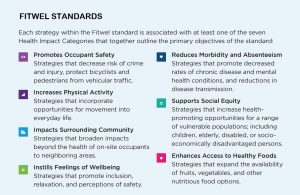
A new report from the Centre for Active Design (CfAD), in collaboration with QuadReal Property Group, points to the positive ways healthy building strategies can drive value in real estate. Released June 8th, the report’s findings support the long-advised notion that investing in the health of a building leads to higher tenant satisfaction ratings and better financial outcomes.

“Demand for healthy buildings has never been higher, and now the case for investing in them is even stronger,” said Joanna Frank, President and CEO of CfAD, operator of Fitwel. “This research makes clear the value of benchmarking to transform the information about a portfolio into a pathway that owners and investors can act on to plan future investments. At scale, this will solidify health-promotion interventions as best practices across the real estate sector.”

While public health research has addressed the link between the built environment and the health of occupants for decades, COVID-19 has underscored the need for better benchmarking and reporting. Commercial building owners are under greater pressure to provide data that shows exactly how their properties are impacting the health and well-being of those who live and work there.

According to Meirav Even-Har, National Manager, Wellness & Healthy Buildings at QuadReal Property Group, the road to transparency is easier than ever, thanks to industry tools and certification programs like Fitwel.

“Pursuing benchmarking using Fitwel has enabled us to analyze healthy building strategies for our domestic residential portfolio, which in turn informs future investment and operating procedures,” she said. “For our industry, benchmarking and certification helps create a standard set of health and wellness indicators that redefines best-in-class buildings.”

So, what constitutes “healthy”?

While no two properties are exactly alike, some of the features of a healthy apartment building include units that offer adequate daylight, views of nature, access to fresh air, indoor greenery, yoga studies, hygiene signage, proof of certification and sanitation stations. At the facility level, all systems and equipment should be properly maintained, with high efficiency and operational standards that prioritize, health, safety, and the environment.

Though there is no shortage of rewards that come from investing in the health of a building, findings outlined in the new report show the following direct correlations:

  • properties located in walkable districts with plenty of amenities and access to nearby services command higher rents;
  • properties that conduct regular maintenance and implement operational strategies to clean, monitor, and improve building systems have higher occupant satisfaction ratings;
  • properties with healthy food access via food courts, farmers markets, or grocery stores in close proximity to the building, are more attractive to residents and represent a great opportunity for developers.

“One of the QuadReal team’s sustainability goals is to provide healthy buildings to our tenants and residents so they can flourish,” said Jamie Gray-Donald, Senior Vice President, Sustainability & EHS at QuadReal. “From the start, we believed that investing in best-in-class operations and amenities would make healthier spaces. This aligns with our commitment to be a responsible company. Thanks to our collaboration with CfAD, we have found a clear correlation between a higher Fitwel score with a greater willingness of occupants to recommend the building to their friends and colleagues. This reinvigorates our conviction to invest in healthy buildings and benchmark wellness more broadly in our portfolio.”

New healthy benchmarking tool

Launched in tandem with the report, Fitwel has also introduced a “Portfolio Benchmarking Tool” that will allow building owners and investors to assess how a single asset or entire portfolio is impacting occupant health.

The new tool enables the user to calculate how their operating decisions will impact mental, social, and physical health outcomes, allowing them to invest more wisely and reap the rewards of better overall health.

To learn more about the Fitwel standards or to access the complete report, visit fitwel.org

Special assessments foreseen as CPI rises

A spate of special assessments is anticipated as condominium corporations update their reserve fund studies and adjust for inflation. Coming out of an extended period when the consumer price index (CPI) hovered in the 2 to 2.5 per cent range, many condo boards will confront shortfalls as the CPI now pushes up toward 7 per cent.

“That’s going to be a huge adjustment as to what you’ve actually got in the bank and what you are responsible under the (Condominium) Act to have in the bank,” observes Greg Moore, president of the construction management firm, Quantum Project Management Services. “There will be special assessments hitting all of these condo boards and people are going to freak out.”

The looming hit for some condo owners reflects a confluence of escalating construction costs for materials, labour and contractual or financing penalties tied to delayed delivery. Industry insiders outlined some of those pressures last week during a panel discussion at the REMI Show.

On one side, contractors and project managers are encountering daunting constraints on the supplies and services needed to keep projects moving. On the other, they’re beholden to developers and institutional clients with budgets and timelines that aren’t sympathetic to supply chain woes.

Jeff Murva, a construction management consultant and chair of the Toronto Construction Association’s board of directors, gave examples of “runaway material and equipment costs” as builders worldwide compete for the scarcity of everything from swimming pool components to the conduit that encases electrical cabling within poured concrete slabs. Turning to labour, he cited soaring wage scales in response to widespread shortages of almost every skilled and unskilled trade. That’s coupled with diminished productivity as employers scramble to fill out their ranks and meet developers’ demands.

“Their clients, the developers, are saying: ‘You better take on this additional project. We don’t care where you get the men; just get the men and take it on, or else we’re going to take all of our dozen projects and give them to someone else’,” Murva recounted.

“And the problem is, you’re getting the C-team — someone who is not performing,” added Craig Lesurf, president of the construction management company, the Gillam Group. “An A-team crew used to have a majority of As. An A-team now has one or two As and all the rest are Bs, Cs, Ds and below.”

Supply chain uncertainty spurs new storage practices and costs

The lingering disruptions of the COVID-19 pandemic are melding with more recent repercussions from Russia’s invasion of Ukraine to create new complications and further goad inflation. Lesurf noted that Ukraine is a prominent source for various construction materials and products, including steel, wood and electrical equipment, much of which is shipped from its beleaguered ports.

“If you want to get a certain birch for millwork. Ukraine is the principal place it comes from. You may have specified it two years ago, but you can’t get the material now,” he said. “I had some components of a building stuck in a container ship in Kyiv and we had to get it off-loaded from the container ship and shipped to Poland to get it out. We were nervous about having to find a replacement (elsewhere) because we ordered it 12 months ago.”

Such supply chain uncertainty is triggering new procurement practices as construction managers order products when the opportunity arises and hold them for the future. That comes with new costs and requirements for storage capacity, while exacerbating overall material and equipment shortages.

“Storage was never common in conversations or contracts three years ago. Now there are so many contracts where we’re having to prospect storage,” Murva reported.

Meanwhile, for in-progress development, it’s another cost that wasn’t contemplated when the budget was set. “If it’s available, we buy it now and store it. Those storage costs weren’t factored in, and it’s robbing the market of something that used to turn over every three months, but now we’re keeping it for nine months before we need it,” Lesurf confirmed.

Investors seek assurance against creeping project costs

There are also soaring transportation costs regardless of when products and material are obtained. It’s all filtering through to development pro formas — interjecting more caution and squeezing the margins even tighter in what Murva typifies as an already precarious pathway to profits for multi-residential high-rise projects. With institutional investors increasingly holding sway in the development space, contractors and project managers are getting the blowback from pension funds’ and insurance companies’ ingrained risk aversion.

“It’s becoming common now to ask for price certainty before the green light is given. What it means is that we are moving towards a stipulated price contract,” Murva said. “Ownership is becoming very nervous about the cost to actually build something, about the cost creeping or escalating on them over the course of the project.”

That appears to be a reasonable fear.

“People are saying: My price is good for 10 days. It’s no longer 30 or 60; it’s 10 days,” Moore underscored. “The notion of historical data is historical; it’s not relevant anymore. It makes it difficult to actually make a pro forma work. It makes investors nervous. It makes the banks nervous. It makes insurance companies reticent about getting involved.”

Condo developments face the added threat of sidelined purchasers.

“These condo buildings are 75 to 80 per cent investor-owned. Now they are all getting nervous about where interest rates are going,” Murva said. “It’s putting pressure on the residential high-rise industry in terms of whether or not future projects are going to be financially viable. So there’s this entire ripple effect.”

Barbara Carss is editor-in-chief of Canadian Property Management.

Grease and degreasers: what you need to know

Most commercial kitchens share one thing in common: grease.

Grease and oil build-up on floors, walls, appliances, and countertops are an unpleasant fact in commercial kitchens.

“This poses several risks for restaurants, cafeterias, and food manufacturing facilities,” according to Lee Chen, President and COO of ProNatural Brands, manufacturers of citric acid cleaning solutions

Among those risks are the following:

  • Fire. Grease is flammable.
  • Injury. Grease build-up on floors makes them very slippery.
  • Blockage. When heated, grease flows down drains. But as it cools, it solidifies, causing severe drain blockage.
  • Fines. Grease build-up in a commercial kitchen is unhealthy, increasing the chances that health inspectors will fine the restaurant or shut it down entirely.
  • Infestation. Grease build-up attracts rodents and insects, creating serious sanitation issues.

To prevent these risks, Chen suggests cleaning professionals select powerful – but safer – degreasers.

“These are potentially dangerous cleaning solutions,” says Chen. “Select non-toxic degreasers with minimal environmental toxicity, no VOCs, and which are biodegradable.”

Additionally, Chen suggests the following:

  • Read the manufacturer’s instructions before using a degreaser. Not all degreasers are used the same way.
  • Always give the product a few minutes to act on the surface; this will save time overall.
  • Never mix degreasers with other types of cleaning solutions.
  • Before using a new brand, try it on a few surfaces just to make sure.
  • Traditional degreasers can release fumes that can burn skin and eyes. Wear safety gear.
  • Verify what ingredients are used to make the degreaser. A traditional degreaser may contain potentially harmful ingredients. A citric-acid degreaser will not.

With these points in mind, Chen adds, “Something else to consider is residue. Traditional degreasers may leave a chemical residue on surfaces that attracts soils and contaminants.”