Articles Archive - Page 282 of 928 - REMINET
REMI

UV disinfection market expected to expand quickly

The market for UV disinfection equipment is projected to expand significantly over the next five years, according to a new report.

Ultraviolet disinfection is an increasingly popular method of ensuring safety and high levels of infection prevention in facilities and is one of several measures that have been spotlighted by the COVID-19 pandemic.

Its popularity is expected to keep rising. A new report by MarketsandMarkets has found that the market for UV-based disinfection is expected to grow from US$5.0 billion in 2022 to US$9.1 billion by 2027 at a compound annual growth rate (CAGR) of 12.5 per cent.

The key factors fueling the growth of this market include extensive use of UV disinfection equipment in healthcare facilities for disinfecting hospital environment, increasing demand for such equipment to combat COVID-19 pandemic, intensifying concerns regarding safe drinking water in emerging countries, and long-life and low-power consumption of UVC LED-based disinfection equipment, found the report.

The growth is expected to be led by UV lamps, which are core components of ultraviolet disinfection. The major factor contributing to the growth of this segment is the high adoption of UV LEDs in disinfection equipment. UV LEDs offer the advantages of longer life expectancy and lower power consumption. Much UV-based disinfection equipment used in industrial and municipal applications employs multiple UV lamps in a single system, hence the high demand.

Meanwhile, another driver of the projected market growth is the water and wastewater disinfection segment. When treated by UV-based disinfection, water and wastewater do not contain any harmful chemicals and are environmentally friendly, and there has been increasing implementation of stringent government regulations pertaining to such treatment of water and wastewater.

In municipal facilities, UV-based disinfection systems are used as a final stage in drinking water treatment to disinfect the water by inactivating and eliminating bacteria, viruses, and pathogens. These systems are comparatively more efficient than chlorine as they also eliminate chlorine-resistant microorganisms, even with a low dose, and they also offer flexibility and lower operational cost, which makes them suitable for municipal water and wastewater treatment.

Ensuring safe and effective flood cleanup

The variety of extreme weather that North American facilities can be exposed to comes with a wide range of risks and threats, particularly as the planet continues to see the ongoing effects of climate change.

Extreme heat and wildfires are big summer risks but so, too, are floods and flash floods, which can be more common than one might think in summer and fall due to thunderstorms and torrential downpours.

Flood cause a host of problems for facility operators and managers and cleaning and maintenance crews, from water damage to the foundations of a building to the threat of mould and so much more.

CMM has offered some tips on how to approach flood cleanup from start to finish.

Safety first

Even before anyone enters the building, be sure to check for damaged power lines, gas lines, and other structural damage, such as sagging floors or ceilings. Turn off the main electrical power and water systems — electricity and water are a notoriously dangerous combination — and wherever possible, open doors and windows to help air out the building.

Make protection a priority

The U.S. Centers for Disease Control and Prevention (CDC) suggests that post-flood protection should include hard hats, goggles, N95 masks or high-protection respirators, heavy work gloves, long-sleeved clothing, and waterproof boots with steel toe and insole. If sewage is involved, make sure the gloves and boots are made of rubber.

Report the damage

It’s vital to report a building’s flood damage to an insurance company as soon as possible.

Before beginning cleanup, take photos of all the damage to both the interior and exterior of the building and label all images and recordings; photograph the make, model, and serial number of all equipment; separate damaged items from undamaged items; and keep samples of carpeting, flooring, wallpaper, and drapery wherever possible.

Clean safely and effectively

After all these preliminary measures have been taken, it’s time to focus on safe and efficient cleanup of a flood area.

CMM recommends:

  • Prioritizing the tasks that are the most important
  • Combining teams to move heavy or bulky objects
  • Immediately removing any wet items from the building
  • Safely and responsibly disposing of damaged items that absorb water and cannot be cleaned
  • Cleaning walls, hard floors, and other hard surfaces first with soap and water and disinfecting with a solution of one cup of bleach to five gallons of water to help prevent mould, while being cautious to never combine bleach and ammonia
  • Using hot water to wash any fabrics that can be salvaged
  • Ensuring workers take breaks and rest as needed and providing clean, safe water for them to drink
  • Instructing all workers to wash their hands and use hand sanitizer regularly and often
  • Watching out for sharp or pointy objects, such as protruding nails and screws, metal, or broken glass
  • Ensuring the prevention of carbon monoxide poisoning through measures such as keeping any generators or pressure washer engines outside and at least 20 feet away from any doors, windows, or vents

Above all, as should be the policy for any restoration or cleanup work, err on the side of caution!

New centre promotes Black-led community housing

A new national institute will build capacity for Black-led community housing. With $650,000 in joint seed funding from the federal and Nova Scotia governments, the Black Communities Housing Technical Resources Centre has a mandate to support housing proponents through a continuum of project planning, development and management processes, and to connect them with government housing programs and other potential investors.

The initiative is aligned with the National Housing Co-investment Fund (NHCF), which has earmarked $50 million to provide up to 40 per cent of funding for new affordable housing for Black households. The new resources centre will be based in Halifax and will operate in partnership with the Community Housing Transformation Centre (CHTC), a national organization representing a network of non-profit and cooperative housing agencies.

“We have heard loud and clear from Black Canadian communities that more support is needed in the housing sector,” says Ahmed Hussen, Canada’s Minister of Housing and Diversity and Inclusion. “We are proud to support the creation of the Black Community Housing Technical Resources Centre.”

Veronica Marsman, a property manager with the Akoma Family Centre, which provides residential services for children and youth, notes that Nova Scotia has been home to Black communities for more than 400 years, making it a fitting host locale for the new resources centre. “We are very happy that the new centre, which will be serving Black Canadians, will also be led by Black Canadians. It is important that those focusing on housing for Black Canadians understand the challenges we all face,” she observes.

Private homes preferred for cannabis use

Private homes emerge as the strongly preferred venue for recreational cannabis use in newly released survey results from the British Columbia government. More than 90 per cent of respondents confirm that they typically use non-medical cannabis in their own homes, while 46 per cent also use it in other people’s homes. A smaller proportion — 35 per cent — report smoking or ingesting cannabis in outdoor public spaces.

As part of the second survey that the BC Cannabis Secretariat has conducted since the drug was legalized across Canada in October 2018, nearly 25,000 provincial residents were queried via telephone between August and October 2021 to compile one of the largest samplings to date of general consumer and non-consumer practices. The 8,473 or 34 per cent of initial respondents who self-reported as cannabis users were then invited to answer a more detailed online questionnaire, and findings are drawn from 2,420 subsequent participants.

“The BC Cannabis Use Survey provides valuable information on the role of cannabis in the lives of people living in British Columbia, including how they use it, where they get it, how it impacts their lives and the extent that they engage in potentially risky behaviours such as frequent or heavy cannabis use or driving shortly after using cannabis,” the preamble to the survey results states.

Of interest to the property and facilities management sectors, fewer than 3 per cent of respondents report having used non-medical cannabis in indoor public spaces, the workplace or at school. However, more than half (53 per cent) of younger consumers, aged 19 to 24, used it in outdoor public spaces.

Licensed retailers have gained market share since 2018, with 71 per cent of respondents reporting they purchased non-medical cannabis from either a licensed private store or a government-operated BC Cannabis outlet. Meanwhile, 17 per cent purchased cannabis from an unlicensed venue, down from 56 per cent before legalization, and 9 per cent purchased from an illicit dealer, down from 16 per cent prior to 2018.

Nevertheless, unlicensed online dealers may be adding to the package delivery traffic in residential buildings since they’ve experienced an uptick in business, with 9 per cent of survey respondents using their services. More recreational cannabis users are also growing their own plants — 14 per cent in 2021 versus 9 per cent in 2018 — although that may be a more common practice for homeowners than renters since 18 to 20 per cent of respondents age 45 or older reported doing so versus 13 per cent of those aged 25 to 44 and 7 per cent of those aged 19 to 24.

Survey results show there are generally more cannabis users now than prior to legalization. The B.C. government pegs it at 32 per cent of British Columbians, up from 28 per cent at the onset of legalization in 2018. Among users, 27 per cent of men and 20 per cent of women reported daily use; while 29 per cent of men and 24 per cent of women reported using it one or more times per week. Women were most apt to be infrequent users with 39 per cent partaking less than 12 times a year.

More consumers don’t necessarily translate directly into smoke and odour-related issues since results show more consumers are ingesting recreational products or applying medical products in the form of ointments and tinctures. Still, 81 per cent of respondents smoked cannabis and more used cannabis cartridges or vape pens in 2021 (42 per cent) than in 2018 (36 per cent).

The survey does not include any exploration of fire safety risks, but it does pose questions about other risky behaviour related to cannabis consumption, including: using it in combination with other drugs; using it while pregnant or breast feeding; and operating a motor vehicle while impaired or travelling as a passenger with an impaired driver. Conclusions to the survey results also reiterate that there are still “data gaps” to fill.

“Most people who use cannabis reported reducing their use of alcohol or other substances (e.g., pain relievers), which highlights the need for further research into the scope and potential outcomes from using cannabis as a substitute. There is also a need for other sources of data on potential changes in cannabis-impaired driving, such as data on collisions and hospitalizations,” it states. “As the market continues to evolve and stigma around cannabis use slowly fades there is a need for regular monitoring and evaluation to effectively assess public health and safety impacts of cannabis use.”

2022 VRCA Silver Award winners announced

The 2022 VRCA Awards of Excellence Silver Award winners have been announced. Projects include hospital redevelopment and expansions; transit station upgrades; university and elementary school projects; infrastructure enhancements; and tenant improvements.

A total of 140 nominations were received from 84 separate projects exceeding $2.8 billion in construction value.

This year, 51 Silver Award winners were selected in 17 project categories. These project‐specific awards recognize the VRCA’s finest member companies and feature industrial, commercial, institutional, multi‐family residential, and special projects.

Project award categories recognize general, trade, mechanical, and electrical contractors, as well as manufacturers and suppliers, who delivered an entire project or a component of a project within the past three years.

“Judging the Awards of Excellence is always an astonishing experience ‐ the creativity, perseverance, and ability to overcome challenges always impresses the committee. VRCA members continue to rise to the occasion and deliver top quality, high‐value projects to our clients,” said Bob Proctor, chair of VRCA’s Awards of Excellence Committee.

All Silver Award winners will be recognized at the Awards of Excellence Gala October 26, 2022, at the Vancouver Convention Centre West. Gold Award winners in their respective category will be selected from Silver Award winners and will be announced at the Gala.

“I am inspired by our members and those in the industry who spend countless hours contributing to the future of construction, while giving back to our communities,” said Donna Grant, VRCA president. “I’m excited to celebrate these passionate individuals and member companies for their dedication and inspirational leadership!”

The full list of winners can be viewed here. Look for coverage of all the winners in the November/December issue of Construction Business.

B.C. issues first contract for Surrey Langley SkyTrain

The B.C. government is inviting companies to submit their qualifications to build the elevated guideway for the $3.9 billion Surrey Langley SkyTrain. This is the first of three contracts for the planned 16-km project.

This is the first contract for the project, which will provide high-quality and low-cost transportation for tens of thousands of people in Surrey, Langley and surrounding areas.

The scope of the RFQ is to design, build and partially finance the guideway, roadworks and utilities, as well as active transportation elements, such as cycling and walking paths along the extension. Responses from interested parties are due Nov. 1, 2022.

Following the RFQ evaluations, as many as three teams will be selected to participate in the subsequent phase of the competitive selection process, which is the request for proposal stage.

The second contract will be for the construction of eight new SkyTrain stations, including active transportation elements, such as cycling and walking paths around the stations. Procurement for the second contract is expected to begin in the fall.

The third contract will be for the design and installation of SkyTrain trackwork, as well as the design, installation and integration of electrical systems, such as power, telecommunications and automatic train control. Procurement for the contract is expected to begin as early as December 2022.

Work on the project is underway, including utility relocations and road widening. Major construction is expected to begin in 2024, with the Surrey Langley SkyTrain anticipated to be in operation in late 2028. The project is the first rapid transit expansion south of the Fraser River in 30 years.


Technology, workers, and BSCs: Bridging the gap

In what you might call the early post-pandemic days, the janitorial industry finds itself in a tough position when it comes to its workers. While the public recognition of the importance of the roles played by cleaning and sanitation staff has undoubtedly increased since the start of 2020, the problem has quickly become getting these staff on board.

At the 2022 ISSA Show Canada in Toronto in June, a panel of building service contractor (BSC) and property management (PM) executives discussed the issue of attracting workers as part of a wider discussion on where the industry goes from here.

Chris King

RELATED: Where do BSCs and PMs go from here?

We also dived a little deeper into the BSC side of things with one of those panelists, Hallmark Housekeeping Services Senior VP Chris King. With King, we discussed how the industry’s evolving technology can help ease the burden on over-stretched workers amid a labour crunch, as well as key ways that BSCs can look to ensure they are attracting and retaining the talent they need to thrive.

This interview has been edited for length and clarity.

Fundamentally, how is evolving technology changing the industry and providing an increased ROI?

King: Technological advancement within our industry is increasing at a rate we’ve never seen before and is allowing us to make significant gains in productivity and even to change the way we clean. Instead of it being there to improve the performance of a specific task, it’s changing the very type of cleaning model we use, mainly from a relatively fixed model to one that’s a lot more dynamic. Technology is supporting post-pandemic cleaning and allowing cleaning companies to go where the occupancy is and where service is needed most. That’s a big change for the positive.

How can these evolutions help rather than hinder overburdened workers?

King: The labour pool has shrunk, so we’re now forced to figure out how we can do more with fewer people to continue to service our customers in buildings to the highest levels of performance. It’s become increasingly important for companies to leverage automation and technology to accomplish more with less staff. Having said that, we certainly don’t want technology to discourage people from joining our industry; suggesting we as an industry are looking for ways to cut labour couldn’t be further from the truth. We will always need people and human labour. The problem is that we don’t have enough staff, so we need to find ways to reduce the burden on them and allow them to dedicate their time to specialized tasks where that is needed most. Technology can be the answer; that it also allows property managers to save on labour costs is a bonus.

Let’s use smart sensor tech as an example: how can this alleviate the labour burden?

King: Smart sensor technology and artificial intelligence, a huge booming sector in our industry and beyond, allows us to be more efficient with our labour by optimizing daily schedules and workloads. It gives us information about building usage: we know where people are and what they’re doing, and that allows us to deploy staff in the most efficient way. Say an office building has two sets of washrooms per floor. In some cases, particularly with the post-pandemic shift in office occupancy volume, no one has been in one floor’s washrooms. So, the trip up the elevator to the floor with all their equipment and supplies is a waste for staff. Now, whereas washroom cleaning staff would previously have had to go to every floor and check every washroom, we’re able to see how many people have gone to the washroom and we can get an alert if a certain threshold is crossed. Then, staff can be sent to that particular washroom because it needs to be serviced. Again, it’s all about accomplishing more with less.

Tech can help ease the strain on workers. But getting workers through the door is still a problem for BSCs. What can we do to help resolve that?

King: Attracting workers is highly difficult right now. It’s incumbent on BSCs to give people a reason to want to not just join but stay in the janitorial industry. We need to continue finding ways to make this industry attractive. There are different areas for us to focus on – technology, yes, but also training, communication, culture. It’s a combination of them all. Improving culture, strengthening wellbeing programs, providing extensive and immersive training programs and clear pathways to internal progression at our companies. When’s someone’s learning new skills, let them know how those skills can allow them to further themselves in the janitorial industry, all the way up to management. All those things are extremely important.

Ultimately, it has been suggested that employee attraction all starts with wages. Is that a fair summary?

King: Future opportunities, company culture, and all those other things are important to employees, but before all of that, yes, we need to pay people properly. If people can’t make enough money and sustain themselves in this industry, they won’t join. That must come first. As an industry, we need to work together to bring wages up. The future of janitorial really does depend on it. BSCs must work with PM partners to ensure we’re on the same page: that wages will go up even though costs will inevitably go up at the same time. We will try to find ways to offset some of those costs with efficiencies, but we need everyone to work together to raise the integrity of this industry and get the wages, benefits, pensions up so that people will want to join. This is not just on BSCs or just on PMs; we all have to be a part of providing a proper future.

Smart washrooms can help reduce germ transmission in healthcare facilities

Even before the pandemic, unsanitary washroom conditions were bothersome and often included smelly odours, splattered surfaces, and no toilet paper or soap. The goal is often to get in and get out as quickly and with as little contact as possible.

As visitation restrictions loosen and foot traffic increases in healthcare facilities, the odds are stacking up for increased healthcare-acquired infections (HAIs). In fact, according to the National Library of Medicine, multiple research studies have found that poor cleaning of surfaces within health care facilities is a major source of HAIs because of the transmission of microorganisms, like MRSA.

According to the U.S. Centers for Disease Control and Prevention (CDC), roughly one in every 25 patients in U.S. hospitals acquires a HAI while receiving care in a healthcare facility. This equates to 722,000 HAIs each year, with approximately 75,000 patients dying from those infections. In addition to the preventable loss of life, HAIs cost U.S. hospitals more than $20 billion annually.

A growing body of research shows that illness-causing germs commonly found in public washrooms can easily be transmitted between individuals through contact with contaminated surfaces, such as door handles, stalls, faucets, toilets, dispensers, and floors. Because the potential for germ transmission from surfaces is high, keeping patient rooms clean should be one of the top priorities for every hospital and healthcare facility, enabling a focus on infection prevention and control.

However, because of the volume of traffic, public washrooms take up much of the janitorial team’s time, which can result in a compromise – either reduced time cleaning patient rooms or less hygienic public washrooms. In addition, without access to data and analytics, most washroom servicing decisions are based on assumptions and historical schedules rather than facts, which can result in wasteful spending.

Smart tech for a more efficient clean

The Internet of Things (IoT) isn’t new to the healthcare industry. Today’s most common uses include insulin delivery, activity trackers during cancer treatment, ingestible sensors, depression-fighting apps, and coagulin testing. In fact, experts predict that the IoT can reduce costs from clinical and operational efficiencies by 25 per cent, or $100 billion each year.

Public washrooms are frequently a forgotten space, but by leveraging the IoT, smart washrooms can provide a range of touchless and data-driven solutions that improve overall hygiene, staff productivity, and operational efficiencies. For example, the lowering cost of simple IoT sensors makes digital monitoring and replenishment of soap, towel, and toilet paper a feasible and valuable proposition.

Non-intrusive sensors can count washroom footfall, help optimize cleaning schedules, and drive on-demand cleaning to ensure hygiene levels are maintained while maximizing the efficiency of scarce janitorial labour. Smart washroom solutions enable facilities to project a caring and progressive image of the establishment that caters to both patients and visitors, all while helping to lower the risk of spreading illness-causing germs.

The COVID-19 pandemic drastically increased the need for accessible and accurate utilization data. With insight into daily traffic patterns, environmental service (EVS) directors using smart connected solutions could find it easier to optimize cleaning schedules despite inconsistent and unpredictable human behaviours. In the third year of the pandemic, people are more aware of germ transmission, hygiene, and sanitation, and cleaning for the health and safety of employees, patients, and visitors has risen to the top of EVS directors’ priority lists.

A May 2020 Kimberly-Clark Professional survey found that 62 per cent of respondents working in a variety of away-from-home environments, including health and care facilities, believe that seeing cleaning in action is important. However, almost one-third of a cleaner’s shift can be spent unnecessarily checking product levels in washroom dispensers, which could divert janitorial staff away from jobs supporting patient care. In today’s challenging labour market, it’s important to use innovative technology solutions to help reach and maintain the high bar EVS directors set for their teams.

How can resource-strained healthcare EVS staff keep up?

All these challenges can be effectively addressed with the help of smart washroom technology that monitors, analyzes, and feeds information to the EVS team. This can help improve hygiene levels and service rotations. Predicting issues before they occur — alleviating stress — is a solutions-orientated approach that EVS directors are craving.

These solutions can provide real-time data and alerts, which can be used to notify maintenance staff when stock levels are low as well as help to inform optimal cleaning schedules. Smart technology enables EVS teams to predict problems before they arise and provides data and insights into traffic and trends.

Access to this information empowers leadership to better allocate resources, optimize consumables supply, and make faster decisions. Testing shows that smart technology adds intelligence to washroom cleaning operations and can help EVS teams achieve up to 75 per cent fewer complaints and contribute to hospital sustainability goals with up to 80 per cent waste reduction. It also reduces the time spent checking dispensers by more than 90 per cent per year.

Compounding the inconsistent and unpredictable daily traffic patterns in healthcare facilities influenced by the pandemic, EVS teams must also account for the increasing use of washroom hygiene products, such as liquid soap, paper towels, and toilet paper. Data provided by facilities using smart washrooms technology solutions for smart washroom servicing show sharp increases in hand soap and hand towel use during the 2021 pandemic period.
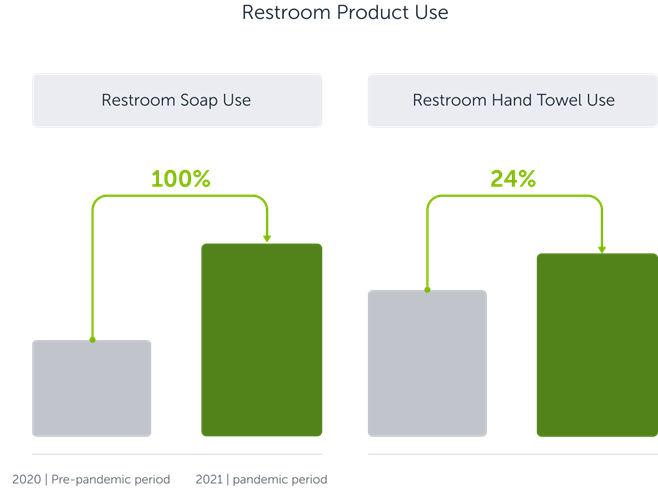
Exhibit 1

Interestingly, clean environments are shown to positively influence personal hygiene behaviours, such as handwashing, which is the most effective tool in preventing the spread of healthcare-associated infections.

There’s no doubt today’s heightened awareness of the need for greater hygiene in public is critical to helping slow the spread of germs and ease the minds of patients and healthcare workers alike. Enabled by data visualization and smart technology, organizations can raise the level of cleanliness in washrooms and have the added benefits of enabling cleaners to focus on patient rooms to drive higher satisfaction among visitors.

How smart are your cleaning systems?

Juliet Hollyhurst is the business operations leader at Kimberly-Clark Professional for Onvation®, a leading smart washrooms solution.


GTA multifamily sales volume stable in Q2

Transactions ebbed in the second quarter of 2022, but multifamily sales volume in the Greater Toronto Area is only slightly behind last year’s pace due to a 16.5 per cent year-over-year increase in the average price per suite. Colliers Canada’s newly released GTA multifamily market report puts that average at $358,390, along with an average cap rate of 3.13 per cent.

Spring saw a total of 1,721 units trade in 19 deals for an overall sales volume of $647.7 million. That’s down from Q1 when 34 transactions encompassing 2,138 units totalled $794.4 million is sales value. Much of 2021’s activity — representing nearly $3.3 billion in sales value as vendors offloaded 10,305 units — occurred in the third and fourth quarters. Sales volume for the first half of 2022 is just 1.3 per cent short of the June 30, 2021 tally.

Deal-making appeared to pick up later in quarter with three notable transactions occurring after the May long weekend. That includes Starlight Investment’s late June purchase of 105 Isabella Street and 100 Gloucester Street in midtown Toronto, acquiring 432 units for roughly $137 million or $317,419 per unit.

Q-Residential pumped up its portfolio in Scarborough with: the $165 million, two-building acquisition of 215 and 225 Markham Road, adding 423 units at $390,071 per unit; and the $48-million purchase of 20 Greencrest Circuit, with 136 units at $353,676 per unit. Outside Toronto, the quarter’s biggest deal was Realstar’s $112.5 million acquisition of 20 North Shore Boulevard W. in Burlington, equating to $511,364 per unit.

Across the GTA, the average cap rate has compressed 9 basis points (bps) since Q2 2021. In tandem with a rising 10-year bond yield, there is now just a 2 bps spread between cap rates and bond yield — a significant narrowing since 2020 when the spread stretched to 259 bps.

Even so, Colliers analysts point to strong multifamily fundamentals with continued robust immigration levels, projected rent growth, expectations for debt stabilization and a potential slowdown in new purpose-built rental construction. “In general, investors are recognizing attractive risk-adjusted yields in multifamily that may be difficult to achieve elsewhere,” they conclude.

Currently, there are more than 20,150 purpose-built rental units under construction in the GTA and nearly 103,000 proposed or in the development pipeline. That’s an upward trend on both counts since Q1 when 19,540 units were under construction and 98,660 were at the proposal stage. More than 7,070 new units are slated for completion this year, while about 6,770 are scheduled to come onto the market for the first time in 2023.

Teams shortlisted for Green Line LRT project

The Green Line Board has approved Bow Transit Connectors and City Link Partners to move forward to the Request for Proposals (RFP) stage of the Calgary Green Line LRT Project.

Bow Transit Connectors consists of Barnard Constructors of Canada, LP, Flatiron Constructors Canada Ltd. and WSP Canada Inc. City Link Partners includes Aecon Infrastructure Management Inc., Dragados Canada Inc., Acciona Infrastructure Canada Inc., Parsons Inc. and AECOM Canada Ltd.

Phase 1 is the largest infrastructure project in Calgary’s history and the successful proponent will build the 18km core of the Green Line, constructing the most technically complex section of the new LRT line to support future expansion to the north and south.

“Green Line is confidently moving forward with Bow Transit Connectors and City Link Partners, two very strong proponent teams. With extensive competition due to record investment in global transit, to have attracted their collective expertise is a great endorsement of the project,” said Green Line Board chair Don Fairbairn.

The submissions were evaluated against technical capabilities, approach, experience and financial capacity and the process was overseen by an external fairness monitor.

“This is a very strong step for Green Line and speaks to the work done by the city to collaborate with industry to drive interest and investment,” said Mayor Jyoti Gondek.

An important addition to the transit network in Calgary, Phase 1 will connect southeast Calgary to the downtown and into the existing LRT and four MAX BRT routes while building:

  • 18 kms of LRT track
  • 13 stations including underground and elevated station buildings
  • Bridge structures
  • Park and Ride facilities
  • A maintenance storage facility for light rail vehicles.

The RFP for Phase 1 will be released by the end of Q3 2022 with one of proponents selected in early 2023 as the development partner followed by the launch of a year-long development phase “to allow for collaboration, design progression, and better understanding of risks and costs in an open and transparent manner,” the release stated.

Dialog reveals Michael Evamy scholarship winner

Dialog announced the winner of the 2022 Michael Evamy Scholarship is Julia Johnston, a student pursuing her master’s degree at the Dalhousie University School of Architecture. Johnston was selected from a field of candidates across Canada, with the scholarship set to support her original research into the afterlives of abandoned gold mines along British Columbia’s Dewdney Trail.  

Drawing on a deft understanding of local culture and colonial exploitation, Johnston’s study — titled The Alchemist’s Atlas: A Metamorphosis of the Anthropocene (through the Lens of Gold) — interrogates the ongoing transformation of Canadian landscapes, using the visual language of design to bring mining sites into the public consciousness. Combining a poetic architectural sensibility with rigorous social and political analysis of abandoned and active mining sites, Johnston’s research aims to increase awareness and drive accountability for Canadian mining practices, as well as the broader consequences of the Anthropocene.  

Johnston’s winning entry harnesses the architectural imagination as a powerful tool of translation and transformation — and a driver of potential policy changes. “Julia’s submission is brave and intriguing,” says jury member Nicole Moyo. “Her research will without a doubt, reveal untold narratives about the Southern border of British Columbia (gold mining trail) that will spark national interest.” 

“With the support of Dialog, I am able to pursue documentation of the Dewdney Trail in order to generate an Alchemist’s Atlas,” says Johnston, describing the project as “a prototypical index of manmade and natural objects which will cultivate speculative design fictions as a basis for reform through the prioritization of vulnerable voices above economically-motivated mapping.” 

Alongside this year’s winning entry, Dialog is also awarding an honourable mention to scholarship applicant Melissa Caron-Labrecque, a Master of Architecture student at the Université de Montréal. Carbon-Labrecque’s proposed research study, Refuge city, investigates how architecture can respond to global refugee crises, using a multi-media approach to examine the role of the built environment in creating inclusive spaces of refuge.  

The Michael Evamy Scholarship is available to all students attending a Canadian school of architecture in their penultimate year of study. Submissions to next year’s Michael Evamy Scholarship will open in January 2023.  

Sask electricity rate set for 8% jump by April

Saskatchewan’s electricity rate will climb by 8 per cent rate over the next eight months, with an initial 4 per cent increase scheduled for September 1, 2022 and the remainder kicking in on April 1, 2023. Large commercial customers paying separate energy and demand charges may also experience some repercussions from a planned change in the allocation of costs across SaskPower’s various customer classes.

“World events have caused a significant rise in the price of natural gas, and with 42 per cent of Saskatchewan’s electricity coming from natural gas-fueled facilities, SaskPower requires additional revenue to maintain reliable operations,” says Don Morgan, the Minister responsible for the provincial utility.

The last electricity rate increase came into force in March 2018. SaskPower is projecting a $1.069 billion expenditure for fuel and power production for the 2023-24 fiscal year — up from $715 million in 2020-21.

Meanwhile, changes in rate distributions arise from moves to merge the current separate urban and rural electricity rates, and from a reassignment of some of the utility’s fixed costs for system infrastructure. Some of the latter had been embedded in the energy charge, but are now being applied to the demand charge. Resulting increases to the demand charge are expected to be greater than 4 per cent for 2023-24, whereas the energy charge will remain flat or possibly be lower than in 2022-23.

“Due to these changes, lower load factor customers (for whom fixed charges represent a greater portion of the bill) will see higher than average rate increases. Higher load factor customers will see lower than average rate increases, since the energy rates are a greater proportion of their total bill,” a report from the Saskatchewan Rate Review Panel states.

Building energy management: The AI advantage

There’s a science to building performance. And when it comes to saving energy and providing occupant comfort, the solution lies in recognizing how thermodynamics and weather data can be used by artificial intelligence (AI) for optimal climate control.

“A building’s energy usage is directly influenced by its thermal mass and weather conditions,” explains Tobias Janes, technical director, with EcoPilot Canada. “All of those factors can be measured and assessed in real-time; but more importantly, that data can be used by building automation systems (BAS) to respond to exterior conditions more efficiently and cost-effectively.”

Understanding thermal mass and its role in the energy-saving formula is step one. In simplest terms, thermal mass describes the building’s ability to absorb, store, and release heat generated from internal (e.g., people, equipment, lighting, etc.) and external (e.g., outdoor temperature, humidity, solar radiation, etc.) sources. A building’s thermal mass can fluctuate based on the above-mentioned factors, creating more and less demand for HVAC equipment.

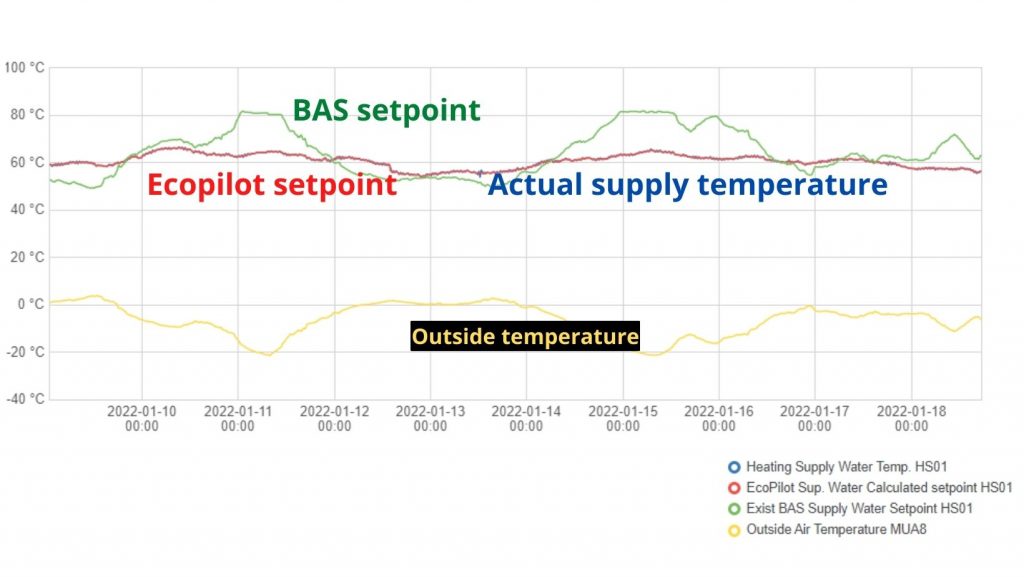
Weather conditions also play a role in determining how hard HVAC equipment has to work to maintain ideal temperatures. Since 2019, Crombie REIT’s Scotia Square complex has reduced HVAC energy savings by 19%, HVAC costs by 17%, and recued CO2e by 1,215 metric tonnes of CO2. Every 2-minutes, Ecopilot® calculates the building balance point temperature and provides a new offset to the BAS based on ever-changing building variables. The result is energy savings while maintaining occupant comfort.

As such, Janes explains, part of Ecopilot®’s solution involves using weather-related data points (e.g., humidity, wind speeds, temperature, solar radiation, etc.) in combination with thermal mass calculations to inform more efficient HVAC
operations: “With Ecopilot®, for example, we can use AI to assess a building’s thermal mass in real-time and use that data alongside weather-related data and forecasts to recommission the HVAC system every two minutes.”

“The result is that these systems start running far more efficiently, use less energy, and reduce their carbon emissions – all while keeping people a lot more comfortable,” he continues.

Enter: Model Predictive Control 

If “automatically re-commissioning HVAC systems based on real-time thermal mass and weather data” is too much of a mouthful, try “model predictive control,” or MPC. As Ecopilot® explains: “An MPC system anticipates the energy needs of a building based on data it gathers, which it then uses to optimize the building’s thermal behavior. As a result, Ecopilot® reacts with changes to heating, cooling, and ventilation, by foreseeing changes in the weather before they occur.”

Benefits of an MPC system include:

  • Automated performance enhancements: Weather-related data can be used by a BAS system to manage HVAC equipment more efficiently. For example, Ecopilot®’s AI-driven solution works with a BAS to constantly assess
    current and future weather conditions and adjust HVAC operations accordingly every two minutes. This automatic process is ongoing and requires zero operator interaction.
  • Easier and more proactive HVAC control: Interpreting weather data enables greater flexibility when programming the building’s HVAC on days the weather won’t interfere. This provides the benefit of recognizing high and low operating performance periods so the building’s system can adjust accordingly.
  • Enhanced responses: By incorporating weather data into a property’s existing HVAC control, the systems can be further programmed to automate energy-saving actions. This makes a crucial difference in improving a commercial building’s energy consumption.“Dealing with weather conditions will always be a substantial challenge for property management,” says Janes. “However, our AI solution helps buildings adapt automatically so that they’re responding to those conditions in the most energy-efficient manner.”
  • Return on investments: Environmental data can be used to show building owners the benefits of installing energy-efficient items (e.g., photovoltaics or wind turbines) and predict their return on investment.
  • Optimizing equipment: Weather data can be used to make investment decisions, such as determining when to use a smaller chiller at full capacity versus a larger chiller at half capacity in order to save on energy and maintenance.

AI in action

Ecopilot®’s AI solution, designed to work alongside any BAS, proactively prepares a building for its energy requirements, using only the energy required to maintain consistent tenant comfort. The AI prevents the control system from overreacting.

AI-driven HVAC controls may seem like a solution for the future, but consider the success that Ecopilot® has already demonstrated in buildings around the globe.

Ecopilot

In the graph above, for example, Ecopilot® was called into a Toronto building to help it gain more control over its internal heating and cooling functions amidst ever-fluctuating weather.

As the case study notes, “In addition to the thermodynamics properties of the building, which remain static, Ecopilot® also uses the collection of real-time data to assess other fluid variables, like weather, people, and heat generated from solar radiation, or machines, that is also stored in the building and released over time.”

In this Toronto scenario, Ecopilot®’s AI produced HVAC efficiency savings of 45%, without sacrificing building occupant comfort.

Comfort in data
The science is complex, but the results are clear: measuring and assessing a building’s thermal mass and weather-related influences in real-time with AI results in smarter, more adaptable, and more efficient climate control strategies.

For more, check out a series of Ecopilot® case studies.

Ecopilot

BOMI launches CRE designations for suppliers

BOMI International has launched two new designations for suppliers and service providers to the facilities and property management sectors. Holders of the new Property Partner Advisor (PPA) and/or Facility Partner Advisor (FPA) credentials can signal that they have successfully completed eight courses that give them a basic grounding in their clients’ daily routines and business responsibilities.

Proponents of the new program note that suppliers and service providers to the commercial real estate industry have often found it insightful to study the course material for the Real Property Administrator (RPA) or Facility Management Administrator (FMA) programs. The new designations offer formal recognition of such efforts.

“BOMI’s coursework provides service and product vendors the opportunity to understand the day-in-the-life of their clients, as well as a way to truly support them,” says Bobbi McGowan, executive director of the Building Owners and Managers Association (BOMA) of New York.

The PPA curriculum provides an overview of building design, operation and maintenance from a property manager’s perspective, including budgeting, risk management, procurement, leasing, marketing and relationships with owners/investors. FPA courses explore the building environment from the facility manager’s perspective, including project management, cost control, maintenance, tenant comfort and health and safety.

“In commercial real estate, property and facility management teams are fueled by quality partnerships with product and service providers,” maintains BOMI International’s president and chief executive officer, Jeffrey Horn. “BOMI is proud to offer these new designations.”

The eight courses can be taken in any order through self-directed online learning, which will culminate in an exam. The initial enrollment fee is CAD $252.

Corporate sustainability challenges – and how to overcome them

Many organizations are implementing corporate sustainability programs.

They view them as a progressive business strategy and astute business executives recognize that these programs help cut costs, make companies more competitive, and help ensure the long-term survival of businesses and organizations.

But sustainability today is more than just tracking emissions and reducing consumption. It’s about business operations, inequality gaps, shipping, transporting, even removing carbon from the atmosphere.

Implementing sustainability strategies also makes a company more inviting to investors, improves its corporate image, and helps it attain more customers and attract more qualified staff.

However, in becoming more sustainable, some organizations may face unexpected hurdles. Such hurdles need not derail the plan. Invariably, they can be overcome.

Among the challenges I have encountered and how I suggest overcoming them are the following:

Not setting goals

Organizations not only need to set sustainability goals, but these should be ambitious goals. Make big plans. Aim high. This will get more staffers excited and behind the program.

Not having monitoring systems in place

Measuring sustainability performance with a robust monitoring system is crucial. Monitoring systems track an organization’s progress, indicating successes, where more effort is needed, and get more people involved in the program. The more people involved in the program, the more likely it will succeed.

The leadership/action gap

Very often, sustainability strategies are created in the C-suite, but implementation and action steps are missing. A plan without action steps goes nowhere. Ensure leaders have laid out the next steps and that the people on the ground are taking action to achieve the company’s goals.

A lack of documentation and communication

Documenting and communicating an organization’s sustainability progress allows investors, customers, and staff to quickly access pertinent data. This is something organizations should want to proudly share with others. Publishing sustainability progress invariably leads to even more progress.

Finally, organizations must make everyone in the organization accountable for sustainability. This way, it gets in the organization’s DNA… sustainability becomes who they are.

Stephen P. Ashkin is president of The Ashkin Group, a consulting firm specializing in green cleaning and sustainability, and CEO of Sustainability Dashboard Tools LLC, for measuring and monitoring sustainability with the goal of protecting natural resources and reducing facility operating costs.

Canada announces $33 million for STAR program

The Government of Canada has announced more than $33 million over five years for the Skilled Trades Awareness and Readiness (STAR) program.

The Government of Canada is making targeted investments to remove barriers and get more Canadians the apprenticeship training they need to build good, well-paying careers in the skilled trades.

The STAR program encourages Canadians—particularly those facing barriers, such as women, Indigenous people, visible minorities, newcomers, persons with disabilities and youth—to explore and prepare for careers in the skilled trades.

Now more than ever, skilled tradespeople are in high demand to fill well-paying jobs and build rewarding careers. Approximately 700,000 skilled trades workers are expected to retire in Canada by 2028, creating an ever-growing need to recruit and train thousands more.

As part of the funding, $2.8 million will go to Selections Career Support Services for their project, Get Ready in Trades (GRiT). This project will support youth with disabilities to overcome barriers to relevant training and meaningful employment within the skilled trades. GRiT will help youth pre-apprentices with disabilities in providing flexible and individualized career plans, skills enhancement and work experience opportunities to empower them to explore and prepare for careers in the skilled trades.

To further support hiring of new apprentices, the Government of Canada recently announced close to $247 million for 13 projects under the Apprenticeship Service that will help small and medium-sized enterprises hire more than 25,000 first-year Red Seal apprentices and provide them with the hands-on experience and training they need to become certified journeypersons.

According to the Canadian Apprenticeship Forum, to meet the demand for skilled journeypersons in Red Seal Trades, an average of around 75,000 new apprentices will need to be hired per year in the next five years. Top trades most at risk of not meeting the demand include welder, industrial mechanic (millwright), bricklayer, boilermaker, cook and hairstylist.

Richmond bisolids dewatering facility completes

A new biosolids dewatering facility at Iona Island Wastewater Treatment Plant in Richmond will help Metro Vancouver to more efficiently use wastewater as a resource, and it is an important first step as the regional district embarks on critical upgrades to the treatment plant.

“The upgrade of the Iona Island Wastewater Treatment Plant — one of Canada’s most dynamic and transformative urban sustainability programs — represents a once-in-a-lifetime opportunity to contribute to the health and well-being of people, as well as the ecological health and biodiversity of the Fraser River estuary and the Salish Sea,” said Sav Dhaliwal, chair of Metro Vancouver’s Board of Directors. “This new facility sets us up well to carry out these ambitious and necessary upgrades.”

The Biosolids Dewatering Facility at Iona Island Wastewater Treatment Plant is fully enclosed and has stringent odour controls. It will mechanically dry the solids left after primary wastewater treatment, turning them into beneficial biosolids. At the facility’s loading bay, dried biosolids will be put directly into trucks so land that was previously used for biosolids drying and storage can be reclaimed for plant construction and ecological restoration projects.

The lagoons where solids are currently stored after primary treatment will be transformed into clean, freshwater ponds that will benefit many species — in particular the large numbers of birds that use the island and foreshore as a stopover along their migration route.

“Metro Vancouver is committed to using innovative approaches to generate energy and other resources from wastewater, including producing biosolids for beneficial use in land reclamation and landscaping projects,” said Richard Stewart, chair of Metro Vancouver’s Liquid Waste Committee. “One goal of the Iona Island Wastewater Treatment Plant upgrade is maximizing resource recovery, and this project will help Metro Vancouver produce and handle biosolids more efficiently.”

Metro Vancouver has used biosolids as a soil amendment safely and responsibly both within the region and throughout the province for decades, meeting or exceeding all provincial regulations. Soil containing biosolids has been used in countless landscaping projects, including at Iona Beach Regional Park and Vancouver International Airport.

Work on the Biosolids Dewatering Facility at Iona Island Wastewater Treatment Plant began in July 2019 and wrapped up in March 2022. Testing and commissioning is underway and the facility is expected to begin full operation in late 2022. The project cost was $61 million.