




Articles Archive - Page 280 of 928 - REMINET
REMI

Plugging into the future of EV charging

There’s been a change in the gas pumps, and it’s not just the price of fuel. Your local garage may have recently retrofitted their pay-at-the-pump screen options to accommodate the increased cost of gas, updating prepaid amounts to a higher value since a twenty-dollar top-up now barely moves the gas gauge.

Consumer confidence in the viability of electric vehicles (EVs) is growing as we consider the long-term impact of what these price hikes mean. Whether it’s getting to work, running errands, or visiting friends and family, the cost of travel is becoming evident. We can now envision a future where it will be cheaper to buy electric rather than a mechanical, gasoline-fueled vehicle. The goal is that by 2035, we’ll all be driving them. What will this look like?

Connor Stewart started up his company, Charge Guys, in 2018 when he recognized a gap between people purchasing their first EV and being set-up with a charging station. As the company grew, he saw an opportunity to educate and provide solutions for multi-residential spaces.

“Up to now, we’ve been very reliant on oil and gas to transport us,” says Stewart “We’ve recognized as a country and as a society that this is no longer sustainable. In Canada, we are now shifting from gas sources of energy—from ‘dirty’ sources to clean and renewable sources. EV charging is the first piece of the puzzle. If everyone is switching their number one mode of transport to something electric and renewable, what’s to say they aren’t comfortable switching their entire home?”

It’s something to consider given the dynamic of the environmental crisis and the speed with which the climate is changing.

“In Toronto there’s already a framework in place called the Toronto Green Standard (TGS),” continues Stewart. “It’s a framework that by 2030, every building built in Toronto has net-zero emissions being emitted into the atmosphere. So, we’re already seeing it further up-stream.”

A poll conducted by Clean Energy Canada in May found 53 per cent of Ontarians now lean towards choosing electric over gas or diesel, but are bothered the province isn’t keeping pace with the rest of Canada.

“There was a higher proportion of EVs sold in the Yukon last year than in Canada’s most populous province,” Transportation Program Manager Joanna Kyriazis said in a statement. “A lack of provincial EV policies has meant that the majority of new EVs made for the Canadian market are sent to Quebec and B.C., making it even harder for Ontarians to get behind the wheel.”

Another factor stalling operations is the wait time for ordered vehicles, with the demand for microchips causing delays.

“I ordered an electric Ford F150. I was told it’ll be here in 2025,” says Stewart. Meanwhile, his father, who owns an automotive dealership in Woodstock, Ontario, has had to completely close for the time being due to the exorbitant cost of stocking new vehicles. “Dealerships are cutting staff and other expenses to save costs,” he says. “Prices will come back down eventually, but right now it’s chaos.”

Stewart says this period is a time of caution but suggests that it also offers an opportunity for condo managers to think ahead. “Now is the time to be proactive. The automotive industry is lagging now, but when it catches up, it’s going to hit hard. You’ll want to have EV charging built into your next reserve fund study and be prepared for demand.”

Revving-up the reserve fund

While subsection 93(2) of the Condominium Act specifies that the reserve fund can only be used for the purpose of ‘major repair and replacement of the common elements and assets of the corporation, including the potential existence and planning of such a system in the reserve fund ensures that it becomes part of the corporation’s long-term goal.

The first step is requesting an Electric Vehicle Study. This allows a corporation to structure the costs of EV charging and to incorporate the cost of installing the electrical panel into their next reserve fund study. As of today, if a unit owner approaches the board to say they’re buying an electric vehicle, there’s 60 days to provide a plan of action. Proper planning now will mean that when this happens, the corporation will have an agreement already drawn up (preferably by a lawyer) and know exactly what the cost to the unit owner will be.

Once installed, maintenance and repair of the charging stations and panel becomes a reserve fund expense, but the planning and installation can be taken care of by one of the many emerging turnkey EV companies that operate throughout Ontario and British Columbia.

New buildings are subject to laws and regulations, which require them to be compatible with EVCs. The benefits of making EV charging accessible in all multi-residential buildings—both old and new—are numerous. It is an attractive sales-factor for potential purchasers, can provide an alternative revenue stream through branding and advertising on charging stations, as well as offer potential revenue from pay-as-you-charge users. Adding to this is the simple factor of the convenience of charging at home.

While the initial cost of EVs may seem expensive now, consider the reduced cost of maintenance (think: ‘no more oil changes’) and the $5 billion being spent in Windsor for a battery plant, and the $2 billion spent by GM to update the Oshawa and Ingersoll vehicle assembly plants to support manufacturing electric vehicles. The increase in the number of available electric vehicle models is multiplying quickly.

When implementing the systems, Stewart says that while some buildings may take a solution allowing billing of individual users, others may tap into an existing sub-meter going to a specific unit and adding the charging costs to their monthly bill. Property management, for the most part, should be excluded from the final billing process, and it should be noted that most property management agreements include a clause that they will not be responsible for hydro billing.

So, where do you put the charging stations? Communal parking spots are desired, but not readily available. Visitor parking stalls may seem like a perfect solution, but the current legislation around their use means a revolving-door of condo-conundrum.

EV charging in visitor parking?

Can a corporation install electric vehicle charging stations in visitor parking? In a post on Miller Thomson’s website, lawyer Jason Rivait explains that: “A common thought from condominium corporations is to install the electric vehicle charging station in the visitor parking spaces of the property. Most declarations will contain language regarding the specific use of visitor parking spaces. Commonly, declarations will provide that the use of visitor parking spaces shall be for visitors to the building and for no other purpose.”

“If visitors are only permitted to park in visitor parking spaces, then an electric charging station in such parking spaces would be of limited value to the residents,” Rivait continues. “Additionally, if residents parked in visitor parking spaces to charge their vehicle (even if only for an hour or two), then such residents would be in contravention of the declaration, and the condominium corporation would be obliged to enforce compliance.”

Jake Fine of Lash Condo Law further commented on this in a Zoom interview. “Generally speaking, if a declaration prohibits the use of visitor’s parking by residents or owners, and exclusively limits it to use by visitors or guests. . . a corporation would not be able to install electric vehicle charging stations in the visitor’s parking for the use by owners or residents. For visitors, yes, that technically would be permitted, generally speaking, of course, but I would say no for the use by owners and residents.

“Now, the workaround—which is not really a workaround—is to amend your declaration, which is an onerous process. Each corporation should ensure to check its documentation and any development agreements because some development agreements require that corporations have a certain number of visitor parking spaces.”

So, does current legislation need to change to meet the demand we’re expecting in the very near future?

“It’s definitely possible,” says Fine. “The electric vehicle charging provisions right now are fairly new and in their infancy. Once amendments are introduced to help reflect some of the problems that are now being seen, it’s possible that the legislation will continue to change to address the evolution of electric vehicles in condominiums.”

Thankfully, hope is on the horizon with revisions to the Condominium Act (Section 93) anticipated, allowing corporations to include green energy projects as approved reserve fund projects. Until then, using the reserve fund for a component, which has not yet been budgeted for, means taking funds away from a repair or replacement which has been preplanned. As always, it is best to consult your corporation’s legal counsel before moving ahead.

Greg Fraleigh is President of The Enfield Group Inc.


Correction, August 18, 2022: This article has been updated to note that a board has 60 days to provide a plan of action if a unit owner approaches with the intent on buying an electric vehicle.
Better storage means better business

Staff shortages are still a major issue for businesses in a post-pandemic world, but product delays and supply chain issues also top the list. Experts suggest that stockpiling your supplies is the way to go. By managing to secure and store extra supplies, you’ll be ahead of the game – and your competition.

Should you be able to score a surplus, where would you store it? A New York Times article from the beginning of the year predicted that companies would be scrambling to secure warehouse space to tackle this issue, causing a shortage in commercial and warehouse space.

Can’t find or can’t afford more storage? Here are five tips to better manage your inventory, maximize storage, and stay on top of customer demand with the space you already have:

  1. Leverage your vertical space, while keeping the same footprint. Find a way to add shelving from floor to ceiling, to add a loft or extra shelving above your bay door. Use every vertical inch to store products or supplies.
  2. Upgrade your racking. If your system is out of date, you may benefit from some tweaks or even from a full upgrade to get the most out of your space. Some companies have gone to a double-deep rack but beware of the FIFO (first in/first out) challenge that this may present.
  3. Reduce aisle width. Is there an opportunity to narrow your aisles for wider storage space? If traffic is heavy or you use large equipment, this may not be feasible, but every foot counts, so make the most of what you have.
  4. It’s time to consolidate locations. Is the same item located in two places? Combine these to make space for something else and to add efficiency to your flow. Similarly, if you have separate shipping and receiving docks, consider combining these to maximize your available floor space for storage.
  5. Try something new! If you can swing it, consider storing supplies in an external storage container. This could give you a significant amount of extra space without disrupting your existing system.

With rising costs and hiring shortages being top-of-mind these days, try these tips to maximize your storage space, allowing you to stockpile supplies to better your business and your bottom line.

Edmonton retailer crowned Canada’s Best Restroom 2022

Majesty and Friends in Edmonton has been named the winner of the 2022 Cintas Canada’s Best Restroom contest.

Majesty and Friends will receive $2,500 in Cintas products and services to help maintain their award-winning washrooms, and will also be honoured with a place in the Canada’s Best Restroom Hall of Fame.

The win means that the title stays in Edmonton after the washrooms at Borden Park in the city won the contest last year.

Majesty and Friends is a modern design boutique. Their motto is “FUN, FUN, FUN” and so their washroom needed to offer the happiest vibes.

The bright mural was inspired by the happiest treat on earth – ice cream. The flooring is Atra Flooring from Liverpool, and the sprinkles are made by Urban Walls. Their building at Manchester Square is the biggest Instagrammable spot in Edmonton.

“The state of the washroom can have an enduring effect on a guest’s perception of a business,” said Candice Raynsford, Marketing Manager, Cintas Canada. “Providing a facility that is clean and inviting takes the customer experience to the next level. Guests recognize this, and in Majesty and Friends’ case, customers have shown their appreciation by voting them this year’s Canada’s Best Restroom.”

Majesty and Friends promoted the contest on their Instagram, Twitter, and Facebook pages, and also created a QR code with a link to the Best Restroom website and posted it in the restroom, on the door and at the front counter. They also posted the QR code at other local businesses.

“We’re so honoured to win the coveted title of Canada’s Best Restroom,” said Julie Morrison, owner, Majesty and Friends. “When we opened this location last year, I put all my savings into it to make our shop a truly memorable and fun destination for our community. I’m so grateful to Cintas for highlighting our business, and to the Edmonton community and our customers for their overwhelming support.”

Now in its 13th year, Cintas’ nationwide contest highlights businesses that have invested in developing and maintaining exceptional washrooms that are accessible to the public.

Nominees for this year’s contest were judged on five criteria: cleanliness, visual appeal, innovation, functionality and unique design elements. Online voting was open to the public June 6 through July 8.

The other finalists (in alphabetical order) include:

  • Niton Junction Petro-Canada (Niton Junction, AB)
  • Rollick Co. (Black Diamond, AB)
  • Toronto Zoo – African Rainforest Washroom (Toronto, ON)
  • Versante Hotel (Richmond, B.C.)

The urgent need for regenerative design

The architectural profession may have evolved over the last 20 years of my career, but construction methods have largely remained unchanged. To address our global climate crisis, the construction industry needs to realize projects at every scale that meaningfully reduce our dependence on fossil fuels.

Despite progress in prefabricated or modular construction, we continue to build onsite by hand using traditional construction methods that emit high levels of greenhouse gases and contain too much embodied carbon. This way of building is not environmentally sustainable. The realization that every project we engage in will either contribute to or mitigate against the climate crisis helps us focus on achieving our ultimate goal: to design buildings that support the regeneration of a healthy planet.

Today, pursuing regenerative design – a process defined as ensuring the built environment has a net positive impact on natural systems – is possible thanks to accessible data management tools that can reduce financial risk for our clients.

Better data will also support effective regulations and codes. Our current building codes require us to design with greater energy efficiency than a generation ago, but they remain overly conservative. The simple reason is apparent: the construction industry has been slow to adapt to the realities of climate change, and clients are reluctant to spend a premium on materials or methods that meaningfully achieve carbon neutrality. Stricter regulations within the construction industry and various levels of government are required to shift the paradigm towards regenerative architecture and urban design. While the urgency to make the shift began well over a decade ago, it is only recently that the possibility of gathering accurate data and deploying efficient measurement tools have become available to architects and designers.

Unfortunately, the volume of lower-energy, highly sustainable real-estate projects has not kept pace with the massive overall rise in development in recent years. All three levels of government have proven reluctant to interrupt the robust real-estate market with stringent energy-use and performance requirements, choosing to address a shortage in housing supply and avoiding an economic slowdown. Only recently has the rise of interest rates, record levels of inflation and escalating construction costs taken a toll on the overall economy. Without the adoption of financial incentives for regenerative buildings, the expected economic slowdown resulting from these factors is unlikely to encourage a robust level of sustainable development that will limit global warming below the 1.5-degree Celsius rise in temperature outlined in the Paris Agreement adopted in 2015.

Undaunted, our firm continues to support clients in de-risking the pursuit of zero-carbon buildings. We remain optimistic in prioritizing projects that embrace natural systems and regenerative design, recognizing how and why the industry’s mindset must rethink strategies to reduce carbon emissions. By leading SvN’s regenerative practice, our transdisciplinary team is helping clients reduce the carbon footprint in all our buildings and urban design projects wherever possible. Our approach includes promoting communities connected to mass transit, conducting energy modelling that assesses lifecycle analysis and zero-carbon buildings, designing for passive house standards, transitioning to mass timber construction as a low-carbon alternative whenever possible, and leveraging carbon-reduction strategies through landscape design.

We recently worked on a new development in Cairo that relies on natural systems and materials to achieve a low-carbon community. Throughout the development, passive ventilation will cool residences, retail and community buildings, drastically reducing the need for air conditioning. At the same time, the extensive use of photovoltaic panels will produce nearly all of the community’s electricity demands. Our firm is also working on projects in Mexico, the Caribbean and the Greater Toronto Area, using data analysis to produce metrics so that clients can make informed decisions relating to regenerative design, reduce their carbon emissions, and improve overall energy performance.

We take a data-driven approach to measuring embodied carbon, energy use, and carbon sequestration. The saying goes, “you can’t improve upon what you can’t measure.” The goal of measuring and tracking embodied carbon will create virtuous cycles for our projects, allowing them to produce more energy than they consume, sequester more carbon than they produce, or be a net provider of clean water. We believe this process is attainable — and necessary — for the health of our planet.

The belief that designers have a role in healing our planet used to be considered aspirational thinking. This sentiment is no longer our reality. Amidst a global climate crisis, pursuing a regenerative approach to architecture and urban design is essential. With proven data management tools at our disposal, building a post-carbon future is viable and desperately needed from an environmental, economic and social perspective.


Aaron Budd, AIA, MRAIC, LEED AP is the director of regenerative practice at SvN Architects + Planners, leading a new firm division dedicated to integrating architecture, landscape design and planning in a holistic, zero-carbon, circular and resilient community framework.

BCIT receives funding for mass timber program

BCIT has received $250,000 in funding from the B.C. government to develop additional programming, building on the success of the new construction of mass timber structures associate certificate.

The new program is helping experienced carpenters, ironworkers and builders gain the in-demand skills needed to succeed in the growing field of mass timber innovation. Investing in mass timber education supports B.C.’s workers through expanding the mass timber sector.

“We are investing in new post-secondary training for students to become leaders in mass timber construction, which will help people succeed and be future ready in a sector that is setting the example of how to build a better British Columbia for all,” said Minister of Advanced Education and Skills Training Anne Kang.

The construction of mass timber structures associate certificate is a part-time, blended six-month program. It is delivered online, with a two-week practicum at the BCIT Burnaby campus, where students gain hands-on installation experience with mass timber structures. A cohort of 12 to 24 students will start in January 2023.

“We’re looking to the future to guide us and our workforce,” said Janet Routledge, MLA for Burnaby North. “That’s why we’re focusing our efforts on growing, retaining and developing homegrown talent through our students right here in B.C. to meet the growing demand for well-paying jobs in a rewarding and innovative field like mass timber installation.”

The province says the mass timber sector will support more than 4,000 jobs in manufacturing, technology, forestry, design and engineering while also promoting new technologies and approaches to further support existing jobs, with a projected worth of $403 million by 2035.

“As the largest provider of trades training in Western Canada, it’s critical that BCIT is delivering relevant, hands-on training to help learners master in-demand skills, while contributing toward an agile workforce with sustained and meaningful impact,” said Wayne Hand, dean, BCIT’s school of construction and the environment. “This investment from the Province of British Columbia allows more trades professionals in upskilling to advance mass timber innovation, clean-energy solutions, as well as the economic prosperity of B.C.”


Bylaw for high-rise radio communication proposed in Kamloops

The City of Kamloops is considering a public safety bylaw that would require in-building radio repeaters in high-rise structures for the use of emergency responders. This bylaw would be applicable to all new construction or as part of renovations to existing high-rise structures.

Kamloops Fire Rescue (KFR) presented a report last week to the community services committee, stating the increase in high-rise structures in the city is hampering radio communication within the buildings and to parties on the outside (incident command, dispatch, etc.). Communication is completely ineffective at times.

“This is due to the inability for radio waves to penetrate into and out of the structures themselves as well as between specific levels, depending on the materials used for construction,” the report states. “Communications are further complicated by limitations in the current radio infrastructure, Kamloops’ challenging topography, and increased signal loss as these taller structures block the signal paths.”

The report zeros in on modernized construction techniques to increase energy efficiency, such as the metallic content of the cladding and high-efficiency windows.

Responders need to clearly communicate with one another to be made aware of critical situational information in real time within and around the building’s parameter.

One such case where this has become an issue is at Royal Inland Hospital’s new tower.

“In order for responders inside the building to communicate with incident command, a responder must stand outside to reach the KFR repeater and use one radio to communicate with the incident command and use another radio on an independent channel to communicate with interior crews,” the report states. “If emergent transmission or general operational communications on tactics are required, communication cannot be achieved between floors or back to dispatch.

​​Public safety radio in-building amplification systems can be installed using various infrastructure. As the report lays out, some of this comes at a cost between $4,000 and $25,000.

In addition to the proposed bylaw, KFR is procuring a consultant for establishing the entire range of possible radio interoperability levels that could be required for any spectrum designated for public safety applications.

Staples Studio’s first co-working location opens in Alberta

Staples Canada unveiled its newest working and learning store in Calgary’s University District neighbourhood this summer, marking Staples Studio’s first co-working location in Alberta.

“We are proud to continue our ongoing expansion of Staples Studio given strong demand amongst entrepreneurs, small businesses, and remote workers and learners,” said Staples Canada CEO David Boone earlier this summer. “We are confident our new University District store will become a space where locals can meet, collaborate and thrive.”

This Staples Studio, located on the store’s second floor, is the largest in Canada, featuring a collaborative, open-concept environment. Staples’ latest Spotlight Space is also located on the second floor, featuring a bookable auditorium-style event and community learning space.

The store also features products and services familiar to all locations across Canada, such as Solutionshop for assisting locals with areas like tech support and graphic design. The University District store is also the second outpost to use electricity exclusively from wind and hydro facilities through Bullfrog Power.

“Staples has been a part of the Calgary community for 27 years” said Chief Retail Officer, Rachel Huckle. “As the Working and Learning Company, we continue to help contribute to the communities we serve by being a dynamic, inspiring partner. To this end, we’ve created a space that helps them solve problems and provides growth opportunities.”


Rental scams rise as vacancies tighten

Vancouver-based rental platform liv.rent reported a 47 per cent increase in rental activity for June 2022, coinciding with a significant spike in reports of suspected rental scams. Employing a feature that allows users to flag suspicious activity on the platform, nearly triple the number of red flags were issued this June compared to a year ago.

“Scams and fraud are my biggest fear when renting in Canada,” said John Harding, a liv.rent user. “I haven’t personally encountered any scams, but I have heard stories from friends where they sent a security deposit for nothing.”

With students starting to return for the upcoming fall semester and 432,000 new permanent residents expected by year’s end, liv.rent says there is an urgent need for Canada’s rental industry to take action to safeguard vulnerable renters. Online rental scams have become more sophisticated and varied, making them harder for would-be renters to spot. Fake profiles and listings remain the root of the problem, and are  typically accompanied by blurry photos, obscured address details, and urgent demands for personal information or cash deposits.

One incident reported on by CTV News Toronto involved a listing on Kijiji that resulted in several tenants submitting cash deposits to a fake landlord for a unit that was never for rent. Current measures to safeguard renters from scams like this include tips and warnings posted for users, but liv.rent says these efforts largely fail because they don’t address the root problem—the existence of the fake ads themselves.  As such, the platform is taking action to combat rental scams by verifying the identity of landlords in a multi-step process. Landlords are asked to upload a photo ID matched against a selfie, and to submit ownership documents or a one-time code that was mailed to the address.

While the industry continues to develop new methods for promoting transparency, liv.rent says it encourages Canadian renters to remain vigilant and educate themselves in order to quell the growing threat posed by rental scams.

New guidance for municipal water standards released 

Municipalities are often at the heart of flood and rainstorm events when it comes to responding to the aftermath. A new guide from CSA Group has been compiled to help cities implement water standards to improve resiliency and manage these weather-related natural disasters.

Such events are  increasing and intensifying every year due to climate change and a higher number of properties in flood-prone areas. The Municipal How-to Guide offers a detailed framework, including a three-step process, to help cities implement community water standards into municipal planning and approval processes.

The guide is intended to serve as a resource for urban planners, managers, and elected municipal officials.

While many municipalities express interest in using water standards, they often struggle with where to start amidst competing priorities. They require support to save time and cost, while gaining the confidence of residents.

The guide was developed in collaboration with four Canadian municipalities that have been significantly impacted by flooding in recent years: Colwood, British Columbia; High River, Alberta; Lakeshore, Ontario; and Cambridge, Ontario.

“Our ultimate goal is to have networks of resilient communities supporting each other,” says Michael Leering, director, environment and business excellence, CSA Group. For a municipality to truly be resilient, their neighbouring municipalities must also be working towards the same goals and implementing the same standards.”

The guide also helps cities understand the standards they can leverage and use to support their municipal objectives, and includes sample language to use for referencing standards in policies, bylaws, and municipal documents.

“The launch of a guide to support municipal uptake of CSA Group standards provides an important tool for interpretation and decision making,” says Chief Planner City of Cambridge Lisa Prime. “Municipalities can benefit from further opportunities to meet technical performance requirements for development through standards.”

Visit CSA Group’s website to download the complimentary Municipal How-to Guide and to learn more about CSA Group’s Community Water Standards.

RJC Engineers reveals new leadership structure

RJC Engineers (RJC) has announced the latest change in its leadership as the firm prepares to mark its 75th anniversary.

RJC has implemented a new governance structure to strengthen its legacy of bringing engineering excellence to industry and clients across Canada. The new structure includes a board of directors and dedicated executive.

“RJC has supported our people, clients, and communities for almost 75 years. We have an impressive history and a strong vision for the future” said Jeff Rabinovitch, board chair. “I am pleased to announce this new governance structure, which will benefit not only RJC, but the industry and clients that we serve. Our elected board members and executive are critical to our ongoing success to steer the growth and strategic direction of the firm as we continue to be a leader of creativity and excellence in our industry.”

The new governance structure focuses the firm’s resources, priorities, and programs to deliver on its strategic plan. The firm wide five-year strategic plan delivers a path forward for the firm.

“This governance structure and our strategic plan capture the collective strength of RJC to build upon our legacy as industry thought leaders and trusted advisors,” shares Rabinovitch. “We are future focused and have the right people and leadership in place to benefit our people and our clients.”

The board of directors is:

  • Terry Bergen, managing principal in Victoria.
  • Michael Blackman, principal and regional manager in Kelowna.
  • Bryan Colvin, managing principal in Calgary.
  • Chris Davis, principal in Calgary.
  • Bill Gladu, secretary, principal in Toronto
  • John Kooymans, principal in Toronto.
  • Jeff Rabinovitch, board chair, principal in Edmonton.

The executive is:

  • Joette Decore, executive principal in Edmonton
  • Mike Moffatt, executive principal in Toronto
  • Roger Steers, executive principal in Vancouver and Surrey.


IDS Vancouver returns this September

Interior Design Show Vancouver (IDS Vancouver) will return this September from the 22 to 25 at the Vancouver Convention Centre West. Presented by Miele, IDS Vancouver will dive deep into the future with its 2022 theme, New Futures.

“Design is at the heart of innovation,” said Bronwyn Gourley-Woo, director of conference, IDS Vancouver. “The IDS team is thrilled to make its return to the Pacific coast this year as we provide a platform to showcase the transformative, insightful, and innovative achievements among the design industry. We look forward to inviting and hosting today’s leading creators, local designers, and global brands this fall as we explore our New Futures.”

Transformative change is occurring at a rapid pace right now for both people and the planet. Now more than ever, design thinking and expertise are needed to push new realities forward by reimagining and reforming how we live, work, and create as we consider our New Futures.

IDS Vancouver will be hosting a program of accredited seminars taking place on Friday, September 23, 2022. The seminars will discuss a range of topics across themes of building the design business, climate change and social responsibility, innovation and technology trends, and more.

Keynote speakers include:

Bridgitte Alomes, Founder, Natural Pod

Lora Appleton, Founder, Female Design Council

Mélanie Cherrier and Laurence Pons-Lavigne, Blanc Marine Intérieurs

Gillian Segal, Principal & Founder, Gillian Segal Design

Lynda Reeves, House & Home Media

The New Mix with Nam Dang-Mitchell – Nam Dang-Mitchell, Founder, Nam Dang-Mitchell Design Inc.

Pure Style with Ami McKay – Ami McKay, Owner and Creative Director, PURE Design Inc.

Vancouver Passive House tower receives funding

The City of Vancouver is receiving $7.1 million from the federal government towards a new Coal Harbour mixed-use passive affordable housing development. The funding will support the net zero energy and Passive House green building design and is coming from the federal Green Municipal Fund’s Sustainable Affordable Housing initiative.

The $81 million project at 480 Broughton Street will include social housing, a school and childcare. It is a fully electrical building, which will reduce embodied carbon through construction by 40 per cent and emit 94 per cent fewer GHGs than a standard building. In addition, the application of the LEED gold standard will improve indoor air quality, reduce water consumption, and maximize the building’s overall energy performance.

“Tackling climate change in an equitable way is a top priority for the City of Vancouver, but it’s only through partnerships with the Government of Canada can we make strong, sustained reductions in carbon emissions while also making life more affordable for people. Thanks to the Green Municipal Fund, cities like ours can work with the federal government to not only deliver affordable housing, but to do it in a way that reduces climate-related impacts for generations to come,” said Mayor Kennedy Stewart.

The 127-ft-tall, 11-storey tower will have a 43,000 square foot elementary school for 340 students within the first three levels, a 9,600 square foot childcare facility for 64 kids on the fourth level with an outdoor play space on the rooftop of the school, and 60 units of social housing within the upper six levels. The building is designed by local firm Henriquez Partners Architects.

The project is being developed by the City of Vancouver with the school owned by the Vancouver School Board, and the childcare and affordable housing owned by the city.

Haebler Construction has begun construction with the project expected to be completed by June 2024.


Canada’s residential rents continue to rise

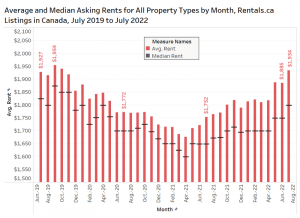
Average residential rents in Canada are closing in on their pre-pandemic peak, with the median rent reportedly hovering at $1,800 per month in July—up from $1,750 in June  and up 9 per cent from a year ago. According to the latest Rent Report, workers returning to the office are boosting rents in the most expensive central markets in Canada, bringing more competition for apartment-seekers in the downtown cores.

“The 2.6 per cent monthly increase in average rents in Canada is the second highest monthly jump in three years, topped only by the 3.8 per cent rise in May 2022,” said Ben Myers, president of Bullpen Research & Consulting. “Rents were boosted by rent growth of 20 per cent and higher in several major municipalities in Canada, and double-digit growth in a number of the most affordable rental markets, such as Red Deer and Saskatoon.”

Rising interest rates are hitting potential homebuyers with a double whammy of higher mortgage rates, along with the worry of future price declines devaluing their investment. Higher interest rates are also keeping would-be home sellers from listing their properties, which ultimately leads to higher demand in the rental market.

Additionally, immigration remains elevated, and the unemployment rate nationwide remains near historic lows, so despite some recession fears, rental market demand remains strong.

Residential rents by city

Data from the latest survey shows Victoria had the highest year-over-year increase of 27 per cent for all property types in July at $2,667. Hamilton average rents were up 26 per cent this year, rising to $2,097 after being down 13 per cent last July. Kitchener came in third with an increase of 25 per cent, rising to $2,108 since July 2021.

Meanwhile, Burnaby, Toronto and London average residential rents all rose 24 per cent in July to $2,680, $2,691 and $2,036 respectively. Mississauga, Calgary, Vancouver, and Red Deer all experienced double-digit rent increases, rising by 19 per cent, 18 per cent, 16 per cent, and 13 per cent. Halifax, Kingston and Saskatoon average rents all increased by 11 per cent since July 2021. Of the 18 municipalities, only Winnipeg’s average monthly rents declined (by 1 per cent) to $1,377, although they’d reportedly risen by 13 per cent in July 2021 to $1,385 per month.

Vancouver once again topped the list of 35 cities for average monthly rent, with one-bedroom homes going for $2,500 and two bedrooms going for $3,630. Toronto finished fourth on the list while Montreal came in 24th.

Other key takeaways:

  • The most expensive units listed on Rentals.ca were single-family homes at $3,043 per month on average in July, an increase of 14.1 per cent year over year. Since January, the average rent for single-family homes has increased by $391.
  • Condos for rent have a significant premium over apartments, with one-bedroom units in BC currently going for 41 per cent more than one-bedroom apartments.
  • With higher home prices and higher interest rates helping to increase demand in the rental market, some investors are seeing this as an opportunity to rent out more single-family properties.

Food-anchored retail tops CRE investment menu

Food-anchored retail plazas remain a staple on the commercial real estate menu, again emerging as the preferred asset type in Altus Group’s survey of Canadian investment trends in the second quarter of 2022. Other retail venues fall further down the rankings of 16 types of properties within the office, industrial, retail and multifamily sectors, but beleaguered tier-1 and tier-2 regional malls — placed ninth and 16th respectively — appear to be pulling up from the depths of the COVID-19 pandemic.

“While still reporting a negative momentum ratio, these assets show the slow, yet steady recovery seen in the retail space as consumers feel more comfortable going back into stores,” contends accompanying survey analysis. “While retail assets are slowly recovering, assets in secondary markets continue to struggle as investors scramble to puzzle out consumer needs. These assets could be prime for redevelopment to aid investors in catering to shifting consumer preferences as they become more apparent.”

Meanwhile, CBRE’s newly released Canadian retail rent survey for the first half of 2022 tracks little change in asking rent levels across most property types in 10 major urban markets, but the small amount of movement has largely been positive. That’s drawn from a scoped pool of “well-performing Class A centres with a strong/stable tenant mix” and premised on a 10-year lease term with standard tenant inducements.

“Market activity and sentiment appears to be on the rise across Canada, with cities noting an improvement in touring activity or vacancy over the last six months,” the report’s key findings highlight. “Neighbourhood centre rental rates have increased in three of 10 markets, the most of any single format type. This coincides with high activity levels in these centres, particularly from F&B (food and beverage), grocery and personal services users.”

The Altus survey’s product/market barometer, which parses out the hierarchy of investment prospects across eight metropolitan markets — Vancouver, Calgary, Edmonton, Toronto, Ottawa, Montreal, Quebec City and Halifax — finds food-anchored retail solidly in the top 15 preferences. Calgary, Edmonton, Montreal, Vancouver and Toronto are all seen as lucrative locales, with Calgary ranked highest.

Just two other product/market combos — single-tenant industrial in Montreal and suburban multifamily in Toronto — surpass the appeal of food-anchored retail in Calgary. Calgary retail is also notably in the handful of Canadian markets to post increased asking rents during the first half of this year. CBRE pegs rents for neighbourhood centres in the range of $38 to $40 per square foot (psf) and for convenience/strip plazas at $35 to $40 psf.

Other retail property types are clustered at the bottom end of the Altus chart, with enclosed community malls in Quebec City and tier-2 regional malls in Halifax deemed the two least attractive opportunities. Tier-2 regional malls in Quebec City, Calgary and Edmonton are also in the bottom 15, along with enclosed community malls in Halifax and Edmonton.

CBRE’s rental rate survey does not cover Quebec City, but regional mall rents in Halifax are cited in the range of $65 to $85 psf, while enclosed community malls command rents in the range of $15 to $18 psf. Asking rents for Edmonton’s regional malls are pegged in the range of $110 to $130 psf, with enclosed community malls securing rents in the range of $40 to $55 psf.

Power centres still make the top half of property preferences for respondents to the Altus survey, but recorded a negative buy-versus-sell ratio for the quarter, meaning more investors would consider selling than buying. Apart from food-anchored retail, industrial assets figure prominently on investors’ wish lists with multi-tenant industrial, single-tenant industrial and industrial land ranked second, third and fifth respectively. Suburban multifamily assets also crack the top five preferences.

Q2 upheaval more moderate in the retail sector

CBRE’s Q2 Canadian cap rate and investment market overview reports an upward trend in cap rates for every retail property type, with national averages rising to 5.8 per cent for anchored strip plazas, 5.6 per cent for regional malls and 6.45 per cent for power centres. Yet, the firm’s analysts conclude springtime upheaval was relatively moderate.

“Given the fact that retail cap rates entered the quarter at higher levels compared to other sectors, the yield increases seen for the asset class in Q2 2022 were relatively mild,” the CBRE report submits. “Outside of the urban streetfront and high street categories, the national average cap rate figures for each of the remaining retail property types only increased by between 7 basis points (bps) and 11 bps quarter-over-quarter. This was significantly lower than other asset classes where national average yield figures rose by as much as 30 bps.”

That’s in line with the view of an industry insider anonymously highlighted with Q2 results of the REALPAC/Ferguson Partners Canadian Real Estate Sentiment Survey. “Real estate pricing overall is too high, apart from retail, which is being priced more fairly,” it states.

Drilling down to markets, Colliers Canada reports Q2 retail cap rates remained steady in five of the 10 major markets it surveys, but edged up in Vancouver, Calgary, Toronto, Ottawa and Halifax. Despite that trajectory, Vancouver and Toronto post the lowest rates in the country, with cap rates for regional malls in the range of 4.75 to 5.5 per cent in Toronto and 4.25 to 6.25 in Vancouver. Strip plazas recorded caps in the range of 3.5 to 5.25 per cent in Montreal and 4.75 to 6 per cent in Toronto.

Prospective purchasers are also eying strategically located retail sites for infill or redevelopment potential. “The appetite for redevelopment of suburban retail has driven some deal volume in retail. As the housing shortage intensifies in Canada, governments are increasingly receptive to large mixed-use developments in place of suburban malls,” Colliers analysts note.

Vancouver and Toronto outperform most Canadian and U.S. markets

Looking at how Vancouver and Toronto compare to a much larger field in the United States, the two Canadian markets stand out with the lowest retail vacancy rates and lowest and third-lowest cap rates among the 53 North American urban regions examined in Lee & Associates’ Q2 commercial real estate report. It cites Vancouver’s retail vacancy rate at 1.2 per cent and Toronto’s at 1.7 per cent, while Seattle, Boston and Raleigh, North Carolina, round out the five tightest markets, all with a 2.7 per cent vacancy rate.

Of those five, Toronto boasts the largest retail inventory at more than 300.5 million square feet, while Vancouver’s complement is about 58 per smaller at 124.6 million square feet. Nevertheless, Canada’s largest city is modestly stocked with retail space compared to the five most expansive markets, ranging from nearly 622 million square feet in New York City to 425.5 million square feet in Houston.

Vancouver’s cap rate is pegged at 4.1 per cent, followed by San Francisco at 4.5 per cent and then Toronto at 4.6 per cent. Orange County, California, and Los Angeles are ranked fourth and fifth, with respective cap rates of 5.1 and 5.3 per cent.

The report confusingly does not differentiate between Canadian and U.S. dollar values (as Lee & Associates staff in Toronto and Vancouver have confirmed). Vancouver cracks the top five for Q2’s highest sales price psf at USD $418.08 (CAD $536) — but should be slotted in fifth, not second as appears in the comparative statistics. Toronto’s top sales price, at USD $317.46 psf (CAD $407) also surpasses the U.S. index average of USD $237 psf.

There is currently about 1.3 million square feet of new retail space under construction in Toronto and about 982,000 square feet in Vancouver. That’s well back of the pace in the five most active U.S. markets, ranging from 4.4 million square feet in progress in Houston to 2.3 million square feet underway in Washington, DC.

Both Toronto and Vancouver post property-wide average retail asking rents that surpass the U.S. index average of USD $23.28 (CAD $29.80) psf. In Toronto, a Q2 average asking rent of CAD $32.66 (USD $25.48) psf in Q2 continues a consistent uptick in the five quarters since Q2 2021, when average asking rent was at CAD $31.55 (USD $24.61) psf. Vancouver’s average asking rent was down slightly in Q2 — at CAD $34.13 (USD $26.62) psf compared to CAD $34.25 (USD $26.71) psf in the previous quarter — but is up more significantly from a Q2 2021 average of CAD $32.54 (USD $25.38) psf.

“Momentum has continued to build over the last few months, mostly in centres anchored by grocery, pharmacies, banks etc. — everyday essentials that have proved to be resilient,” reports Nicole Moniz, a Lee & Associates vice president based in Toronto.

“Consumers are still showing a willingness to spend,” says Macyn Scholz, Lee & Associates’ director of research in Vancouver. “This can be attributed to pent-up demand from pandemic restrictions, as well as increased foot traffic in downtown areas due to the return to office.”

“Vancouver has witnessed a significant increase in activity from return-to-office plans and travel where people and cruise ships have returned close to the financial district and Vancouver port, adding an influx of residual foot traffic to the CBD (central business district) and other major retail corridors,” concurs Adrian Beruschi, a CBRE senior vice president in Vancouver.

CBRE’s survey finds asking rental rates have remained steady for most retail formats in Vancouver, with the exception of a downward trajectory for enclosed community malls. Montreal has seen an uptick in asking rents for convenience/strip plazas with stable asking rents for other retail formats.

Rents have also been steady across the board in Toronto, in tandem with a pickup in leasing levels. Arlin Markowitz, Toronto-based CBRE executive vice president, reports the “creative” landlord-tenant agreements of the pandemic period are much rarer. However, industry insiders foresee potential future fallout in the extensive network of below-grade retail concourses, known as the PATH, connecting most of the major office and institutional buildings in the financial district.

“Location-wise, interest is most prominent in Class A properties, with touring levels recovering more slowly in tertiary properties. Activity on the PATH has also resumed and among Class A product, it is no longer a question of whether the space will be filled, but of pricing instead,” Markowitz says.

Anonymous insight in the REALPAC/Ferguson Partners sentiment survey includes a more cynical observation. “The pathways need to be rethought — 25 per cent of clients are back to the office — the pathway retail is not sustainable,” it contends.

Ontario introduces Strong Mayors, Building Homes Act

The Ontario government has announced new legislative changes that, if passed, would give the mayors of Toronto and Ottawa more power to advance provincial priorities that would bring more homes to market faster.

According to Tim Hudak, CEO of the Ontario Real Estate Association, the proposed act represents a good step forward in addressing the housing crisis in Ontario, as it would help cut red tape and speed up the local planning process by giving municipal leaders the ability to reduce timelines for development, standardize processes, and address local barriers to increasing housing supply.

Huduk added that the ‘Strong Mayors’ system would allow for the adjustment of development plans to create gentle density as needed, ensuring municipalities are not introducing policy or bylaw changes that directly contravene or work against provincial priorities—including the commitment to build 1.5 million homes over the next decade. Further changes that could help speed new housing supply include mayoral responsibility for budgets, the ability to appoint a CAO, and the ability to hire and replace department heads, including the Chief Planner.

“While today’s new legislation is a good step towards giving mayors a greater role in accelerating housing supply and cutting red tape and runaround, Ontario’s REALTORS would like to see these powers expanded to other urban areas,” he said. “More can still be done to address the existing housing affordability crisis, including ending exclusionary zoning in Ontario’s highest-demand urban neighborhoods, which would allow for the building of duplexes, triplexes and fourplexes on lots traditionally zoned for single-family housing.”

For the full government backgrounder, click here: Strong Mayors, Building Homes Act | Ontario Newsroom


FCM Summer 2022 issue out now!

Facilities such as hospitals, long-term care homes, and other health and care institutions continue to learn from the challenges and the pain of the pandemic and to look to safeguarding the future.

Our Facility Cleaning & Maintenance Summer 2022 issue focuses on those facilities but the analysis and lessons on the pages ahead by no means apply exclusively to health and care. There are features on the cleaning and real estate industries’ labour troubles, the disinfecting power of UVC light, how technology is enhancing cleanliness in the washroom and beyond, hand hygiene, air purification, and more.

Our cover story sees us chat to Wendy Boone and Julie Hoeflaak of the Canadian Healthcare Housekeepers Association (CHHA) about the great work the organization does within the sector and how the pandemic has altered the terrain.

In our Expert Q&A, we grilled Hallmark Housekeeping Services’ Chris King on how technology, labour, and training intertwine, and there are great features from industry experts such as Global Biorisk Advisory Council (GBAC) senior director Gavin Macgregor-Skinner.

We also dedicate some pages to recapping a fantastic summer in Toronto. The 2022 REMI Show and the ISSA Show Canada were held concurrently at the Metro Toronto Convention Centre a few weeks ago, reuniting the industry after too long apart and with much to discuss. We present an ISSA Show Canada recap, there’s an in-depth feature on the exceptional “Where Do We Go From Here?” panel session featuring numerous leading building service contractor and property management personnel, and we spotlight some of the excellent products and technologies currently paving the way in commercial cleaning and hygiene.

Ultimately, the message of the issue is that while challenges certainly persist – and are unlikely to wane any time soon – a combination of compassion, diligence, and technological adoption and advancement can ensure facilities across Canada stay hygiene, healthy, and safe.

Read the full issue here.

