


Articles Archive - Page 267 of 928 - REMINET
REMI

With Solar, the Sky is the Limit

As sustainability mandates and the high cost of utilities continue to drive commercial property owners to seek out innovative solutions, those looking to reduce overhead and save on energy should consider harnessing the power of the sun. Photovoltaic solar panels have come a long way in recent years, and the benefits are steadily growing.

“Solar panels continue to come down in cost, and they’re more economically favourable thanks to a range of eligible subsidies and grants,” said Kevin Vogt, Project Engineer with RJC Engineers. “Standardized modules and mounting solutions have made it possible to install them on a greater variety of roofing and standalone structures, including flat roofs, peaked roofs, and vertical surfaces, so the opportunities for this technology have opened up considerably.”

Another leap forward is the fact that data is more readily available for those considering a new solar array. Unlike a few years ago, building owners exploring their options can predetermine the return period on their upfront capital cost by inputting key factors like the size of the array, efficiency of the panel, orientation, and utility costs—meaning there’s far less guess work and fewer questions about solar technology’s effectiveness.

In fact, the possibilities are proving to be quite significant. Case in point: at CF Chinook Centre in Calgary, AB, Vogt and his team recently assisted with the structural aspects of a solar installation project involving 1,900 panels on behalf of Cadillac Fairview and ENMAX Power. For its part, RJC was involved with reviewing the effects of the additional loads on the existing roof structure to find workable solar panel layouts to fit within the allowable weight restrictions and coordinating the mounting of two new rooftop transformers.

Since wrapping in 2021, the project has been deemed “an exciting step forward in the adoption of renewable energy sources” with the new system now acting as a secondary network serving high-density areas of the city. Since May, it has generated over 600,000 kilowatt-hours (kWh) and exported 5,425 kWh back into the grid—which is enough to power a typical-sized home for 10 months.

“Today, the completed arrays cover approximately 53,000 square feet and are successful in reducing the mall’s reliance on purchasing electricity from the traditional grid,” said Vogt. “The mall has now been able to supply electricity back into the greater grid, a first for secondary networks in Calgary.”

Opportunities & limitations

As a large-scale project expected to spur others like it, CF Chinook Centre is a terrific example of what can be achieved using today’s solar technology. But, according to Vogt, smaller buildings can reap some amazing benefits too.

“Solar panels allow electricity usage and expenses to be offset by renewable electricity generated on site,” he said. “Incentives for adding solar panels on new and existing buildings include those provided by local jurisdictions to meet climate strategy targets and those aiding in achieving green building standards such as Net Zero and LEED. These, of course, are helping to bring down the costs.”

That said, there are still some limitations impacting which buildings are best suited to take advantage of the solar movement: the size and orientation of exposed roofs; weight restrictions on the existing structural roof system; and the types of electrical demand of the occupancy may prevent some buildings from qualifying.

“Think of a small building with multiple stepped roofs shaded by adjacent buildings and exposed to large snow drifts,” Vogt said. “With that geometry, or if the building requires uninterrupted power supply for critical equipment, chances are it will not see a high return on investment with solar compared to a large warehouse with a single flat roof and plenty of south exposure.”

But for those that are feasible, the best time to consider adding solar to a roof is when a re-roofing program is scheduled.

According to Vogt, “Often when an older gravel ballasted roof is replaced with a lighter roofing system, the reserve capacity in the roof structure can accommodate the additional weight of a new solar array. Installing solar on a new or recently replaced roofing system also prevents the panels from needing to be temporarily removed in the short term due to re-roofing.”

If interested in learning more about solar panels on structures and considerations for your building, please visit www.rjc.ca or contact Kevin Vogt directly at: [email protected]



Infrastructure investment a go-to in downturn

Prospective project proponents in the United States are looking to Canadian models for facilitating public-private partnerships (P3s) as they contemplate the infrastructure investment that two recently enacted spending bills are designed to trigger. Speaking during the Bloomberg online Canadian finance conference earlier this fall, Mac Bell, director of infrastructure investments with Fengate Asset Management, identified Infrastructure BC and Infrastructure Ontario as frameworks that could help U.S. state and local governments take advantage of the vast new pots of funding.

“In Canada, these agencies work on behalf of governments everywhere to procure infrastructure. They have the documents. They have the process. They have the expertise to manage execution of the project and the procurement to pick a private sector partner through the P3 model,” he said. “The U.S., I think, is still at a very early stage. It would be very helpful if there was a SWAT team of experts, perhaps domiciled in a federal agency or a state agency somewhere, where states, counties and cities have access to expertise and best practices around procurements.”

An onslaught of transportation, telecommunications, energy, utility, facilities and decarbonization projects are foreseen in the months and years ahead as state and local governments and a range of broader public sector and community-based players tap into capital grants and tax incentives conveyed through the U.S. Infrastructure Investment and Jobs Act and the Inflation Reduction Act. Bell and fellow panellist Anthony Phillips, co-head of public-private partnerships and projects with the P3 investor and manager, John Laing Group, predict that P3s will be central to the rollout of many of those projects.

For public partners, P3s are a means to transfer capital and ongoing operational risk. For the private sector, infrastructure’s recession-proof profile dovetails with expectations for a prolonged building spree.

Clean energy, grid capacity to enable the electrification of transportation and space heating/cooling, and broadband for real-time smart controls of almost every element of the transmission and distribution system are chief among the required components to achieve the ambitious targets for curbing greenhouse gas (GHG) emissions that both the Canadian and U.S. governments have embraced. As well, massive amounts of investment is needed in facilities and civil engineering to rein in carbon footprints and improve climate change resilience.

“The asset class is highly attractive both to industrial and financial investors given its core characteristics — given the sector tower winds, the strong ESG profile and attractive investment characteristics,” Phillips submitted.

“Infrastructure is a good long-term investment for those contemplating the class and this is why: public policy; fiscal policy; and a secular growth story,” Dave Wahl, a director and portfolio specialist with ClearBridge Investments, reiterated during a recent webinar sponsored by the NEO Exchange.

EV charging on wish lists in Canada and the United States

In the U.S., Bell and Phillips cite opportunities in education facilities and campus energy systems, transportation hubs including airports, rural broadband and electric vehicle (EV) charging infrastructure. In the near term, the majority of states now have federally approved EV deployment plans, giving them access to a share of the USD $5 billion allocation for 2022-23 earmarked for charging networks.

“We’ve started to see that money rolling out to support that infrastructure,” Phillips reported. “There needs to be a robust charging network and this is where we think P3 can play a role supported by the federal funding.”

EV charging is also on the Canada Infrastructure Bank’s (CIB) wish list for joint investments with private sector partners. The 2022 federal budget affirmed that $500 million of “existing resources” in the CIB’s green infrastructure envelope would be dedicated to “large-scale urban and commercial zero-emission vehicle charging and refuelling infrastructure”, while the government commits an additional $400 million over five years (2022-23 to 2026-27) to its zero-emissions vehicle infrastructure program (ZEVIP) to subsidize installations in less densely populated areas of the country.

Speaking during the Bloomberg online finance conference, CIB chief executive officer, Ehren Cory, summarized the bank’s five priorities — clean energy; green infrastructure; transit systems; trade and transportation; and broadband — and mandate to leverage CAD $35 billion to stimulate further investment. He characterized the fund as a lubricant.

“What we are really trying to find is those good projects that deliver public value that are stuck. They might be stuck because they are too risky or uncertain or have really long paybacks,” Cory noted. “Those are the sorts of things that government money can help solve — patient capital, long-term capital, risk-taking capital — to pair with that private sector money in those five sectors.”

Thus far, the CIB has invested in nearly 40 projects, of which about 20 are now under construction. That includes a number of deals for commercial building retrofits and municipal transit fleets, which Cory called “almost the base load” of agreements to date, but low-carbon fuel and EV charging projects are expected to come on soon. The latter could epitomize the stuck project, presenting a scenario in which prospective investors look for assurance of demand for chargers, while prospective EV purchasers hesitate to buy before they have assurance of an easily accessible charging network.

“To me, this is like a perfect use case for the CIB,” Cory maintained. “There’s a real chicken-egg problem in that investment case, but in the long run, there’s a great business.”

Inflation and rising interest rates complicate business case

Inflation and rising interest rates have also emerged to complicate investment in ways not felt when the CIB was launched in 2018. “The role of the CIB gets even bigger in periods like we’re in right now of high market uncertainty and risk because that’s what we can help manage. We can help insulate to some extent, or share in that risk,” he asserted.

“Investment in infrastructure is really important in times like these,” Cory added “It is one of the few truly cycle-proof kinds of asset classes. Infrastructure helps bring us through economic downturn and recessionary periods because it grows our competitiveness. It grows our economy.”

From a P3 perspective, Phillips commended the trend to inflation riders in Canadian contracts so private and public partners share the impact of rising material and equipment costs, and argued the practice would also serve U.S. proponents well.

“The alternative is that our contractors will just choose to focus on other projects and away from what they consider to be a position that’s just got too much risk for them,” he said. “It goes to market appetite and the mechanisms that clients can provide to ensure that they have the world’s best turning up to their projects.”

“There are mechanisms that have been developed elsewhere to allow contractors to address that risk and it’s for the benefit of the public sector also because it allows for more competitive pricing from contractors to deliver these projects,” Bell concurred.

Barbara Carss is editor-in-chief of Canadian Property Management.

Tricon Residential launches resident “Bill of Rights”

Tricon Residential Inc. announced it has launched an industry-leading “Bill of Rights” for residents of its U.S. single-family rental home portfolio. The new bill of rights outlines the company’s commitment to providing quality, move-in-ready homes with caring and reliable service.

The rights described within the pledge are:

  • Right to Shelter
  • Right to Renewals
  • Right to Fair Advance Notice
  • Right to Moderated Rent Increases
  • Right to Participate in Financial Health and Credit Builder Programs
  • Right to Buy Your Home if We Decide to Sell
  • Right to Our Support if You Buy Another Home
  • Right to Respect

“Tricon has always been a different kind of housing company,” said Gary Berman, Chief Executive Officer and President of Tricon. “For us, that starts with being distinctly resident-centric in our approach. Today, we are proud to strengthen our commitment to our residents by releasing our Resident Bill of Rights; in doing so, we stand firmly behind our belief that residents deserve transparency and dedication from their housing provider.”

The company says it takes its commitment to residents seriously, having invested millions in home revitalization efforts since the beginning of 2022. In addition to providing responsive and caring maintenance services, Tricon offers residents unique assistance to help them achieve their financial goals, through credit builder programs, financial literacy workshops, and one-on-one coaching through its Tricon Vantage program.

“Whether we’re saving families money each month by moderating rent increases or empowering our residents to make their financial futures brighter through credit builder programs, it’s our goal to be more than a housing provider,” said Kevin Baldridge, Chief Operating Officer of Tricon Residential. “The announcement of our Bill of Rights further demonstrates our steadfast commitment to positively impact the lives of our residents and the communities we serve.”

For more information on Tricon’s Resident Bill of Rights, visit triconresidential.com/bill-of-rights

Calgary completes Airport Trail Interchanges

Construction on Airport Trail, an important transportation corridor running across Calgary’s northeast, is now substantially complete. With the two new interchanges at 19 Street and Barlow Trail N.E. open to traffic, the vision for a connected Airport Trail corridor is here.

This route is a significant local and regional transportation corridor, the completion of which better connects local communities and businesses, provides improved access to the Calgary International Airport, and serves as a strategic link between Deerfoot Trail and Stoney Trail.

“The Airport Trail Corridor investment generated hundreds of local jobs and will now play an important role to keep our economy moving. The project addresses a significant missing transportation link in the area and will greatly improve access for Calgarians, businesses transporting goods, and tourists navigating our city,” said Mayor Jyoti Gondek.

Funding for the Airport Trail Phase 2 was provided by the Government of Canada, Government of Alberta, The City of Calgary, and the Calgary Airport Authority, representing a $153 million investment in Calgary.

“The completion of Airport Trail is a major milestone for The Calgary Airport Authority,” said Chris Miles, vice president operations and infrastructure with the Calgary Airport Authority. “We are grateful for the government investments in this project which has created hundreds of jobs and enabled seamless connections to the airport for millions of guests, thousands of employees, and the cargo that Canadians rely on.”

The Airport Trail Corridor vision has had several steps along the way. The Airport Trail Tunnel opened to the public in 2014, the southbound Stoney Trail to westbound Airport Trail ramp was completed in 2020, the 2.4 km Airport Trail extension between 36 Street and 60 Street N.E. was opened in September of 2021, and now the two new interchanges at Barlow Trail and 19 Street N.E. are both open to traffic.

Keeping your custodial closet clean

No matter what business you’re in, first impressions matter. You want your facility to look its best, and that includes your custodial closet.

Not only does a clean and organized closet set your janitorial team up for success, but it also shows that you are serious about cleanliness, writes Mike Sawchuk for CMM.

When your closet is dirty, it gives the impression that your facility may not be clean or safe. If it’s disorganized or a mess, it could look like your business is that way, too. Do you have a sign-out sheet or inventory list? Are your products labeled? If not, people might think you aren’t on top of the cleaning protocols or that maybe you lack the supplies to take proper care of your building.

Cleanliness and hygiene are still top of mind for staff and visitors, so you need to be sure people know they are a priority for you, too.

If you think of your closet as a symbol of your business, you want it to be tidy, organized, and professional. Are you eco-friendly or health-conscious? Those qualities should be obvious when an outsider peeks into your custodial closet.

It’s not all about impressions, though, adds Sawchuk. Custodial closets can be a source of pathogen transmission. When airborne germs accumulate and settle to collect on the surface of the floor, there’s a risk of them transferring to hands and surfaces via shoes and equipment resting on the floor.

A study in Cleveland concluded that 57 per cent of contaminated objects in contact with the floor transferred bacteria to the hands, so keep your closet floor clean and disinfected to minimize the risk of spreading germs this way.

RELATED: Cleaning floors for health, instead of for appearance

Between leaving a lasting impression of professionalism, keeping your janitorial team organized, and working on minimizing the spread of pathogens, it’s worth the time and effort it takes to keep your custodial closet clean.

300 Main – Earls Kitchen + Bar

Opened in 2022, the flagship Earls Kitchen + Bar in downtown Winnipeg brings the brand’s new design direction to the city.

The design concept for the 6,000-square-foot space focuses on finding a thoughtful balance between embracing the grand modern architecture, while still creating an intimate space that offers approachability, warmth and intrigue.

Jennifer Hoffbeck, vice president, design at Earls Kitchen + Bar, says attention to detail, distinct experiences between each space and enabling unobstructed views were all key to creating an inviting and light filled space.

The restaurant features local art, planters and an abundance of fresh plants. A variety of dazzling custom-designed light fixtures are used throughout to highlight the warmth, sparkle and volume of the space such as the organic chandelier in dining room and low level sconces at the bar and entry.

“We worked in close collaboration with Synonym Art Consultation to ensure the fabric of Winnipeg was being thoughtfully reflected. A large-scale mural anchors the front of the lounge, providing unexpected colour and form, while showcasing a young local artist, Bramwell Enan,” says Hoffbeck.

Custom-designed furniture is modern and warm, allowing for maximum guest comfort, while balancing sophistication to sustain the test of time.

The biggest challenge on the project was the curved floor plan, notes Hoffbeck. “We worked with the curved floor plan – the space has a 20-foot high glass curved façade – in a way that embraced the geometry, while still providing a warm and inviting experience.”

The design team also had to navigate this project in the height of the pandemic. “This design came to life during the early days of the pandemic and we are so proud of the resilience and creativity that shone through,” she says.

For their efforts, the project earned an IDIBC Award of Excellence as well as Interior Designer of the Year.

“It’s extremely special – it truly was a team effort,” says Hoffbeck about the awards. “Lead designer, Emily Stadnyk alongside designer Samantha Duncan and creative director Elly Chronakis, spearheaded the design of 300 Main and achieved an absolutely outstanding experience for our guests. Our in-house studio values a highly collaborative design process and several team members are reflected in the success of this project.”


INTERIOR DESIGNER OF YEAR
IDIBC AWARD OF EXCELLENCE, FOOD & BEVERAGE

Photography: Janis Nicolay Photography

Winterizing your commercial property

Even the toughest commercial buildings can fall prey to Canadian winters. Harsh storms, heavy snow, and heightened water damage risks can jeopardize critical systems and infrastructure while putting occupants and visitors at risk. Still, as is always true in property management, being proactive pays.

“Every winter introduces a host of potential hazards, all of which can affect the safety and structure of your properties. And if winter-related damage isn’t prevented or detected until spring, you could be looking at additional issues and costly repairs,” says Craig Smith, Director of Commercial Business Development with FIRST ONSITE.

Surely, by identifying and addressing potential winter risks, commercial property managers and owners can take preventative measures to protect their assets and keep tenants safe and comfortable.

It begins with a plan

The first step in winterizing a commercial property is to create a game plan. Collaborate with your facilities team and disaster prevention specialists to design a winter-preparedness plan that your teams can follow throughout the winter to ensure your

building and its occupants stay protected.

Key components of a commercial property winter plan include:

  • Building assessments & routine inspections: Knowing where your building is most vulnerable to winter damage is the first step in cold-weather preparedness. Walk the property with your facilities teams and specialists to size up potential structural issues and maintenance needs that need addressing before the snow, sleet, and cold set in.
    And don’t just stop at one. Continue conducting building inspections throughout the cold months to keep track of your building’s condition. This is especially important after a storm or during extreme temperature dips when even the slightest damage (e.g., cracks, tears, water leakage, etc.) can evolve into costly and unsafe issues.
  • Prevent flooding and water damage: Water from melting snow and ice can damage commercial properties if given a chance to seep in. Seal, repair, or address any deficiencies on your roof, building envelope, or foundation that may facilitate water infiltration (e.g., cracks, holes, weaknesses, etc.), and remove snow piles on the roof or near the foundation that may thaw and pose additional water issues. Remember: when a water emergency happens, you need to catch it quickly. For this reason, many multifamily property managers/owners have found it beneficial to install water monitoring and leak detection technology that alerts the appropriate responders to potential water events the moment they begin to occur.
  • Control exterior water access: Turn off water access to outside faucets to avoid pipes from freezing and bursting, which could lead to flooding. Similarly, shut down irrigation systems to preserve them through the winter and avoid problems in the spring.
  • Protect your pipes: Seal or block drafty areas in a building where pipes may be exposed to freezing temperatures, and wrap pipes to insulate them from freezing or cracking. Doing so will keep heating systems in working order and will go a long way toward preventing the aforementioned risks of water damage.
  • Install backwater valves: Melting snow or ice can push municipal water systems to their limit, sending dirty, unsafe water back into a building’s system and necessitating a property restoration team and sophisticated cleaning methods. Avoid backwater by installing a mainline sewer backup valve that makes sure sewage travels on a one-way path out of the building.
  • Prevent snow and ice build-up: Prevent snow from piling up on roofs and supporting structures. Heavy snow loads can lead to structural damage or collapse, leading to costly repairs and – more importantly – putting building users at risk. Similarly, excessive ice build-up on roofs can jeopardize the integrity of the building and pose safety risks for residents below. On the topic of ice, inspect meters, door locks, and door handles on the ground level, as they may freeze due to melting water from higher surfaces dripping down and reforming as ice.
  • Keep entrances and exits clear: Make sure all points of entry and exit are continually cleared of snow and ice so they can be used safely in the case of an emergency. This can be done by placing sand, salt, and shovels in an accessible area or hiring a snow removal company ahead of time to clear sidewalks, parking lots, and roads when needed.
  • Don’t forget about fires: The risks of a fire are always a concern. Collaborate with your fire department to mark the hydrants close to your business property above the snow line so they’re easier to locate. Also remember to clear space around hydrants after a snowstorm and check that all building extinguishers are full and working properly.
  • Crack a door: While it may seem common sense to keep doors closed in a commercial building to keep the area warm, it is advisable to leave them open in areas prone to condensation and precipitation, as the continuous air flow will minimize cold spots and help prevent moisture build-up.

Ready to react 
Even the most prepared commercial property may experience an emergency. Herein, one of the most important things to consider as winter approaches is that an emergency plan is in place.

First OnsiteEmergency preparedness plans include considerations for evacuation plans and routes, ensuring life safety systems are working (e.g., alarms and sprinklers), and that people are assigned to close off water, gas, and electricity to avoid property damage from fires or flooding. They should also include contacts for emergency services (fire, ambulatory, and police), insurance reps, and a trusted property restoration partner.


“There are a lot of steps you can take to prevent a winter disaster, but when an unpredictable winter event occurs, it is also imperative to have an emergency preparedness plan for your business,” adds Smith.

Craig Smith is Director of Commercial Business Development with FIRST ONSITE, a leader in emergency response planning, disaster remediation, property restoration, and reconstruction services, helping clients restore, rebuild, and rise after catastrophic events of every kind.

Winter ready, resident safe

Canadian winters can be harsh on condo buildings. Severe storms, heavy snow, and excess ice or water damage risks are only some of the cold-weather hazards that can impact building envelopes, roofs, and critical equipment.

The good news is property stakeholders are far from defenseless. By identifying and addressing potential winter risks, managers and owners can take preventative measures to protect their assets and keep tenants safe and comfortable.

Assess your vulnerabilities: Knowing where your building is most vulnerable to winter damage is the first step in cold-weather preparedness. Walk the property with your facilities teams and size up potential structural issues and maintenance needs that should be addressed before the snow, sleet, and cold air sets in.

Conduct routine inspections: Keep track of your condo’s condition throughout the winter months, particularly after a storm or extreme temperature dips when even the slightest crack, hole, or pipe leak damage can snowball into a costly and/
or dangerous issue.

SnowyCondo

Protect your pipes: Wrap pipes to keep them insulated and block them from drafty areas where pipes may be exposed to freezing temperatures, as this will prevent cracks and bursts from occurring due to cold weather. Also remember to turn off the water to your condo’s hose bibs, remove the hoses, and drain the pipes. Lastly, make sure your building teams know the location where all pipe shut-off valves are located so they can be turned off immediately in the event of a burst.

Winterize your roof: Fall debris can clog a roof’s gutters, drains, and downspouts. Clear all drainage systems to prevent snow and ice from building up, melting, and creating excess water damage risks.

Remove snow loads: Prevent snow from piling up on roofs and entrances, as heavy snow loads can lead to structural damage or outright collapse. Also, ensure all points of entry and exit are kept clear of snow so that they can be used safely in the case of an emergency.

Prevent ice build-up: Like snow, excessive ice build-up on roofs can jeopardize the integrity of the building and pose safety risks for residents (e.g., falling icicles, slipping, etc.). Similarly, take measures to keep ice from forming on building’s parking lots, sidewalks, and other surfaces to prevent slipping and parking lot accidents.

Mitigate flooding and water damage: Water from melting ice or snow can get inside the building and do lasting damage. Ensure your inspection accounts for this (e.g., overflowing gutters, envelope cracks), that snow piles close to the property’s foundation are removed, and that the building has adequate insulation to control heat loss and keep ice dams from forming.

Seal the deal: Use caulking and insulation to seal cracks, tears, or holes in a building envelope that may allow cold air into the building, where it can wreak havoc on pipes, affect HVAC systems, and lead to energy loss. As well, add weather-stripping around
doors and windows to control air leaks.

Have an emergency plan: Even the most prepared multiresidential buildings may experience an emergency. Create an emergency preparedness plan that includes evacuation plans, instructions for staff (e.g., water and electricity shut-off procedures),
emergency contacts (fire, ambulatory, and police), and follow-up contacts, such as your insurance partner and trusted property restoration partner.

“It is becoming standard practice for property management companies to incorporate a mitigation/restoration component into their overall Emergency Response Management Plan,” says Craig Smith, Director of Commercial Business Development with FIRST ONSITE, adding, “Emergency mitigation saves time and money and it helps keep everyone safe.”

FIRST ONSITE is a leader in emergency response planning, disaster remediation, property restoration, and reconstruction services, helping clients restore, rebuild, and rise after catastrophic events of every kind.

Construction of Seven Sisters facility underway

Construction of a new state-of-the-art Seven Sisters mental-health facility in Terrace has begun.

“The new Seven Sisters will ensure that when people in northwestern B.C. need mental-health support, they get timely, high-quality care close to home, which is crucial to their recovery,” said Adrian Dix, minister of health. “We are committed to continuing to build a strong health-care service network in the region, which will help build resilient communities.”

Seven Sisters is a regional mental-health facility that provides long-term rehabilitation and recovery programs for adults living with serious and persistent mental illness. The redevelopment will allow more people to receive care in a larger space with additional amenities.

The new Seven Sisters will be nearly twice as big as the existing building and include 25 beds, which is an increase from the current 20. The new facility will also add treatment rooms, meeting spaces and recreational facilities. Patients will have access to abundant natural light and outdoor space.

The Seven Sisters project is part of the Mills Memorial Hospital replacement project. Construction on the new hospital started in June 2021 and is expected to be complete by fall 2024. The new hospital will also see an improvement in mental-health services, with 20 of the 78 beds dedicated to adult in-patient psychiatric care.

Both the new Seven Sisters and new hospital are being built on the same site as the existing facilities. The new Seven Sisters will be on the southwestern corner of the site to the left of the existing hospital’s main entrance. The existing Seven Sisters facility will be demolished, and the site will be used for the new hospital. The new mental-health facility is expected to be complete in late fall 2023.

PCL Constructors Westcoast is designing and constructing the hospital and the mental-health facility in Terrace.

GTA new condo sales for September down 89%

Sales of new condos in the Greater Toronto Area, including units in low, medium and high-rise buildings, stacked townhouses and loft units, with 289 units sold, were down 89 per cent from September 2021 and 84 per cent below the 10-year average.

The data comes from Altus Group, the Building Industry and Land Development Association’s official source for new home market intelligence. Overall, the GTA new home market slowed in September, with sales well below the 10-year average and inventories low, but rising slightly, BILD announced on Monday.

Single-family homes, including detached, linked, and semi-detached houses and townhouses (excluding stacked townhouses), accounted for 45 units sold, down 96 per cent from last September and 96 per cent below the 10-year average.

“September new home sales were quite low,” said Edward Jegg, research manager at Altus Group. “However, inventory rose as builders brought more condominium apartment projects to market.”

Total remaining inventory increased compared to the previous month, to 11,900 units, comprising 10,291 condo apartment units and 1,609 single-family lots, representing 4.4 months and 3.1 months of inventory respectively. A balanced market would have nine to 12 months of inventory.

The benchmark price for new condos in September was $1,159,455, which was up 11.8 per cent over the last 12 months and the benchmark price for new single-family homes was $1,853,214, which was up 17.8 per cent over the last 12 months.

BILD President and CEO Dave Wilkes said that the market has stalled due to monetary policy and rising interest rates. “Inflation in construction and labour costs, elevating government fees, taxes and charges and tight supply make significant price correction for new homes very unlikely,” he said. “The solution remains significantly adding supply to the market and this requires a wholesale change to the way we regulate, tax and deliver new homes to the residents of the GTA.”

KingSett a global leader as GRESB uptake swells

KingSett Capital has emerged as the global leader among 59 mixed office-residential real estate portfolios benchmarked in the 2022 GRESB survey of environmental, social and governance (ESG) practices and performance. This year, 1,820 entities worldwide, including private companies, property funds and REITs, reported to the annual assessment, which considers 60 indicators across 14 components of activity.

The GRESB real estate database now captures 150,000 individual assets in 74 countries collectively valued at about USD $7 trillion. The total number of respondents has increased by more than 237 per cent during the past decade, while average scores for those reporting over that entire period have climbed from a range of 45 to 54 in 2013 up to 81 to 85 in 2022.

This is KingSett’s eighth year of GRESB participation and the second consecutive year it has been atop the office-residential category. The company also attained a five-star ranking for the fifth consecutive year, meaning that its GRESB score is in the top quintile (20 per cent) of the total field of participants.

“We are grateful to our people, partners and customers who helped make this achievement possible,” says Jon Love, chief executive officer of KingSett Capital. “We are committed to our ESG strategy and continue to expand our efforts and ambitions, seeking to make an impact and build long-term value for all our stakeholders and communities.”

Other notable Canadian results include: QuadReal Property Group, which posted the top score in the Americas region for diversified portfolios with office, retail, industrial and residential properties; and Oxford Properties Group, Triovest and BentallGreenOak, which were all Americas region leaders in the separate development benchmark for ESG attributes in design, construction and renovation.

The five companies are veterans of the GRESB assessment, witnessing a steadily growing contingent of Canadian participants. Enrollment has nearly doubled over the course of the COVID-19 pandemic — climbing from 30 in 2019 to 59 reporting entities this year, and with 44 per cent year-over-year growth from 2021 to 2022.

That’s a trend throughout the Americas region, as the United States gained 79 new respondents for a 26 per cent growth rate, and Brazil recorded a 170 per cent jump from 7 to 19 entities. The influx is also deemed a major cause for a drop-off in the region’s average GREB score, which dipped to 72, down from 73 in 2021.

“The first year of reporting to GRESB can be extremely challenging,” Reid Morgan, manager, member relations, for GRESB’s Americas region, observed earlier this week during an online summary of the results. “Another critical contributing factor to lower overall scores this year was the significant change in how buildings were used in 2021 as compared to 2020. With workers starting to return to the office and businesses reopening, we saw a decrease in like-for-like scores in the energy, water and GHG emissions aspects.”

Still the data bodes optimistically for the future. This year, the first-year reporters collectively posted an average score of 58.3, while the average score for entities in their second year of participation was 68. At five or more years of participation, the average scores hit or surpassed 81.

Across the board, the Americas average score was the lowest of the four most represented world regions and also underperformed the global average of 74. Oceania, encompassing 108 portfolios in Australia and New Zealand, again retained the title as top-performing region after achieving an average score of 81. Asia follows with 78 and then Europe with 73. Seven African portfolios — four in South Africa and three in Kenya — also reported this year.

Oceania’s 10 first-time reporters achieved a collective average score of 70, while average scores surpassed 85 for entities with more than five years of GRESB participation. Asia added 50 new participants in 2022, for a 21 per cent growth rate, with first-year reporters likewise posting an average score of 70.

Europe continues to hold an influential sway over the global average with its 907 reporting entities accounting for about of the total benchmark this year. However, its ranks are growing at a slower pace than in the Americas — expanding by 15.6 per cent from 2021. Drilling down to individual countries, Germany picked up 26 new participants, pushing its count above 100 and representing a 34 per cent increase, while the United Kingdom added seven new participants, for a total of 264 and national growth rate of 2.7 per cent.

Meanwhile, the Americas bring a smaller number of larger portfolios to the mix. Its 477 reporting entities account for 26 per cent of global participation and 43 per cent of the gross asset value — equating to about USD $3 trillion — of all participants’ holdings.

Touchless technology for your building

The last few years have seen so many changes in cleaning and hygiene, with technology improving cleanliness, increasing safety, and easing some of the stress from labour shortages.

Touchless technology has become an increasingly popular tool for everything from restrooms to elevators. What gathered pace as a reaction to the pandemic is quickly becoming the standard, as over 62 per cent of people look forward to increased touchless technology.

Limiting the spread of germs helps keep your employees and guests safer, and it also benefits your business. Fewer germs mean cutting down on sick days and keeping your staff at full capacity. It could also mean that less maintenance is required in those areas, so you can better allocate your labour.

If you are looking at upgrading your facility to include touchless technology, a building assessment is a great place to start.

Start the process by identifying your highest-traffic areas. Pay close attention to restrooms, break rooms, and shared workspaces. Build your budget according to top priority.

Some technology is a nice-to-have but if hands-free sanitizing stations, touchless taps and soap dispensers, sensored paper towels, or hand dryers are where you’ll get the most value for your investment, start with the restrooms.

Everybody needs to access your front door, so you may want to prioritize an automated entry system. These days, that looks like keyless entry, hands-free access, and full remote control. This technology allows you to issue guest access, monitor sign-in, assign permissions, and more – all from your phone, wherever you are.

Along with limiting cross-contamination and a crowd at your door, this technology provides specific building insights, so you have the data you need to improve performance. For example, using analytics to determine the busiest traffic times and highest occupancy rates could cut down on your labour costs, increase efficiency, and simplify your processes.

Touchless technology is no longer a tool of the future; it’s an effective way to manage your building, maximize cleanliness and provide a safer environment for staff and guests.

New three-tower rental development underway in Vanier

A new three-tower, purpose-built rental development recently broke ground in the Vanier neighbourhood of Ottawa. When complete, the mixed-use project by Main + Main and Equiton will bring over 1,000 residential suites and 20,000 square feet of retail space to the revitalizing river-side area.

According to Equiton, special attention has been paid to creating a community atmosphere that promotes street-level connections, including the planned development of an 18,000-square-foot public park, an urban courtyard, city parkette and custom art installation with ground-level commercial opportunities throughout.

“Great things are happening in Vanier,” said Jason Roque, CEO of Equiton, adding that the project was designed mindfully with multi-functional living and workspaces; it also checks all the boxes when it comes to an active, urban lifestyle with plenty of parking, public transit access and a location that can’t be beat just 10 minutes from downtown and the ByWard Market, and close to the Queensway and University of Ottawa.

“It’s not just three buildings; it’s a lifestyle that’s being built here, and a community,” said Daniel Byrne, vice-president of Main + Main.

Now in Phase 1 since October 7, the project  is aligned with the revitalization of Montreal Road, set to re-open later this month. The rental development is expected to welcome its first tenants in mid-2025.

Anthony Minniti is new BCCA board chair

The British Columbia Construction Association (BCCA) has announced Anthony Minniti has been elected as board chair for the 2022-2023 term effective immediately.

Based in Victoria, Minniti is the vice-president of Operations for CGI Constructor’s Canadian Operations, where he leads a team of 100 plus non-union and union staff across British Columbia, Alberta, and Ontario.

Minniti served on the board of directors of the Vancouver Island Regional Construction Association for 10 years, as well as on the BCCA board since 2014. He also served on the boards of the BC Construction Foundation, Saanich Foundation, St. Margaret’s School, and as president of the Cordova Bay Community Association.

“Construction is a strong and resilient industry, and there is no limit to what we can do when we work together. Construction is a driving force in the economy of our province and it is also a noble profession of our communities. No organization understands that better than BCCA, and we are proud to serve all ICI contractors, regardless of labour affiliation, size, or location in the province,” said Minniti.

The association will continue to implement a strategic three-year plan and the role of the chair will continue to be prioritizing collaboration with the four other major B.C. regional construction associations.

“We welcome Anthony to the chair’s role and look forward to his contributions as an experienced, long-time board member. Anthony is fearless when it comes to asking tough questions and challenging the status quo. I’m excited to see what we can achieve together,” added BCCA president Chris Atchison.


Goal set for Alberta construction scholarships

A $15 million investment campaign has been announced to fund scholarships for careers in Alberta’s construction industry.

The campaign is to address the current and future need for skilled tradespeople to improve the industry’s capacity to build homes.

“The shortage of skilled labour is the largest single issue our industry has ever faced, extending build times for new homes and putting at risk home affordability in our province,” said Jay Westman, CEO and chairman, Jayman BUILT. “I have chosen to lead by example and lead this investment campaign to make a notable impact in overcoming the financial concerns of students, while also bolstering our industry’s much-needed construction capacity across Alberta. This is an Alberta initiative with an Alberta solution.”

Westman issued a challenge to industry peers and community leaders to match funds raised to establish the BILD Alberta Scholarships for Construction Careers initiative, which has passed its initial $3 million goal, including $2 million donated by Westman.

With contributions from other leaders in the homebuilding community, including notable investments from Homes by Avi and Anthem Properties, more than $7 million has been committed. Westman said he will chair the campaign to reach the $15 million goal.

Tuition for apprentice and diploma programs at Southern Alberta Institute of Technology (SAIT) and Northern Alberta Institute of Technology (NAIT) can surpass $5,000 for a four-year program. The campaign, if fulfilled, could fund approximately 3,000 awards for SAIT and NAIT homebuilding apprenticeship and pre-employment students with preference given to demographics underrepresented in the industry.

The student awards will cover the full range of residential construction careers, including carpentry, plumbing, sheet metal, electrician, bricklayer, cabinet maker, roofer, drywall, glazier, insulator and painter, for example, and will help workers on a pathway to their journeyperson certifications.


Nokia Canada to create sustainable R&D hub

Nokia Canada is transforming its 26-acre campus at the Kanata North Business Park in Ottawa into a sustainable research and development hub— set to lure skilled global talent and expand capacity for cyber security innovations and information and communications technology (ICI).

The project begins construction next year and expects to open in 2026. The plan will include a mix of corporate, residential and commercial uses, and add 340 positions, with 2,160 based in Ottawa.

“Canadians rely on wireless and Internet services for virtually everything: working, school, commuting, as well as staying in touch with loved ones,” said François-Philippe Champagne, Minister of Innovation, Science and Industry. “That is why it’s essential we have access to the most advanced digital telecommunications tools.”

The new facility will also support Nokia’s global target of 50 per cent greenhouse gas emission reduction by 2030 through implementing technologies, such as water side heat recovery, air side heat and energy recovery, water side free cooling, and rainwater harvesting.

Nokia is investing $340-plus million in labs and equipment, labour, and operating costs between 2023 and 2027. The federal government  is finalizing plans to provide up to $40 million via its Strategic Innovation Fund and Ontario plans to offer $30 million through Invest Ontario,.

Nokia Canada President Jeffrey Maddox said the company has invested $1.4 billion in R&D over the past five years. “Nokia’s R&D hub will generate net-new Canadian IP and bring innovative advanced telecommunications and cyber security technologies to market, helping us achieve our goal of improving people’s lives in Canada and across the world.”


Hurricane Fiona costs $660 million

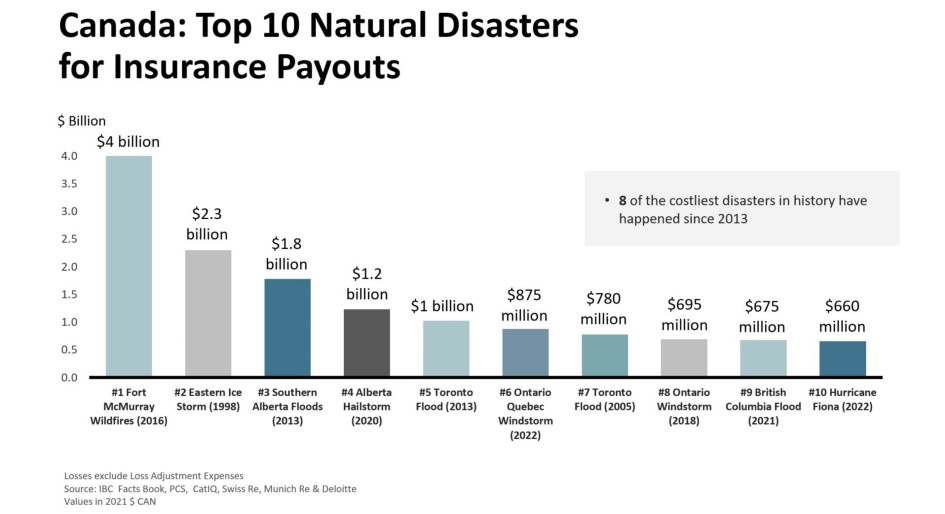
Hurricane Fiona is estimated to be the costliest extreme weather event ever recorded in Atlantic Canada at $660 million in insured damage.

The initial data comes from Catastrophe Indices and Quantification Inc, and also estimates the event was the tenth costliest in Canada– surpassing the 2011 Slave Lake wildfire. The storm first made landfall in Atlantic Canada on September 24, 2022.

With maximum wind gusts exceeding 100 km/h in Atlantic Canada and Eastern Quebec, Hurricane Fiona resulted in tragic loss of life as well as violent winds, torrential rainfall, large waves, storm surge, downed trees and widespread power outages.

Many affected residents were located in high-risk flood areas and floodplains where residential flood insurance coverage is not available. As a result,

More than $385 million was recorded in Nova Scotia alone, where power outages topped 415,000 customers in Nova Scotia on September, leaving about 80 per cent of the province without power.

“As we begin to see the extent of damages caused by Hurricane Fiona, it is clear that much more needs to be done to enhance our resilience to extreme weather events and build a culture of preparedness moving forward,” said Amanda Dean, vice-president, Atlantic, Insurance Bureau of Canada (IBC). “Climate change is real, and the fatalities, emotional turmoil and financial consequences we’ve witnessed must be a call to action – we must prioritize the protection of all Canadians from the impacts of climate change.”

Insurance claims from severe weather have more than quadrupled across Canada since 2008. The new normal for insured catastrophic damages in Canada has reached $2 billion annually. IBC continues to advocate for governments to act on the urgent need to do more to prioritize investments that build resilience and better protect families and communities from a changing climate.

IBC has put forward options to create a residential flood insurance program – including a public-private partnership model – that would make affordable insurance available to residents of high-risk areas, and also a national adaptation strategy, including a high-risk flood insurance pool, to address climate-related disasters.