




Articles Archive - Page 263 of 928 - REMINET
REMI

Ford government seeks to amend rental replacement bylaws

The Ford government is seeking to enact a “Minister’s regulation-making authority” to give ministers the ability to regulate bylaws related to the demolition and conversion of residential rental properties. Currently, rental replacement bylaws vary among municipalities and include requirements around number, size, type, and cost of rental units, as well as right of first refusal for existing tenants. Amended legislation under s.99.1 of the Municipal Act, 2001 (MA) and s.111 of City of Toronto Act, 2006 (COTA) would “bring consistency” and “streamline the construction and revitalization of new housing supply,” the government says.

“Legislative amendments to the above Acts are intended to streamline processes and speed up construction; they will not impact renter protections or requirements under the Residential Tenancies Act (RTA),” states the proposal. “Tenants who must vacate a unit for extensive renovations will retain all existing rights to return to the unit at the same rent and terms as though there were no interruption to the tenancy, and landlords would maintain the same obligations to inform tenants of this right and provide compensation to tenants as required by existing legislation.”

The proposal also points out that under the RTA, it remains an offence to evict a tenant so that major repairs or renovations can be made to the rental unit without compensating the tenant or offering them another acceptable place to live. Failure to offer a tenant the right of first refusal after major repairs or renovations or when the building is changed to a condominium also remains an offence.

The Ministry of Municipal Affairs and Housing is also considering new regulations under this proposed authority to standardize rules and requirements municipalities may include in their bylaws (e.g., those that may be negatively impacting housing construction or renter protections).

To inform the content of these potential regulations, the Ford government is seeking input in the following areas:

1. What types of requirements should municipalities be able to set around residential rental demolition and conversion?
2. What types of requirements should municipalities not be able to set (e.g., are there requirements that pose a barrier to creating new or renewed housing supply or limit access to housing)?
3. What impact do you think municipal rental replacement bylaws might have on the supply and construction of new housing?
4. What impact do you think municipal rental replacement bylaws might have on renter protections and access to housing?

If approved, the Minister’s regulation-making authority to standardize municipal rental replacement bylaws could directly affect municipalities that currently choose to have rental replacement bylaws. Work is currently underway to analyze possible administrative and other costs to impacted municipalities.

To join the conversation, visit Seeking Feedback on Municipal Rental Replacement By-Laws (ontariocanada.com). 
New air traffic control tower planned for Victoria

Construction of a new air traffic control tower at Victoria International Airport (YYJ) will begin in the spring of 2023 with completion expected in 2026.

The new energy efficient LEED certified tower will include a control cab with a 360-degree view of the airport and have the most modern air traffic management, communications, and aviation surveillance systems to ensure safety of operations.

With a height of six storeys and a total floor space of approximately 969m2, the new structure will stand several metres taller than the current tower, providing air traffic controllers with improved sight lines over the airfield.

“While the new tower will be equipped with state-of-the-art technology to safely and efficiently manage growing air traffic demand, it will also be LEED certified, which is an investment in energy efficiency and sustainability and demonstrates NAV CANADA’s commitment to its net-zero goal by 2050,” said Raymond G. Bohn, president and CEO, NAV CANADA.

NAV CANADA’s decision to replace the existing tower, built in 1958, was based on the need for an upgraded facility to better support airport and aircraft operations and future years of continued uninterrupted service in the area.

“We are pleased to see this new state of the art control tower being constructed at Victoria International Airport. Aviation is a critical industry for economic prosperity and this project will help facilitate continued growth in the region,” said Geoff Dickson, president and CEO, Victoria International Airport.

Employees of NAV CANADA will continue to work at the existing facility until construction is finalized, at which point air traffic control operations will transition to the new tower.

Repaired Highway 8 reconnects B.C. communities

Highway 8 between Merritt and Spences Bridge in B.C. is now open to all vehicle traffic, restoring connectivity to residents, Indigenous communities and the local forestry and mining industries.

“From the first day of the atmospheric river, people have gone above and beyond to help us to reach this important milestone,” said Rob Fleming, minister of transportation and infrastructure. “We all owe a huge debt of gratitude for the impressive work that crews and staff have done to reconnect the people and communities along Highway 8.”

November 2021’s heavy rains and flooding washed out more than 25 sections of the highway and rerouted some sections of the Nicola River, leading to the complete closure of the highway between Merritt and Spences Bridge. More than seven kilometres of Highway 8 was completely lost due to the event.

Numerous Thompson Nicola Regional District residences, as well as Nooaitch, Shackan and Cook’s Ferry First Nations communities, were isolated. Reopening Highway 8 reconnects rural communities, allows residents to return home and improves transportation access for various sectors, such as forestry, mining and ranching.

“The International Union of Operating Engineers Local 115 is proud of the work that has been done by our members in getting Highway 8 reopened,” said Brian Cochrane, business manager, IUOE Local 115. “We’re committed to rebuilding the province’s highways and to supporting the local and First Nations communities on all of our projects.”

In the past year, ministry staff, crews and local Indigenous communities worked together to make considerable progress on Highway 8 with temporary repairs. This included partnering with Indigenous community-partnered contractors to deliver repairs, while maintaining a workforce that is more than 30 per cent Indigenous.

While temporary repairs are complete, the highway remains an active construction zone. Crews continue to install roadside barriers, place riprap (large rocks) to stabilize road embankments and process rock to undertake permanent repairs along the corridor.

Alberta Premier issues mandate letters addressing affordability

Alberta Premier Danielle Smith has issued mandate letters to multiple government ministers tasked with addressing the effects of the affordability crisis. The letters outline specific actions the Alberta government will take to help Albertans deal with the national inflation crisis, improve quality of life and increase supports for families, seniors and vulnerable Albertans.

“Alberta’s economy remains strong, but many middle- and lower-income families, seniors and vulnerable Albertans are struggling to even heat their homes and feed their families,” Smith said. “With these mandate letters, our message to Albertans is clear: help is on the way. Our government has Albertans’ backs, and we will take decisive action now and in the coming weeks and months to help our fellow Albertans manage through this storm.”

Mandate letters were issued to the ministers of Affordability and Utilities, Children’s Services, Culture, Education, Municipal Affairs, and Seniors, Community and Social Services

Key actions outlined include:

  • Ensuring income supports, such as AISH and the seniors benefit are adjusted for inflation.
  • Development of targeted inflation relief measures to address affordability and cost-of-living concerns for families, seniors and others hit hardest by the inflation crisis.
  • Actions to immediately address the cost of utility payments, including a review of Alberta’s electricity pricing system.
  • Continued work with the federal government to increase the affordability and availability of child care.
  • Continuing to address gaps in mental health and wellness support for our youth.

“Affordability and the inflation crisis are top of mind for Albertans, and as these mandate letters show, they are also top of mind for the Alberta government,” she said. “I have tasked ministers to provide real relief to Albertans whose budgets are stretched thin. I know we can get through this inflation and affordability crisis if we work together.”

Additional mandate letters will be issued over the next week in three remaining tranches addressing the issues of health and skilled labour, standing up for Alberta and growing the economy, and Alberta Advantage. They will address in detail Premier Smith’s commitments to addressing challenges in health care, job creation and diversifying Alberta’s economy, and to protecting Albertans against continued federal government overreach.

Work starts on North Vancouver Phibbs Exchange

Construction has started on a major upgrade of the Phibbs Exchange in North Vancouver that will increase capacity, enhance safety and security, improve active transportation connections and support the evolution of transit service on the North Shore for decades to come.

“The Government of Canada is committed to supporting projects that connect our communities. Investing in public transit infrastructure facilitates convenient, inclusive and sustainable public transportation. Once complete, the major upgrade of the Phibbs Exchange will improve transit in North Vancouver and help more British Columbians get to where they need to go as safely and efficiently as possible,” said Johnathon Wilkinson, federal minister of Natural Resources and MP for North Vancouver.

The $32-million Phibbs project includes 12 new bus bays to accommodate the community’s current and future transit needs, including additional space for articulated (accordion) buses. The project will also ensure that the Phibbs Exchange is compatible with RapidBus service to meet the needs of the growing North Shore community.

The improved exchange will feature safer pedestrian and cycling accessways, better lighting and signage, and enhanced road infrastructure with new drainage facilities and on-site rain gardens. Commuters and transit employees will also benefit from two new buildings – a snack bar and a transit operator rest station.

“Providing a safer and better-equipped exchange point for those taking transit around the North Shore is a good step towards addressing our challenging transportation needs,” said Mike Little, mayor of the District of North Vancouver. “Phibbs Exchange is one of the most critical transit hubs in our community, so these much-needed upgrades are welcome additions.”

The first six months of construction will be focused on relocating existing transit needs. Full construction is expected to begin in the spring 2023.

The project was awarded to Conwest Contracting Ltd. in September.

Martin Nielsen awarded UBC medal of distinction

Dialog partner Martin Nielsen has been awarded the 2022 Dean’s Medal of Distinction from the Faculty of Applied Sciences at the University of British Columbia (UBC).

Presented during the 2022 Applied Sciences Celebration, eight esteemed members of the Faculty of Applied Sciences community were honoured for their unwavering contributions in their respective fields, in service to the betterment of broader society.

As a double Applied Science alumnus and member of both UBC Engineering and the School of Architecture and Landscape Architecture communities, Nielsen was bestowed this high honour in recognition of his ongoing commitment to creating innovative and sustainable design solutions for the many challenges facing our world today. His work as a registered architect and mechanical engineer transcends disciplines to achieve socially, economically, and environmentally responsible outcomes, building upon an award-winning portfolio of work.

This includes the LEED Gold certified Campus Energy Centre at UBC and the new Exchange Residence and UBC Bus Exchange. He was also lead on Heather Lands, an urban design and rezoning project of a 21-acre site, centrally located in Vancouver, on unceded traditional territories of the Musqueam, Squamish, Tsleil-Waututh Nations (MST). The project is rooted in the processes of reconciliation and is an unprecedented joint venture partnership between Canada Lands Company and the MST Development Corporation.

In addition to his project work, he has served as chair of the UBC Advisory Urban Design Panel and as a member of the UBC Land Use Committee. He is currently a board member of Habitat for Humanity Greater Vancouver and the Canada Green Building Council (CaGBC) and has served as chair on the City of Vancouver Urban Design Panel.

Canadians rank affordable housing as top issue

Canadians rank affordable housing as the third most important issue facing Canada today, behind inflation and healthcare. In The Habitat for Humanity Canada Affordable Housing Survey, almost all Canadians (96 per cent) said their cost of living has increased this past year and four-in-five Canadians (78 per cent) are worried about having to spend less on food, savings, transportation costs, and/or debt payments to continue to afford their current housing.

“This survey underscores how deeply concerned Canadians are about their housing situations and futures as affordable housing becomes increasingly out of reach,” says Julia Deans, President and CEO of Habitat for Humanity Canada. “To address these growing concerns and make affordable housing and homeownership a reality for all Canadians, we need an all-in approach from non-profits, businesses, individuals and all levels of government.”

Some key findings show that 40 per cent of Canadians are concerned about paying their mortgage or rent over the next 12 months. Gen Zs (51 per cent) and Millennials (52 per cent) more than twice as likely to be concerned about this issue compared to Boomers (23 per cent).

Almost three-in-ten Canadians (28 per cent) cannot currently afford a down payment of any amount towards a home, while 27 per cent are feeling pessimistic about whether much can be done to deal with Canada’s housing problems. A negative outlook figures higher among Millennials.

Lack of housing supply seen as greatest contributor to affordability crisis

Nine-in-ten Canadians believe that there is a shortage of affordable housing in Canada and four-in-ten see lack of supply as one of the greatest contributors to making housing less affordable, ahead of foreign buyers (40 per cent), and investment firms buying homes (36 per cent).

NIMBY and discrimination: additional barriers to affordable housing

Half of Canadians feel that NIMBY sentiment is one of the main barriers to making affordable housing available in neighbourhoods, yet 71 per cent of Canadians agreed with the statement that ‘people worry about the impact of affordable housing on their property values and neighbourhood’.

One-in-ten Canadians (11 per cent) have experienced racism, sexism, and/or other discrimination during their pursuit of housing, with BIPOC Canadians being more than twice as likely as non-BIPOC Canadians to have experienced discrimination (18 per cent vs. 8 per cent).

Canadians want an affordable place to call home

Three-quarters of Canadians (75 per cent) believe that more affordable housing could solve social issues. Despite the growing concerns and barriers to homeownership, the majority of Canadians (87 per cent) agreed that owning a home can create more stability in one’s life.

Furthermore, 60 per cent of Canadians surveyed agreed that homeownership can improve educational opportunities for themselves and their families and 73 per cent agreed that homeownership can strengthen ties to their community.

“In our work, we see firsthand how access to stable housing transforms futures and fosters resiliency across generations,” says Deans. “We must act now, and we must act together towards addressing the systemic barriers and creating sustainable solutions to achieve affordable housing for all.”

To read more of the survey, visit: https://habitat.ca/en/news/housingsurvey

Photo by Oleksandr Pidvalnyi

Supporting your janitorial staff is important for your business

Cleaning and sanitizing have been centre stage in recent years, and it’s taken its toll on cleaners.  According to a recent study, 80 per cent of professional cleaners are feeling more pressure to clean and disinfect public places, and with 48 per cent of the public doubting that cleaners are able to protect them from germs, a real disconnect exists between what “clean” looks like.

Your janitorial staff needs your support and taking just a few simple steps could make a real difference for your team and your business.

RELATED: Setting your janitors up for success

Make public partnerships

Your staff can’t be everywhere at all times, so improve public perception by making sure that things like windows and counters are always clean. If you haven’t already upgraded, consider adding touchless technology for less maintenance and increased sanitization.

Also, get your visitors to help out. Consumers want sanitization and safety, and they’re willing to work for it. In fact, 70 per cent of people surveyed think they share with cleaning staff the responsibility of keeping public spaces clean.

Make it easy for guests to do their part and lighten the load on your team by providing wipes, hand sanitizer, and signage instructing them on the safest practices.

Stay up to date

With all the changes in the last few years, retraining your team is a great way to connect, boost confidence, and make sure everyone is on the same page.

Studies show that 75 per cent of people say that strong workplace training would highly impact their decision to stay at a company. Investing in your team means investing in your business by decreasing turnover and showing your staff that they are worth the time and money to keep them learning and up to date.

Listen to your team

Often the janitorial team works a solitary shift, after hours. You may not know if they have concerns, need supplies, or are understaffed. Staying in touch and keeping your team happy is the key to productivity, loyalty, and retention, so listening should be priority number one.

With all the changes in the last few years, your janitorial staff has been through a lot, from changing protocols to shifting public perception to heightened performance pressure. Put your team first by sharing the workload, keeping them informed, and making them top of mind for happy staff and a growing business.

Dr. Steve Gupta appointed to Order of Ontario

Dr. Steve Gupta, executive chairman of The Gupta Group, was appointed to the 2021 Order of Ontario on November 4.

This is the province’s highest civilian honour, awarded to an Ontarian who has shown the highest level of excellence and achievement in any field, and whose impact has left a lasting legacy in the province, in Canada, and around the world.

Dr. Gupta immigrated to Ontario from India in 1971 with just $108 in his pocket and he is now recognized as a leader in the hospitality and condominium industries.

“It is an incredible honour to be appointed to the 2021 Order of Ontario and recognized in this
way, he said. “When we immigrated here in 1971, I wanted to provide more for my family and am humbled to have played a part, however small, in also helping Ontario communities grow.”

Over the last 40 years, he invested in and developed communities across Ontario for millions of citizens. He started by purchasing a single highway car and truck stop in Port Hope in 1978. Since then, he has built The Gupta Group, an award-winning organization with 25 hotels and counting across Ontario and Quebec, two high-rise residential properties and one commercial property and five more high-rise residential projects under development.

He developed many prominent projects that have led to thousands of jobs created in
Ontario. From 1981 to 1996 when Dr. Gupta developed several projects in Port Hope, the
town’s population grew by over 50 per cent. The Gupta Group’s 25 hotels and
counting have also directly uplifted tourism for core communities across Ontario.

“I have watched my father, since my early childhood years, work so hard to build up The Gupta Group from one gas station in Port Hope to what it is today. He is an inspiration, a mentor, and a true example of humble excellence,” said Reetu Gupta, chairwoman and ambassadress of The Gupta Group.

Aside from these achievements, Dr. Gupta made it his personal mandate to lead philanthropic
initiatives around the globe. He built Eye Camps in rural India, where over 50,000 patients have been treated for eye disease, given life-changing surgeries, and more. He helped Gujarat after the devastating earthquake and built sanitation systems for girls’ schools.

He also has supported the Toronto International Film Festival for over a decade through sponsoring the Steve and Rashmi Gupta box office. He has also sat on numerous governing boards including Centenary Hospital/Rouge Valley Health System, Ontario College of Pharmacists, and the University of Toronto, to name a select few.

Dr. Gupta has received dozens of other awards and honours including the Skills of Change
Entrepreneurship Excellence Award, the Transformation Institute’s Innovation Award, RBC’s
Top 25 Canadian Immigrant Award, and Ernst & Young’s Entrepreneur of the Year Award for
Ontario (Real Estate and Hotels). He is also a recipient of the Queen’s Diamond Jubilee and
Gold Medal, in addition to receiving the prestigious Doctor of Laws honoris causa from Ryerson University.


ACEC announces winners of engineering awards

The Association of Consulting Engineering Companies – Canada (ACEC-Canada) handed out the 54th annual Canadian Consulting Engineering Awards at a celebration in Ottawa, that included five Special Achievement Awards, singled out from the 20 Award of Excellence winners.

The awards honour outstanding achievements in the consulting engineering industry and highlight the important work consulting engineers do in communities across Canada and the world.

The top prize, the Schreyer Award, went to Stantec for the Calgary International Airport East Deicing Apron. Stantec also received Awards of Excellence for its Inclusion, Diversity, & Equity Program, and the firm’s work on Ottawa’s Combined Sewage Storage Tunnel.

Special awards were given to four other projects:

  • The Engineering a Better Canada Award – Hedgehog Technologies for the Fort Severn First Nation Solar Array in Northern Ontario.
  • The Tree for Life Award – Associated Engineering (AE) for Phase 1 of the Blatchford District Energy System in Edmonton.
  • Ambassador Award – AECOM for the Gordie Howe International Bridge Environmental Management Program; and Entuitive, for the Buddy Holly Hall of Performing Arts and Sciences in Lubbock, Texas.

Three Vancouver based projects were the recipients of this year’s Awards of Excellence:

  • Fast + Epp Home Office – Fast + Epp
  • Highway 1 Keith Road / Mt Seymour Parkway Interchange – McElhanney Ltd.
  • St. Andrew’s Wesley United Church Heritage Conservation & Seismic Upgrade – RJC Engineers.

“By pushing boundaries and delivering ground-breaking solutions to the problems we face, these consulting engineering firms are paving the way forward in the field of engineering,” said John Gamble, president and CEO of ACEC. “Consulting engineers have the remarkable opportunity and responsibility of shaping Canada’s future. Their work greatly contributes to a growing economy and thriving neighbourhoods in every corner of this country – as celebrated ACEC members, this year’s award winners are doing just that. Their achievements are a testament to their unparalleled ingenuity, as well as their dedication to building stronger and more sustainable communities.”

How to prepare your landscaping for winter

Do you have landscaping you need to protect over the winter months? With the wind, snow accumulation, and dry, icy temperatures, winter can take its toll on your garden and landscaping. Now’s the time to prepare your lawn, shrubs, and trees for winter’s arrival.

RELATED: Building a fall facility maintenance checklist that ticks all the boxes

There are a few key things you can do to save your landscaping and encourage its survival for spring.

Looking after your lawn

First, cut your grass short and remove any leaves or debris. It might be tempting to leave these to compost under the snow, but they can cause mould or fungal disease if left through the winter.

You can get a headstart on spring by applying a winterizing fertilizer to your lawn before winter comes. It’s the perfect time to apply it because fall’s morning dew helps the lawn to absorb it faster, encouraging the grass to grow more stamina to survive the winter.

Setting your shrubs up for success

Wrapping delicate shrubs and hedges will help protect them against wind and heavy snow or ice. Use a breathable material like burlap so they don’t get smothered. You might also want to install temporary snow fencing to help keep snow drifts away from the bottom of your bushes. This will provide a barrier for your landscaping from blowing snow.

As the weather changes and their food supply becomes scarce, deer, rabbits, mice, and more may also be an issue. If this is a risk in your area, install deer netting or use a spray to keep your shrubs from becoming food. You may also want to wrap the bottom 60cm  of your shrubs or trees to protect the bark and discourage attention from wildlife.

Taking care of your trees

Ensuring that your trees are well-watered in the fall will help to keep those roots strong and the soil from drying out throughout the winter. While snow at the base of your tree will keep it insulated, it isn’t guaranteed consistently. Prepare your trees by adding mulch to the base to moderate soil temperature, keep the soil moist, and prevent the roots from freezing.

Winter’s conditions can be tough on your landscaping, so you want to prepare it as much as you can to eliminate issues in the winter and additional expenses for your property in the spring.

New health centre to be named after philanthropist

A new Vancouver integrated community health centre located at 58 West Hastings will be named after one of the city’s most community-minded and generous philanthropists, Lily Lee.

Once complete, the Lily Lee Community Health Centre will be a 50,000-square-foot integrated health centre operated by Vancouver Coastal Health (VCH). It will provide critical resources and accessible health care to support the unique needs of the Chinatown and DTES residents, including access to specialized mental health and addiction care. The new centre will be purpose-built with culturally safe facilities and services to support all neighbourhood residents.

“After my graduation from the School of Nursing at UBC, my early days of working as a public health nurse in Strathcona created my passion for community health care. I believe this new health centre will have a tremendous impact in these unique neighbourhoods, and I am so happy to put my support behind it,” said Lee.

Neighbouring Vancouver’s Chinatown, 58 West Hastings is a 10-storey community-oriented social housing and health centre led by the Vancouver Chinatown Foundation. The innovative project will provide 230 new units and brings together multiple levels of government support, including BC Housing and Canada Mortgage and Housing Corporation and $30 million from the Chinatown Foundation.

“This centre will provide much needed community-centred health care in the Downtown Eastside,” says Angela Chapman, president & CEO, VGH & UBC Hospital Foundation. “The Lee family has championed many community-focused initiatives that impact lives in Vancouver every day. Our Foundation is proud to be associated with the 58 West Hastings project and hopeful for the impact this facility will have on the neighbourhood.”

Lee and her late husband, Robert Lee, are prominent Vancouver philanthropists who feel strongly about championing building healthy communities and important causes in the city that means so much to them. “Once open, the proposed Lily Lee Community Health Centre Hastings will immediately have its impacts felt across these diverse neighbourhoods,” said Carol Lee, chair of the Chinatown Foundation. “With the generosity of my mother, Lily, and in combination with support from multiple levels of government, this is an important moment for the Chinatown Foundation as we work to revitalize these neighbourhoods. And that starts with the health of the residents of these communities.”


ECABC announces new chair and president

The Electrical Contractors Association of BC (ECABC) has appointed Derek Fettback as its new chair and confirmed its board of directors for 2023.

Fettback is the vice-president of Western Pacific Enterprises Ltd. (WPE) and will serve as chair for a two-year term. He has served on the ECABC board since 2018 and most recently held the position of first vice chair.

Fettback joined WPE in 1997 as an apprentice and has established a career managing a diverse set of commercial, industrial, and utilities projects. Currently, he is responsible for the several districts within WPE, as well as Western Pacific’s central estimating for projects between British Columbia and Manitoba.

ECABC’s 10-person board possess significant experience, with nine of the members having previously served on the ECABC board of directors.

ECABC also welcomed Matt MacInnis as its new president in September 2022. He takes over from long-time president Deborah Cahill, who served for 14 years and was inducted into the ECABC Hall of Fame in October.

MacInnis most recently served as the vice president, communications for the Mining Association of British Columbia. He previously worked as vice president for a public relations firm, providing communications services to a diverse group of clients including ECABC. MacInnis also has experience working in the BC Legislature and for local and digital media outlets.

“I am very excited to join the great team at ECABC and spend time with our members to learn more about their priorities and how the association can best support them,” said MacInnis. “I believe it’s important that we recognize the critical role of electrical contractors in supporting key priorities of British Columbians. From building homes, to maintaining and repairing power lines, to installing electric vehicle charging stations, electrical contractors are supporting efforts to meet our climate change targets and address the housing crisis.”

A challenging heritage restoration

A heritage 1914 building in Vancouver has been given renewed life thanks to an extensive exterior restoration.

The Heritage Hall, an iconic landmark in the Mount Pleasant neighbourhood, is a three-storey building known for its elegant architecture and clock tower. The successful roof replacement and envelope seismic upgrade by Scott Construction ensures the building will continue to serve the community for many years.

Work began in August 2020 with the project awarded as part of a Master Service Agreement (MSA) between Scott Special Projects and City of Vancouver.

The scope of work included removal of existing asbestos tile roof; extensive upgrades on underlying wood frame; and installation of a new slate roof to match original construction. Original copper finials, roof tops, curbs and gutters were replaced with new copper flashing custom-made to replicate the original installation. Brick and stone masonry work was anchored, re-pointed, and repaired to achieve seismic requirements. The project was substantially completed in March 2022.

“The project is a piece of history and we strive on the challenge to bring these structures back to life.  We are honoured to be recognized for this project because of many different factors,” says Darin Hughes, president, Scott Construction. “First off is the innovative delivery model under our MSA agreement with the City Vancouver which helped us work through the early design related sequencing and value engineering. Through the commitments of our subtrade partners, who are true experts at their craft, this great project was able to be realized.”

Victoria’s Grist Slate & Tile removed asbestos-containing shingles and copper flashings from the circa-1914 roof and replaced them with new North Country natural quarried slates installed in a diamond pattern to replicate the original roof. Additional scope included replacement of the three tower caps with decorative and ornate 20-ounce copper anthemion leaves and finials, as well as replacement of the two main decorative copper finials.

Challenges included pandemic related labour and supply chain issues; ensuring scaffold safety; managing hazardous building materials and a tight site.

The project received two VRCA Gold Awards and two Heritage Awards for both Scott Construction and Grist Slate & Tile.

“We would like to thank the VRCA, City of Vancouver, and our entire subtrade teams for the Gold Awards and look forward to continuing to bring back these great buildings,” says Hughes.


Cheryl Mah is managing editor of Construction Business. Read about more VRCA members in the Nov/Dec issue of Construction Business.

Robots gain momentum for commercial floor cleaning

In recent years, we’ve mostly heard about touchless technology dominating commercial cleaning, with things like traffic counters, automatic dispensers, sensored doors, and more, but part of being a ”smart” building may mean adding robots to your cleaning practices. In fact, experts predict the robot cleaning market to jump 21.5 per cent by 2027, making it something facilities may want to include in their upcoming equipment budgets.

RELATED: Upgrade your facility with 2022’s biggest technology trends

While sanitation has been predominantly prioritized recently, there are other important issues to address. “We are quickly learning that robotics is not replacing, but filling a gap in staffing needs,” explains Brian Cobb, chief innovative officer at CVG Airport Authority.

One of the important ways these autonomous floor cleaners could help your business is by operating during off-hours when your facility is closed and your employees are off shift. This could improve your productivity during the day, without adding to your labour costs.

They may also be faster, cleaning a large area more quickly than it would take one or two of your staff. If a spill occurs, it means less time for a production slowdown, as workers can resume their duties in that area sooner.

According to Indeed, the average base salary for a cleaning job in Canada is $17.92 per hour. In today’s market, candidates may be difficult to find – and to keep. Robotics can also help with employee turnover, also called churn, which refers to the cost for a company to replace and retrain custodial team members.

In short, technology and innovation are a part of every industry and as a facility owner or manager, you need to look at the big picture. Consider whether cleaning robots could save you time and money, increase efficiency, and allow better allocation for your staff to benefit your facility in the long run.

Tarion releases radon protection tips for homeowners

Radon exposure is estimated to be the cause of 16 per cent of lung cancers in Canada. People who live in buildings with high radon levels, or spend a lot of time in them, face the highest risk.

The invisible, odourless gas that can seep into homes through cracks in floors, walls and foundations. People cannot see, smell or taste the gas, but as it quickly decays, it gives off tiny radioactive particles. When inhaled the particles can damage cells that line the lung.

Last year, findings from a three-year-long Canada-wide citizen science initiative found that radon levels consistently eclipse provincial and national estimates. Dangerous levels of the cancer-causing gas are much more common that what Health Canada determined more than 10 years ago.

November is Radon Action Month. Tarion, the not-for-profit consumer protection organization that administers Ontario’s new home warranty program, is raising awareness of the dangers of excessive exposure in new homes. Here are some tips and commonly asked questions about testing:

1. When is the best time to test for radon?
Fall and winter are the best seasons to test your home for radon because they will provide the most accurate reading for how high radon levels in your home can get. During these colder months, we reduce the air flow through our homes by keeping windows closed, thus allowing radon concentrations to build up inside. As a result, November is the perfect time to start thinking about how you can take action on the potential hazards of radon in your home.

2. How do I conduct a test?
There are a few options to choose from. You can buy a do-it-yourself test kit at your local hardware or home improvement store. Another option is to check in with your local library (yes, you read that right). Many libraries across the province allow you to borrow radon detectors. Finally, if you prefer to hire a professional to conduct the test for you, make sure they are certified by the Canadian National Radon Proficiency Program.

3. Do I need to test even if I own a new home?
The simple answer is Yes. Since radon has more to do with the soil beneath your home than your home’s age, you should consider testing your new home as soon as you can to determine if it is prone to high radon levels. The good news is that many new homes include rough-ins for radon mitigation systems, which will make things a lot easier if you need to reduce radon levels.

4. What if my results are above the Health Canada guideline?
If your radon levels are above Health Canada’s guideline of 200 becquerels per cubic metre, you should take action to reduce it as soon as possible. Fortunately, radon mitigation services are easy to find and are not very expensive. If your home is less than seven years old, radon mitigation is covered for up to $50,000 by the new home warranty. Click here to learn more about how you can get warranty assistance for elevated radon levels.

5. What if my radon levels are low?
If your radon levels come in below Health Canada’s guideline of 200 becquerels per cubic metre, you don’t need to take actions to reduce it. However, you should continue to monitor them, as they can change over time. Experts recommend testing again after about five years.

If you want to learn more about how you can take action, visit takeactiononradon.ca.


Canadian Certification Program for renters and property managers unveiled in Edmonton and Northern Alberta

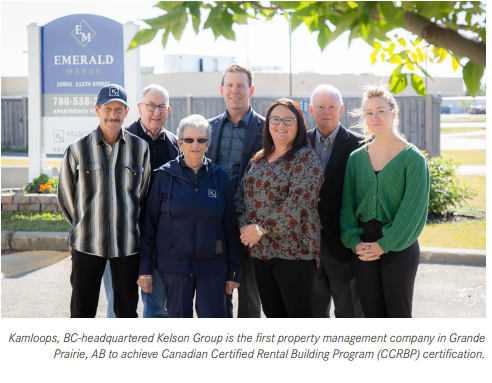
This September, Kelson Group became the first property management company in Edmonton and Northern Alberta to have its multifamily apartment buildings recognized under the Canadian Certified Rental Building Program (CCRBP); specifically, its buildings in Edmonton, Leduc, Sherwood Park, and Grande Prairie, AB.

The Kelson Group celebrated its first CCRB-designated buildings in BC in 2016, shortly after the program expanded to BC in 2015. Kelson Group President Jason Fawcett says its newest certified properties in Alberta represent a win-win for its apartment renters and all property management companies, noting, “Our objective with the national CCRBP-approved apartment building program is to provide Edmonton, Sherwood Park, Leduc, and Grande Prairie renters with the peace of mind and a clear quality assurance alternative when selecting their rental apartment home.”

CCRBP is North America’s first quality assurance program that specifically promotes and acknowledges quality for rental housing consumers, as well as professionalism for multifamily property managers and their staff. The program is a huge game-changer when it comes to the rental industry in Canada. Apartment shoppers who choose a CCRBP building enjoy enhanced peace of mind, knowing that their apartment community meets defined standards for quality and service.

In short, says Ted Whitehead, CCRBP Certification Director, “The designation means tenants can rent with confidence. With the added impetus of an increasing number of multifamily companies adopting Environmental, Social, and Governance (ESG) as a strategic business imperative, we expect that over the next 18 months this program will help build a national network of professional multifamily property managers whose focus will go far beyond financial measures to incorporate factors measuring the sustainability and ethical impacts of their investment.”

For a multifamily apartment building to qualify as a Canadian Certified Rental Building, it must meet five mandatory requirements:



  • Abide by the Program’s Member Code of Conduct
  • Adhere to the Program’s Mandatory Standards of Practice
  • Successfully comply with a mandatory third-party audit process
  • Have identified staff successfully complete the program’s training and education
    component.
  • Agree to market and identify their building as a Canadian Certified Rental Building to prospective tenants.

“We are happy to have our members participate in this important ‘for-renters’ initiative,” said Donna Monkhouse, Executive Director of the Albert Residential Landlord Association (ARLA).

At the heart of the Canadian Certified Rental Building Program are 54 standards of practice and associated requirements to which all organizations and buildings must adhere. These requirements translate the concepts of environmental, social and governance into concrete measures that focus on environmental and social responsibility and enhanced corporate accountability.

“We want renters to recognize that ARLA landlords care about their renters and the buildings in which they live,” Monkhouse adds.