Articles Archive - Page 258 of 928 - REMINET
REMI

The new employee monitoring policy

Ontario has taken the lead in terms of enhancing employer transparency in the workplace by introducing legislation requiring employers with 25 or more employees (as of January 1, 2022) to have an electronic monitoring policy. Bill 88, the Working for Workers Act 2022 became law in April and requires employers to be transparent about how they monitor their employees’ use of devices such as computers, cell phones and GPSs.

While the deadline to prepare the policy was October 11, 2022, it is better late than never to get an electronic monitoring policy in place. Once drafted, the policy must be presented to employees within 30 days.

I don’t even know if or what we’re monitoring

The introduction of this new bill has been an eye-opener for many employers who were previously unaware of it or how electronic monitoring was taking place in their workplace. A helpful tip to get you started is to consult your IT department or IT provider and ask them to create a list of the hardware and software that could be monitoring your employees. This may unearth some overkill monitoring and data collection – passive and unintentional, or otherwise.

What can employers monitor?

Employers can use monitoring programs that track the websites that employees visit (even when in private browsing mode), apps they’re using, inter-office chat groups, work email, work calendars, social media activity, as well as the amount of time spent doing each of these. Hardware such as GPS installed in company vehicles are also likely to be electronically monitoring employees.

The reality is that most employers are busy running their businesses and are not bothered with especially intrusive electronic monitoring measures, like reviewing data from programs that count an employee’s keystrokes in a day.

However, if needed, employers are permitted to monitor to confirm an employee’s work and whereabouts, and whether they may be doing something that violates company policy or requires further investigation.

The new legislation does not increase employee privacy rights. Rather, it creates an employer obligation of transparency: employers must now outline what electronic monitoring will occur and how the information may be used.

Policy requirements

As always, to reduce the risk of constructive dismissal or privacy-related claims, employers need to ensure that their monitoring is reasonable under the circumstances and necessary for employment-related purposes (e.g., workplace safety and security, protection of confidential and proprietary information, attendance and performance management, etc.). To meet the transparency requirements of the policy, the ‘what, how and why’ of electronic monitoring practices must be set out in the electronic monitoring policy.

At a minimum, an electronic monitoring policy must set out:

  • whether the employer monitors employees’ electronic devices;
  • how and in what circumstances the employer may monitor employees;
  • the purposes for which information obtained through electronic monitoring will be used by the employer; and
  • the date the employer prepared the policy and, if updated, the date of any policy changes.

Without identifying your clear purpose in collecting the data, you may run into some legal difficulties should you try to rely on the data for reasons other than what is stated in your policy. If, for example, you are collecting data for the sole purpose of discipline, say so. Otherwise, you risk not being able to rely on what you learn from the data when you need to actually discipline your employee.

Finding a balance

Employers are required to identify every way they are electronically monitoring employees and how they might use the data collected. Therefore, they should think carefully about keeping programs around that are overdoing it when it comes to the sort of data and monitoring the program is doing.

If employers take a purposeful and practical approach and limit their monitoring to only what is necessary and reasonable (and effective), it is more likely to be accepted by employees. Be very clear about how the collected data will be used. If, for example, the program is only essential for legitimate business reasons and there are no plans on using it for reasons that are very scary to employees (i.e. discipline and termination), be sure to say so – this will help in keeping workers calmer and happier.

Assuming that the loss of employee privacy is proportionate to the benefit gained, and there was no less intrusive method of gathering the information, then all should be fine.

Drafting the policy

After compiling a list of how employees are being electronically monitored, turn your attention to drafting the policy. For example, if company cars have GPS systems that are electronically monitoring employees, the policy should state, at a minimum, the following:

1. The company is electronically monitoring;

2. GPS trackers installed in company cars are tracking employee movements throughout the day; and

3. The data collected from the GPS systems is being used to ensure employee safety and compliance with company policies and procedures.

Finally, don’t forget to date the policy and note the date of any updates to the policy. This policy is all about transparency so listing only some of the ways or a few examples of how employees are being electronically monitored won’t cut it.

A key goal of any properly implemented and reasonable electronic monitoring policy should be to deter unauthorized workplace conduct, not to create a gotcha moment. Aren’t we all on our best behaviour if we know we might be watched?

Tiffany Thomas is a lawyer at SpringLaw, a virtual law firm practicing exclusively in the areas of employment, labour and human rights law. Tiffany works with both employers and employees to resolve their workplace issues. She can be reached at [email protected]. www.springlaw.ca

Maintaining healthy contractor relationships

It has been a disastrous year when it comes to completing projects and any type of construction within the condominium industry. Frustrations and anxiety are running at an all-time high. The first target for these unprecedented challenges is usually the contractor, who often bears the responsibility of providing qualified staff and ensuring deliverables of materials/repairs on time.

Labour and material shortages have put strain on the construction and maintenance industries, which have undoubtedly altered how any type of work can be managed. How do we labour through these challenges and maintain healthy working relationships with the contractors who are working extra harder with fewer staff, while facing higher costs?

Manage expectations

The condo industry expectations must always be moderated to reflect reality, and COVID has effectively rewritten the book on what is currently reasonable. Construction and project planning, now more so than ever, must assign realistic expectations of scheduling and staging to meet contractor and material availability.

Communicate with the contractor ahead of time to determine reasonably possible deliverables and document it. Advise the board and other involved stakeholders of the proposed and reasonably possible times to deliver the project to its completion. If materials are available for a higher premium but shorter delivery time, present this option to the decision makers.

It is notably important to weigh the cost benefit analysis and assess the risks. If a project schedule is poorly planned, the strain that will be put on the owners, contractors, and all the employees involved in the project will often lead to poor results.

Listen and seek to understand

Due to the close quarters and enclosed workspaces they frequently share with their coworkers, contractors, resultantly, face significant mental stress. The stress level has increased because of worries about their health and what they might contract and spread whether it is COVID or other respiratory illnesses.

Additionally, the anxiety concerning the increased costs, uncertainty of materials’ deliverables and staff retention have caused contractors much toil. Aging workforce and lower trades participation rates are also significant contributory factors. Listen to these concerns and plan accordingly. As a project manager or condominium manager, it is imperative to maintain that two-way communication.

By paying attention to the contractor, you will frequently make them feel valued, and they will be much more likely to inform you of any problems before they get worse. For the contractor, it is crucial to be forthcoming and upfront about the aforementioned challenges of staff members. It is irresponsible to assign blame solely on COVID or shortages and take advantage of the present times. Look for alternatives and if unsuccessful, communicate these outcomes to client.

Involve an expert

More than ever, boards and management are looking to project management firms or engineering consultants for help in managing construction projects. These experts enforce the contractor’s legal responsibilities, including ensuring that the work is finished and that it is managed to represent the status of the project.

Having a project manager or consultant also assists boards and management in adhering to various legislation when it comes to projects. Having a designated professional lead the project reduces the number of people the contractor has to report to on the progress and completion of the work. This creates checks and balances during the project. One of the condo manager’s or project manager’s duties, if assigned, is to address schedule and workmanship issues through documented communications and progress/site meetings involving all the necessary parties.

Ensure that the regular and minuted meetings occur to report on the progress and document the intricacies of the project. Ensure that the copies of these reports are delivered promptly and accurately. Some of the challenges that the contractors face are incomplete details and information received from the client.

Ensure that you are providing them with all the necessary details involving the project and be available to answer any queries. Delays in communication can transcend into delays in providing solutions.

Remain not just available but also valuable

One of the key ingredients to maintaining healthy relationships with contractors is to maintain the collective approach that you are working with them. Include the contractor early in the design phase, think about a design-build strategy, and create a cooperative atmosphere with your suppliers and tradespeople.

For the contractor, ask questions to obtain as many details as possible. Offer advice and expertise with concrete examples and solutions and guide the client through the challenging times. Gaining a client’s trust is easy when you walk them through the procedures and are transparent and honest about how adjustments will affect the cost and schedule for construction. Create long-term value in providing these turnkey solutions.

Val Khomenko is a Regional Condominium Manager with ICON Property Management Ltd. based in Toronto, Ontario, providing condominium management services in the Greater Toronto Area. Val can be reached at [email protected]

Michael Hensen is Vice President in the Central Region for IRC Buildings Sciences Group, A Rimkus Company. Mr. Hensen is a professional engineer a Registered Roof Consultant (IIBEC) and is the Practice Leader for building enclosure, roofing, waterproofing and technical leader for the company’s corporate sustainability engineering initiatives.

Have you implemented your harassment rules and policies?

When we first think of condo living, images of Disney’s Snow White and the Seven Dwarfs come to mind. The birds are chirping, the landscaping looks great, the air smells fresh and everyone lives harmoniously under one roof. However, the reality of condo living sometimes turns into a scene from the 1980’s movie the “Burbs,” where communal living is not so ideal.

Unfortunately, over the last couple of years, we have seen an increasing trend of unacceptable behaviour within condo communities, directed at property managers, directors, other owners/residents and even contractors. As a result, condo corporations are beginning to implement harassment rules and policies and seek legal advice on how to handle these difficult situations.

As condo communities are not only places where people live but also workplaces for many, even if the condo itself does not have employees, it is important to address this unacceptable behaviour from a variety of angles.

As a workplace, condo corporations have responsibilities under the Occupational Health and Safety Act (OHSA). Under OHSA, an “employer” is defined as someone who employs one or more workers or contracts for the services of one or more workers and includes a contractor or subcontractor who performs work or supplies services. The obligations of employers under the OHSA apply to condominiums as well, even if the condominium does not have any employees of its own.

Condos will fall under the definition of employer as they are someone who contracts for services. Condos are also considered owners under the OHSA and as such have obligations as owners. Under section 32.0.1 of the OHSA, an employer must prepare a policy with respect to workplace violence and harassment and review the policy at least annually. While there are other obligations under the OHSA that need to be followed by employers, at a very minimum, a condominium corporation should implement a workplace harassment, violence and discrimination policy to meet their obligations under the OHSA.

In addition to the policy, the condominium corporation must implement a rule that prohibits harassment, violence and discrimination. A rule is necessary as there are no provisions in the Condominium Act that allow a condo to enforce a policy.

However, a rule that prohibits harassment, violence and discrimination and makes it a requirement to follow the policy can be used to ensure that condo corporations can enforce the policy. When drafting the rule and policy, it is recommended that you consult your legal counsel.

Even if condos were not considered workplaces, the need for rules and policies to address harassment, discrimination and violence are needed. Whether you live or work at a condo, a basic expectation is that everyone will treat each other with decency and respect, and will not engage in harassing, discriminatory or violent behaviour.

Why is such a rule not part of the standard set of rules in every condo from the very beginning? Maybe because it is just common sense and everyone expects this without having to say so. However, for a condo corporation facing a situation where there is harassment, discrimination or violence occurring, having a rule in place which they can use for enforcement purposes makes it much easier for a board or manager to take action sooner in relation to this unwarranted behaviour.

The other alternative is to rely on s. 117 of the Act which prohibits dangerous activity that could cause damage to people or property. However, while the courts have recognized that harassing behaviour can be considered conduct that falls under s. 117, it would be much easier to deal with that behaviour once it starts as a breach of a rule rather than wait for the behaviour to get to the level that would meet the s. 117 threshold.

If we take a look at cases in which the courts have used s. 117 to deal with harassment in condos, the type of behaviour that was presented to the court went on for long periods of time. Having a rule that specifies what type of conduct is and is not acceptable can be beneficial to condos when trying to put an end to that behaviour sooner than later.

While to many it is just common sense and decency to act appropriately around fellow owners, residents and workers, sometimes you will run into a situation where this common sense needs to be clearly spelled out in a rule. Having such a rule in place is preventive medicine.

In addition to implementing a rule, there are some other things boards and property managers can do to help curb this type of behaviour and deal with difficult situations. While this may not stop all instances of harassment, discrimination or violence, it may prevent a difficult situation from turning into one.

At the November 2022 CCI Huronia webinar entitled, “Difficult People or Difficult Situations: Are they the Same?”, a panel of speakers, including myself, offered some useful tips on dealing with these challenges. Here are my top five takeaways from that webinar.

1. Separate the problem from the person. Address the problem and don’t make it a personal attack on the person. It is not an “us” vs. “them” proposition.

2. Look in the mirror. What are “you” doing to make the situation more difficult to handle.

3. Be proactive. Think about your tone and content of communication so you do not make the situation more difficult. Perhaps use your first letter as an opportunity to educate and open a conversation about the situation rather than just telling someone they are doing something wrong. Keep in mind cultural issues and language barriers.

4. Be transparent and employ the open book principle. Situations and people become more difficult when there is a feeling that something is being hidden.

5. Learn more about mental health issues and resources available in your area to be able to assess whether or not you are dealing with a mental health issue and if you are located where you can get assistance. Not every difficult person has a mental health issue but sometimes an underlying mental health issue can explain behaviour and may alter how you handle the situation.

Finally, it is important to remember the limits of a board member or property manager’s capabilities. Far too often, owners contact the board or property manager because they are scared of someone’s behaviour or a situation. Educate your owners about when they should call the police instead. Certain types of harassment can be Criminal Code offences and the police should be involved.

In situations where someone faces or fears imminent harm or danger, condo directors and property managers are not equipped to respond to these types of situations and shouldn’t be expected to get in harm’s way and become the target of harassing, violent or discriminatory behaviour.

The CCI Huronia webinar, “Difficult People or Difficult Situations: Are they the Same?” can be accessed here: https://ccihuronia.com/events/2022/10/21/lunch-and-learn-webinar-october-2022 or at https://www.youtube.com/watch?v=gQeb5KHEGQQ

Sonja Hodis is a litigation lawyer based in Barrie who practices condominium law in Ontario. She advises condominium boards and owners on their rights and responsibilities under the Condominium Act, 1998 and other legislation that affects condominiums. She represents her clients at all levels of court, various Tribunals and in mediation/arbitration proceedings. She also acts as mediator or arbitrator in condo disputes. Sonja can be reached at (705) 737-4403, [email protected] or via her website at www.hodislaw.com.

This article is provided as an information service and is not intended to be a legal opinion. Readers are cautioned not to act on the information provided without seeking legal advice with respect to their specific unique circumstances. Sonja Hodis, 2022 All Rights Reserved.

Modernizing building security

For a condo to operate smoothly, it must be efficiently managed with streamlined security, maintenance, and owner feedback procedures. As a property manager, refining even one of these three factors allows them to devote increased attention and consideration to the other two.

The simplest of the three is condo owner feedback. Here are some ways it can be streamlined.

Common condo owner concerns

Studies show that the most common complaints made by building owners pertain to the upkeep of common areas, disorganized management, maintenance concerns being ignored, security concerns, insufficient lighting, and preventive maintenance being side-lined.

Disorganized management will inevitably exacerbate issues faced by tenants, as their concerns go unheard and unaddressed. The best property managers have systems in place to receive tenant feedback and quickly address concerns in a reasonable timeframe.

It is essential that condo owners can easily reach management or building staff to voice any concerns they may be experiencing. Property managers can also be the ones who reach out, contacting owners ahead of time to check in on how they’re doing. An approach that isn’t too formal makes owners feel heard and valued. If owners feel heard and valued, then half the work is done. All that remains is resolving the problems they’re facing.

Be present, quick to respond, and invested in tenants

The best property managers are not magicians who resolve owner concerns in the blink of an eye. They understand that owner concerns can be nuanced, complex and in need of more involved solutions which can take time to implement. The best thing a manager can do is keep owners in the know about the progress of their complaint.

Some complaints take a long time to fix, and if the owner is unaware of the progress being made, they can become frustrated with a perceived lack of movement regarding their issue. For some people, having their complaint acknowledged and a timeline provided is enough to assuage their worries.

In the case that maintenance issues are a common complaint, property managers should have a list of professionals prepared to perform repairs and upkeep work quickly. Typically, delays in complaint resolution are caused by a lack of availability of relevant industry workers who can solve maintenance-related problems.

When owners feel that their concerns have been heard, and a system is in place for tracking the status and timeline of issue resolution, property managers can design and implement a comprehensive maintenance plan.

Proper and regular maintenance

Put simply, proper and regular maintenance contributes to the safety, structure, and security of a building.

Failing to carry out proper maintenance can cause not only tenant dissatisfaction, but security complications. If building lights, intercoms, access units, locks, or answering units are not properly maintained, they could malfunction and put the safety of a building’s owners at risk.

When owner feedback is quickly addressed and maintenance is performed regularly, then property managers must concern themselves with building security. Modern building management technology offers end-to-end solutions which make security simple and centralized. If a property manager can efficiently manage building security, then they can easily focus on the other important aspects of running their building.

Complete or retrofitted building management systems

The top companies in the building management industry offer solutions for today and tomorrow. For multi-unit dwellings, they will come with extensive portfolios which contain intercoms, answering units, access units, and more. A building could be outfitted top to bottom with offerings from one single company and installer or instead integrate new products into an existing building management system.

Perhaps the best way to improve building security is through the implementation of a robust access control system. Modern systems can control who can access the building and can impose restrictions for individual entrances based on customizable timeframes.

For example, service elevator entrances can be locked overnight, even for registered owners, but allow entry during the day when reserved by residents. In condominiums, all manner of people pass through its doors every day, including guests, repair staff, deliveries, and other services. Professional property managers must carefully balance security and the convenience of their residents’ lives.

High quality intercom systems, viewable from anywhere

Most top-tier companies have a dedicated mobile application which works in tandem with their intercom systems to grant residents the luxury of viewing visitors, even on the go. If residents are expecting visitors, but running late on their journey home, they can still be notified of visitors and remotely grant entry to friends and family. Even if the resident is travelling in another country, they could still view their intercom in real time to allow a courier to drop off a delivery.

Since they receive a high-definition video feed on their mobile device, they can clearly see who is trying to gain entry and turn away unfamiliar faces if necessary. Modern intercoms also come equipped with video cameras capable of infrared night vision, enabling residents to recognize visitors even in total darkness.

These advances offer increased security over simple buzzer or call-based intercom systems, as they can easily identify exactly who is requesting access to their unit and turn them away accordingly. Even if a multi-unit dwelling has a modern intercom but chooses to forego installing modern answering units for every resident, an image of a visitor’s face can be seen through a mobile companion application or delivered via email to the resident.

Modern intercom systems have made significant advances in usability and integration. For property managers, they are easy to install, configure, and maintain. Premium offerings are water-resistant, dust-resistant, and vandalism-resistant.

When software updates are released, they can be provisioned through a centralized application, and the need to run proprietary analogue cables throughout a building is a requirement of the past.

Modern solutions can be connected via a regular ethernet cable, which will provide power and connectivity on an IP network. In cases where running ethernet cable is too difficult, in the case of older buildings, some companies, such as 2N, offer LTE solutions which can be installed and allow residents access to high-definition, two-way voice communication with visitors, without the challenges posed by cable installation work.

Modern building security solutions set themselves apart through their versatility and the convenience they offer to residents and property managers. The ability to install LTE units to avoid running ethernet cable has already been touched on, but it is possible to upgrade the intercom system without installing answering units, or just install secure access units along with an intercom, and so on. The flexibility provided by modern building security solutions is one of their biggest selling points, as it grants property managers of new and old properties the ability to increase security incrementally.

If a building already has answering units installed, they can upgrade their existing intercom and secure access systems and integrate them with existing solutions. The concept of upgrading an entire building using a complete portfolio of products initially sounds like a daunting and expensive task, but being able to pick and choose what is most important and achievable for a multi-unit dwelling at a given time is invaluable.

Video answering systems with streamlined installation

High-quality products offer luxurious displays that can receive calls, connect to a video intercom to show residents who are trying to gain entry, and even integrate with home automation systems. Units provide high quality audio and video, allowing residents to carry out clear conversations and accurately identify visitors.

Premium answering units are installed with a single ethernet cable providing internet connectivity and power. If new cabling can’t be installed, certain companies offer WiFi enabled versions which can accommodate older buildings and allow for quicker installation processes.

Units can come equipped with Android OS support, which allows for easy installation of third-party applications, such as smart home control or monitoring applications. This means a resident can control lights, blinds, thermostats, and other smart home devices, all from their answering unit. They can also, through a mobile companion application, access their answering unit remotely to utilize all its features, including watching past video footage and reviewing missed calls from anywhere in the world.

Customizable access systems

Who can enter the building, and when? This question has traditionally formed the basis for all security decisions that are made by property managers. Physical keys were once the only way to secure access to locations, so hundreds of keys had to be catalogued, monitored, and distributed to ensure an uninvited guest did not gain unauthorized access to the structure.

Modern access systems have begun utilizing RFID cards which can grant access to the building and be remotely deactivated if lost or stolen. This offers better security but is still bogged down by the need to physically distribute credentials and replace them if an authorized user loses them. This could also lead to situations where authorized users are unable to enter their unit if, for example, they happen to forget their card at home.

Secure access systems are seeing a transition to mobile access systems, which are not only more convenient, but can open doors much faster with the use of pre-authentication technology.

They are also more secure, with the ability to detect when an authorized user is approaching a door, as opposed to leaving a door or simply sitting near an entrance. These systems operate on secure Bluetooth channels using AES-128 and RSA-1024 encryption keys. These access units eliminate the need to distribute physical credentials or RFID cards, as they can be opened with fingerprints, PIN codes, and mobile devices. If a contractor is coming to perform repair work, their mobile device can be authorized before they arrive and de-authorized after the work is done to maximize convenience and minimize security risk.

How a building can be secured and monitored, all at once

Perhaps the biggest sell of modern building security solutions is their centralized operation. From one station and one piece of software, an entire building can be managed and overseen, down to each individual intercom and access unit. Top companies offer software solutions that are available as a virtual machine, which means they can be easily scaled and deployed to any server regardless of the operating system.

In real time, property managers can modify who has access to the building and monitor the status of access control units. Firmware updates can be pushed in bulk with just a few clicks, ensuring continuous optimal performance and security of all devices.

The software will grant access to detailed logs and instant alerts which can be sent via email or appear in the software itself. If an incident has taken place, relevant figures can be granted full access to camera logs at specific timestamps to review footage and better understand chosen events. Visitors can be granted credentials or time-limited access to individual areas remotely, and an audit trail can be kept for compliance purposes.

End-to-end solutions which have the future in mind

The best solutions will make the lives of property managers easier, while passing on benefits to a building’s residents. Owners can enjoy high-quality, intuitive hardware and software which streamlines building access for them and their guests, and property managers get to work with systems which are easily installed, maintained, and integrated.

In the case where upgrading an entire building with brand new devices in every residential unit is too expensive or complicated, then premium companies will offer solutions which can be easily integrated with existing hardware and software.

If security is supported by integrated network solutions, then property managers can devote more time to maintaining the quality of a building and quickly responding to condo owner concerns. Both are conducive to a safe living environment.

Jason Chiu is the professional services group manager with Axis Canada. He has a background in IT and networking and has spent over 15 years in the security industry, from being an integrator, consultant, and manufacturer.


How to go green with your landscaping

If you want to take a greener approach to your facility’s landscaping, now is a great time to plan ahead, optimize your asset management, and be ready for spring. From adopting a more natural approach to embracing new technology, boost your facility’s sustainability with a new look at landscaping.

Try greenscaping

Start with “greenscaping” by maximizing what nature already does best.

When you’re looking at adding to or relocating your gardens, consider using water-efficient plants, trees, and shrubs to cut down on the amount of water you need.  Adding elements like compost or mulch around your plants and the base of your trees will also help hold water, so you can water less frequently.

Installing things like rain barrels and permeable paving can also help get water where it’s needed without turning on your sprinkler system.

Switch from gas to battery

Traditionally, using gas to power commercial equipment has made it challenging for companies to lower their carbon footprint.

With the emissions from gasoline-fueled equipment and the possibility of spills, thankfully, some greener alternatives are emerging to limit the environmental effects of commercial landscaping.

There are some heavy-duty electric-powered riding mowers on the market now that can get the job done, capable of mowing at a 25-degree slope, at 19,000 feet per minute, so you don’t have to compromise on performance.

There are even options out there that use solar power to recharge the batteries, so you can skip electricity altogether.

Get tech

You’ve likely heard about smart warehouses, but what about smart landscaping? Investing in technology to boost performance and lessen your environmental impact is the way of the future. Gadgets like soil meters, robotic mowers, irrigation sensors (and more) will all up your game in going green.

Getting the data you need to monitor performance and automate your processes will save you time and money as you improve your efficiency.

Not only is switching to greener landscaping better for the environment, it’s also better for your budget. Limited maintenance, no re-fueling, and taking less time to prepare the equipment means that you are saving money for your facility. And, you don’t have to convert everything at once, choose where to invest in alternatives one at a time, so you can spread out the investment and really appreciate the benefits.

Indigenous inspired library design

Saskatoon’s new central library is set to begin construction next spring and open in 2026. Designed by Formline Architecture, Chevalier Morales, and Architecture 49, the project draws inspiration from First Nation and Métis architecture.

In its vision, public program, architecture, and urban plan, the library is conceived as a key pillar in the reconciliation of Indigenous and Western ways of living and building. Saskatoon’s new central library will be Canada’s first major public building conceived for the Reconciliation Era – and beyond. The library will bridge spiritual and cultural ways of thinking, and experiment with hands-on, practical spaces for people, books, media, children’s theatre, community cooking, sharing, and learning.

The four-level, 142,000 square foot library will be located downtown on Second Avenue between 24th Street and 25th Street. Targeting LEED Gold, the design goal is to showcase the best of library design and community-building.

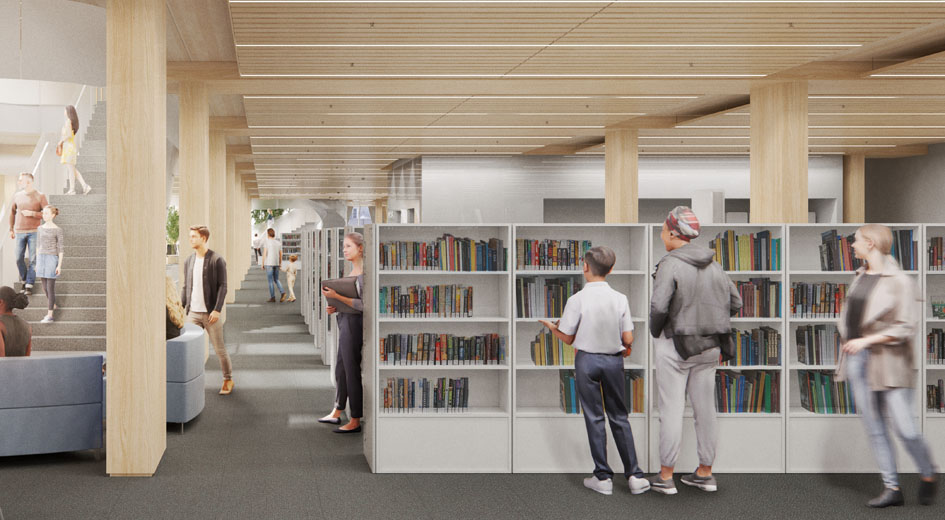
According to the architectural team, the transparent and translucent skin of the building will take advantage of and diffuse the crisp natural light of the prairies. Inspired by the Saskatchewan landscape and local architecture traditions, the library will also evoke the Métis log cabin with exposed glulam beams and a cross-laminated timber strategy.

The Métis log home design features an exposed mass timber structure with an open floor plan, reflecting traditional values of communalism and social connection. The library’s interior references the log home design with wood columns, ceilings and other elements visible throughout. It also features an open concept, providing a warm and inviting atmosphere.

Clever public spaces will be featured throughout the building, from a children’s theatre, to a community kitchen and a bright learning and sharing circle. The library will also house book and media collections, multimedia labs, and cafés. Accessible entrances, luminous staircases, floor openings, and intimate circulation spaces will intertwine, allowing visitors to move freely, find books, and meet friends.

Elevating the rental experience

Hazelviews’ new “Story of Home” collection includes several well-appointed rental communities opening soon in key Canadian markets. The first two properties have already begun leasing: Story of Brampton Central and Story of Rideau & Chapel. Described as “master-branded, purpose-built rental communities carefully crafted to represent a chapter of a larger story told through architecture and interior design,” the unique concept was brought to life by partners Graziani + Corazza Architects, rla/architecture, and 4té. With some 1,600 rental units currently in the pipeline, more are anticipated to follow.

“Whether it’s young professionals, families, students or empty-nesters, many Canadians are seeing purpose-built rentals as a valuable option for their lifestyle and needs,” said Michael Williams, Head of Real Estate Development at Hazelview. “We’re incredibly proud and excited to launch this collection of newly built rental residences and to provide much-needed new rental supply to urban Canadian centres.”

The concept

Completed in November, Brampton Central and Rideau & Chapel provide a good indication of what the concept is all about. According to Colleen Krempulec, SVP, Brand Marketing & Corporate Social Responsibility, it was inspired by Hazelview’s corporate campaign, “Moving Stories”, and put into motion shortly before the pandemic shuttered the world.

“Story of Home seeks to celebrate the special stories from residents who call our properties home,” she said. “Also, we took a nod from the hospitality industry to develop a master-brand approach to build equity across a collection of properties versus individually branding and marketing each one independently. Looking ahead, additional chapters of the Story of Home will be launched across new cities and provinces, including Toronto and Halifax.”

As Canada contends with an ongoing housing crisis, made worse by COVID-19, 1,600 new rental units is no small sum—but will these “elevated rental homes” benefit the residents who need them most?

Hazelview Story of Home“We believe that delivering new supply of rental housing, especially well-amenitized rental housing that has an elevated operating platform, will be welcomed by a diverse range of renters across Canada,” Krempulec said. “We are not catering to renters with higher incomes. We believe the Story of Home collection will attract young families, students, downsizers, and young professionals—and that is what we are seeing in these early days since opening. The properties offer a range of suite types and sizes at market rent. Average household income of those moving in are in the same range as the average household incomes in the markets in which the buildings are located.”

Amenities and programming

Amping up their appeal, residents will also have access to an expansive array of on-site amenities and ‘best-in-class” programming—features that are known to enhance the renting experience for today’s health-conscious, tech-savvy tenants. Amenities include co-working spaces, community gardens, fitness centres, hobby rooms, cafés, juice bars, and indoor-outdoor social spaces.

“The decision to rent vs. own varies for each household,” Krempulec said. “We know ownership is becoming more difficult for many Canadians, and the percentage of people renting is growing. We also believe many choose to rent given the benefits that come with renting such as access to expansive amenities, flexibility to move, community programming at your doorstep, and professional property management that you can rely on for maintenance and repairs.”

Building locations

To determine its locations, Hazelview identified key markets in Canada that were undergoing exceptional growth and that already had the urban infrastructure to support the additional housing.

“Brampton is ranked Canada’s fastest growing city and needs new rental housing options to support its growing population,” said Krempulec. “There, we built a 31-storey building near existing urban infrastructure including access to nearby highways, transit, entertainment, and schools to meet the need of this growing city. Ottawa comprises a diverse mix of empty-nester downsizers, mature and young professionals, and students who prefer renting with lifestyle programming in apartment buildings. With its proximity to the ByWard Market, University of Ottawa, CF Rideau Centre, and downtown Ottawa, this 25-storey building is extremely well located near both urban and green amenities.”

In the coming years, the company looks forward to unveiling the next batch of buildings in the Story of Home collection—in other words, this story isn’t over yet. To follow along, visit: Elevated Rental Residences | Story of Home (mystoryliving.com)

The four pillars anchoring the Story of Home collection:

  • Move – invites residents to embrace “movement in all forms”, whether it’s in each property’s fully equipped fitness centre or in the dedicated spin or yoga studios.
  • Connect – fosters a “connected community” in the buildings via complimentary Wi-Fi and gathering spaces.
  • Nourish – provides residents with convenient access to food and beverages right on site.
  • Grow – offers “the space and room to build a story worth telling” through scheduled events with partners including cooking classes and craft beer tastings.

Jose Trinidad wins Hugh Ferriss Memorial Prize

Diamond Schmitt associate Jose Trinidad has received the AIP 37 Hugh Ferriss Memorial Prize from the American Society of Architectural Illustrators (ASAI) for his ‘Study model of building façade’. The prize is considered one of the highest professional honours for an architectural illustrator.

“It is an honour to be recognized by the American Society of Architectural Illustrators for this year’s Hugh Ferriss Memorial Prize,” said Trinidad. “I would like to extend my appreciation to the jurors, Ronen Bekerman, Victor Enrich, Nigel Hunt, Taras Kvitka, Fabio Palvelli, and Michael Putman. I would like to thank Diamond Schmitt Architects for their continued support, the project design team, and to Jon Soules who introduced me to ASAI. I would also like to thank this year’s conference organizers, Andrei Dolnikov, the Binyan team, Tina Bryant, Gordon Grice, and all who were involved. And finally, I would like to thank the broader ASAI community for such inspiring work that has taught me much and continue to influence my love for illustration.”

The award winning image was created using Rhino, Enscape, Photoshop (Wacom tablet). Trinidad has a Bachelor of Design degree from OCAD University for Environmental Design and a Master of Architecture degree from University of Calgary. Since joining Diamond Schmitt Architects in 2014, he has worked on a range of projects such as, Buddy Holly Hall in Lubbock Texas, David Geffen Hall in New York, Ottawa Public Library and Library Archives Canada Joint Facility, York University Markham Campus, and Carleton University Residences.

Each year the ASAI invites professional and student illustrators from around the globe to take part in the Architecture in Perspective competition. The international juried competition recognizes the world’s best architectural illustrations created in any 2D medium including drawings, paintings, renderings, and digital imagery.

Trinidad’s winning illustration will be featured in the 37th annual Architecture in Perspective catalog and exhibition.

Aecon-EBC awarded John Hart Dam civil works

Aecon-EBC General Partnership has been awarded the first phase of a $245 million two-phase civil construction contract for the John Hart Dam Seismic Upgrade project in Campbell River.

The scope of work involves upgrading earth stabilizing infrastructure to improve the seismic resiliency of the existing John Hart Dam.

The project is on track for construction work to start in summer 2023, following anticipated final internal approvals and the conclusion of the BC Utilities Commission process in spring 2023.

“This project will ensure the continued supply of safe, reliable power for surrounding communities and adds another signature project to our diverse backlog in Western Canada – underscoring our preeminent reputation as the preferred contractor for complex civil construction,” said Jean-Louis Servranckx, president and CEO, Aecon Group Inc. “We are proud of the critical role Aecon played in successfully delivering the John Hart Generating Station Replacement project and we look forward to working with our partner while further strengthening our relationship with BC Hydro through this collaborative approach.”

The proposed project will address dam safety risks at the John Hart Dam and will significantly improve the facility’s ability to withstand a major seismic event. The project will also improve the reliability of the ageing spillway gate system and increase the dam’s spill capacity.

The civil works contractor will upgrade the earthfill and concrete sections of the dam and create an overflow spillway under the existing road deck.

The hydro-mechanical work will replace the three spillway gates and related works. The Request for Proposals for this contract is currently planned to be issued in 2024, with the construction work proceeding after completion of the civil work.

Work on the 2,624-foot-long dam is expected to continue through 2026. The entire cost of the dam work has been estimated at between $497 million and $882 million.


B.C.’s economy expected to remain steady in 2023

B.C.’s economy is expected to remain steady after slower economic growth through 2023 due to global inflation and higher interest rates, according to projections from private-sector forecasters.

Each year, B.C.’s finance minister meets with the Economic Forecast Council (EFC), a 13-member council of private-sector forecasters from throughout Canada, in preparation for the next year’s budget. This is the second year that an additional set of discussions was added, providing an opportunity to consult with an Environmental, Social and Governance (ESG) Advisory Council to explore how the provincial government can continue to build a more inclusive, sustainable economy and support well-being in British Columbia.

The EFC anticipates the province’s economy will grow by 2.9 per cent in 2022 and 0.4 per cent in 2023; slower than their January 2022 forecasts of 4.2 per cent and 2.7 per cent, respectively.

The updated figures are similar to what was presented in the province’s Second Quarterly Report. Real gross domestic product (GDP) growth is then expected to pick up, with an increase of 1.6 per cent in 2024, followed by gains of 2.3 per cent, 2.3 per cent and 2.1 per cent in 2025, 2026 and 2027, respectively.

“We’re entering this period of slower growth and challenging global economic times in a strong position to continue supporting people, because B.C.’s economy grew more than most last year,” said B.C. Minister of Finance Selina Robinson. “We’ll use the resources we have to address the issues that matter most to people, including housing, health care and building a sustainable economy that works for everyone – but no matter what is on the horizon and no matter what the numbers show, this government will continue to be here to support people.”

Forecasts and feedback from the two councils will be used to inform the next provincial budget, which will be released on Feb. 28, 2023.

Federal funding for Jewish centre in Vancouver

The federal government has announced $25 million for the new Jewish Community Centre of Greater Vancouver.

The infrastructure funding will help the organization to modernize and expand its capacity through a new facility. The two-phase redevelopment project, known as JWest, will provide a diverse community hub with updated arts, cultural, heritage and recreational facilities, in addition to a wide range of community-based support services. JWest will also create new rental housing units and childcare spaces.

The new site will additionally include a new home for the Vancouver Holocaust Education Centre. This builds on the Government of Canada’s historic commitment to preserving Holocaust remembrance, including recent investments to support new Holocaust museums in Montréal and Toronto.

“The Government of Canada stands with Jewish communities across Canada and around the world. Supporting cultural facilities is essential, not only to retain their viability today, but to help them flourish for generations to come,” said Pablo Rodriguez, the federal minister of Canadian Heritage.

The federal government’s contribution matches the provincial government’s $25 million contribution in 2021. Another $25 million was donated by the family foundation of Jack and Gordon Diamond in September 2022.

The organization will redevelop its current facility, located in Vancouver’s Oakridge neighbourhood, into a mixed-use multi-building campus. JWest will house a replacement community centre with new recreational and retail space, an expanded aquatic centre, an early childhood education centre, a library, a gallery, an auditorium and professional theatre, and non-profit office space.

“We are deeply grateful to the Government of Canada for supporting our vision for a renewed Jewish Community Centre to address the issues that affect so many people in the Lower Mainland. We see this as an opportunity to build a legacy that will benefit people across the region for generations to come,” said Ezra Shanken, CEO, Jewish Federation of Greater Vancouver


Graham awarded Leduc 65th Ave Interchange

Construction is set to begin on the 65th Avenue Interchange in Leduc that will accelerate the rapid growth happening in and around the Edmonton International Airport trade hub.

“Work is getting under way. This is one of the busiest sections of highway in Alberta, and we’re going to help make it faster and safer to get around. It will take commercial and airport traffic off local roads. It will provide a better connection for Alberta businesses to the Edmonton airport, letting them get their products to the world a bit faster and a bit cheaper,” said Minister of Transportation and Economic Corridors Devin Dreeshen.

The City of Leduc has awarded Graham Construction the contract for the 65th Avenue Interchange project. The QEII and 65th Avenue Interchange project is a joint effort between the City of Leduc, Alberta Transportation, and the Edmonton Regional Airports Authority. About 49,700 vehicles travel this stretch of the QEII Highway every day.

According to officials, with a project cost of $112 million, and supporting 660 jobs, this economically significant infrastructure project will help the region reach greater economic potential.

Key components of the project includes: new overpass over the QEII Highway; new on-off ramps from the QEII Highway; improvements to some existing ramps; intersection improvements at 65 Avenue and 50 Street in Leduc; and, completion of Perimeter Road and 65 Avenue, west of the QEII Highway.

Graham is experienced in delivering projects of this scope and complexity, including the Macleod Trail Interchange in Calgary, and the Groat Road Bridge and Road Renewals in Edmonton.

“We look forward to partnering with the City of Leduc and Alberta Transportation to deliver this critical infrastructure,” says Tom Cole, Graham’s vice president of infrastructure. “The interchange will support safety and ease of movement of people and goods and Graham is proud to be part of the project that will bring significant and long-standing benefits to the community.”

Construction is anticipated to take approximately three years and will commence in winter 2023.

50 companies complete ISSA’s cleaning industry management standard certification

ISSA, the worldwide cleaning industry association, today announced that 50 companies have achieved the Cleaning Industry Management Standard (CIMS) certification, including several prominent Canadian firms such as Bee-Clean Building Maintenance and GDI Services (Canada). Created by the industry, for the industry, CIMS is the first consensus-based management standard that outlines the primary characteristics of a successful, quality cleaning organization.

“Earning CIMS certification demonstrates that organizations are dedicated to a higher standard of cleanliness, which is essential given the bio risks that exist today,” said ISSA Executive Director John Barrett. “Using CIMS as a management framework allows cleaning organizations to maintain quality, efficiency, and customer satisfaction.”

Relevant for in-house operations and outsourced building service contractors of all sizes, CIMS leverages five core elements of management best practices and requires participants to meet 100% of the mandatory elements and 60% of the recommended elements, per section. An ISSA-accredited third-party assessor completes an on-site evaluation to validate that the cleaning operation follows documented systems and processes that support cleaning for health. To earn CIMS w/ Honors, an organization must achieve 85% of the recommended elements.

Since July of 2022, here are the new and renewing companies that have earned CIMS-Green Building (GB) with Honors:

  • ABBCO Service Corp.
  • ACHIEVE Human Services Inc.
  • ANK Maintenance Services
  • APEX Surface Care
  • ATALIAN Global Services
  • Accurate Building Maintenance
  • Ace Maintenance & Services Inc.
  • Addlife Facilities Services Inc.
  • Alliance Building Services
  • Aspen Services Group
  • Auraclean
  • BEST – For a cleaner world
  • Bee Clean Building Maintenance
  • Charitar Realty
  • Chenega Healthcare Services LLC
  • Community Hospital Anderson
  • DMS Facility Services
  • DRTC
  • Enterprise Professional Services Inc.
  • Esquivel, Melissa
  • Franciscan Health Indianapolis
  • Frantz Building Services Inc.
  • GDI Services (Canada) LP
  • GW Commercial Services Inc.
  • Good Clean Property Services
  • Harvard Maintenance Inc.
  • Harvard Services Group Inc.
  • Helpful Hands, Inc.
  • Hui Huliau
  • IQS Inc.
  • Integrity National Corp.
  • Jay’s Building Maintenance Inc.
  • L-5 Services LLC
  • Main Building Maintenance Inc.
  • Melwood Horticultural Training Center
  • Michigan State University
  • Micwalis Pro Cleaning Service Inc.
  • NANA Management Services
  • Northern New England Employment Services
  • NuGate Group
  • OMEGA, ALPHA
  • Pegasus Building Services
  • Rising Star Resource Development Corp.
  • SMG Corporate Services
  • Service Disabled Veterans Business
  • Sunshine Cleaning Systems Inc.
  • Supreme Maintenance Organization
  • UVM
  • Valor United LLC
  • VersAbility Resources Inc.

For more information about CIMS, visit  www.issa.com/cims.

Lender confidence varies by CRE asset class

Lender confidence varies across market segments, but there is a general affirmation of commercial real estate heading into an expected recession. Logistics warehouses, multifamily rental buildings, data centres and life sciences labs are tapped as favoured assets in CBRE Canada’s newly released survey of 29 companies that collectively hold $200 billion in real estate loans.

“The rapid escalation of costs of capital, valuation uncertainty and general chill over the real estate market stood out this year,” Carmin Di Fiore, CBRE’s executive vice president, debt and structured finance, observed during last week’s online presentation of the survey results. “Given all the news influencing real estate, the best news we have is that 93 per cent of lenders still expect to grow their portfolio next year.”

Even so, their enthusiasm has ebbed from 12 months earlier. This year, 48 per cent of survey respondents state they’ll be actively or very actively bidding on real estate deals in the coming year, with the slightly larger majority typifying themselves as cautious or conservative bidders. That contrasts with the fall of 2021, when 90 per cent of respondents foresaw they’d be active or very active bidders.

Last year, 53 per cent of participating lenders envisioned a 20 to 30 per cent year-over-year expansion in capital debt for real estate while 40 per cent anticipated a 10 per cent increase in their budgets. Across all asset classes, lenders collectively fell about 30 per cent short of their 2022 targets — an outcome CBRE analysts attribute largely to “rapid escalation in the cost of capital” in the second half of the year, but also somewhat to a simple shortage of some highly sought asset types like data centres and life sciences facilities. Notably though, 78 per cent of survey respondents met or exceeded their budgets for loans on industrial assets.

For 2023, two thirds of respondents are targeting a 10 per cent year-over-year increase in real estate loans. “Relative to last year, the pressure to put out more money has been dialled back,” Di Fiore said.

Nor are lenders as eager to shift a larger share of their overall capital debt portfolio to real estate. In the fall of 2021, more than two thirds of survey respondents voiced that objective, while this year, more than three quarters expect to keep their real estate allocations at current proportions. Only three per cent intend to shrink their real estate allocation relative to other investment classes, which is consistent with the sentiment garnered in 2020 and 2019.

“No typical lender in Canadian real estate is isolated from the comparable liquidity issues of competing investments nor the overall increase in costs of funds witnessed in higher credit spreads,” Di Fiore submitted.

Canada considered well positioned for 2023

Although survey respondents unanimously concur that a recession is coming, 83 per cent do not expect it to have more than a minor or moderate impact on real estate underwriting. Picking up on that theme, Peter Senst, president, capital markets, with CBRE Canada underscored the relatively stronger outlook compared to elsewhere. While a 16 to 17 per cent decline in global real estate transactions is projected for 2023, a more modest 4 to 5 per cent drop is foreseen for Canada, with sales volume falling from about $59 billion to $56 billion.

“In Canada, we’re just not feeling it the same way. We’re still trading with reasonable velocity,” Senst maintained. “The size and significance of the deals we’re doing in Canada, especially in the second half of the year, will be the biggest in the world.”

Among trends backing his optimism, he hypothesized that interest rates are nearing a peak, and a projected 70- to 80 basis point drop in the 10-year Canada bond rate by the end of 2024 will bring predictability and lower financing costs. For now, he suggests many investors with capital to deploy will seek out value-add and opportunistic assets.

“Really, more than half the money that’s available will be looking for ‘alpha’; they’re going to be looking for outsized returns going into the year. When we’re pricing core, it’s tough to make core work today with today’s cost of capital,” Senst advised.

Office stumbles, multifamily and industrial retain favoured status

From lenders’ perspective, Class B suburban and downtown office properties are the least preferred loan candidates, causing concern for more than 90 per cent of survey respondents. Class A downtown and suburban office have more positive profiles, but both slipped in lenders’ estimation over the course of 2022 and lag 11 other types of assets on the confidence scale. A fairly substantive majority of lenders — 59 per cent — plan to decrease their budgets for office loans in 2023, representing the largest shift away from any asset class.

Continued low levels of office attendance is a key factor. Thirty six per cent of survey respondents do not foresee near-full conditions for at least 18 to 36 months, and another 36 per cent push the timeline beyond 2025. “Softer office attendance is materially or moderately impacting the opinion of over 80 per cent of lenders,” Di Fiore affirmed.

Upwards of a third of survey respondents are uncertain of the long-term impacts of a hybrid workplace model in which some to many staff spend only a portion of the work week in a formal office setting. However, more see it as a long-term risk in suburban offices (48 per cent) versus downtown (34 per cent). As well, 21 per cent of respondents view hybrid work as a potential long-term opportunity for downtown office compared to just 10 per cent holding that view about the suburbs.

Lenders’ favoured asset classes for 2023 include: multifamily rental buildings, for which 54 per cent of survey respondents are planning to increase their budgets; industrial properties; and a trio from the alternative asset class — data centres, life science/biotech labs, and self-storage facilities. Toronto, Vancouver, Montreal and Ottawa emerge as the top markets, with 76 per cent of respondents expressing a “strong” appetite for deals in Toronto and 72 per cent for Vancouver.

Looking at potential or likely adjustments to the underwriting process, 71 per cent of survey respondents indicate they’ll be more questioning of appraisal values and stringent about sponsorship evaluations. A majority will also be modelling for increased vacancy in properties (57 per cent) and adjusting growth projections of net operating income (52 per cent). As well, 48 per cent intend to increase debt service coverage ratios and lower maximum allowable loan to value.

“Given these expected changes, debt underwriting will likely be fluid and protracted,” Di Fiore said. “It may also influence the terms of initial buys and what shape a formal commitment will ultimately look like.”

Energy-saving tips for your building

With winter almost here, heating and energy efficiency is top of mind for many building operators, but what if you could manage your building optimally, save money and help the planet at the same time?

There are several ways to better manage your assets, improve performance, cut costs, and reduce your building’s carbon footprint.

Check heating and cooling

Have you checked on your HVAC lately? Checking out your HVAC’s performance should be part of your fall checklist, as you look to avoid preventable costs through the winter. HVAC systems account for about 40 per cent of a building’s energy consumption, so you want to make sure it’s in good working order and performing as efficiently as possible.

RELATED: Preventative HVAC maintenance tips for fall

Monitor windows and doors

It seems logical that keeping windows and doors closed during the months will lower heat loss, but that may be easier said than done with bay doors constantly opening for deliveries. Consider controlling foot traffic in your warehouse with features like automatic door closers to help keep heat in and save your HVAC from working overtime.

You might also consider investing in upgraded windows and doors, with thicker glass and airlocks. Double-glazed glass serves as an insulator, helping to keep heat inside. Also, opening blinds to let the sun in will naturally help heat your building, relieving a little of the burden on your heating and cooling system.

Manage the thermostat and lights

Monitoring traffic and adjusting your thermostat accordingly can result in significant cost savings. By keeping it at a comfortable working temperature, you may not need to heat the building at all times. When no one is there, consider lowering the heat to lower your bill.  The same goes for your lighting system, look into opportunities where you can turn lights off during non-peak periods to save energy.

Look at the data

While it may take an initial investment, installing data-gathering technology will give you valuable insight into possible opportunities for savings. From smart meters that monitor appliance and electronic use to technology that turns off your sprinklers when it detects precipitation, there are tools available to help you make the best decisions for your building.

Peak winter performance and greater sustainability mean running your business better. Investing the time and money to go greener will help you to better manage your facility’s assets, cut down on energy use, and be ahead of the game when spring comes.

Centurion to acquire Gatineau multi-res development

Centurion Asset Management has announced the pending acquisition of Phase I of a three-phase multi-residential apartment portfolio located in Gatineau, Quebec. In Q1, Centurion acquired the neighbouring development, Le Central, from the same developer, Junic. The acquisition of the NOX will bring Centurion’s total Gatineau portfolio to 879 rental units.

NOX in GatineauThe NOX consists of seven mid-rise, multi-residential apartment buildings that are being constructed in three phases. Phase I, located at 350-380 Boulevard de l’Amérique-Française and comprising four buildings with 277 rental units, was just completed in October 2022. Phase II, located at 40-60 Marguerite Maille and comprising two properties with 158 rental units, is anticipated to be completed in January 2023. Phase III, located at 615 Boulevard Du Plateau and consisting of one building with 99 rental units, is anticipated to be completed in April 2023.


The buildings rise seven stories and offer a variety of suite types, from studios through to two-bedroom plus mezzanine units. Amenities include shared rooftop terraces with BBQs, a condo-quality gym, a swimming pool and hot tub, a lounge, pet wash facilities and ample indoor and outdoor parking.

“We are thrilled to further expand Centurion’s presence in Gatineau,” said Centurion President and CEO Greg Romundt. “The Gatineau-Ottawa region is Canada’s fourth largest cosmopolitan area and this development will help fulfill the city’s growing rental needs.”

Located in the Le Plateau region of Gatineau, NOX is centrally located close to public transit and highways, with downtown Ottawa only a 10-minute drive away. The development benefits from its strategic location in close proximity to Agora Urban Village Community, a modern mixed-use development consisting of an abundance of retail, entertainment, grocer and lifestyle amenities including boutiques, food markets, cafes, pharmacies, health clinics as well as a 26-acre Centre Park.

According to the press please, this superior location coupled with the opportunity to build on Centurion’s existing Gatineau footprint will enable Centurion to achieve immediate scale opportunities in a market benefitting from both extremely high rental demand and little supply of purpose-built rentals.

Click here for more info: News | Insights | Centurion Asset Management Inc.

NFL legends headline ICBA Gala dinner

Terry Bradshaw and Joe Montana, two NFL legends who have combined to win eight Super Bowl championships, will be the guest speakers at the Independent Contractors and Businesses Association (ICBA) Gala Dinner in Vancouver next spring.

“Bradshaw and Montana are two of the most exciting players in NFL history, with Super Bowl success matched only by Tom Brady,” said ICBA president Chris Gardner. “To have them together on our stage will be an outstanding experience – we can’t wait to hear their stories of success and perseverance.”

The ICBA Gala will be held on Wednesday, April 26, 2023, at the JW Marriott Parq Hotel in Vancouver.

Combined, the two NFL Hall of Famers have won eight Super Bowls, three season MVPs, and five Super Bowl MVP awards. They each authored a signature throw that lives on in football lore: for Bradshaw’s 1970s Pittsburgh Steelers, it was the Immaculate Reception; and for Montana’s 1980s San Francisco 49ers, it was The Catch.

Bradshaw has been a host on FOX NFL Sunday for two decades and acted in several movies. In recent years, he has also shared openly about his struggles with mental health and has recently overcome two different types of cancer.

Montana, nicknamed Joe Cool for the clinical way he carved up opposing defences, has generally stayed out of the public eye since retiring, while doing significant charity work with the Make-A-Wish Foundation.

Bradshaw and Montana join an impressive list of Super Bowl champion quarterbacks to speak at the event, following Hall of Famers Peyton Manning (2017), Brett Favre (2018) and Troy Aikman (2019), and former Seahawk Russell Wilson (2022).