Articles Archive - Page 255 of 928 - REMINET
REMI

Montreal condo developer joins Order of Canada

Samuel Gewurz, a pioneering builder on Montreal’s Ȋle des Soeurs, has been named to the Order of Canada. The president of the development firm, Proment Corporation, is among 65 newly announced members recognized for their outstanding achievements and service to the country and their communities.

In making the year-end announcement, Governor General Mary Simon commended  appointees’ commitment to Canadian society. Gewurz, who founded Proment nearly 60 years ago, is cited for “his ground-breaking contributions to Montreal’s urban development, and for his transformational philanthropy and community engagement”.

The Order of Canada carries the motto, Desiderantes Meliorem Patriam, which translates to “they desire a better country”, and is one of the highest awards bestowed to citizens. Gewurz will join a select roster of approximately 7,600 recipients who have attained the honour since 1967.

Proment has built nearly 5,000 condominium units in 20 towers on Ȋle des Soeurs, and has recently broken ground on the final phase of Quartier Pointe-Nord, a mixed-use community, certified LEED Gold for neighbourhood development. The company built Quebec’s first LEED Gold residential towers and is a seven-time winner of APCHQ (Association provinciale des constructeurs d’habitations du Québec) Builder of the Year honours.

Gewurz is an active and generous supporter of Montreal community service organizations, including Federation CJA and the MADA Community Centre, and is the sponsor of the Gewurz Lecture in Urban Design at McGill University’s School of Urban Planning.

“What a beautiful way to end the year, honouring Order of Canada appointees and learning about the depth and range of their accomplishments,” Governor General Simon observes. “Celebrated trailblazers in their respective fields, they are inspiring, educating and mentoring future generations, creating a foundation of excellence in our country that is respected throughout the world.”

Canada’s ban on foreign property buyers takes effect Jan 1

As of Jan. 1, 2023, all non-Canadian individuals and corporations will be prohibited from purchasing residential properties in Canada for a minimum of two years. The Prohibition on the Purchase of Residential Property by Non-Canadians Act was passed by the Canadian government on June 23, 2022, in an effort to address the country’s widespread housing affordability issues, and accompanying regulations have now been set out.

According to the official backgrounder, all non-Canadians that contravene the prohibition, or any person or entity that knowingly assists a non-Canadian in contravening the prohibition, is liable to pay a fine of up to $10,000.

“Homes should not be commodities,” said the Hon. Ahmed Hussen, Minister of Housing and Diversity and Inclusion. “Homes are meant to be lived in, a place where families can lay down roots, create memories and build a life together. Through this legislation, we’re taking action to ensure that housing is owned by Canadians, for the benefit of everyone who lives in this country. We will continue to do whatever we can to ensure that all residents of this country have a home that is affordable and that meets their needs.”

Exemptions include:

  • Canadian citizens and permanent residents;
  • International students who meet certain requirements, including having spent the bulk of the previous five years in Canada;
  • Workers who have worked and filed tax returns in Canada for at least three out of the four years prior to purchasing a property;
  • Diplomats, consular staff and members of international organizations living in Canada;
  • and, foreign nationals with temporary resident status, including people fleeing conflict, and refugees.

Buildings containing more than three dwelling units, and recreational properties such as cottages, cabins, and other vacation homes, will also be exempt.

For the full details, including accompanying regulations, visit: Prohibition on the Purchase of Residential Property by Non-Canadians.  


Equiton closes 2022 with Toronto multi-res acquisition

Equiton Residential Income Fund Trust announced it has ended a busy year with the acquisition of a Toronto multi-residential property for $50 million. The building, now known as Ravine Park Apartments, has seven storeys, 169 units, several onsite amenities, and 183 combined indoor and outdoor parking spots.

“We are truly excited to be expanding our presence in Toronto with the purchase of this building, which brings us to $272 million in acquisitions for the Apartment Fund this year,” said Jason Roque, Equiton Founder and Chief Executive Officer. “It’s been an outstanding year for the Fund, and we’d like to thank our investors and partners for their continued support.”

The property is located directly across from the upcoming Eglinton LRT station and within walking distance of the Kennedy subway and GO stations. It marks the seventh acquisition by Equiton’s Apartment Fund this year, and closely follows the previously announced purchase of Park Square Apartments in early December. All tolled, the Fund added more than 755 portfolio units in 2022 in Ontario and Alberta, as well as a development project. Equiton’s Apartment Fund now comprises 32 properties across 17 communities with 2,548 residential units in total. 

The Fund specializes in acquiring multi-residential properties in Canada and says it intends to increase value through active management, targeting an annual net return of 8-12 per cent.

Find out more about the Equiton Apartment Fund at www.equitonliving.com 

It’s time for your polished concrete floors to shine

If you have polished concrete floors in your building, you know that winter can make it tricky to keep those floors looking clean and shiny. The snow, salt, and ice melter can create a slipping hazard, can appear dirty, and can also damage the floors.  Making sure your floors are clean also contributes to the health and wellness of your staff and your visitors, so it’s important to get it right.

RELATED: Cleaning for health, instead of for appearance

Create a plan to proactively address your polished concrete floors this winter. With a few simple steps, you’ll see your reflection in your floors in no time.

Forget the old ways

Waxing and stripping your floors is common practice and works well to maintain many surfaces, but it is not the best approach for polished concrete. It is labour-intensive in large spaces and because it doesn’t allow the concrete to breathe, it can trap moisture inside, damaging the floors’ surface. When the moisture tries to get escape, it can create a white appearance that looks like salt stains and dirt, prompting you to start the process all over again.

Take a new approach

Rather than constantly trying to clean dirty-looking floors, a daily maintenance program will help keep them shiny all winter long. Here are a few steps for better maintenance that will extend the life of your polished concrete floors:

  • Use your machine with an abrasive pad to clean your floor daily.
  • Invest in cleaning products designed specifically for polished concrete.
  • Clean the entire floor daily for a consistent finish, rather than simply focusing on high-traffic areas.

If your floors are damaged or worn, taking a more aggressive approach will do the trick. Follow these steps more frequently throughout the day until you see the shine return to your floors.

Take a proactive approach to your polished concrete floors this winter! Your floors are part of your building’s appearance and affect the way visitors view your business. Keeping them clean saves you money over the long haul and provides a safer environment, but it also leaves a lasting professional impression on your building’s guests.

Apprenticeship numbers rebound in 2021

The number of new registrations in apprenticeship programs and certifications in the trades rebounded in 2021, according to Statistics Canada.

While many pandemic restrictions persisted throughout 2021, apprenticeship registrations jumped more than 31 per cent last year, and trades certifications increased by 33.7 per cent but remain below pre-pandemic levels.

In 2021, job vacancies in the trades, transport, and equipment operators and related occupations hit an all-time high, nearly doubling since 2019. At the same time, employment in the trades almost reached pre-pandemic levels, while unemployment rates fell below those observed in 2019.

New registrations in apprenticeship programs and certifications in the trades saw significant increases as businesses and tradespeople faced tight labour market conditions.

While all trades saw some growth in new registrations in 2021, carpenters (+46.3 per cent); heavy duty equipment mechanics (+45.9 per cent); refrigeration and air conditioning mechanics (+42.9 per cent); millwrights (+42.0 per cent); plumbers, pipefitters and steamfitters (+39.0 per cent); and electricians (+37.0 per cent) posted the largest year-over-year increases. Certifications in these trades also showed similar trends.

British Columbia certifications were largest among plumbers, pipefitters, and steam fitters (+23.4 per cent) and welders (+26.5 per cent).

Statistics Canada also reported there were 8,688 new registrations and 4,821 certifications by female apprentices in 2021. This represents some recovery from the significant drops in 2020 but remains well below 2019 levels for new registrations in apprenticeship programs (-17.1 per cent) and certifications in the trades (-24.4 per cent).

Women in the trades made significant gains in apprenticeship programs where they have been historically underrepresented. New registrations of female apprentices surpassed pre-pandemic levels in many construction-related trades, such as exterior finishing (+56.5 per cent), carpenters (+29.8 per cent), electricians (+27.0 per cent), interior finishing (+25.8 per cent), and refrigeration and air conditioning mechanics (+25.0 per cent).

While this shift was already underway before the pandemic, the events of recent years may have acted as a catalyst to bolstering these trades, which saw their highest numbers of new registrations for women since the beginning of the series in 1991.

Surrey firm named KBIS Kitchen Award finalist

Interior design firm Welton Design Group based in Surrey has been named a finalist for the Kitchen & Bath Design + Industry Awards 2023 (KBIS).

Welton Design is one of the top three finalists in the Specialty Kitchen category, a new category for 2023, for their project “North Vancouver Laneway.”

When the boutique design firm was hired to design the kitchen in a North Vancouver laneway house (a coach house separate from the main house), the owners wanted a space that felt inviting and cozy without highlighting the home’s limited square footage.

“We designed a kitchen based on their love of pub-style dining, with layers of materials that added dimension,” said Rebecca Foster, director of design at Welton Design Group. “Brick wall details, high ceilings of natural wood, a warm colour palette, and a custom banquette-style eating nook make the home feel lived in and comfortable.”

Materials from “North Vancouver Laneway” were carefully selected to suit the home’s character and the family’s needs,  including antibacterial and heat-resistant Caesarstone quartz countertops, easily cleanable bench seating, textural brick for warmth, and Anne Sacks Savoy Series tile backsplash for simplicity.

Another priority was storage, which was incorporated into every possible space, including soft-green shaker cabinetry, a pantry with roll-out shelving, drawer storage beneath the banquette seating, and a closet with repurposed antique doors – all while floating shelving allows natural light to flow through the house. An oversized island allows extra space to host friends at the counter and a wood ceiling that mimics the engineered hardwood flooring draws the eye to the home’s unique architectural elements.

Winners will be announced at KBIS 2023 in Las Vegas, in January. First-place winners in each of the eight categories will receive a $5,000 prize, second-place winners will receive $2,500 and third-place winners will get $1,500. The People’s Pick winners will receive $3,000.

B.C.’s Highway 91/17 project nears completion

The Highway 91/17 Upgrade Project in Delta, B.C. is nearing completion with lanes now open on the Highway 91 at Nordel Way interchange.

Opening the final interchange to full capacity is a major milestone for the $260-million Highway 91/17 and Deltaport Way Upgrade Project.

“A faster commute on safe, high-quality roads is important to Delta and the surrounding communities,” said Carla Qualtrough, federal minister of Employment, Workforce Development and Disability Inclusion. “Our government’s investments to improve the quality of our roads and traffic flow will help save time for residents south of the Fraser River. We will continue to work with our municipal and provincial partners to make improvements to our infrastructure and, in turn, improving the quality of life for all residents of Delta.”

The interchange at Highway 91 and Nordel Way is the last of four interchanges included in the project. The first interchange, at River Road and Highway 17, opened to traffic in December 2021, followed by the Highway 91 Connector and Nordel Way and Highway 17 and Highway 91 Connector interchanges this past summer. Minor construction work remains, including asphalt repairs and paving on the River Road and Highway 17 interchange in spring 2023.

The Highway 91/17 Upgrade Project, which is part of the broader Highway 91/17 and Deltaport Way Upgrades, is being delivered by the Province and is on track for completion in spring 2023. The project was designed to improve road safety and support growing economic and trade development in the region.

The design-builder, Pacific Gateway Constructors (PGC), employed an all-local workforce for the project. PGC also awarded more than $16 million in contract value to local Indigenous businesses and partnerships through subcontracting opportunities. Construction began in spring 2020.

The $5.2-million 27B Avenue upgrades component of this project is complete. It was funded by the Tsawwassen First Nation and the Government of Canada, and delivered by the province.


Residential energy use re-emerges in CDM plans

Residential energy use is back on the agenda for Ontario’s conservation and demand management (CDM) strategists. In 2019, the provincial government dismantled most incentives to promote energy savings within homes and retained just two programs — geared to low-income electricity customers and remote Indigenous communities — within its 2021-24 framework of CDM initiatives. However, program reviewers are now recommending broader inclusion of the multifamily and single-family housing sectors.

The newly released mid-term review of the 2021-24 CDM framework re-evaluates the cost-effectiveness of incentives given new assumptions about growth in provincial energy demand, and concludes it’s worthwhile to tap into residential energy-saving potential. Already, a new demand response program for central air-conditioning in single-family dwellings is slated to be launched in 2023, but analysts with Ontario’s Independent Electricity System Operator (IESO) recommend further consideration of new programs for 2024 and beyond, including a more comprehensive targeting of multifamily buildings.

“Currently, common areas can apply to the Retrofit Program (for commercial buildings), while income-qualified customers can access the Energy Affordability Program for in-suite measures,” the IESO’s review states. “Focused offers for multi-residential buildings will simplify application processes.”

Associated with the CDM mid-term review, the IESO conducted surveys to calibrate the general public’s awareness of Ontario’s Save on Energy programming and to assess consumer preferences and inclinations. The results suggest there is likely to be sufficient uptake to justify the contemplated incentive programs, particularly since there are currently no programs for the residential sector focused on conserving electricity.

“The residential sector is currently served by Natural Resources Canada and Enbridge, which focus on GHG emissions and natural gas reductions, respectively,” the report observes. “Residential consumers are willing to and actively seeking opportunities to increase energy efficiency and control over energy costs, but lack the knowledge and direction on how to proceed.”

Tender issued for Cochrane interchange

The Alberta government has issued a tender for the construction of an overpass at the intersection of Highways 22 and 1A in Cochrane. The project will improve the flow of traffic along the Highway 22 corridor and make both highways safer for all travellers.

“This intersection has long been a source of frustration, not only for Cochrane residents, but also for commercial carriers and the thousands of people who use Highway 22 to travel to tourist destinations such as Kananaskis Country and the Rocky Mountains. This interchange will eliminate congestion and improve travel times,” said Minister of Transportation and Economic Corridors Devin Dreeshen.

When complete the project will include:

  • A twin overpass (north and southbound) over Highway 1A and the CP Rail tracks.
  • Twinning of Highway 1A under the overpass.
  • Roundabouts and ramps to access both Highway 22 and Highway 1A.
  • A bridge on Highway 1A over Big Hill Creek.

The interchange will be based on a partial cloverleaf design to make best use of the area’s geography, while also accommodating future upgrades. This approach will help ensure the interchange can effectively accommodate: population changes in the area, traffic growth and transportation corridor use.

The partial cloverleaf design will meet growing traffic volumes now and in the future and provide more efficient traffic flows in the Town of Cochrane and the surrounding area, while minimizing the footprint of the interchange and cost of overpass structures.

Now that a tender has been issued, construction is expected to begin in spring 2023 after a contract is signed. It is estimated that the interchange will take about three years to complete.

“This long-awaited project represents a significant milestone achievement in Cochrane’s roadway infrastructure,” said Jeff Genung, mayor, Town of Cochrane. “We have made substantial investments in our local roads, bridges and transit to enhance community connectivity. This provincial project is an integral component in our vision to deliver effective local and regional transportation. It takes the work of many hands over many years pulling together in the same direction for a major infrastructure project of the magnitude of the Highway 1A/22 interchange. And while this project has long been identified as a provincial priority, it is both gratifying and a relief to see the project out for tender and work anticipated to begin in 2023.”

Donation supports women in trades at Camosun

Camosun College in B.C. has received a $1.285 million gift to help open the doors to more women pursuing a career in a range of Red Seal trades programs.

The gift from The Gwyn Morgan and Patricia Trottier Foundation is the second time the foundation has supported the Empowering Women in the Trades program and is a five-year commitment. It represents the largest philanthropic gift in the history of the college outside of estate gifts.

“The Empowering Woman in the Trades program has changed my life in such an incredible way, words can’t express the gratitude I have,” says Sarah Cooper, who completed the Women in Trades sampler in 2021 and who will soon be returning to the college for her next level apprenticeship. “I don’t know where my family and I would be there today without the ongoing mentorship and financial support that I’ve been given throughout my time at Camosun.”

n 2017, the Foundation made a $1,000,000 to pledge to create this incredibly important and successful program. This second pledge will ensure the program will continue to grow and support women over the next five years. The College has great ambitions when it comes to changing the demographics of the trades and this gift will help support this.

“We saw the tremendous impact the first gift had on the lives of women over the last five year and how it encouraged more women to enter trades so it made sense to do it again,” says Gwynn Morgan. “It is important to ensure the Empowering Women in the Trades program can continue to raise the quality of life for tradespeople and their families, as well as ensure employers and industries have a workforce to draw upon.”

Government programs often assist with tuition costs but Empowering Women in Trades breaks down additional financial barriers facing women in the trades and assists with areas such as transportation, child care, living expenses and the cost of protection equipment and tools. The goal is to allow more women complete their Red Seal certification.

While financial assistance is one barrier, Empowering Women in Trades also offers one on one support, networking, and mentoring opportunities as well as employment support. The program is unique to Camosun, striving to meet and support each student where they are on their own journey. 

NexLiving acquires Saint John portfolio for $34.3 million

NexLiving Communities Inc. announced it has acquired two properties in Saint John, New Brunswick, for $34.3 million. The acquisition includes an adjacent parcel of land that has been approved for a future development of up to 85 units.

The first property, 50 Calabria Street, is a four-storey luxury building with 82-suites, located in the east end of Saint John near the city’s prime shopping district. The property is described as “newly constructed” with two elevators and ample parking. Amenities include three fitness centres, a community room, walking trails, pickleball and basketball courts, and more. All units have a balcony, in-suite laundry, multi-zone air-conditioning and smart home features (resident’s app, valet entrance, keyless entry technology, facial recognition entry, smart home water heater, EV charging stations etc.).

The second property, 5 Woodhollow Park, is a four-storey building with 67 suites located in the east end of Saint John with close proximity to transit and local amenities. The building was constructed in two phases in 2013 and 2015 and is equipped with an elevator, spacious one- and two-bedroom suites featuring walk-out patios, in-suite laundry and generous surface parking options for residents.

Pro forma the previously announced acquisition of 2251 & 2261 Mountain Rd., which is expected to close in Q1 2023, NexLiving will own 1,166 suites. The company says it expects to continue to build upon its “successful acquisition track record and acquire an additional 500+ suites over the next year, with a focus in secondary markets across Canada.”

For more information visit www.nexliving.ca

Few dramatic reversals foreseen in CRE trends

Canadian real estate executives foresee few dramatic reversals of current industry trends during the next five years. Recently released findings of REALPAC’s 2022 Prospective Survey pick ESG and hybrid workplaces to be prominent influences on investment and operational decision-making up to 2027. Multifamily and industrial assets are still expected to be in favour, and it’s envisioned that companies will be steadily, but not necessarily aggressively adopting new technologies.

Those insights and projections are gleaned from 38 leaders of commercial real estate companies or affiliated services, collectively representing a workforce of 36,500 and holding about CAD $290 billion in assets under management. The survey was conducted in late October and posed questions in 12 categories to chart the industry’s anticipated course in the mid to longer term, and perhaps prompt some thinking on what’s needed to the support the journey.

Underpinning the desirability rating of apartment and industrial assets, an overwhelming majority (97 per cent) of survey respondents foresee a continued shortage of purpose-built rental housing, while 68 per cent expect industrial rents will exceed current levels in five years’ time. Enthusiasm is considerably more muted for retail and office, with just 29 per cent and 24 per cent of respondents, respectively, projecting those property types will be desirable five years out from now.

More than two-thirds of respondents anticipate a hybrid mix of on-site and offsite work will be the predominant arrangement for companies with office space, but nearly three quarters expect that downtowns will continue to be business centres and 94 per cent project that tenants’ employees will spend at least three days per week in the formal office. Respondents were generally more inclined to suggest that tenants will keep the same amount of space for a smaller on-site staff contingent (42 per cent) than to foretell reductions in tenants’ footprints (24 per cent).

More than 75 per cent of survey participants forecast e-commerce activity will remain flat or increase slightly over the next five years, compared to 21 per cent expecting substantial growth. Wide-spread deployment of robots is mostly envisioned for further into the future, with only 16 per cent of respondents projecting retail staff will automated by 2027.

A larger share of respondents expect to adopt automation within their own companies (30 per cent), while 27 per cent foresee rollout of technologies related to operations and property-level management. Data analytics implementation is on the menu for 17 per cent of participating firms and 13 per cent are looking at tenant engagement technologies. As well, 17 per cent of respondents indicate they’ll adopt all four of those technologies.

Turning to business pressures on real estate owners/managers, 57 per cent of respondents expect accounting practices will become more onerous while 92 per cent anticipate they’ll be called on to integrate sustainability into financial reporting. Both investors and regulators are expected to prioritize ESG, and 70 per cent of respondents are awaiting onerous policies from the latter. In sync with those expectations, ESG and burdensome government regulations are identified as the two top business challenges and more than half of respondents suggest boards of directors will be pushed to come up to speed on ESG factors and requirements. ESG acumen is also ranked as a critically sought new skill for commercial real estate executives, along with technology and data skills.

On the ESG performance front, 38 per cent of respondents predict a 10 to 25 per cent cut in their portfolio’s greenhouse gas emissions by 2027, while 27 per cent envision a 25 to 50 per cent reduction. Only 3 per cent expect decarbonization to go deeper than 50 per cent.

More than half of respondents (56 per cent) expect their companies will be more socially responsible in 2027, with more than a third (35 per cent) targeting gains in diversity, equity and inclusion (DEI) and 26 per cent foreseeing greater community involvement. Only 12 per cent of survey respondents conclude their companies will show no improvement in social performance over the next five years.

Looking at what may present a lesser challenge, 90 per cent of respondents expect capital for transactions will be equally or more available than currently. Meanwhile, just 8 per cent of respondents expect construction costs, inflation or labour shortages will be ranking business challenges.

Is your warehouse accessible?

Is your warehouse accessible to your entire team? Even with the continued growth of automation and “smart warehouses,” people are still the lifeblood of your business, and making sure that everyone can get where they need to – physically or remotely – is an important part of your management strategy.

There are a few ways you can make your warehouse more accessible and they don’t all involve a hefty investment. With the use of automation, you can make it easier for your current staff to get the job done.

Access to inventory

Automation allows for innovation like goods-to-person systems, which makes it easy for your staff to access the goods they need by having inventory brought to them. So, someone with limited mobility doesn’t have to be excluded from accessing the inventory they need.

Picking is often one of the most inefficient practices in a warehouse. Consider drones or equipment to pick those items on high on shelves or in harder-to-reach places. This makes the job easier for your team and increases your efficiency.

Access to information

The smart building concept means that all your data is stored at your fingertips, so with a tablet, someone could use large print, voice or touch-activated screens, and simplified functionality to gather the information they need to make decisions for your business.

Storing all your information in one place makes it easy to access, adjust and analyze at a moment’s notice, without the need for mobility.

Access to employees

When you make your warehouse accessible to everyone, you open your business up to a new group of potential employees. Only four per cent of businesses are marketing their companies to people with disabilities, so this is an opportunity to grow your business and get ahead of your competition.

Don’t guess what your employees need. Ask potential and existing employees what would make their jobs easier, helping them to perform to their potential. Add a training and growth program to continue to build on your team’s skillset. Promote your company as inclusive, accessible, and forward-thinking.

Making your warehouse more accessible creates a better place for your employees to work, increases productivity, and makes you a place where other people want to work, too.

Coquihalla marks milestone lane reopening

The Coquihalla (Highway 5) marks major milestone with the reopening to four lanes following completion of temporary repairs at three bridge sites.

“This is another momentous achievement as we rebuild our highways following last year’s storms,” said Minister of Transportation and Infrastructure Rob Fleming. “By reopening the Coquihalla to four lanes, we’re increasing safety and reducing congestion. This is great news for people, industry and the provincial economy as we head into another busy travel season.”

The completed work includes new temporary bridges for southbound traffic at the Bottletop and Jessica bridge sites, and a bridge for northbound traffic at the Juliet bridge site that will serve as the permanent southbound crossing. This work was completed by KEA5, a joint venture between Peter Kiewit & Sons and Emil Anderson Construction.

Work will continue this coming winter and into late 2023 to complete the permanent repairs. The area remains a construction zone and drivers can expect to see ongoing speed and traffic-pattern changes.

Permanent repairs to the Othello section of the Coquihalla are done. Emil Anderson and the Chawathil First Nation combined to repair 460 metres of the southbound lanes that were washed out, as well as:

  • replacing and enlarging culverts to accommodate future extreme weather events related to climate change;
  • widening shoulders and replacing barriers; and
  • reinstating the roadside barrier and spillways.

The Coquihalla was closed to regular vehicle traffic on Nov. 14, 2021, due to damage caused by heavy rain and flooding.

Flooding and washouts associated with the November 2021 rains damaged more than 20 sites along 130 kilometres of the Coquihalla between Hope and Merritt.


Surrey awards next contract on Cloverdale arena

Surrey council has approved the next construction contract for the Cloverdale Sport & Ice Complex.

A $3.1 million contract for the supply and installation of piles was awarded to Graham Construction and Engineering LP for the next phase of construction. Once complete, the new arena will increase Surrey’s overall ice capacity, while accommodating the need for an additional ice arena in Cloverdale.

“This next phase of construction of the Cloverdale Sport & Ice Complex is a milestone for this long-awaited project,” said Mayor Brenda Locke. “With foundation work starting, this new destination sport complex is on its way to providing much-needed additional ice in Cloverdale. When completed, the Cloverdale Sport & Ice Complex will have two NHL-sized sheets available for team play and public use.  This project has also been designed to grow as the community grows by having the option to add a third ice sheet.”

Construction of the Cloverdale Sport & Ice Complex began in August 2022 and was included in the 2021 Five-Year (2021-2025) Capital Financial Plan. Along with two new ice sheets, the project includes seating for 200 spectators per sheet, multi-purpose and community rooms, change rooms and other supporting amenities. The Complex is also designed with the option to add another NHL-sized arena sheet.

When opened, the new ice sheets will offer various programs including ice hockey, figure skating, public lessons, skating sessions, and dry-floor summer use for sports such as a lacrosse and ball hockey. The new sports and recreation facility has been designed to be energy efficient and meet the highest standards for accessibility.

The Cloverdale Sport & Ice Complex will be located at 6336 177B Street and will open in the fall of 2024.


Ottawa commercial landlords bid welcome

Many Ottawa commercial landlords and their retail tenants can look forward to busier buildings as the Canadian government’s newly announced common hybrid workplace policy unfolds across all federal departments this winter. Mona Fortier, President of the Treasury Board of Canada, confirmed yesterday that public service employees will be expected to spend 40 to 60 per cent of their working hours in a formal office setting by no later than March 31, 2023.

“We need consistency in how hybrid work is applied across the federal government,” she said. “This will support our purpose: serving Canadians.”

That’s generated some pushback from the Professional Institute of the Public Service of Canada (PIPSC), which had called for government departments to separately develop their own plans in consultation with public sector unions. However, core health and safety measures aligned with industry specifications, such as ASHRAE and GBAC, have long been in place in host office buildings.

Dean Karakasis, executive director of the Building Owners and Managers Association (BOMA) of Ottawa lists a slate of protocols related to air circulation and filtration, cleaning, signage and public education that members have adopted. He maintains landlords can provide informed support to government facilities managers as they identify staff needs and space configuration requirements, drawing partly on the experience developed from working with private sector tenants.

It’s estimated that 70 to 75 per cent of the city’s private employers again have staff in their offices on a regular basis, typically making for about 55 per cent attendance on any given day in the space they occupy. In contrast, government tenanted space has often been at less than 20 per cent occupancy.

“Our members have been ready for the whole year, and there have been a few false starts (from government) where they geared up and then it didn’t really happen,” Karakasis recounts. “It’s de rigueur these days. Everybody’s going hybrid, but everybody defines it differently. So whatever the various government departments need from their landlords — whether it’s adjustments to the office space; whether it’s technology infrastructure — those are things they’re ready to address as people come back.”

The Office of the Chief Human Resources Office (OCHRO), a division within the Treasury Board secretariat, has been tasked with coordinating the return. Fortier characterized it as a shift “from remote-by-necessity to hybrid-by-design” and enunciated the government’s position on the importance of staff interaction in the office.

“In-person work better supports collaboration, team spirit, innovation and culture of belonging. It helps teams build trust and learn from each other,” she asserted. “We’re not going back to the way things used to be. We’re reimagining our workplace.”

In turn, business operators and civic boosters are optimistic that will help to reinvigorate downtown Ottawa. While private sector return-to-work patterns have noticeably increased activity from Tuesdays to Thursdays, the city’s largest single employer and tenant has been a modest contributor to that dynamic thus far.

“Retailers have been the tenants that have been hurt the most in terms of not having that downtown vibrancy, especially through the nice weather months when office workers go outside, and they shop or go to the restaurants,” Karakasis notes.

In the bigger market picture, the federal announcement is further evidence of the growing entrenchment of hybrid workplaces and perhaps a harbinger of continued, albeit evolving leasing activity, which building owners and prospective investors have been awaiting. Speaking during the recent online presentation of CBRE Canada’s annual lenders’ report, Peter Senst, the firm’s president of capital markets, reiterated that many tenants have been in a holding pattern throughout the pandemic period.

“2023 is going to be the year where decisions have to be made. The CEO can’t keep kicking the can down the road,” he mused. “You’re going to find them, and you’re going to find Canadian governments, all starting to make calls going into next year. We’ll see what that looks like.”

Barbara Carss is editor-in-chief of Canadian Property Management.

Getting “smart” with package management

Between personal deliveries and work packages, online orders and everyday mail, managing a multi-residential building can feel like running a small post office. And despite best efforts, it’s common for property teams to become overwhelmed.

Dave Dexter, VP of Multifamily Sales, Luxer One.

“Package management is taking up more time and resources than ever before,” says Dave Dexter, Vice President of Multifamily Sales with Luxer One. “If not handled effectively, it can become a burden for the property team and result in a less-than-satisfactory experience for residents.”

Handling today’s influx of deliveries diverts time and resources away from other building priorities. For this reason, many property teams are turning to package management technologies to handle the heavy lifting.

Controlling the flood

Many factors have contributed to an uptick in package deliveries at condos and apartments. Online shopping, for one, has surged in popularity, largely driven by years of pandemic lockdowns and limited shopping opportunities. Combined with the work-from-home revolution and the steady uptick of “on-demand” delivery services, it’s no wonder that multi-residential properties are seeing packages pile up.

“Over the last couple of years, people got used to the ease and convenience of having packages delivered straight to their residence; and once you get used to something, it goes from being a ‘nice to have’ to an expectation,” notes Dexter.
Providing ease and convenience is part of the property management job. Even so, it can be difficult for property management teams to keep pace with residents’ needs when their time and energies are being spent accepting deliveries.

“Imagine you’re an office manager or leasing agent and a delivery person comes into the office with 20 packages,” says Dexter. “All of a sudden, you have to stop what you’re doing, log the packages into your system to ensure accountability, notify the residents that they have a package, and then put it in a safe and secure location until arrangements can be made to get it in the right hands.”

“That’s not the best use of their time,” he adds. “Property management teams have other priorities that are higher than playing post office.”

There are also security and liability issues to consider. Lack of adequate property management processes and oversight could result in damaged or lost packages, opening the property to liability issues.

After all, says Dexter, “If an expensive or sensitive parcel goes missing after it’s delivered to the front lobby, guess who the resident is going to blame?”

Taking back control

Like many property management challenges, the solution to package management lies in innovative tech. And already, property stakeholders are leveraging automated equipment, mobile apps, and advanced security to regain control of their package rooms.

For Luxer One, exploring “smart” package management solutions is nothing new. Over the past 15 years, it has been working with multi-residential stakeholders to install its controlled access package room solutions for buildings across North America.

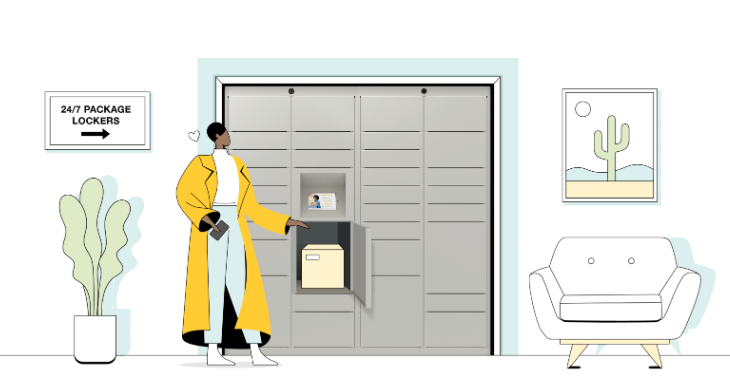
“The idea is to make the process much quicker, more automated, and more secure for both buildings and residents,” explains Dexter. “When a delivery person comes in, they go right to the locker, use their code to enter the package into the system, drop it in a secured locker, and go about their day. They get to move quickly, and property management staff doesn’t have to do anything.”

The Luxer Lens smart camera technology can also fast-track package deliveries. This proprietary software gives Luxer One’s cameras the ability to scan a package label and automatically enter it into the system.

“Typically, when a carrier goes to deliver a package, they have to open a list, scroll through names and find the person on the label,” notes Dexter. “With Luxer Lens, they can show the package to our camera and have it read, verified, and logged by the system. After that, the right-sized locker is opened, they drop it off, and they’re off to the next delivery.”

The process is equally convenient for residents. Once a parcel has been dropped into the Luxer One locker, the corresponding resident receives a notice on their mobile device with a QR code they can use to unlock the assigned locker and retrieve their package at any hour of the day.

Overall, Dexter adds, “It is one of the easiest systems for the carriers, the property, and the residents to use.”

Yet beyond streamlining the package delivery process, the Luxer One system is designed to bring speed, accuracy, and accountability to the package auditing process. Each locker system has a camera recording at all hours of the day, and property managers can access the system to see a full audit trail showing when each package was delivered, which locker was used, and who picked it up.

“So not only do you have the physical security of a 12 gauge steel locker door, but you also have 24/7 footage and a digital audit trail,” adds Dexter.

Signed, sealed, delivered

Package management is a growing priority, but it’s one of many that property teams must balance throughout their day. Here is where PropTech solutions like Luxer One can reduce the workload while enhancing delivery oversight, accountability, and security.

“The more you can take advantage of automation and smart technology in a multifamily building, the more you can save costs, work more effectively, and free up precious time for your staff,” says Dexter.

Learn more about Luxer One’s controlled access locker solutions at www.luxerone.com.