Articles Archive - Page 244 of 928 - REMINET
REMI

Green retrofit for historic Imperial Theatre in Saint John 

The historic 110-year old Imperial Theatre in Saint John, New Brunswick, designed by Philadelphia architect Albert Westover, will undergo an energy efficient modernization to reduce energy consumption by 62 per cent and greenhouse gas emissions by 135 tonnes.

Funding will come through a joint venture. Canada is investing $2,153,548 through the Green and Inclusive Community Buildings (GICB) program and Imperial Theatre is contributing $538,387.

Upgrades will include the replacement of the building’s aging HVAC system and gas-powered boiler with new heat pump and control systems, as well as upgrades to the building’s lighting systems.

“We have a responsibility to decrease our carbon footprint and make strategic changes in how our facilities operate by choosing cleaner and more efficient energy solutions,”  stated Angela Campbell, executive director of Imperial Theatre. “We also recognize it is a process; one that our organization takes seriously. This incredible grant will help Imperial take the next step toward that greener future.”

When the theatre first opened its doors to the public in 1913 it was billed as the ‘finest theatre in Eastern Canada,’ with best available amenities from its water piping to its theatrical equipment. The venue brought many celebrated names to the city, including actress Ethel Barrymore and John Philip Sousa.

Designated as a National Historic Site of Canada, the structure was built and financed by the Keith-Albee Chain of vaudeville houses and was erected upon the site of the Lyceum Theatre that was destroyed during the Great Fire of Saint John in 1877.


Childcare providers in Manitoba to receive $60-mil for facility upgrades

Early learning and child care providers in Manitoba will receive $60 million to carry out facility infrastructure improvements, curriculum development, and workforce retention.

As part of the Canada–Manitoba Canada-wide Early Learning and Child Care Agreement, the federal government is investing $45.9 million in grants, part of its $1.2 billion commitment over five years. Manitoba is contributing $14 million, which is part of its $4.8 million goal to equitably support school-age programming for children aged seven to 12.

There are three streams for the grants under the Canada-wide ELCC Agreement:

  • The Quality Early Learning and Environments Grant will offer $875 per licensed non-profit child care centre and home-based provider space to help improve aging infrastructure, equipment and materials.
  • The Enhancing Diversity and Inclusion Grant will offer $500 per licensed non-profit child care centre and home-based provider space to help ensure children of all backgrounds and abilities feel a sense of belonging and have the ability to participate in the program through enriched curricula, space adaptations, and staff development opportunities.
  • The Innovative Recruitment and Retention Grant will offer $200 per licensed non-profit child-care centre to help implement creative and innovative strategies to recruit, retain, and support a high-quality workforce. This includes a Retirement Enhancement and Retention Benefit that will offer a one-time Registered Retirement Savings Plan (RRSP) top-up of up to $500 per home-based child care license holder who contributed to an RRSP in 2022 to recognize home-based providers’ dedication to the child care sector.


Maple Reinders wins Royal BC Museum contract

Maple Reinders has been awarded a $204 million contract for the design and construction of the Royal BC Museum Collections and Research Building in Colwood, following a competitive design-build procurement process. Total capital project costs for the building are valued at more than $270 million.

Construction on the project is set to begin in the coming months, with completion expected in 2026.

The new 5,200-square-metre (163,611 square feet) building will be an advanced, sustainable, and culturally sensitive building that will serve as a community and learning hub for the region. Once complete, the new facility will house the Royal BC Museum’s collections, research departments, learning spaces and the BC Archives. Mass timber construction will be used extensively and the building will meet CleanBC energy efficiency standards, and be LEED Gold Certified.

Key areas of the Collections and Research Building will be open to the public, facilitating community access to the collections and to museum staff. Visitors will be able to interact with displays and artifacts that shed light on the history of the province and observe researchers at work in person and online in the media centre. The BC Archives will continue to provide research access to archival records of enduring value to the province in this new, state-of-the-art environment.

“We are humbled to have been chosen to design and construct this important cultural facility,” said Reuben Scholtens, vice president of major projects at the Maple Reinders Group. “Our team is committed to delivering a world-class facility that will not only serve as a community and learning hub but will reflect and pay respect to the deep cultural connections the local Indigenous peoples have to the place where the facility will stand.  There is a vibrant and compelling story to be told and we are enthused at the prospect of being able to assist in its telling.”


New Brunswick revises disaster relief formula

New Brunswick properties will be flagged on the provincial land registry and denied further disaster relief once they’ve received $200,000 in assistance for any one type of natural incident. The newly revised rules for potential payouts are framed as an incentive for homeowners to leave flood-prone areas.

This comes after 12 events have been declared disasters since 2014. With affected residential property owners eligible for up to $160,000 per disaster, the provincial government delivered about $369 million in aid over the nine-year period.

“All the provinces and the federal government are struggling with the rising costs and how to address them,” reports New Brunswick’s Public Safety Minister, Kris Austin.

Under the new formula, homeowners could receive a higher one-time grant, but will be eligible for no more than $200,000 cumulatively for multiple overland or coastal flooding events. Additionally, the provincial government has lowered the threshold for offering buyouts of damaged properties. Homeowners will now be eligible if the damage sustained in any one disaster event is equivalent to at least 50 per cent of the property’s market value or when damage from multiple flooding events equates to 80 per cent of the market value.

Common mistakes to avoid when hiring commercial cleaning salespeople

Is hiring a team and growing your business top of mind? Commercial cleaning, janitorial, and maintenance service companies often overlook the back-of-house operations that help grow their business. As much as you need frontline personnel to service your clients, hiring a solid sales team is equally important.

In this industry, there are many things to consider as a small business owner when the economic landscape changes, or in the case of recent days, is volatile and unpredictable. In strained economic times, starting or growing a small business can be risky, even for those opening a recession-resistant business like commercial cleaning.

As an owner or operator, keeping that “business mentality” outside of the product or service you’re offering is important. Owners and operators must develop robust business plans, be ready to pivot, and invest in people to keep their commercial cleaning or maintenance business viable and profitable.

For many entrepreneurs, hiring the right salespeople to get the revenue stream flowing is the first step. In the commercial cleaning franchise sector, entrepreneurs come from all backgrounds, professional experiences, and skill levels to launch unit franchises designed to help them succeed. While some have excellent back-of-house expertise and others shine on the front lines, commercial cleaning or maintenance business owners must focus on hiring the right people to create a balanced team.

When combing through resumes and interviewing candidates, there are some common mistakes you can avoid to build a winning team for your business.

Hiring a marketer instead of a true salesperson

Don’t make the mistake of hiring a marketing person when you need a salesperson. The lines sometimes get blurred between these two departments. If you suspect someone with a “business development” background may be a marketer, ask the right questions. Are they able to accurately communicate the need for professional cleaning services? Are they problem solvers? Are they client-centric? Although they do work very closely together, sales and marketing serve different purposes for your business.

Hiring the wrong sales persona for the position

Choose the right candidate for your business. Take a look at the five types of salespeople below, consider which category your current sales reps fall into, and adjust as needed.

  1. Order taker: This person is pleasant, reliable, and typically inexpensive but does not excel at prospecting, following up, or closing.
  2. Business developer: This candidate creates new business opportunities, but they could present a weakness when making the necessary number of cold calls or visits.
  3. Account manager: These types build client relationships, generally follow-through, and demonstrate a high close rate, but may be weak in prospecting, as their experience tends to be limited.
  4. Closer: This person excels in the sales process when given a warm lead and is highly skilled at getting prospects to a decision point. Similar to the centre on a basketball team, think about them putting up a lot of points, but needing the team to feed them the ball before they finish the job.
  5. Prospecting closer: This candidate is the overall sales professional. This could be considered the jack of all trades, often not as effective as closers or as skilled at relationship management as the account managers. On the basketball court, the prospecting closer is like the point guard, creating opportunities and finishing at the hoop, but rarely outscoring the star centre.

Everyone on your commercial cleaning or maintenance sales team has specific strengths and weaknesses, so don’t hitch the future of your business to just one salesperson’s wagon.

Hiring someone who regularly colours outside the lines

When building and managing your commercial cleaning or maintenance sales team, be on the lookout for salespeople who disregard the standard to suit their needs. Set up clear incentives, measurement tools, standard operating procedures, and expectations from day one, and regularly review those with your reps.

Discovering new sales leads and closing contracts can make or break your business, so your sales reps need to understand the importance of anticipating customer needs.

Not empowering your sales superstars

One of the best things you can do for your sales team is to measure the right things at the right time to empower your superstars. Measure and report behaviors that lead to results – every day. It could be appointments, bids, or follow-up calls. Once they get the process down, you can then move to weekly progress reports. If someone falls behind, reassess behaviors and outcomes daily until they improve.

The success of your sales team (and your business) ties directly to the growth of your objectives and the feedback from your clients. Remember, learning about the commercial cleaning and maintenance industry from the client’s viewpoint is an experiential journey. Clients are looking to fill a no-frills need and outcome. Ensure your team understands the “desired need and expected outcome” from the start and reverse engineer the processes for a sales team of stars.

Adam Povlitz is CEO & President of Anago Cleaning Systems, one of the world’s leading franchised commercial cleaning companies and a leader in technological advances relating to business operations and janitorial services.

Report digs into homebuyer sentiment for 2023

A new Leger survey, commissioned as part of RE/MAX Canada’s 2023 Industry Trends Report, found homebuyers are primarily concerned about the rising cost of living and inflation, followed by the lack of affordable housing options and the rising cost of rent, which impacts the ability to save for a home.

The report also found that one in five homebuyers and sellers endorse new building developments that address the missing middle gap and 32 per cent are optimistic the housing market will regain balance.

Beyond the transactional impacts, the challenges felt in the Canadian housing market could touch other industries as well. According to RE/MAX Canada, this includes impacting employers’ and companies’ ability to attract new workers who may find it difficult to secure housing; local communities’ ability to attract and retain new businesses to support economic growth due to rising office rental prices, lack of availability, and more.

Christopher Alexander, RE/MAX Canada President, advises how wide-spread impacts could be mitigated. “I encourage visionary thinking and solutions that may include reforming municipal zoning laws to allow for a greater diversity of housing; expanding capacity for laneway developments; and using available land to drive housing supply in a manner that doesn’t compromise climate adaption and mitigation efforts,” says Alexander. “For that to happen, some tough decisions need to be made.”

The survey underscores that most Canadians strongly believe governments should prioritize the affordability and supply crisis, while 41 per cent feel that removing zoning and development red tape is a key measure to improve housing supply. A majority of 66 per cent believe that protecting the environment (i.e. Greenbelt in Ontario) is essential for quality of life in the long-term

“Our severe lack of supply in every town, community, and city across the country, seeps into almost every facet of the lives of Canadians,” Elton Ash, executive vice president of RE/MAX Canada, said in a statement. “Not only are their housing options being impacted, but a tighter housing market may compromise job prospects, among other things, placing even greater urgency on governments and housing industry experts to address Canada’s affordability crisis.”

Regional industry trends

The top trends anticipated to impact Greater Vancouver Area’s housing market in 2023 include higher interest rates, the mortgage stress test and low inventory, which is compounded by looming demand from move-over buyers and the influx of new immigrants to the city.

The Greater Toronto Area is also likely to feel the impact of the rising cost of living, increased demand from a growing population, unemployment status, the mortgage stress test and housing diversification as it relates to “the missing middle.” With the higher cost of living hobbling first-time homebuyers’ capacity to buy, rental prices are also hitting new highs. The added demand of immigration is expected to drive up both residential sale and rental prices unless more housing inventory is added to the market.

In Edmonton, the rising cost of living is a primary concern, however, unique to the region is the growing demand from inter-provincial migration, as Canadians continue to search for pockets of affordability across the country. According to local RE/MAX broker, John Carter, this is likely to put further strain on an already-limited housing supply.

Winnipeg’s market is likely to experience many of the same factors that are expected to impact other regions surveyed, yet higher taxes are also likely to be top of mind in 2023.

In Halifax, red tape impeding development and “missing middle” housing is a prominent consideration in 2023. Together, these factors have contributed to stifling accessible and affordable housing options in a market that is already facing limited supply.

Photo by Ketut Subiyanto


GTA new home market quiet in January

The new home market in the Greater Toronto Area experienced a slow month in January, according to the Building Industry and Land Development Association (BILD).

There were 567 new home sales, which was down 81 per cent from January 2022 and 70 per cent below the 10-year average, according to Altus Group, BILD’s official source for new home market intelligence. This was the lowest number of new homes sold in January since Altus Group began tracking in 2000.

Only 186 single-family homes, including detached, linked, and semi-detached houses and townhouses (excluding stacked townhouses), were sold, down 70 per cent from January 2022 and 78 per cent below the 10-year average.

Condominium apartments, including units in low, medium and high-rise buildings, stacked townhouses and loft units, accounted for 381 units sold—the lowest level for January in 14 years. This was down 84 per cent from January 2022 and 64 per cent below the 10-year average.

“New home sales started 2023 on a very quiet note,” said Edward Jegg, research manager at Altus Group. “Developers, particularly in the condominium apartment sector, continue to bring new units to the market though buyers remain largely hesitant.”

With the launches of two large condominium apartment projects in January, total new home remaining inventory increased compared to the previous month, to 13,490 units, the highest level in two years. This included 11,869 condominium apartment units and 1,621 single-family units, representing 7.5 months and 4.8 months of inventory respectively, based on average sales for the last 12 months. A balanced market would have 9 to 12 months of inventory.

“We are seeing a modest increase in inventory, due to prospective home buyers sitting on the sidelines as a result of current monetary policy,” said BILD President & CEO Dave Wilkes. “But given the rate at which the population of the GTA and the province is growing, we need to build 1.5 million new homes in Ontario in a decade. We are committed to working with all levels of government to implement the changes necessary to meet this ambitious goal.”

The benchmark price for new single-family homes decreased in January compared to the previous month, to $1,730,359, which was down 2.3 per cent over the last 12 months. The benchmark price for new condominium apartments decreased in January compared to the previous month, to $1,127,192, which was down 2.0 per cent over the last 12 months.

Graham awarded Cariboo Memorial Hospital

Interior Health has signed a contract for the construction of the Cariboo Memorial Hospital (CMH) redevelopment project with the preferred proponent, Graham Design Builders LP.

“Signing this contract is a major milestone in the Cariboo Memorial Hospital redevelopment project,” said Adrian Dix, minister of health. “Soon people will see shovels in the ground as the modernized and expanded hospital begins to take shape. With a new emergency department, mental-health unit and cancer department, the redeveloped CMH will be a gamechanger for decades to come.”

The CMH redevelopment project includes an addition to the existing hospital as well as renovations to the existing facility. The addition will be three storeys, plus a basement, and approximately 9,300 square metres (100,100 square feet). The redevelopment will add 25 in-patient beds for a total of 53.

People will have increased access to health-care services as the expanded hospital will include a new emergency department, medical/surgical in-patient unit and mental-health and substance-use in-patient unit as well as an expanded ambulatory care and oncology unit, maternity and women’s health unit and pharmacy. The hospital will also include administrative, educational and training spaces for the University of British Columbia’s Faculty of Medicine.

The addition at CMH will be designed and constructed to achieve Leadership in Energy and Environmental Design (LEED) Gold certification at a minimum.

Construction will happen in two phases. Phase 1, which includes the addition, will begin in March 2023 and is expected to finish in fall 2026. Phase 2, which includes renovations to the existing hospital, will begin in fall 2026 and is scheduled to be complete in early 2029.

The budget for the project is more than $366 million and will be shared by the province and the Cariboo Chilcotin Regional Hospital District.

Accessible public bathrooms show bad form

Bad form abounds in purportedly accessible public bathrooms, whether it’s fixture configurations that don’t suit the needs of people with disabilities or the conduct of able-bodied people who misappropriate the space. Accessibility advocates participating in a recent online discussion highlighted some practical adjustments and low-cost investments that could improve safety and convenience, giving people with disabilities more assurance to learn, work, play, enjoy social relationships and contribute to the economic and cultural life of their communities.

“At its core, where we go to the bathroom when we’re away from home is a question about equity and our right to the city,” observed the discussion moderator, Rhonda Solomon, a PhD candidate and researcher at University of Toronto’s School of Cities and Centre for Global Disability Studies.

That has prompted the sharing of details about private bodily functions so that designers, contractors, landlords and property/facility managers can gain a clearer understanding of how best to accommodate — or avoid thwarting — the intended patrons of accessible bathrooms. Julie Sawchuk, a Rick Hansen Foundation Accessibility Certification (RHFAC) professional and author of the resource manual, Building Better Bathrooms, explained some of the practicalities from her perspective as a paraplegic wheelchair user reliant on a catheter to empty her bladder.

“These are uncomfortable conversations, but if you don’t know the whys behind an accessible toilet set-up then you can’t really understand why a set-up just isn’t right,” she said. “I could have filled this presentation with stories of what not to do because that’s primarily what I see.”

Similarly, Michelle Cousins, mother and principal caregiver to a young teenager reliant on a wheelchair, decried the lack of accessible bathrooms properly equipped for children’s smaller physical size and shorter reach. That’s an inadequacy she has encountered even within relatively recently constructed schools where bathrooms comply with adult-sized accessibility standards.

“When I had to approach the school board and say: ‘this bathroom is not accessible’, they were perplexed,” she recounted. “How we do some very intimate tasks is not something that most people talk about. Yet it’s through this vulnerability and this willingness to share that we really educate and inform, and hopefully bring about change.”

The basics of fixture placement and respectful accommodation

Sawchuk sketched out some of the basics, beginning with well-lit identifying signage that includes Braille and is placed adjacent to the door latch for maximum visibility and reachability. Inside, the sink, taps, soap dispenser and hand-drying towels/equipment should be reachable from a sitting position and all reachable from each other. There should be an adult-sized changing table and an emergency call system.

There should be a minimal height differential between toilet seats and wheelchairs. U-shaped toilets with a space in front allow catheter-users to more easily reach between their legs. That should go in tandem with a toilet seat lid that will protect and cushion their backs as they lean backwards. Grab-bars should be installed on both sides of the toilet and the sanitary disposal container should be easily reachable from the toilet.

“Grab-bars serve the purpose of balance,” Sawchuk advised. “If you need one grab-bar, more than likely you would benefit from having the use of two grab-bars.”

The toilet roll holder should be placed so it doesn’t obstruct gripping of the grab-bar or pose a hazard for knocking hands or elbows, and it should be operable with limited dexterity. Uncovered toilet rolls that can be easily dispensed from below the grab-bar or within the grab-bar itself are recommended.

“In commercial set-ups, you always see those giant toilet roll holders, and where are they? Always right above the grab-bar,” Sawchuk noted.

Meanwhile, grab-bars calculated to be within an adult’s reach risk throwing children off balance, particularly if their feet can’t touch the floor because the toilet is geared to an adult’s height. That height differential can also create an added challenge for those, like Cousins’ daughter, who use a transfer board between their pediatric-sized wheelchair and the toilet.

“I have become the human grab-bar for my daughter,” she said. “There is a gap in public settings between what we need and what we find.”

Among other frustrations, she calls out able-bodied people for using accessible public bathrooms. Although there is general social censure around illegitimately commandeering designated accessible parking spaces, attitudes tend to be more ambivalent if accessible bathrooms are conveniently nearby and unoccupied at the time.

“There is nothing inherent in the design of these accessible bathrooms that safeguards the space for the intended end-user, which is the person with the disability,” Cousins reflected. “We have to rely upon social conditioning and the goodwill of others to make sure they reserve those spaces for those who need it.”

Looking to the United Kingdom’s example

Joining the conversation from afar, Karen Hoe, national development manager for the Changing Places program in the United Kingdom, briefly outlined her organization’s successful campaign to gain regulatory recognition for accessible facilities that can meet more complex needs. Since June 30, 2022 specified new buildings or major expansion projects — including: assembly space for a minimum of 350 people; malls with a minimum of 30,000 square metres (322,000 square feet) of retail space; community centres and sports venues with at least 5,000 square metres (54,000 square feet) of floor area; retail stores with a minimum of 2,500 square metres (27,000 square feet) of floor space; hospitals and primary health care facilities; and cemeteries and crematorium buildings — must comply with Changing Places criteria in addition to existing requirements for standard accessible bathroom facilities.

The new Changing Places standards mandate a space that is at least 12 square metres (129 square feet), accommodating a height-adjustable adult-sized changing table, a ceiling hoist to lift patrons from their wheelchairs onto the changing table and a peninsular toilet so that caregivers could stand on both sides, if necessary. It’s estimated that about 7,000 new Changing Places facilities will be added to the U.K.’s national building stock annually via these standards, augmenting the approximately 1,800 that now exist.

“The Changing Places logo is trademarked. If you see that logo, it’s a guarantee of what you’ll expect to find behind that door when you walk in,” Hoe affirmed.

Accredited facilities are registered and highlighted on a publicly available national map. The Changing Places program is also working with the U.K. government to oversee the design and installation of 600 new facilities, funded with a £32 million (CAD $52 million) allocation in the 2020 budget, and targeting England’s local authorities and motorway service stations.

Sawchuk applauded the United Kingdom’s leading example, but urged building owners/managers everywhere to proactively upgrade their accessible bathroom facilities ahead of regulatory dictates.

“Kids with disabilities become adults with disabilities, and if you need a changing table then you need a changing table,” she said. “And that means that you don’t have to use the floor or the back of a van or a folding table at an arena.”

Barbara Carss is editor-in-chief of Canadian Property Management.

Energy-efficient housing complex opens in Montreal

The Îlot Rosemont senior’s housing complex recently opened in Montreal, featuring 193 affordable units and direct access to the Rosemont metro. The newly opened building also serves as an administrative centre for the Office Municipal d’Habitation de Montréal (OMHM) and its 300 employees.

Touting exceptional energy efficiency features, Huntsman Building Solutions (HBS) and partner Isolation Multi-Services Inc. (IMS) were brought on board to effectively address the requirements of the project and meet the demands of the harsh Quebec climate. Îlot Rosemont is described as “a sophisticated initiative” led by the OMHM with the support of GRT ‘Bâtir son quartier’.

“The insulation installed at Îlot Rosemont will require zero maintenance and remain durable for the lifetime of the building,” said Geneviève Savary, Sales Manager Quebec, Specialty Products with Huntsman Building Solutions. “Twenty years from now, exterior, and interior finishes may look different and require touch-ups, but the insulation will be in prime condition.”

The spray foam insulation used for this project is known to create a more comfortable living environment, while also protecting building occupants from the negative effects of Radon build-up. Radon is an odourless, tasteless, colourless gas and the leading cause of lung cancer in non-smokers. HF-based, closed-cell spray foam functions as an air barrier, which prevents Radon from seeping into buildings and accumulating to deadly concentrations.

“We wanted to create a living environment that was not only comfortable for the people living here, but also aesthetically pleasing and welcoming to the community at large,” explained Vincent Brouillette and Martin Côté, owners of IMS. “Spray foam insulation allowed us to achieve architectural ambitions that traditional insulation methods could not, and we’re thrilled that residents will enjoy lower energy costs without sacrificing building beauty and home comfort.”

According to the partners, use of the spray foam insulation could save as much as 110,000 kg of CO2 over a service life of 75 years.

To learn more about the building products used in this project, visit  https://huntsmanbuildingsolutions.com/en-CA. 

Preparing for the EV Onslaught

The days of sitting back and waiting to see how Canadians embrace the electric vehicle (EV) movement are over. In 2022, the federal government announced it is mandating electric car sales as of 2026. This means condo corporations, boards, and property managers must act decisively if they want to choose a strategy to ensure their parking facilities are properly equipped at a cost that isn’t prohibitive.

But getting that ball rolling isn’t easy. It can be daunting and confusing, especially given the way EVs have been slow to catch on, with costly upfront considerations creating buyer hesitancy. While developers of new single-family homes and multi-residential buildings can include zero-emissions vehicle (ZEV) infrastructure in their building plans, existing properties aren’t so lucky. Most high-rise residences today are underequipped to meet the current level of EV need, let alone what is projected. All around the world, governments are targeting for a complete switch to EVs by 2030 or shortly thereafter.

Here in Canada, car manufacturers will be subject to penalties for not producing and selling the right quota of electric cars as it progresses towards its target of reaching 100% ZEV sales by 2035.  Annually, that translates to approximately 395,000 new ZEV sales in 2026, 1.2 million new ZEV sales in 2030, and 2.0 million new ZEV sales in 2035.

“As we are seeing in European markets and in some U.S. states, the mandating of electric cars will require a huge investment in charging infrastructure to meet the influx of need,” said John Nassar, Founder at Hwisel EV, a company that specializes in supplying, installing, and managing EV charging Infrastructure. “Right now in Canada, many condo boards are struggling to figure out the best way to implement this technology in a manner that will benefit current and future residents and take pressure off the corporation.”

With so few EV drivers to accommodate in the past, charging stations in condominiums were typically dealt with on a case-by-case basis. Each owner would approach the board and work privately toward getting their EV charger installed. That said, the power needed to supply the parking space generally came from the corporation’s electrical infrastructure, which in most cases had a limited capacity for additional electrical loads. Sometimes this meant non-EV drivers were subsidizing the cost for the EV-users, or future EV drivers were excluded given that early adopters used up all the available electrical capacity in the building.

Although this approach is still available and suited to smaller buildings with limited to no parking, there is a better option for condominiums looking for an alternative, long-term solution, with less capital requirements and administration. According to Nassar, the approach is similar to how Bell, Rogers, and Telus provide their Internet, cable, and phone services directly to the unit-owner.

“Going this route, the condo corporation does not own or pay for the infrastructure or the electricity; rather it is provided directly to the owner as a service, transferring all operational costs and obligations onto the supplier, and providing key savings,” he said.  “Additionally, since all condos need a service provider to bill and collect electricity charges from EV users (even if the condo purchases the infrastructure), extending the service to also include the infrastructure makes sense. For a small additional monthly fee, they get a complete solution that is equitable, does not require an investment, and is turnkey.”

Level 2 or Level 3?

In addition to strategy and service considerations, another important distinction is the level of charging equipment needed for the property or unit-owner. While Level 2 chargers are considered to be fast, effective and affordable by current standards, Level 3 is the fastest charging system available, but requires significantly more power. As such, there are limitations to where this charger can be installed.

“At Hwisel, we provide worry-free Level 2 and Level 3 stations for direct purchase, or through affordable monthly plans,” said Nassar. “Additionally, our unique monitoring service allows us to fix EV charging issues remotely and deliver software upgrades, helping our customers save time, energy, and money.”

Find out which EV plan is right for you at www.hwisel.com


Looking at leaks in your building

As we get closer to spring weather and the snow starts to melt, leaks can become a serious threat to a building, stopping work, causing internal damage, and forcing expensive repairs. If you get a leak and are not sure where it’s coming from, there are a few things you can do to get to the source and determine the best course of action.

Finding a pattern

The first step in locating the source of your leak is trying to determine whether it is a plumbing leak or a weather-related leak. Do you only get water inside the building when it rains, the snow melts, or you experience extreme weather? Noticing the pattern will help you narrow down a few places you can look to locate the source.

Plumbing leaks mean water could be coming from your ductwork, so check to see whether there is condensation and that will hint at the source. Are you seeing water coming through the foundation? If so, it could be groundwater leaking into your building.

Knowing your building

If you are getting leaks or see water stains in the ceiling, knowing how your building is built can help you investigate. Just because it’s coming from above, that does not necessarily mean it is coming from your roof. Conversely, a roof leak does not always look like a dripping ceiling. Water can travel through the building before you see it on the interior, so knowing where your plumbing lines, mechanical lines, and where storm drains are can help you determine the source of the leak by process of elimination.

Narrowing down the location

Before you call in a professional to properly address the leak, it’s helpful to get as close to narrowing down the location of the leak as possible. When you have a general idea of the area, conduct a visual check to look for obvious sources like missing caulking, holes, or exterior damage that could be the cause.

If you suspect the source, you may want to conduct a water test to try and confirm. This involves spraying water from a hose on the suspected area to see whether this exacerbates the leak. If it does, you know you’ve found the source and can take action to have it fixed.

If you have water inside your building, you need to take care of it before it causes expensive interior damage, stops business, or threatens the integrity of your building. Determining the source can save the time it takes to repair the area once you decide the best course of action.

CPP names new global head of real assets

Maximilian Biagosch has been appointed global head of real assets for Canada Pension Plan Investment Board (CPP Investments). Already a member of CPP Investment’s senior management team, he will continue to serve as the fund’s European head.

Biagosch joined CPP Investments in 2015 following senior roles at Permira Advisers LLP and tenure as an investment banker in the London offices of Deutsche Bank and BNP Paribas. He holds a Master of Laws from Ludwig-Maximilians-Universitat in Munich and serves on the boards of Petco and BAI Communications.

“We have valued Max’s experience, strong leadership and demonstrated performance on CPP Investments’ senior management team — all attributes that position him well to lead our global real assets program,” says John Graham, president and chief executive officer of CPP Investments.

As well, Jon Webster will be joining CPP Investments as chief operating officer, arriving from Boston Consulting’s financial institutions and technology group where he was managing director and partner. He holds a Bachelor of Science in Industrial Mathematics and a Ph.D. in Mathematics from Loughborough University in the United Kingdom, and will now oversee CPP Investments’ technology, data, investment operations, security and corporate services functions.

“Jon’s successful track record in operations and technology-enabled transformation with financial organizations makes him ideally suited to both take on the role of COO and contribute important insights to the organization,” Graham observes.

Vancouver streamlining building permit times

City of Vancouver is taking several steps to streamline building permit times. As part of the city’s Permitting Improvement Program (PIP), building permits are now available electronically through the Electronic Plan (ePlan).

“Vancouver is in the midst of a housing crisis – permitting delays have had a significant impact on both housing supply and our local economy,” said Mayor Ken Sim. “The updates put forward are an important first step towards cutting permit wait times for Vancouver residents and businesses. We are excited about these changes and what they will mean for the future of our city.” Designed to digitally transform and streamline the permitting process, PIP has also resulted in:

  • Plans for houses, duplexes, laneways and townhouses can now be checked in as little as two and half weeks, saving over nine weeks.
  • Updated inspection review processes significantly reduce the need for applicants to address/redo previously unpermitted work, unless it is a life-safety concern.
  • The Tenant Improvement Program provides a dedicated building permit review stream for office tenants in eligible commercial buildings, allowing them to receive a permit in as little as two weeks.

Meanwhile, staff continue exploring technology to provide more real-time permitting performance, and are looking to establish an external advisory panel for input on additional proposed improvements.

The city is also looking to provide education and in-person support for those who need assistance in submitting applications. For example, nearly 45 per cent of all low-density housing permit applications submitted in 2021 were incomplete, which can create delays in issuing permits.

On February 22, the city is launching a business license online application pilot to allow home-based businesses to apply, track, pay and receive their business licence electronically. Providing a central, online source of information for applicants frees up staff time and allows applicants to track their applications in real time, which will help them plan more effectively.

Upon completion of the pilot, the city will expand the online application form to all business categories later this spring.

To further streamline the permit process, the city continues to review opportunities including:

  • Simplifying conditions for development permits.
  • Simplifying the review process for renovation permits.
  • Reducing both the number of steps and staff required to review applications.
  • Improving letters to applicants so they easily understand items they need to address/rectify before a permit can be issued.


Canada is third in world for LEED buildings

Canada ranks third in the world for LEED certified buildings on USGBC’s annual list of Top 10 Countries and Regions for LEED in 2022.

The ranking highlights countries and regions outside the United States that are making significant strides in healthy, sustainable and resilient building design, construction and operations. In 2022, Canada certified 248 projects, representing more than 5.3 million gross square meters (GSM) of LEED space.

“Over the last 20 years, CAGBC, its members and stakeholders have proven that green buildings have positive impacts on people, business and the planet. They also drive the innovation and skills development needed for a strong economy,” said Thomas Mueller, president and CEO, Canadian Green Building Council (CAGBC). “LEED certification continues to be the gold standard for green building, offering Canada’s building sector a holistic way to deliver on sustainability targets, from energy efficiency and wellbeing, to resource use, carbon emissions and resiliency.”

Mainland China topped the list with more than 16 million GSM certified to LEED in 2022 and India ranked second with more than 10 million GSM.  Brazil and Sweden rounded out the top five.

These countries represent the ever-growing international demand for certified LEED green buildings that help reduce environmental impact and support health and well-being.

LEED continues to be the most widely used green building rating system in the world and provides a framework for healthy, highly efficient, and cost-saving green buildings.

The list ranks countries in terms of total LEED projects as of December 31, 2022. The U.S. is not included in the list but remains the world’s largest market for LEED with more than 47 million GSM certified space in 2022.


Vancouver Chinatown receives $1.8 million

The Vancouver Chinatown Foundation announced a $1.8 million investment from the Government of Canada to revitalize the city’s historic Chinatown neighbourhood. The funding will support infrastructure improvements within the neighbourhood, illuminating iconic cultural landmarks and enhancing tourism experiences.

The funds will support the Vancouver Chinatown Foundation’s mission to drive the economic, cultural, and physical revitalization of Chinatown, one of Vancouver’s most historic and culturally significant neighbourhoods while preserving its irreplaceable cultural heritage.

The federal funding will support the enhancement of iconic neighbourhood buildings, including the Chinese Cultural Centre, the Millennium Gate, the Chinatown Storytelling Centre and the Sun Yat-Sen Classical Gardens, with new lighting, signage, and other improvements.

“On behalf of the Vancouver Chinatown community, we extend our gratitude to Honourable Harjit S. Sajjan, Minister of International Development and the Government of Canada for their support in the revitalization of this historic neighbourhood, said Carol Lee, Chair of the Vancouver Chinatown Foundation. “Chinatown is home to many legacy, new, and small businesses and organizations that rely on tourism as an economic driver. Through infrastructure and cultural landmark enhancements and celebrations of our Chinese Canadian identities, the investment from PacifiCan will reignite a once thriving tourism industry in this neighbourhood.”

This investment will also go toward expanding the Light Up Chinatown! festival, held annually for two days in September in celebration of Vancouver’s Chinatown community. Each year, Light Up Chinatown! illuminates the streets of Chinatown with lanterns and features outdoor performances, traditional food tastings and other family-friendly activities. Last year, the Light Up Chinatown! festival drew over 8,000 visitors to the neighbourhood.

“Tourism is an important contributor to the economic sustainability of the neighbourhood and to its cultural attractions,” said Royce Chwin, president and CEO of Destination Vancouver. “At Destination Vancouver, we want to see Chinatown, not just survive, but to thrive and overcome the recent challenges that the neighbourhood has experienced.”


Average rent in Ontario up 13.5 per cent

As reported by Rentals.ca and Urbanation, Ontario placed third among provinces in January for average rent increases, up 13.5 per cent for both condo rentals and apartments. Alberta had the highest annual rent increase  in January with 14.6 per cent growth, closely followed by British Columbia at 14.4 per cent.

The average listed rent for all property types in Canada rose 10.7 per cent year over year, making January the ninth straight month for double-digit increases. The average listed rent for all property types was $1,996, decreasing 0.5 per cent from December after averaging above $2,000 during the previous two months.

“The Canadian rental market started 2023 where it ended in 2022, posting sharp annual rent growth amid low supply and quickly rising demand,” said Shaun Hildebrand, president of Urbanation. “Outside of Toronto, rent increases are becoming more acute in markets in BC and Alberta, which are experiencing relatively strong rates of population growth.”

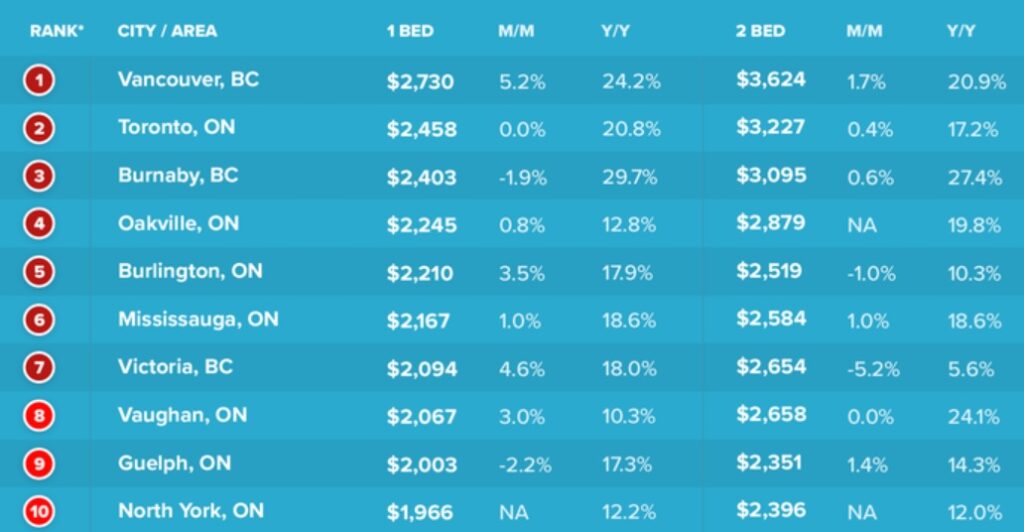
average rent Jan 2023Average rent by city 

Toronto finished second in terms of Canadian cities with the highest average rent in January. For a one-bedroom, tenants were paying $2,458 per month on average and $3,227 for a two-bedroom. Oakville, Ontario, finished fourth on the list and Mississauga finished sixth.

Vancouver and Calgary had the highest increases in average rent for condominium rentals and apartments in January, with annual growth of 22.9 per cent and 22.7 per cent respectively.

Average annual rents for condo rentals and apartments in Ottawa rose 11.5 per cent in January; average rents increased 9.3 per cent in Edmonton and average rents for condo rentals and apartments were up 7.9 per cent in Montreal.

Find out more at www.rentals.ca