Articles Archive - Page 241 of 928 - REMINET
REMI

Tania Artenosi named new OREA president

Tania Artenosi is the new president of the Ontario Real Estate Association (OREA), which represents 96,000 brokers and salespeople who are members of the 34 real estate boards throughout the province.

In her new role, Artenosi will lead OREA’s efforts to continue advocating for affordable homeownership, fighting for fair and equitable access to homes across the housing spectrum, and establishing Ontario realtors as North American leaders in professional standards and education.

She has been active in the real estate profession for 16 years. At OREA, she previously served as a director-at-large, chair of the standard forms committee and as a member of the marketing and communications committee.

“Standing up for our members and bringing affordability closer to home for Ontarians across the province will be my north star as OREA’s President in 2023,” she said in a press release.

In addition, Oakville-based real estate broker Rick Kedzior was elected 2023 president-elect and will also serve as director-at-large for the upcoming year. “In recent years, we’ve made great progress in our mission to help young Ontarians and their families find great places to live, work, and thrive, creating vibrant communities across the province,” said Kedzior.

The 2023 OREA Board of Directors also welcomes the following new members:

  • Lisa Patel, director-at-large;
  • Andrew McAllister, provincial director for Central Ontario; and
  • Kimberly Fairley, provincial director for Northern Ontario.

Getting paid in construction

In the construction industry, there is no shortage of challenges. One of the most significant is managing cash flow due to delayed payment and non-payment. In B.C., the lack of prompt payment legislation and permitting approval times are major obstacles for the steady, positive cash flow required for a healthy industry and economy.

Prompt payment legislation, permitting delays and supplementary conditions were three pressing issues discussed during a construction keynote in Vancouver.

David Volk, partner at Jenkins Marzban Logan, explained supplementary conditions are amendments, revisions or changes to standard form construction contracts. While they are often used to reflect the project and client’s unique needs, the conditions do add complexity and there is no case law, he said.

Pay-when-paid clauses are increasingly common in today’s supplementary conditions. “General contractors are adopting them across the board because they don’t want to carry the cash flow issue – managing the subcontractor’s payments or delay claims,” said Volk.

According to Katy Fairley, “cash flow is the number one hot button topic” in construction.

“One of the main items that we see modified in supplementary conditions are the payment terms,” she said, emphasizing she has no sympathy for owners who can’t pay their bills on time because “it’s not up to contractors to finance construction work.”

“At BCCA, there’s no more important topic than bringing prompt payment legislation to B.C. to assist with cash flow,” said Fairley, who is the association’s industry standard practices consultant.

“What we’ve seen across Canada and other jurisdictions is that it can work. B.C. is behind the times in this topic. B.C. is unique and stands out for the failure to have this sort of legislation.”

While there is no current progress on prompt payment legislation, Fairley said all the construction associations continue to push very strongly on the issue. “Prompt payment is going to be that first great step to helping resolve cash flow for contractors.”

Permitting delays also impact cash flow and is a longstanding headache for getting projects off the ground in B.C. The extreme backlog of permitting adds risk, complexity and instability to the industry.

Scott Kennedy, principal of Cornerstone Architecture, stressed there are numerous problems with the administration of the permitting processes at municipalities. And that the current economic and market environment is just adding to them. “Permitting times are taking projects that were profitable and making them unprofitable.”

“I want to see a client focused municipal approval system – not a bureaucracy approval system. They must be facilitators and not gate keepers,” he advocated, adding the delays especially impact high performance buildings. “All these different departments need to be on the same page instead of working in all these silos. It has to be a more collaborative environment.”

Tim Ryce, chief building official for the City of North Vancouver, agreed there are permitting problems and their municipality has taken steps to implement solutions.

He discussed several updates and changes at the city to improve permitting delays including creating a unified service centre – a one-stop shop – to streamline communications and operations in the building division along with a fully digital permitting process.

The industry can help in the process by making sure applications are completed properly.

“We have major gaps in application completeness and inspection failures,” noted Ryce. “Let’s work together and have full and complete designs and applications coming in. If the process worked perfectly, there would be no need for administration. Give me a perfect application. Revisions are terrible which costs construction delays.”


Cheryl Mah is managing editor of Construction Business.

The benefits of automated and high-tech cleaning

There are endless pros and cons to the continuous evolution of automated and high-tech cleaning. When it comes to the workplace, many people argue that machines and technology are replacing the need for human employees. However, studies show that implementing automation in the workplace alongside employees can greatly improve workflow and efficiency.

When cleaning and maintenance professionals have access to automated and high-tech machines, it results in greater facility safety and better job efficiency. At least 41 per cent of employees say that stress makes them less productive. Automated and high-tech cleaning can increase productivity, boost employee satisfaction, and help in furthering the success of your facility.

What is automated and high-tech cleaning?

Technology has been a part of the workforce for a long time. However, it’s only within the past five to seven years that technology really started to change the game for the cleaning industry, going beyond basic sponges and buckets of water. Instead of manually mopping an entire facility, many facilities will now use robotic scrubbers that work at a faster and more powerful pace or can clean floors on their own with little assistance from a cleaning professional.

Along with automatic machines and multitasking cleaning technology, there are also apps and other systems that can alert facility workers when a specific area needs attention. This can be useful to let your team know when a machine is low on battery or needs to be filtered. Another great benefit to high-tech cleaning is that many are environmentally friendly. This benefits your facility by using greener products and practices that help the planet by reducing your carbon footprint.

RELATED: Sustainability and the cleaning industry

Safety first  

The pressure to keep facilities clean has dramatically increased in recent years. This means that professionals need to be using the most effective methods and products. A significant benefit of technology in the cleaning industry is that it has made cleaning processes much safer. Before the implementation of electrochemically activated cleaning technology, many cleaning professionals came in direct contact with harmful cleaning chemicals. This can lead to health problems such as skin irritation, difficulty breathing, and even certain cancers.

High-tech cleaning allows for an increased barrier between cleaning professionals and the products they use. Touch-free systems such as automatic paper towels and soap dispensers significantly reduce lingering bacteria in public restrooms that can lead to illnesses and the spread of germs. This helps keep occupants and employees safe and shows consideration towards the health of those who enter your facility.

Work smarter, not harder

The mission behind automation and high-tech cleaning is not to take jobs away from people but to help relieve the physical labour and demands that come with working in the cleaning industry. Recent studies show that 62 per cent of employees that face burn-out lack energy and feel worn down. Along with burnout, the current pressure of labour shortages means that cleaning professionals are being asked to do more jobs with less people. This is when technology can make a substantial difference to workload and employee satisfaction.

When cleaning professionals are trying to juggle multiple tasks with little to no help, it increases stress and reduces productivity. This means that the cleanliness and safety of facilities become a greater risk. With the use of advanced machines such as robotic floor scrubbers, carpet cleaners and facility systems, cleaning professionals can clean areas in a shorter amount of time, exert less physical energy and ensure that a high-quality job is done every time.

A cleaner future

As more and more companies turn to the use of technology to increase productivity and make the workload lighter for employees, the cleaning industry is moving in the same direction. When it comes to the cleanliness and safety of a facility, it’s crucial to ensure that cleaning procedures meet the occupants’ expectations. The benefits of automated and high-tech cleaning mean an increase in the care put into your facility as well as making work more effective and efficient for employees.

David Jackson is the General Manager for GSF USA in Rockford, Illinois. GSF USA is a leading provider of cleaning services. For more information, visit www.gsf-usa.com or contact David Jackson at [email protected].  

Top 10 ceramic tile trends

Coverings, North America’s largest international tile and stone exhibition and conference, has revealed the top 10 ceramic tile trends for this year.

The trends were gathered and forecasted by the three leading international tile associations and sponsors of Coverings 2023 — Ceramics of Italy, Tile Council of North America and Tile of Spain. The conference takes place April 18-21, in Orlando, Fla.

The top 10 trends are:

Bricks Tile
The humble brick conjures a handmade feeling, while also serving as a module for creating wholly unique compositions. Ceramic tile can be stacked horizontally or vertically to create monochromatic environments or mixed with different colours to construct myriad patterns like stripes, chevron and herringbone.

Cemented Tile
Concrete looks can bring visual harmony to a space and still evoke a raw urban energy. A worn patina effect tells the story, sometimes layered, sanded or tinted. Cemented tile’s subtle colour variation and often dimensional texture makes it versatile enough to suit a wide range of applications, from bustling corner cafes to serene spa-like garden spaces.

Cobbled Tile
Large-scale aggregate looks ranging from time-worn terrazzo to cobblestone to Byzantine mosaics can ground a space with a foundation of history but with the modern technology of porcelain panels. This tile trend allows the old-world charm of cobblestone without a threat to stilettoed passersby.

Wood-look Tile
The natural world is made even more wondrous when creative elements can be combined for the best outcome. Ceramic tile companies have perfected the art of wood-like tile, which remains an important solution for projects that desire the aesthetic but require the ease of maintenance that ceramic tile provides. Creative applications of wood-look tile abound as a favoured trend and are fast-becoming highly preferred.

Emerald City
Jade, sage, mint and aloe — no other hue conjures nature like the colour green. Select manufacturers have released show-stopping porcelain slabs featuring saturated colours, giant palms and exotic stones like green onyx and Patagonia green marble. Others take a subtler approach, offering large and small-format tiles in muted shades of green and subtle textures like Moroccan plaster.

Enduring Elegance
From subtle shading and colours used by designers in both residential and commercial settings to creative uses of naturally forming striations that give added depth to walkways and flooring, large-format ceramic tiles are statement-making and create elegant and enduring aesthetics.

Nature-inspired Indoor-Outdoor Tile
Connecting interior and exterior living spaces with ceramic tile inspired by Mother Nature blurs the line between the built environment and natural settings, which encourages a better, more flexible use of available space. This ultimate tile application is even more apropos with hyper-realistic interpretations of natural elements, painterly florals and new material looks like cork and rammed earth. The trend is further enhanced by porcelain tile collections with two-centimetre-thick outdoor pavers to match their thinner indoor counterparts, allowing for indoor-outdoor transitions with stylistic continuity.

Sensory Seduction
This trend is experienced in many types of tiled settings that beckon the senses and create a desire to experience the space to its fullest, often giving rise to a feeling of relaxation or even excitement, depending upon the chosen application and essence of design.

Seventies Tile
The 70s was a decade defined by dichotomies. On one hand, it celebrated spectacle with glam rock artists, flashy prints and metallic accessories; on the other, it was very naturalistic and breezy. Materials and patterns conjuring the sailing lifestyle became popular, including stripes, wavy patterns and wood panelling. Earthy tones and pop art florals were also prevalent, which can be seen in groovy ceramic tile trends today.

Undulated Tile
Subtle undulations in the surface emulate manually applied thick glazes. Gently uneven surfaces draw the eye and create the sense that each tile was intentionally crafted by a skilled artisan.


New Crown corporation promised for NB housing

The New Brunswick government is planning to streamline its housing operations into a new Crown corporation. This will transfer program responsibility from three separate provincial departments into a new entity that will oversee the Residential Tenancies Tribunal, property management of the provincial social housing portfolio and development, implementation and evaluation of housing strategy.

“A bolstered New Brunswick Housing Corporation will give us the focus, resources and unified approach needed in helping to address our housing challenges,” maintains Jill Green, Minister of Service New Brunswick, who is currently responsible for housing.

Enabling legislation is to be introduced in New Brunswick’s legislative assembly this spring. As a Crown corporation, the new body will have a board of directors, executive leadership and personnel largely composed from staff that has been transferred from Service New Brunswick and the Departments of Social Development and Transportation and Infrastructure. New Brunswick Premier Blaine Higgs will also name a dedicated Minister of Housing.

“The new corporation will be focused on working with all levels of government, community groups, organizations and the private sector to identify and maximize development opportunities and ensure we are providing the necessary support through a housing strategy,” Green reports. “We are working diligently to finalize the details and hope to have more information to share during the housing summit in May.”

Alberta invests $10.7M to support women in trades

The Government of Alberta is investing $10.7 million over three years in Women Building Futures to support women developing careers in the skilled trades.

Women Building Futures is a non-profit organization that helps unemployed and underemployed women explore a future in the skilled trades, where they can gain paid, on-the-job experience and build a career. Through employment training, support services, readiness workshops, affordable housing and more, the organization connects women to employers while they develop job-ready skills.

Partnering with Women Building Futures to increase the number of women in the skilled trades offers new opportunities for well-paying, high-demand work while providing industry with access to crucial talent.

“More women are joining the skilled trades each year and I’m so excited to see that. Women Building Futures does such important work to prepare and support women looking at skilled trade careers and I’m thrilled that our government is supporting their work. This is great news for women, for families, for businesses, and for Alberta as a whole,” said Tanya Fir, parliamentary secretary for Status of Women.

About 5,700 women apprentices were registered in Alberta last year, a 20 per cent increase from 2021. While the number of women continues to increase, there is more work to be done to alleviate the gender gap in the skilled trades.

“Stable operational funding for Women Building Futures during the next three years gives us the flexibility to keep our focus on helping unemployed and underemployed women remove barriers to successful careers in the trades. This is good for women and good for Alberta,” said Carol Moen, president and CEO, Women Building Futures.


B.C. funding for Iona Island plant upgrade

B.C. is providing Metro Vancouver with funding to upgrade the Iona Island Wastewater Treatment Plant in Richmond, ensuring it can meet the demands of the growing population, while protecting the health of people and the environment.

“B.C.’s population is growing at an unprecedented rate, and with that growth comes increasing demands on our infrastructure and our environment,” said Premier David Eby. “Municipalities need help building climate-resilient infrastructure that provides people with the services they need while protecting nature. That’s why we’re investing $250 million in upgrading Richmond’s Iona Island Wastewater Treatment Plant to ensure our communities and our coastal waters remain healthy.”

The province is providing $250 million to Metro Vancouver to cover one-third of the total cost of Phase 1 of the upgrade project. Funds will support facility upgrades that will help improve wastewater capacity and quality for more than 750,000 residents, address seismic resiliency, and protect residents’ health and the Fraser River’s ecosystem for years to come.

“We are working together to make sure needed infrastructure is updated and maintained so communities can thrive into the future,” said Anne Kang, minister of Municipal Affairs.

Metro Vancouver is engaging with local First Nations through the project planning phase and is working closely with the Musqueam Indian Band whose primary lands are directly across the north arm of the Fraser River from the Iona facility.

“I would like to extend my gratitude to the province for cost sharing in one of the largest and most transformative infrastructure projects Metro Vancouver has ever undertaken,” said George V. Harvie, board chair, Metro Vancouver. “Together, we are protecting important marine environments, creating jobs, improving resiliency to climate change and taking meaningful steps toward reconciliation.”

The upgrades must meet federal regulatory requirements. Phase 1 is underway and is scheduled to conclude in 2026.

A supermarket becomes Meaford’s new library

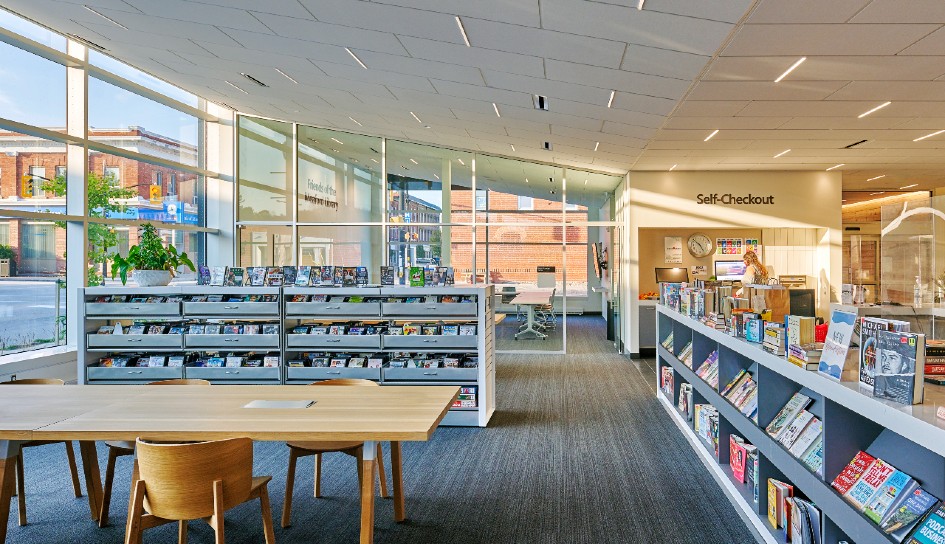
People have gathered for years at 11 Sykes Street North in Meaford, Ontario. Once an 1800s-era hotel for locals and recreational travellers—a fire burned it down in winter of 1960—then a franchised supermarket that closed in 2016, the bustling corner was, more recently, reimagined into a new public library.

The adaptive re-use project relocates Meaford Public Library from an inaccessible three-storey building to a one-storey facility that blends into the historic red brick façades of downtown.

The municipality and library board had been discussing expansion plans since 2002, reviewing various relocation sites, including an OPP office, a school and the ground floor of a new condo. In 2018, the city bought a former Foodland for $1,525,000 and began re-designing the space with LGA Architectural Partners, which has overseen the design of other library reboots. The library was fully completed last fall.

As Brock James, a partner at LGA, explains, the city required a barrier-free design to fit its demographics, which are primarily retirees and new families.

“They also wanted an inviting facility with greater visibility to attract passersby,” he says. “Parking was an asset for a rural community. Transforming the supermarket also helped the town to meet its sustainability objectives, and turning a substantial portion of the parking lot into a parkette enabled the library to generate green space and outdoor programming areas.”

An angular ceiling plane adds visual interest to the former grocery store’s boxy footprint. New ceilings also create a variety of spatial experiences throughout, for instance, lower in the children’s zone, higher over the collections and swooping upward towards the main entrance on Sykes Street. “The interior layout was fully demolished, but the large, open span floor plate gives the library complete flexibility,” says James.

Meaford

The Meaford Public Library was completed in fall 2o22. Photo by Bob Gundu.

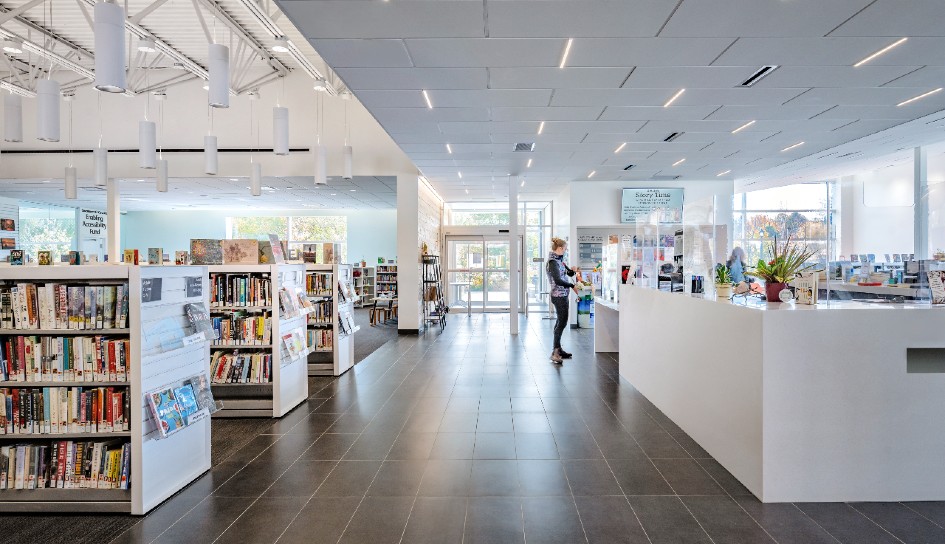
An orchestrated layout connects various sides of the library to its centre. All entrances are at grade. The city’s first adult changing station is located inside. “The interior has tremendous visibility, with entries at both the north and southern axes, so you can see your way around, and easily know where everything is located,” adds James.

Meaford

Photo by Bob Gundu.

Large communal tables in the main reading area encourage social moments, while flexible meeting rooms are used for community events, drop-in activities, lounges for seniors, celebrations and corporate rentals. Next to the young adult area, another room houses the latest tech devices, such camera tripods, a green screen and podcasting equipment.

From the children’s area, views of the community planting bed and a mini apple orchard bring nature inside and reflect the Grey County’s historic apple industry.

Where a parking lot once thundered with the sound of rolling shopping carts, a tree-studded gathering space with grassy areas, cafe-style seating, more than 6,000 plants and a fire pit make up the new town parkette, which directly connects to the Bighead River. Armour stone borders double as seating close to Sykes Street. Toward the back, a raised stage capped with paver stone  brings movie nights, story times and performances, with extra seating in the main grassed area.

Meaford

The children’s library. Photo by Doublespace.

For the exterior, re-cladding the original shell with charcoal grey fibre cement board complements the dark roof of nearby Meaford Hall, a neoclassical landmark, and re-brands the building while improving energy and carbon performance.

Installing window openings and glazed curtain wall windows in the existing façade bring natural light deep into the library and allow for connection to Sykes and Trowbridge Streets.

“A challenge was to optimize the scale of the windows while keeping the building structurally sound,” notes James. The original glass facade had been lost over time during renovations, but openings were restored after carefully considering the poor soil conditions and capacity of the original structure, which limited the potential for both window size and position. According to LGA, the desire for transparency had to be weighed with a ratio of glazing to wall surface of less than 40 per cent for operational energy efficiency.

Meaford

A gathering space brings programming outdoors during cooler weather. Photo by Doublespace.

Through the course of the project, a public consultation informed certain features that exist today, while budget constraints deterred other elements from manifesting. Overall, the library brings the community together in a place of historical significance, says James. “We are most happy with how we were able to transform the simple box of the previous supermarket into one of the most important public spaces in Meaford.”


Feature photo by Doublespace

Manitoba reaffirms energy equipment tax credits

Manitoba has permanently entrenched tax credits for the purchase of energy equipment related to geothermal, solar thermal or biomass systems. The newly released 2023-24 provincial budget announces the ongoing extension of the rebates, which had been scheduled to expire June 30, 2023.

Tax credits for geothermal heat pump and solar thermal systems apply on both residential and commercial installations. The program offers tax credits equivalent to 7.5 per cent of the cost of geothermal heat pumps manufactured in Manitoba and 15 per cent of other related capital costs if the installer is certified by the Manitoba Geothermal Energy Alliance.

Refundable tax credits are available for 10 per cent of the capital costs of specified active solar water or gas heating equipment, including: solar collectors; solar energy conversion equipment; solar water heaters; energy storage equipment; control equipment; and equipment that interfaces with other solar or non-solar heating equipment. Swimming pool water heating systems and air-source heat pumps are not eligible.

The 15 per cent tax credit for the capital cost of biomass energy systems applies only for equipment that is used in a business.

How cleaning companies can build recession-proof relationships

As we face some uncertainty in the economy with rising inflation and talk of recession, it can cause anxiety on how best to secure a strong position for your business and build those customer relationships. Recessions impact every business, and the best way to weather that storm is to know your customer.

That sounds so simple, however, when the customer is also the decision-maker for the provision of your services, you should understand everything you can about them.

Be aware of the customer’s situation

It is important to determine your customer’s wants and needs. In difficult economic times, you want to understand the customer’s entire situation. What problems do they have? What are they worried about? What options are they considering?

Consider the issue of trust and think of your first interaction with your customer. For example, most customers when are not present while cleaners are present, so highlighting that your employees are bonded could put you in a different class than someone who is not as thoroughly vetted. When a customer is anxious, having a trusted service alleviates worry and adds to the trust factor for your company.

Highlight your value

When economic challenges persist, and customers re-evaluate their spending, your competition is not only from others providing your service, but with an entire bucket of services within the customer’s spending. Our customers are not focused on making a trade between cleaning companies, rather, they will be looking at their entire spending bucket and deciding which services to maintain and which to defer. This is your opportunity to communicate your value.

We have an advantage in the cleaning industry because we have moved away from being viewed as a discretionary service and have shifted more into a needs-based service. One of our brand values is that we afford people more time, especially now when people are busier than ever.

Time is still worth more than money to most of our customers.

Stay true to your brand

Every business faces the need to adapt from time to time. It might be to implement new technology, and it might be to manage an economic circumstance. Having flexibility in your services will make it easier to maintain your customer base.

That might mean that a customer who receives service every week takes a step back, choosing service every other week. We still maintain them as a customer because we can adapt to the needs they have at the time. We still maintain our promise to deliver high-quality service in a trustworthy way, and when the customer feels more confident about the economic situation, it is an easy transition back to full service.

RELATED: The importance of relationships in commercial cleaning

Trust can weather nearly any economic storm. While changes in the economy can be jarring at times, they are also short-lived; the trust built in a business relationship should have a long-term commitment. Brand commitment is crucial because it builds a relationship of trust and consistency of service.

Leverage your strengths and experiences

As a long-standing cleaning business, there is the benefit of deep experience leading through challenging economic times. Similarly, we have all been through COVID, and there are lessons learned and leveraged to make good decisions for the future.

Use everything you have to your advantage — time, intelligence, experience — to adapt your company in ways that will allow you to continue to be successful in any economy. Cleaning services offer peace of mind, consistent quality, dedicated commitment, and a trusted relationship—core values that are key to earning customer trust and loyalty in good times and bad.

Don’t be shy about communicating all of your value to your customer. You understand their needs, and you can continue to deliver your service in the same reliable manner that makes their lives just a little easier to manage. Consistency breeds comfort.

Take care of your people

Anyone in a leadership role has a responsibility to create a positive experience for their people because the way they treat their people will be reflected in how their people treat their customers.

Frontline workers are the people who deliver the service, and we need to make sure we are taking care of them. We can all do a better job of taking care of our people and developing them to feel more valued.

Take the time to build a rapport with your teams so they deliver the experiences you want them to provide as ambassadors of your brand. When employees are appreciated and encouraged and feel you are also invested in their lives, you will reap the benefits of hiring and onboarding new people.

With challenge comes opportunity

Change is hard for most people. As a service provider, the sooner you start understanding the changes you need in your business, the more time you have to become more flexible for your employees and customers.

Take a proactive approach toward adapting to external factors that affect your service and consider how those factors may be impacting a customer. Your customer is at the core of your business, and challenging times often present strong opportunities to solidify and grow your business.

Jean Grossman was appointed president of Merry Maids® in February 2023. She has been at the helm of customer service leadership for more than 25 years and has helped navigate both established and emerging franchise brands through challenging economic times.

RAM promotes Marnie Williams

Marnie Williams has been promoted to director of project services (Alberta) at RAM. She formerly held the role of senior manager, quality & inspections in B.C.

“We are extremely proud to announce this promotion which has come about from recognition of Marnie’s work and dedication, and we are grateful to have her join the executive team as we continue to grow RAM across Canada,” said Joe DiPlacito, president of RAM.

Williams is a Certified Manager of Quality/Organizational Excellence (CMQ/OE) from the American Society for Quality and has extensive construction experience specifically relating to Quality Management.

She exemplifies leadership through coaching and effective communication with personnel in relation to company policies, procedures, and best practices. Marnie partners with executives to enhance operational excellence. She also networks and collaborates with internal and external stakeholders to ensure innovation, productivity, and performance. Marnie is passionate about operational excellence with a strong focus on innovation, productivity, and performance. Marnie is a member of the American Society for Quality and the Construction Quality Executives Council. 

Her focus at work for the upcoming year is to support RAM’s growth in Alberta.

“In this new role at RAM, I’m responsible for the strategic leadership, business development and operations for project services in Alberta. Although my role is specific to project services, I will be supporting RAM’s growth into the Prairies. The initial challenge with my new role will be building RAM’s brand in a new province, so I’m excited to be attending industry events in Alberta and giving back to the communities through philanthropic efforts.,” she said.

As a quality management professional with more than 15 years of experience, her career advice is to “embrace situations when you feel vulnerable or uncomfortable, your next opportunity for growth is about to begin if you do.”


Restoration plans unfold for Queen’s Park legislature

A major renovation of Ontario’s 130-year-old legislative building at Queen’s Park is moving forward as the province proposed a new ministry that would oversee the restoration project.

Since the Romanesque Revival structure opened its doors in 1893, there have been no large-scale renovations in more than 100 years, other than gradual repairs. Even so, plumbing, heating, electrical and IT system are beyond their end of life as said to be at risk of total failure.

Fully modernizing the facility would include interior deconstruction to preserve heritage elements and upgrading building systems for safety and accessibility. Doing so means having to temporarily relocate parliamentary operations while the multi-year project is underway.

The newly proposed Queen’s Park Restoration Act, 2023 would create a secretariat that would oversee the whole process, including the move. The building currently houses the Legislative Assembly of Ontario, offices of the members of the Assembly, offices of members of the press, and the Office of the Lieutenant Governor.

Paul Calandra, minister of legislative affairs, introduced the Act yesterday. “Our government’s proposal strikes an important balance between the need to leverage the infrastructure expertise, fiscal transparency, and accountability of the government with the independence and oversight of our Legislative Assembly,” he said.

First Capital resolves dispute with unit-holders

First Capital Real Estate Investment Trust (REIT) has resolved a dispute with activist unit-holders, Sandpiper Group and Artis REIT, and rescheduled the annual meeting that had been set for later this month. Under the agreement, Sandpiper and Artis have withdrawn a challenge to the tenure of four of First Capital’s board members.

“First Capital is pleased to have reached an agreement with Sandpiper and Artis that the board believes is in the best interests of all unit-holders,” says Paul Douglas, chair of First Capital’s board. “Our refreshed board and management team will focus on continuing to enhance and unlock value across the REIT’s portfolio.”

“We are pleased to have arrived at a settlement with First Capital,” concurs Samir Manji, chief executive officer of Sandpiper Group and Artis REIT. “As a significant owner of First Capital, we will continue to collaborate with the board and provide constructive input and ideas for their consideration.”

Meanwhile, Artis REIT is set to be deleted from the S&P/TSX composite index — the benchmark Canadian index representing about 70 per cent of the value of the Toronto Stock Exchange’s market capitalization — as of March 20, 2023.

Lighten the load: the value of outsourcing professional cleaning services

By Julia Messinger

Facility maintenance is a complex responsibility, with many factors to consider, and elements and outsourcing professional cleaning services could help make your job easier. One of the core elements of facility maintenance is a building’s cleaning program. A robust, effective facility cleaning program not only helps prevent the spread of germs but can also boost a company’s image and contribute to a positive customer and employee experience.

Cleaning also continues to be in the spotlight as people’s expectations have heightened following the pandemic. A recent survey found that people are putting increased emphasis on the cleanliness of the workplace, with nearly 90 per cent of respondents feeling that workplace cleaning protocols are important.

Keeping a facility clean around the clock is a multifaceted operation, with a long to-do list. Outsourcing more difficult and time-consuming tasks can help ease the burden on facility managers and employees, allowing them to focus on other responsibilities. This can be very helpful in accomplishing more tasks in the same amount of time and knowing that important maintenance duties are being completed on schedule to keep your building operating at – and looking – its best.

Save money while improving cleanliness

Outsourcing services has always been a cost-effective way for businesses to improve their bottom line. Essentially, it reduces overhead costs and allows you to pay for the exact service needed. When it comes to cleaning, outsourcing select professional services allows facility managers to cut down in-house cleaning time, while achieving increased and consistent results. Even better, outsourced professionals provide their own top-of-the-line equipment and products specifically designed to complete the job, eliminating the need to purchase and maintain costly equipment and products only used for one task.

It’s important for facility managers to determine which services make sense to outsource and what is more beneficial to keep in-house. For example, cleaning and laundering facility floor mats can be an extremely time-consuming, labour-intensive task for employees. Also, it must be performed regularly as mats can get saturated and dirty very easily. By outsourcing this, mats will be professionally cleaned, laundered, and replaced on a schedule to maximize performance. In addition, there is no need to invest in inventory, saving you money on replacement costs.

Outsourcing intensive tasks such as floor mat cleaning help businesses save time, money, and manpower, while also providing the peace of mind that it will still be completed correctly and on time.

Alleviate stress and staffing challenges

Facility management can be stressful. In fact, a recent building operating management survey found that 59 per cent of people were most stressed by not having enough time in the day to get everything done.

Enabling facility managers to outsource facility services can help ease the stress of being bogged down with routine cleaning and scheduling duties. Since outsourced cleaning professionals track their cleaning tasks and maintain a level of cleanliness, facility managers will have more time to focus on other building matters and tend to any urgent issues that arise. This can help alleviate facility manager burnout.

In addition to freeing up valuable time, outsourcing facility services can help improve staffing challenges. Facility managers won’t need to spend time recruiting, hiring, and training additional staff for often high-turnover cleaning positions – especially during the current turbulent job market. This helps save headaches and resources, knowing that the job will be completed by trained, outsourced professionals. Outsourcing also eliminates the need to pull in employees that weren’t hired for cleaning, helping with employee retention.

Make everyone feel more comfortable

A clean work environment has been linked to improved mental health. It can help increase productivity, heighten focus, and boost happiness. With the amount of time people spend at work, it’s important to provide a clean and welcoming environment so that people feel comfortable. Outsourcing less glamorous, yet critical, jobs such as deep cleaning bathrooms can help ensure a positive restroom experience for all building occupants.

Since restrooms require a lot of attention, some facility managers partner with a service provider to ease the burden. In-house staff typically handles spot cleaning and daily cleaning, while a service provider handles inventory management and deep cleaning. Outsourcing restroom deep cleaning eliminates the need for employees to do the heavy lifting and the extra dirty work. It also eliminates the need to stock auto scrubbers, dry vacuums, wet vacuums, pressure washers, and grout cleaning machines. By freeing up inventory space and limiting labour associated with ordering and inventory management, employees can focus on their core responsibilities, eliminate guesswork and let out a sigh of relief that they don’t have to deep clean the restroom.

RELATED: what your washrooms say about your business

Find the perfect fit

When looking to outsource professional facility services, thoroughly research and compare providers to see who will provide the most value-add to your facility, employees, and customers. The right service provider should complement and boost your existing in-house cleaning program. Look for a partner who is flexible to fit your specific needs and can adapt quickly to any changes that you need to protect your investment.

Outsourcing is not taking the easy way out. If it simultaneously boosts the bottom line and improves employee morale, it’s a smart business move and a win-win for your building. You can have peace of mind knowing that specific facility services will be completed on time and on schedule to help improve your image, protect your business, save you money, and provide an inviting atmosphere in your building.

Julia Messinger is a marketing manager for the Facility Services division of Cintas and is currently responsible for product line management in the cleaning tools and chemicals category.  For more information about facility services offerings from Cintas, visit cintas.com/facilityservices.

Squamish Adventure Centre renovations underway

Construction is underway on the revitalization plan for the Squamish Adventure Centre (SAC), a landmark visitor centre located along the Sea-to-Sky Highway between Vancouver and Whistler.

The $700,000 project will bring physical improvements to the SAC building to improve the visitor experience and economic viability of the building. The SAC is closed for two months while renovations are underway. The project is made possible through Tourism Dependent Community funding from the Province of B.C.

“The Squamish Adventure Centre is an iconic visual anchor in our community and a key point of entry for our visitors,” says District of Squamish Mayor Armand Hurford. “This funding from the province allows us to improve the way in which we welcome visitors, introduce them to all our community has to offer, and inspire a culture of responsible tourism and recreation. We thank the province for this funding that will allow us to modernize our tourism-oriented facility and create an enhanced experience for all that we welcome.”

Once complete, upgrades will include:

  1. Immersive Squamish (Sḵwx̱wú7mesh) Storytourism experience aimed at inspiring a new generation of travellers to Squamish.
  2. Theatre improvements to increase flexibility and modernize the space for meetings, trainings and events.

“Tourism is one of our province’s most dynamic industries. Every day, people around the world are making plans to visit our great province,” says Lana Popham, minister of Tourism, Arts, Culture and Sport. “I am pleased to see that our direct investment in tourism-dependent communities is benefitting the Squamish Adventure Centre. Investments in tourism infrastructure are integral to community vibrancy, continued recovery, and will benefit residents and visitors for years to come.”

Built in 2006, the Squamish Adventure Centre is Squamish’s only purpose-built visitor centre. Known for its unique architectural design, the District of Squamish-owned venue welcomes thousands of patrons each year and contributes to the local economy as a visitor service centre, location for business meetings, training and events, and community meeting space.


Regina selects non-profit housing partner for new project

The City of Regina has selected North Central Family Centre (NCFC) as the non-profit housing partner to lead the delivery and operation of a Rapid Housing Initiative (RHI) involving a 30-unit, multifamily residential building.

“The North Central Family Centre is eager and ready to play our part to increase the availability of safe and affordable housing for residents in our community,” said Kim Wenger, Executive Director, North Central Family Centre. “With our 20-year history within the North Central neighbourhood, this project is a stepping stone in expanding our contribution in addressing the needs and barriers that the community has always expressed to us. This project is more than a building, it’s about community pride, connection, inclusion, sharing and hope and will serve as a model for future housing growth.”

The City received $6.6 million in federal funding to support the development of new affordable rental units under the third round of the RHI Cities Stream, administered through Canada Mortgage and Housing Corporation (CMHC). Upon approval, the project must be delivered and available for occupancy within 18 months, which is anticipated to be late 2024.

“The City of Regina’s selected housing partner, the North Central Family Centre, has a strong understanding of the residents, and the challenges they face, in Regina’s North Central community,” said Mayor Sandra Masters. “Developing new affordable housing will improve community safety and wellbeing for residents and contribute to revitalizing this neighbourhood.”

NCFC is working to finalize the purchase of a site in North Central. Details about public engagement opportunities will be shared in the coming weeks.

Visit Regina.ca/rapidhousing for more information.


Department store drain continues

Nordstrom Canada’s sudden swoosh into the department store drain will leave empty anchor space in some of the country’s top-performing and most prestigious regional malls, adding to a decade of challenges thus far for retail landlords. The U.S. based retailer filed for insolvency protection under the Companies’ Creditors Arrangement Act (CCAA) late last week and announced plans to close 13 physical stores by late June. Sales through its Canadian e-commerce platform ceased as of March 3.

“This will enable us to simplify our operations and further increase our focus on driving long-term profitable growth in our core U.S. business,” Erik Nordstrom, chief executive officer, said as the company released results for the fourth quarter of 2022. “Despite our best efforts, we do not see a realistic path to profitability for the Canadian business.”

Looming closures include six large-footprint Nordstrom stores in enclosed shopping centres and seven mid-sized Nordstrom Rack stores in a mixture of enclosed malls, open-air centres and urban streetfront locations. That will empty out anchor space in five of Cadillac Fairview’s regional malls: Pacific Centre, Vancouver; Chinook Centre, Calgary; Rideau Centre, Ottawa; and Toronto Eaton Centre and Sherway Gardens in Toronto. Oxford Properties will also see vacant anchor space at Yorkdale Mall in Toronto, while Ivanhoé Cambridge awaits the departure of Nordstrom Rack from Vaughan Mills in the Greater Toronto Area and Calgary’s Deerfoot Meadows.

Nordstrom’s move comes just days after the U.S. parent of Bed Bath & Beyond announced the shutdown of 65 outlets throughout Canada, and is the newest in a string of retail closures in recent years. In that context, industry analysts suggest it’s both a shock and a somewhat foreseeable event.

Closures called unexpected, but not necessarily surprising

“Bed Bath & Beyond wasn’t really a surprise at all. Nordstrom is more unexpected,” observes Lisa Hutcheson, managing partner with the retail strategy consulting firm, J.C. Williams Group. “I don’t think we’re surprised, but it’s unexpected that there weren’t more warning signs.”

On the latter front, credit rating service DBRS Morningstar recently downgraded the retailer’s status from positive to stable after lower-than-expected earnings over the past two quarters. In a March 3 statement, DBRS Morningstar projects the termination of Canadian operations will have a positive effect on Nordstrom’s profitability and operating efficiency, but undermine the company’s geographic diversification efforts along with a “lesser extent” hit to its market position and size.

“In aggregate, the closures do not have a material effect on Nordstrom’s overall credit risk assessment because of the relatively small size of the Canadian operations, which account for less than 3 per cent of total sales,” the statement advises.

Looking at the total distribution of stores, Canada accounts for six per cent of Nordstroms and fewer than three per cent of Nordstrom Racks. However, Hutcheson notes they’re more densely concentrated into a few markets with the six stores in the Greater Toronto Area perhaps eroding each other’s market share as high-end fashion and goods providers.

“I think they have two Nordstrom stores and one Rack store in all of New York City and Chicago only has one Nordstrom store so it’s kind of not a surprise that we just don’t have the density (of consumers) for these big category killers and large-format stores,” she reflects.

Hutcheson attributes the over-abundance in part to a misperception that it could be an easy plug-in replacement for Sears. That’s coupled with the waning stature of department stores in general and the COVID-19 pandemic’s wallop to the fashion retail category in particular, making it unlikely that any single contender will arise to fill the void Nordstrom now leaves behind.

“The quick answer is not going to be: oh, there’s some other amazing retailer that’s just going to fit that space perfectly,” she warns. “I think we’re at a tipping point where the anchor is not going to be an anchor in the traditional way that we have defined them as department stores or grocery stores. We’re going to start to see them be much more catered to the unique proposition of each shopping centre and the demographic and psychographic needs of those customers.”

As with Target’s insolvency and retreat from Canada eight years ago, affected landlords will now be entering negotiations to see what losses can be recovered from abandoned leases. For now, there are few details of their ranking among creditors.

Prestige malls deemed well positioned to navigate upheaval

There are also concerns about possible reduced traffic and associated repercussions for other retailers in the vicinity of shuttered stores. However, Raymond Wong, vice president, data operations, with Altus Group maintains this group of properties has both the prestige to draw replacement tenants and the depth to weather the loss of an anchor.

“Granted, Nordstrom is a large and significant tenant, but when you look at the number and quality of retailers at malls like Yorkdale, the Eaton Centre or Pacific Centre, they are still going to be a destination for consumers and for tourism as well,” he submits. “This could also mean an opportunity for a retailer that’s looking into Canada and this would give them an opportunity to get into some of these great retail locations.”

Among some of the touted potential newcomers, Hutcheson reports talk of Primark, a fashion and household goods retailer that has expanded beyond its main base in Ireland and the United Kingdom into the United States and throughout Europe, and Quebec-headquartered Simons, which currently has 16 Canadian stores including six outside Quebec and is already Cadillac Fairview’s tenant in four locations.

As well, both she and Wong cite a burgeoning introduction of mixed uses, bringing in fitness facilities, professional services and co-working space. To date, that has largely occurred in community and lower-tier regional malls, but sudden emptying of hundreds of thousands of square feet presents an opportunity to test the concept in prime retail real estate.

“It’s not going to be a one-size-fits-all. If I think about the Eaton Centre, it’s really primed for something that’s more entertainment and tourism focused,” Hutcheson suggests. “Other spaces are going to get carved up and there’s going to have to be a lot of creativity.”

“Owners are constantly looking at and getting inquiries from other retailers, whether it’s domestic or on a foreign basis, and they are well versed with the international retailers that are expanding. So it’s not like they’re starting from zero,” Wong says. “You have a lot of smart owners that will come up with new solutions, new configurations to get that space leased up or reused to ensure there’s alternative income in that space. It will be interesting to see what type of pivot-and-change the space takes.”

He argues retailers will continue to seek out physical retail space where, statistics show, they’re more likely to generate impromptu extra purchases than through e-commerce, while consumers will continue to see in-person shopping as both a practical and social exercise. Elsewhere, the demise of Nordstrom Canada’s online platform could be good news for a handful of prospective industrial tenants and/or landlords positioned to capture rent gains.

“Depending on where the Nordstrom warehouses are located and how they service the client, it may free up a little bit of additional space in a really tight market,” Wong says. “It will help slightly, but the demand is still outpacing the supply so it’s not a significant change in the industrial market.”

Barbara Carss is editor-in-chief of Canadian Property Management.