


Articles Archive - Page 199 of 927 - REMINET
REMI

EGBC announce 2023 award winners

The Engineers and Geoscientists BC (EGBC) Award winners have been announced. The award recognizes commendable professional, technical, and volunteer contributions made by the profession towards public safety and wellbeing.

This year’s eight recipients will be presented with their awards at the Awards Gala at the 2023 Annual Conference on October 27.

THE MCLACHLAN AWARD FOR OUTSTANDING ACHIEVEMENT IN ENGINEERING
ANGUS ENGLISH, P.ENG.

As the vice president, Water & Wastewater at WSP Canada Inc., Angus English, P.Eng., has close to 40 years experience in infrastructure revitalization, replacement and upgrading for the public and private sector. Throughout his career, he has made countless contributions to the improvement of public safety and has an extensive background in coaching, mentoring and volunteering.

THE WESTERMAN AWARD FOR OUTSTANDING ACHIEVEMENT IN GEOSCIENCE
BRENT WARD, PHD, P.GEO., FGC, FEC (HON)

Dr. Brent Ward, P.Geo., FGC, FEC (Hon) has made geoscience accessible and understandable for many students over the past 25 years as a professor in SFU’s earth sciences department. He has also been active in educating the public about geoscience, a collaborator in research, and involved in the industry as a volunteer.

THE MERITORIOUS ACHIEVEMENT AWARD
PHALGUNI MUKHOPADHYAYA, PHD, P.ENG.

Research by Dr. Phalguni Mukhopadhyaya, P.Eng., a professor in the Civil Engineering Department at the University of Victoria, has sparked building envelope advancements in moisture management and thermal insulation around the world.

THE LAMBERT AWARD FOR VOLUNTEER SERVICE
ABDOLHAMID (HAMID) GHANBARI, PHD, P.ENG., FEC

Over his 40-year career, Dr. Abdolhamid (Hamid) Ghanbari, P.Eng., FEC, has worked in project management and building design as well as research, teaching, and curriculum development in Canadian universities and colleges. He is principal and senior project manager at EduBuild Solutions. His extensive volunteer experience includes mentoring immigrant engineers and students and contributing to Engineers and Geoscientists BC and local communities.

THE EQUITY, DIVERSITY AND INCLUSION AWARD
KELSIE PRIEST, P.ENG.

Five years ago, seeing a need to build a strong support system for women engineers, Kelsie Priest, P.Eng., co-founded the nonprofit organization Women in Consulting Engineering (WCE). A project engineer at Glotman Simpson Consulting Engineers in Vancouver since 2012, Kelsie has led several equity, diversity, and inclusion initiatives for the company and is an advocate for junior engineers.

THE YOUNG PROFESSIONAL AWARD
PIA ABERCROMBY, P.ENG.

As a strong project manager, committed volunteer and engaging leader, Pia Abercromby, P.Eng., has demonstrated how to excel at all levels. Pia is currently the acting division manager of McElhanney’s new Sustainability Services Division and advises on sustainability and resilience on infrastructure projects.

THE INNOVATION IN SUSTAINABILITY AWARD
SCHOOL DISTRICT 78 SOLAR & ENERGY STORAGE MICROGRID: HEDGEHOG TECHNOLOGIES INC.

Hedgehog Technologies designed and managed the implementation of a first-of-its-kind solar and energy storage microgrid project specifically for Harrison Hot Springs elementary that included a PV solar, battery, and an innovative microgrid controller called Nimba. The system was created to address the constant power blackouts at the school caused by the winds.

GEOSCIENTISTS CANADA’S CANADIAN PROFESSIONAL GEOSCIENTIST AWARD
CATHERINE HICKSON, PHD, P.GEO., FGC

Dr. Catherine Hickson, P.Geo., FGC, has made significant contributions to geoscience through her career, volunteer service, and leadership. A pioneering volcanologist and a globally-recognized geoscience and geothermal expert with more than 30 years’ experience, she is the author of more than 100 scientific papers as well as articles for the public, including two books.


 

It’s a First! Fire Safety Plan Accredited Training Now Available

When a fire broke out at 2 Forest Laneway in North York on January 6, 1995, most residents were still sleeping. The fire began at 5 a.m. in an apartment on the fifth floor and spread quickly. Six people died, all overcome by smoke and found in the upper levels of the two stairwells of the 365-unit building.

A study by the National Research Council of Canada determined that of those living above the fifth floor, “only those leaving their units at a very early time had a chance of reaching ground level safely.” The study found that many occupants had not received appropriate fire safety information. With eleven false alarms sounding the previous year, residents weren’t even sure if they should take the alarm seriously. Some made breakfast and watched TV.

The tragic fire prompted a coroner’s inquest which identified a failure on the building owner to train building staff on their roles and responsibilities under the Fire Safety Plan, including being able to effectively use the building’s emergency voice communications system. In addition, it found that security guard “emergency procedures” differed from the building’s approved Fire Safety Plan procedures. As a result, the Fire Safety Plan’s correct procedures were not followed. Following the fire, a total of 65 recommendations were made by the coroner’s inquest. Number two on their list was the recommendation to ensure that all Security/Superintendents and building staff received mandatory training on a building’s Fire Safety Plan.

A Fire Safety Plan explains emergency procedures and inspections the building must complete in order to meet the Ontario Fire Code. The Chief Fire Official of the local Fire Department must approve a condominium’s Fire Safety Plan. Once approved, its implementation is a Code requirement of the Condominium Corporation.

“The Fire Code requires each staff member working at the building to know their Fire Safety Plan,” says Jason Reid, Senior Advisor of Fire, Safety and Emergency Management for National Life Safety Group. “Every condominium manager, every superintendent, every concierge and all security personnel are required to have training on the building’s approved plan, prior to being assigned responsibilities.”

Although the requirement to train building staff has been active for years, until recently, no accredited training was available. National Life Safety Group (NLSG) now offers the first accredited training certification for managers, staff and owners of multi-residential buildings. Their program ‘Implementing a Residential Fire Safety Plan’ is accredited and endorsed by the Institution of Fire Engineers (IFE) Canada Branch to meet the Ontario Fire Code. The 3-hour certificate program is developed and delivered by NFPA recognized Fire and Life Safety Educators specifically for condominium managers and staff who work at buildings. For licensed condominium managers, the training is recognized by the Condominium Management Regulatory Authority of Ontario (CMRAO) and counts towards 3 CPE credits. NLSG’s courses are designed for high-rise, mid to low rise, and townhome communities.

“It’s the only accredited program in the province of Ontario,” explains Reid, who notes that the lack of accredited training modules leaves buildings vulnerable both during and after the emergency. “We find that training, if completed, isn’t meeting the standards, and is blatantly wrong in some areas. In several cases, security guards at the front desk are using emergency procedures and building announcements that they have been instructed to perform from their security supervisor, or at times the building management, and even the Board. This often contradicts what was approved in the Fire Safety Plan approved by the local fire department. When they say or do anything else, lives could be at stake.”

According to the Office of the Fire Marshal, 133 people died in fires in the province of Ontario last year. In high-rises, residents will sometimes hear the announcement but choose to stay in their suites, then try to leave minutes after the alarm goes off. “By that time, smoke is already in the building,” Reid explains. “Residents have options, and they need to know and understand those options before the next fire alarm.”

To build on essential life safety training in multi-residential buildings, NLSG has developed two further instructional courses: ‘Resident Fire Safety & Awareness Training’ is designed for residents of high-rise buildings to educate them on all aspects of fire safety and their own responsibilities in the event of a fire. A further certificate program from NLSG, ‘Condominium Risk Management & the Fire Code’ is designed for Directors and Administrators of condominiums, to allow Boards to be educated on the fire code requirements for their building.

Each Fire Safety Plan typically includes a detailed handout which should be sent out to residents. “The handout explains what the front-line staff will do during fire emergencies,” says Reid. “It also explains what the residents should do. The only way to fully implement the plan, as required by code, is to ensure all parties having roles and responsibilities in that plan, are made aware of those roles and responsibilities.”

Informing all staff of the procedures to be followed is also part of the Occupational Health and Safety Act (OHSA) for every employee of a condominium. Reid asserts that the Fire Safety Plan is an informational tool which can save lives – but only if they all know about it.

“To ensure that the life safety systems are fully functioning, Security staff or Superintendents are required to complete daily inspections of the fire alarm system in condominiums. They’re required to check and inspect the sprinkler system and the generator every seven days, and they must also perform a full building inspection every 30 days. These fire code requirements are outlined in your building’s approved Fire Safety Plan. A plan helps you comply with the Ontario Fire Code; it has everything you need and acts as the staff’s training curriculum.”

Ongoing education for building staff is required for high-rise buildings through fire drills with their staff every three months, yet many buildings are unaware of how to conduct and document these drills. Through NLSG’s accredited training, building staff and managers can understand each other’s roles and responsibilities, ensuring compliance to the Ontario Fire Code, and be confident in case of an emergency.

To book your accredited training certification, or to learn more, visit www.nationallifesafetygroup.ca or contact [email protected]


NS asserting more control in housing arena

The Nova Scotia government is asserting more control over planning and housing development in the Halifax Regional Municipality (HRM). Newly introduced Bill 329 includes dozens of amendments to HRM’s charter to impose new requirements for the planning and development approvals process and to give the provincial Minister of Municipal Affairs and Housing authority to overrule the municipality and/or dictate policy related to various planning and development manners. As well, a two-year rate freeze is proposed on all development-related fees and levies, which would additionally prohibit the introduction of any new charges unless the Minister formally agrees.

“We have an unprecedented housing problem, and the solutions need to be bold,” maintains John Lohr, Nova Scotia’s Minister of Municipal Affairs and Housing. “This legislation gives the minister the authority to intervene on behalf of Nova Scotians when outdated policies and practices are slowing down construction and keeping them from accessing a safe and affordable home, faster.”

Under the proposed legislation, the Province is exempt from the requirement to consult with HRM prior to Bill 329’s adoption. Other amendments would: remove healthcare facilities from municipal planning and development oversight, retroactive to January 1, 2023; mandate a “trusted partner program” to create a channel for qualifying development proponents to receive expedited approvals; and convey authority to the HRM’s Chief Administrative Officer to sign off on some matters in lieu of Council.

Lohr cites recommendations from the provincially appointed Executive Panel on Housing in the Halifax Regional Municipality as the impetus for the proposed new legislation. However, HRM has responded with concerns.

“This proposed legislation is an incursion into municipal authority, undermining the public role in thoughtful, responsible planning that supports not only housing but community livability,” says Mayor Mike Savage.

Meanwhile, the Nova Scotia government has also tabled legislation to allow for a rebate on the provincial portion of the harmonized sales tax (HST) for the construction of new rental housing units.

Is your facility ready for winter?

Winter brings its own unique challenges to facilities, and preparing for those conditions ahead of the cold weather can save you time, money, and headaches. Creating a fall maintenance checklist can help you develop consistent annual practices to stay on top of equipment status, create performance benchmarks, and prepare accurate budgeting for your facility.

There are several elements in your facility that need to be considered and assessed before the weather drops and the snow arrives.

Building exterior

It’s important to look at the outside of your building to make sure everything is in tip-top shape for winter. Assess your landscaping to determine whether you have to wrap any shrubbery, fertilize your lawns, and cut back any hanging branches that could freeze and break. Check window seals for places that need re-sealing, so they don’t allow cold air to enter your building.

Look at your roof, too, and confirm that the drains are clear and in proper working order to avoid ponding water on your roof that can freeze and thaw in the winter, causing damage to your roof. Don’t forget outdoor or pipes that are located on an exterior wall. These can often freeze in the winter and may need extra insulation to keep them working when the temperatures dip.

Heating systems

Before the time comes to heat your building, make sure that your heating system is working the way it should. Have it inspected, check your thermostat settings, test the system, bleed radiators, and change HVAC filters for maximum indoor air quality for your building. You might want to consider investing in a “smart” technology like thermostats you can program on a grid. This type of upgrade may save you money along with offering you a simple and accurate way to stay on top of your heating systems.

Snow removal

To keep visitors and staff safe, a snow removal plan needs to be set up before the season starts. If you are using a service, ensure that you have a contract and know that you will be covered when winter starts. If you are managing snow removal on your own, stock up on ice melter, develop a schedule for cleaning walkways and parking lots, and create a location for your snow to be evacuated once it accumulates. Don’t forget to identify possible areas of obstruction or places where your downspouts might create icy patches you will need to monitor.

With fall in full swing, now’s the time to put your maintenance plan in place to ensure you have a safe, secure, and dry facility this winter.

New data indicates rent growth may be slowing

While most major markets across Canada experienced rent increases in September, reaching an average high of $2,149 per month, there are indications that the annual rate of rent growth may be slowing. According new data from to Rentals.ca and Urbanation, Toronto in particular saw a deceleration in rent growth across all unit types, potentially signaling a broader trend as the economy cools and renters face mounting affordability constraints.

“While rent inflation in Canada remained exceptionally strong in September, most major markets experienced a slower annual rate of rent growth compared to recent months,” said Shaun Hildebrand, president of Urbanation. “This was particularly true in Toronto, where rents grew by their slowest pace in two years.”

At the national level, one-bedroom apartments recorded the most substantial annual growth in asking rents, reaching 15.5 per cent year-over-year, while two-bedroom apartments saw an increase of 13.1 per cent. Studio apartments, representing the most affordable option among unit types, experienced an annual rent growth of 11.3 per cent.
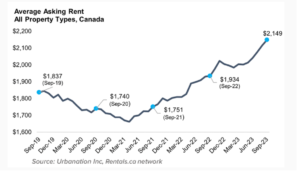
At the provincial level, Nova Scotia and Alberta led the way for both purpose-built and condominium apartments with annual growth rates of 15.4 per cent and 15.3 per cent respectively. Quebec and British Columbia also posted strong rent growth figures at 13 and 12.3 per cent. Meanwhile, Ontario saw a slowdown from 9.9 per cent in August to 6.6 per cent in September while Saskatchewan and Manitoba experienced the slowest annual rent growth at 3.8 and 3.1 per cent apiece.

Among Canada’s major cities, Calgary led with a 14.3 per cent annual increase in asking rents, reaching an average of $2,091, followed by Montreal, which posted a 10.2 per cent year-over-year increase, reaching $2,030. Toronto witnessed the most significant slowdown, with rent growth slowing to 2.3 per cent representing the lowest annual rate of increase in two years.

Medium and smaller markets

Canada’s medium and smaller markets continued to experience strong annual rent growth, with Richmond (Greater Vancouver) leading at 28.9 per cent followed by Cote-Saint-Luc (Greater Montreal) at 27.5 per cent. Red Deer, Alberta, ranked third with an annual growth rate of 21.8 per cent.

In Ontario, Oakville demonstrated the fastest rising rents with an annual growth rate of 19.4 per cent. Halifax and Regina led the way in smaller provinces, with 15.5 and 13.4 per cent annual rent growth rates respectively.

Listings volume

As Canadians seek to save on housing costs, the volume of listings for shared accommodations increased by 27 per cent over the past three months compared to the previous year. This included a 40 per cent increase in listings in B.C. and a 78 per cent increase in Ontario. Average asking rents for shared accommodations grew by 18 per cent year-over-year to $944 per month.

For more information, visit www.rentals.ca 


Conversion momentum draws on combo of drivers

Replicating Calgary’s nascent office-to-residential conversion momentum in other markets will likely depend on the same combination of factors: weak office fundamentals; strong housing demand; and a generous dollop of cash to subsidize required capital investment. That’s the reading from Rob Blackwell, chief operating officer with Aspen Properties, even as two noteworthy conversion projects unfold in his company’s Calgary portfolio.

“It would not make financial sense at all if the City of Calgary was not providing a very meaningful grant of $75 a foot to help convert,” he told attendees at the Building Owners and Managers Association (BOMA) of Canada’s recent national conference in Edmonton. “That’s even with extremely depressed (office) values in Calgary and a pretty robust rental market right now. You’re buying at the bottom and you’re basically renting at the top, and it still barely pencils out.”

Other senior real estate executives joining Blackwell in a discussion of industry issues concurred that asset conversion is unlikely to be a common or easy fix for either the affordable housing shortage or the office sector’s doldrums, but that it can be feasible in some scenarios with a resulting positive impact on the surrounding urban dynamic. While conversion of downtown office buildings to multifamily residential is still relatively rare, there is an established record of productive redevelopment of vintage warehouses, factories and churches in many Canadian cities.

In Calgary, Aspen Properties is undertaking one of the first three projects approved through the City’s downtown development incentive program. Roughly half or about 200,000 square feet of the 27-storey tower, known as Palliser One, will be converted to residential uses, comprising 176 one- and two-bedroom rental units and amenity space. Another 225 rental units are slated to be delivered in about 215,000 square feet of former office in the other two buildings.

Since choosing these initial conversion candidates in the spring of 2022, the City has announced five more in a second phase. The program has also been expanded to include incentives for converting downtown office space into post-secondary educational facilities and for demolishing obsolete office buildings that are not viable for conversion.

Ultimately, the City envisions converting or removing about 6 million square feet of downtown office space by 2031, or roughly equivalent to 14 per cent of total inventory in a market where the vacancy rate has consistently hovered upwards of 25 per cent in recent years. “It’s about salvaging the downtown property tax base. That’s really what that investment from the public sector is about,” Blackwell maintained.

With a floorplate of 16,700 square feet, Palliser One is a little larger than the 15,000-square-foot threshold that Avison Young analysts applied in a recent data scan to plot how many office buildings in various North American cities could practically accommodate typical apartment formats. However, at 53 years of age, it’s well within the demographic of buildings constructed prior to 1990, which the Avison Young analysis established as a plausible cutoff for conversion.

“It depends on the physical attributes of the building. Our building just happens to work fairly well,” Blackwell said.

“There are more buildings that are able to convert than you might think. It just might not be the most efficient two-bedroom apartment building you’ve ever seen,” he added. “We’re going to have to think bigger — student housing, seniors housing, storage.”

Meanwhile, an even more unique conversion project is planned nearby for 65,000 square feet of underused office space at the base of the Calgary Tower. Earlier this year, Aspen Properties inked a deal with the vertical farming enterprise, Agriplay Ventures, to house a “showcase facility” that will eventually see 150 varieties of crops growing in the downtown location.

Blackwell characterized it as a happy fit for aging circa-1968 office space in a venue that should support the aim of attracting attention to the technology, given the location at the foot of a major tourist attraction. However, he predicted it will remain a one-of-a-kind tenancy, speculating that most vertical farmers will opt for lower-cost and/or purpose-built facilities with less traffic congestion and more loading space when there’s no showcasing agenda to fulfill.

“I don’t think vertical farming is going to do anything for the office world, although where it might work is New York City, where there’s so much population density that could be a local customer base,” Blackwell mused.

Other panellists noted that such heretofore untested concepts are being afforded at least an exploratory consideration as the industry grapples with continued low office occupancy and other fallout from the COVID-19 pandemic.

“It’s got significant complications like water and weight and structure, but we do have a duty to some extent to ask ourselves: Can it work somewhere for some specific reason?” observed Lachlan MacQuarrie, senior vice president, national real estate management, with Epic Investment Services. “It’s a case of trying to figure it out so we’re not falling behind if it does turn out to be something.”

Blackwell suggested that the industry is really just beginning to tackle the pandemic’s drain on downtown vibrancy, which has seen the daytime population drop by half in some office districts. Nor will office-to-residential conversions provide an equivalent replacement for those missing workers.

“Yes, asset conversion will help, but we’re still not solving that gap of all the people that need to come downtown just to take our vibrancy back to the way it was,” he asserted. “We’ve got to be on the pull side of getting people downtown. Certainly, when we talk to the tenants, that’s what they want help with. It’s: Help me get my employees back to the office.”

New study looks at impacts of Airbnb on rents

Airbnb activity at the current levels has not generated an economically meaningful increase in rents across Canada’s major cities, according to new research from the Conference Board of Canada in collaboration with Airbnb. The study is the first of its kind to use actual Airbnb booking data rather than information gathered from the webpage, and the first to focus on the effect of these short-term rentals on rents in the Canadian market.

“We’ve seen a significant increase in rents across Canadian cities since 2016, as well as an increase in Airbnb activity,” said Tony Bonen, Director, Economic Research at the Conference Board of Canada. “However, contrary to the common narratives around Airbnb listings, of the 30 per cent increase in rents observed in our sample of neighbourhoods, at most less than 1 percentage point can be attributed to increased Airbnb activity.”

The Conference Board of Canada found that despite having a significant effect on the number of active, high-use Airbnb units, regulations restricting short-term rentals to a host’s principal residence haven’t led to lower rents in the areas they were implemented. Additionally, the research found that areas that implemented principal residence restrictions tended to have higher rents, suggesting these cities may have been motivated to introduce restrictions to address broader affordability concerns.

The research focused on high-use, full-time Airbnb listings offered between 2016 and 2022 across 330 neighbourhoods in 19 of the largest cities in Canada. According to the study’s authors, these properties were chosen for their ability to “increase pressure on rents by lowering long-term rental market supply,” as opposed to listings also used as intermittent places of residence.

The Conference Board of Canada found that the number of high-use Airbnbs relative to the number of households in a given neighbourhood is generally low, though it does vary both within and between sample cities.

New fund targets construction productivity

The Government of B.C. has launched the Workplace Innovation Fund, a program focused on labour supply and inclusion, along with new ways of improving productivity and employee retention.

Part of the StrongerBC: Future Ready Action Plan, the Workplace Innovation Fund aim to fund innovative projects to tackle the current labour shortage, better prepare employers and workers for the changing economy, and attract, hire and retain a diverse workforce.

“The Workplace Innovation Fund centres around developing sector-wide solutions that can help increase construction productivity and prepare a talented workforce for the challenges that lie ahead,” said Selina Robinson, minister of Post-Secondary Education and Future Skills. “This fund is responding to address multiple workforce challenges, including developing technologies to increase productivity and supporting the hiring and retention of good people who have the skills required in construction as new technologies are developed.”

The Workplace Innovation Fund seeks to help address five critical areas in the construction industry where government can support workforce development:

  • supporting industry to adopt new technologies and improve productivity;
  • improving workplace culture and human resource practices to attract and retain workers, including under-represented and diverse workers;
  • developing and supporting innovative training practices;
  • elevating the prestige and awareness of the industry and a career in construction; and
  • streamlining career pathways for newcomers.

Initial concept proposals are now open. The initial intake of proposals closes at 11:59 p.m. (Pacific time) on Nov. 10, 2023. Grants up to $5 million per project are available. Eligible applicants include, but aren’t limited to:

  • businesses and for-profit organizations, including Indigenous and First-Nation-owned enterprises;
  • not-for-profit and/or social enterprise operations;
  • labour organizations;
  • local governments; and
  • consortia or partnerships.


B.C. to develop new digital permit tool

The B.C. government is working with local governments to develop a new digital building permit tool to speed up the construction.

Once completed, the new digital building permit tool will make it faster and simpler for builders and developers to digitally submit building permits for new housing and for local governments to receive and process the application.

The tool will also automatically review the submission to ensure it is compliant with key parts of the BC Building Code to prevent any delays with the submission process.

Currently, many jurisdictions in B.C. rely on a paper-based application process for new housing developments that leads to delays and slow approval times.

Establishing a provincial building permit submission tool is the first step toward a modern housing development process that embraces innovation and digital collaboration technologies like building information modelling (BIM). The Ministry of Housing is also working with the National Research Council of Canada to make construction codes machine readable, which will allow for more automated and faster permit reviews in the future.

The tool is being developed through a pilot partnership between the province, 16 local governments and one First Nations government that will implement the new digital building permit tool. The tool is expected to begin testing in partnership communities by March 2024, following which it will be expanded into other communities.

In addition, the province has also created a new digital advisory council to provide strategic advice. The council will include representatives from 12 leading organizations across the housing development system, such as construction organizations, engineers, architects, local governments and the tech sector. The council will begin regular meetings this fall.

“Digitizing the BC Building Code and building permit processing will help builders more efficiently obtain approvals to deliver the homes and job spaces British Columbians need,” Anne McMullin, president and CEO, Urban Development Institute. “UDI is pleased to participate on the digital advisory council for this pilot partnership and is committed to working with the government on innovative solutions like this.”


Getting started in decarbonization

As we strive to lessen our impact on the environment, decarbonization is something that maintenance managers can work towards to help reach the sustainability goals. Studies show that buildings are responsible for 40 per cent of all greenhouse gases, so facility and maintenance managers have an important role in minimizing the carbon emissions affecting the environment.

Experts predict a significant increase in the need for warehousing, and that means that there is a need to get the environmental impact of these facilities as low as possible.

Going electric

Optimally, shifting your entire business away from carbon is the goal, but that likely doesn’t fit in with your immediate budget. Even replacing things like heat pumps can cost up to 20 per cent more initially, and this may not be something that’s feasible, but there are smaller steps you can take to get closer to sustainability.

Shifting from fuel to electricity is one way that maintenance managers can lower emissions, and that can be done without breaking the back or completely overhauling your building. For example, simply switching maintenance equipment like gas powered lawn mowers can start to make a difference.

If you looking for large scale alternatives, think solar panels, wind turbines, or geothermal systems to reduce your electric grid use. Start small with some simple swaps and move up to larger changes to get your maintenance plan carbon-free.

RELATED: Make your groundskeeping greener

Date driven change

Energy audits are a great way to measure your usage and assess where improvements can be made.  By scheduling regular assessments, you can identify opportunities, measure success, and create goals for greener practices.

Along with carbon reduction, think about using less water and energy. Technology like sensors can help you get a better handle on your needs, helping to limit waste and lower use. Installing things like motion lights can save energy use, too, along with touchless taps and dryers in your washrooms. Your HVAC system can also be improved with today’s technology, allowing you to control temperature in separate sections of your building with an app on your phone to only use the energy you need.

Do the research

Not sure about the best place to start? From the Canadian government to the Canada Green Building Council’s most recent low carbon training plan, there are several resources out there to make it easier to take the first step. There are even some financial incentives you can apply for to lessen the strain on your budget and make the transition easier as you head towards your sustainability goals.

Green by association

Not only can you make change at your facility but start examining your supply chain. Are you dealing with companies who support your goals? Look at how your inventory is being transported, what methods and products your affiliate companies are using, and how your distributors are operating to see whether there are improvements to be made in your supply chain. It may be time to align yourself with companies that are also working towards sustainability so you can make change from start to finish.

As many industries strive to go greener, decarbonization is becoming a priority. As part of your maintenance plan, start small with steps that you can budget for and go bigger when time and finances permit.

The impact of minimum wage increases

Condominium service providers are always challenged to provide superior service while helping boards remain fiscally prudent. Part of that equation is a commitment to pay employees more and with great benefits so that companies can attract and retain great talent. The goal for most companies is to pay employees more than the minimum wage while remaining market competitive. It is a very difficult balancing act to keep both clients and employees happy.

On October 1, 2023, there was another Ontario government-imposed wage increase. This time it was a 6.8 per cent increase improving minimum wages from $15.50 to $16.55 per hour. This minimum wage increase is larger than most in recent history, second only to that imposed on January 1, 2018. Many are unaware that the effective rate of this increase is much higher because all such wage increases include impacts to wage fringe (WSIB, EI, CPP, EHT, etc.). The net effect of this wage increase is over 8 per cent.

The intention of government-imposed minimum wage increases is to provide lower income earners with a living wage. In 2022, there were over six million workers in Ontario, 942,400 of those earning minimum wage. The Ontario minimum wage is fourth highest in Canada despite Ontario having by far the highest percentage population at 38.45 per cent.

A living wage is the hourly amount a worker needs to be able to function, stay healthy, and participate in the community. This includes things like food, housing, clothing, and transportation, and varies between $15 and $33 depending on the community throughout the country.

There is a lot of ongoing online debate on minimum wages, good, bad, ugly, pros and cons. Most condominium boards are sympathetic to employees, even demanding higher wages in contracts. Boards want to help employees and attract great talent, but not at the expense of their corporation.

Let’s take our minds back to 2018 when the minimum wage in Ontario was increased from $11.60 per hour to $14.00 per hour. Business and condominium owners were shocked by the whopping 20.69 per cent increase because it was communicated with very short notice and ill-timed during a provincial election.

This angered many in Ontario, but minimum wage earners benefitted by improved lifestyles. Condominium boards struggled to explain double-digit maintenance fee increases that hit the pocketbook of owners hard. The government has continued with smaller minimum wages increases and also wage fringe increases each year since that time.

Fast forward, in 2023 Ontario’s average living wage is now estimated at $19.72 per hour. The Greater Toronto Area has the highest living wage set currently at $23.15 per hour, and the lowest is reported in London-Elgin-Oxford at $18.05 per hour.

Boards often ask, “Why is it that condominium owners always have to foot the bill for such increases and when will it end?”

This latest increase by the government, like all others, is designed as a flow-through with cost increases that are directed to end users and is based on the consumer price index (CPI). This is similar to such increases and taxes that stem as far back to the implementation of the harmonized sales tax (HST) in July of 2010. The HST impacted all end users heavily at that time. Like tax hikes, government-imposed minimum wage increases affect not just condominium owners, but everyone directly and indirectly.

Take for example, restaurants that are recovering from the COVID-19 pandemic. Traditionally, restaurant owners pay their staff minimum wage, allowing their workers to keep all tips. Tips represent a very large portion of their weekly take-home pay. The restaurant owner must raise menu prices to offset such minimum wage increases along with food price inflation. This scenario can be translated to other businesses in Ontario.

Some of the minor annual increases have been absorbed by building services providers since January 2018 but quickly forgotten when the next increase is on the horizon. Security, cleaning, and maintenance companies cannot completely absorb larger increases as the one that was imposed on October 1, 2023. Profit margins for such service providers are very lean as they try to maintain competitiveness in this marketplace while, at the same time, paying employees more to attract talented people.

What’s Next?

Ontario’s average living wage is now $19.72 per hour. With the latest increase on October 1, 2023 that was set at $16.55, there is still a $3.17 shortfall that the government will very likely want to fill at some point. That represents a 19 per cent gap.

How long will it take for the Ontario government to fill this 19 per cent gap? That is a political question that the government will struggle with. One thing is for sure: the Ontario government has signaled its intention to raise the minimum wage again on October 1, 2024, and thereafter at least once a year. Each year there will be a cat-and-mouse game of service providers asking for more money and boards demanding companies to sharpen their pencils.

When will it end? It is a reality that government-imposed minimum wage increases are here to stay for the foreseeable future until the wage gap narrows. So, for everyone who lives in Ontario at least for the near future, we all can expect higher costs of consumable goods, rent, restaurant tabs, and, yes, condominium maintenance fees every October. Maintenance fee increases are never an easy pill to swallow, especially for those on fixed incomes, but it is a reality that everyone must prepare for.

For board members and property managers come budget time, be prepared. This is the new norm. Boards and service providers need to come together and have open conversations to manage expectations on service quality versus the costs involved.

October 1st is likely a new anniversary that workers will look forward to each year, but not so much for those who have to foot the bill.

Quintin Johnstone is CEO of Samsonshield Inc. & Riskboss Inc. https://samsonshield.com/ and https://riskboss.com/


Westshore community rolls out first phase of townhomes

As part of its efforts to bolster missing middle housing options across the Greater Toronto Area, Minto Communities GTA has introduced the first phase of its Westshore development in South Etobicoke—geared for first-time buyers, growing families and empty nesters.

More than 500 townhome units are planned over several phases. The first phase features a human-scale approach—developed in partnership with architecture firm BDP Quadrangle. The design showcases underground parking, elevator access, rooftop terraces, and a common internal corridor — with a range of grade-related townhouse options.

A combination of one- and two-storey units minimizes circulation space, offering more area to the units and extra space to call home.

“What is interesting about this new design is that the units are based off a shared grid size, allowing for a degree of versatility in unit combinations”, says Richard Witt, principal at BDP Quadrangle. “A central corridor at alternating floors, served by a central elevator core, provides access to the units, essentially giving us more space to dedicate towards units, keeping the homeowner at the forefront of our design.”

The design includes two-storey upper units with rooftop patios, one-storey units with balconies, and two-storey ground units with garden patios. They range between 472 and 1,282 square feet and feature one to three bedrooms. Future phases of the community will also include stacked townhomes and traditional townhomes.

“We believe it is important to develop missing middle housing typologies that works to meet market needs while also playing a role in bringing a diverse community together”, says Matt Brown, director of product development at Minto Communities.

Minto notes the first phase includes spacious open-concept layouts and systems that reduce energy costs and improve air and water quality. Westshore is also targeting ENERGY STAR certification.

Nearby amenities offer access to splashpads, BBQ areas and expanded parks, lakefront trails, and connections to downtown Toronto by way of the 501 Streetcar or Long Branch GO station.


The Well transforms into hub for public art

At The Well, passers-by will discover seven new art pieces on display.

The public installations are a nod to the arts and culture vibe of the King West neighbourhood of which The Well expands upon. The grand mixed-use development includes 1,700 residential units spread across six rental and condominium towers, 1.2 million square feet of workspace and 320,000 square feet of retail and food offerings.

The Well

EMERGENCE is Dustin Yellin’s latest creation.

At the art unveiling last week, world-renowned artist Dustin Yellin’s revealed his first cast metal sculpture piece, EMERGENCE, which is also his first-ever work in Canada. There was also a sneak peek of the immersive environmental art exhibit Arcadia Earth, which made its Canadian debut as a permanent installation at The Well.

“Public art is fundamental to making culture accessible and to building a more equitable world,” said Yellin. “I am delighted to play a small part in the artistic landscape of this city, and to know that curious minds may explore this piece for years to come.”

EMERGENCE weaves together the origin of the universe, the story of the birth of life, and the creation of computing – into an approximately 2.75 metre tall human-like being.

Arcadia Earth is a 17,000 square-foot immersive multi-sensory experience that showcases the beauty of the planet and the impact of human actions through a 10-room interactive adventure that includes projection mapping rooms, a curved LED screen tunnel and large-scale art installations.

The Well

A Neighbourhood Stroll by Vanessa Spizzirri, a local contemporary artist

Vanessa Spizzirri’s, A Neighbourhood Stroll, showcases all types of dogs living together harmoniously in an urban landscape. The dogs stand out in their own individualistic styles through simplistic shapes and bold patterns.

This idea touches on the notion that dogs are not just pets but unique beings, highlighting the diversity of cultures and ethnicities that make up the uniqueness of Toronto. The art installation is located in The Well’s East Lane.

HELLO VELO is another art piece adorned with people on scooters and bikes, aptly located in the bike lobby at 8 Spadina Avenue. The piece is designed by Jenn Kitagawa, whose creative explorations are inspired by nature, the human body, and playfulness.

Another piece uses reclaimed wood from the industrial buildings that previously stood at the site. Local fine furniture makers Brothers Dressler collaborated with the interior design team at Hariri Pontarini to create the site-reclaimed sculptural furniture.


The CCxA-designed Wellington Place Promenade realizes a 100-year vision to connect Clarence Square to Victoria Memorial Park with an 18-metre wide, 450-metre long tree- and garden-lined promenade. The 8 Spadina Ave lobby also features an art-deco door frame salvaged from the Globe and Mail building. The doors have been transformed into a monument that celebrates the fascinating publishing history of the site.

“Public art and placemaking is at the forefront of what The Well is about,” said The Well’s General Manager Anthony Casalanguida. “It is a place for people from down the street, across the country, and around the globe to experience elevated retail, dining, and entertainment offerings. Presenting a range of public art on display will further enhance the King West neighbourhood and visitor experience.”

Feature photo is Arcadia Earth.

Andrew Petrozzi to lead Newmark Canada research

Andrew Petrozzi will lead Newmark Group’s research division in Canada. He joins the commercial real estate advisory firm with an extensive background in industry research and data analysis, most recently as the head of commercial transactions data solutions for Altus Group.

“Bringing Andrew on board reflects Newmark’s commitment to expanding its Canadian presence,” says Norm Taylor, head of Newmark in Canada. The company currently boasts 170 offices worldwide, including in Toronto, Vancouver, Calgary and Edmonton.

Petrozzi also previously led Avison Young’s research team in British Columbia and has been actively involved in industry organizations throughout his career, establishing a reputation as a knowledgeable speaker. In addition to providing insights for Newmark’s brokers and clients in Canada, Petrozzi will work closely with the firm’s executive managing director of global research, David Bitner.

“His wealth of market knowledge will further strengthen Newmark’s reputation as a go-to resource for Canadian market trends and insights,” Bitner says.

Vancouver mayor declares new steps to build homes faster

Increasing the maximum allowable floor plate size for Vancouver’s residential towers is just one item listed in Mayor Ken Sim’s proposed motion to tackle the city’s housing crisis. Doing so would allow for greater design flexibility to unlock more housing units.

Other items he plans to bring before Vancouver City Council further prioritize the construction of new housing in Vancouver, while outlining clear policy objectives to cooperate with senior levels of government on. They include working with senior levels of government to express the City’s support for increased enforcement of short-term rentals.

The motion also proposes to:

  • Accelerate the implementation of the 26 Village Areas outlined in the Vancouver Plan to facilitate the construction of townhouses, multiplex buildings, and mixed-use low-rise buildings between three to six storeys.
  • Explore the steps and measures to harmonize and otherwise align the Vancouver Building By-law (CBO) with the BC Building Code (BCBC), which governs how new construction, building alterations, repairs and demolitions are completed, for a more rapid delivery of housing.
  • Review the City’s Shadow Impact Criteria and Guidelines.
  • Explore opportunities to expand and improve the City’s Certified Professional (CP) program to more efficiently and effectively deliver a wide range of housing.
  • Explore opportunities to increase housing density through the rezoning of lands in proximity to the city’s underdeveloped SkyTrain stations, such as Nanaimo Station, 29th Avenue Station, Renfrew Station, and Rupert Station.

“Since being elected just over a year ago with a significant majority on council, we have heard one thing over and over: people can’t afford to live here,” Mayor Sim said in a statement released today. “We’ve already made the most significant changes to zoning in decades, we’ve streamlined regulations and permit approvals, and today, we are doubling down on our efforts to unleash a new wave of building in our city. With a vacancy rate below one per cent, we need all hands on deck to build more homes right across the city. If adopted by council, that’s exactly what this motion will do.”

Improved permitting eases home renos in Vancouver

The City of Vancouver is making it easier for homeowners of townhouses and condos to renovate their dwellings through improved permitting.

The Residential Renovation Fast Track stream issues permits within a week for simple residential renovation projects under $95,000. Projects eligible for these Fast Track permits include simple kitchen or bathrooms alterations, expanding storage, solar panels, plumbing or electrical updates, restoration work and some accessibility upgrades. These expedited permits now account for 20 per cent of all renovation applications.

“Renovations are some of the most complex permits the City processes with great variability in scope and complexity,” said Corrie Okell, director of permitting services. “Processing times for these types of residential renovations are the fastest we have seen in five years, and with more applicants using this simple process, we are optimistic this positive trend will continue.”

The City has also made it easier for people to explore if a laneway house is allowed on their property through the interactive digital Project Requirements Exploration Tool (PRET), which allows applicants to research and understand all regulations and requirements associated with their site.

Other changes over the past few months include:

  • Simplifying the regulations for low-density housing, including the elimination of many design requirements and consolidating nine separate zones into one new Residential Inclusive (R1-1) zone.
  • Eliminating more than 150 engineering conditions previously required for many complex development projects and expanding the use of risk-based reviews for remaining conditions, which reduces staff review times by one-third.

The City aims to expand PRET to include more project types and areas in Vancouver, expand the fast-track renovation permits to include commercial renovations, further simplify land use policies and guidelines, and recommend that Council revoke several existing land use policies.

The City also plans to eliminate a large number of additional development permit conditions. Work also includes advocating for statutory changes to simplify procedural requirements for rezoning so more projects may proceed without the need for rezoning.


NB funds advance preparations for new housing

The New Brunswick government is promising up to $22.5 million annually to underwrite advance preparations for affordable housing projects. The money is to be split between two new funds to support pre-construction studies and core infrastructure needed to accommodate new housing development in small communities.

Both funds are aligned with the housing strategy the provincial government unveiled earlier this year, which sets targets for 6,000 new housing starts per year and a 32 per cent decrease in the waitlist for subsidized accommodations by 2026, reducing it to 7,500 from the current 11,000 individuals or families. Successful applicants can receive grants to cover up to 75 per cent of their eligible project expenditures with the further possibility of up to 90 per cent coverage in “extenuating circumstances”.

Pre-construction funds are on offer to not-for-profit corporations, municipalities, regional service commissions and First Nations communities and organizations for pre-construction documentation such as housing needs assessments, feasibility studies, business plans and engineering/architectural reports. Nackawic-Millville, a municipality of about 1,000 situated on the Saint John River roughly 65 kilometres from Fredericton, has received the first grant through the program. It will use the $351,000 to complete a housing development plan for a 19-hectare municipally owned tract.

First Nations and municipalities with fewer than 25,000 residents are eligible to apply for infrastructure funding, which is to be used to install or upgrade core services, such as water, wastewater and roads, required for a new housing development. The fund is meant to alleviate costs that would otherwise undermine the economic viability of a project.

“One of the barriers we heard about during our housing strategy development consultations was a lack of available working capital, particularly in small communities and for non-profit housing providers,” says Jill Green the Minister for Social Development and the New Brunswick Housing Corporation. “The other barrier is that many proposed small community housing developments are stalled due to a lack of serviced properties, such as water, roads and wastewater.”