Articles Archive - Page 169 of 927 - REMINET
REMI

Keeping your building safe and dry

While we continue to experience a mix of winter and spring, melting snow and extra precipitation often cause flooding and water damage. In order to minimize that damage, maintenance managers need to know how to decrease the risk of moisture and mould, where to look for potential damage, and how to handle it if it arises in the building.

Keeping your building dry allows you to preserve the look of your property, keep staff and visitors safe from the effects of mould, and save time and money on costly repairs.

Minimizing the risk

Taking a proactive approach to keeping your building dry this spring starts with regularly assessing your property. Look for missing sealants, check your roof for damage or openings, make sure any vents are hooded, assess your HVAC for leaks, and address the humidity in your building, keeping it at an optimal 30 to 50 per cent. Schedule regular maintenance for all areas, too, so you are prepared for any failure and can correct any issues before they lead to leaks or water damage.

Looking for water damage

Identifying water damage can be simple, but finding its origin may require a professional. Check for staining on ceiling tiles, water running down the walls, and puddles on the floor as obvious signs. More subtle signs could include peeling or bubbling of wallpaper or paint, a musty odour, and evidence of mould growth with green or black dots on the walls or ceiling.

Water damage can become apparent in a matter of hours, or it may take days, so be vigilant in catching it so you can take care of it before it worsens.

RELATED: Looking at leaks in your building

The best course of action

Once you see signs of water inside the building, you need to act fast. Replace any wet drywall, flooring, or interior material to mitigate mould growth and risk inside your building. While this will not address the root of the issue, it will help to minimize resulting health risks and could lower the cost of the repairs or replacement later. Also, ensure to protect any equipment, inventory, or areas of concern to avoid any further damage while you handle the issue. Calling in a restoration company is the best and fastest way to determine the source of the leak and get it fixed, avoiding potentially costly repairs and work stoppage.

Spring showers and melting snow often bring water inside the building. Stay ahead of any water damage by assessing your building, conducting regular maintenance, identifying damage early, and tackling the issue early to minimize health risks and protect your budget.

VRCA’s new committee to foster equity

The Vancouver Regional Construction Association (VRCA) has launched its Equity, Diversity, and Inclusion (EDI) Committee.

The VRCA EDI Committee, comprised of VRCA members and industry leaders from the Lower Mainland, will play a crucial role in advancing and fostering a more inclusive and equitable construction industry in our province.

“This is a pivotal moment and a giant step forward in VRCA’s advocacy work to champion diversity and inclusivity in B.C.’s construction sector,” said Jeannine Martin, president of the VRCA. “We feel honoured to work alongside industry peers and influential individuals who generously dedicate their time to help create a more welcoming and inclusive industry for all.”

Anna Lary, a master electrician and instructor in the Electrical Apprenticeship Program at the British Columbia Institute of Technology (BCIT), will chair the newly established EDI Committee. Lary is recognized within the industry for her advocacy efforts to promote equity in the trades. She has actively participated in numerous national working groups dedicated to enhancing the recruitment and retention of equity-priority trades workers.

“There is a groundswell of change occurring across the industry, and there are tremendous opportunities to not only improve the participation of equity-priority trades workers but for organizations to adapt, evolve and profit from these changes,” said Lary. “I look forward to working with my fellow committee members, who represent an interesting and diverse cross-section of the industry. I firmly believe the advocacy work that this committee will do will help provide the resilient and richly resourced workforce that is so urgently required to address labour shortages.”


CCA National Awards winners announced

The Canadian Construction Association’s (CCA) National Awards were handed out in March, recognizing contributions from individuals, companies and associations.

Ledcor earned a total of three awards including Community Leader, Workforce Excellence and Excellence in Innovation.

Ledcor won the CCA Workforce Excellence Award for their ongoing efforts to continuously improve upon their employees’ experiences, and their commitment to a diverse and equitable workplace. Ledcor Pipeline earned a CCA 2023 Excellence in Innovation Award for its Canadian adaption of new methodology for steep slope pipeline installation.

“We are honoured to receive the CCA Excellence in Innovation Award for the groundbreaking work of our pipeline project team in adopting raised bore technology in their industry. Our approach to innovation not only sets new standards but also demonstrates our commitment to pushing boundaries and driving positive change in our industry,” said Quentin Huillery, chief operations officer, Civil, Mining, and Infrastructure.

Other 2023 award winners include:

  • Vancouver Island Construction Association, CCA 2023 Community Leader Award – For emerging as a central force addressing substance use and overdose deaths with a groundbreaking toolkit. Launched in 2019, the Tailgate Toolkit is a provincial-wide program that provides education and training for members of British Columbia’s construction industry on issues regarding substance use, mental health, and pain management.
  • Kinetic Construction, CCA 2023 Gold Seal Award — For ongoing commitment to excellence and education. A staunch supporter of Gold Seal since its inception, Kinetic has celebrated countless employees’ journeys to certification.
  • Graham Group, CCA 2023 National Safety Award — Honoured for its outstanding overall approach to and success in the areas of health and safety. Actively Caring is one such example of a Graham program designed to cultivate a culture where people are actively looking out for others with courage and compassion.
  • Dave Filipchuk, CCA 2023 Pinnacle Leader Award — His achievements are reflected not only in his firm’s success and growth, but also in his leadership, dedication to excellence, and community contributions, which position him as an exceptional leader, partner and example to all.
  • Ryan Davis, CCA 2023 Young Leader Award — Recognized for an impressive portfolio, his dedication to continuing education and his community spirit.


UK tenants face challenging rental market conditions

New research by UK-based Zero Deposit reveals that surging demand for rental homes has caused the average rent to sky-rocket in recent years, with UK tenants now paying 46 per cent more for their monthly rent than they were a decade ago. What’s more, the average cost of a rental deposit has increased for the first time since the introduction of the “The Tenant Fees Act 2019” in June 2019.

“It’s clear that our reliance on the rental market has been growing consistently over the last decade; however, demand for rental homes has exploded in recent years as soaring house prices have forced many to postpone their plans to purchase,” said Sam Reynolds, CEO of Zero Deposit. “Given the fact that house prices are only predicted to increase further this year, it’s unlikely that this cultural shift will change anytime soon. We simply don’t have an adequate supply of quality rental accommodation to satisfy this surge in demand and the consequence of this market imbalance has been a huge acceleration in the cost of renting.”

The Zero Deposit research incorporates data from several areas of the rental market, including the number of renters across the UK, the average cost of renting an apartment, the increase in the number of tenancy deposits held for UK tenants, and the total value of these deposits. Findings from the research show that:

• The current rental market is buckling under the pressure of high demand from UK tenants.

• There are currently over 5m deposits held across the UK, a 66 per cent increase on the 3m held a decade ago. This number has climbed by 5 per cent in the last year alone, having also increased by 5.5 per cent between 2022 and 2021, the highest rates of annual growth since 2017.

• On the supply side, there were an estimated 5.22m private rental homes in 2023 across the UK, down 3.1% compared to the peak of 5.38m private rental homes in 2017.

• The average monthly rent climbed to £1,232 in 2023, marking a 9.7 per cent increase over 2022 and a 5.8 increase over 2021. To put this into perspective, in the seven years between 2014 and 2020, the average UK rent increased by an annual average rate of just 2.3 per cent.

In its summary, Zero Deposit also points out that the Tenant Fees Act 2019, which came into effect in June of that year, limited the rental deposit charged to tenants at five weeks rent, or six weeks if the annual rent exceeded £50,000. As a result, the rental deposit paid by UK tenants had been declining, falling by an average of 2.6 per cent per year between 2019 and 2022. The latest figures show that in 2023, this cost climbed by 3.1 per cent, up from £996 in 2022 to £1,026 in 2023. Zero Deposit estimates that the total value of tenancy deposits held by government approved protection schemes totalled £5.15bn in 2023, up 73 per cent from the £2.98bn held in 2014.

Learn more here: No deposit renting – Freedom from deposits – Zero Deposit

Work begins on QEII Halifax Infirmary expansion

The largest healthcare construction project in Nova Scotia’s history is now underway.

Construction on the QEII Halifax Infirmary expansion will add an acute care tower with 216 patient beds, 16 operating rooms, upgraded diagnostic imaging, laboratories and treatment spaces, and a larger, more efficient emergency department to provide care to more patients. Work will begin with a new emergency department entrance and renovations to the ambulance entryway.

“This is a historic moment for our province and our first priority, as always, is to patients, their families and healthcare professionals,” said David Benoit, president and CEO, Build Nova Scotia “To minimize disruption and ensure there is no impact to the delivery of care, we are working closely with the Central Zone leadership and the Halifax Infirmary throughout the expansion project.”

The province is investing $254 million in this phase of the project. The expansion is part of the More, Faster: The Action for Health Build, a government plan for improving health services for residents.

“As we begin on-site activity, we are one step closer to giving the amazing staff working at the Halifax Infirmary access to the space and technology they need to continue providing modern, accessible care to the community,” added Paul Knowles, vice-president and district manager for PCL Construction.

Don Gilpin leaving job as IFMA President

The International Facility Management Association (IFMA) announced its current President and CEO, Don Gilpin, has made the decision to not renew his contract and will instead pursue other interests after June 30, 2025. He will continue to serve in his current capacity as the board of directors proceeds with its succession planning.

“Over the past several years, I have had the great privilege of leading an exceptional team of professionals, and it is extremely rewarding to look back on all that we have accomplished together,” he said. “Today, IFMA has a global audience of over 120,000 followers and members from over 130 countries worldwide.”

Gilpin initially joined IFMA in 2018 as a consultant and transitioned into the roles of chief operating officer and president. In 2022, he was promoted to the position of CEO. During his tenure, he successfully led IFMA through a transformative period, steering the organization from a four-year deficit to a consistent six-year streak of positive revenue growth, managing a substantial $16 million budget.

“Don took the helm during a time of challenge for the organization and was able to skillfully navigate the association to a position of ongoing strength and respect across the industry, said IFMA Chair Dean Stanberry.

“During his tenure the association invested $2 million in professional development, formed an internationally respected research department, invested almost $1 million in new technologies, paid off over $1 million in debt, expanded into the Latin America market, and established new influential partnerships across the built environment community.”

First Vice Chair Lynn Baez said the association is in an “exceptional position for continued growth” under a new CEO. “We are committed to approaching this transition with the same care and diligence that has characterized our organization, ensuring that IFMA continues to thrive and serve its members with excellence,” she added. “We are confident in finding a leader who will build upon our foundation and drive IFMA forward into its next chapter of success.”

Critical minerals promise to work on their attitude

Contrite critical minerals say they will try to be more forgiving of humanity’s shortcomings. In an interview with the REMI Network earlier today, the expected agents of the low-carbon transition also expressed regret for undermining supply chain confidence and dampening the general mood of the periodic table.

“I am not proud of the label I’ve earned,” Cobalt conceded. “I would rather be noble like Neon.”

In an effort to smooth their bristliness and become more encouraging, the clean tech enablers pledge to ease up on scathing remarks about humanity’s tendency to procrastinate, get easily distracted, bicker incessantly and persist in a degrading relationship with hydrocarbons. Mnemonic guidance — “hold your tungsten and cesium from tellurium like it is” — has been developed to remind some of the worst offenders.

Gallium is tapped to be an important influencer in the campaign for kindness given its super-cool status. Nickel is striving to retrieve the “nice” that is buried within it, and an energy storage mainstay is offering both empathy and a plea for understanding.

“I recognize that I am fiery when I’m under pressure so I can certainly see that humanity is juggling a lot of stressors right now,” Lithium said.

Positive reinforcement is within many critical minerals’ skill sets and they say they’ll make a conscious effort to extend that to humanity. Nevertheless, some of their validating comments still have a passive-aggressive edge.

“People had the smarts to conjure up fluorinated formulations that last in the atmosphere for thousands of years so they should be able to figure out how to keep their own families around for a few more generations,” Zinc observed.

Others remain wedded to the traditional approach.

“Oh, humans are sooo sensitive. We’re expected to adjust our personalities because they see everything in terms of what we should do for them,” Vanadium snarled. “Boo-hoo for the crybaby shirkers.”

Alberta moving to regulate life lease housing

Proposed amendments to Alberta’s Consumer Protection Act will add new rules for life lease housing. The contracts to secure long-term occupancy are most commonly offered in seniors housing, and have not previously been regulated in the province.

Under the life lease structure, leaseholders purchase the right to occupy a residential unit for a prolonged period from a controlling entity that retains ownership of the building. Residents pay an upfront entrance fee to gain access to their unit, along with monthly maintenance fees and property tax, and are entitled sell their property interest back to the ownership entity or to will it to an heir. Only two Canadian provinces, Manitoba and Saskatchewan, currently regulate the industry, but Alberta is now poised to be the third.

“We heard some life leaseholders and their families were struggling to receive their money back from their entrance fees and that their contracts were unclear,” says Dale Nally, the Minister of Service Alberta. “Albertans deserve to feel safe when entering into contracts and should be offered clear and fair agreements.”

The proposed new section of the Consumer Protection Act will give the government authority to prescribe the provisions that a life lease must contain. It will also establish a new 180-day time limit for returning entrance fees when a life lease is terminated and a mandated 10-day period in which the resident party can withdraw from a life lease contract, without penalty, after signing it.

“We look forward to working with Minister Nally and his team to ensure that life lease options are a safe, secure and viable choice for Albertans through the Consumer Protection Act with a sustainable development and operational model for providers,” says James Nibourg, president of the Alberta Seniors and Community Housing Association.

White joins Vancouver as new GM of planning

The City of Vancouver has appointed Josh White as its new general manager of planning, urban design and sustainability (PDS).

White brings a range of public and private sector experience to his new role in Vancouver. In his most recent role as director, city and regional planning and co-chief planner at the City of Calgary, he stewarded the adoption of a new housing strategy in collaboration with partners and led the creation of a simpler and more effective planning policy and regulation.

“Josh has a wealth of experience leading innovative change in the urban planning realm across Canada, and a strong record of responding to the many challenges facing growing cities today. I’m thrilled to have him on board to lead PDS as we continue to implement council’s agenda as it relates to streamlining land-use permitting, housing delivery, affordability and sustainability in Vancouver,” said Vancouver city manager Paul Mochrie.

White holds a master’s degree in urban and regional planning from Queen’s University and began his career in the private sector, serving a variety of private and public sector clients as a consultant with Urban Strategies in Toronto. His private sector experience also includes leading planning and approvals for Alpine Park, a new community development in Calgary.

“Vancouver is experiencing tremendous growth, and I’m committed to leading the city in managing this growth, as it continues its transformation and standing as one of the world’s most livable, sustainable and inclusive cities. I look forward to leading and collaborating with such a forward-thinking team of staff, stakeholders and partners to tackle the challenges that confront Vancouver, particularly facilitating more housing supply and improving affordability,” said White.

White will start in Vancouver on May 1 in his role as general manager and will lead overall operation, administration and policy related aspects of the department. Doug Smith, who has been acting general manager during the recruitment process, will return to the role of deputy general manager, PDS.


Considerations for deferring capital project work

Many condo corporations are feeling the pinch of inflation, which is putting pressure on reserve funds and prompting special assessments in some cases. While residential construction costs trended down in 2023 compared to the double-digit increases seen in 2022, prices remain higher than they once were due to skilled labour shortages, rising material prices and higher interest rates.

Residential construction inflation was 10.08 per cent, year-over-year in Q4 2023, which is still higher than the long-term average of 4.66 per cent, Chris MacMillan, owner of Avid Capital Reserve Planning, observed during an online discussion, hosted by CCI Huronia. “We have seen exorbitant increases in costs in recent years, which has led to a shortfall in funding for many corporations,” he said.

“The shortfall can be realized in the short-term when reviewing the bids for recently tendered work and comparing those costs to your current fund balances or passed budgets. But it can crop up in the long-term when your reserve fund study is updated with current costs and inflation rates are applied to future work.”

The industry panel discussed what major repairs and replacement costs could potentially be deferred by prolonging the life of various building components and what professional resources to seek out for guidance on the matter. They also presented real-life examples of such projects.

Weighing the decision

Looking at reserve fund studies will determine if the corporation’s collected contribution amount is adequate. Studies include a physical analysis with an assessment of each item to determine its remaining life. MacMillan also noted the limitations of basic studies, which do not include detailed condition assessments or invasive investigations that could generate more options for corporations looking to prolong the life of capital assets.

“Reserve fund estimates are subjective; they are based on planners’ understanding of the life cycle of building components and their experience gained from observing buildings,” he noted. “We are giving you our best guess; the study is a financial document based on the visual inspection of a sampling of the components where feasible and based on interviews with directors and agents of the corporation.”

Boards may wrestle with the decision around phasing or deferring major repairs and replacements. MacMillan laid out three factors to consider before formulating a plan: a risk assessment to determine potential safety issues such as poor air quality or excessive heat; business interruptions or financial loss; and secondary damage that might escalate costs.

“In weighing those decisions, remember in Section 37 of the Act, a director is not liable if relying on good faith on a report or opinion from a professional,” he noted.

Mechanical building systems

Jeff Livingstone of Pretium Engineering leads the mechanical engineering division. Some invasive en-suite mechanical projects include fan coil replacements, heat pump units and perimeter radiation heating units, which he says can cost anywhere between $500,000 to $5 million depending on the size of a building and whether riser pipes are being replaced.

Domestic water riser replacements are also invasive and can potentially be pushed off every 50 years instead of 40 years, he suggested. At one condo where he was conducting a feasibility study, a condo’s reserve fund study determined its domestic water risers were in need of replacement due to reaching a typical 50-year lifespan.

The two 20-storey condos had never experienced a single pinhole leak or pipe failure across those decades, so the engineering team dove deeper into their investigation using ultrasonic pipe thickness testing, which can be used for any type of riser, typically steel, copper and cast iron.

“The results came back from that testing and we were surprised to find the thickness of the piping was actually equal to and in some cases thicker than the gauge of new piping that we would have installed today,” said Livingstone. “They don’t make things like they used to.”

The original cost estimate was nearly $6 million for full replacement of the risers across both buildings, but the project is now being revisited in about 5 years.

“This was an opportunity for a building that could have gone in blindly and done a major renovation, but because they were willing to take the time and do the study, they are now pushing off this major project for some number of years,” he said. “Being proactive turned out to be a really valuable resource.”

Being mindful of scheduled maintenance outlined in the reserve fund is key. Livingstone described the importance of making sure a chiller receives its mid-life overhaul, which typically happens at the 12 to 15-year mark. He said this his can cost between $7,500 to $150,000, depending on the size and number of chillers.

“Many property managers and board members have asked me, ‘Do I need to do this’? The answer is and should be yes,” he stressed. “This is similar to changing the oil in your car.”

A chiller in a Toronto condo had a bearing failure, which caused one of the major components to break, ultimately destroying the machine at the beginning of summer, he related. Contractors can identify potential issues at this mid-life mark and replace necessary parts, so the equipment performs as it should for the next 15 years.

Protecting concrete components and waterproofing

“What we’re seeing is that even though inflation is starting to temper, the actual construction prices are not, at least if you’re looking at your construction prices from one reserve study to the next; you’re going to see a big jump,” said Jeremy Nixon, an engineer with Brown and Beattie.

Deferring concrete projects for balconies and garages are increasingly seen as an unhelpful strategy. “The costs of concrete tend to escalate at greater rates than are often carried in reserve funds studies,” he noted. “Concrete has the potential to get exponentially worse in time the more you defer.”

If pieces of concrete are not falling off this may present an opportunity to defer, depending on the case. He also suggested looking at the corrosion of embedded steel. “The longer you leave things un-repaired, the worse they can get,” he said. “Not just on a linear basis but exponentially.”

Waterproofing should also be kept in good condition, especially in garages where salt is carried in, which causes steel to deteriorate at an accelerated rate. There are alternatives to chloride salt, which can be pricey. Nixon said the operational cost might save some of the capital cost over time by extending the life of the element.

Methods for waterproofing parking garages have greatly evolved over the past 30 years. “There was a time when we didn’t even waterproof our garages, at least the interior slabs, but we learned that was a really bad thing,” said Nixon. “Anyone who operates on one of those older buildings has probably gone through at least one major restoration.

“They are at a bit of a lifetime disadvantage unfortunately, unless they have slab replaced totally. If it hasn’t been totally replaced, you’ll still have those embedded chlorides in those un-repaired areas. With a good waterproofing system on it you’re at least limiting the introduction of new salts.”

Strategies in newer buildings that have been waterproofing for 25 to 30 years are different, he noted. “Increasingly, there is more emphasis on local repair of the waterproofing, perhaps in more regular intervals,” he said. “Understanding how exponentially damaging unprotected concrete can be should factor into some early thinking.”

Refurbishment alternatives for cladding and windows 

Jon Dickson, an engineer with Pretium Engineering, often encounters significant shortfalls when providing cost estimates during the pre-design assessment or design process. For a window replacement project at a Toronto condo, he discovered a shortfall of more than twice what the corporation had planned in their reserve fund. The updated budget revealed a price tag around $6.5 million.

Due to a lengthy deferral of the window replacement, there was leakage in several units,  condensation throughout the building, and temperature imbalances where residents were either overheating or freezing, depending on their unit’s location. The corporation underwent the borrowing bylaw process; however, the majority of owners lived outside Canada. It took them over two years to pass the bylaw to accomplish the work.

“If you are the property manager or board member for a building, which is highly dependent on rentals, so close to universities, schools, etc., passing a borrowing bylaw in your building can be a very difficult process,” he noted. “Just achieving quorum can be difficult.”

Delayed projects could also advance into other capital work. Reserve funds are spaced out to prevent a snowball effect. “If you see a major capital expenditure project coming up in the next few years, I’d recommend you conduct a condition assessment to get what the real value is,” cautioned Dickson. “Make sure that if you do have to scramble, you have time to do so without negatively impacting the building.”

Sometimes, window replacement projects can be deferred to a future year. In one case, a three-tower, 1000-unit condo deferred what would have been a $10 million-plus project.

“The window replacement in their reserve fund is on an as-needed basis, but they were getting to the point where it was needed,” he said. The units, which began leaking one by one, were replaced randomly until the yearly allowance was exceeded. This caused an equity issue in the building and a mismatched exterior.

Deciding to do a whole replacement was inevitable, but a conditioning assessment found that 5 to 7 years was  reasonable time frame in which to defer this line item, which moved from a  localized replacement approach and go to a wholesale replacement approach.

If corporations cannot pay for the major replacements scheduled in their reserve fund study, they can also question if a problem truly exists. Depending on the case, some work can be completed for the short-term and the rest deferred for a future year.

A two-tower development of 400 units was experiencing widespread leakage from the perimeters of the windows. Residents were also complaining about its exterior appearance. The condo planned to undertake a full window replacement, which was more than double the price than anticipated.

According to an engineer, the project could be deferred up to 10 years if current work was executed: full replacement of sealant around the windows, rejuvenating the exterior through painting to address premature corrosion, and localized replacement of the hardware.

“By undertaking a project that was less than eighth of the cost of the replacement, they were able to defer the replacement by 10 years and generate the capital accordingly,” said Dickson. “Looking at the long term, this is likely a more expensive option because you have to access the exterior of the building twice; however, it was really their only option with the financial situation in front of them.”

In another example, a condo replaced all its sealant due to leakage through cladding systems, costing around $800,000. The leakage then occurred two years later. “After investigating, we found that the leakage was actually occurring behind the brick; it was a membrane tie-in between the brick and windows, not the exterior sealant,” said Dickson. “If you are choosing to modify the scope, make sure you are modifying the right portion to address the problems that you have.”

Bringing in professionals

Once detailed reports on a building’s condition are sent to reserve fund planners, they can use that information to determine potential options and calculate the impacts on funding needs, suggested MacMillan.

“Perhaps there is a cash flow issue, and slight modifications to the expenditure plan will avoid a special assessment,” he said. “But if the motivation is to keep monthly fees lower, from my experience, just slight deferral of work will not often make much of an impact on paper.”

Bringing in professionals helps with this decision-making, said Sonja Hodis, a condo lawyer with Hodis Law who also moderated the event. “You may have to spend a little bit of money upfront to be able to defer the larger expense down the road, so you need to prepare and budget for that as well.”


Analysis reveals GTA’s highest and lowest condo fees

New analysis has found the top 10 condo buildings in the Greater Toronto Area with the most and least expensive median monthly condo fees, including insights into how fees range around the region.

Digital real estate platform, Wahi, ranked condo buildings based on maintenance fees for one-bedroom units that were sold between 2021 and 2023. The report established a median monthly payment for thousands of multi-family buildings throughout the GTA and includes the age of each building and a list of its amenities, which factor into the price.

“For homebuyers who are considering buying a condo, maintenance fees are an important factor to consider when figuring out their budgets,” said Wahi CEO Benjy Katchen. “Wahi’s latest study provides a ballpark estimate of what condo owners can expect to pay at different price points in the GTA market.”

Buildings had to have a minimum of three sales over the study period to be included in the rankings. A three-year period was chosen to maximize the number of buildings that would meet this threshold as well as provide a more relevant median figure based on more transactions. Condo townhomes were excluded from the rankings.

A variety of factors were known to influence maintenance fees, such as the size of a building’s reserve fund as well as the exact square footage of each unit, and Wahi was unable to take these into account as this information is not consistently provided in listings

Highest fees

An estimated 13 GTA condo buildings had a median monthly maintenance fee in excess of $1,000 per month. The top 10 most expensive buildings for fees were predominantly concentrated within older luxury buildings in downtown Toronto, with only one located outside of the city’s limits, in Oakville.

Older buildings typically have larger floor plans and have heat and hydro rolled into fees, which can skew fees higher. Meanwhile, a luxury building with lots of fancy amenities costs more to maintain.

The Residences of the Ritz Carlton and Four Seasons Private Residences topped the list at $2,268 and $1,561, respectively. The Granary in Oakville, came in third place with an average monthly maintenance fee of $1,440.

Lowest fees

The least expensive maintenance fees were mainly located beyond Toronto’s core, in Milton and Oakville, as well as more suburban parts of Toronto, such as Scarborough and North York. They were built within the last several years, with the majority completed between 2018 and 2022.

The top three condos with the lowest fees include Origin Condominiums’ two towers in Milton at ($217 and $241). SweetLife Condos in Scarborough came in third at $237.

Comparing across the GTA

The lowest median local maintenance fee for 2023 was found in Milton, which was also home to two of the three condo buildings with the least expensive maintenance fees in the region.

Newmarket had the highest median maintenance fee. To look at how maintenance fees range throughout the region, the analysis compared the median one-bedroom fee for 2023 in 24 towns and cities in the GTA, as well as the six former boroughs of Toronto.

Brock, East Gwillimbury, and Halton Hills did not have sufficient sales activity to measure maintenance fees. With a larger pool of sales to examine when looking at the entire region rather than specific buildings, the study focused on a single year so that year-over-year changes to maintenance fees would not skew the results (some condo boards froze increases during the pandemic).

The mix of units that sell can also influence the median. If luxury sales are concentrated in a smaller market, the median may appear higher than what’s reflective of the market average.

Politics, red tape and the housing industry crisis

There has been tremendous growth in the residential construction industry, as well as myriad obstacles thrown at it by successive governments. Where are we now in the cycle of governmental red tape?

The condominium and low-rise residential industries exploded after the last major recession of 1990-1995 and have not really stopped until April 20, 2022, when interest rates skyrocketed in a very short time.

The massive growth in the housing industry, in particular the low-rise industry, the need for better use of resources, as well as the desire to protect the environment, resulted in successive Liberal governments from the early 2000s until 2018 enacting more real estate-related legislation in those 15 years than probably the 50 years before, far surpassing any other industry in Ontario. For some reason, residential construction was an easy way to show that the government was doing something both for the environment and for housing, without actually spending any money.

The first of the two major pieces of legislation that started the housing crisis was the Greenbelt legislation, which removed two million acres of potential development land from the equation. It was pre-dated by the Oak Ridges Moraine legislation in 2002/2003. This restricted municipalities from growing greenfield development to preserve nature and farm land.

The second most impactful set of legislation was passed in 2005/2006. The Places to Grow Act was designed to curb urban sprawl and force municipalities to intensify in built-up areas first before they went to areas for future development.

Intensification means higher density projects, either townhouses or, more likely, condominiums. In this regard, the Liberals were successful in significantly cutting land supply for single-family dwellings and forcing development upwards in towns that never had high or mid-rises. As a result, choices were more limited for individuals and low-rise was made substantially more expensive. The real growth in condominiums was in part accelerated by this legislation.

Unfortunately, over the next 12 years, the amount of regulation from environmental, conservation, building code, zoning approval, tenant-friendly legislation, etc. lengthened the time for development approvals substantially. Low-rise approvals for pure greenfield lands were now a minimum of 10 years and sometimes longer. High-rise would be anywhere from two to six years. Again, the results were constriction of supply and increase in prices.

The resistance of municipalities together with the ratepayer groups to higher density projects and, in particular, an obsession about height, lengthened the development process significantly, which only added to costs.

Progressively more developments needed to go through the appeal process available to the city, developers and ratepayers alike, known as the Ontario Municipal Board (OMB). This independent body was the final arbiter, particularly for developers who faced unreasonable opposition by the cities and ratepayers to well-planned developments, which were being delayed or stymied by either municipalities or ratepayer groups.

One of the last legacies of the Kathleen Wynne Liberal government was to enact legislation that severely restricted the ability of the OMB (whose name was changed to the Local Planning Appeal Tribunal (LPAT), such that municipalities were given much longer times to review development applications before a developer could appeal.

When appeals did occur, they were made substantially more arduous in terms of the materials that needed to be supplied and the reviews that were conducted. Finally, the ability of the LPAT to make a decision was limited, either to support the zoning decision by the City or reject it. They had no ability to approve the developer’s application or amend it as they did under the OMB rules.

If they rejected the City’s decision, it then had to go back to the City to review and revise the zoning. There would then be a second appeal if the developer was unhappy. Timelines in these situations were doubled or longer and delayed project approvals substantially and added more significant costs.

In 2018, the Conservatives came in with a platform that recognized that the only way to deal with both availability of housing and pricing was to increase supply and move the process of approvals faster. This meant undoing all of the obstacles that had been built-up over 13 years.

In December 2021, the Conservatives commissioned a Housing Affordability Task Force, represented by a cross-section of developers, professionals, consumers and government officials to determine recommendations for increasing supply and housing affordability.
The group published a report in February 2022 that featured 55 recommendations. In response, the government accelerated efforts to make housing easier to build and enacted a series of legislation.

Prior to that, the government took steps to reverse the impact of Liberal legacy on LPAT. Essentially, Conservatives passed legislation to rename the Tribunal the Ontario Land Tribunal, and gave back essentially all of the powers that the OMB previously had. It reduced the timelines for municipal approvals to limit delays and created the appropriate forum for hearings and appeals. It restored the ability of the OLT to approve a municipal decision, reject a municipal decision, approve zoning as proposed or amend it.

In a series of sweeping pieces of legislation starting in spring 2022 and then at the year-end of 2023, Bills 109, 23, 97 and 143 were passed that, once implemented, could have significant impact on eliminating red tape, moving projects forward more quickly, expanding the approval times for developments, and as well impacting significantly on the Ontario Land Tribunal (OLT). The breadth of the legislative changes proposed, which were passed in December 2022, are far too extensive to go into detail but they did include things like:

1. Penalties on municipalities for not meeting certain prescribed timelines for reviewing development proposals and providing responses which would result in reduction of fees payable by developers;

2. Caps on new or increased development charges imposed by municipalities over a five-year period;

3. Limitations on site plan control by municipalities which would speed up the process and limit the ability of municipalities to change designs;

4. Removal of requirements for public meetings on draft plans of subdivision, limitations on parkland dedication charges which were escalating, particularly in the 905 area;

5. Exemptions for developments of up to 10 residential units for site plan control as of right provisions to build 3 residential units on a lot;

6. Substantial exemptions of DCs for rental housing, non-profit housing, projects with inclusionary zoning units;

7. Limitations on who could appeal a zoning decision to the OLT and stricter rules on eliminating frivolous appeals; and

8. Hiring of new adjudicators for the OLT to deal with a backlog of appeals (over 38 hired).

The government also looked at eliminating dual tier municipal approvals. In Toronto, there is only one level of approvals but in many other regions such as Durham, York, Kitchener, Waterloo, etc., any development requires approvals from both the regional authority and their local municipal authority. Rules were proposed for eliminating the dual approvals. However, these have not been passed.

Steps were also taken to expand municipal boundaries in various municipalities, such as Hamilton, or to increase supply of development land. All this was positive and led towards a streamlined approval process, which allowed more development, faster and cheaper.

Unfortunately, the investigations and allegations of the government’s impropriety towards the Greenbelt legislation, which opened up about 7,000 acres in the fall of 2022, have set back all of these proposed and enacted measures.

The government has become very reticent of being viewed as running roughshod over municipalities and is relooking at many of the provisions that they passed or are considering, including the boundary expansions, elimination of the dual municipality authorities, the capping of the DCs and other measures. They have introduced Bill 162 to return much of the lands temporarily removed from urban boundary expansions. However, no decisions have been made regarding Ottawa and Hamilton.

In fact, the industry does not know where it stands at this time. Many of these measures were announced in late 2023. Dave Wilkes, President and CEO of BILD, stated in a press release last December that the government has “no coherent housing plan” based on the steps that it had taken. He further stated that “the decisions, coupled with the announcement to review its commitment to reduce taxes on new housing through proposed changes to development charges, have created unmanageable uncertainty for the housing industry.”

So where are we on streamlining government approvals and increasing supply and affordability? This is uncertain. However, hopefully, the government will now be focussed on its original goals of reducing red tape and increasing housing affordability in conjunction with consultations of municipalities, consumers and the development industry in order to achieve the housing affordability reports goals of 1.5M new homes by 2031, in order to satisfy the present and future housing needs of Ontario. It has two years to right the housing ship before the next provincial election.

Leor Margulies is a Partner at Robins Appleby LLP. As head of the Commercial Real Estate and Development Group, he leads a team that specializes in land and housing development representing both established and newer real estate developers and builders. Within the housing development practice, he leads the condominium group, assisting in the construction, marketing, and sales of a range of condominiums, from common elements condominium projects to multi-residential/commercial ones and mixed-use projects. He has been a leader in the construction lending and development fields for over 40 years and was recently awarded the 2021 Ontario Bar Association Award of Excellence in Real Estate. He is also an ardent supporter of the residential construction industry, sitting on the BILD Board and Executive since 1999. Email: [email protected] Website: https://www.robinsappleby.com


Competition Bureau orders Quebec divestiture

Canada’s Competition Bureau has instructed Quebec-based concrete supplier, Béton Provincial, to divest a ready-mix concrete plant that is part of its pending acquisition of a rival’s Quebec operations. The plant — which is one of the assets CRH Canada Group brings to the deal —shares the Laurentide region market with two of Béton Provincial’s existing plants.

In a decision released last week, the Competition Tribunal deems the sell-off necessary to preserve competition in an area where there is “an insufficient number of alternative suppliers” and onerous barriers for new players to set up production. For its part, Béton Provincial does not endorse that interpretation but has agreed not to contest the Tribunal’s findings and to carry out the divestiture so that the larger transaction with CRH can proceed.

“The Bureau is satisfied that the sale will resolve the competition concerns arising from the proposed transaction,” it states.

Condominium RePiping: A Second Wave of Plumbing Failure

The second wave of plumbing failure has arrived. First it was Kitec, which caused chaos and floods in buildings due to the use of two dissimilar metals in the plumbing system. And now there’s another system raising eyebrows, and budget expenditures.

Although on a smaller scale, the newest pandemic in plumbing failure is epoxy-lined plumbing pipes. Around 2010, building owners began relining rather than replacing their piping to save costs. Now, the epoxy linings are failing, causing major blockages in the water and heating systems. A temporary repair to unblock the lines can cost tens of thousands of dollars, and even though fan coil units and heat pumps are often the responsibility of the individual unit owner, buildings with epoxy-lined heating or air conditioning risers are discovering that since the deficiency lies outside of the unit boundary, the corporation could be responsible for the repair or replacement of the fan coil or heat pump.

“We are finding in some of the newer buildings with epoxy piping that the risers are failing prematurely and causing leaks, some of them catastrophic,” says Mark Cohen, founder of Jermark Plumbing and Mechanical, a company which specializes in high-rise properties. “And we’re finding a lot of older buildings with copper piping are also starting to fail.”

According to Cohen, the industry is currently incredibly busy due to work previously delayed during Covid. “The industry is still trying to catch up, and the cost to repair water damage is escalating,” he says.

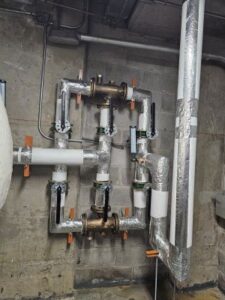
Plumbing insulation and fire stop installed.

Insulation and fire stop installed.

How to Choose a Repiping Company

While the process of repiping is invasive for residents, the work is a lot less intrusive and damaging than the possibilities resulting from a flood. Residents will feel more comfortable if they have confidence with the contractors doing the job, and for those receiving and reviewing quotes, that means spending time qualifying the right companies for the job and not jumping at the cheapest pricing.

“I always recommend an engineer be hired and consulted to investigate,” comments Cohen. When the work goes to tender, he urges a Board of Directors to consider the following:

  • Length of Time in Business: Many new companies try to enter this market and fail, he says, suggesting the company chosen should have experience repiping buildings for “at least 15 years, if not longer.”
  • Master Plumber’s License: Does the principal of the company hold their Master Plumber’s license or are they renting one from someone that may not be working daily for the company? A Master Plumber’s license is needed to get a business license with the City of Toronto. “Some companies reside outside of Toronto as a way to sidestep the credentials,” Cohen warns.
  • Ontario College of Trades membership: Insist on having a copy of each plumber’s Ontario College of Trades membership number, and verify they are working for the company you are using.
  • No Sub-Contracting: Ensure the company does not subcontract the plumbing portion of the project. Make sure this is stated in the tender documents directly.
  • Make the “A” list: Newer companies with less experience may have challenges completing large projects on time. Ask the “A-listers” to tender the project.
  • Ten Year Warranty: Request a 10-year warranty on the piping in the tender documents.

Despite the known issues with some times of piping, a few buildings have held out and not yet replaced the piping due to the cost and being underfunded. According to Cohen, this is now creating an issue with insurance companies. “Some buildings are being told that coverage for flood is not offered, or the cost of their deductible is increasing to hundreds of thousands of dollars.”

If you’re starting to see four or five leaks in a one-month period, Cohen recommends consulting with an engineer to determine the severity of the problem: “Even if your Reserve Fund says you don’t need to repipe your building for another twenty years—if you’re getting leaks—you need to deal with it.”

Low Zone Duel mixing valves installed and running as per engineering specifications.

Low Zone Duel mixing valves installed and running as per engineering specifications.

Understandably, a Board of Directors may feel nervous about announcing such a big project. Not only is it expensive (does this mean a special assessment?), but it also means contractors coming into private residences to complete considerably noisy and dusty work and making some people uncomfortable. During Jermark piping contracts, a representative will meet with residents to explain what’s going on. “This helps them understand the work and feel better about the project,” Cohen explains.

In a high-rise, plumbing failures don’t go unnoticed. If you have concerns or questions, Mark invites you to email him directly at [email protected]. If there’s an emergency, use [email protected]. For general information, please contact 416-789-7611 during offfice hours.

Mark Cohen is the founder of Jermark Plumbing. Established in 1982 in the city of Toronto, the company specializes in repiping and plumbing for the high-rise industry. Cohen is the principal of the company and holds his Master Plumber’s License. Learn more at www.jermark.ca.

WATCH: “How Re-piping Saves Major Dollars in Repairs” Industry Insights interview with Mark Cohen.

Jermark logo


Building more affordable homes faster

Housing and the high cost of living are prominent issues for Ontario citizens, and the newly released 2024 Ontario Budget reflects the heightened burden felt across the province. Featuring measures to address the housing deficit and amp up purpose-built rental construction, proposed action steps range from investing $1 billion in the new Municipal Housing Infrastructure Program to a commitment to supporting key solutions like transit-oriented development and modular construction.

“In the face of global economic uncertainty and high interest rates that continue to put pressure on Ontario families, our government is taking a responsible approach by investing to rebuild Ontario’s economy without raising taxes,” said Finance Minister Bethlenfalvy. “As we invest in key public services and infrastructure, including new roads, highways and the largest public transit expansion in North America, we refuse to offload the costs onto hardworking Ontario families or municipalities at a time when they’re counting on us to keep costs down.”

Calling the 2024 Ontario Budget “a step in the right direction,” Ontario REALTORS issued a statement thanking the Ford government for putting forward a strong fiscal foundation. That said, the association also cautions that more urgency is needed, pointing out that to reach its goal of building 1.5 million new homes by 2031, the government must keep its foot on the gas and “take bold action” via steps like modernizing zoning to support commercial-to-residential conversions, allowing for greater density along transit corridors, and eliminating exclusionary zoning.

Building more homes on existing properties is an essential key to unlocking affordable homeownership,” said Tim Hudak, CEO of the Ontario Real Estate Association. “Several municipalities, including Toronto, London, and Barrie, have led the way by proactively enabling four units as-of-right per lot, and it remains a key recommendation of the Province’s own Housing Affordability Task Force.”

Tony Irwin, President and CEO of the Federation of Rental Housing Providers of Ontario (FRPO), also expressed support for the 2024 Ontario Budget, calling the investments encouraging for the rental housing sector.

“FRPO is pleased to see the government make significant investments in Ontario’s infrastructure in Budget 2024,” he said. “Through initiatives like the $1 billion Municipal Housing Infrastructure Program, Ontario is helping communities to accommodate new neighbours and support higher-density housing. Also, enabling municipalities to reduce the property tax rate for purpose-built rental housing will provide much-needed relief for many residents, and is welcome by FRPO members who are committed to building more rental housing right across Ontario. Together, we can ensure all Ontarians have access to safe and affordable housing.”

Purpose-built rental development 

Of course, one of the most promising measures for rental housing developers was introduced last fall when Ontario announced it would be removing the full eight per cent provincial portion of the HST on qualifying new purpose-built rental projects. This move has already helped trigger the construction of new rental housing across the province, as indicated by the latest CMHC data that shows a record-high number of rental housing starts in 2023.

The enhanced relief applies to any new purpose-built rental housing project, such as apartment buildings, student housing and senior residences, built specifically for long-term rental accommodation. Qualifying projects that began construction on or after September 14, 2023, and on or before December 31, 2030, and complete construction by December 31, 2035, may benefit from this cost savings measure.

Highlights of the Province’s actions include:

  • Helping to get more homes built by investing $1 billion in the new Municipal Housing Infrastructure Program and quadrupling the Housing-Enabling Water Systems Fund to a total of $825 million to help municipalities repair and expand the critical infrastructure needed to reach their housing targets.
  • Addressing Ontario’s housing supply crisis by rewarding municipalities that achieve their housing targets with funding from the three-year, $1.2 billion Building Faster Fund.
  • Helping to build Ontario’s end-to-end electric vehicle (EV) and battery supply chain through upwards of $28 billion in automotive and EV battery‐related investments from global automakers, parts suppliers, and EV battery and materials manufacturers, which are expected to create more than 12,000 new permanent jobs.
  • Connecting approximately 600,000 people to primary health care with a total additional investment of $546 million over three years.
  • Launching a new $200 million Community Sport and Recreation Infrastructure Fund to strengthen communities across Ontario by investing in new and upgraded sport, recreation and community facilities.
  • Investing $46 million over three years, including for the purchase of four police helicopters, to improve community safety in the Greater Toronto Area by supporting increased patrols and faster response times to major incidents and serious crimes.
  • Keeping costs down for people and businesses by proposing to extend the temporary cuts to the gasoline tax rate by 5.7 cents per litre and the fuel (diesel) tax rate by 5.3 cents per litre until December 31, 2024. This would save Ontario households $320 on average since the cuts were first introduced in July 2022. This relief is especially important as the federal carbon tax is set to increase on April 1, 2024.
  • Helping workers and job seekers, including apprentices, get the skills they need to advance their careers with an additional $100 million investment in 2024–25 through the Skills Development Fund Training Stream.
  • Supporting individuals facing unstable housing conditions and dealing with mental health and addictions challenges by investing an additional $152 million over three years towards various supportive housing initiatives designed to support vulnerable people.

“Our responsible approach allows us to support Ontario families, workers and municipalities while retaining a path to balance,” said Minister Bethlenfalvy. “We will keep investing prudently to help create stronger communities and better opportunities for future generations.”

Click here for more on the 2024 Ontario Budget.  

Constraints on cannabis retailers could loosen

A tweak to the rules governing store configurations could make Ontario’s enclosed shopping malls more welcoming for cannabis retailers. The provincial government is currently seeking public input on a handful of proposed regulatory amendments that are presented as a means to “reduce regulatory burden” on licensed cannabis retailers and mitigate their financial losses when they close a store.

Under current rules, a licensed cannabis retailer can operate in a shopping mall provided the space is completely enclosed within walls that separate it from all other commercial establishments and interconnect only with the mall’s common area. In practice, that has prevented cannabis stores from occupying spaces with connections to rear hallways, employee service spaces and/or loading docks.

“This limits retailers’ choices for retail locations and creates barriers to market entry,” states the explanatory text posted on Ontario’s regulatory registry.

The amendment would clarify that only customer-facing areas need to be kept separate from other commercial establishments. Other proposed new rules would allow a new owner of an existing outlet to assume the previous operator’s retail store authorization and enable the transfer or sale of inventory between two licensed retailers.

Under current rules, the Ontario Cannabis Retail Corporation has the exclusive right to sell inventory to a licensed cannabis retailer. The Alcohol and Gaming Corporation of Ontario specifies how retailers are to dispose of their unsold inventory when they relinquish their licences and close down operations, but the proposed new rules would give them flexibility to sell some of their stock to other licensed retailers.

In cases where a new proprietor who is a licensed cannabis retailer acquires their operations, they’d also be able to transfer their retail store authorization. In that scenario currently, incoming proprietors have to apply anew.

The public can comment on the proposed new rules until May 9th.

Your spring sprinkler checklist

Once the snow has melted, it’s time to start thinking about your spring outdoor maintenance plan. A working sprinkler system keeps your lawn looking great and your curb appeal high, so get ahead of the warmer weather by making sure that your irrigation system is up and ready for spring and summer.

Follow this checklist to get your sprinkler system ready for when the temperatures rise:

  • Often, sprinkler heads go missing or get damaged during the winter months, so check to make sure that they are all there and that they are pointed correctly. Skipping this step may result in uneven watering, leaving your landscaping dry and underwatered in some areas through the spring.
  • If you opened your lines to drain them in the fall, ensure that they are now closed. Next, open the main valve slowly to fill the lines and empty out any remaining air pockets.
  • Confirm that your water pressure is where it should be. The ideal pressure for lawn irrigation is 40 to 65 psi.
  • The start of the season is the best time to flush the system to get rid of any built-up dirt or debris, making sure the sprinkler system is ready to perform when you need it.
  • If your system has a rain sensor, check it to make sure it is operating so that it knows when rain starts, saving you money and limiting your water use through the season.
  • Before you start your system this spring, check on the settings and reprogram them based on your needs, with accurate times and zoning for maximum efficiency.
  • Drainage matters, too, as standing water poses a potential risk for insects, infection, and tripping hazards. Ensure that your sprinkler system drains the way it’s supposed to away from any walkways, entrances, or parking lots and complete any repairs or alterations if necessary.
  • Turn on the system once the threat of frost has completely passed and the weather has warmed up to avoid flooding your lawn and your property.

RELATED: Investing in robotic lawnmowers

Get your irrigation system spring-ready with a few simple steps to save time and money, and up your curb appeal through the warmer seasons.