Articles Archive - Page 127 of 928 - REMINET
REMI

Slow mortgage debt growth continues

Residential mortgage debt increased 3.5 per cent year-over-year in July 2024, reaching $2.2 trillion. Many would-be homebuyers opted out of purchasing this year due to high borrowing costs and higher home prices.

According to the Canada Mortgage and Housing Corporation’s (CMHC) latest Residential Mortgage Industry Report, the expectation of lower mortgage rates in the short-term was another factor that had prospective homebuyers waiting to purchase mortgages in the first half of 2024.

The Canadian Real Estate Association (CREA) saw an uptick in home sales after each policy rate cut by the Bank of Canada. Although currently below recent and historical averages, mortgage debt growth was higher than inflation and could increase further in an environment with more affordable financing.

“Mortgage debt growth remained below average and shorter mortgage terms stayed popular through the first half of the year as homebuyers and those renewing mortgages anticipated lower interest rates.” said CMHC Deputy Chief Economist Tania Bourassa-Ochoa. “The Bank of Canada’s consecutive rate cuts since June, including a 50-basis point cut in October, may spark an uptick in mortgage activity through the rest of 2024 and into 2025.

Of the estimated 1.2 million fixed-rate mortgages up for renewal in 2025, more than 85 per cent were originally contracted when the Bank of Canada policy interest rate was at or below 1 per cent. The financial industry and policymakers are monitoring these renewals at higher interest rates and already high household debt levels.

The mortgage delinquency rate rose from 0.17 per cent in Q4 2023, to 0.19 per cent in Q2 2024, but it still has not reached pre-pandemic levels and remains well below the historic average since 1990. As CMHC states, “The uptick in mortgage delinquencies aligns with increased delinquencies among other leading indicators such as car loans and other credit products. However, mortgage holders have seen a significantly smaller rise in delinquency rates in these loan products than non-mortgage holders.

Investment properties and mortgages

Based on the regulatory filings of chartered banks, the most common reason for a mortgage loan is to obtain an owner-occupied property. However, this share has been dropping since 2019. In Q3 2019, 75 per cent of newly extended mortgages were for owner-occupied properties. In Q3 2023, that share had fallen to 70 per cent

Canadian real estate is widely viewed as a strong investment, backed by strong market fundamentals and housing demand. The strong demand for rental housing is supporting heightened investment in rental units. The decrease in mortgages for owner-occupied properties has been replaced by increased mortgages for investment and rental properties, which rose to 17 per cent of total mortgages in Q3 2023, compared to 13 per cent in Q3 2019.

Sustainable infill project gets green light

A new sustainable, transit-oriented infill development at 30 Cleary Avenue in Ottawa has received the green light from city council to proceed. The project is a unique partnership between Theia Partners, the First Unitarian Congregation of Ottawa (FirstU), and Ontario Aboriginal Housing Services (OAHS).

Odayanhaway (“Little Village”) will transform an underutilized parking lot adjacent to transit and the Ottawa River into an inclusive community for 200 individuals and families. The project aims to address Ottawa’s need for affordable housing while setting a new standard in sustainability and community collaboration.

Odayanhaway will feature two distinct buildings: a 16-storey high-rise, jointly owned by FirstU and Theia Partners, featuring 148 affordable and “deeply affordable” units; and a 6-storey non-profit building with 66 units, facilitated through a land donation from FirstU. Indigenous-owned and operated by OAHS, the building will be designed to provide culturally appropriate housing for Indigenous individuals and families.

“This affordable housing project at 30 Cleary Avenue will provide much-needed homes for Indigenous families and individuals in Ottawa, helping to address the pressing shortage of affordable housing,” said Justin Marchand, CEO of OAHS. “By incorporating culture-based approaches into the design and development, we are not only building homes but also fostering a sense of community and friendship among residents and between community organizations. These partnerships enable us to work collectively towards our shared vision of a more inclusive and supportive community for all.”

Both buildings will adhere to strict environmental sustainability standards, demonstrating that affordable housing can also be sustainable housing. The project will feature innovative green technologies such as geothermal heating and cooling, and sustainable design practices to reduce the buildings’ carbon footprint.

Ontario explores building official mobility

Ontario is considering opening up building official functions to professionals who have been trained and certified in other jurisdictions. A newly launched public consultation asks for input on appropriate equivalents to current requirements to pass a series of technical examinations in order to practice in the province.

If approved, this could help augment the ranks of provincial and municipal employees who are qualified to inspect buildings and sign off on various plans on behalf of authorities having jurisdiction (AHJ). The accompanying regulatory analysis suggests this would eliminate an inter-provincial barrier to professional mobility and could reduce costs for qualifying individuals, who could avoid the fees to write Ontario’s five certification exams.

As well, a larger field of qualified building officials could reduce some municipalities’ reliance on third-party building code expertise. “A local municipality can spend up to three times as much on external service costs when compared to the costs required to directly hire a building official as an employee,” the analysis states.

The consultation is open for comments until Dec. 4. Discussions with stakeholders are also promised.

Energy conservation in multi-unit buildings

Energy conservation refers to the effort to reduce wasteful energy consumption as a means to advance sustainability, lower greenhouse gas emissions, save on utility costs and improve the built environment. While the goal to conserve energy isn’t new, pressures facing building owners to comply with higher standards have augmented considerably, as evidence grows about the impacts of fuel-burning on climate change.

Thankfully, there is far more data today—and available solutions—to support rental-housing providers as they embark on energy improvements at their buildings. But with an abundance of new technologies and best practices to choose from, confusion and hesitation may inhibit some well-intended landlords from taking proactive steps.

In other words, things aren’t as straightforward as they used to be.

Recently, Bondi Energy Corporation hosted an event to showcase some of the latest smart-tech products and shed light on incentives for multifamily building retrofits. From heat pumps for HVAC and water-heating, to integrated building control systems and products to improve distribution pipework efficiency, the event put new technology on display and answered questions about funding, policies, and Canada’s changing building landscape.

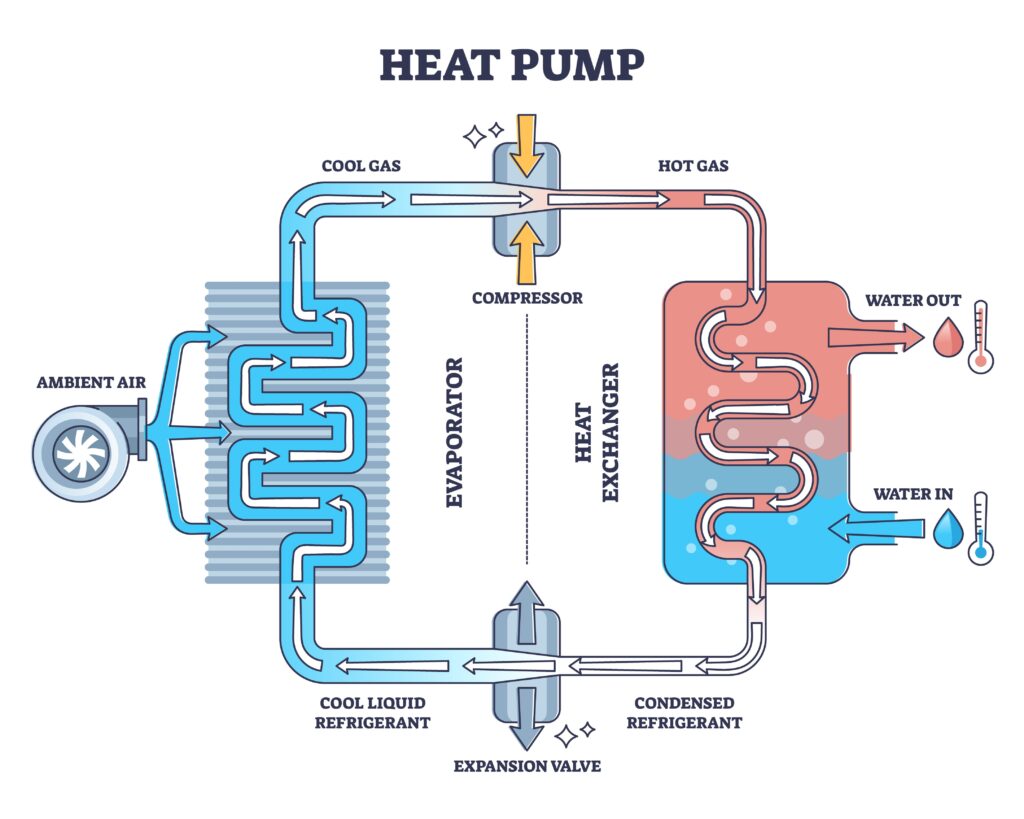
heat pump tecnology

“We are on a mission to increase energy efficiency in multifamily and commercial buildings across North America,” said Belinda Gilbey, Co-Founder and President of Bondi. “Heat pumps have been proven to be the most efficient way to decarbonize buildings, while also reducing energy bills, introducing air conditioning, and improving air quality. In addition to heat pumps, we are also seeing some emerging new technologies that will greatly benefit apartment owners.”

According to Quinn McGovern, Director of Operations at Bondi, the benefits of embracing new technologies—fuel switching in particular—are impossible to ignore, especially as more buildings undergo conversion projects, bringing an influx of supporting data to the forefront.

“Electrically heated buildings generally offer a bulletproof business case for HVAC heat pump retrofits, cutting heating bills in half while adding building-wide air-conditioning,” he said. “Fuel-switching the gas-heated building stock to use electricity is our next major priority. We have carefully analysed business cases for gas-heated multi-res buildings, which make up the vast majority of MURB building stock, and today we are focused on showcasing that data from research and from the field. I believe we can make a real difference supporting building owners with technology for improving their building stock and reducing GHG emissions.”

Of course, every retrofit requires a financial investment, and substantial upgrades can be costly. Bondi recently launched a unique financial product available to property owners facing budgetary hurdles as a barrier-to-entry for many retrofit efficiency projects. Describing it as “a distinct way for owners to pay for building efficiency work while avoiding the capital expense,” McGovern said the financial product will help relieve some of the worry many property owners have about funding.

Sector-wide pursuit

Speaking about the broader impacts of climate change, Peter Love, President of Love Energy Consultants Inc., was on hand at the event to address why it is incumbent upon apartment owners to invest in energy retrofits—especially in Canada, which is recognized as one of the worst global offenders when it comes to energy consumption.

“I am a big believer in continuous improvement,” he said. “Every positive change we make contributes as we strive for decarbonization and a net zero carbon economy. Most energy efficiency upgrades are invisible, so it’s important that multi-unit building owners celebrate them. This includes telling staff, suppliers, and residents about any energy improvements that have been made across the board.”

Love breaks out energy efficiency improvements into the following six categories:

1. Conservation behaviour – creating a culture among staff and residents that prioritizes energy efficiency.

2. System operations – effectively managing, maintaining and training facility operators on current systems, including HVAC commissioning/recommissioning.

3. Fuel substitution – switching to heat pumps or other alternative power sources to reduce carbon emissions.

4. New technologies – investing in smart, new tech solutions designed to improve efficiencies at the building.

5. Demand response – curtailing or reducing demand for electricity and water at peak times.

6. Onsite generation – incorporating “behind-the-meter” systems such as solar panels to create energy.

Essentially, by taking steps across these six areas, whether the plan includes making small energy-saving adjustments or investing in a solar array, Love asserts there are many ways to advance energy conservation without resorting to leveling the building.

“Awareness is by far the biggest barrier to increased energy efficiency,” he said. “Fuel substitution, for instance, is a form of energy efficiency that has become extremely important as we strive to attain a net zero carbon economy. Heat pumps aren’t all that new, but still, not enough building owners are tapping into their amazing benefits.”

Benefits include increasing the building’s value, reducing energy costs, introducing efficient cooling where it didn’t exist before, improving tenant comfort, and lowering baseline GHG emissions by up to 60 per cent. The technology works by using electricity to transfer warm and cold air rather than generating it by burning fossil fuels.

While executing a generational change to the heating system of a 50-year-old building may sound daunting, installing the units isn’t as invasive as it seems. According to Gilbey, “Heat pump technology has advanced tremendously, with little disruption to the tenants or the building façade. It’s a low-cost way to upgrade an aging asset at a time when the multi-residential sector urgently needs to pursue decarbonization.”

Changing codes and policies

Energy savings and resident comfort aside, the state of our changing climate has greater implications. According to a recent report from the Building Decarbonization Alliance (BDA), buildings directly account for around 13 per cent of our annual greenhouse gas emissions yet change across the sector is happening far too slowly to meet Canada’s 2030 and 2050 emissions targets.

“The status quo is clearly not working,” BDA analysts wrote. “Heat pump sales in the next three years will need to more than double current projections to meet Canada’s climate goals.”

But to get there, Love acknowledges building owners need more clarity and support in terms of available programs and funding to incentivize fuel switching.

“With past programs, there has been a tendency from the utilities to make forms more complicated than they need to be, coupled with policies and regulations that just aren’t clear,” he said. “There needs to be better messaging, better programs, and a simpler way for building owners to move forward.”

Meanwhile, building codes are changing to raise the minimum standards of existing buildings, and not just to ensure new buildings are constructed with lower emissions from the ground up. Owners of older apartment assets need to ramp up their energy strategies and invest in decarbonization if they want to stay afloat.

For more information on energy conservation strategies for multi-unit buildings, visit the BONDI Energy website.

Ryder, 3XN GXN selected for UBC student housing

Ryder Architecture, in partnership with 3XN GXN, will provide architectural services for the University of British Columbia’s (UBC) Lower Mall Precinct Phase One project.

This $560-million endeavour includes the largest provincially funded housing project to date, delivering over 1,500 new beds and significantly contributing to British Columbia’s remaining target of approximately 6,700 new student housing beds by 2028.

The Lower Mall Precinct Phase One project will encompass five buildings, totalling 710,000 square feet. It will include an 18-storey tower, an eight-storey mass timber hybrid prototype structure, and the adaptive reuse of a historic fire hall. The development also includes:
●     1,508 student housing beds (1,333 new and 175 replacement), focusing on graduate students.
●     A 400-seat dining hall.
●     37 new childcare spaces.
●     Common amenity spaces.
●     Academic and administrative office spaces honouring the communal legacy of St. John’s College.

The project aims to set new standards for sustainability and inclusivity on campus. The buildings will target net-zero emissions by 2035, achieve LEED Gold certification, and adhere to the UBC LEED Implementation Guide. They will be zero-waste ready, achieving a 10 per cent reduction in embodied carbon. Climate resilience and biodiversity are integral, aligning with provincial frameworks and UBC guidelines for climate adaptation and bird-friendly design. Delivering inclusive design will include fully accessible architecture supportive of UBC’s Inclusion Action Plan and Positive Space Campaign.

“By integrating mass timber technologies and adhering to CleanBC initiatives, we are committed to advancing UBC’s sustainability goals,” said Adam James, principal at Ryder Architecture. “Our team, supported by 3XN GXN’s research-driven studio, pioneers strategic sustainability within the construction industry.”

UBC’s Point Grey campus presents unique challenges and opportunities in one of the world’s most expensive real estate markets. The project’s focus on affordable, specialized housing addresses the pressing need for student accommodation in a socially cohesive environment while easing pressure on the local rental market beyond the campus.

Construction is set to begin in fall 2026, with the project expected to open for students in phases starting in fall 2028 and completing in fall 2029.


Stantec wins four CCE Awards

Stantec was awarded four 2024 Canadian Consulting Engineering (CCE) Awards, by ACEC-Canada. The awards recognize exceptional engineering projects by Canadian firms and highlight the important work they do to connect communities, grow the economy, and improve safety and sustainability.

This year, Stantec received Awards of Excellence for the firm’s work on the LNG Canada Material Offloading Facility, British Columbia Housing Climate Risk Assessment Framework (CRAF) Tool, Twinning of Stoney Trail over the Bow River in Northwest Calgary, and the Arthur J.E. Child Comprehensive Cancer Centre.

LNG Canada Material Offloading Facility
The LNG export project facilitates the delivery of construction materials and 8,000-tonne plant modules, playing a crucial role in Canada’s largest private capital investment. The facility is optimized to withstand typical and atypical seismic, marine, and weather conditions. It supports large vessel docking and heavy equipment unloading. The accelerated design timeline helped deliver this vital, economically impactful project on time.

BC Housing Climate Risk Assessment Framework (CRAF) Tool
Morrison Hershfield, now Stante,c developed a Climate Risk Assessment Framework (CRAF) tool that allows BC Housing to apply a standardized approach to integrating climate risk and resilience at its assets across the province. This first-of-its-kind tool can be used to assess site viability for new developments, development proposals scoring across sites, and prioritization and budgeting of risk-mitigation strategies. It also has potential for future expansion to additional climate risks and communities.

Twinning of Stoney Trail over the Bow River in Northwest Calgary
This crucial project for the City of Calgary included the design and construction of a new 5-span river crossing. It’s a 470-metre-long bridge over the Bow River, directly west of the existing Stoney Trail bridge. The bridge was segmentally cast in place using a balanced cantilever method. This complex method of bridge construction means the superstructure of the bridge—the part of the bridge that rests on the piers (the upright support for the structure) and abutments (substructure at the ends of a bridge span)—was built out from the 6 separate piers and abutments and joined together at completion.

Arthur J.E. Child Comprehensive Cancer Centre
The Calgary-based centre opened in fall 2024 as Canada’s largest cancer treatment and research facility; it is the second largest in North America. It features cutting-edge engineering design, showcasing advancements in healthcare design and public infrastructure. Integrating all of the electrochromic tinting present within the building’s exterior glazing into the building automation system enables the facility to operate more efficiently and with greater occupant comfort year-round. To provide uninterrupted service during power outages, four generators were seamlessly integrated with the main power supply and located below grade to minimize noise disruption.


New report reveals Canada’s trending cities

Leading North American apartment search website, RentCafe, recently published the Canadian Renter Interest Report, highlighting the top trending cities in Canada that have captured the most interest from renters in Q3 2024. To compile the list, analysts considered millions of interactions on its platform, specifically looking at four key indicators across Canadian properties: availability of apartments, listing views, apartments saved as favourites, and personalized saved searches.

Below is a snapshot of Canada’s top trending cities of Q3, according to the new report:

  1. Winnipeg, MB, leads as Canada’s top trending city for renter interest, with the highest possible score of 100 points driven by the high engagement metrics from renters. Winnipeg’s strong, diverse economy attracts apartment hunters from all over Canada, mostly from Toronto, Calgary, and Vancouver.
  2. Saskatoon, SK, ranks second with a score of 90.49, driven by a 27 per cent increase in online traffic and a 34 per cent rise in favourited listings year-over-year. Interest for apartments in Saskatoon mainly comes from renters in Winnipeg, Calgary, and nearby Regina, SK.
  3. Edmonton, AB, sitting at number three, stands out as the only major Canadian city in the top 10. With a score of 88.88, the city has the highest number of apartments marked as favourites. Edmonton attracts interest from young professionals and families, especially from cities like Vancouver, Toronto, and Calgary.
  4. Victoria, BC, claims fourth place, driven by a 34 per cent increase in favourited listings and a 17 per cent rise in online traffic year-over-year. The city’s high quality of life and strong community appeal make it a favourite among renters from Toronto and within British Columbia.
  5. Ottawa, ON, rounds out the top five with increased interest from government workers and young professionals looking for housing in the nation’s capital. Despite a slight drop in page views year-over-year, Ottawa ranks third for favourited listings, showing a strong, focused interest among apartment hunters.

Other key insights:

  • Ontario stands out as the most highly sought-after region with Toronto, Ottawa, and Kingston among the top 10. Mid-sized cities are also in the ranks as their balance between affordability and quality of life draw renter interest.
  • The Prairies lead with three trending cities in the top five: Winnipeg, Saskatoon, and Edmonton highlight the growing appeal of mid-sized cities as renters seek better deals and job prospects beyond traditional hubs.
  • High home prices and limited housing options continue to make renting the go-to option for many Canadians. As a result, renters across the country are consistently on the lookout for apartments that align with their budgets and lifestyrles, even beyond the peak moving season.

For the full list of trending cities in Canada this quarter, click here: https://www.rentcafe.com/blog/rental-market/market-snapshots/canada-renter-interest-report/

Winners celebrated at MASI Design Awards

The Manitoba, Alberta, Saskatchewan Interior (MASI) Design Awards were held on Oct. 23, 2024 at the BMO Centre Calgary. These annual awards showcase the best interior design talent from across the three provinces.

Gold awards went to 10 projects in their respective categories while 10 winners received silver and nine received bronze awards.

GOLD WINNERS

Residential New Construction
Scarboro Residence
Sarah Ward Interior Design

Residential Renovation
Sunset Residence
Amanda Hamilton Interior Design

Restaurant
On the Lake
Amanda Hamilton Interior Design

Office Over $150/sqft
Fasken
iN STUDIO

Office under $150/sft
CK Office Fit Up
1×1 Architecture

MASI

Retail
The Beige Label Salon
Mackey Design Group

Healthcare and Wellness
Imagine Dental
Lawrence Interior Design

Hospitality and Recreation
Mountain House
Base Camp Resorts

Special Feature
Artistic Divider
iN Studio

Institutional
Community Animal Centre
1080 Architecture Planning + Interiors

SILVER WINNERS

Residential New Construction
Dumoulin Residence
1X1 Architecture

Residential Renovation
Smith Street Lofts
MMP Architects

Restaurant
Rhythm & Howl
Basecamp Resorts

Office Over $150/sqft
111 Prospect
3twenty

Office under $150/sft
TransAlta Office Relocation
Zeidler

Retail
Alter Ego Sports
Rodych Integrated Design

Healthcare and Wellness
Wonderment Child Centre
Holland Interior Design

Hospitality and Recreation
SaskPower Customer Experience
1080 Architecture Planning +Interiors

Institutional
Argyle St. Pius Joint use School
1080 Architecture Planning + Interiors

Special Feature
Ceremonial Space
P3 Architecture Partnership

Slight dip in GTA condo prices during Q3

Condo sales were down on a year-over-year basis, while the number of listings rose in the third quarter of 2024. This resulted in more negotiating power for buyers and a slightly lower average selling price, according to new data from the Toronto Regional Real Estate Board (TRREB).

“While condo sales remained low in the third quarter, market conditions are expected to improve,” said TRREB President Jennifer Pearce. “As the positive impact of interest rate cuts continues to grow, a growing number of renters will likely make the move into homeownership. Many of these households can initially start to take advantage of lower borrowing costs and lower home prices, thereby making their monthly payments more affordable.”

Total condominium apartment sales amounted to 4,204 in Q3 2024, down by 4.4 per cent compared to Q3 2023. There were 14,721 new condo listings, which represented a year-over-year increase of 10.6 per cent. With more supply in the market, the average price dipped by 3.3 per cent annually to $692,672. The average Q3 2024 price in the City of Toronto was $713,80, down from $737,035 in Q3 2023.

“As condo market conditions start to improve in the months ahead, we will start absorbing the large standing inventory of listings that built up over the past year,” said TRREB Chief Market Analyst Jason Mercer. “Ultimately this will lead to tightening market conditions and renewed price growth, but this will become more of a story as we move through 2025.”

CAO expands director training

The Condominium Authority of Ontario’s (CAO) newly launched Director Training 2.0 expands upon previous programs with two brand-new modules for communication and conflict resolution.

The update also refreshes content, provides tools and tips to better equip condo boards for their roles and responsibilities and features a self-assessment module so directors can understand what areas to revisit in their learning path.

The CAO also introduced a new Condo Director Competency Framework that includes a reference list of skills and further development materials to support ongoing growth.

“Directors told us through surveys and consultations that more in-depth education was needed to better support them in their important roles and responsibilities, particularly now that 1.71 million Ontarians call condos home.,” said Condo Authority CEO and Registrar Robin Dafoe. “There are more than 45,000 active condo directors in the province and I’m proud that this new training delivers just that, while also enhancing consumer protection and supports for all members of Ontario’s condo communities.”

All Ontario condo board directors must complete the training within six months of starting their term going forward, unless they’ve already finished the mandatory training within the past seven years. The free, self-paced training is available to anyone who’s interested and can be accessed on CAO’s website.

The role of BIM in enhancing facility management efficiency

BIM (Building Information Modelling) is well known for its application in the architecture, engineering, and construction sectors, however, this technology is making waves in other disciplines, such as facility management. By leveraging detailed insights into a facility’s physical and functional characteristics, BIM ensures that facility operations are cost-effective, sustainable, and, perhaps most importantly, happier places to work.

Integrating facility management in the design phase

Modern construction is highly collaborative. BIM works in construction by bringing together various stakeholders and disciplines so that designers, architects, and engineers can have input into the early stages of a project. This proactive approach helps identify and resolve potential clashes and problems, reduces costs, and speeds up the project lifecycle.

What if facility management expertise was added to that process? That would allow things like space utilization, maintenance, and operational requirements to be baked into the design process from day one, ensuring greater functionality and longevity for the facility.

How BIM transforms facility management

BIM provides a vast, comprehensive database of all the pertinent information about a building project, including asset and facilities management data. Centralizing all this data means that managing the placement and maintenance of infrastructure within the building becomes far more efficient.

Here’s how BIM can drive improved facility management:

Better maintenance planning

As mentioned above, BIM collects intricate details about building components. Some of this data includes specifications, warranty information, and even maintenance schedules. Early access to this information ensures proactive maintenance planning that can extend equipment lifespan and overall output.

Better lifecycle management

The wealth of data compiled within BIM systems means facility management teams can plan for the entire lifecycle of assets. Therefore, decisions about maintenance, repairs, and renovations are data-driven, ensuring the facility’s lifecycle is maximized, and resource use is optimized.

Better space management

Access to precise 3D models allows for optimal space management. However, these benefits are not just about packing in as many components as possible. It also allows designers to consider the overall flow of the building and how facilities fit into that picture.

Additionally, this spatial data allows teams to plan for future needs, ensuring the space can adjust and adapt to changing conditions or requirements.

Better communication

BIM tools also serve the collaborative nature of modern building planning. All stakeholders have access to essential information, allowing each discipline to bring their experience and expertise to the project. Moreover, these tools allow faster and more efficient communication, reducing project delays and costs and driving better contract management and execution.

Utilizing BIM for effective preventive maintenance and asset management

All assets within a facility represent an investment. Maximizing their lifecycle and minimizing downtime and repairs is essential for achieving a return on this expenditure.

BIM software is a centralized repository of information on each asset. Facility managers can leverage this data to open the door to many benefits, including:

Asset tracking: BIM is an effective asset management tool. It collects data such as when an asset was installed, how long it is under warranty, maintenance schedule and history, and more. Knowledge about asset performance and condition helps extend the lifecycle.

Predictive maintenance: BIM tools can help organizations keep track of historical data and performance metrics. From here, teams can predict maintenance needs and implement timely preventative maintenance that reduces downtime and costs.

Inventory management: Another huge benefit of using BIM for facility management lies in the software’s ability to manage inventory. This process eliminates manual inventories and ensures accurate, real-time record-keeping accessible to all stakeholders.

Real-time data integration: IoT devices and sensors can easily integrate with BIM systems to provide real-time data asset performance. Again, this can help with timely interventions that help minimize downtime.

Maintenance coordination: By centralizing building component data, firms can establish a single source of truth. This setup allows everyone from facility managers, maintenance staff, and contractors to understand performance and maintenance schedules, meaning response times are lower and workflows are more efficient.

Overcoming the challenges of implementing BIM in facility management

Implementing any system comes with a set of challenges. However, the benefits of BIM for facility management are so pronounced that overcoming these hurdles is a must.

Data integration

Firms that want to use BIM must integrate with their existing facility management systems. Ensuring interoperability could involve combining several platforms to harness the power of centralized data fully, which is a not insignificant challenge.

Solution: Developing standardized data protocols can resolve these issues and ensure all connected systems play well together. Working with quality BIM software vendors will ensure a smooth experience.

Data accuracy and management

Implementing any new data system raises questions about data quality and responsible stewardship of sensitive information.

Solutions: Again, establishing solid data protocols is a must. Data quality checks and audits will go a long way toward ensuring accuracy and reliability. Furthermore, robust access controls, encryption, and the utilization of a Common Data Environment (CDE) can ensure sensitive information and intellectual property is accessible to stakeholders without compromising privacy.

Costs

Implementing any new system comes with costs, and a BIM solution is no exception. Some of the expenses that firms must consider are subscription costs, hardware, and training.

Solution: The costs of BIM software and any attendant expenses should be offset against savings and productivity increases. Conducting a cost-benefit analysis can give an insight into potential ROI and help make the case for investment in the boardroom.

Additionally, the advent of cloud-based BIM tools can reduce hardware spending, making these innovative platforms more accessible. While costs are always a consideration when adopting new tools, some research reports that one BIM use case had an ROI of as much as 39,000 per cent.

Skills gap

BIM tools exist on the cutting edge of technology. As such, many stakeholders and facility managers will lack the required skills and experience to get the most from these platforms. Any barriers to adoption can reduce the returns on your BIM investment.

Solution: Quality BIM vendors provide the support and training facility staff need to get up to speed on these new tools. Other proven methods to explore include appointing an internal BIM champion, using digital adoption platforms (DAPs) to drive contextual learning, or leveraging BIM consultants to support the transition toward a new system.

By implementing BIM technology, many facilities have enhanced operations, saved money, increased sustainability, and improved the quality of their workplace.

Anna Liza Montenegro, Director of Marketing, Microsol Resources, develops design technology conferences for architecture, engineering, and construction (AEC) professionals as a forum to exchange innovative strategies, and best practices, and facilitate discussions into the technology trends driving significant change in building design and construction.


BCCA reports declining investments in B.C. projects

The threat of poor industry support and declining investments in major projects is alarming despite the value of existing projects continuing to grow, according to the B.C. Construction Association (BCCA)

In its Fall 2024 Construction Industry Stat Pack, BCCA  found that since spring 2024, the value of proposed major infrastructure projects has decreased in value by five per cent and nearly 20 per cent over the past five years, which makes the future of the industry look problematic as current major projects begin to wind down with no guarantee of being adequately replaced.

British Columbia is in high demand for major infrastructure projects. Hospitals, schools, multi-unit housing, bridges, and supporting infrastructure across the province must be built. Still, the decreasing value of proposed construction projects suggests that the province is not invested in making these a reality.

This decrease in investments is coupled with the concurrent need for more robust support mechanisms to ensure that said projects can be delivered. The underlying factors of payment uncertainty, workforce shortage, and high labour costs pose significant strains on the construction industry, which need to be addressed by our political leaders.

“British Columbia’s construction industry will be paramount to building our province’s critical infrastructure and alleviating the housing crisis,” said Chris Atchison, BCCA president. “During the election campaign, B.C.’s political party leaders committed to supporting the construction industry. Now that the results have been finalized, we need the government and opposition caucuses to work together to implement policies geared towards payment certainty and workforce development to ensure the construction industry can meet the current and future demand to build B.C. better.”


Clinically fit space on the leasing agenda

A small but noteworthy cohort of tenants will be leasing specialized space as the Ontario government moves toward granting licences for a raft of new independently operated surgical and diagnostic clinics. Two calls for applications from prospective service providers have been conducted since the summer with the third slated for later this fall.

Under the rules set out in the provincial Integrated Community Health Services Centres (ICHSC) Act, these will be out-of-hospital facilities where patients can obtain publicly funded orthopedic surgeries, gastrointestinal endoscopy procedures or MRI and CT scans. Chosen candidates will first be provisionally approved through the application process and then have a prescribed period to fulfill all licensing conditions. That includes a pre-licensing facility inspection to confirm it complies with required standards.

“The proactive groups that are applying for these licences and have the belief that they are going to be successful, they’re out looking for space today so they can be prepared to sign a lease quickly and get up and running,” reports Scott Rasmussen, a vice president and sales representative with Colliers Canada’s life sciences and medical tech advisory team. “This is a unique opportunity for innovative practitioners to support the Canadian health care system, and some buildings are more suitable than others to accommodate it.”

It’s foreseen that significant capital upgrades would be needed to offer health care in conventional office buildings, while some would be outright disqualified for some services. Heavy and/or delicately calibrated diagnostic equipment may require floor loads and vibration safeguards beyond the structural capacity of existing stock. Other buildings would not have spacious enough corridors and/or elevators to handle stretcher gurneys if immobile surgical patients had to be moved in an emergency evacuation.

There would also generally be heightened requirements for ventilation, backup power, infection control and waste handling. Thus, it’s not a straightforward formula to compare facilities costs in hospitals and commercial real estate. Gordon Burrill, president of Teegor Consulting, a firm providing facilities management and construction services to the health care sector, cautions against simple assumptions based on current hospital construction costs and seemingly cheaper space elsewhere.

“There’s a reason why hospitals are more expensive and office space is less expensive. It’s about the infrastructure within those two building types,” Burrill says. “You might be looking at office space that is x number of dollars per square foot, but then there are all these upgrades that will have to go along with it. ”

Relief valve for backlogged service delivery

The pending new clinics in Ontario are intended to be a relief valve, not a competitive alternative to existing health care delivery. Licences will be tied to regions where there is high and backlogged demand for the designated services.

“It’s a licence to support the need. Just because there are entrepreneurs who believe they can deliver the services, doesn’t mean that licences will be granted,” Rasmussen reiterates.

Both he and his colleague, Matthew Johnson, a senior vice president with Colliers, anticipate that densely populated urban areas will fall within that high-needs category. However, there is little expectation for the multi-tenant buildings solely geared to private medical clinics seen in the United States.

Ontario’s new clinics are more likely to be scattered in a patchwork of suitable commercial buildings and life sciences facilities that predominantly house research activities. Existing health care and life science research clusters are identified as a logical source of qualified clinic operators, particularly given the professional fluidity that commonly sees medical clinicians and researchers serving on university faculties and sometimes becoming med-tech entrepreneurs.

“Some of the great life sciences and med-tech IP discoveries are generated by the people who are doing that medicine day-to-day and are trying to find a way to improve it. So you can have the chief executive officer of an early-stage life science company running the company in the morning then going to the university to teach a class or to the hospital to scrub in for a surgery in the afternoon,” Rasmussen observes. “Proximity provides the ability to get back and forth to these different parts of their lives, or the different hats they wear, on a convenient basis.”

“There would be logical reasons why a clinic would go into a life science building to be in a cluster of other like organizations to create this community of ebbing and flowing,” Johnson concurs. “This is an area that could be a tremendous focus for future development in the life science development space.”

He hypothesizes that savvy investors and developers will need to understand the complexity of their medical tenants’ needs and the capital required to meet them, and also grasp the more intangible factors for patients. Some traditional tenets of real estate may not apply.

“I have never met anybody who would say: My number one priority for my knee replacement is convenient location,” Johnson quips. “It’s tough to quantify, but, if the facility doesn’t feel right, people utilizing that facility may question the quality of the service being given to them.”

Expanded role for third-party facilities managers and maintenance contracts

The ICHSC Act assigns Accreditation Canada the responsibility for overseeing compliance with facilities and medical practice standards in both new and existing independently operated surgical and diagnostic centres. (The latter encompasses roughly 900 Ontario clinics licensed to provide a range of publicly insured health services including eye and plastic surgeries, abortions, dialysis and sleep studies.)

As it pertains to facilities management, a statement from the not-for-profit inspection body says it will use “expert and trained peer assessors” in the “assessment of the physical environment and its proper maintenance, as well as maintenance of the equipment used in the provision of services offered”. In practice, this means that clinics will be held to the same body of standards as every other health care facility.

“If the service is being funded by the provincial government through the Health Ministry, it’s a health service,” Burrill confirms. “It doesn’t matter what kind of a building it’s in, it has to meet all the appropriate health care standards.”

Yet, there should be some simpler requirements — for example, related to contingency power — because of the scoped service offerings compared to large health care centres. “If it’s a surgical clinic, you don’t need three days of backup power for a space like that; you just need enough time to be able to finish a surgery safely. The standards do accommodate for that to a certain degree and do provide for more economical space (than in hospitals) in some conditions,” Burrill advises.

On the flipside, moving to an out-of-hospital location means losing in-house facilities managers. Third-party service providers and maintenance contracts are likely to have an expanded role.

“Maintenance of health care facility equipment is more rigorous than maintenance of commercial equipment,” Burrill affirms. “MRIs only function within very tight temperature ranges so there are significant operating restrictions on it. Or, if it’s any kind of sophisticated equipment with microscopes, any hospital facility manager will tell you that’s an area of the hospital where you have to be very, very careful about vibrations.”

Alternative asset class gaining share in the United States

The pending licences in Ontario, and similar growth of health service options through privately operated clinics in Alberta and British Columbia, represent a negligible niche of the market compared to the United States, where purpose-built, multi-tenanted buildings for medical services are an established alternative asset class for commercial real estate investors and owners/operators. Players in that market, such as Al Rabil, co-founder and chief executive officer, real estate, with the investment platform, Kayne Anderson, have enjoyed a national average occupancy rate of 93 per cent over the past 20 years.

“It’s an incredibly safe asset class that continues to be under-supplied as well as under-invested,” Rabil told an online audience during a recent webinar sponsored by IPE (Investment & Pensions Europe) Real Assets. “Fifteen years ago, 99 per cent of medical office in the U.S. was owned by health care hospital systems. It’s about 65 per cent today and I would dare to say that will probably drop down closer to 20 or 30 per cent in another 10 years because hospital systems own real estate by default not by desire.”

His company boasts one of the largest medical office portfolios in the U.S., with 768 buildings across 43 states, encompassing approximately 32 million square of space and affiliated with more than 170 health care entities. That’s geared to tenants Rabil defines as “higher margin businesses” providing services such as orthopedics, oncology, cardiology, neurology and diagnostics — resulting in what he terms “an operationally intensive asset class”.

“These are purpose-built buildings that house practitioners and bear no resemblance whatsoever to traditional office. Traditional office can’t generally be converted into medical office,” Rabil stressed. “This is a specialty area that requires specialist knowledge.”

While Canada continues to have a very different health care philosophy, requirements for facilities management expertise are similar on both sides of the border. So, too, are patient demographics.

“There are demand drivers for the next 25+ years in terms of an aging population,” Rabil submitted. “Just one quick statistic: the 65-and-older population requires approximately three times the number of doctor visits that the under-65 population requires.”

Deerfoot Trail improvements reach completion

The expansion of Deerfoot Trail in Calgary, a major transport artery for the city, is now complete.

The suite of Deerfoot Trail improvements began in 2022 with work on 64 Avenue, which was competed in 2023. The Beddington Trail and 11 Street NE project is the second key segment to be completed.

The totality of work on Deerfoot Trail includes increased capacity on ramps, additional lanes, reconfiguring exits and intersections and twinning a bridge. Improvements to Deerfoot Trail are being completed in distinct projects, prioritizing the most congested areas. It is estimated that the remaining Deerfoot Trail improvements will be complete by fall 2027. This important work will enhance safety and save time for drivers.

Work on this section of Deerfoot Trail began in spring 2023 and includes connecting 11 Street NE to westbound Beddington Trail and northbound Deerfoot Trail. Upgrades also included adding a fourth continuous lane to Deerfoot Trail in each direction from Airport Trail to Beddington Trail.

“It’s great to see provincial construction wrap up on this critical road for Calgary drivers. I’d like to thank the contractors for building a wider, more efficient Deerfoot and also thank Calgarians for their patience during construction. This project will benefit so many families that commute every day and is another example of how we’re making life better for Albertans,” said Alberta Minister of Transportation and Economic Corridors Devin Dreeshen.

Aecon Transportation West completed the construction of the Beddington Trail and 11 Street NE connector for $19 million.

Diverting considerable commuter, industrial and airport traffic between McKnight Boulevard and Beddington Trail to the new connection will increase safety and reduce weaving northbound on Deerfoot Trail. It will also address bottlenecks between Glenmore Trail and Anderson Road/Bow Bottom Trail.


ISSA announces honourees for the 2024 Achievement Awards

The annual awards program recognizes cleaning and facility solutions industry professionals who are committed to driving the industry forward through their positive contributions in their businesses and beyond. These four honourees will be recognized on November 19 during the ISSA Spotlight Event and Awards ceremony at ISSA Show North America 2024, which takes place November 21-24 at the Mandalay Bay Convention Center in Las Vegas.

“As ISSA continues to champion excellence in the cleaning and facility solutions industry, we are grateful for the dedicated individuals who drive innovation and uphold the high standards that define our association,” said ISSA 2024 Board President Matthew Schenk. “Congratulations to this year’s Achievement Awards honourees. I look forward to honouring their remarkable contributions at the upcoming celebration in Las Vegas.”

The 2024 Achievement Awards and their recipients are:

  • The ISSA Honorary Lifetime Achievement Award celebrates an individual who, in the opinion of the ISSA board, deserves recognition for substantial contributions to the advancement of the industry and/or to ISSA over a significant period of time. This year’s recipient is Walter Dethlefsen, chief operating officer at Network Services Co. Over his 40-year career with Network Services, Dethlefsen has brought together the top independent distributors, manufacturers, and customers to create lasting partnerships and business growth. He has a remarkable ability to connect people and find common ground.
  • The Jack D. Ramaley Industry Distinguished Service Award, reserved for individuals with at least 10 years of outstanding service to the professional cleaning industry, will be presented to Carey Jaros, president and CEO at GOJO. Jaros exemplifies the values that define our industry. Her character, professionalism, kindness, and innovative thinking shine through in all she does. Jaros is a strong advocate for cleaning and facility solutions, consistently giving back to the industry by mentoring, supporting emerging leaders, and championing women in our field through the ISSA Hygieia Network. She generously shares her time and expertise in countless ways, making an impact that resonates across our community.
  • The Manufacturer Representatives’ Distinguished Service Award, which recognizes individuals who support manufacturer representatives, the industry, and ISSA, will be awarded to John Carroll of TPC Enterprises. Carroll’s professional journey began in 1973 when he built a solid foundation in direct sales for various manufacturers. By 1992, Carroll transitioned to become a manufacturers’ representative, providing unwavering support to the industry even after his retirement. His passion for fostering growth continued in 2023 when he took on a new role as an industry consultant, helping emerging manufacturers make valuable connections with established reps.
  • The ISSA Rising Star Award in Honour of Jimmy Core acknowledges one of the class of 30 ISSA Emerging Leaders who has made positive contributions to their organization and the industry. Konstantin Ekelman, director of sales at BradyPLUS, receives this year’s honour after being selected through an industry voting process. Ekelman brings a unique blend of professionalism, humility, and innovation to his role. He leads a highly respected team of sales professionals, earning admiration from colleagues and customers alike. His approach is built on fostering strong relationships and treating everyone like extended family. His care for both his team and clients forms the foundation of his leadership, creating a culture of trust and growth.

Join ISSA in celebrating these four Achievement Awards recipients at the ISSA Spotlight Event and Awards ceremony on Tuesday, November 19, at 9:00 a.m. PST at the Mandalay Bay Convention Center in Las Vegas.

Property reassessment still on hold in Ontario

Ontario’s newly released fall economic statement confirms that property reassessment is still on hold, but a small tweak is in the works to alleviate the tax burden on some student housing projects. In the interim, 2016 market values will remain in place for the 2025 tax year.

“Through this review, constructive input has been received from municipalities, business representatives, property tax professionals and other stakeholders,” the economic statement reports. “Provincewide property tax reassessments will continue to be deferred until this work is complete.”

Thus far, those consultations are identified as influencing factors in the newly created flexibility for municipalities to establish an optional tax subclass for new purpose-built rental construction. As well, based on feedback from the review, the government is promising to open up the Municipal Property Assessment Corporation’s (MPAC) database to help inform municipal planning exercises, and to create a centralized electronic assessment roll for public access.

A package of legislative amendments introduced in tandem with yesterday’s tabling of the economic statement also includes a proposed change to the Assessment Act to clarify that land that accommodates university-operated student housing is exempt from property taxation even if it is located separately from that university’s main campus.

The economic statement hints there could be future “assessment methodology changes” for affordable rental housing. It also identifies York Region as the first municipality to indicate that it plans to approve a reduced property tax rate for new purpose-built rental housing for the 2025 tax year.

Meanwhile, some landowners who support new construction can expect to receive updated assessment notices after the Ontario government created a new property tax class for lands used for aggregate extraction earlier this year. This applies to roughly 3,200 pits or quarries across province. Evaluations will continue to be pegged to 2016 market values, but will apply a methodology arising from a recent Assessment Review Board ruling and subsequent appeal court decision.

Ontario’s sprinkler deadline up for discussion

Some of Ontario’s long-term care (LTC) home operators could be getting an 18-month extension on a looming deadline to install automatic sprinklers for fire suppression. A proposed regulatory amendment would give specified lollygaggers until July 1, 2026 to comply with the Ontario Fire Code mandate, provided other enhanced fire safety measures are in place.

The Ontario government is now inviting public comments on this proposed new deadline, which would give affected operators a total of 13+ years of advance warning since the provincial Fire Code first outlined the future sprinkler requirements in 2013. The associated regulatory analysis describes the extension as a measure to “manage the risk of capacity loss from homes that may not have sprinklers installed by the deadline” which would only be available in three designated scenarios.

It’s proposed that LTC operators could obtain an extension if they can demonstrate they have a contract for sprinkler installation in an existing building that will be completed by July 1, 2026, if redevelopment of the home is in progress and an equivalent number of beds will be available in a sprinklered facility by July 1, 2026 or if the facility is in the process of closing, but will still be occupied on January 1, 2025.

To warrant an extension, LTC operators would also have to pay extra attention to fire safety. That includes: committing staffing for continuous fire watch duty; submitting proof to local fire officials that LTC supervisory staff have completed prescribed online training; conducting more frequent fire drills and testing of the fire alarm and voice communications systems; and equipping all nurses’ stations with portable fire extinguishers.

The proposed regulatory amendment is open for comment until November 13.