Articles Archive - Page 116 of 928 - REMINET
REMI

Accessibility grants available for Manitoba orgs

Eligible organizations in Manitoba can now apply for accessibility project funding of up to $50,000 through the Manitoba Accessibility Fund grant program.

Projects must target accessibility standards under the Accessibility for Manitobans Act to improve customer service, employment or information and communication, and must also fulfil one of three objectives including: raising awareness about the prevention and removal of barriers; developing tools, resources and training to support compliance with legislated standards; or removing barriers to information and communications electronically, in print and in person.

Potential applicants can include municipalities and local authorities, such as planning districts and Northern Affairs Community Councils, universities, colleges and school divisions, non-profits and on-reserve organizations. The deadline to apply is February 14, 2025.

To date, the fund has awarded more than $2.4 million in funding to support 109 projects across the province.

Interested parties can find more information on eligibility and the application process here.

The new $158M Fort St. James Hospital opens

The new $158 million Fort St. James Hospital, three times the size of the previous one, is now open to patients.

The new facility has 27 beds, with 18 long-term care and nine acute-care beds. It has an expanded emergency department with two treatment rooms, a trauma bay and an ambulance bay. In addition, there are bigger laboratory and diagnostic-imaging spaces.

”We’re thrilled to announce that the new hospital is opening to patients in Fort St. James, increasing access to health care close to home,” said Josie Osborne, Minister of Health. “This facility represents a significant investment in the health and well-being of people in the region; a need that First Nations and local communities have been expressing for decades. We recognized the urgency of replacing the facility and now both the community and workers will benefit from a modern health-care environment in this state-of-the-art facility.”

The current Fort St. James health centre will be integrated with the new hospital and will open for patients on Monday, Jan. 20, 2025.

“Families will receive better access to care closer to home at the new Fort St. James hospital starting tomorrow and for many decades to come,” said Minister of Infrastructure Bowinn Ma. “Improving access to health care is a priority for our government and that’s why we’re building more hospitals and health-care centres to deliver the services people need.“

First Nations in the area were consulted throughout the design process to help ensure the facility is welcoming to everyone and is reflective of the local Indigenous culture.

The previous hospital opened in 1972 and is severely outdated in terms of space, size, functionality and technology. It had 12 beds and no decontamination room or dedicated area to receive, assess or triage patients in the emergency department. That facility had two treatment bays, one trauma room and no ambulance bay.


Construction moves forward on Scotia Place

The next phase of construction for Scotia Place is set to begin after excavation is complete by spring 2025. In December 2024, the Calgary Planning Commission (CPC) approved the design for the new downtown sports and entertainment venue and granted the project its final development permit.

“Excavating to the bottom of the site will be the first of many exciting milestones we will see between 2025 and the project’s completion in 2027,” said Bob Hunter, project committee member.”

Since last July, crews have dug down more than 10 metres to lower the event bowl of Scotia Place. This design feature gives visitors a barrier-free experience between the main concourse and the outdoor plaza for street level accessibility and integration with The Culture + Entertainment District.

In early 2025, underground utility work and installation of the foundation begins, followed by structural concrete and steel work across the entire site. Walls will go up first, then below-grade columns, stairs, elevator cores, and access ramps.

Designed with inclusivity and accessibility in mind, Scotia Place will host sporting events and concerts and accommodate a wide range of indoor and outdoor community events. The plans also entail a community rink, publicly accessible dining options and retail shops.

“United by a shared vision, we are building a modern gathering place that honours its culturally significant setting on the ancestral and historical land of the Indigenous Peoples,” added Hunter. “Scotia Place also reflects its significance to Calgary’s Downtown and The Culture + Entertainment District, creating a new destination for generations of Calgarians and visitors. This collaborative effort produced a design that is both innovative and inclusive to all – a new landmark that Calgarians can truly be proud of.”

Feature photo courtesy of the City of Calgary.

Easy reference for refrigerant status launched

A new interactive map gives online searchers easy reference to the regulatory status of mildly flammable refrigerants across Canadian jurisdictions. The joint project of the Air-conditioning, Heating and Refrigeration Institute (AHRI) in the United States and Canada’s Heating, Refrigeration and Air Conditioning Institute (HRAI) provides pop-up information when users click on any of the provinces or territories.

That includes a simple yes/no indicator of whether jurisdictions have updated their building and fire codes to allow for the refrigerants, which are classified as A2L, and a list of the currently referenced standards for equipment containing refrigerants in each province or territory’s codes. It follows after AHRI produced a similar interactive map for the United States last year.

“The response to AHRI’s U.S. interactive map was overwhelmingly positive, so we were confident that providing this resource to our Canadian counterparts would be helpful to all stakeholders,” says Tom Deary, senior director of codes at AHRI. “Information on building codes and legislation will be updated as codes and laws change.”

Singleton Reynolds announces new partners

Singleton Reynolds has announced two new partners in Vancouver: Mollie Deyong and Matthew Milne.

“We are excited these talented members of our firm have joined our partnership. They each provide valuable legal advice to help our clients achieve their business objectives. Congratulations to Mollie Deyong, Matthew Milne, and Nicholas Reynolds on this well-deserved accomplishment,” said Singleton co-managing partners, David Edinger and Sharon Vogel.

Mollie Deyong has a strong focus on infrastructure projects and has specialized in construction and infrastructure since the outset of her legal career.

She has honed her skills in respect of drafting and negotiating standard form and bespoke contracts of varying degrees of complexity, including design-build contracts, construction (design-bid-build) contracts, construction management contracts, supply contracts, and professional services contracts. She understands the importance of both high-level risk considerations and technical details, and has a facility with all manner of contract documents including technical specifications, project schedules, contractual amendments and change documentation.

In addition to providing front-end services, Deyong works with clients both large and small representing their interests in respect of a myriad of construction-related issues. She has experience in large-scale infrastructure disputes, including negotiation, mediation, multi-party litigation, and arbitration to resolve the disputes that arise on construction projects. She has experience working with large infrastructure owners, mid-size project owners and developers, contractors, suppliers, consultants and design professionals.

Matthew Milnespecializes in insurance defence and coverage work, most often in the construction context. He is a relationship-builder, bringing practical decision-making to his construction and insurance practice with the drive to bring major disputes to successful resolution.

Milne maintains a practice acting for owners, developers, engineers and contractors throughout the course of construction and following project completion. He also regularly advises clients with respect to commercial general liability, E&O, builder’s risk, and wrap-up liability policies.

He articled at the firm, and has appeared before all levels of court in British Columbia and Saskatchewan.


Cambridge Memorial Hospital unveils its largest expansion

At the grand opening of a new patient care tower at Cambridge Memorial Hospital in Ontario, healthcare leaders, staff, government and volunteers celebrated the construction and refurbishment of more than 400,000 square feet of space, which was unveiled last week.

This is the largest redevelopment in the hospital’s history with a $220-million investment from the province. Lynn Woeller, chair of the CMH, said remaining inpatients that are currently in the 1950’s era Wing C are slated to move into the Wing B complex the weekend of January 18.  “January 20th will be the first time in 10 years that we will function as a complete hospital,” she said during the ribbon-cutting ceremony.

The new tower offers surgical and birthing suites, an emergency department, intensive care unit, maternal newborn unit, pediatric unit and mental health unit. The renovation also adds 52 new inpatient beds for acute care and support services, bringing the total number of beds to 197.

Fully renovated and enhanced laboratory and diagnostic imaging departments feature three radiology rooms,  fluoroscopy, mammography, bone density, and a new nuclear medicine unit to help detect and treat cancer and other diseases.

In the a purpose-built rehabilitation department are 17 more rehabilitation medicine beds and specialty rooms with a mock kitchen, bathroom and laundry to help assess patients with day–to-day tasks before going home. As well, dedicated endoscopy suites come equipped with an expanded pre and post operative recovery space.

“We celebrated the completion of a transformative, multi-year project—the largest health care investment in the history of Cambridge and North Dumfries,” said CMH CEO and President Patrick Gaskin. “But this is more than just a new building—it’s a heartfelt promise to our community. Designed with care and compassion at its core, this space is all about healing, connection, and creating a future where we can grow alongside our community’s needs.”

Feature photo courtesy of Cambridge Memorial Hospital.

Nominations open for the 12th annual Cintas Custodian of the Year contest

Cintas Corporation (Nasdaq: CTAS) launched its 12th annual Cintas Custodian of the Year contest, which honours exceptional school custodians. From now through February 7, the public can submit their custodian nominations at custodianoftheyear.com.

“Beyond cleaning and maintenance, school custodians often make our schools and universities feel like home,” said Emily Ramos, Director of Marketing at Cintas. “For more than a decade, we’ve been inspired by countless incredible stories of custodians going above and beyond, and we’re thrilled to continue honouring them as we celebrate the 12th year of this contest.”

Cintas will award $10,000 to the winning custodian and $5,000 in Cintas and Rubbermaid products and services to the winner’s school. The winner’s school will also receive a complete facility assessment and Cleaning Industry Management Standard (CIMS) Advanced certification by GBAC from ISSA, The Worldwide Cleaning Industry Association, valued at $20,000. The other nine finalists will receive $1,000 each from Cintas, a cleaning supply package from Rubbermaid and complimentary tuition to one ISSA Cleaning Management Institute (CMI) virtual training event valued at $1,500. The top three finalists will also receive an all-expense-paid trip for two to the ISSA Show North America in Las Vegas in November, where they’ll be celebrated for their accomplishments.

“Creating healthy and inspiring learning environments wouldn’t be possible without the dedication of custodians,” said John Barrett, Executive Director of ISSA. “ISSA is honoured to partner with Cintas to recognize and celebrate the dedication, hard work and essential contributions of custodians across the U.S.”

Last year, Cintas Corporation awarded Bob Galewski of Wabasha-Kellogg High School in Wabasha, Minnesota, the 2024 Cintas Custodian of the Year.

The Cintas Custodian of the Year contest is open to all elementary, middle, high school, college and university custodians who have worked at their school for at least two years. Nominations must be 500 words or less on why the nominee deserves the award and must be submitted by February 7. Cintas will announce the top ten finalists on March 4. The public will then be able to vote for their favourite custodian through April 11, and the finalist with the most votes will be crowned Custodian of the Year in the spring.

“We’re proud to partner with Cintas to honour the custodians who go above and beyond daily,” said Robert Posthauer, Senior Vice President and GM of Commercial Business of Rubbermaid Commercial Products. “Custodians are true heroes, and we are committed to showing our gratitude and appreciation for all they do.”

Ontario recharges energy efficiency budget

Ontario’s energy efficiency budget has been recharged with a pledged 12-year, $10.9-billion spending strategy, including the resumption of incentives for residential electricity customers that were largely cancelled when the current provincial government took office. A new three-year program cycle, beginning this month, also significantly boosts the funds available for commercial, industrial and institutional consumers.

As envisioned, a maximum of $3.2 billion could be available in any one of the four program cycles from 2025 to 2036, with up to 85 per cent of that to be divided among province-wide programs for commercial, industrial, institutional and residential electricity consumers. Other funding envelopes are specifically geared to low-income electricity customers, on-reserve First Nations and various geographically targeted measures to be offered through select local distribution companies (LDCs). There is also an opening for the budget and scope of programming to be readjusted after a scheduled comprehensive review in 2030.

This is a significant jump in spending from the Ontario government’s initial allocation for its 2021-24 conservation and demand management (CDM) framework. At that time, $456 million over four years was earmarked for province-wide programs for the commercial, industrial and institutional sectors — an amount that was then topped up with an extra $342 million to add programs for 2023 and 2024. Just $65.6 million over four years was made available for additional programs for customers of specified LDCs.

Now, the government is preparing for a forecasted 75 per cent increase in provincial electricity demand by 2050, which will be needed to support anticipated population and economic growth and the shift away from fossil-fuel-based heating and transportation. Energy efficiency is viewed as a cost-effective means to take a bite out of the some required investment in new generation and transmission capacity. Stephen Lecce, Ontario’s Minister of Energy and Electrification, cited the recognized formula that $1 put towards energy efficiency yields a $2 avoidance in new generation costs as he laid out instructions for the Independent Electricity System Operator (IESO) last November.

“Electricity efficiency programs are an established part of Ontario’s energy mix and provide continued opportunities for electricity consumers to manage their electricity costs, to help cost-effectively meet system needs and provide economic opportunities for the network of companies involved in the delivery of energy efficiency programs and services,” he wrote in a directive that outlines the programs and associated administrative oversight the IESO will be expected to deliver for the 2025-2036 period. “Programs under the Framework will help support energy affordability and customer choice for homes, competitiveness, productivity and cost management for businesses, as well as the province’s transition to a cleaner energy economy.”

Previously dubbed the CDM framework, the newly unveiled programming cycle has been renamed the electricity demand side management (eDSM) framework and given a tighter three-year run-time before the IESO is routinely scheduled to refresh and reset it. Perhaps most notably, the 2025-2027 eDSM framework will reintroduce incentives for residential customers to replace energy-using appliances/equipment and/or upgrade energy performance in their households.

Thus far, other announced changes affecting non-residential customers include new incentives targeting: cooling loads in data centres; solar photovoltaic generation for distributed energy resources (DER); energy management support in industrial facilities; and smart thermostats for small businesses. As well, the budget for LDCs’ specialized incentives — which could flow to either or both residential and non-residential customers within a particular geographic area — has been set at a minimum of $90 million and potentially as much as $150 million over the three-year period.

“Basically, any programs that were offered in 2024 will continue to be offered in 2025 and beyond. We’ll amp them up to reach more customers and then also continue to enhance them,” says Tam Wagner, the IESO’s director of demand side management. “We’ll continue to explore what new technologies are available, where customer needs are and how they align with what the electricity system’s needs may be. What we’re looking at is not just maintaining the status quo, but continuing to evolve and approve programs.”

Additional commercial rebates and resumed attention to in-house energy managers

The retrofit program, which provides a set rebate amount for designated energy-saving equipment and systems, has now added two new categories of items for commercial/institutional electricity customers and three for industrial customers. All qualified business sector applicants are promised: up to $1,000 per kilowatt (kW) for the installation of a microgeneration solar photovoltaic (PV) system with a capacity of less than 10 kW; up to $860 per kW for installing small-to-midsize solar PV systems with a capacity of 10 kW to 1 megawatt (1,000 kW); and up to $10,000 per unit for designated high-efficiency air conditioners deployed in computer rooms. Industrial customers can additionally receive up to $250,000 to subsidize the cost of an energy management information system.

Eligibility for the solar PV incentive will be contingent on whether the system can be connected to the electricity grid to augment distributed energy resources (DER). Generation systems with a capacity greater than 1 MW would also qualify for the incentive, but it would be capped at a maximum of $860,000.

“The solar PV incentive was (previously) offered in the Ottawa area under the local initiatives program and we saw a lot of interest and uptake there,” Wagner reports. “We’re now offering that measure province-wide for businesses to be able to offset their energy use through the installation of solar.”

The new incentive for industrial energy management information systems draws on federal funding through Natural Resources Canada’s (NRCan) initiative to promote decarbonization in industrial and manufacturing facilities. The same pot of NRCan funds also underpins a promised expansion of the IESO’s energy management program that is to include a resumption of support for remuneration of in-house energy managers in industrial facilities.

The latter highly popular element was phased out of the 2021-2024 CDM framework at the halfway mark, then replaced with facilitation of training, coaching and networking  for various groups of participants aligned with different industry subsectors. Findings from the IESO’s commissioned program review, released last fall, reveal somewhat uneven engagement in the first year of the new approach.

It points to “many passive participants” who, evaluators conclude, were either intimidated by other group members’ perceived greater expertise or guarded about sharing information with contemporaries from competitive companies and organizations. Evaluators recommended reinstating funding for in-house energy managers, and the IESO committed to consider the recommendation in future program development.

“That is absolutely on our radar,” Wagner confirms. “We’ve been able to reintroduce the energy manager program to the industrial space, but we are considering it and stay tuned for more information about a similar (wider) reintroduction.”

As well, small businesses with fewer than 50 employees will now be encouraged to participate in demand response through the expansion of an incentive program initially introduced for residential electricity customers in 2023. It offers $75, via a prepaid virtual Mastercard, for first-time enrollment of Wi-Fi-enabled thermostats associated with central air conditioning, a rooftop unit or a heat pump that is part of a central air conditioning system. Enrollees can subsequently receive $20 for each additional year they continue in the program.

“We’re exploring commercial HVAC demand response also,” Wagner advises. “That’s work that’s underway around how best to be able to yield energy and peak demand savings associated with that.”

Multifamily incentives scattered across residential, business and income-qualified programs

More details about the new program for residential energy efficiency improvements are promised for later this month. For now, it has been revealed that it will be jointly administered with Enbridge Gas and rebate amounts have been outlined for 10 upgrade measures, including energy assessment, windows and doors, insulation, air sealing, hot water heaters, heat pumps, solar panels and battery energy storage. That list will be expanded to include energy-efficient appliances, including refrigerators and freezers, later this year.

“Generally, rebates could offset up to 30 per cent of the cost of new upgrades,” states background information from the Ontario government. “Rebates will be paid within 30 to 60 days of an approved application.”

Condominium corporations and multifamily rental landlords may also be eligible for some of these new incentives. In other cases, the commercial retrofit or custom track programs may be deemed a better fit.

“Multifamily res sometimes straddles the residential and business programs,” Wagner acknowledges. “We are not trying to force them into one program or the other. We want to understand what the needs are and how we can evolve our programs to be responsive.”

Condo corporations and landlords of sub-metered multifamily buildings may want to provide residents with information about options for electricity account holders who qualify for the energy affordability program. They may be eligible for free installation of a range of energy efficiency improvements — covering everything from LED lightbulbs and clothes drying racks to window air conditioners and refrigerators and freezers — if their annual income falls within designated thresholds prorated to the number of household members. Other electricity customers with higher, but still modest incomes may be eligible for a free energy saving kit, which contains items such as LED lightbulbs and night lights, weather stripping, block heater timers and water-efficient showerheads and faucet aerators.


Ten home staging tips

Getting a home ready for potential buyers can feel a bit overwhelming, but it’s really about making the space look its best. Here are some tips to do just that.

1. Declutter and create space: Before staging, go through each room and remove items that are no longer needed. This makes a space appear larger and helps with packing for a move. In smaller units, three key tricks can create the illusion of more space. First, opt for lighter shades on walls, furniture, and decor to create an airy feel that reflects more light. Second, mirrors are your best friend. Strategically place them to reflect light and create the illusion of depth. A large floor-to-ceiling mirror on one wall can make a big difference. Lastly, arrange furniture in a way that promotes natural flow and movement. Avoid placing large pieces in the centre or blocking pathways.

2. Deep clean: A clean home is essential. Dust, vacuum, and scrub every surface. Pay special attention to kitchens and bathrooms, as these areas can make or break a buyer’s impression.

3. Go neutral: Bright and bold colours tend to distract and make it hard for potential buyers to envision their own style in the space. Consider repainting with neutral tones.

4. Depersonalize: Remove family photos, personal memorabilia, and anything that might distract buyers from imagining themselves in the home.

5. Highlight key features: Make sure the home’s unique architectural details or features stand out. Arrange furniture and decor to draw attention to them. A beautiful fireplace mantel can serve as a stunning focal point when furniture and colour schemes are arranged thoughtfully around it. Use exposed beams to showcase high ceilings for character and warmth.

6. Don’t forget the outside: Whether it’s a patio, a small back or front yard or a balcony, there’s a way to freshen it up. Add potted plants or flowers to create a welcoming environment or trim the hedges. For townhomes, if the entrance or siding needs a quick paint touch-up, take extra time to give it curb appeal.

7. Lighting: Ensure all rooms are well-lit. Open curtains for natural light and use lamps strategically to brighten up darker areas.

8. Add inviting touches: Consider fresh flowers, a bowl of fruit, or a few cozy throws to create a warm and inviting atmosphere, or even some freshly baked cookies before every open house.

9. Get feedback: Before showings, ask friends or family for their honest opinion about your staging efforts. Sometimes an outside perspective can help identify areas for improvement.

10. Consider professional staging: If the furniture screams mismatched, uncoordinated, or may be a bit of an eye sore, consider investing in a professional stager who has knowledge about enhancing the appeal of your space.

Staging your home doesn’t have to be costly or time-consuming. Even in an older condo, simple upgrades can truly transform a space. For instance, adding new knobs to kitchen cabinets or giving a wall a fresh coat of paint can dramatically improve the look without breaking the bank.

Bri Macdonald is an interior designer and contributing writer for several North American publications on topics related to interior design.


Toronto’s luxury home sales surge in Q4 2024

In the Greater Toronto Area, luxury home sales with price points above $3 million were up by 40 per cent in Q4 2024 compared to the previous year’s levels for the same period.

There were just over 360 freehold and condominium properties sold, up from 259 sales, according to an analysis by RE/MAX Canada.

“The impact of the first and second 50-basis-point rate cuts by the Bank of Canada radiated throughout the GTA in the fourth quarter, jumpstarting demand for high-end properties both within the city and suburbs,” said RE/MAX Canada President Christopher Alexander. “We’ve been expecting a surge in top-tier sales activity as the economic climate and corresponding pause in buying intentions prompted a build-up in pent-up demand. The fourth quarter did not disappoint.”

In Toronto, buyers capitalized on suppressed housing values, at price points between $5 million and $7.5 million. Sales over $5 million reported the strongest percentage gains, with more than 80 properties changing hands—an increase of almost 59 per cent over the same period in 2023, according to MLS data from the Toronto Regional Real Estate Board (TRREB). A 41.2-per-cent increase was posted in home sales over $7.5 million (24 versus 17), while the number of homes sold over $10 million were comparable with year-ago levels.

“The momentum in the luxury segment has outpaced the overall market in 2024,” explained Alexander. “Affluent buyers appear to have acclimatized to Toronto’s higher land transfer tax structure, which went into effect on January 1, 2024.

“The initial shock of the tax hike has likely subsided, and purchasers are simply treating it as the cost of doing business. That said, nearly half of the high-end sales over $5 million reported by TRREB occurred on the outskirts of the city. Last year, sales in the 905 represented just 36 per cent of luxury homebuying activity.”

He says the uptick in activity sets the stage for a strong luxury market in 2025.

“After several years of softer sales at higher price points, affluent buyers have the confidence to move forward once again,” he added. “Supply has been a considerable factor hampering strong buyer intentions and we expect that to continue. While we do expect to see more listings come on stream, they’re being offset by the increase in buyers moving off the sidelines.”

Values held steady in markets with tighter supply. Areas with greater selection experienced a five- to 10-per-cent decline, especially at the $5 million to $7.5 million price point.

The strongest activity occurred in Toronto’s Rosedale-Moore Park area, with 13 sales, followed by Forest Hill South (7), Bridle Path-Sunnybrook-York Mills (5), and St. Andrews-Winfields (5). In suburban markets, Oakville (8) led in terms of sales over $5 million, followed by Richmond Hill (6), Vaughan (4), King (4) and Milton (4).

Luxury homebuyers are slowly re-entering the top end of the condo market after condos experienced instability across all price points last year. A turnaround is expected by the end of 2025 and in early 2026, as aging sellers move to luxury condos. Opportunity, followed by safety and security, is motivating the move to condos. For example, a new luxury condo project in the Bridle Path with large units is selling well in pre-sales.

According to RE/MAX Canada, there has been a resurgence in luxury home-buying activity among young, landed Chinese immigrants. Many are seeking assistance from their parents abroad.

“China continues to grow in affluence, with significant purchasing power in all categories of luxury goods globally and real estate remains no exception, despite stricter policies on foreign ownership in several countries,” the analysis states. “The transfer of wealth from baby boomers will also continue to empower Gen X, Millennials and some Gen Z buyers, with billions of dollars poised to change hands in Canada over the next decade. In many cases, this is happening sooner in life in the form of an early inheritance gifted by living relatives. Statistics Canada reports that nearly one-third of all first-time buyers in Canada cover their down payment—in whole or in part—by money from parents or relatives. Wealth transfer is propping up home-buying activity across all segments, including the luxe and uber-luxe segment.”

What you need to know about microfibre cloths

With sustainability and green products taking centre stage in commercial cleaning in recent years, many products have emerged to help businesses reduce their negative effect on the environment. Microfibre cloths have gained popularity as a way to eliminate germs and bacteria without the use of chemicals and the market is projected to grow 24 per cent by 2030.

There are several factors to consider when evaluating whether it’s worth investing in microfibre cloths for your commercial needs:

  • GSM determines the cloth’s density, which relates to its durability and absorption. Look for higher GSM for increased durability.
  • Denier measures the thickness of the cloth’s individual fibres. A higher number means a thicker fibre, making them more robust and absorbent.
  • The cloth’s texture affects its scrubbing ability, with additional friction allowing better removal of dirt, and smoother textures better able to polish and buff surfaces.
  • The edge of the cloth, or how it’s finished, can help determine its longevity and the potential to scratch surfaces.
  • The weave type, such as looped, mesh, diamond, honeycomb, or waffle, impacts the cloth’s absorbency and ability to trap dirt.
  • Common blends of microfibre cloths include polyester and polyamide (nylon), which affect the absorbency and durability of the cloth.

The benefits

If you have not invested in microfibre cloths yet, they offer a few benefits that may make sense for your business.

  • Microfibre cloths are a versatile cleaning tool, available for use on windows, glass, and soft and hard surfaces, making them a valuable addition to your cleaning supplies.
  • While they work hard to pick up dust, they can also absorb up to seven times their weight in liquid for effective and efficient performance.
  • Eliminating the need for chemicals means saving money on supplies, making space in your supply closet, lowering your environmental impact, and making the cleaning process safer for staff.

To consider

However, while microfibre cloths offer a greener alternative for cleaners, there are some other factors to consider before making a complete switch:

  • With a more complex manufacturing process involving polymer splitting and specialized machinery, microfibre cloths have a higher price point than their counterparts.
  • While microfibre cloths are a more eco-friendly alternative, there are growing concerns about microfibre shedding, which is when microfibres break down to microplastics when they are being washed, potentially entering water systems as they wash down the drain.

Microfibre cloths offer certain advantages for commercial cleaning but consider whether making the switch makes the most sense for your business.

Lafarge lands YVR runway paving contract

Lafarge Canada has been selected as the subcontractor for the paving of the Vancouver International Airport (YVR) North Runway Modernization Program. This initiative, estimated at $133 million, will upgrade the runway and improve drainage and electrical systems to ensure the longevity and resilience of this critical piece of airport infrastructure.

Working in collaboration with Kiewit, Lafarge will provide durable, high-performance asphalt solutions that meet airport runway construction needs, including resistance to heavy aircraft loads and diverse weather conditions. The North Runway Program involves a full asphalt overlay of the runway and connecting taxiways, with construction scheduled to begin in the spring of 2025 and conclude in the fall. Construction is planned to occur during nightly runway closures to minimize disruptions to flight schedules and passenger experiences.

“We are pleased to be selected to work on this landmark project at Vancouver International Airport and look forward to contributing our expertise in asphalt solutions. Leveraging decades of expertise, Lafarge is setting a benchmark in sustainability and durability by delivering infrastructure that not only meets the rigorous performance requirements of a world-class airport but also minimizes its environmental impact,” said Lincoln Kyne, senior vice president British Columbia & US Pacific Northwest, Lafarge Canada (West).

A key milestone in this project is Lafarge’s use of Environmental Product Declarations (EPDs) for all asphalt mixes—the first time Lafarge has implemented this in Canada. EPDs provide transparent, verified data on the environmental impacts of the materials, highlighting Lafarge’s commitment to sustainable building practices.

Additionally, to further reduce the project’s carbon footprint, Lafarge will incorporate 10,000 tonnes of asphalt containing 30 per cent recycled content for the runway shoulders, alongside energy-efficient production techniques and advanced asphalt formulations.


Winter’s freeze-thaw cycling can damage your building

Maintenance managers deal with a variety of issues throughout the winter season as temperatures rise and fall, including the freeze-thaw cycle, potentially causing complications for the inside and outside of your building.

What is freeze-thaw cycling? As precipitation occurs and temperatures fluctuate throughout the winter, water can get into building or pavement cracks or sit on your roof, and when that water freezes, it expands (up to nine per cent in some cases), which can cause severe damage to your building year after year.

There are a few common complications that maintenance managers should look out for as the weather fluctuates throughout the winter season and some steps you can take to mitigate the risk to your building.

The roof

There are a few ways that the freeze-thaw cycle can negatively affect your roof, potentially causing rook leaks, expensive repairs, and work stoppage. If you have water ponding on your roof or collecting in your eavestroughs, expanding and contracting through the winter can create added weight and stress on your eavestroughs, large icicles that are a hazard for passersby, displaced roofing gravel, membrane splits and damage, and the risk of a roof leak. The best time to address this is during the spring and fall by ensuring that your drains and eavestroughs are cleared and functioning properly to lower the risk of water accumulating on your roof.

Building façade

If water gets into any cracks or crevices in your building façade, the expansion when it freezes can cause damage to the building. As buildings age, mortar and sealants deteriorate, allowing water to penetrate the surface more easily, and creating a bigger risk once winter comes.  Employ a proactive approach by checking for open areas, replacing cracked or missing sealant, repointing mortar, and ensuring that your weepers are unobstructed for best results.

Driveways, parking lots, and garages

Like façades, parking lots, garages, and driveways are susceptible to moisture penetration, but are also typically exposed to large amounts of sodium chloride from salt and de-icers used to help manage snow and ice. Often the salt builds up, getting into cracks (that grow with the freeze-thaw cycle), causing increased damage to asphalt and concrete. Applying a deck coating can help seal cracks and keep water on the surface. As well, staying vigilant about cleaning the surface to eliminate salt build-up can help keep it out of the cracks and limit the amount of damage.

RELATED: Snow storage and removal tips for maintenance managers

As the temperatures fluctuate throughout the winter, keeping an eye on the condition of your building and potential risks from the freeze-thaw cycle will help maintenance managers mitigate damage to the inside and outside of the building.

VRCA’s Bring Trades to School inspiring students

The Vancouver Regional Construction Association (VRCA) is celebrating the ongoing success of its Bring Trades to School (BTS) program. This groundbreaking initiative sparks interest and excitement among students in grades 8 – 12 about careers in skilled trades.

Launched in 2024, the BTS program offers hands-on workshops in high-demand trades such as electrical, mechanical, carpentry, roofing, heavy equipment operation, virtual welding, and masonry. The program has introduced more than 80 students across three school districts to the exciting opportunities available in the trades industry, equipping them with invaluable skills and career insights.

2024 Program Highlights:

  • 80+ Students Participated: Youth from grades 8 – 12 participated in hands-on workshops, gaining practical skills and direct exposure to the trades.
  • Real Outcomes: A third of participants expressed interest in pursuing further trade training, while eight students secured part-time jobs or apprenticeships in their chosen fields.
  • Diversity Focus: The program prioritized inclusivity, with tailored efforts to engage women and Indigenous students in trades education.

For 2025 the BTS will expand to reach more students. The program will travel to West Vancouver, where 180 students from two high schools will participate in a day of trade workshops.

“Programs like Bring Trades to School are crucial for showing students what’s possible in the trades,” said Jeannine Martin, president of VRCA. “We’re thrilled to see the enthusiasm from students, teachers, and industry partners. This program is not just an investment in our youth but in the future strength of B.C.’s construction and trades workforce.”

The Bring Trades to School program is a cornerstone of VRCA’s mission to prepare the next generation of skilled workers while addressing the growing workforce demand in the trades sector. By fostering hands-on learning and building connections between schools and industry, BTS empowers students to make informed career choices and contributes to a sustainable future for B.C.’s trades industry.


Asking rents in Canada declined 3.2% in 2024

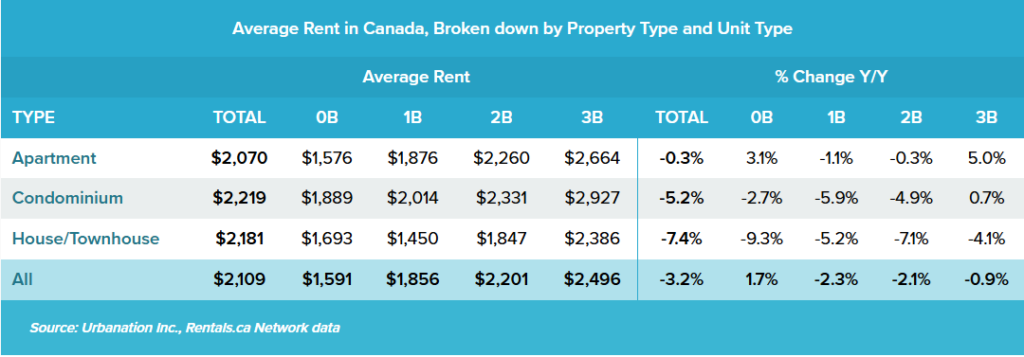
Hitting a 17-month low of $2,109, the average asking rents for all residential property types in Canada dropped 3.2 per cent in 2024, according to the latest data from Rentals.ca and Urbanation. The decline follows rent growth of 8.6 per cent in 2023 and 12.1 per cent in 2022, making this the first annual rent decrease since the COVID-19 pandemic.

Despite the recent drop, rents have remained up over the past five years, by an average of 3.15 per cent annually.

“The rental market softened across most parts of the country last year following record-breaking growth in 2022 and 2023 and amid multi-decade highs for apartment completions, slowing population inflows, and a weakening economy,” said Shaun Hildebrand, President of Urbanation. “Current trends suggest rents may experience further decreases in 2025, which so far have been focused on secondary market units. However, any rent declines should be temporary and remain minimal mostly due to a long-term undersupply of rental units in the country, with rents set to accelerate in the coming years as the current slowdown in construction works to restrict supply.”

Key data highlights:

  • Purpose-built rentals remained stable, with a slight 0.3% decline in average rents to $2,070, while townhouse and house rentals experienced the steepest drop, falling 7.4% to $2,181.
  • Studios were the only unit type to see rent growth, rising 1.7% to $1,591. Rents for one- and two-bedroom units declined 1.1% and 0.3%, respectively

Provincial trends:

  •  Rents in Ontario experienced the steepest provincial decline, down 4.7% annually to $2,332, driven by decreases in one- and two-bedroom units.
  • BC apartment rents fell slightly by 0.5% to $2,487, with larger declines in smaller units such as studios (-2.3%).
  • Quebec City became the fastest-growing rental market, with average rents increasing 14.9% year-over-year in December.
  • Rent growth in Alberta slowed to 1.6% annually, following a 15.6% increase in 2023, with average rents reaching $1,718 in December.

Rents in major markets:

  • Rents fell 7.1% in Toronto to $2,632, reversing the 2.1% increase recorded in 2023.
  • Rents in Vancouver dropped 5.8% to $2,882, maintaining its position as Canada’s most expensive market.
  • Calgary posted the steepest decline among major markets, down 7.2% to $1,921.
  • Rents in Montreal remained relatively stable, declining 1.1% to $1,998.
  • Edmonton bucked the trend with rents rising 2.7% to $1,506.

Shared accommodation trends

The average asking rent for shared accommodations decreased 1.9% annually to $986. Toronto saw the largest decline, with shared rents dropping 9.0% to $1,194, while Vancouver and Ottawa saw increases of 4.0% and 4.9%, respectively.

For the full National Rent Report, visit: Rents in Canada Decline to 17-Month Low

Graywood partners with Hankyu Hanshin Properties

Japan-based Hankyu Hanshin Properties formed a new partnership with Graywood Developments, marking its entry into the Canadian real estate market.

The partnership will develop high-quality residential projects within the Greater Toronto Area, drawing on Graywood’s extensive experience in the Canadian residential development space and Hankyu Hanshin Properties’ global expertise. To mark their first collaboration, Hankyu Hanshin Properties will joint venture with Graywood on the development of Claystone, a premier residential project located in Oakville, Ontario.

“We are thrilled to partner with a top-tier real estate firm like Hankyu Hanshin Properties,” said Stephen Price, President & CEO of Graywood. “This collaboration represents a significant milestone for both companies, and we are confident that our combined expertise will deliver an exceptional living experience for future residents of Claystone. We look forward to completing more joint venture projects with our new partner.”

Claystone is located in the heart of Bronte Village in South Oakville. The seven-storey boutique condo building is set to begin sales in 2025 and deliver units in 2028.

Graywood will serve as the lead developer, constructor, and sales manager for Claystone, working in close partnership with Hankyu Hanshin Properties. The project aims to bring an elevated boutique condo building to South Oakville, combining sophisticated design with high-quality construction in one of Ontario’s most coveted communities.

“Claystone is a testament to our shared vision of creating outstanding residential communities,” added Masahiko Toda, director at the overseas business headquarters of Hankyu Hanshin Properties.  We look forward to the success of this venture and to exploring more opportunities together in the future.”

Colliers Canada and Colliers Japan acted as advisor for the transaction.

East Village public washroom & pickleball court opens

The Open, a new permanent washroom and adjoining pickleball court in downtown Calgary’s east end, has officially opened.

This modest piece of public infrastructure has a social placemaking element that is intended to serve a multi-generational demographic in Calgary’s burgeoning East Village.

“As development in East Village progresses and we prepare to welcome hundreds more residents to the community in the coming years, CMLC remains committed delivering public amenities and placemaking activations that foster community and create vibrancy,” said Clare LePan, CMLC’s vice president of communications & strategic partnerships. “Strategically located at the intersection of 7 Avenue and 6 Street S.E., The Open sits adjacent to East Village’s off-leash dog park, playground, and community garden, and is a short distance from Jack & Jean Leslie RiverWalk, serving the 4,000 residents of the community as well as the 80,000 visitors who frequent the community’s diverse retail offerings, dynamic programming and public spaces every year.”

The Open is the winning submission of a national public design competition that attracted 11 submissions. 

The design by Winnipeg-based Public City was chosen for its imaginative, functional, and distinctive design. The hybrid architecture and landscape architecture facility marries sport with utility, aiming to transform a functional program into a meaningful urban place. Construction of the facility was managed by Delnor Construction.

The 3,000-square-foot building features four universally accessible all gender bathroom stalls—one wheelchair accessible with grab bars – and a shared handwashing space. The adjoining pickleball court features a living green roof of natural grasses and a tiered spectator seating area.

The facility is wrapped with a teal metal screen, and the court is painted with vibrant colours and court lines. A sedum-planted, wedge-shaped roof nods to the nearby Rocky Mountains.

“CMLC’s ongoing transformation of East Village into one of Calgary’s most dynamic and inviting urban neighbourhoods shines through in projects like The Open,” said Councillor Terry Wong. “This thoughtfully designed space exemplifies how vibrant projects can transform the well-being of those who live, work, and visit the area, creating an inclusive atmosphere that enhances quality of life for residents and warmly welcomes the thousands of visitors who come to enjoy everything East Village has to offer every year.”

CMLC collaborated with the Calgary Police Service, social outreach organizations, and safety experts to integrate Crime Prevention Through Environmental Design (CPTED) principles in the facility’s design, which includes clear sightlines facilitated by glass walls on the washroom’s exterior and mesh sports court fencing, all well-lit inside and out.