


How outdoor-rated, wire-free smart deadbolts are making electronic access practical for weather-exposed condominium unit doors.
Electronic access has become commonplace across Canadian condominium properties. Residents may use a card, fob, phone, or digital credential to enter the lobby, parking garage, fitness centre, package room, amenity space, or other common areas. Property managers can issue or revoke access centrally, while electronic systems provide visibility that traditional mechanical keys simply cannot.
But at many condo properties, that digital experience still stops at the resident’s unit door.
Solving the Exterior Unit Door Problem
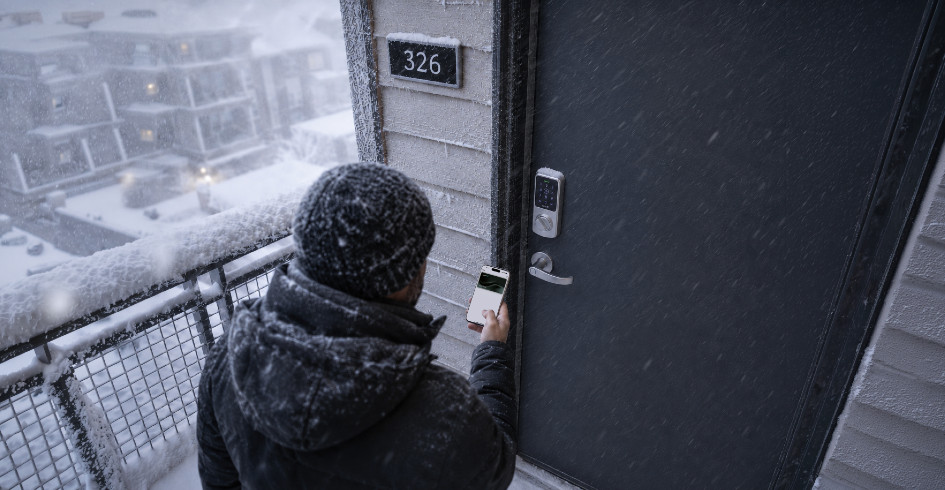
The obstacle has never been a lack of interest in keyless access. It has been Mother Nature. Icy cold winters, humid summers, and everything in between; the Canadian environment can be harsh.
A smart lock installed inside an environmentally controlled corridor lives a relatively sheltered life. Move that same electronics package outside and the operating conditions change significantly. Exterior doors may encounter prolonged sub-zero temperatures, snow and ice, wind-driven rain, condensation, summer heat, and dramatic temperature changes within a single day.
Coastal properties introduce salt and moisture. Prairie communities can experience extreme cold. Southern Ontario and Quebec bring repeated freeze-thaw cycles. Across the country, an exterior residential lock must perform under conditions that many consumer smart locks were simply not designed to handle.
A smart lock designed for a single homeowner with a standalone app does not necessarily translate well to condominium management. Property managers and condominium corporations need predictable maintenance, credential administration, auditability, and the ability to manage access for residents, staff, contractors, cleaners, trades, and other authorized users at scale.
That helps explain why the traditional mechanical deadbolt has remained stubbornly in place at exterior condominium unit doors, even while the rest of the property has moved toward electronic access.
The Most Challenging Door in Condo Communities
For property management companies, traditional keys create a burdensome workload throughout the life of a property.
Lost keys, ownership or resident changes, lockouts, contractor access, master-key management, cylinder replacements, and questions over who may still possess a copied key all require attention.
The issue becomes particularly noticeable in ground-oriented communities, where property managers and service technicians may be travelling between buildings and entrances spread across a large site.
There is also a disconnect in the resident experience. A condominium owner or resident may already use one credential to enter the building, access the parkade, open an amenity room, or enter other controlled areas, and then rely on a separate mechanical key for the door they use most often.
For developers designing new communities and management companies modernizing existing ones, the exterior unit door has become an important missing piece in the broader access strategy.
Retrofit Ready
One of the reasons this problem is increasingly solvable is surprisingly simple: most residential doors already use standardized deadbolt preparations. Residential deadbolts have been installed around common door preparations for decades. That means the opening required for the hardware often already exists.
For retrofit projects, that now becomes a major advantage.
If converting a unit entrance to electronic access requires a replacement door, new drilling, frame modifications, wiring, or specialty trades at every opening, a relatively simple technology upgrade quickly becomes a construction project. Multiply that complexity across dozens or hundreds of condominium units and the economics become difficult to justify. The Salto DBolt Touch Outdoor was designed around a different approach.
The outdoor-rated smart deadbolt is designed to retrofit compatible standard residential deadbolt preparations without additional drilling, door replacement, or frame modification. It supports the two common residential backsets of 2-3/8 inches and 2-3/4 inches and accommodates a broad range of residential door thicknesses.
For an existing condominium property, that can change the nature of the project considerably. Instead of rebuilding the opening around the access technology, the technology fits the opening already in the door.
For developers, the same principle can simplify specification across different residential building types. For condominium corporations and management companies, it can make modernization possible without undertaking a major door-replacement investment.
No Wires at the Unit Door
The second major challenge in electronic access retrofits is power.
Traditional hardwired access control requires electrical or low-voltage cabling to the opening, pathways through finished walls, coordination with multiple trades, and considerable disruption within occupied residential buildings.
That model may make sense for a lobby entrance or another high-traffic common-area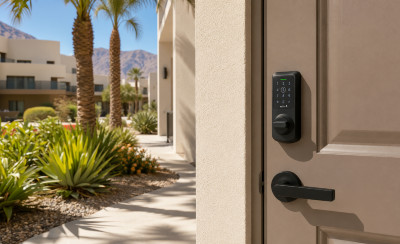 opening. Replicating it at every individual condominium unit is a very different proposition.
DBolt Touch Outdoor is wire-free and operates on three AA batteries, eliminating the need to bring wired power or data to each unit entrance.
That can be particularly important in existing condominium communities where opening walls, disturbing finished interiors, or coordinating electrical work inside dozens or hundreds of privately occupied units would create substantial cost and disruption.
Depending on the Salto system and functionality selected, wireless infrastructure can provide additional connectivity without requiring each individual unit door to be conventionally hardwired.
The result is a much more manageable deployment model. For a condominium corporation evaluating a retrofit, the business case becomes less about undertaking a major access-control construction project and more about replacing existing mechanical hardware with electronically managed hardware.
Engineered for Outdoors
Ease of installation means very little if the lock cannot withstand the environment.
The Salto DBolt Touch Outdoor carries an IP55 ingress-protection rating on the exterior side and is rated AAA under ANSI/BHMA A156.40, the standard for residential deadbolts.
That outdoor rating is particularly relevant in Canada. An exterior-facing condominium unit door cannot be treated as though it were simply an interior apartment entrance with a little additional weather exposure. It may be subjected to months of freezing conditions, blowing snow, moisture, direct sun, and repeated temperature swings.
For developers and property managers considering electronic unit access, weather resistance therefore has to be part of the specification from the beginning rather than an afterthought.
The distinction is important: the question is no longer simply whether an electronic deadbolt can fit the residential door. It is whether that hardware was engineered to operate reliably on the outside of the building.
All Doors, One Access Platform
The larger opportunity is not simply replacing a key with a keypad. It is bringing the resident’s unit entrance into the same broader access strategy as the rest of the property. The Salto DBolt Touch Outdoor is compatible with Salto Homelok, Salto KS, and Salto Space and can support mobile credentials, RFID cards and fobs, and PIN access through the touch keypad.
That gives management companies more flexibility in designing the resident experience. Instead of creating one access system for common areas and leaving the unit entrance as a mechanical exception, electronic access can potentially extend from the property perimeter to the resident’s door.
There are operational benefits as well. Lost credentials can be managed electronically rather than automatically triggering a mechanical rekey. Temporary or time-limited permissions can be created for appropriate users. Access activity can become more visible. And property managers can reduce some of the administrative burden associated with physical key inventories and master-key systems.
For condo communities, those capabilities can also help establish clearer boundaries around access for property staff and authorized contractors.
Ultimate Flexibility
Existing communities do not necessarily have to convert every unit door at once. Because a wire-free retrofit does not require new electrical infrastructure at each opening, properties have greater flexibility in how a modernization program is structured.
New development presents a different opportunity. Developers can consider exterior unit access as part of the condominium’s overall access strategy from the outset rather than treating common-area access and residential-door access as separate systems. That becomes increasingly relevant as condo projects diversify beyond the traditional high-rise tower.
Stacked townhouses, mid-rise communities, mixed-use developments, master-planned communities, and other ground-oriented forms of housing all introduce exterior-facing residential entrances. A common electronic access strategy that can work across these different building typologies gives developers greater flexibility while creating a more consistent resident experience.
Bringing the Last Door Online
Canadian condo access has steadily become more digital, but the exterior-facing unit door has remained one of the hardest to modernize. The challenge was not simply making a residential deadbolt electronic. The hardware had to withstand direct weather exposure, fit the residential door already in place, avoid the expense of wiring every opening, and operate as part of an access system suitable for a professionally managed property.
That equation has changed. Outdoor-rated, wire-free smart deadbolts now give condo developers, owner groups, and management companies a practical way to reconsider an opening that has remained mechanical long after many other doors on the property became electronic.
For townhouse, stacked-townhouse, low-rise, and other exterior-access communities, the unit door no longer has to remain the exception to the property’s smart access strategy.
For more information: www.saltosystems.ca