




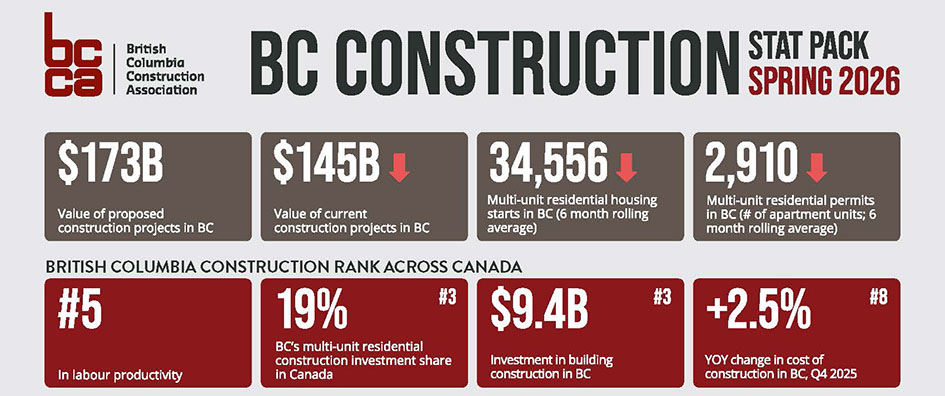
Construction is showing strength and resilience but requires government action to ensure delivery of infrastructure commitments, according to the British Columbia Construction Association’s (BCCA) industry survey and 2026 Spring Stat Pack.
The survey included business owners reporting several frustrations, including disputes, non-payment, economic uncertainty, and high overhead costs. According to the survey, 89 per cent reported being paid late for work at least one time this past year, while 61 per cent report being paid late for work completed over 25 per cent of the time.
“Across British Columbia, our industry is consistently being asked to do more with less,” said Chris Atchison, president of BCCA. “The industry has shown incredible resilience, especially in light of ongoing economic, global, and supply chain instability and uncertainty, but resilience cannot be mistaken for invincibility.”
When asked how much of a risk premium contractors will build into a bid, the average response was 14.5 per cent, with 43 per cent reporting the number one reason they do not bid on a public project to be onerous contract clauses.
Measures like the addition of PST to architectural, engineering, and related professional services introduced in Budget 2026 add additional cost pressures that impact project viability and competitiveness locally, nationally, and internationally. Until the provincial government addresses these challenges, B.C. risks higher costs while falling critically short on its infrastructure commitments.
“British Columbia depends on builders,” emphasized Atchison. “But high costs, risks, and uncertainty have created an environment that makes it harder for our sector to deliver at the level this province requires. With $173 billion in proposed construction projects on the books, our province can’t afford to move forward without adequate support for industry.”