




Articles Archive - Page 87 of 928 - REMINET
REMI

Crackdown on property controls clarified

Commercial landlords are less exposed than retailers to the Competition Bureau of Canada’s crackdown on property controls, but investigators will be considering whether lease or transaction agreements contain a “significant purpose” to weaken other market players. Newly released guidance on how the Bureau interprets abuse of dominance also clarifies that reprieve could be given for exclusivity clauses in leases, while there will be little tolerance for restrictive covenants on land titles.

The guidance was published earlier this month following a public consultation and in the midst of an ongoing investigation into the use of two property-related mechanisms that could be helping some grocery retailers to undermine prospective competition. Those are:

  • clauses within commercial leases that restrict the landlord’s ability to lease space to a retailer’s competitors and/or to retailers selling certain designated types of products; and
  • restrictions on land that prevent new owners from opening or accommodating ventures that compete with the business interests of a previous owner.

“In most cases, we consider the party who proposed or benefits competitively from the competitor property control to be a potential target of an abuse of dominance investigation,” the guidance advises. “Restricting competition is the source of a competitor property control’s value. Competitor property controls may prevent competitors from entering markets in locations that would be competitively significant or exclude them from a market entirely.”

The Competition Bureau and Tribunal are the joint investigative and enforcement bodies authorized to ensure compliance with Canada’s Competition Act. For a first violation, organizations found to be engaging in practices that hinder or block market competition could be subject to administrative monetary penalties (AMPs) of up to $25 million and three times the value of benefits derived from thwarting competition, or 3 per cent of their annual worldwide gross revenues if the value of gains can’t be calculated. AMPs could then jump to up to $35 million and three times the value of misbegotten gains or 3 per cent of annual worldwide gross revenues for subsequent offences.

In considering abuse of dominance, the Competition Bureau examines the power that a company wields within a market — local, regional or national — and the tactics that help achieve that status. The investigation into property controls was launched after an earlier market study, published in 2023, flagged concerns about concentrated corporate ownership in Canada’s grocery retailing industry and its impact on food costs and consumer choice. The study’s accompanying recommendations also urged provincial/territorial governments, which have constitutional oversight of commercial property transactions, to review and possibly disallow exclusivity clauses and restrictive covenants. (Manitoba recently became the first province to do so.)

Considering the context

The new guidance acknowledges that exclusivity clauses can sometimes be “pro-competitive” if, for example, they draw a retailer that would not otherwise have opened a business in a particular locale or vicinity. Such clauses might also help insulate protected retailers to make investments that, in turn, enhance the overall social and business environment. That might apply for a particular development or within a designated economic development or community improvement zone.

The Competition Bureau confirms that it will consider such factors, but cautions that controls should apply:

  • for a limited period;
  • on select products/services so that competitors are not comprehensively blocked from business opportunities; and
  • within the tightest geographic boundaries possible.

Property owners and local planning officials are also advised to consider if there are other ways to encourage investment or if there are other potential tenants that would not demand an exclusivity clause.

“We recognize that whether a different tenant would be appropriate may depend on a variety of factors, including the nature of their business, how they would fit within the mix of retailers in the area and how effective they would be at attracting customers to the development,” the guidance states. “Considering whether a competitor property control is justified because of a credible pro-competitive rationale is a key part of our analysis. We will not take enforcement action against competitor property controls that we believe are pro-competitive.”

There is far less latitude for restrictive covenants, which are characterized as an entrenched competitive advantage for business operators that have historically owned land in commercial districts. In such cases, retailers could move to new locations with assuredness that competitors could not set up on their former sites, or they could prevent competing infill businesses on portions of their land sold off to other investors.

“Restrictive covenants used by firms with market power are more likely to attract scrutiny. We do not consider their use to be justified outside of exceptional circumstances,” the guidance reiterates.

Grocery industry responses

Last year, the Competition Bureau obtained a federal court order compelling Empire Company Limited and George Weston Limited — the parent companies of Sobeys Inc. and Loblaw Companies Limited — to hand over documentation pertaining to their leases and land titles in the Halifax Regional Municipality. That’s one of the Bureau’s investigative procedures, which entails looking for evidence of intended anti-competitive behaviour. However, the new guidance notes that it also has flexibility to “infer that firms intended the reasonably foreseeable consequences of their actions”.

Both the scrutinized parties have since made moves to revise some of their practices. In January, Empire Company Limited, agreed to remove property controls in Crowsnest Pass, Alberta. In February, Loblaw announced plans to eliminate exclusivity clauses in leases for its stores in the Halifax Regional Municipality; to review similar clauses in all of its existing leases across Canada; and to reduce the scope and duration of exclusivity clauses in its new leases. It has also committed to removing or refraining from enforcing existing restrictive covenants and avoiding new ones in the future.

For its part, the Competition Bureau has said it will monitor those commitments. It urges other retailers to follow suit, and continues to gather public reports of possible anti-competitive property controls via an online submissions portal.

Unacceptable agreements

Situations in which a commercial landlord could be implicated in an investigation fall under the section of the Competition Act addressing anti-competitive collaboration. That’s generally applied to two or more competitors suspected to have colluded through mechanisms such as price-fixing, allocating markets to specified retailers or controlling the supply of goods/services coming onto the market. However, it also pertains to agreements or arrangements between non-competitors that have a “significant purpose” to harm competition.

In the latter case, the Competition Bureau may infer culpability from the outcome. All parties to the agreement — landlords and tenants related to exclusivity clauses; property buyers and sellers in the case of restrictive covenants — could then potentially be scrutinized.

“When assessing an agreement that contains a competitor property control, we focus on if the agreement has the effect of harming competition. If the agreement has the effect of harming competition, it will likely also have a significant purpose to do so,” the guidance states. “We may seek different remedies from different parties to an agreement, depending on the circumstances.”

At the moderate end of the spectrum, the Competition Tribunal can simply nullify the property controls in question. The more onerous possible remedies include AMPs of up $10 million and three times the value of the benefit derived from the agreement for a first occurrence or up $15 million and three times the value of the benefit derived from the agreement for subsequent occurrences.

Largest off-grid solar project underway in B.C.

BC Hydro is upgrading its Anahim Lake Station and integrating solar energy from Ulkatcho’s Anahim Lake Solar Farm into its microgrid. A first-of-its-kind initiative in B.C., this project sets a new benchmark for renewable energy integration in remote communities across the province.

“I am honoured to be involved in this great initiative. Since my first meeting with BC Hydro five years ago, this project has come a long way and will have a very positive impact on our community,” says Chief Nelson (Charlie) Williams of the Ulkatcho First Nation. “Through our Ulkatcho Group of Companies, we are giving our people a cleaner environment and preserving our lands through reducing greenhouse gas emissions on our Traditional Territory. The Ulkatcho First Nation is proud to be a leader in the future of green energy in British Columbia.”

BC Hydro currently serves 14 remote areas that include many First Nations communities through isolated microgrids that are not connected to the main provincial grid. Ulkatcho First Nation and Anahim Lake are entirely reliant on diesel. To reduce this dependency and advance clean energy solutions, BC Hydro will integrate solar power from the Ulkatcho First Nation-owned 3.8-megawatt Anahim Lake Solar Farm, which is currently under construction and set to be Canada’s largest off-grid solar farm.

In April 2024, BC Hydro signed its first-ever Community Electricity Purchase Agreement with Ulkatcho Energy Corporation, marking a major milestone in Canada’s renewable energy landscape. Through this agreement, BC Hydro will purchase solar energy generated at Anahim Lake Solar Farm for the next 20 years, helping reduce the BC Hydro’s use of diesel to power the community by nearly two-thirds.

This upgrade includes the installation of a Battery Energy Storage System and a Microgrid Control System, transitioning operations from analog to digital. By bringing this leading-edge technology into the station, BC Hydro will enable efficient storage and distribution of solar power from the Anahim Lake Solar Farm to homes and businesses, reducing diesel dependency and significantly cutting carbon emissions, while also ensuring improving reliability.

“BC Hydro is driving renewable energy innovation in remote communities by bringing leading-edge technology into the Anahim Lake Station and investing in advanced battery storage and microgrid technology,” says Chris O’Riley, president and CEO of BC Hydro. “Our collaboration with Ulkatcho Energy Corporation not only sets the foundation for future partnerships with First Nations across the province, but also underscores BC Hydro’s commitment to supporting Indigenous-led clean energy initiatives, ensuring reliable, sustainable power for generations to come.”

Work to upgrade the Anahim Lake Station is already underway and is expected to be completed by early 2026. Once construction is complete on both the Anahim Lake Solar Farm and BC Hydro’s station, testing and integration will begin. The entire project is slated to be complete and in service by summer 2026.


Outdoor workers may be at risk for hearing loss

Seasonal property maintenance includes various tasks that take place outdoors, and many of which include loud machinery. Protecting your teams means investing in the PPE and tools to keep them safe from workplace injury, including hearing loss. According to the Canadian Centre for Occupational Health and Safety (CCOHS) 42 per cent of Canadian workers are exposed to potentially hazardous noise at work, and approximately 11 million are exposed to workplace noise that could cause hearing damage.

In most areas, the occupational exposure limit is 85 decibels (A-weighted) or dBA, but outdoor maintenance professionals are frequently surrounded by loud equipment and
machinery such as lawn mowers, leaf blowers, drills, compressors, and HVAC systems, which can expose them to noise levels exceeding this threshold.

Proper PPE is essential for the protection of workers exposed to loud noises while performing their jobs, such as earplugs, noise-cancelling earmuffs, and other hearing protection devices. Here are some factors to consider when implementing protocols to protect your team’s hearing:

  • Choose protection that makes sense for the job. Refer to the Canadian Standards Association (CSA) Standard Z94.2-14 (R2019) “Hearing Protection Devices – Performance, Selection, Care and Use” or contact the agency responsible for occupational health and safety legislation in your jurisdiction for more information on what’s most appropriate.
  • Consult the manufacturer’s literature for the best protection for the equipment’s noise level.
  • Ensure that what you choose is compatible with other required PPE, like hard hats or safety glasses, for example.
  • Comfort is also a consideration when workers need to wear protection for a long period of time. Ensure proper fit and use to maximize effectiveness and protection for all staff.
  • Think about the weather conditions and whether the protection you’ve chosen is conducive to extreme heat. Perhaps this will affect your choice or scheduling for when the task will need to be completed.
  • Soundproofing may not be feasible if communication, like alarms or warning sounds still need to be heard during the work.
  • Music earphones or headsets are not substitutes for hearing protectors and should not be worn where hearing protectors are required to protect against exposure to noise.

Keeping outdoor staff safe, from heat protection to noise protection, needs to be top priority this summer and maintenance managers who are exposed to loud noises as part of their jobs need to be protected with the correct PPE and noise-defence tools.

Premium new rental project breaks ground in Calgary’s Beltline

GWL Realty Advisors (GWLRA) celebrated the ground-breaking of a new rental tower at 1405 4th Street SW in Calgary’s Beltline district. With occupancy targeted for mid-2028, the 24-storey tower will bring 219 rental units to market along with and a vibrant ground-level retail area, contributing to the revitalization of one of Calgary’s most dynamic neighbourhoods.

GWLRA“Projects like this show confidence in Calgary’s urban core and align with our goals for density, sustainability, and vibrant, livable communities,” said Mayor Jyoti Gondek who attended the June 12th ceremony. “We welcome GWL Realty Advisors’ investment and look forward to seeing this new development take shape in the heart of our city.”
Developed on behalf of The Canada Life Assurance Company, the property will be allocated as an investment to the Canada Life participating and non-participating life insurance accounts. Construction will begin immediately and is expected to be completed within 36 months.

“This new development represents our continued commitment to building high-quality rental communities in Canada’s top urban markets,” added Glenn Way, President, GWL Realty Advisors. “With its prime location, premium amenities, and our long-term approach to investing, we are excited to play an active role in shaping Calgary’s future and contribute to establishing the Beltline as a premier residential neighbourhood.”

The project reflects GWLRA’s vision of creating boutique, hospitality-inspired rental communities in exceptional locations. Designed to maximize livability, the building will feature open-concept layouts, plenty of natural light, modern finishes, and numerous amenities, including a fitness centre, social lounge, co-working spaces, rooftop dining and pet-friendly facilities, such as a dog run and pet wash.

GWLRA has an active pipeline of nearly 3,500 residential units across the country in various stages of planning, pre-development, or development. Since 2020, the company has added over 1,500 rental units in key markets, demonstrating its commitment to enhancing urban living through thoughtful development.

Reality lags government downsizing ambitions

The Canadian government has made slow progress in downsizing its real estate portfolio and is carrying hundreds of millions of dollars in undue annual costs for sparsely occupied and obsolete office space. A newly released report from the Auditor General of Canada highlights the mere 2 per cent reduction in the federal government’s office inventory during the period from 2019 to 2024, falling far short of a target to shed 50 per cent or nearly 32 million square feet.

However, the Auditor General’s investigative team maintains that momentum has picked up since Public Services and Procurement Canada (PSPC), the government’s de facto property manager, was allotted dedicated funding for the task in the 2024 federal budget, resulting in an updated implementation plan. Recommendations accompanying the auditors’ findings now suggest that better data, more stringent tenant accountability and a coordinating focus within the Treasury Board of Canada Secretariat could help push the process along.

PSPC currently estimates the government could realize nearly $4 billion in savings over the next 10 years if it could dispose of excess office space, after which this smaller footprint would deliver ongoing operational savings of about $900 million per year. That’s been the notional objective since soon after a 2017 study decreed that 50 per cent of the government’s office inventory was underused.

Beginning in 2019, one element of PSPC’s space reduction campaign aimed for the annual conversion of 4 per cent of office space to an open plan format — to replace individual offices and assigned desks with a more efficient configuration with a lower space-per-employee ratio. To date, the transformation has unfolded at a slower pace of about 2.4 per cent of office space annually between 2021 and 2024, which the auditors attribute to a combination of tenant resistance, impediments due to building conditions and lease considerations, and inadequate funding in sync with inflationary costs.

That’s in keeping with a general hypothesis that PSPC had sound intentions and a credible plan at an earlier stage, but faced constraints that prevented it from making much headway until last year. In reaching that conclusion, auditors studied PSPC and Treasury Board documents for the period from April 1, 2018 to Oct. 31, 2024 (also extending to PSPC’s implementation plan, which was formally finalized in Feb. 2025) to track the evolution of the government’s downsizing ambitions. Under the direction of principal auditor, Markirit Armutlu, they also conducted a survey of the 100+ federal departments that are tenants within roughly 63.5 million square feet (5.9 million square metres) of office space across Canada, and interviewed various third party real estate and property management specialists.

“We found that, mainly because of a lack of funding since 2019 to implement the original reduction plans, Public Services and Procurement Canada was able to achieve only a slight reduction in office space,” the report states. “Budget 2024 announced that the government would provide $1.1 billion over 10 years, starting in 2024–25, for Public Services and Procurement Canada to reduce its office portfolio by 50 per cent to 2.95 million rentable square metres. The funding is intended to help accelerate the termination of leases and disposal of vacant or underused federal properties and reduce maintenance and operating costs.”

Complications and obstacles

The updated space reduction strategy begins with the identification of buildings to be removed from or retained in the federal portfolio. PSPC will take the lead in deciding where various federal departments should be located, but with a promise to work with tenant representatives to determine their (presumably reduced) space requirements. That’s expected to involve renovations, particularly given the federal government’s green operations mandate, and the possible need for temporary swing space to accommodate government workers during the process.

Ultimately, PSPC will dispose of vacated buildings, but auditors warn that a circa-2024 government directive to prioritize the disposal of office buildings that have potential to be converted to housing complicates that process and could eat into projected cost savings over the longer term. Separate of the policy intentions to boost housing supply, it could mean the government is forced to hold some mothballed properties for an extended time period if they aren’t suitable for conversion. That would also necessitate longer-term costs for basic building services, maintenance and payments in lieu of property tax to host municipalities.

Since 2024, PSPC has established a new division dedicated to building disposal and is currently testing what’s promised as a streamlined sell-off process on 10 buildings in the Ottawa-Gatineau region. However, there are no results yet to prove that supposition.

“Information provided by the department on pre-2022 disposals showed that once a property had been declared surplus, disposing of it took six to eight years. Moving forward, the department anticipates it will be able to dispose of real properties in three years,” the auditors note. “The longer the disposal process, the more it costs the government to maintain the buildings slated for disposal.”

Negotiations with tenants have also added to PSPC’s timelines. That began in earnest in June 2024 when the 37 federal departments with the largest footprints, accounting for about 90 per cent of federal office space, were asked to commit to space reduction agreements. Fifteen of those departments, representing about 41 per cent of the affected workforce, had not yet signed an agreement nearly a year later as the auditors finalized and prepared to release their report.

“Tenants have expressed a variety of reasons to explain why office space reduction agreements have not been signed, including funding and growth concerns, the need for specific accommodations to deliver on their mandate and an unwillingness or disagreement to move into the new locations that Public Services and Procurement Canada proposed,” the auditors report.

Drawing other inferences, they advise that, in most cases, accommodation costs are not linked to departmental budgets, but, instead, come out of general government revenues.

“Of the 15 tenants cited who did not agree to the reduction of the space they occupy, 13 (or 87 per cent) had no financial incentives to reduce the space. In total, 93 federal tenants (89 per cent) do not reimburse the department (PSPC) for the space they occupy,” the auditors observe. “Of the 12 federal tenants with financial incentive to reduce the space they occupy, nine (or 75 per cent) had agreed to the requested reduction of space or were finalizing their reduction plans.”

Supporting the process

The auditors call for standardized tracking of office occupancy to better inform PSPC’s decision-making, and for the public release of more information about the government’s real estate portfolio, such as:

  • occupancy rates;
  • market values of buildings;
  • transactions and sale values;
  • housing units gained through conversion of disposed buildings; and
  • building-level greenhouse gas (GHG) emissions.

The current divulgence of information, including percentage of space modernized, accessibility compliance and GHG emissions reduction, is compared to the wider scope of information that other countries, such as Australia, release about their government office space.

“Parliament and the public need additional relevant information to be better informed on the progress being made and on how office space is being used. Furthermore, if made publicly available, information such as cost per square metre, cost per employee and square metre per employee by federal tenant may incentivize federal tenants to optimize their use of office space,” the auditors reason.

Finally, the auditors commend and lament the subsequent dismantling of the Centre of Expertise for Real Property, which was temporarily established within the Treasury Board Secretariat earlier in this decade. That body arose from a $5-million allocation in the 2021 budget and a three-year mandate to oversee the implementation of recommendations from a comprehensive review of all of the government’s fixed assets (going beyond office space to include national parks, national defence holdings, correctional facilities, RCMP detachments, interprovincial bridges, ports of entry, etc.) and to help government departments respond to COVID-19 related facilities management issues.

The auditors conclude that the Centre “played an important role in providing leadership and oversight” and that momentum within government has slowed since it was dissolved in March 2024. They urge its reactivation or the establishment of a similar body that could coordinate the effort centrally and leverage Treasury Board’s government-wide clout.

For its part, the Canadian government has accepted and agreed with the Auditor General’s recommendations.

“In particular, I welcome the recommendation that PSPC improve its public reporting on progress toward achieving the 50 per cent reduction of its office portfolio by 2034. The department recently shared an update on its website and will provide updates on results annually going forward,” Joël Lightbound, the Minister of Government Transformation, Public Works and Procurement, said in a June 10 statement. “My department also remains committed to working with federal departments and agencies to improve data collection so that we can better achieve our office space portfolio targets.”

RAIC launches Climate Action Plan

The Royal Architectural Institute of Canada has launched its Climate Action Plan (CAP) – A Framework for Engagement and Enablement. The CAP sets a course for the architectural community, providing a dynamic roadmap to accelerate the transition toward low-carbon, resilient, and regenerative development and design across Canada.

Globally, buildings and construction account for about 37 per cent of all carbon emissions, according to the United Nations Environment Programme (2022).

“For over a century, the RAIC has championed design excellence in service of the public good. That commitment extends to meeting one of the greatest challenges of our time: the climate and biodiversity crises,” said Jonathan Bisson, FIRAC, president of the RAIC. “The Climate Action Plan reflects our responsibility to future generations and our unwavering dedication to leadership in climate-responsive architecture.”

To achieve the goals of the Paris Agreement and maintain a 1.5-2°C pathway, by 2030, emissions must be cut in half by ensuring new buildings are net-zero energy ready and existing buildings are deeply decarbonized (including at least a 40 per cent reduction in embodied carbon). By 2050, the goal is to reach a net zero carbon-built environment, including embodied carbon, will require a focus on reusing and recycling.

The CAP is organized around four key priorities:

  • Accelerating the transformation of practice.
  • Advocating boldly to create pathways for change.
  • Mobilizing partnerships and collaborative action.
  • Investing in education and research.

Developed through two years of nationwide engagement with more than 800 contributors—including Indigenous Knowledge Holders, allied professionals, students, and community members—the CAP calls on architects to embed reconciliation, social justice, and holistic health into their climate action efforts.

“The urgency of the climate crisis demands bold, collective action,” said Mike Brennan, CEO of the RAIC. “The Climate Action Plan is both a call to action and a tool for transformation.”


Concert and GDI launch energy retrofit program

Concert Infrastructure and GDI Integrated Facility Services Inc. (GDI) and Ainsworth Inc. have entered into a partnership to launch a national program that finances energy retrofits in aging buildings across Canada.

This partnership will finance the capital improvements in institutional, commercial and multi-residential buildings, supporting Canada’s transition to a low-carbon economy. The partnership will work with building owners to install new energy-efficient technologies and smart building solutions. These upgrades will reduce GHG emissions, lower energy consumption and generate operational cost savings.

Each project carried out by the partnership will vary in scale and approach. Once all retrofits are complete, it is estimated that approximately 44,000 tonnes of GHG emissions will be reduced per year. In addition, the projects are expected to support approximately 500 jobs in the trades sector. The first set of projects is expected to be announced in the coming months.

“This partnership reflects Concert Infrastructure’s long-standing commitment to responsible, long-term investments that improve the lives of Canadians while strengthening both local and national economies,” said Derron Bain, CEO of Concert Infrastructure. “By bundling retrofit projects into a structured portfolio, we’re creating an efficient investment vehicle that maximizes both financial and environmental outcomes—generating emissions reductions, supporting job creation and delivering long-term value for the pension plans that own us. With a clear focus on sustainability, resilience and social impact, we’re planning not just for today, but for the future of our communities.”

Services provided by the partnership include initial energy audits, energy modelling, system design, installation, commissioning, measurement and ongoing energy management, data analytics and energy optimization.


Grosvenor starts Brentwood Block construction

Grosvenor has started construction on Phase 1 of Brentwood Block, a 7.9-acre pedestrian-focused, masterplan community in Burnaby. The initial phase includes a 41-storey residential strata tower, two rental towers, a new 100,000 square foot Brentwood Community Centre and 180,000 square feet of commercial.

“Brentwood Block represents a bold step forward in urban development and a significant milestone for Grosvenor in the region,” said James Patillo at Grosvenor. “We’re proud to contribute to the region’s housing goals through thoughtful, sustainable design that improves quality of life for generations to come.”

Spanning an entire city block, Brentwood Block is Grosvenor’s largest mixed-use development in North America and is the first project in Brentwood to be entirely pedestrian-focused, with cars accessing the underground from the site’s periphery. The development prioritizes green landscapes and public spaces, with an abundance of courtyards and plazas that encourage community interaction. Retail and dining are woven throughout, with patios spilling into public areas and a mix of cafés and restaurants offering everyday gathering spots for residents and neighbours alike.

“We’ve spent many years planning Brentwood Block because we believe in the potential of this neighbourhood and this development’s role in addressing the region’s housing needs,” said Marc Josephson, senior vp of development at Grosvenor. “We are pleased to be starting construction and to be leading the way in Brentwood at a time when large-scale residential starts are increasingly rare.”

The new Brentwood Community Centre, incorporated into the masterplan and close to the Brentwood Town Centre SkyTrain station, is estimated to attract well over one million visitors to the site annually. Grosvenor will oversee the construction of this multi-level facility, which will be owned and operated by the City of Burnaby. Completion of the Community Centre is anticipated for late 2029.

“The Brentwood Community Centre will be an outstanding community focal point for the entire Brentwood Town Centre, providing much needed space for individuals, families and seniors to gather together and enjoy Burnaby’s fantastic recreation programs,” said Burnaby Mayor Mike Hurley. “And we’re excited to see this neighbourhood continue to grow with forward thinking, community-oriented developments like Brentwood Block.”

Upon completion of the entire master-plan, which includes both Phase 1 and Phase 2, Brentwood Block will feature a mixed-use community with roughly 3,500 new homes, including 2,450 rental homes, 50,000 square feet of green and public space, and approximately 200,000 square feet of commercial space.


Report explores current state of FM technology

As facility managers face growing workloads, shrinking budgets and fewer skilled workers, many are turning to technology to fill the gaps. From automation software to predictive maintenance and artificial intelligence (AI), digital tools are increasingly seen as critical to managing modern buildings efficiently.

JLL’s latest State of Facilities Management Technology report outlines how facility leaders are seeking greater visibility, data-driven insights and streamlined operations across an expanding range of properties. Among the nearly 300 professionals surveyed, most said they need clearer understanding of completed work and more actionable data to guide decisions. At the same time, they are navigating heightened risks, compliance demands and an uncertain economy that continues to disrupt workplaces.

“There is so much more we need to do and we are all being forced to do that with less,” said Tim Bernardez, global head of workplace management technologies at JLL.

A workforce under pressure

FMs say pressure is most acute for day-to-day operations. Jason Noorian, vice president of asset management at Brinker International, said turnover during the pandemic left teams with fewer experienced managers and a harder time creating what he called an “operations ownership mindset.”

“It has also been tricky obtaining good vendors who are often overworked,” he said. “Sourcing new equipment also takes longer, so being proactive to reduce operational disruption is key.”

The consequences reach into routine decision-making. “We need to be experts in the facilities so we can train and ensure our operators know about the equipment,” Noorian said. “Some of them have anxiety about touching a piece of equipment or changing a filter—things that maybe in the past were common knowledge are not there and the fear of breaking something keeps them more paralyzed.”

Automation powering efficiency

As budgets tighten, automation is becoming essential. “You need to have a growth mindset and think about facilities as a profit generator not only a cost to the business,” Noorian said. “We have over 6000 preventative maintenance tickets that go out every three months. Having someone do that by themselves would take an army of people. Because we have a system that is automated we can put the scope and detail on there with one person clicking a button and getting that out to everyone.”

Automation, he added, also provides visibility into vendor performance.

Max Serrao, owner and chief operating officer of CFM Associates Inc., said sourcing both service providers and in-house technicians has become more difficult, but digital tools have helped make jobs more manageable. Automatic notifications for reactive and preventive work orders, for example, help prioritize projects by urgency.

According to JLL’s report, facility professionals said the most valuable outcomes from automation software include eliminating repetitive tasks, improving analytics and compliance, and providing technicians with powerful mobile tools to complete work efficiently. The top areas identified for automation were work order tracking, invoice and payment approvals, and reporting.

Noorian noted that data captured through computerized maintenance systems has become essential for financial decisions, particularly when weighing whether to repair or replace equipment. “With my current system, I am able to see the repair history, its asset life and if the equipment is under warranty to prevent wasteful spending,” he said.

Asset tagging

Another emerging trend is asset tagging — the digital labeling of equipment to track maintenance, history and performance in real time. While some clients have been hesitant to adopt it, Serrao believes it is inevitable. “I think it’s something we’re going to ultimately adopt and everyone will,” he said.

Noorian said the approach has already improved decision-making. “Our desire is to have a holistic view of our asset management strategy and to do that we need to have assets tagged.”

He added that tagging eliminates inefficiencies that stem from traditional communication between vendors and managers. “Sometimes it might take three back-and-forths between a vendor and a manager to get the right serial number and model number, to take pictures they can actually see so the tradesperson can have the right equipment or part to help repair,” he said. “Asset tagging takes all that out of the question. We also want to make sure we are being better with repair versus replace decisions. The tag has all the history where the manager, in real time, can understand the best route to take.”

Bernardez said asset tagging is most effective when tied to a clear strategy. “There are some really cool technologies that can augment the data you collect from asset tagging where you can begin to use AI to pull back manuals and all sorts of relevant information to help those who are working on the asset be more proficient [and] have more knowledge,” he said.

Artificial intelligence driving insights

Many facility managers expressed interest in exploring artificial intelligence (AI), though most have yet to implement it. According to the JLL survey, about 59 per cent of respondents said they have no AI strategy but are eager to learn more. Sixteen per cent said they were skeptical about its maturity, while roughly 10 percent already use AI regularly.

Scott Boekweg, product management lead at JLL, said AI is beginning to automate key processes in facility management, particularly in predictive maintenance and scheduling.

“With AI power-driven predictive maintenance you can anticipate when equipment failures are going to happen,” he said. “This not only reduces the downtime but it also prevents the overspending on unnecessary maintenance.”

At least one global elevator company is already using AI-powered predictive maintenance systems. “They are collecting and analyzing data from their sensors and predicting failures before they occur,” he said. “It’s actually reduced their elevator downtime by up to 50 per cent and extended the lifespan of those elevator components.”

Scheduling systems that use AI can intelligently assign work orders based on urgency, the verbiage in the work order, the specialty, the technician’s skill level and availability, and the geography for route optimization. “It’s like having a super efficient dispatcher working 24/7,” said Boekweg, pointing to a university campus that has reduced its response times by 20 per cent with the system, while improving its operations and maintenance.

Another up-and-coming technology is AI vision systems.“Basically, its able to analyze video and pictures and be able to see the assets that sit within them. You can take these images and video feeds and in seconds pull down the specific equipment. Boekweg has seen early applications that can be used for tagging equipment virtually using a smartphone. Technicians can also use that same app to find the equipment they need by simply tapping on it.

“We’ve seen this really take flight in some adjacent industries such as warehousing where they’re using computer vision AI to identify and categorize millions of items rather quickly instead of having to barcode and do manual data entry,” he noted. “I suspect we’ll see more of that as we continue to leverage AI.”

AI Chatbots and AI Analysis and also help FMs optimize resources and improve operational efficiency. Boekweg explained how AI Chatbots are the frontlines of solving complex problems and inquiries and understand FM jargon. “It really helps FMs to interact with their asset management system, to analyze real-time sensor data, maintenance records, and equipment specifications to provide the insights on the asset help and also look at vendor performance.

While AI clearly leads to opportunities, he doesn’t foresee it replacing the important role facility managers hold; rather, learning specific AI tools will create more efficiency in the FM field. “It will help them do more with less, but there’s still the critical human skills—you need to be able to talk to customers and those doing work orders, and also do some complex problem solving. AI is not perfect, so you still need to know what is really going on in the facility.”

MPAC unveils data collection enhancements

Data collection enhancements could ease drudgery for Ontario commercial and multi-residential ratepayers required to submit annual income and expense information to the Municipal Property Assessment Corporation (MPAC). The provincial assessment agency has launched the 2025 information collection campaign, which runs until July 14, touting updates to its online portal that will allow users to avoid re-entering data that is unchanged from the previous year.

Under Ontario’s Assessment Act, MPAC is authorized to collect financial data about income-producing properties to maintain up-to-date records that can underpin fair assessments and contribute to an accurate and comprehensive picture of value and market trends. Details related to revenues, expenses and the rent roll, where applicable, are requested annually for commercial/industrial properties, multifamily rental buildings, mixed-use properties, hotels, motels, large resorts, golf courses, land lease and mobile home parks, retirement residences and long-term care facilities.

Notification letters were recently mailed to subject ratepayers. MPAC is now encouraging responses via its online portal, but also allows other electronic and paper-based means of conveying the mandatory information.

Ratepayers who opt for the online portal will see enhancements this year that should improve navigation through the document. They will also be able to choose a pre-population option, which presents the previous year’s submission that can then be edited to update information where necessary. As well, a new summary page will allow users to review their information inputs before submitting them, while other new viewing options will allow them to retrieve and read completed submissions for 2025 and the previous year.

Edmonton extends solar rebate program

The City of Edmonton is extending its Solar Rebate Program for multi-unit residential properties.

The program offers significant financial incentives, providing up to $0.50 per watt towards the cost of solar photovoltaic systems. Properties must have four or more permitted units or dwellings and are eligible for rebates based on the size of their system to a maximum of $4,000 per dwelling and a maximum of $100,000 total rebate per property owner per calendar year. This support helps offset the upfront costs of installation, making solar more attainable.

“The City of Edmonton encourages all eligible multi-unit residential property owners to explore this opportunity,” said Kent Snyder, branch manager of planning and environment services. “By participating, property owners can not only enhance the value and appeal of their buildings but, along with their tenants, be part of Edmonton’s journey towards a net-zero future.”

Property owners who invest in solar typically see a reduction in overall building energy costs, which can translate to lower utility bills for renters who pay them. In addition, living in a solar-powered building contributes to a cleaner environment, aligning with the growing desire for sustainable living.

Local property owner Federico Berloni recently installed solar panels on his multi-unit building through the program and is already seeing positive effects. “This program has been a game-changer for my tenants,” said Berloni. “It helps us all feel pride in living in a building that’s actively contributing to a greener Edmonton. It’s truly a win-win, fostering a sense of community around shared environmental values.”

Property owners have until August 15, 2025 to apply for the multi-unit residential solar rebate program.

Vancouver Island celebrates construction excellence

The best of Vancouver Island’s construction and development sector were celebrated at the second annual Vancouver Island Building Industry (VIBI) Awards.

The awards are presented by the Urban Development Institute – Capital Region (UDI-CR), Canadian Home Builders Association – Vancouver Island (CHBAVI), and the Vancouver Island Construction Association (VICA).

“This year, we received almost 60 submissions for 16 categories, highlighting the pride our membership takes in their work. The effort, proficiency, and collaboration of these projects are a testament to the abilities of these companies and their teams, and are considered exemplary within our highly competitive industry,” said Rory Kulmala, VICA CEO.

The VICA Award contractor winners are:

PRIME CONTRACTOR – Over $25 million
Pomerleau, B Jetty Recapitalization Project

PRIME CONTRACTOR – From $10 million to $25 million
Makon Projects Ltd., Sunrise Ridge Resort

PRIME CONTRACTOR – Under $10 million
Casman Projects Ltd., Hulitan Child Care Centre

ELECTRICAL CONTRACTOR OF THE YEAR
Hakai Energy Solutions, Clayoquot Wilderness Resort Renewable Energy Microgrid

MECHANICAL CONTRACTOR OF THE YEAR
PML Professional Mechanical Ltd., Nanaimo Correctional Centre Replacement Project

SUBCONTRACTOR OF THE YEAR
Skytec Contracting Canada Ltd., Port Alberni Child Care Center

VICA Award Individual winners are:

EMPLOYEE OF THE YEAR
Jordin Dillon, Knappett Projects Inc.

WOMAN IN CONSTRUCTION OF THE YEAR
Caitlyn Bruce, Green Island Builders

UUNDER 40 OF THE YEAR
Brett Willsie

VICA VOLUNTEER OF THE YEAR
Jayna Wiewiorowski

EMPLOYER OF THE YEAR
Heritage Masonry

SUPPLIER OF THE YEAR
Harbour City Kitchens


All the VICA Award winners will be featured in the summer issue of Construction Business.


Indigenous partners on infrastructure agenda

Canada’s leadership has endorsed Indigenous ownership stakes in energy and infrastructure projects, underscoring that they will be pivotal to economic development and national cohesiveness. A recent First Ministers’ statement, representing the Prime Minister and the 13 provincial/territorial Premiers, sets out five key principles for major projects, including that they should rank as high priorities for Indigenous leaders and draw on clean technologies and sustainable practices.

“First Ministers also agreed to build cleaner and more affordable electricity systems to reduce emissions and increase reliability toward achieving net zero by 2050,” the statement affirms. “In order to generate economic and social benefits, this work must be done by bringing together the right conditions, including Indigenous equity and participation, and deferring to provincial and territorial environmental assessments, where applicable.”

This follows soon after the federal Speech from the Throne confirmed the doubling of backstop funds available through the federal Indigenous loan guarantee fund, which will expand that pot to $10 billion. As well, the 2025 Manitoba provincial budget outlined plans for a new $300-million Indigenous loan guarantee program; the 2025 Ontario provincial budget announced a $3-billion Indigenous opportunities financing program to replace an existing $1-billion loan guarantee fund; and Newfoundland and Labrador’s Finance Minister reiterated in her 2025 budget address that the new Newfoundland and Labrador Hydro and Hydro-Québec memorandum of understanding (MOU) for the Churchill River’s energy resources would present economic opportunities for Indigenous peoples.

In sync with those initiatives, the First Nations Major Projects Coalition (FNMPC) released a primer on Indigenous-owned electrical utilities earlier this spring. The Coalition’s more than 170 members — including elected councils, hereditary Chiefs, Tribal Chiefs and development corporations affiliated with First Nations — are focused on project development and/or facilitating ownership stakes for host communities where resource/infrastructure projects are located on First Nations’ lands. That’s currently taking form in 18 projects, located in British Columbia, Alberta, Yukon, Northwest Territories, Ontario and Newfoundland and Labrador, collectively totalling more than $45 billion worth of investment.

The new primer highlights the role Indigenous equity partners could play in generating low-carbon electricity and expanding the transmission grid to help meet national and provincial/territorial expectations for future power needs. However, Canada’s fragmented and often restrictive regulatory landscape poses some obstacles.

Provinces/territories hold authority over electricity generation, transmission and distribution within their borders, creating a patchwork of differing rules and market structures across Canadian jurisdictions. All markets have at least some monopoly elements, which constrain how prospective producers sell to customers and gain access to the transmission grid, but Indigenous project developers face some extra complications. The federal government holds the title for and retains regulatory oversight of reserve lands, depriving First Nations of collateral for raising project capital and the standard approvals path.

“This regulatory gap can make it harder for some First Nations to form or regulate utilities because the regulatory and legislative structures do not exist at the federal level and provincial laws may not extend to federal lands,” the FNMPC primer observes. “Financing challenges are a significant barrier to Indigenous equity participation in infrastructure projects in Canada. The Indian Act has long prevented Indigenous nations from access to capital for investment and economic development.”

The primer offers recommendations for how governments, regulators and Indigenous project proponents can ease those barriers, and provides some examples of existing Indigenous-led electricity utilities in Canada and the United States. It also outlines the options for various scales of operation, including: an on-reserve utility; an on-reserve utility with some off-site customers; a co-ownership model involving two or more neighbouring First Nations that can leverage economies of scale across a larger customer base; and an Indigenous power authority with a wider customer base and a number of vertically integrated business functions. What’s important, FNMPC maintains, is for other levels of government to be open to the possibilities.

“Indigenous-owned electrical utilities would proactively keep Canada’s electrification and reconciliation goals on track and become critical conduits to bring clean energy coast to coast to coast. More importantly — if done well and not unduly restricted — Indigenous-owned utilities will bolster Indigenous self-determination, nationhood and own-source revenues for Indigenous nations,” the primer’s executive summary asserts.

Indigenous participation was likewise identified as a must-have, along with speed, reliability and affordability, for ensuing the electricity system can support the electrification of heating, transportation and industrial processes that is envisioned in Canada’s goal for reducing greenhouse gas (GHG) emissions. The 2024 final report from the Canada Electricity Advisory Council, a 19-member expert panel tasked with exploring how best to decarbonize the electricity grid, underscored the need for infrastructure and the expectation that much of it will be built on Indigenous lands.

“Ownership of assets, revenue-sharing agreements, equity partnerships, job creation and supply-chain opportunities contribute to the economic well-being of Indigenous communities and allows them to assume a stronger role in decision-making,” the report states. “Indigenous participation also supports the diversification and growth of the Canadian electricity sector, while enhancing certainty and decreasing risk. In remote regions, this approach can also help reduce reliance on dirty and expensive diesel.”

FNMPC is now weighing in on the newly tabled, Bill C-5, proposed federal legislation which would enable projects to be designated as in the “national interest” and thus eligible for an streamlined approvals process. The legislation sets out five considerations for that designation that closely echo the language in the June 2 First Ministers’ statement, including projects that:

  • advance the interests of Indigenous peoples; and
  • contribute to clean growth and to meeting Canada’s objectives with respect to climate change.

The preamble to the bill also explicitly states that the government is committed to respecting the rights of Indigenous peoples as recognized and affirmed in section 35 of Canada’s Constitution Act and set out in the United Nations Declaration of Rights of Indigenous Peoples (UNDRIP).

FNMPC reiterates the critical importance of that pledge and the associated principle of obtaining free, prior and informed consent before the law is enacted, but notes that it is “encouraged” by the bill’s language. It also advises that project partnerships should include elements such as:

  • equity ownership stakes or revenue sharing, and access to capital for prospective Indigenous investors;
  • embedded procurement processes that integrate Indigenous labour and businesses into the supply chain;
  • recognition of First Nation approval processes; and
  • transparent metrics and reporting on Indigenous inclusion in projects.

“Many First Nations across the country are ready to partner on, lead, co-own and own major projects that benefit the Canadian economy,” the FNMPC reports. “The experiences of FNMPC’s membership and First Nations across the country are a testament to this: projects advance faster and with much greater legitimacy when First Nations are involved from the beginning as economic beneficiaries and environmental stewards.”

ACI elevates health and hygiene with Cleaning for Health initiative

The American Cleaning Institute (ACI) launched its new Cleaning for Health initiative, aimed at empowering individuals and communities with the knowledge and tools to put into practice smart, targeted cleaning strategies that not only maintain their health, but create healthier living environments.

ACI’s latest survey, conducted by Wakefield Research, revealed that 97 per cent of Americans believe cleaning and hygiene are important for public health and the health of our communities. Additionally, three in four people (74 per cent) have changed their cleaning habits to improve health – and the majority recognize the positive impact of cleaning on both physical (91 per cent) and mental (84 per cent) well-being.

RELATED: Staying ahead of restroom hygiene

To kick off the launch of Cleaning for Health, ACI is introducing a new resource guide: “Levels of Clean.” This free resource guide, backed by health and safety experts, provides helpful tips and information on the level of cleaning you should employ throughout your home based on factors such as the presence of viruses and sickness or a family member’s susceptibility to illness or allergies.

“At ACI, we know cleaning plays a critical role in everyday life, but how you approach it often shifts depending on life stage, seasonal routines, and personal health concerns,” said Brian Sansoni, ACI Senior Vice President of Communications and Outreach. “Cleaning is more than just a chore; it’s one of the most important actions individuals and families can take to prevent the spread of common viruses and illnesses. The Cleaning for Health initiative builds on our commitment to being a trusted source for practical, science-based guidance that helps individuals and families make informed choices about their cleaning routines.”

“In my practice, I see the consequences of preventable illness every day – missed school, missed work and germs being passed from one family member to another,” said Dr. Bayo Curry-Winchell, urgent care physician and health advocate. “I try to emphasize to my patients that small, consistent habits – like handwashing, surface disinfecting, and maintaining a clean home can play a powerful role in keeping individuals and families healthier.”

To learn more about Levels of Clean and how to stay safe and healthy, visit the new Cleaning for Health webpage at https://www.cleaninginstitute.org/cleaning-levels.

Montreal’s crackdown on short-term rentals

Montreal has introduced strict new rules for short-term rentals in an effort to ease the housing crisis and crack down on unauthorized listings. In March 2025, city council passed a bylaw restricting short-term rentals of principal residences to just three months a year, from June 10 to September 10. Outside of this period, only full-time Airbnb units operated by commercial enterprises will be permitted, and violators will face fines of $1,000 to $2,000. Hosts are required to obtain a $300 permit and register with the province. Principal residences may only be rented for periods of 31 days or less.

The new enforcement measures come after a tragic fire in Old Montreal in 2023 that resulted in the deaths of seven individuals, six of whom were residing in illegal Airbnb rentals. In response to the incident, the Province of Quebec enacted legislation mandating platforms such as Airbnb to display tourism license numbers on their listings. Montreal city officials report that illegal short-term rentals have persisted despite these regulations, noting that as of January 2025, over half of the 4,000 short-term rental units in Montreal were not authorized to operate.

“By adopting its bylaw on short-term tourist accommodation, Montréal is seeking to increase the supply of housing within city limits by encouraging the return of many dwelling units to the rental market,” the official website states.

On the flipside, short-term rental platforms worry that the new restrictions will hurt tourism, raise hotel prices, and deter Quebecers from traveling. Airbnb has criticized the regulations, pointing out that 140,000 people used its rentals in Montreal in 2024, and a three-month annual rental limit may harm tourism and the city’s ability to host major events.

“Instead of enacting extreme and short-sighted restrictions, the City of Montreal should pursue sensible regulations that balance the needs of residents, hosts, and the broader tourism economy,” said Alex Howell, Policy Lead, Airbnb, Canada. “We strongly urge policymakers to reverse this economically damaging law and work collaboratively to support responsible short-term rentals that benefit the city, its economy, and its people.”

According to a study by the Montreal Economic Institute, the city of Montreal regulates housing more heavily than 73 per cent of Canadian cities and provinces. Airbnb suggests that this regulation has contributed to rising housing costs. In the Greater Montreal area, residential real estate prices increased by 30 per cent between Q4-2019 and Q4-2023, despite earlier government efforts to reduce unlawful short-term rental operations.

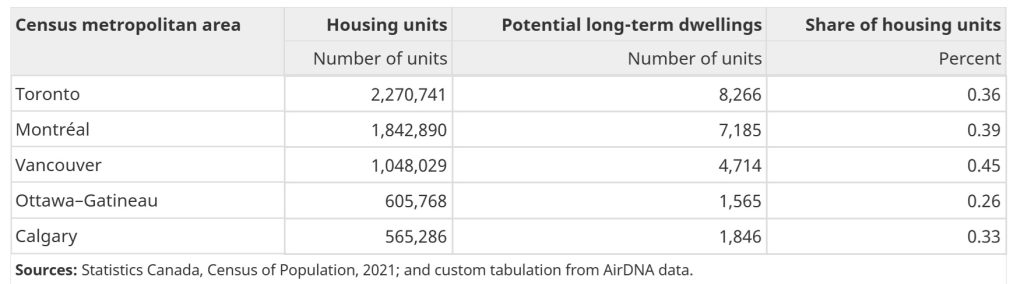
Meanwhile, a 2024 report from Statistics Canada indicates that the number of short-term rental units that could potentially be converted into long-term housing is minimal, accounting for less than one per cent of most cities’ housing supply. In tourist areas and ski towns, like Whistler and Mont Tremblant, the share tends to be higher, in some cases reaching up to 35 per cent.

Common crackdown measures

Montreal isn’t alone in its mission to curtail unlawful short-term rental operations as a way to free up  long-term housing. Since 2023-24, Nova Scotia, Vancouver and Toronto have also introduced measures such as setting occupancy limits, introducing licensing requirements and imposing fines for a failure to comply. In BC, hosts must register with the provincial short-term rental registry and pay an annual fee. Short-term rental licenses are only issued for a host’s principal residence, meaning secondary suites or laneway houses are not eligible.

Market data

While it remains to be seen whether the new requirements will achieve the desired outcomes, other factors are influencing Canada’s rental market, including population growth, unemployment rates, the cost of homeownership and construction challenges. According to the latest data from livrent.ca, Montreal’s rental market experienced a slight cooldown in May, with average prices dipping for both furnished and unfurnished  units. Furnished one-bedrooms now rent for an average of $1,702 per month, reflecting a 0.20 per cent decrease, while unfurnished units dropped by 0.92 per cent to $1,710 per month. Hochelaga-Maisonneuve remains the most affordable area, averaging $1,474 per month, while Verdun holds the top spot as the priciest neighbourhood at $2,007 per month.

According to recent reports, Montreal has approximately 4,000 short-term rental units available on the market, with the majority of listings concentrated in the following neighbourhoods: Quartier Ville-Marie, Sainte-Marie, Le Sud-Ouest, Parc-La Fontaine, Père-Marquette, and Préfontaine.

Canadian Tire plans nex-gen HQ with major retrofit

Two office towers at the Canada Square property in midtown Toronto are set for redevelopment. Originally constructed in the 1960s and 1970s, the 18-storey building at 2180 Yonge Street will undergo internal upgrades and a complete façade renewal, followed by a full renovation of the 17-storey tower at 2200 Yonge Street.

Co-owners Oxford Properties Group, the global real estate arm of OMERS, and CT Real Estate Investment Trust are partnering with Canadian Tire Corporation (CTC) on the retrofit to deliver 680,000 square feet of modernized office space, more than 80 per cent of which will be anchored by CTC. Having operated its head office at Canada Square for more than 50 years, CTC is aiming to build a next-generation headquarters for thousands of employees.

“This ‘made in Canada’ solution which sees the coming together of these great Canadian institutions to revitalize a key hub for Torontonians is a proud moment for OMERS and Oxford,” said Blake Hutcheson, President and CEO of OMERS. “This investment represents our ongoing commitment to being a champion for Canada, here at home and around the world.”

Plans entail new employee amenities and nearly 15,000 square feet of modern retail space on Yonge Street. Construction, which will begin in late 2025, will lower embodied carbon from the project while introducing significant energy efficiency upgrades in support of LEED Certification.

This Canadian-led partnership includes a 550,000-square-foot, 20-year office lease with CTC. “This is a proud milestone for Canadian Tire and a major reinvestment in a neighbourhood we’ve called home for more than half a century,” said Greg Hicks, President and CEO, Canadian Tire Corporation. “We’re excited to help transform this vibrant corner of the city. Our employees will be among the thousands who come here each day – for work, for play and for the ease of new transit connections in every direction.”

The project promises a more accessible TTC entrance on Yonge Street to help local residents and workers more efficiently access Eglinton station.

“This substantial investment at Canada Square is part of Oxford’s deep conviction that well-located, high-quality, and sustainable workplaces that focus on the employee experience will continue to outperform,” said Daniel Fournier, executive chair at Oxford. “Not only is this an environmentally friendly approach to revitalizing one of the most transit-connected sites in the city, but it brings a substantial amount of employment to the neighbourhood and will benefit Torontonians for generations to come as we continue to advance our long-term plans for Canada Square.”

The office retrofit project is a step towards the planned redevelopment of the 9.2-acre site into a vibrant, mixed-use addition to the community.

Photo courtesy of Canadian Tire Corporation. 

New hotel coming to Calgary Stampede Park

The Calgary Municipal Land Corporation (CMLC) and the Calgary Stampede announced Truman as the development partner for the first hotel on Stampede Park in Calgary’s Culture + Entertainment District.

“CMLC and the Calgary Stampede are proud to partner with Truman, who bring more than 40 years of exceptional building experience in Calgary to this much-anticipated hotel development right at the front door to Stampede Park,” said Kate Thompson, president and CEO of CMLC.

Located on an approximately 85,000 square foot parcel, the Truman hotel will be a full-service, 13-storey upper-upscale lifestyle boutique hotel with approximately 320 rooms; 15,000 square feet of meeting and ballroom space; 14,000 square feet of food and beverage offerings including restaurants, a lobby bar, a coffee shop, and a roof-top lounge with views of downtown; a south-facing leisure terrace with activity pool, jacuzzi and an outdoor bar; and an indoor swimming pool and fitness club.

“This is an exceptional location for a hotel, allowing guests to just stay steps away from the action of The Culture + Entertainment District – whether it’s a convention, meeting or event held in the BMO Centre, a hockey game in Scotia Place, a concert in The Big Four Roadhouse, or the Calgary Stampede’s annual celebration of Western heritage and community spirit each July,” said Tony Trutina, CEO of Truman.

With a development value of approximately $330M, this will be the first full-service convention-oriented hotel built in downtown Calgary in 25 years, demonstrating significant confidence in the emerging Culture + Entertainment District.

The partnership is working with architecture firms NORR Architecture (Chicago), Scatliff+Miller+Murray (Calgary), and CivicWorks (Calgary) to lead design and planning for the hotel. The hotel design is inspired by the unique curvature of Flores LaDue Parade and the expanded BMO Centre, with a sweeping curved form that draws inspiration from the movement of a bucking horse and materiality representative of both the rich identity of the Calgary Stampede and of Alberta’s landscape.

Construction is anticipated to be completed in late 2028.

