Articles Archive - Page 564 of 929 - REMINET
REMI

GTA condo starts set Q2 record as sales slow

Condominium construction starts in the GTA reached a record 7,981 units in Q2-2018, according to Urbanation Inc.’s recent quarterly condo market results. The total number of condo units under construction also reached a high of 63,903 units, 95 per cent of which were pre-sold. Construction was driven higher by a record number of new condo pre-sales in 2017.

The decrease in new condo activity this year was expected following last year’s record-breaking pace of activity. In the first half of 2018, sales were down 58 per cent year-over-year to 9,058 units, compared to the 21,316 units sold in the first half of 2017. This figure is also 13 per cent below the 10-year first half average of 10,471 sales.

New condo sales fell by 56 per cent year-over-year in Q2-2018 to 4,977 units, due to fewer new project openings and absorptions moderated to their longer-term average. In Q2-2018, there were 5,759 units brought to market in pre-construction projects, with 56 per cent of those pre-sold by the end of the quarter, compared to an 80 per cent opening absorption of the record 9,521 units launched in Q2-2017.

“Fewer new pre-construction condo sales this year will help to keep the supply pipeline in check as construction starts and completions move to new highs over the next couple years,” said Shaun Hildebrand, president of Urbanation, in a press release. “Ultimately, low unsold inventory and a stabilizing resale market will provide support for the new condo market in the second half of 2018.”

New condo sales are heavily dependent on activity from investors, whose interest in the market is dependent on the outlook for investment returns. Developers have reacted to this changing market environment by launching fewer developments, as new openings declined by 51 per cent annually in the first quarter of 2018. This has helped keep inventory levels low and prices relatively steady at elevated levels, compared to last year.

The average opening price for new condo launches in Q2-2018 was $835 per square-foot, an increase of 18 per cent year-over-year, but down from the high of $954 per square-foot for units launched in Q4-2017.

Unsold inventory in development increased to 9,341 units, the highest it has been in six quarters, but remained well below the 10-year average of 15,087 units. Pre-construction buyers have become more cautious as new condo prices began their sharp climb last year, as price appreciation slowed for resale units.

Condo apartment resale volume dropped 17 per cent year-over-year in Q2-2018, but this figure was an improvement compared to the 31 per cent decline recorded in Q1. In Q2, there were 6,019 units resold, which is five per cent higher than the 10-year average for Q2 (5,708 units).

Annual resale price growth of five per cent in Q2 represented a strong deceleration compared to the 30 per cent annual growth recorded in Q2-2017. Continued positive resale price growth has been supported by low levels of supply, as total listings have fallen on an annual basis for the last 10 consecutive quarters.

Making Your Podium Deck a Priority

Given the costs and construction logistics, a podium deck project can be intimidating. With the right team and a strategic approach, however, work on this critical asset can yield lasting benefits.

“Podium deck jobs add significant value to the property,” says Jeremy Horst, Principal, Building Science and Restoration, with RJC Engineers (RJC). “You’re not only improving your waterproofing system, which saves money and headaches later on, but these projects are an opportunity to enhance your curb appeal, which benefits residents and building owners.”

How do you determine when a podium deck needs work? Check your calendar. Typical deck lifespans run 25 to 30 years, after which waterproofing systems can begin to fail. Leakages through slab crack locations can also be a telltale sign but are just one of the less visible indicators.

For a full view of a podium deck’s health, consider a condition survey assessment. These are useful in looking beneath a property’s hard and soft landscaping features to assess the true state of a podium deck and its working parts. They are also critical in determining how effective the waterproofing system is at keeping water and salts out of the structure and, therefore, preventing deterioration.

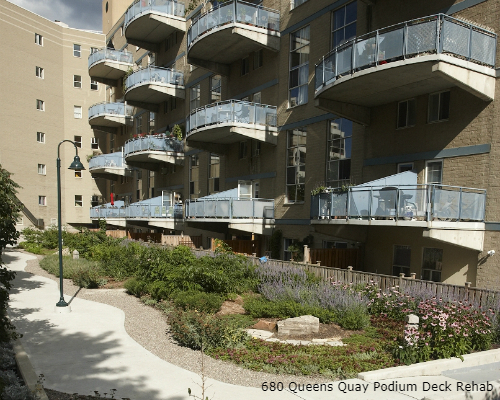
680 Queens Quay Podium Deck Rehab“By taking test cuts of the podium deck landscaping and waterproofing system at targeted locations, you’ll get a much better idea of the as-built condition of the podium deck and the underlying condition of the waterproofing system and structural slab,” Horst explains. “That being said, podium decks can span thousands of square feet, so it’s a challenge to know where to test. That’s where we rely on our experience and a knowledge of how the underside of a slab provides information on how well the podium deck structure is performing as a whole.”

The fix beneath your feet

Podium deck issues can pose significant risks if left unchecked. Not only can the deterioration of the slab soffit result in falling concrete, but unaddressed damages can add up to more costly repairs in the future.

As Horst warns: “The longer you allow leakage to occur, the more structural deterioration you allow to carry on. And the more work you need to do on the concrete, the greater amount of noise and construction disturbance there will be to the people living in your building when you finally decide to undergo that replacement.”

In short: it’s important to take action. Depending on the age of the waterproofing system, it might be possible to conduct localized repairs. This entails digging into specific areas, unearthing the existing membrane, and patching it at the known leak locations. If the system is older, though, it might be time for a full replacement.

Fortunately, a full podium deck rehabilitation/replacement doesn’t have to be stressful. Instead, these projects present an opportunity for condo owners to reshape their landscape by adding new amenities or enhancing existing features. They are also an opportune time to make changes to meet “barrier-free” building requirements in applicable regions.

680 Queens Quay Podium Deck Rehab (2)Herein, Horst says, RJC makes it a habit of collaborating with landscape designers when called in to consult on podium deck projects: “Design trends and regulations are constantly evolving. Design professionals and landscape architects are in tune with these changes and can provide timeless landscaping designs over repair work that will last the full design surface life.”

It’s important that all parties are involved in planning these designs. That includes consultants like RJC who can map out needed work, condo owners who can communicate their visions for the space, and contractors who can work with landscapers to make those landscaping features a reality.

Moreover, Horst notes, involving all parties from the start is key to construction planning: “Phasing is critical because podium deck jobs have a significant impact on ground floor access and egress for people who live and site servicing vehicles like delivery vans, moving trucks, and garbage and recycling vehicles. The right partners will walk you through these challenges and help create a plan to maintain access and minimize the overall disruption to the building during construction.”

After all, he adds: “Like every other project, you have to remember that you are working within a living building.”

Jeremy Horst is a Principal with RJC Engineers. Learn more at www.rjc.ca.

What technology can’t replace in communities

There was a time not that long ago that community living was about working together to advance the best interests of every member. Consider the farming communities that settled in Canada, for whom developing community relationships was necessary for survival. Everyone in a community could rely on each other for trade — money and belongings were of little importance.

Since then, technology has introduced new tools for everyday success, promising increased productivity for those who develop the new skills required to adapt to changing environments and spawning a generation that needs things to be newer, faster and better.

But what is being left behind as technology becomes more a part of day-to-day living in a community? Are there things that should be done the “old-fashioned” way? How does this impact property managers specifically? What’s changing for the better, and for the worse?

Customer relations

Technology has had a positive impact on a property manager’s ability to give condominium residents access to information. Digital options for delivering correspondence means that when the water is shut off unexpectedly, it’s easy to let all residents in a community know about the problem — preventing many angry inquiries about the issue.

More and more, however, the simple art of building relationships with clients is being lost. Electronic communication can obscure the intended message as readers impose their own thoughts and feelings onto the written material, leaving room for misinterpretation and misunderstanding.

While documentation is important, so is making sure the message is clear! In particular, when dealing with a sensitive matter property managers should be mindful that picking up the phone can go a long way to helping their clients understand the subject being discussed. Conversations can always be followed up with written correspondence confirming the discussion.

Physical building assets

Technology has done so much for the management of the physical assets of a condominium building. It’s possible to monitor mechanical components for peak efficiency, minimizing the use of utilities, and thereby reducing costs and environmental impact, as well as extending the life of new materials, and thereby reducing long-term repairs and replacement costs.

There remain, however, physical assets that can’t be managed using technology. Buildings and their surrounding property still need to be inspected to identify any potential problems that need attention. Even using tech-forward approaches to inspections, such as drones, a property manager still needs to physically review any camera footage collected. Images can also lack certain perspective and detail that would help a manager to strategize the best repair approach.

Property managers should remember that managing the physical assets of a condominium can’t be done from behind a desk!

Finances

Is technology helping or hurting communities financially? There are positive and negative financial implications associated with technological advancement. On one side, technology can be expensive to purchase and maintain. On the other, technology can help save costs.

While the answer is complex, the question should be considered by property managers recommending upgrades as well as by board members contemplating the financial implications of making changes. It’s important to carefully study the potential payback to ensure that, financially, moving forward on a technology project is a responsible choice.

Community living

Technology does not foster relationships. While it may give an individual greater access to others with similar interests, access alone does not bring people together.

Take a moment to consider if technology is creating a more anonymous lifestyle in condominium communities. Relationships with neighbours are extremely important for the success of a community, for many reasons. Neighbourly relationships increase safety and security, they provide an environment of support, they help people to trust each other, and they can reduce the issues that can arise among people living so closely together.

All members of a condominium community, including and especially the property manager, should take the time to remember the good old days, when it was possible to borrow a cup of sugar from a friendly neighbour.

Technology keeps moving forward. Property managers must embrace the changes in order to stay relevant and provide communities with the best possible service and advice. Just remember that newer and faster does not always equal better.

It will be interesting to see how technology continues to change how the condominium industry operates physical buildings, but also how community members interact with each other. New challenges and solutions are sure to develop over time.

Fifty years ago, the idea of every member of the population having access to instant information and communication was completely out this world. What will change in the next 50 years?

Lyndsey McNally, RCM, is team leader for Malvern Condominium Property Management and is ACMO’s Property Manager of the Year 2017. She is not anti-technology, but concerned about losing sight of what’s really important in communities.

Construction underway for Abbotsford courthouse

Construction is underway for a new courthouse complex in Abbotsford that will help meet the increasing demand for judicial services in one of B.C.’s fastest-growing regions. The Abbotsford facility will be the first new B.C. courthouse to be built in 10 years.

Slated to open in early 2021, and adjacent to Abbotsford City Hall, the courthouse will provide improved access to a broad range of legal resources by consolidating a variety of justice services into one location. Once complete, the 14-room courthouse will include new provincial and Supreme courtrooms. There will also be judicial conference space, along with added capacity for community justice programs.

“Our government is committed to making the justice system work better for British Columbians,” said David Eby, Attorney General. “The new Abbotsford courthouse, and the legal resources it will contain, will add badly needed capacity to the region.”

The $150-million public-private partnership project will provide work opportunities to an estimated 1,000 B.C. workers, and will provide registered apprentices with valuable experience in the province’s skilled trades sector.

“The City of Abbotsford is extremely grateful to the Government of B.C. for this significant investment in our community and region,” said Henry Braun, Abbotsford mayor. “The building of a new courthouse will create better access to our justice system, provide services and jobs to residents across the region, and help to shape Abbotsford’s evolving city centre.”

In May 2018, the Ministry of Citizens’ Services and the Ministry of Attorney General finalized negotiations with developer Plenary PCL for the new facility. The province partially secured funding for the development through a green bond, which are used to finance projects with environmental benefits.

The Plenary PCL Justice consortium includes Plenary Group (Canada) Ltd.; PCL Investment Canada Inc.; PCL Constructors Westcoast Inc.; WZMH Architects as prime architect; Smith + Andersen; and Johnson Controls Canada LP.

Canadian Open makes sustainability leader board

Although a home grown champion continued to elude the Canadian Open last weekend, sponsors of the PGA Tour tournament at Oakville’s Glen Abbey Golf Club could boast carbon neutral status for a seventh consecutive year. RBC’s drive for sustainability combines renewable energy, carbon offsets and waste reduction to hit the leader board as one of the PGA’s greenest annual events.

RBC contracted with a renewable energy and green natural gas supplier to account for Glen Abbey’s electricity and gas consumption, then purchased carbon offsets to neutralize emissions from diesel generators and shuttle buses required for the event. Zero-waste sorting stations for spectators’ cast-offs, and water stations offering free filtered water and reusable bottles were located in high-traffic areas of the course.

More than 100,000 visitors over the four-day tournament were encouraged to cycle, and leave their bikes with the complimentary valet service at the course, or take advantage of a free shuttle bus service from nearby GO Transit stations. Cycling and transit should also be easily accommodated next year, when the Canadian Open is slated to move to a springtime date, June 3 to 9, and a new venue at the Hamilton Golf and Country Club.

Like Glen Abbey, the Hamilton club is a participant in the Audobon Cooperative Sanctuary program for golf courses.

National housing market remains highly vulnerable: CMHC

For the eighth consecutive quarter, Canada’s overall housing market remains highly vulnerable, mostly due to evidence of overvaluation and price acceleration in Toronto, Vancouver, Victoria and Hamilton, finds Canada Mortgage and Housing Corporation (CMHC) in its quarterly Housing Market Assessment (HMA).

“At the national level a high degree of vulnerability continues due to moderate levels of price acceleration and overvaluation,” said Bob Dugan, CMHC’s chief economist, in a press release. “Regionally, we are seeing a fair amount of differences, for instance in major centres in Ontario and British Columbia a high degree of vulnerability remains while in the Prairie and Atlantic markets range from moderate to low.”

CMHC defines vulnerability as imbalances in the housing market, which occur when overbuilding, overvaluation, overheating and price acceleration, or any combinations of those, significantly stray from historical averages.

HMA results are based on data as of the end of March 2018 and market intelligence as of the end of June 2018. CMHC’s report assesses the housing market at the national level and provides summary assessment results for 15 Census Metropolitan Areas (CMAs).

In Vancouver, the HMA framework detected moderate evidence of overheating, although price growth has slowed measurably over the last two quarters, and has turned negative in some areas. Declining prices for detached properties in some areas are a result of high inventories that have accumulated due to sustained falling sales volumes.

Evidence of overbuilding remained high in Calgary, but the peak inventory count for apartment units, the largest share of inventory, took place in December 2017, and has since declined. The absorption rate of condos at completion averaged 83 per cent to date as of May 2018 compared to 67 per cent in the same period a year ago, helping to reduce inventory and mitigating the same accumulation of inventory experienced in 2017.

Evidence of accelerating home price growth remained low in Q1-2018 in Saskatoon. Among housing categories, the benchmark prices for single-family, townhouse and apartment units all fell in Q1-2018, compared to Q4-2017, and were down on an annual basis. Compared with the same quarter one year before, the price decline during Q1-2018 was significantly larger among townhouses, where supply far exceeded demand.

In Regina, downward pressure on home prices continued in Q1-2018, contributing to low evidence of price acceleration. The MLS HPI benchmark prices for single detached and townhouse units in Q1 were $291,300 and $230,900, respectively, a decline of 2.6 per cent and 2.2 per cent quarter-over-quarter, respectively. Meanwhile, the benchmark price for an apartment unit was $178,200, up 1.3 per cent compared to Q4-2017. However, prices for all three home types were down on an annual basis.

Winnipeg is showing moderate evidence of overvaluation, as the combination of rising home prices and falling incomes have created some imbalances. Real personal disposable income levels have fallen year-over-year for the third consecutive quarter, while mortgage rates have started to climb from historically low levels.

Despite slowing price growth across the Greater Toronto Area, CMHC reports that lower home prices would have to remain in place for a longer period of time in order for any evidence of price acceleration to be discounted. As a result, Toronto maintained its rating from the previous quarter.

Although overvaluation in Hamilton decreased on average, moderate evidence of it remained as home prices were still significantly higher than levels supported by some housing demand fundamentals. Population growth continues to be a key driver of housing demand in the region.

In Q1-2018, Montreal’s seasonally adjusted sales-to-new listings ratio was close to 69 per cent, only one per cent below the problematic threshold of 70 per cent. This ratio increased for the seventh straight quarter, with sales rising more rapidly than new listings. Because of this, the ratio was closer to the threshold for overheating, maintaining significant pressure on prices.

As of the end of May, Halifax experienced a 12 per cent growth in year-over-year sales, causing the sales-to-new listings ratio to rise to 62 per cent. Since this remains well below the problematic threshold of 85 per cent, the Halifax market still exhibits low evidence of overheating. The average number of days on market has trended down throughout 2018, as homes have sold more quickly in all of the city’s submarkets.

Overall, CMHC found low evidence of vulnerability in Moncton, as the indicators of overbuilding, price acceleration and overvaluation remained below problematic thresholds. However, monthly home sales in the city are setting records, due to increased immigration and improved labour market, while listings remain at historical multi-year lows and continue to fall. Resale price growth can be expected if demand continues to outpace supply.

“Policy changes to the housing market over the past 12 months have dampened home buying demand and softened price growth,” added Dana Senagama, manager, market analysis for Ontario. “However, our assessment continues to indicate a high degree of vulnerability in the Toronto CMA housing market as price growth persists above rates justified by economic and demographic fundamentals such as income and population.”

Investors chase multifamily properties

Cap rates are holding steady at low levels as investors chase multifamily properties in major Canadian markets. Midyear results from CBRE and Colliers International also find almost every other property type, except premier office, is trading at higher cap rates.

“Sector fundamentals remain exceedingly strong with low vacancies and rising rents seen in most markets across the country,” reports David Montressor, executive vice president of CBRE’s national apartment group. “With a limited number of quality offerings reaching the market, several cities are reporting greater than normal demand from investors.”

Nationally, CBRE pegs the average cap rate for Class A high-rise properties at 3.96 per cent. Class B high-rise and Class A low-rise likewise register lower average cap rates than the national average for Class AA downtown office buildings, which is 4.81 per cent.

Within Canadian markets, cap rates in Vancouver, Toronto and Ottawa are lower than the national average for all four multifamily formats. Vancouver remains at the low end of the scale, with cap rates for Class A high-rise properties in the range of 2.5 to 3 per cent. Changing dynamics for new residential construction in British Columbia may also have an impact on demand for existing multifamily stock in the coming quarters.

“The residential real estate market has seen some cooling in some segments and markets, however there is still demand for product outside of luxury markets,” observes James Glen, Colliers’ vice president in Vancouver. “The big story is the rapid rise in construction costs and development levies, squeezing residual land values down. Many of the largest developers have amassed large land holdings over the years, and so are not immediately affected directly by softening.”

In Ottawa, Class A high-rise properties are trading at caps of 3.25 to 3.75 per cent with Toronto Class A high-rise properties in the 3 to 3.75 per cent range. Winnipeg, Calgary and Edmonton exhibit cap rates above the national average — although Winnipeg’s 5 to 6 per cent range also partly reflects that no high-rise Class A buildings sold in the second quarter.

“Despite an increasing vacancy rate, new supply is being added in the multifamily market, led by high-end rentals and student housing,” reports Ryan Behie, CBRE’s vice president and managing director in Winnipeg.

Halifax presents a similar scenario. “The multi residential market continues to see substantial development of new buildings in all areas of the City, with the downtown now being a focal point for high quality development,” says Mitch Wile, Colliers’ managing director in Halifax. “The new supply is being met with enthusiasm from the market as tenants are upgrading from older rental stock to modern buildings. The downtown is emerging as a new residential community — a virtuous circle by which the growing neighbourhood will support resident-oriented businesses (shops, services, restaurants, cafes, etc.) and the office market to an extent.”

Colliers analysts also speak enthusiastically about trends in Montreal, where cap rates were at 4 to 5 per cent for high-rise and 5.25 to 6 per cent for low-rise apartment buildings. Michael Colgan, managing director in Montreal, notes that the multifamily sector was the most active component of the investment market in the second quarter of 2018, although many of the deals were smaller transactions. The largest Montreal transaction was a 268-unit building that sold for $79.6 million or $297,200 per unit.

Canada and Quebec invest in low-rental housing upgrades

The governments of Canada and Quebec announced the completion of $1,398,000 in modernization work at La Maison du lac, a building that is part of the Macamic municipal housing bureau in the Abitibi-Témiscamingue region. The low-rental housing project for independent seniors is located at 92 Principale Street North, in Macamic.

The work, now completed, included the installation of an elevator to make it easier for tenants to move between the floors of the building, a former school that was converted to low-rental housing in 1982.

The financial assistance also helped renovate the units, replace the roof, repair the exterior building envelope, redesign and repave the parking lot and do work on the potable water supply system.

“This government is proud to assist in providing safe, affordable and accessible homes to Canadians,” said Honourable Jean-Yves Duclos, Minister of Families, Children and Social Development and Minister Responsible for Canada Mortgage and Housing Corporation. “The installation of an elevator at La Maison du lac, part of the Macamic municipal housing bureau is truly a victory, offering easier access and greater mobility to residents and visitors. It is through such improvements that we are able to support our communities, enhancing their contribution to housing in Canada.”

These investments come from the annual replacement, modernization and improvement (M&I) budget that is dedicated to the upgrade of Quebec’s social housing stock composed of more than 74,000 low-rental housing units.

Over the past 10 years, the funds allocated by the Société d’habitation du Québec (SHQ) and Canada Mortgage and Housing Corporation (CMHC) to renovate low-rental housing in Quebec have more than tripled, from $103 million in 2007 to $343.4 million in 2017. For 2018, a sum of $343.4 million is again available to perform work.


Canada invests in Sikh Heritage Museum of Canada project

The Government of Canada is investing $380,000 to the Sikh Heritage Museum of Canada for its project “Becoming Canadians Eh! The Sikhs.” The investment is being provided through the Canada History Fund, administered by Canadian Heritage, over the 2018-19 and 2019-20 fiscal years.

The project will create a Canadian Sikh Heritage Trail and a travelling Canadian Sikh Timeline Exhibition, along with a web portal and interactive mobile application providing facts, figures and personalities that have shaped the civic life of Canada. It will also allow current and future generations to learn more about the struggles, sacrifices and successes of Sikhs in Canada. The total budget for this project is $593,000.

“This project will create virtual spaces that will help the museum to reach a broader national and international audience through dynamic, interactive exhibits and cultural programming,” said the Honourable Navdeep Bains, Minister of Innovation, Science and Economic Development, in a press release. “The Government of Canada is working hard to promote inclusion as a means of fostering innovation, social cohesion and economic prosperity. This funding is just one of the concrete steps we are taking to encourage Canadians to embrace their diversity.”

The Sikh Heritage Museum of Canada is a provincially incorporated non-profit organization. The museum’s goal is to provide a public amenity by establishing and operating a Sikh Heritage Museum to preserve, curate and exhibit artifacts, publications, photographs and documents of historical significance. It also hopes to advance education by creating and touring exhibits, and by providing educational lectures and seminars related to Sikh history and culture.

Services and amenities for aging Canadians

When planning to build a rental property aimed at older Canadians, developers should balance the need to remain competitive in the marketplace with the need for cost-effective services and amenities that correspond to the demands of residents.

Unlike mainstream housing developments, where built-in amenities are largely influenced by the desire to capture the interest of the purchaser, developers targeting seniors are more likely to consider the inclusion of carefully chosen services or amenities with the expectation that these will be used—either because residents need them, or are willing to pay a premium for them, or both.

For this reason, a careful analysis of the costs and benefits of on-site amenities that require upfront investment (such as central dining facilities and a kitchen) is critical early in the planning process, as not only will these decisions affect the financial viability of the project but ongoing operational expenses, as well.

Here are some important factors CMHC recommends developers consider when planning their future retirement communities:

1. Urban or rural setting

The first and most important consideration is the location of your project and the offerings of the community-at-large. Highly urban locations are more likely to have services and amenities available within walking distance, or perhaps a short drive or bus ride away. Planned projects close to a community centre that offers fitness classes targeting seniors, for example, may only need a minimal investment in fitness facilities. Similarly, access to a local library where books and computer facilities are readily available can reduce the need to provide room for those types of facilities on site.

Projects in more rural settings, however, are more likely to require well-equipped on-site amenities given the distances involved and the frequent lack of convenient public transportation. Moreover, they can make a larger footprint because of lower land values, although the choice of amenities to be included still requires careful assessment to ensure that the investment makes sense from both a fiscal and marketing perspective.

Some developers are predicting that increasing numbers of older Canadians will prefer developments with all-encompassing lifestyle appeal versus developments that depend on the surrounding community for important services. In other words, prospective residents may be more attracted to a project that offers its own wellness centre, theatre, salon, walking trails and parkland, compared to a development in an urban area that has fewer amenities offered within the project.

2. Characteristics of the target market

Since older Canadians are a diverse group with a wide range of needs and expectations, developers should accurately identify and understand the particular target market for a development. The first baby boomers in Canada will be retiring in the coming years, and in general, the needs and preferences of this group are very different from those of their parents.

Baby boomers are, on average, better educated, more active, healthier, more affluent and more sophisticated in their tastes. They want access to restaurants and entertainment venues and seek a “worry-free lifestyle” where they can travel without having to fret about home maintenance. If the development is targeted to the baby boom generation, the focus should be on convenience, recreation and lifestyle services and amenities.

Since baby boomers have high expectations for the range and quality of services, in some cases, they may prefer that an amenity not be offered at all rather than accept something that is wanting or substandard.

If the target market caters to an older clientele, such as seniors 75 years and over, the services and amenities should focus more on in-home support services that assist with their daily activities, and assistive technology (such as emergency response systems) to augment safety as their abilities decline.

It is also important to consider that Canada is increasingly culturally diverse. About 30 per cent of the population 65 years and over consists of immigrants. Many immigrant seniors, particularly recent newcomers who represent three per cent of the immigrant population aged 65 years and older, have different interests, activities and preferences compared with seniors who were born in Canada.

Developers and potential project sponsors working in markets where a significant proportion of the senior population is immigrant or Aboriginal should pay extra attention to providing facilities that are culturally sensitive (i.e. places of worship).

Regardless of the target demographic, it is useful to take account of seniors’ preference to “age in place.” Even when targeting a younger market, developers should ensure that the services and amenities on offer are flexible enough to respond to the changing needs of residents. Multi-purpose rooms that can be adapted as necessary is certainly something to consider.

3. Identifying gaps in the community

When doing market research, it’s important to pay special attention to which services and amenities are not available in the community; have long waiting lists or are expensive. In such cases, providing these services within a project potentially makes it more appealing to prospective residents. If the project is in an urban area where many services and amenities are available, providing higher quality services and amenities would be attractive to prospective residents, as they would not have to compete with the rest of the community to access these services.

Additionally, the growing diversity of the population may provide an opportunity to offer services and amenities that are culturally, linguistically or spiritually relevant, but which are currently not being offered elsewhere.

4. Market affordability

A key element of market research is identifying how much the selected demographic can afford to pay for services and amenities and how much they are prepared to pay. Affordability is very important to the success of a project. Older Canadians generally live on fixed incomes. Although many older Canadians choose to continue working past the traditional retirement age, they may not be willing to spend a large amount of money on services and amenities over and above their accommodation costs. Looking at the rates charged by competitors may give a good indication of market affordability, particularly if the competition is serving a similar group.

Popular amenities found in retirement communities:

– Game rooms
– Hair salons
– Computer rooms
– Cafés
– Libraries
– Theatres
– Chapel areas
– Private dining spaces
– Walking paths
– Gardens
– Outdoor sitting areas

Graeme Huycke is Senior Specialist, Client Relations, Multi-Unit Underwriting at CMHC.   For more information on housing for older Canadians, visit www.cmhc.ca or contact Graham at (416) 250-2705  or [email protected]

Building laneway houses easier with bylaw changes

Building laneway houses in Vancouver has been made easier and more cost effective with bylaw changes approved by city council.The move will help improve livability and help meet the Housing Vancouver target of providing 4,000 new laneway homes over the next 10 years.

The Laneway Housing Program has been in place since 2009, and to date more than 3,300 laneway homes have been approved across the city.

“It’s great to see city council support changes to get more laneway homes built in neighbourhoods across the city,” said Mayor Gregor Robertson. “We’ve heard loud and clear that Vancouver residents want more housing choices and laneway homes are a great option for middle-income households.”

Key benefits resulting from the change

  • Streamlining approvals for one and a half storey laneway houses by introducing an outright review process similar to the current process for one storey laneway houses.
  • Supporting more functional and flexible laneway house design by increasing allowable heights and updating the method of measuring height.
  • Improving livability by introducing minimum room size requirements
  • Providing more flexibility for the location and design of one-storey laneway houses.

Enactment of the approved changes is expected in September 2018.

“These changes are a result of consultation with the public through Housing Vancouver about housing needs, as well as focused engagement with owners and renters of laneway homes, industry engagement, and staff analysis,” says Paula Huber, senior planner. “By removing identified barriers to building a laneway home, we are making it easier and faster to build the type of housing we know people want and need.”

Hollyburn acquires Vancouver office building

Hollyburn Properties, Vancouver’s largest owner/operator of apartment buildings, has expanded its portfolio to include an office building located at 1155 West Pender. The new property, ideally located near Vancouver’s city centre, is set to become the company’s new head office in early 2020.

As an industry leader, Hollyburn said it felt the need to diversify its asset base in an extremely competitive and somewhat uncertain market. The physical reality of the dated, more maintenance-heavy Vancouver apartment building stock, coupled with the economic reality of high valuations, transfer tax, and change of legislation, plus other punitive political risks, made the prospect of a commercial building an attractive consideration.

In a time when the downtown Vancouver office market has the second lowest vacancy rate in North America at sub five per cent, the move offers the growing company promising opportunities to further expand and develop.

And Hollyburn isn’t alone in recognizing the benefits of a central downtown office—the neighbourhood is rapidly transforming with new commercial property vendors snatching up available space, including: Reliance Properties, Oxford Properties, and Bentall Kennedy. Sharing the building with Hollyburn will be anchor tenants Continuing Legal Society and Bazinga Technologies, both with full floor plates.

Benefits of a downtown office

The central location presents a number of benefits for Hollyburn. These include: easy access to public transportation; reputable restaurants and shops; close proximity to 30 of Hollyburn’s downtown apartment communities; and according to Hollyburn’s Allan Wasel, the fact that the property “satisfied [their] short-term requirements as an owner user on a 11,400 sq ft floor plate with 12-foot ceilings, [their] medium-term requirements of repositioning the property for accelerated rental growth, and [their] long-term requirements as a property with strong redevelopment potential on a 16,511 square foot site with dual Hastings and Pender street frontages.”

Hollyburn Properties, a Canadian-owned company founded in Vancouver over 40 years ago, currently manages and operates 90 rental communities nationwide, with over 5,600 suites across Vancouver, Calgary, Toronto and Ottawa.

Tower crane use up 10 per cent nationally

The North American construction industry is in healthy shape, finds Rider Levett Bucknall’s upcoming Crane Index, which will be released later this week. According to the Index, a nearly 10 per cent increase in tower cranes nationally confirms the fast pace of urban building, with residential and mixed-use sectors leading the activity.

“The increase in the net crane count indicates that the construction industry is prospering, despite a tight labour market and materials tariffs,” said Julian Anderson, president of RLB North America, in a press release. “Our outlook for the industry through the end of the year remains positive.”

The Crane Index shows the national tower crane tally is increasing. In July 2018, there were 420 cranes counted, compared to the 383 counted in January 2018, for a difference of 9.66 per cent. The U.S. national average increase in construction cost is approximately 1.18 per cent.

Meanwhile, Toronto has the highest number of cranes across all the cities surveyed for this edition of the index for the third consecutive reporting period. In January 2018, the number of cranes sat at 88, and increased to 97 in July 2018. The residential sector continues to lead the market, accounting for over 86 per cent of the total crane count, followed by mixed-use and commercial developments, education, healthcare and hospitality.

Going forward, Toronto is expected to see an increase in spending on infrastructure, which is anticipated to cause an increase in construction activity. In addition, over 400 high-rise projects have been proposed in the city.

Opposition to B.C. Benefits Agreement grows

Opposition to the B.C. government’s recently announced Community Benefits Agreement continues to grow. The Vancouver Regional Construction Association (VRCA) has joined a coalition of business associations and non-affiliated unions in signing an open letter to Premier John Horgan demanding his government abandon the agreement.

VRCA took this action out of concern that workers, construction contractors and taxpayers will lose with the ill-conceived and ill-advised procurement model announced July 16, on the basis that it will:

  • result in local companies facing potential barriers to participate in key public-sector infrastructure projects in B.C.;
  • result in out-of-province companies building B.C.’s infrastructure and returning the economic benefit to their respective jurisdictions; and
  • exacerbate an already tight labour market that needs all the skilled workers it can find.

“The overall cost of construction of our public-sector infrastructure will increase. It will not represent best value for taxpayers’ dollars yet will be funded by hard-working British Columbians,” said VRCA president Fiona Famulak.

“Government must understand that its Community Benefits Agreement will have enormous consequences for our industry – and for taxpayers – that neither VRCA nor its members can accept.”

Premier Horgan promises the Community Benefits Agreement will deliver good-paying jobs, better training and apprenticeships, and more trades opportunities for Indigenous peoples, women and youth around the province.

However, the announcement did not reference that the Agreement comes with a union-labour component that is prescriptive and regressive. Further, the details of the labour agreements, including the definition of “key infrastructure projects” and whether it will extend to schools and hospitals, have yet to be released.

VRCA advocates for fair, open, and transparent procurement processes, and strongly opposes any procurement practice or program that seeks to confer exclusive bidding rights to firms based upon any system of quotas or legislated wages within the province.

The decision to sign the open letter follows VRCA’s July 18 statement expressing alarm and concern about the government’s decision to implement a Community Benefits Agreement on public-sector infrastructure projects that include the Pattullo Bridge.

NB office markets improve as St. John’s slips

Fredericton is the lone office market in Atlantic Canada to boast a vacancy rate below the national average of 10.7 per cent. Turner Drake & Partners Ltd. reports 133,000 square feet of positive absorption in New Brunswick’s capital since June 2017, trimming nearly 170 basis points from last year’s vacancy rate to take it below 9.5 per cent. Class A office supply is even scarcer, with a vacancy rate of 6.3 per cent, allowing it to command an average net rent of $15.38 per square foot.

Saint John registers the highest vacancy rate of New Brunswick’s three provincial centres, but it also shows the year’s most marked improvement — dropping 370 basis points from 20.7 per cent to 17 per cent. Class A space records a vacancy rate above the city’s average, at nearly 18.2 per cent, but it achieves higher rents than Fredericton’s Class A space, with an average net rent of $15.83 per square foot.

The vacancy rate in Moncton has also declined since midyear 2017, from 13. 4 to 12.17 per cent. It dips further still, to about 9.6 per cent, for Class A office space, which garners average net rent of $14.65 per square foot

The three New Brunswick office markets collectively offer about 7.9 million square feet of office space in 164 buildings. Approximately 50,000 square feet of new office space was added in the Fredericton market since June 2017, while inventory grew by less than 7,000 square feet in Saint John and less than 4,000 square feet in Moncton. For 2018, however, Saint John will see an influx of 300,000 square feet of owner-occupied space when the new Irving headquarters opens and the company’s employees relocate from five smaller buildings.

Looking east to Newfoundland and Labrador, the vacancy rate climbed 200 basis points and now rests slightly above 20 per cent in St. John’s, which is the second largest Atlantic market, after Halifax, with nearly 4 million square feet of office space in 85 buildings. The Class A vacancy rate is even higher, at 23 per cent — more than 7 per cent greater than the 15.9 per cent vacancies in Class B office space.

Average net rents declined citywide, from $19.07 per square foot at midyear 2017 to $18.88 per square foot. However, Class A space commands an average net rent of $22.55 per square foot, surpassing CBRE’s second quarter findings for Class A space in downtown Halifax, which is pegged at $19.31 per square foot. St. John’s Class B office stock records an average net rent of $18.11 per square foot.

Toronto airport office node attracts investors

Crown Realty’s fund, Crown Realty IV Limited Partnership, has added a fourth asset as its administrators look to invest $234 million of committed capital in Canadian commercial real estate. The acquisition of 10 and 20 Carlson Court, a 305,000-square-foot Class A office complex near Toronto’s Pearson International Airport, was announced earlier today.

Two mid-rise towers sharing a central two-storey atrium comprise the LEED Gold complex, which also offers a fitness centre, restaurant and conference centre for tenant use. It sits on a 9.7-acre site with connections to major highways, and in close proximity to a planned hub for the Greater Toronto Area’s inter-regional transit services.

“The airport employment zone is the second largest concentration of employment in Canada after downtown Toronto. With plans underway across all levels of government to enhance the area’s transit connectivity, the airport office node is an excellent suburban option for employers,” says Emily Hanna, partner, investments, with Crown Realty Partners.

Recently released statistics for the second quarter of 2018 reveal an availability rate in the 16 per cent range in the Toronto airport office node, but that’s an improvement of 190 basis points since the end of March. Avison Young calls it “robust leasing activity” as asking net rental rates across the entire GTA west market gained $0.36 per square foot over the quarter. About 122,000 square feet of new office space is now under construction or in the development pipeline in the vicinity.

Amenities key to promoting occupant well-being

Health and wellness-promoting amenities are no longer just nice-to-have perks in sustainable office buildings — increasingly, employees are demanding them. As a result, forward-looking companies are seeking out these features because they realize employee productivity, innovation, creativity and job satisfaction are measurably affected by workplace wellness.

In past years, the momentum behind sustainable buildings was driven by opportunities to realize economic and operational efficiencies. Buildings that focused on environmentally sound operations, such as water and energy management, saw lower utility costs and, thus, savings on operational expenditures.

However, a growing body of research suggests green design features also lead to healthier, more productive building occupants. A recent Harvard study found that cognitive scores of occupants in green buildings were 61 per cent higher than those in conventional buildings. And research from the World Green Building Council found that workplaces with natural light, thermal comfort and minimal contaminants in cleaning agents help to reduce absenteeism and enhance job satisfaction.

More recently, wellness has emerged as a natural extension of green-building initiatives, since many of the features that reduce a building’s carbon footprint, such as HVAC systems that improve indoor air quality and the increased use of natural light, also are good for the well-being of those who occupy the space. And, according to World Green Business Council, companies spend, on average, one per cent of their annual costs on energy, nine per cent on rent and operations, and 90 per cent on salary and benefits. Given that employees represent such a significant proportion of company costs, low productivity, sick days and absenteeism can quickly add up.

Real estate’s role in productive workplaces

While many factors contribute to a healthy, productive workplace — from corporate culture to fair pay and benefits — real estate has a key role to play. People spend more than 90 per cent of their time indoors, so the buildings where they live, work and play have a clear influence on their health and well-being.

Building wellness certifications, such as Fitwel and WELL, provide tools for developing strategies that can boost employee health and well-being. Fitwel outlines a framework for improving building design and operations for individual and community health, while WELL provides best practices in design and construction for healthy buildings.

In an effort to attract and retain talent, companies are also recognizing the importance of amenities that can enhance employees’ well-being and allow them to function at the top of their game. In this regard, asset managers, property managers and tenants share a mutual interest in creating dynamic and highly desirable spaces that invest in well-being for the long term.

Creative approaches to adopting wellness amenities that promote an active lifestyle, such as fitness centres and bike storage, often require the ability to reimagine and repurpose underutilized spaces. Tenants and property managers are finding dual purpose in conference room space that can double as a functioning yoga studio and the refurbishment of previously unused space to develop basketball courts and other athletic facilities. Outdoor spaces such as rooftop gardens, courtyards or patios hold high potential for the creation of stress-free zones for tenants to enjoy nature.

Healthy buildings bring business benefits

A study commissioned by the Canada Green Building Council found the top three business benefits of healthy buildings (those with features that promote the health and well-being of occupants) include increased building value, the ability to lease space more quickly and the ability to charge premium rents. For example, 150 King St. in Toronto repurposed a portion of the parking garage to meet changing tenant demands. The space was repurposed into a bike room with full shower and locker facilities and a multi-purpose yoga studio that will be programed to the building occupants’ preferences. This key element in revitalizing the building has helped to attract new tenants.

Ultimately, sustainability and wellness impacts the bottom line for all stakeholders. Keeping employees healthy is both a financial and social imperative, and the workplace provides a profound opportunity to positively impact worker health, happiness, productivity and well-being.

Keith Major is executive vice president of property management at Bentall Kennedy (Canada) LP.