Articles Archive - Page 495 of 929 - REMINET
REMI

White Rock reopens Canada’s longest pier

The City of White Rock has reopened its iconic pier, the longest pier in Canada, after it was closed for major repairs following a devastating storm in December 2018.

The 470-metre-long White Rock Pier is a major attraction in White Rock, a picturesque city of 20,000 located on Semiahmoo Bay in southwest B.C.

The pier was battered and severed in half by a storm surge with winds of up to 91 kilometres an hour on Dec. 20, 2018. Working with Greystone Design Management Contractors, the City of White Rock restored and reopened the East Beach Promenade in July. Working with contractor PPM Civil Constructors, the city has now repaired the pier for public use.

The community, businesses and the Province of British Columbia contributed funds to help repair and reopen the pier, paying for costs not covered by insurance.

Donations will be publicly recognized at the official reopening of the White Rock Pier scheduled to be held on Saturday, Sept. 21.

“Reopening the White Rock Pier is a highlight for me as mayor of this beautiful city by the sea,” says Mayor Darryl Walker. “I am extremely proud of the work of City Council and staff for making it a priority to reopen the pier before the end of the summer. Residents and visitors have been enjoying our beach and restored promenade. Now, everyone can enjoy the much-loved White Rock Pier.”

The long-term impact of short-term rentals

Rules surrounding short-term rentals have been the subject of much debate in housing-strapped cities all across Canada, ever since home sharing services like Airbnb and VRBO became the go-to sources for affordable, temporary accommodations.

Defined as stays of 28 straight days or less, the popularity of short-term rentals has been rising year-over-year. Statistics Canada found that revenue from this market segment increased by almost 10 times between 2015 and 2018 to $2.8 billion. According to Airbnb data, 21,000 listings appeared for Toronto in 2018 versus 15,869 in 2016.

But there’s no denying that the popular housing trend comes with its share of havoc. Fraught building managers and fed-up neighbours left coping with late-night benders and strewn trash are calling for stricter rules. And then there is the bigger question of housing supply—are short-term rentals taking thousands of much-needed dwellings away from would-be long-term renters?

At a six-day housing tribunal that began August 26th in Toronto, those for and against the city-proposed rules have been squaring off on the benefits and downsides. If approved, short-term rental operators would be restricted to an owner’s principal residence, require users to register with the city and pay a four-per-cent municipal accommodation tax. The rules would also allow an entire primary residence to be rented out when an owner or long-term tenant is away for up to 180 nights a year. Multi-residential apartment owners would not be permitted to rent out vacant units for short-term stays; only the renting tenants.

As the tribunal continues throughout the week and the city awaits an official ruling, many multi-residential landlords are uncertain about whether a vote in favour of the new rules would have a positive or negative impact in the long-run.

“There is no simple answer to that,” says Joe Hoffer, a lawyer and partner with Cohen Highley LLP. “On the one hand, landlords may benefit in circumstances where tenants earn supplementary income in order to fund higher rents. The grant of a right to engage in short-term rentals may result in even higher market rent levels when units are turned over. On the flipside, where short-term rentals are institutionalized and random third parties are permitted into a multi-res building with the only oversight being the tenant renting the unit, there is a higher security risk.”

Hoffer does acknowledge that some of the new regulations—i.e. necessitating that all users register with the city and that proper insurance is in place—may mitigate some of the risk, but he says he is doubtful those steps will diligently be taken by all. “It is likely that many tenants will just operate under the radar. In addition, landlords (including condo unit owners) who themselves would like to run short-term rental operations will be adversely affected by the proposed restrictions, since the rules will limit their ability to do so.”

Meanwhile, city officials and housing advocates concerned about the bigger-picture housing supply argue that the rules are designed to limit the impact of short-term rentals on the availability of longer-term rental stock as most major cities face tight rental markets.

A recent study by McGill University’s David Wachsmuth, conducted on behalf of Fairbnb—a coalition of tenant groups, condo boards and the hotel industry—reports that short-term rentals have removed 5,500 housing units from Toronto’s long-term rental supply.

Monica Poremba, a lawyer for Fairbnb who spoke at the tribunal, said: “The city is facing a housing crisis and the proliferation of short-term rentals, which has gone unchecked, is exacerbating that crisis.”

But Hoffer is skeptical the new regulations will have much of an impact on the long-term housing market. “Short-term rentals are most attractive in large urban centres like Toronto or Vancouver where tenants and landlords will make aggressive efforts to meet demand regardless of the restrictions,” he says. “In my view both market demands—short- and long-term rentals—can thrive as long as municipal regulations don’t interfere with development.  At this time municipal cash grabs and political interference are the principal suppressors of new housing supply, not restrictions on short-term rentals.”

The hearing throughout the week will look into 32 issues, including: questions around zoning; justifications for the primary residence restriction; economic impacts of the by-laws; effects on housing supply; as well as potential amendments to the rental by-laws.

In the meantime, it’s been nearly one year since the City of Vancouver passed its own short-term rentals bylaw requiring that all operators have a valid business licence—or risk being fined up to $1,000 per offence.

According to the City’s website, a short-term rental can be an entire home or a room within that home that is rented for less than 30 consecutive days at a time. It can only be operated from a principal residence, or in secondary homes or basements suites as long as the operator lives there full time. Short-term rentals are not permitted in accessory buildings (like a garage or art studio), and nor are businesses, societies, and commercial operations eligible to seek a licence.

So, since taking effect last September, has the bylaw had a positive impact on Vancouver’s housing market?

Initially reports were not all positive. Difficulty with enforcement and a loop hole allowing operators to input fake licence numbers led to thousands of illegal short-term rental listings. Since then the City has been working with Airbnb to support enforcement efforts and crack down on unlicensed operations, with the intent to free up those units for long-term tenants. At the six-month mark, the City of Vancouver issued a statement asserting positive strides had been made.

Condo pet bans: A legal perspective

Emotions are running high at two CityPlace buildings after the condominium corporation started enforcing a rule that prohibits any pets that were not registered with the corporation by a specified date. The effect of this rule means that any new pets, as well as any pets not registered by the cut-off date, are prohibited.

It was reported in the media that the rule was passed by the condominium board in 2016 but enactment and enforcement of the rule were deferred until recently. At the time that the board adopted the rule and notified the condominium owners of the rule, the corporation did not receive any requisition from the owners requesting a meeting about the rule. The rule was enacted in response to complaints by non-pet owners about dogs urinating and defecating on the common elements, growling at people and running off leash.

Condominium corporations can enact reasonable rules to promote the safety, security or welfare of the owners and the property of the corporation or to prevent unreasonable interference with the use and enjoyment of the common elements, the units or the assets of the corporation. Below are examples of reasonable pet restrictions that can be incorporated in the rules:

  • weight or size restriction;
  • maximum number of pets per unit;
  • prohibition on nuisance pets;
  • a requirement that all pets must be on a leash or carried while on the common elements;
  • prohibition on exotic pets.

A prohibition on pets contained in the rules is not valid and could be challenged by owners.

In order for a corporation to prohibit pets it needs to amend the condominium’s declaration. This is difficult to do as it requires the written consent of the owners of 80% of the units. This high threshold is particularly difficult to obtain when a large number of the unit owners are investors who do not live in their units.

Even if the corporation is able to amend the declaration to incorporate a pet prohibition, it would not apply to any pets living in the condominium prior to the enactment of the prohibition – those animals would be grandfathered and be allowed to live in the condominium until they died.

Not surprisingly, pet owners at CityPlace are fuming about the rule. It was reported in the media that some residents have circulated a petition to present to the condominium board to ask it to reconsider the rule.

The condominium declaration and rules are binding on all owners and residents of the condominium. However only registered unit owners have right to vote on condominium matters or to requisition a meeting. Tenants and other non-owner residents do not have any standing to participate in voting or give or withhold consent if required by the corporation. Some residents may think that it is unfair that they do not get any say in decisions relating to the place that they call home. However, the Condominium Act, 1998, which is the legislation governing all condominiums in Ontario, does not give these rights to non-owners.

Denise Lash is founder of Lash Condo Law.

Searching for condo board software

With technology moving into every aspect of our lives, it is no surprise that condominiums are following suit. As such, it can be daunting for a condo board to find software that fits their needs and their condominium community. There are lots of products on the market and deciding on the right one is a challenge. Moreover, most condominium corporations have tight operating budgets and may question how the cost of the software can be justified.

Even the way we buy software has changed. We used to buy a software license and then downloaded it from a CD or the internet. Now, software is purchased on a subscription basis and “rented” rather than purchased. Subscriptions are paid for on a monthly or annual basis. The industry refers to this type of product as SaaS (software as a service), which is a baffling term to anyone but industry insiders.

Even without specific experience in software procurement and implementation, it can be done well. Here are tips to ensure that the process will be successful.

Prepare, prepare, and prepare
Before embarking on the search for a software product, take time to prepare. Usually, the process begins when one person suggests that the board consider buying condo software. This is a good start, but take the discussion to a board meeting for decision and follow up. Buying software is a significant decision, and buying the wrong
software can be costly and waste a lot of time and effort.

Purchasing any product for a condo requires a majority of the board to be interested and ultimately approve the decision. If only one director is interested, the project is doomed to failure unless other directors can be motivated. Therefore, it is important that the condo’s property manager (PM) is also interested. That said, the PM’s interest will vary depending on the type of software under consideration.

Get organized
Assign a director to lead the project and consider creating an ad-hoc committee to take the lead. Also, engage non-board members such as owners to help. If a knowledgeable outsider with experience in software can be enticed to join, then, by all means, get him or her on the committee. If a committee is not created, the next steps will have to be done by the board. Even still, having a committee will lighten the workload for the directors.

Decide on a timeline
Work backwards from an expected start date for using the new product. Make sure to leave enough time for product consideration, review, and decision making. It is a good idea to select a start date during a less busy time for the board.

Identify problems
What are the problems that the board thinks can be solved with software? Have a brainstorming session that includes the directors, managers, and perhaps a few owners as well. Have a thorough discussion and let everyone provide input. Make sure that all identified problems are considered.

Create a ranked list
An important next step is for each director or committee member to score the identified problems on a scale from 1 – 5. Using this scale, ask: How painful is the problem for the board? How often does the problem occur? Calculate a pain score by multiplying scores from the first two questions. This will identify the most significant issues to solve first.

Next, sort the problems into one of the four typical categories of software that a board could consider, including board management, financial management, property management, and social and communications. The category with the highest  cumulative pain score identifies the most significant problems and will inform the board as to what type of software it should pursue.

In addition to creating a ranked list of problems, ask: Does the problem negatively affect the condo’s mission? If the answer is no, then the board should not be investing time and money in fixing it. Every condo board has the same mission: to maintain or improve property values. Boards must be focused on their core mission and governance, and not be sidetracked by other issues.

Decide on a budget
Software costs vary widely and could range from $50 to $500 per month (or more). There could also be an onboarding fee that needs to be included in the costs. Sometimes this fee is hidden, so make sure and ask specifically.

Onboarding fees can be OK since migrating data into systems can be a bit complicated; however, if this fee is high, consider what happens if the condo decides this software is not a good fit. When deciding a budget, it is also important to as the following: Is there a contract to sign? Is there a money back guarantee? And remember, once a budget is determined, stick to it. This will eliminate some products, but keeping on budget is important.

Set evaluation criteria
An evaluation grid will help make an informed and collaborative decision. The evaluation could be done by the committee and then approved by the board, or the board could create and hand over to the committee to use. The purpose of the checklist is to provide a scoring system for evaluating products. Using the identified problems, consider the type of features that solve those problems.

It may be necessary to narrow the list of features, but it is good to start from a big list and then narrow down. The more specific, the better. Comparing apples to oranges presents challenges. Rarely do two software companies provide the exact product. Some have more features, some have less, and some have features that the condo won’t need.

For each potential vendor identified as a possibility, gather details about solutions or features that address problems, cost, access, ease of use, type of support available, and customer service standards. Also look for information about data storage, security, additional data costs, and what happens if the corporation decides to move to a new management company (e.g., Can the board take the software with them? Who keeps it? Who keeps the records?) Once the evaluation grid is complete narrow down potential vendors to three (if possible).

Start looking
Now the fun begins. As the board or committee gets down to work, be open to learning about new things. There are many new and exciting products on the market that might not be familiar to the board or property manager.

The broader the consultation, the better the recommendations will be. Contact fellow directors to see if they are using any software, talk with other boards, and remember to ask people from different backgrounds. It can also be helpful to reach out using professional associations or via LinkedIn or Twitter possible to contact other condos.

When shopping around, research potential products and contact vendors and ask questions, request demos, or watch demo videos.

Make a decision
Take the finalists to the board for the final decision and present the results of the evaluation grid.

Success
A decision has been made. Now it is time to get started using the new software. Implementing new products is a challenge, so accept that there will be bumps along the way. No product is so simple that anyone can pick it up and become an expert power user in a few minutes.

These are exciting times, but they come with the need to make changes to procedures. Not everyone is as willing to learn new things or has the time to do so. It will be helpful if there is a champion (a keen director) to help the board and managers get started and stay motivated.

Success will be greatly increased with a champion to guide the process, encourage users who get frustrated when they can’t figure out something, and overall keep the implementation on track and get everyone up to speed and comfortable using the new product. The champion understands that all software has bugs, could have downtime and might be unavailable for service at various times.

The journey has been long, but if it has been followed it will result in the selection of software that will improve the condominium community.

Pat Crosscombe is founder and CEO of Boardspace.

Aramark Chairman, President & CEO to retire

Aramark has announced that Chairman, President & CEO Eric Foss is retiring. Foss will remain in an advisory capacity until October 2, 2019.

Lead Independent Director Stephen Sadove has been named non-executive chairman of the Board of Directors. Sadove, who has been an independent director on the Aramark Board since 2013, is the former Chairman and CEO of Saks Incorporated and former Chair of the National Retail Federation. A graduate of Hamilton College and Harvard University (MBA), Sadove currently serves on the Boards of Colgate-Palmolive Company, Park Hotels and Resorts and Movado Group, Inc.

The board has established an Office of the Chairman, whose members will oversee the company’s day-to-day operations and engage with the board until a successor to Foss is named.

“We thank Eric for his leadership and strategic contributions that position Aramark for future success. In addition to solid financial performance, Eric built a strong management team and advanced the Company’s efforts in diversity & inclusion, health & wellness and frontline education,” Sadove said in the company’s press release.

“It has been an honour and privilege leading Aramark through a transformative journey, from a successful IPO to an impressive run as a public company,” Foss added. “I am enormously proud of the Aramark Service Stars around the world and what we have accomplished together. The Company’s future prospects are extremely encouraging and I look forward to a smooth transition.”


Report tracks Canada’s hottest condo markets

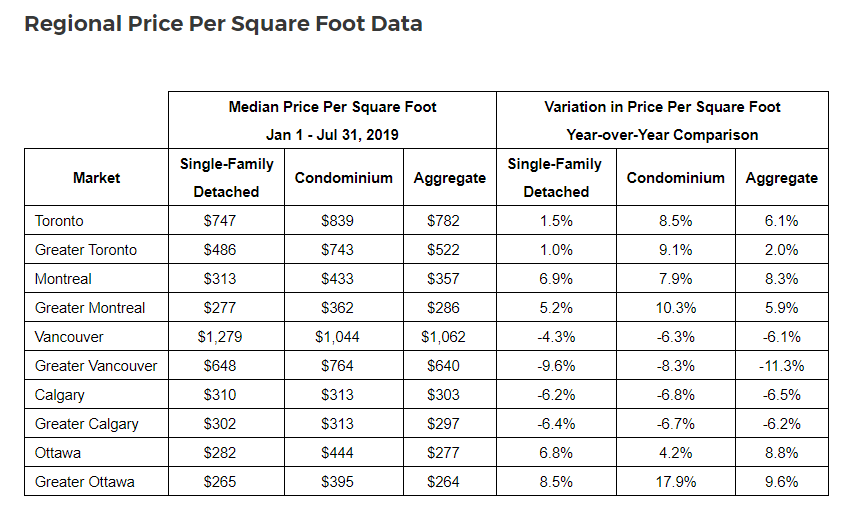
Ottawa and Montreal are home to fastest-growing condo prices, while Calgary may be the ideal destination for prospective buyers. These are among the findings from a recent Royal LePage study which tracked year-over-year changes in condo prices across major cities across Canada.

Findings from the report point to rising prices in hubs throughout the country; particularly, in Ontario and Quebec. According to the numbers, the median price per square foot of condos sold in the Greater Toronto Area rose 9.1 per cent (to $743/sq. ft.) since the same period last year. Meanwhile, the Greater Ottawa condo price per square foot appreciated the fastest among Canada’s largest markets, rising 17.9 per cent year-over-year to $395; while prices in Greater Montreal Area rose double-digits year-over-year, increasing 10.3 per cent to $362.

“In Canada’s largest cities, many younger buyers searching for affordability and baby boomers looking for maintenance-free living purchase condominiums. Not surprisingly, that strong demand has pushed up the price per square foot, with the exception of Vancouver and Calgary,” said Phil Soper, president and CEO, Royal LePage. “Buyers are adapting by purchasing smaller units, especially among those looking for entry-level properties.”

Prices have softened in the Greater Vancouver Area, where the median condo price per square foot declined by 8.3 per cent to $764 – the most of any major market in the country. Despite the drop, the price per square foot in Vancouver remains the highest in Canada.

Elsewhere in Canada, median condo prices also dipped in Calgary by 67 per cent to $313/sq.ft., making the Albertan destination the most friendly for potential condo owners.

“Calgary condominiums offer the best value in Canada’s major markets,” said Soper. “It is no wonder that the city vaulted to number four in The Economist’s ranking of the World’s Most Livable Cities.”

Condo Price Chart

As for where condo buyers can get the most space for the buck, Royal LePage reports that Montreal and the Greater Montreal Area offer the largest median condominium living space at 944 square feet and 989 square feet, respectively. In contrast, the Quebec locales offer 25.5 per cent and 21.0 per cent more condo square footage than Toronto and Vancouver, respectively.

Except for Vancouver, the median price per square foot for condos is higher than single-family detached homes across all the markets covered by the study.

Number TEN returns to renovated Winnipeg office

After nearly six-months of construction, Number TEN welcomed back staff to it’s 36-year-old Winnipeg office in the heart of the Exchange District with a fresh new office re-design. Located in the historic 120-year-old Bains building, the refresh blends forward-thinking modern workplace design within the building’s historic features to create a space that is both current and timeless.

“We wanted to create a space that allows our team to work more openly and collaboratively while inspiring us to fully harness our creative energy,” says Number TEN practice leader Greg Hasiuk. “It was important to our firm to respond to the changing nature of the workplace and use our own office design as a tool for designing even better spaces for our clients.”

During the renovation, Number TEN’s Winnipeg staff worked from a temporary space at 200 Waterfront Drive. The strategy allowed the team to continue working from a temporary office setting without the noise and distraction of construction.

“Our staff was fully on board with the renovation from day one,” says Hasiuk. “They dealt with a lot of challenges over the past few months, but it feels like we never missed a beat. It was so rewarding seeing their faces when they arrived at the new space for the first time. Their energy and enthusiasm alone made this effort very worthwhile.”

The Winnipeg office is open for business and is currently getting the finishing touches completed.

Ontario to improve Blue Box Program

Based on recommendations from Special Advisor David Lindsay’s report on Recycling and Plastic Waste, the Blue Box Program will transition to producer responsibility in phases over a three-year period.

In June, Ontario engaged Lindsay as a special advisor to help address plastic litter and improve recycling in the province.

“Transitioning the Blue Box Program to full producer responsibility will promote innovation and increase Ontario’s recycling rates while saving taxpayers money,” said Minister of the Environment, Conservation and Parks Jeff Yurek. “This shift is a big step towards diverting waste, addressing plastic pollution and creating a new recycling economy that everyone can be proud of in Ontario.”

Over the coming year, Ontario will develop and consult on regulations to support the new producer responsibility framework for the Blue Box Program. Once producer responsibility is fully in place, recycling across the province will be more consistent, with a standard list of materials that can be recycled. There are currently over 240 municipal programs that have their own separate lists of accepted recyclable materials, which affects cost savings and contamination.

“Retail Council of Canada (RCC) supports the Ontario government’s commitment to improving the blue box recycling system. For our part, retailers are committed to full producer responsibility. We share a common view that plastics, printed paper and packaging do not belong in [the] landfill. RCC looks forward to working with all stakeholders to ensure better environmental outcomes,” said Diane J. Brisbois, President & CEO, Retail Council of Canada.

“Residents may not see a big difference at the curb, but it will make a difference for our environment, spur more innovation and importantly, lower costs for taxpayers,” added AMO President and Mayor of Parry Sound, Jamie McGarvey.

The first group of municipalities or First Nations will transfer the responsibility of their programs to producers starting January 1, 2023. By December 31, 2025, producers will be fully responsible for providing blue box services provincewide.

Students perceptions of school restrooms: survey

As a new school year begins, the Healthy Hand Washing Survey from Bradley Corporation., revealed unclean school restrooms cause students to have a negative perception of their institution and its leaders.

According to the press release, 68 per cent of students said school restrooms that are poorly maintained or unclean show the school doesn’t care about its students, reflects poor school management and lowers their overall opinion of the school. In fact, nearly half of students describe the condition of their school restrooms as poor or fair.

“The negative impact of poorly maintained school restrooms is clearly significant and spreads beyond the bathroom doors to the entire school,” says Jon Dommisse, director of strategy and corporate development for Bradley Corp in a press release. “Female students are even more inclined to be negatively influenced by run-down school restrooms.”

Other highlights from the survey include:

  • The state of a school restroom likely factors into a student’s decision on whether or not to visit the restroom. While most (81%) use their school restroom on a daily basis, 19 per cent claim to never frequent it. They avoid the facilities in part because they’re dirty, smelly or have broken or old toilets, sinks and doors.
  • Students number one suggestion for school restroom improvements is more privacy including taller stall doors and eliminating gaps between the stall panels. Their second wish is for cleaner facilities followed by more air fresheners.
  • If students do encounter an unclean or unpleasant restroom, they usually skip their trip. More than half say they leave without using the restroom and 39 per cent try to avoid using that restroom in the future. Only 20 per cent take action to address the situation by notifying a teacher or school management.
  • Only 60 per cent of students said they always wash their hands before leaving the school restroom. Their reasons for not washing include: no soap or paper towels; not enough time between classes; and the sinks weren’t working or were unclean.
  • 57 per cent of students said they’d be more likely to wash if there was a sign in the restroom reminding them to.

The Healthy Hand Washing Survey was conducted online Jan. 3-8, 2019 and queried 630 American students enrolled in 9th – 12th grade.

Funding for Edmonton Winspear Centre expansion

The federal government has announced more than $18.1 million funding for the expansion of the Francis Winspear Centre for Music, home to the Edmonton Symphony Orchestra.

The $54 million expansion project involves building a 3809-square metre facility that will provide cultural programming space for the community and surrounding areas. Among the new amenities will be a 550-seat performance venue with automated raked seating that will allow for multiple adaptations to the room’s configuration.

It will also feature a childcare centre, underground parkade, multifunctional spaces and commercial space.

Once complete, the Francis Winspear Centre for Music expansion will provide a wide variety of programming opportunities for the community, promoting community engagement, and supporting regional economic growth.

Funding for the project is through the Community, Culture and Recreation Infrastructure Stream of the Investing in Canada Infrastructure Program. The remaining funds for the project are being provided by the Province of Alberta and the City of Edmonton.

“This is a great example of all levels of government coming together to support an infrastructure project that will benefit the entire Edmonton Metropolitan Region. The Winspear is a thriving component to our arts community and investments like this are critical to maintaining and enhancing our reputation in offering incredible arts experiences,” says Mayor Don Iveson, City of Edmonton.

Construction of the Winspear Centre is scheduled to be complete in 2021 with a grand opening in 2022.

Complacency could cost Montreal property owners

Some Montreal property owners could find themselves on short notice ahead of the city’s next three-year assessment cycle, which is set to begin in 2020. Proposed changes to Quebec’s Act Respecting Municipal Taxation will tighten the timeline for disputing the property values ascribed to smaller apartment and commercial buildings assessed at less than $3 million.

Currently, owners of properties valued at $1 million or greater have 120 days from the day the municipality dispatches its assessment notices to request a review of the evaluation. The deadline for the remainder of ratepayers — typically single-family homeowners — is May 1 or 60 days after the mail-out of assessment notices, whichever date is later.

Unless modifications to the property trigger a reassessment, Quebec ratepayers only have the opportunity to appeal assessed values during the first year of the three-year cycle. After the initial appeal period in 2020, Montreal’s assessment roll — based on values as of July 1, 2018 — will be largely locked in until 2023.

New measures proposed in the omnibus Bill 16, which was introduced in the Quebec legislative assembly last April, would raise the threshold to qualify for the 120-day time limit to properties valued at a minimum of $3 million. Meanwhile, owners of larger properties may have to become more proactive about monitoring those values since municipal governments would also gain the flexibility to cease delivering printed assessment notices by mail if the assessment roll is posted on the municipality’s website.

The timing of the assessment cycle is staggered across Quebec, placing Montreal property owners first in line to be subject to the proposed new rules. Quebec City and several suburban cities near Montreal launched a new three-year run in 2019, while Gatineau’s next cycle begins in 2021.

Changes to assessment procedures are among a smaller number of amendments in Bill 16 that have implications for commercial landlords. The proposed Act focuses more extensively on the residential sector, including numerous amendments pertaining to procedures of the rental housing regulator, the Régie du Logement, and to the governance of residential co-ownership buildings. Other amendments address the certification of building inspectors and skilled trades on construction sites.

After a summer recess, a committee of Quebec’s legislative assembly has resumed the clause-by-clause consideration of the bill that began in late May. Montreal’s assessment roll is due to be posted later this fall.

Condo fees and residents’ rights

Why is it that a select few people can decide what condo fees for the ensuing year will be? Why can’t owners have input into the new condo fees? These are both extremely good questions and perhaps a couple of the most commonly asked questions in the condo world. Whether you’re in one of our province’s bigger cities or a small rural community, these two questions apply.

There was a case many years ago when a new owner was faced with a substantial increase after having just moved into his first home. Upon review, he found that the board of directors had been presenting a budget to owners for approval for the last ten years. Given the choice, it came as no surprise that those owners voted against any increases.

This new owner was savvy enough to learn about condominium regulations. They discovered that setting an annual budget was one of the obligations of the board of directors that could not be downloaded to owners. In other words, by voting in directors, owners are granting them certain rights and obligations as outlined in the condominium act that include setting the annual budget.

The new owner took the condominium to court saying that he should have been notified in his status certificate that this practice was in place and sought remedy under the oppression clause of the act. He was successful; and to this day, the case is often cited to illustrate that the volunteer board is privy to information that forms the basis for the annual budget (and fees) and they are best situated to establish the annual budget.

Sometimes we forget that the volunteer board of directors are bound by the budget that sets the annual fee the same as any other owner. Owners should embrace expenses that allow directors to become better educated such as the annual fee to attend The Condo Conference held each year in Toronto. The event provides an invaluable source of education for both Condominium Directors and Condominium Managers alike.

Murray Johnson is an organizing committee member for the The Condo Conference. For more information regarding The Condo Conference, visit condoconference.ca.

Jaime McKenna joins Fengate Asset Management

Jaime McKenna has joined Fengate Asset Management (Fengate) as managing director and group head, real estate.

McKenna will be responsible for the firm’s real estate business and is a member of the executive team.

Bringing 20 years of professional business experience, McKenna joins Fengate from Minto, where she has worked since 2008 and, most recently, held the role of chief investment officer of Minto Apartment REIT.

Prior to Minto, Jaime was the director of finance for Bell Canada where she specialized in financial reporting, mergers and acquisitions and led the financial integration of newly acquired ICT (information and communication technology) companies.

“We are delighted to welcome Jaime to Fengate and her arrival further strengthens the significant talent and drive of our team,” said Lou Serafini Jr., President and Chief Executive Officer, Fengate in the press release. “Her extensive experience will be invaluable for our real estate business and for our work across the firm to consistently deliver the very best service and results for our clients.”

McKenna frequently speaks on expert panels at conferences across Canada and she chaired the 2018 Canadian Apartment Investment Conference. She holds a bachelor of business administration degree with honours from Trent University and both a Chartered Professional Accountant and Chartered Business Valuator designation.

B.C. wood: growing part of neighbourhoods

For many, recreation centres are becoming a home away from home.

Showcasing the beauty of wood, British Columbia (B.C.) forest products from sustainably managed forests are being used to help make these important facilities feel warm and inviting, enhancing well-being.

Scott Groves oversees the design, construction and operation of all civic facilities in Surrey, B.C.

“Today, more and more people live in homes or condos where they don’t have enough room for a garage, workshop, or studio anymore,” he said. “Civic and recreational facilities are becoming an extension of our living space, a kind of community living room in some ways.”

Rec centres are a social hub, providing space for exercise, fitness classes, aquatics, hobbies and childcare.

Grandview-Heights-Aquatic-Centre-Web2

Grandview Heights Aquatic Centre in Surrey is an example of how the fast-growing City of Surrey is often incorporating wood from B.C. forests in its civic buildings.

The 8,825-square-metre aquatic centre boasts a 65-metre-long free-hanging catenary, curved roof. Glue-laminated (glulam) beams offered the performance required to construct the unique suspended roof.

“Visitors almost feel like they’re swimming outside, and that’s an experience that people don’t get so much anymore,” said Groves.

Surrey adopted a Wood First Policy in 2010 that recognizes wood’s social, environmental and economic benefits, and makes it the material of choice for public buildings. Many other communities are also using B.C. forest products in their recreational facilities.

The West Vancouver Aquatic Centre features custom-designed glulam mullions – vertical bars between window panes that accommodate overhead doors and solar shading devices. The structure features eye-catching wishbone shaped wood columns. Through careful detailing, connections are virtually invisible and structural lines flow uninterrupted.

In Vancouver, adjacent to the Pacific Spirit Regional Park, the Wesbrook Community Centre fits in naturally with its surroundings. Natural light pulls the outside in, and gives those using the facility a sense of the nature that surrounds them. The building’s exterior is granite, western red cedar and aluminum cladding. Inside is an abundance of wood. Glulam columns and cross-laminated timber panels (CLT) help form the primary structure of the two-storey building.

The beauty of B.C. wood was showcased to the world at the Vancouver 2010 Winter Olympics and Paralympic Games. The Richmond Olympic Oval is a precedent-setting achievement of wood engineering and construction. The wood roof spans over six football fields. It was fabricated with hybrid glue-laminated timber-steel arches and 452 innovative WoodWave panels that use wood salvaged from forests impacted by mountain pine beetles.

Paul Fast, the co-founder of Fast + Epp Structural Engineers, remembers suggesting using beetle-kill wood during a design charette for the project.

“I brought in a hunk of pine beetle-kill wood and put it on the table,” he recalled. “I said, ‘We might want to look at using this in the structural design in some way.’ It wasn’t going to solve the infestation, but it was a gesture of what we could do with the wood.”

The Oval housed a 400-metre speed skating track and 8,000 spectators during the Olympics. After the Games, it was converted to use for numerous sports—ice, court, and track and field.

B.C.’s forest sector continues to innovate with adaptive resource management practices and advancements in product design and building systems. With sustainable management, B.C. forests will continue to be a source of jobs and green building products now, and for the future.

These projects and others are featured in a newly released book, Naturally Wood, which showcases British Columbia’s cutting‐edge wood architecture and design. The beautifully illustrated, 160-page publication contains more than 65 innovative wood buildings and projects, including how wood is being used in urban communities and recreation.

Download Naturally Wood digital copy here.

1 Hotel announces Canadian debut

Toronto’s Thompson hotel to be turned into Canada’s first-ever 1 Hotel in partnership with Mohari Hospitality.

Located at 550 Wellington West, the downtown property will undergo an “extensive transformation” into a relaxing luxury sustainable hotel. 1 Hotels purposefully reuse existing structural and reclaimed materials gathered from the local community, including timber, driftwood and local limestone in its designs.

“1 Hotel Toronto will introduce the city to a new standard for an eco-conscious luxury experience, and is the first of its kind in Canada,” said Barry Sternlicht, 1 Hotels Founder and CEO & Chairman of Starwood Capital Group in the press release.

“We look forward to sharing our mission to inspire conscious consumption with guests from across the globe as well as the local community. Our partnership with Mohari is key to the re-development of the project, and we are pleased to be collaborating with them.”

The hotel will remain open and operating as the Thompson until the renovation begins. 1 Hotel Toronto is set to open summer 2020.

Image courtesy of Mohari Hospitality.

Saddledome demolition plan bucks transparency

The upfront cost to demolish the Calgary Saddledome has been projected at $13.8 million. The environmental repercussions of dismantling and discarding a 474,000-square-foot concrete and steel structure are more difficult to peg.

Life cycle assessment (LCA) — which can help to gauge a building’s environmental footprint from construction through to its end of life — accounts for four distinct sources of embodied carbon as a building is taken out of useful service: deconstruction/demolition; transporting debris; processing waste; and final disposal. In this case, abandonment of the now 36-year-old facility ahead of its designed lifespan will trigger those impacts.

“From a structural perspective, it probably is premature. The question is, is it premature from an economic perspective? The decision whether a building is deconstructed, demolished or preserved is almost always going to be economic,” muses Jamie Meil, research principal with the Athena Institute, a not-for-profit provider of life cycle assessment resources, including free software for estimating the environmental footprint of building materials and pavement. “The number one reason buildings get torn down is economic versus whether they have outlived their usefulness.”

The city of Calgary’s communications around a proposed new event centre — envisioned as a $550-million joint development with private sector partner, Calgary Sport and Entertainment Corporation (CSEC) — aligns with that observation. A list of 27 presumed questions of interest posted on the city’s website begins with the statement: “The City of Calgary remains committed to the economic recovery of our city on behalf of citizens, communities, businesses and customers.”

“The Event Centre is more than an arena,” it asserts. “The Event Centre is a catalyst for attracting private sector investment into the area and the development of under-utilized lands.”

Meanwhile, three references to the Saddledome farther down the list in questions number eight, 10 and 22, repeat the same message: “It has served Calgary well, but is aging.” In other documentation, the city manager’s July 22 summary of the details of the development partnership includes a section with the heading, “Social, Environmental, Economic”. Yet, only the potential economic and social spinoffs are itemized.

“I wouldn’t say: Don’t redevelop the site. But I’m all for being open about the impacts. If they quantify it, maybe they’ll be able to offset it to a certain extent,” urges Ryan Zizzo, an LCA practitioner who is founder and chief operating officer of the climate impact consulting firm, Mantle. “There needs to be transparency.”

Embodied versus operational carbon

The oversight is not the city of Calgary’s alone. Efforts to measure and reduce greenhouse gas (GHG) emissions in the buildings sector have been largely focused on operational emissions from energy consumption and waste production directly within buildings. Whereas, embodied carbon is the tally of indirect GHG emissions tied to the extraction, manufacturing and transportation of building materials and to construction, renovation or demolition processes.

It’s generally estimated that embodied carbon will account for 80 per cent of the environmental footprint of new construction for 10 years after completion, but proportions will vary at the individual building level depending on operational performance and the carbon intensity of the power supply. Heavy reliance on fossil-fuel-fired electricity generation tends to skew the split.

“In Alberta, embodied carbon may not be as big a percentage of the impact, but that doesn’t mean it couldn’t be lower,” Zizzo says.

Under the terms of the deal, the city of Calgary will cover 90 per cent of Saddledome demolition costs, a share currently estimated at $12.4 million. Although CSEC is allocated the remaining 10 per cent, the agreement also caps the company’s contribution at $1.5 million. The Saddledome’s parkade will be left in place and eventually transferred to the Calgary Stampede’s ownership.

A May 2017 consultants’ report — released later in the year to the filers of a Freedom of Information submission — calculates that demolition costs could be kept in the range of $23 to $27 per square foot if 90 per cent of recyclable metals are recovered, and if all concrete is crushed and stored on the Stampede grounds for later use. “Note that repurposing of concrete would provide for cost savings in the millions and, in general, would show a strong commitment to sustainability by the City and Stampede,” it recommends.

Since diesel-powered demolition equipment typically expends 45 to 50 megajoules (MJ) of energy per square metre (m2), Meil estimates that component, alone, would produce about 12 tonnes of carbon dioxide equivalent (CO2e) for a building the Saddledome’s size. Emissions from transporting recovered materials or debris offsite, and the embodied carbon in materials destined for landfill, would also have to be factored into the tally.

While the suggested target for recapturing metals may be realistic, Meil notes that typically only about 50 per cent of concrete is recovered from a deconstruction project and it’s generally then “downcycled” to a lower form of use, such as for roadbed.

“Canada is still at a point where almost 20 per cent of landfill deposit is comprised of used construction materials. It was worse, at almost one third,” observes Marc Denhez, a lawyer, heritage building advocate and former Ontario Municipal Board adjudicator. “You won’t find any recognition of that in public policy. We have policies to reuse items as small as pop bottles, but when it comes to reusing items as large as buildings, or even neighbourhoods, the public record is essentially dead silent.”

Design considerations and accountability

Vancouver is now at the vanguard of addressing embodied carbon at the construction stage. It was identified as one of six “big moves” in the Climate Emergency Response actions City Council endorsed in the spring of 2019. That sets a target for a 40 per cent reduction in the embodied emissions from new buildings and construction projects, compared to 2018 levels, by 2030.

Looking to the United States, the Buy Clean California Act will enforce standards for acceptable global warming potential (GWP) for structural steel, carbon steel rebar, flat glass and mineral wool board insulation used in that state’s public construction projects, beginning in 2021. Building proponents everywhere can also take up the voluntary options in programs like LEED, Living Building Challenge and Carbon Smart Building.

The latter organization sets a goal for the lifespan of existing buildings to reach at least 100 years — a notion that is wildly incongruous with the recent history of venues for professional sports teams. In the past 25 years, 17 cities have built new facilities for their National Hockey League teams and 14 have then demolished vacated arena complexes. Meil cites the example of the Seattle Kingdome, former home to the city’s professional football team, which was demolished, via implosion, just 24 years after it opened and 15 years before the bond used to finance it was repaid.

Many of those venues were consigned to destruction because of their purportedly unworkable suburban locations, but that’s not the issue in Calgary. “The Saddledome is already downtown,” Meil reiterates. The proposed replacement is also expected to have approximately the same 19,000-seat capacity.

Given the ample past evidence, Meil suggests new venues could at least be developed with an eye to possible early obsolescence. Criteria for design competitions and requests for proposals could prioritize materials and structural components that could be disassembled and recovered. Meanwhile, a life cycle assessment of the Saddledome demolition footprint could give Calgary taxpayers better insight into the impacts.

“That might add to the demolition costs, but there are also costs attached to not addressing it,” Zizzo maintains. “The question is: what numbers are they including and what numbers are they just ignoring?”

Barbara Carss is editor-in-chief of Canadian Property Management.

Tech hub, O Mile-Ex sold to Spear Street Capital

Canada’s biggest artificial intelligence hub – O Mile-Ex – has just been sold to Spear Street Capital, a San Francisco based real estate fund that develops buildings for companies active in tech.

Located at 6650–6666 Saint-Urbain, the 400,000 square-foot former textile mill was acquired in 2014 and fully converted by TGTA, a real estate development and investment firm based in Montreal since 1989.

According to the press release, the two-building complex houses approximately 20 tenants, including Mila, IVADO, Thales and Element AI. It features a gym, board game area, daycare and a cafe operated by chef Martin Juneau, owner of Restaurant Pastaga, and his team. This summer, a park was added to the back of the building on a site that was originally intended as a parking lot, but later repurposed to add more space for greenery and relaxation.

“Spear Street Capital’s bid was the most attractive offer and the most reassuring in terms of the future of the project. Given their experience and their portfolio of assets, we believe they’ll be able to uphold the vision that has guided us in designing, developing and managing this one-of-a-kind workspace that contributes to the Montreal of today and tomorrow,” a partner at TGTA, Martin Galarneau said in the press release.