Articles Archive - Page 265 of 928 - REMINET
REMI

TRU Kamloops housing construction underway

Construction of a new four-storey building is currently underway at Thompson Rivers University’s (TRU) Kamloops campus. The project is being built on a portion of the vacant land north of the existing student housing — TRU’s East Village — on Dalgleish Drive. Once completed, the permanent modular housing will contain 80 single- and double-occupancy rooms, enough for 148 students.

Set for completion by the summer of 2023, this development is Phase 1 of a three-phase plan for the university to build three student-housing buildings. To support this plan, the modular student housing project includes site preparation for future student housing, including utility relocation and paving the parking lot.

The project was made possible with $10.85 million from the province, with TRU contributing $7.91 million toward the total project cost of $18.76 million.

“On-campus student housing at TRU is always in high demand. This housing project will provide students with an extremely attractive and affordable option. These new units will also help to alleviate pressure on the rental market in Kamloops, which benefits the whole community,” says TRU president Brett Fairbairn. “We are grateful to the province for their significant investment in this student housing project.”

All rooms will have a kitchenette and bathroom. Each interconnected floor will include a common space ideal for gatherings, collaboration or study. Students will have access to 38 outdoor parking spaces, including one handicapped-accessible stall, 40 enclosed bike spaces and two electric vehicle chargers. The area will also feature well-maintained green space, stunning mountain views and a multi-use pathway connecting Summit Drive and Dalgleish Drive.

The B.C. government is investing in this student housing project as part of Homes for BC, a 10-year housing plan to build 114,00 units throughout the province by 2028.


B.C. Recognizes Apprentices in November

The B.C. government has proclaimed November 2022 as Apprenticeship Recognition Month for the fourth year in a row.

Throughout November, the Ministry of Advanced Education and Skills Training and the Industry Training Authority (ITA) will be celebrating and acknowledging the contribution and value of apprentices, employer sponsors, youth program participants throughout B.C., and raising awareness of the benefits of a career in the skilled trades.

“There has never been a more exciting time to enter the skilled trades in B.C.,” said Minister of Advanced Education and Skills Training Anne Kang. “With more than 85,000 new job openings in the trades over the next decade, we are making sure that apprentices have the supports they need to get in-demand, good paying jobs.”

Technical training in more than 70 trades programs is offered at 15 public post-secondary institutions throughout B.C., as well as employer and union trades training. The ITA funds approximately 27,000 apprenticeship and foundation training seats annually and works with more than 10,000 employer sponsors.

The Skilled Trades BC Act, passed in spring 2022, establishes a made-in-B.C. system to support and train apprentices and modernize the Crown agency responsible for trades training. Skilled trades certification will require people to register as an apprentice or be a certified journeyperson to work in one of the 10 initial mechanical, electrical and automotive trades.

The new legislation replaces the Industry Training Authority Act and transforms the Industry Training Authority into SkilledTradesBC, the modernized Crown agency responsible for skilled trades training in British Columbia.

The renewed focus of SkilledTradesBC reflects the expanded responsibilities associated with skilled trades certification, and a new focus on supporting apprentices and trainees throughout their training journey. SkilledTradesBC will remain the authority on trades training in B.C. with enhanced and streamlined services to help apprentices navigate training and get access to support.


Canadian presence noticeable as ISSA Show North America sees strong increase in attendance

ISSA Canada made its return to the one show for facility solutions – ISSA Show North America – which took place at the McCormick Place Convention Centre in Chicago, IL.

After a three-year hiatus due to the pandemic and resulting travel restrictions, it was time for the Canadian market to once again have a presence at the trade show, held October 10-13. And judging by the 11,000+ in overall attendance, many felt the same. In fact, this year’s event saw a 10 per cent increase in attendance over last year’s show in Las Vegas.

With a noticeable electricity in the air and a hum on the trade show floor, the 2022 show offered numerous opportunities for education and product discovery to assist industry professionals evolve their businesses and help change the way the world views cleaning.

As in years past, education remained a key draw to the event. This year, the show hosted over 70 education sessions, providing delegates with insight into such top-of-mind issues as hiring and retention in post-pandemic times, infection control and disinfection, budgeting, and the future of sustainability in the cleaning industry. Additionally, a host of workshops were offered allowing attendees to achieve industry accreditation or certification to further their business success.

Networking was also a key part of this year’s show. Among the multiple events that were held during ISSA Show North America, ISSA Canada was excited to see the return of its social event of the year – Canada Night. Held Wednesday, October 12 in the Vista Ballroom, ISSA Canada was extremely excited to welcome and reconnect with the 600 industry representatives who attended.

Held in conjunction with ISSA Show North America, Canada Night has traditionally been known as the highlight of ISSA Canada’s social calendar. This event allows Canadian representatives who are attending the show (along with their guests) an opportunity to mix and mingle, network with peers, and enjoy some fine food and beverages.

“Although there are still some fears around the pandemic and various travel challenges, ISSA Canada was so excited to see the great turn-out of Canadian representatives at this year’s Canada Night event,” said ISSA Canada Executive Director, Mike Nosko. “Canada Night  provides ISSA Canada with an opportunity to celebrate our nation as well as those who comprise the Canadian sanitary maintenance and supply industry. It was just a fantastic night to reconnect.”

ISSA Canada would like to recognize and thank the sponsoring firms for their continued support of this beloved industry event. Platinum Sponsors: Bunzl Canada, Charlotte Products Ltd., Dissan Group, Kimberly Clark Professional, and R3 Re-distribution; Specialty Station Sponsors: Advantage Maintenance Products, Diversey, Dustbane Products Ltd., Imperial Dade Canada, NaceCare Solutions, Rubbermaid Commercial Products, PLZ Corp., and STAPLES Professional; and Buffet Station Sponsors: Atlas-Graham Furgale, Certainty Brands by Innocore, ProTeam, SC Johnson Professional, Spartan Chemical, and Swish Maintenance.

As 2022 draws to a close, it’s time to look forward to the opportunities available in 2023 for industry professionals to connect, and remain in tune with the latest industry trends and product innovations.

ISSA Canada is currently well on its way to organizing the 2023 ISSA Show Canada taking place June 14-15 at the Metro Toronto Convention Centre. In addition to an expanded trade show floor, we’re excited to note that the upcoming event will also see an expanded educational program. Stay tuned to www.ISSAShowCanada.com for all the latest updates. Additionally, mark your calendars now for November 13-16, 2023, when ISSA will celebrate its 100th year during ISSA Show North America, taking place at the Mandalay Bay Convention Centre in Las Vegas, NV.

There are exciting times ahead. ISSA Canada looks forward to celebrating them with our industry.

PCL Construction wins Yellowhead Trail contract

PCL Construction has been selected by the City of Edmonton as its partner to deliver the St. Albert Trail to 97 Street project, which is considered the most technically complex project of the Yellowhead Trail Freeway Conversion.

The city and PCL will work collaboratively throughout both design and construction. Construction is scheduled to begin in 2023 and is anticipated to extend to the end of 2027.

“We’re excited to reach this important milestone and move forward with this stage of the project,” said Kris Lima, director of the Yellowhead Trail portfolio. “This next step gets us closer to our goal of improving the safety, reliability and efficiency of a critical transportation corridor. The Yellowhead Trail Conversion will help support our city’s growth into an economically prosperous city that can support two million people in the coming decades.”

Key features of the St. Albert Trail to 97 Street project include:

  • Removing the traffic signals at Yellowhead Trail and 127 Street, 124 Street, 121 Street and 107 Street.
  • Constructing new interchanges at 127 Street and 115 Street.
  • Introducing new service roads to manage traffic flow into residential and business neighborhoods in the west part of the project area.
  • Realigning and straightening Yellowhead Trail to remove the curve between 121 Street and 107 Street. This will accommodate plans for a future LRT bridge.

The concept plan for St. Albert Trail to 97 Street was completed in spring 2021. Design is underway and is anticipated to be complete by the end of 2023. Additional engagement opportunities on the design are planned for early 2023.

“PCL is excited to partner and collaborate with the City of Edmonton for the delivery of the St. Albert Trail to 97 Street project”, said Jason Portas, vice president and district manager of PCL Construction Management Inc. “With a successful and lasting local presence in the Edmonton region, PCL is proud to build essential infrastructure for our communities, where we live, work and play. We will complete this project safely and efficiently, helping the City of Edmonton in their goal to connect people and goods effectively along the corridor for years to come.”

The Yellowhead Trail corridor will change from an expressway with signalized intersections and access locations to a free-flowing freeway with interchanges with six core lanes and a target operating speed of 80 km/hr.

Highway 1 Glover Road crossing moves forward

Work to improve travel times on Highway 1 through the Township of Langley is moving ahead with the replacement of the Glover Road crossing.

A contract for the Glover Road replacement valued at $19.5 million has been awarded to Tybo Contracting Ltd. of Langley. Preparatory construction will begin this fall. Major construction will begin in early 2023. Completion is anticipated for summer 2024.

The new Glover Road crossing will allow the widening of Highway 1 to add a lane in each direction for high-occupancy vehicles, designated electric vehicles and transit, helping reduce congestion. The new crossing will also increase the clearance height over Highway 1, improving safety on the highway by reducing the risk of over-height vehicles hitting the structure.

The new Glover Road crossing will also allow the Township of Langley to improve its active transportation network, with three-metre-wide multi-use pathways on either side of the crossing and approaches. Drainage and lighting will also be improved.

The replacement of the Glover Road crossing is a key component of the Highway 1 216th to 264th widening project and is the first major work contract to go to tender. Improvements planned for this project will help relieve congestion for drivers and accommodate more sustainable transportation options.

Tenders will follow later in 2022 for the other elements of the widening project, including replacing the existing railway crossing just east of Glover Road, replacing the 232nd Street Interchange, and widening Highway 1 from 216th to 264th to add an HOV/EV/transit lane in each direction.


A new facility for Laval Immigration Holding Centre

The Canada Border Services Agency has transferred the current Laval Immigration Holding Centre (IHC) operations to its new facility that centres around the care and wellbeing of detainees.

This is the last major infrastructure project of the National Immigration Detention Framework (NIMF), which was announced in 2016. So far, Canada has invested about  $138 million over 5 years into the NIMF to reduce reliance on provincial correctional centres and upgrade federal facilities.

The newly designed Laval Immigration Holding Centre features video conference capability, and hearing and bond reporting areas to reduce the need for detainees to be transported off site. There will be a multi-denominational worship room and libraries with access to leisure activities and reading materials while in detention. Detainee living units will be split by gender and risk level, with a specialized wing to respect unique needs.

CBSA is also providing the following support services to the Detainees are also accessing translation and expanded health services within the holding centre, along with mental health supports.

Since before the launch of the NIDF, the average length of detention has decreased by 29 per cent and the use of provincial correctional facilities has also decreased by 22 per cent.


Facility operations at your fingertips

The impact from the pandemic on the long-term care homes has brought to light the importance of optimal indoor air quality (IAQ) for the health and safety of occupants.

But optimizing buildings for better IAQ requires HVAC systems to work harder, use more energy and involves regular monitoring and maintenance — which in turn increases operational costs.

Integrating smarter building management systems such as Schneider Electric’s EcoStruxureTM for Healthcare solution helps you tackle this challenge by boosting the operational and energy efficiency of your long-term care facility by up to 30%.

The future-ready EcoStruxure for Healthcare solution is tailored to your facility to give visibility and control over the building’s conditions – allowing you to optimize energy efficiency for running the building. In terms of automation, the solution can set up schedules for systems like HVAC and lighting remotely further reducing labour costs.

Multi-site portfolio management is also simplified and automated with visualizations for analysis and control of set-points and schedules.

ENHANCING OCCUPANT EXPERIENCE

Integrating the building management system plays a key role in delivering the quality comfort, and health the occupants deserve. With remote monitoring and maintenance of air quality, temperature and lighting, the solution enables the best experience for your occupants while maintaining minimal energy usage.

To follow compliance with infection control policies, the solution acts as an integrated control platform to monitor, manage and document patient care in occupant rooms.

With the added visibility, alerts to alarms and security threats are reported real-time for you to respond within seconds using the open, mobile, cloud security system. Pre-canned reports on occupant’s wellbeing and visitors can be generated and sent to the occupants’ loved ones for their peace of mind.

Designed for upgrading or modernization projects of any level, EcoStruxure for Healthcare can achieve higher efficiencies in your facility operations and empower your personnel – anywhere, at any time. To learn more, visit se.com/ca/healthcare.

Schneider Electric provides energy and automation digital solutions for efficiency and sustainability. As a global specialist in energy management with operations in more than 100 countries, Schneider Electric offers integrated solutions across energy and infrastructure, industrial processes, building automation, and data centres/ networks, as well as residential applications.

Psychological ergonomics in the workplace

Jobs with high physical demands are understood to result in higher-than-average incidents of musculoskeletal disorders (MSDs); however, jobs with high cognitive demand and/or psychological stress have also been linked to increased incidents of MSDs.

It is relatively easy to correlate the implication of high force or repetition to muscular stress; however, studies are now showing that individuals who report feeling high levels of stress are also more likely to report muscular discomfort. Psychological factors such as deadline pressures, lack of control over work, supervision responsibilities and high accountability can impact how the body behaves by increasing applied forces, awkward postures and static loading of muscular tension. To understand how this happens, we need to consider the body’s physical response to stress:

  • Increased tension in the muscles: tension in the upper back, neck and shoulders can be found even before manual work activities have started and lead to extended durations of fatigue and discomfort after an employee’s shift ends.
  • Less relaxation and recovery: although the physical load on the body may have a specific timeline, cognitive stress doesn’t stop at the end of the workday. After work, muscles remain under stress and are unable to relax, resulting in more hours of tension and decreased blood flow which is a much-needed component to cellular health and healing in the muscles.
  • Increased workload perception: those employees feeling mentally overwhelmed often will categorize their jobs as being ‘hard’ and frequently report physical exhaustion at the end of the workday that can lead to higher injury reporting.
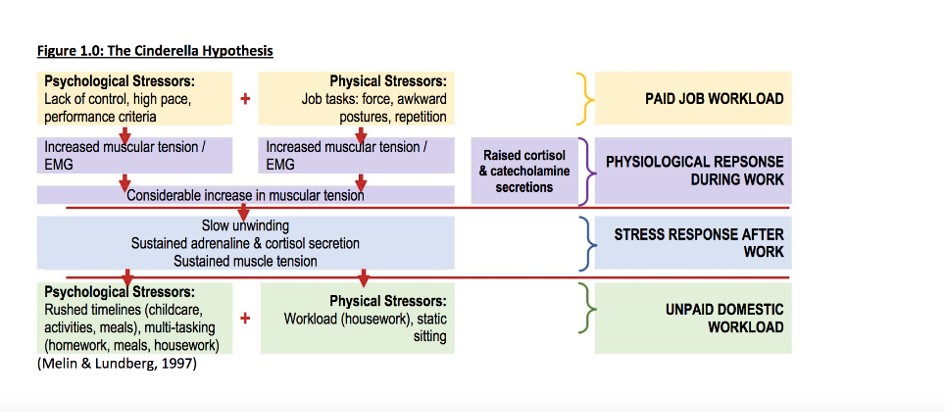
  • Increased hormone levels: after the physical aspect of work has ended, the body will still retain high levels of stress regulating hormones such adrenaline, cortisol and catecholamine as shown below in Figure 1.0.

The Cinderella hypothesis demonstrates how all of the above factors when considered together contribute to MSDs, where one factor alone could be overcome; but when stress factors are combined, the effects are cumulative and contribute to stress on the body.

ergonomics

The amount of psychological stress staff underwent over the last 2 years has been significant. Workers have been asked to relocate to their homes, work in small living spaces, give up personal space, blend the lines of work and home, miss out on connections with colleagues and, instead, spouses and children became their co-workers.

That, combined with increased monitoring of productivity and supervision/micromanaging to allow employers to track work progress while balancing concerns of illnesses, disease testing, and potentially poor health, has led to cognitive overload and an increase in psychological stress.

As employers and workplaces pivot once again to return employees to the workplace either full-time or hybrid, they should be evaluating whether they have the infrastructure in place to assist with the psychological effects of the return to the office.

A literary review of 54 longitudinal studies concluded “that psychosocial factors should be considered as independent predictors of onset of MSDs and be relevant to prevention and intervention programmes in occupational safety and health” (Hauke, et.al, 2011). As such, workplaces should be actively working to address the psychological factors for returning to the office to prevent any further increase in MSDs. Some organizations are providing resources to assist with increasing awareness of psychosocial ergonomics and overall psychological well-being:

  • Stress Assess App (OHCOW/CCOHS): Asks employees 25 questions pertaining to workload, organizational factors, workplace culture and health & safety.
  • Psychological health and safety in the workplace (CSA Z1003-13): Prevention, promotion, and guidance to staged implementation

More and more emphasis is being put on employers to embrace a holistic ergonomic approach, which would include looking to, not only improving the principles of physical ergonomics by reducing physical MSD risk factors, but also tackling the cognitive stressors associated with work. Some excellent starting points would be to:

  • Review job descriptions and document the cognitive demands through the completion of Cognitive Demands Assessments (CDAs).
  • Provide employee training on ergonomic and mental awareness training.
  • Develop an ergonomics and psychological health programs to support employees through both the muscular and cognitive workload.

Through this comprehensive strategy achieving the ergonomic ideals of higher productivity, employee retention and lower MSD injuries may be a reality for employers.

Alexandra Stinson R.Kin., CCPE is a Certified Professional Ergonomist and Co-Owner of PROergonomics. With over 20 years’ experience across North America, she excels in solving diverse ergonomic challenges, lowering injury claims and developing sustainable ergonomics programs, policies and training programs. PROergonomics prides itself on a professional experience that is focused on a proactive, preventative ergonomics model that helps organizations move past a reactive claims-driven approach.

Report reveals C-suites are wearing rose-coloured glasses

A newly released survey on change management post pandemic has revealed that C-suites across the United States are out of sync with the rest of their organizations. This is culminating in disengagement and turnover.

Results from The Change Report 2022: A Study of Attitudes, Perceptions, and Impact of Workplace Change, by Notion Consulting, a leadership and transformation consultancy, found that employees and people managers are struggling for transparency, respect, and recognition.

“Our latest study reinforces what we tell all our clients: in order to drive successful transformation, leadership must understand that change is about people – their experiences, their behaviors, and their mindsets,” said Christine Andrukonis, founder and senior partner at Notion Consulting. “Those who stay curious, open-minded, and empathetic will reap the benefits — or otherwise risk disengaging and even losing key talent and customers, and ultimately damage their bottom line. It’s a delicate but meaningful balance.”

In August and September 2022, the company surveyed 325 U.S. professionals, ranging from C-suite executives to junior-level employees, about their experience with change in the workplace in 2022. Following are other key lessons from the study:

  1. It’s tough leading people when change is constant. An estimated 75 per cent of the workforce experienced three or more major changes in the past 12 months. While change is necessary and often exhilarating, a constant swirl can impact the employee experience for the short- and long-term.
  2. Attitudes vary dramatically based on where people sit. Most leadership (56 per cent) is overwhelmingly optimistic about change, proclaiming themselves as “enthusiasts” and “champions” of their emotional commitment to it, whereas individual employees are more hesitant and skeptical, considering themselves only “bystanders” (4 per cent) and “skeptics” (37 per cent). Significantly, 3 per cent of participants expressed a desire to leave their organization when hearing change is coming.
  3. Successful change needs more human connection and empathy. An estimated 60 per cent of organizations are “mediocre or worse” at retaining and engaging employees. Top talent is leaving these organizations during times of change, causing employees to disengage (“quiet quitting”). They are feeling unseen, under-valued, and unappreciated, which puts the business at risk.
  4. Managing change matters – and how it’s done can impact results. An estimated 40 per cent of organizations are failing to meet business objectives during times of change. Regarding the factors that make change management successful, 50 per cent of organizations are “mediocre or worse” at delivering best practices.

Prior to the pandemic, Notion Consulting interviewed 50 Fortune 500 executives and entrepreneurs about their business challenges in leading change. The proprietary study, Change 2020: How Successful Leaders Drive Change Now, has laid the groundwork for their efforts to create a community of practice and dialogue about leadership and change.

Utilities join efforts on building grid capacity

Thirteen electricity utilities and system operators across Canada have agreed to share experiences and learnings around expanding grid capacity for decarbonization through renewable power sources, energy storage and smart technologies. The Canadian Renewable Energy Association (CanREA) is coordinating the collaborative effort through a newly established electricity transition hub, launched with a $1.6 million funding injection from the Canadian government.

“CanREA is uniquely positioned to gather global knowledge on wind energy, solar energy and energy storage integration, and then to translate these resources effectively to be relevant in all of Canada’s different regions and electricity systems,” says Phil McKay, who will serve as senior director of the electricity transition hub.

CanREA has also contributed $300,000 to the initiative with the aim of building a repository of transferrable knowledge related to decarbonizing the electricity grid and delivering sufficient and reliable supply for the electrification of transportation and space heating/cooling. The hub will provide a forum for utilities and system operators to connect through quarterly meetings and an annual summit, and will also publish quarterly reports.

Founding partners include: Alberta Electric System Operator; BC Hydro; City of Medicine Hat; EPCOR; Essex Power Corporation; Fortis Inc.; Manitoba Hydro; NB Power; Ontario Power Generation; Qulliq Energy Corporation; SaskPower; Toronto Hydro; and Utilities Kingston.

“The renewable energy industry has a critical role to play in helping Canada meet its net-zero commitments, and we must build new wind energy, solar energy and energy storage projects at an unprecedented pace,” observes Robert Hornung, CanREA’s president and chief executive officer. “Now is the right time to bring together Canada’s electricity utilities, system operators and the renewable energy industry for capacity-building activities related to the deployment and integration of these technologies within electricity grids. There is not a moment to waste.”

From office to residential

Office-to-residential building conversions have been gaining momentum in some jurisdictions, particularly in urban centres hard-hit by the economic fallout of COVID-19. As new strains of the virus continue to circulate and many workers resist returning to the office, some cities, like Calgary, have been left with a surplus of unused commercial space amid the interrelated housing and climate crises.

To contend with the glut of vacant commercial buildings and revitalize its downtown core, the city launched the Downtown Calgary Development Incentive Program in 2021, offering grants to help facilitate office-to-residential building conversions. As of mid-October, a total of seven projects had received a grant, and 665,000 square feet of unused office space has since been replaced with 707 new homes.

Among those projects was Neoma, an office-turned-affordable-rental-building run by the non-profit housing provider, HomeSpace Society. The conversion took about six months to complete at a cost of $30 million. Funding came from multiple sources, including $16.6 million from the Rapid Housing Initiative; $2 million through the Canada-Alberta Bilateral Housing agreement under the National Housing Strategy; and $5.5 million from the City of Calgary’s downtown revitalization program. Private donors also raised nearly $6 million toward the extensive renovations required to repurpose the 10-storey building into private, livable homes.

“By investing in projects like Neoma, we’re creating a downtown where low-income families, seniors and newcomers can build their lives with access to key amenities just a short walk away,” said Calgary Mayor, Jyoti Gondek, at the official opening in September. “Calgary is proud to be leading the country with this project that will serve as a blueprint for cities looking to address both the housing crisis as well as downtown revitalization.”

While not all building conversions will offer this same noble mix of affordable rental units, shelter spaces, and transitional housing to help families in need, there is no question that more rental housing is needed arguably everywhere. Will building conversions pick up speed and be widely embraced as a viable housing solution? The answer, according to Sheila Botting, Principal & President, Americas Professional Services, Avison Young, is complicated.

“Given most governments are taking an active role in spurring rapid housing development, we could certainly see more conversions happening in Canada,” she said. “On its own as a single solution, it won’t deliver the substantive number of new housing units needed to meet the demand across Canada’s major cities…but every little bit helps.”

First off, Botting points out that some properties—i.e., those of a certain vintage—are more likely to be considered for an office-to-residential project than others, particularly if they are well-located.

“Office tenants today are drawn to trophy, A-Class buildings with higher-quality amenities like fitness centres, cafeterias, and coffee shops—spaces that foster opportunities for collaboration, brainstorming and engagement,” she said. “Employers and building owners that want to attract back their current employees and bring in new talent are relying on these things to help them achieve that goal.”

Increasingly, older C-Class buildings will be challenged by this flight to quality as leases come up for renewal, making them obvious targets for office-to-residential projects, especially those buildings with historic significance or character in downtown and midtown areas. But regardless of age or quality, Botting says there are some practical challenges building owners should be aware of before considering a conversion.

“Floor plates should be in the 8,000 and 14,000 square feet range for a project to be feasible,” she said. “Buildings with very large floor plates are impractical in that they are too deep with limited windows. Also, inserting plumbing for kitchens and bathrooms can be expensive, and older buildings may not have the required infrastructure for a residential environment, with sufficient parking, staircases, access, etc.”

In some cases where the infrastructure is inadequate, it might make more sense to demolish the pre-existing building and replace it with a brand-new high-rise apartment to deliver the needed housing units, particularly in Toronto and Vancouver where higher density land values justify conversion.

“Challenges in these cases might arise from municipalities reluctant to give up commercial space and employment land with high tax-paying, job-creating tenants,” she warned. “So, while this strategy represents one of many options to bring more housing to market, it isn’t a viable solution on its own to meet housing need across Canada. Other solutions include unlocking surplus land and dedicating this to future affordable housing, which we are now seeing happening by the City of Toronto and Province of Ontario. Converting employment land could provide another similar option from the private sector.”

Ultimately, Botting’s take on building conversions is that if the project checks all the boxes in terms of the physical asset, infrastructure, zoning, location, and having support from partners and government funding, it will likely see a successful outcome worthy of the initial investment. But unless all the boxes are checked, the risks of undertaking a conversion project will likely outweigh the rewards.


The Stack achieves Zero Carbon Certification

The Stack in downtown Vancouver has achieved the Canada Green Building Council’s (CAGBC) Zero Carbon Building – Design standard certification. As Canada’s first commercial high-rise office tower to achieve this certification, The Stack sets a new standard for environmental performance across workplaces in Canada.

The 37-storey, AAA-class 550,000 sq. ft. commercial office tower by Oxford Properties is the largest project in Canada to achieve the certification to date. Upon completion later this year, The Stack will become the tallest office building in Vancouver.

The Stack has incorporated many innovative features that minimize carbon emissions, energy and water usage, and landfill waste. These include low carbon building systems, triple-pane glazing on all windows, rainwater management and enhanced air tightness. On-site renewable energy will be achieved through the use of a rooftop photovoltaic solar panel array.

“Oxford’s purpose is to create economic and social value through real estate, and The Stack embodies Oxford’s ongoing commitment to sustainability and decarbonization,” commented Andrew O’Neil, Vice President of Development, Oxford Properties. “The CAGBC certification is the culmination of over five years of planning to pioneer a new zero carbon framework in a high-rise and architecturally-significant office tower, all while juggling the demands of realizing an economically viable commercial project for our stakeholders.

Also targeting LEED v4 Platinum Core and Shell certification, The Stack will deploy smart building technology to provide insights on energy management, optimize building performance and enable preventative maintenance. Designed to encourage active transportation options and promote wellness, The Stack will feature 250 bike parking stalls and club-quality fitness and change facilities for an exceptional customer experience.

“Oxford continues to demonstrate leadership in lowering carbon emissions across their portfolio. With this stand-out project, Oxford is setting a new benchmark for Canada’s top real estate owners,” comments Thomas Mueller, CAGBC president and CEO. “The time is now to target zero carbon in all new building construction and in existing building retrofits. By pursuing LEED v4 in addition to ZCB-Design, Oxford is ensuring The Stack will offer the best in sustainable design: zero carbon emissions, reducing environmental impacts and improving occupiers’ wellbeing.”

B.C. construction statistics report is bleak

The statistics reported in the Fall 2022 BC Construction Association (BCCA) Industry Stat Pack, combined with findings from a new economic and policy report paint a stark picture for B.C. contractors.

Investment in B.C.’s industrial, commercial, and institutional (ICI) construction sectors is down 10.9 per cent since February 2020, while the non-residential building price index spiked 19.6 per cent.

Rising prices led to the largest industry in B.C.’s goods sector growing 10 per cent in dollar value despite the decrease in demand, contributing 9.7 per cent of provincial GDP. Construction has seen a whopping 80 per cent increase in the value of current projects compared to five years ago.

Contractors are struggling to balance declining commercial demand with rising costs of materials and labour, even as waning procurement standards on public sector projects add to project risk.

B.C. is living its lowest construction unemployment rate since 1976 at 5.7 per cent, with the competition for talent sending average construction wages soaring 26 per cent since 2017 and 11 per cent since last year alone. That 2022 jump includes a 2 per cent increase due to the five days mandatory paid sick leave legislated this past January.

Making a challenging situation worse, the provincial government has failed to deliver on prompt payment legislation. Without it, B.C.’s contractors will experience significant financial risk, taking on increased cost of debt and in danger of bankruptcy as they wait 90-120 days to be paid.

“Waiting to be paid is getting even more expensive,” says Chris Atchison, BCCA president. “Slow payment for services rendered is unique to our industry, and with costs of goods, labour, and borrowing all rising, many B.C. contractors are reaching crisis.  Prompt payment legislation is not experimental, it is proven. Unlocking cash flow is an economic necessity and in the best interests of every community in B.C.”

Despite a sustained increase in the number of ICI construction companies in BC (now 26,262), the number of tradespeople in the industry has dropped 5 per cent over three years. The average company size has decreased 7 per cent over the last three years to an average of 6.53 workers.

Women comprise 5.7 per cent of tradespeople, an increase of 24 per cent since 2017 but a year-over-year decrease of 8 per cent.

The complete Stat Pack, Economic Report from Sage Policy Group, and more information regarding the value of the construction industry to B.C.’s economy can be found here.

Unused Ontario school to become community hub

An fast-growing Ontario town will transform a former elementary school into a community centre for vulnerable residents, with a number of social services, including a Helping Hand Food Bank.

The town of Bradford West Gwillimbury will upgrade the infrastructure and equipment with energy efficient alternatives, re-do the building envelope, increase wall insulation, install a new roof with insulation, and put in high-quality energy-saving windows. The improvements will reduce the 28,000 square-foot facility’s energy consumption by an estimated 67.6 per cent and greenhouse gas emissions by 83 tonnes annually.

Canada is investing more than $5.3 million into the retrofit through the Green and Inclusive Community Buildings (GICB) program.

Applicants with large retrofit projects to existing community buildings or new community building projects with total eligible costs ranging from $3 million to $25 million were accepted through a competitive intake process which closed on July 6, 2021.

A second intake is anticipated later in 2022, however, the date has not yet been determined. Details will be published to the Infrastructure Canada – Green and Inclusive Community Buildings’ website as soon as they become available. Applicants with small and medium retrofit projects to existing community buildings ranging in total eligible cost from $100,000 to $2,999,999 will be accepted and funded on a rolling intake basis.


Reimagining Canada’s health care system

The Canadian health care system is at a tipping point with rising demands for service, record levels of job vacancies, and increasing public and political pressures. This, combined with an aging population, increasing opioid deaths, a rise in mental health conditions, and increasing food insecurity and poverty, all put a strain on the health care system. Hospitals are now over capacity and health care services are temporarily closing in rural and remote communities due to lack of staffing.

In 2009, the Canadian Nursing Association predicted that Canada could see a shortage of over 60,000 full-time nurses by 2022. Fast forward to the second quarter of 2022 and according to Statistics Canada there were 136,000 job vacancies in the health and social assistance sector, up 29 per cent from the previous year and driven by nursing vacancies.

Compounding these high levels of job vacancies are increasing demands for health services throughout the country.

These issues present challenges for any organization, even more so within the Canadian health care system, which is highly politicized and fragmented with provincial and regional approaches, challenged in recruitment and retention of trained staff and physicians, and lagging in the areas of digital health and innovation.

There are three areas of opportunity to support the Canadian health care system to thrive and meet the demands of the diverse Canadian population: collaboration, digital health, and design thinking.

Collaboration

Strengthening collaboration both within each province and federally, including collaboration with other government ministries, universities, and other organizations can enhance delivery of health care services. For example, partnering with universities can improve forecasting and projections for the future human resource demands, proactively increase the number of available seats and provide incentives for those choosing health as a career path.

Ministries of education can further build basic health education into school curriculums to provide the foundation for children to understand the social determinants of health to learn healthy behaviours that will help them in the future.

Digital health

Digital disruptors are rapidly changing the health care landscape. This accelerated during the pandemic. As individuals are becoming more comfortable using virtual platforms, digital companies are innovating to reduce the distance between patients and health care providers. For example, the NHS in the United Kingdom has created virtual hospitals where patients are cared for in their homes using wearable technology and are supported by a remote health care team of nurses, physicians, and other health practitioners. Other Canadian digital disruptors are re-imagining what healthcare can be and creating new opportunities not thought possible even a few years ago.

Through collaborative partnerships, there is an area of opportunity within the health care system to better innovate with digital organizations to create a system that can be predictive, preventative, personalized, and participatory by using technology to increase care delivery.

This includes formally shifting care outside of a clinic or hospital setting to virtual platforms that provide equitable access and care regardless of where individuals live.

Design thinking

Design thinking is the concept of using human-centred techniques to understand the obstacles within the health care system and challenge assumptions to create innovative solutions. This includes redefining the purpose of health care institutions, and rethinking what is health and where it can be provided and who can provide it. It is understanding the underlying motivations to improve performance, and limiters to innovation and the responsibilities of the patient within the health care system.

By taking a design thinking approach there can be collaboration from different industries to test ideas, and look at new opportunities that can be found and shared across multiple provinces and territories to have substantial improvements to the entire health care system. A design thinking approach can be the backbone to re-examine the health care system and advance how and where health care is provided in Canada.

Aaron Miller is a human factors and ergonomics consultant based in Kelowna, B.C. As a Canadian Certified Professional Ergonomist (CCPE), Aaron specializes in leading design and strategic change initiatives to improve organizational efficiency, effectiveness, and discover opportunities for performance improvement. Aaron can reached at [email protected]