


Articles Archive - Page 236 of 928 - REMINET
REMI

Investing in the greater good

Building decarbonization is the process of reducing or eliminating the carbon dioxide emissions that contribute to climate change from a building’s energy sources. As the commercial real estate sector seeks to eliminate harmful emissions that contribute to the climate crisis, the known benefits are piling up. These include improved indoor air quality, lowered utility bills, improved occupant comfort, building resilience, and helping Canada achieve its 2030 goals.

But getting there won’t be easy. According to a new report by Ontario’s Independent Electricity System Operator’s (IESO), emissions from Ontario’s electricity grid are steadily growing despite clean energy currently powering up to 90 per cent of the grid. Implementing new technologies to transform the way electricity is produced and used, and incorporating more renewable energy supplemented by other non-polluting solutions, are integral to ensuring Canada maintains its course to becoming net zero by 2050.

“Bridging the work of today with the needs of a decarbonized world will be challenging and complex,” the IESO report contends. “A collaborative approach across all sectors of the economy will be necessary to decarbonize Ontario’s electricity system while maintaining reliability and affordability.”

For apartment owners, the path to decarbonization is becoming clearer day by day. This is thanks, in part, to the many reputable building owners and property managers that have been committed to lowering their carbon footprints for years, if not decades. Take Skyline Group of Companies, for example. In late March, the Guelph-based company released its 2023 Sustainability Report reflecting on the year’s achievements in environmental stewardship, social responsibility, and ethical governance (ESG).

“Sustainability is an integral part of our operations across Skyline Group of Companies,” commented R Jason Ashdown, Co-Founder and Chief Sustainability Officer. “We recognize our responsibility to take real, effective action to make positive change happen and help fight some of the major crises affecting Canadian communities, such as homelessness, food insecurity, and climate change.”

In 2021, Skyline launched a Sustainability Taskforce to focus on strategic development and monitor sustainability goals across all levels of the organization. Some of the company’s recent accomplishments with its taskforce at the helm include generating 38, 299 MWh of clean energy through company-owned solar panels; investing more than $11 million in energy and water efficiency measures; raising nearly $380,000 for non-profit organizations through various fundraisers; installing 160 EV charging stations; and planting more than 16,500 trees and shrubs in partnership with Ten Tree and Tree Canada.

Back in 2018, Skyline launched Skyline Clean Energy Fund (“SCEF”), a privately owned and managed portfolio of medium- to large-scale clean energy assets such as solar arrays and biogas facilities. In 2022, SCEF made a substantial investment in biogas, a type of clean, renewable energy generated from organic waste, when it purchased its second facility in Lethbridge, AB. Together with the fund’s biogas plant in Elmira, ON, the facilities have the capacity to divert 184,000 tonnes of organic waste per year and are expected to produce 240,000 GJ (gigajoules) in Renewable Natural Gas annually.

2022 also saw Skyline partner with Better Battery Co., a manufacturer of carbon-neutral batteries that “give back” and can be easily recycled through an innovative and integrated recycling program. These are just some of the steps Skyline has taken to help build the cleantech sector in Canada and further the commitment to decarbonization.

“Although we have seen additional cleantech investment from Canada this past year, a collective effort will need to continue among all the provinces and the private sector in 2023 in order to achieve Canada’s targets for 2030,” said Rob Stein, President, Skyline Energy. “Canada has an abundance of resources that can be used to produce clean energy, and there is a widespread consensus that we need to move away from polluting energy as the fight against climate change becomes direr.”

What smaller rental housing operators can do

While not all operations have the means to invest in clean energy technology, putting money and effort into improving their own aging assets (and reaping the accompanying rewards) is a step in the right direction. As decarbonization efforts amp up across the commercial building sector, smaller landlords can consider implementing some of the following changes, if they haven’t done so already:

1. Energy Efficiency 

According to most building experts, the first step on the road to decarbonization is to make the building as energy efficient as possible so that less energy is required for it to operate. This could involve simple measures like adding wall insulation, using LED lightbulbs, and equipping the units with ENERGY STAR certified appliances and smart  thermostats to reduce wastage.

2. Electrification 

Electrification is the process of replacing any equipment in the building that uses fossil fuels with the latest electric technology. When the time is right, building owners should consider replacing the furnace (which burns natural gas), with a heat pump that only uses electricity to heat and cool the building.

3. Renewable Energy

Once all the gas equipment has been replaced with electric equipment, it’s time to take a closer look at where the energy comes from. Electricity can still come from fossil fuels, so switching to a renewable energy that doesn’t create greenhouse gas emissions is important. A great example of this is solar energy, one of Skyline’s renewable energy sources of choice. Last year the fund acquired a ground-mounted solar development project located near Bassano, Alberta, marking its first investment in a non-operational development project, as well as its first investment in the Alberta solar market. It also acquired an additional 7,852 KW/DC (7.852 MW/DC) in ground-mounted and rooftop solar assets throughout 2022.

4. Load Management

As more people use electricity instead of gas to power their homes and buildings, the demand for electricity will only keep rising. Residential building owners should look at ways to manage their load by shifting energy use to different times of the day. While load controllers can help keep consumption in check, they can also be restrictive, especially as more tenants are working from home since the onset of COVID-19. Smart energy management systems are a great way to manage energy use in real time, and they help balance need with goals.

To learn more about Skyline’s clean energy and sustainability pursuits, visit https://www.skylineenergy.ca/ 
 

Cape Breton U announces $84-mil for net-zero building

Joint funding of $84 million was announced for the new Centre for Discovery and Innovation, an academic building on the Cape Breton University (CBU) campus. A net-zero design will be realized through the installation of a geothermal closed loop system, solar panels, and smart building controls.

Canada is investing $20,000,000 in this project through the Green Infrastructure Stream of the Investing in Canada Infrastructure Program. Nova Scotia is contributing $35,000,000, while Cape Breton University is contributing $29,514,000.

The new building will house labs, classrooms, research facilities, and student services, and its modular design will bring interactive learning experiences. The aim to position the post-secondary institution as a leader in climate change preparedness.

“The Centre for Discovery and Innovation, featuring the latest in green technology and digital infrastructure, will change the trajectory and elevate Cape Breton Island as a national destination for research and a global destination for students,” said Cape Breton University President and Vice-Chancellor David Dingwall.

The university is undergoing other innovative transformations. Last month, plans were announced for a second medical school campus by fall 2025.

“Cape Bretoners have experienced first-hand the impacts of climate change and understand the need to make our infrastructure more resilient,” added Intergovernmental Affairs Minister Dominic LeBlanc. “By investing in net-zero ready buildings like the Centre for Discovery and Innovation, we are positioning Cape Breton University as a model for sustainable growth. This new facility will create good jobs during construction and help keep more of Cape Breton’s young people living and working in Cape Breton – generating growth and dynamism across the Island.”


Global heat pump sales gain momentum in 2022

The International Energy Agency (IEA) is reporting 11 per cent growth in global heat pump sales last year. Europe exemplified that momentum, posting a 40 per cent surge over 2021 with nearly 3 million heat pumps sold in 2022. However, Asia and North America both surpassed that tally for total number of units sold.

The newly released analysis is part of the IEA’s efforts to track the shift to low-carbon energy and progress toward net-zero emissions by 2050. In order to meet interim 2030 targets, it calculates heat pumps will have to cover at least 20 per cent of heating loads in buildings globally.

“The world is almost on track to reach this milestone if new installations continue to grow at a similar rate globally as they did the last two years. However, sales need to expand by well over 15 per cent per year this decade if the world is to achieve net zero emissions by 2050,” the analysis states.

Of note, heat pumps sales surpassed sales of fossil fuel based heating systems in the United States and France last year. With several countries in the Europe either committed to or considering a future prohibition on fossil fuel heating, this trend is expected to spread.

For now, heat pumps are gaining the most significant market share in the single-family residential sector, although the analysis notes that the number of apartment buildings in the United States that rely on heat pumps more than doubled in the years between 2015 and 2020. Data from the U.S. Energy Information Administration shows that about 14 per cent of apartment buildings with five or more units rely on electricity for space heating versus nearly 37 per cent of single family homes.

“Installations of heat pumps remain concentrated in new buildings and existing single-family homes. Multi-storey apartment buildings and commercial spaces will need to be a priority area if solid growth is to continue,” the IEA maintains.

It also calls for new and continued incentives. Canada is among the more than 30 countries worldwide that now have incentives in place.

“Collectively, these countries make up more than 70 per cent of global heating demand for buildings,” the IEA advises. “Addressing other barriers such as a shortage of installers and restrictions or practical constraints for new installations becomes even more pressing as upfront costs come down. Continued growth in heat pump deployment also requires secure and resilient supply chains.”

Scott Construction is B Corp certified

Scott Construction has achieved B Corp Certification, a global international designation that shows a business is meeting high standards for social and environmental impact as well as transparency, and accountability to all its stakeholders, including employees.

To achieve B Corp certification, organizations must measure their impact, benchmark against best practices and demonstrate a commitment to high environmental, social, and governance standards by scoring a minimum of 80 on the B Impact Assessment.

“We have always operated with a people-first mindset, a company driven by more than just a balance sheet,” said the company. “Striving to be known for the people behind our hammers, we know our impact in building physical communities. We have built our business around purpose and people.”

Scott Construction underwent a rigorous evaluation to ensure it met the B Corp global standards for people, the planet and the communities in which it work.

“We are proud to join the B Corp community. We look forward to continuing to share with you the ways we’re using business as a force for good,” said the company.

Some key highlights to achieve certification for the company include:

Cultivating Community: Paid volunteer days off, group community initiatives with more than 240 hours of employee volunteer service.

Putting People First: Scott focuses on career development programs coupled with well-rounded rewards programs, resulting in high engagement (86 to 94 per cent in the last three years) and high retention rates.

Taking Care of the Planet: Beyond building to sustainability standards like LEED, WELL, and Passive House, among others, Scott says it aims for more than 75 per cent waste diversion on its sites. They are also a Climate Smart Certified business, working to minimize its own environmental impact.

Values in Action: The company has an employee-led environmental, social, and governance (ESG) committee, as well as mental health and volunteer committees that influence its policies and internal initiatives.


Burnaby plans new District Energy Utility

Burnaby is exploring the development of a District Energy Utility (DEU) that, once established, would take clean thermal energy captured from Metro Vancouver’s Waste-to-Energy (WTE) facility to provide heat and hot water to Burnaby homes and businesses.

“Burnaby is making bold moves on climate action and creating our own District Energy Utility will deliver huge carbon reductions, while at the same time delivering a safe, reliable, resilient and affordable heating to local buildings,” said Mayor Mike Hurley. “These are the kinds of innovative solutions we need as we move to circular economy and forge a path to a carbon neutral future.”

Approximately 38 per cent of carbon emissions in Burnaby come from buildings. By using the captured heat from the WTE facility, replacing carbon intensive fuels like natural gas, the city anticipates reducing the equivalent of 22,400 tonnes of CO2 annually.

The city intends to begin by introducing the service in the Metrotown and Edmonds neighbourhoods, where almost half of Burnaby’s residential growth over the next 20 years is expected to occur.

“Metro Vancouver is dedicated to climate action and we’re looking forward to adding the Metrotown and Edmonds neighbourhoods to our district energy system, which will provide heat and hot water powered by our Waste-to-Energy Facility,” said chair George V. Harvie. “Making better use of our available energy resources will help us achieve our goal of becoming a carbon-neutral region by 2050, while providing a sustainable heat source for homes and businesses.”

Later this year, the city will finalize the District Energy Policy that will outline requirements for new buildings in these areas to be connected to the District Energy Utility, as well as opportunities for existing buildings to connect to the system. The city aims to begin providing district energy service in Metrotown and Edmonds in 2026.

Burnaby is already home to district energy systems at Simon Fraser University, British Columbia Institute of Technology, Solo District and Burnaby Central Secondary School.


ESG dating app supports CRE value proposition

Tenant engagement, sustainability and wellness programmers are embracing an ESG dating app to boost their buildings’ profiles as hubs for meaningful connection. cliMATEfriendly is a platform for developing relationships around shared convictions with an associated module that provides ESG ratings of venues and events where romantic bonds could blossom and strengthen.

“We’re switching the dial from the earnest serious grind that’s typically required to verify performance and meet investors’ expectations to an emotionally spirited groove that says: let’s take these principles and have some fun,” explains Matt Chemaker, climMATEfriendly’s director of quality programming and interpersonal dynamics (QPID). “Ultimately, though, we think both trajectories point in the same direction.”

Enrollment for companion seekers is left to self-selection, but property/facilities managers and event organizers must meet a minimum threshold of certifications and standards to register with the app. Thus far, adopters in the commercial real estate sector express satisfaction with the results.

“The industry continues to grapple with translating qualitative ambience into measurable attributes of asset value, but the anecdotal evidence suggests a cliMATEfriendly profile can reinforce a building’s brand to an audience that is likely to include existing and potential tenants, investors and career candidates,” observes Primo Aprilli, a consultant and 2023-24 chair of the Green Aligned Society of Boutique Advisory Groups (GASBAG).

On the building operations front, the app has been harnessed to draw participation in energy/water conservation and waste reduction campaigns, emergency preparedness exercises and other resilience-bolstering initiatives — literally spurring increased tenant engagement. “I met my fiancé when we both signed up to be Earth Hour champions through cliMATEfriendly,” reports happy subscriber, Bea Sottud.

Committed couples can still use the app’s other networking options for leisure pursuits and professional development. Some of those offerings include listings of architectural tours and an interactive portal to coordinate study groups for credentialling exams.

“If you find your soulmate, that’s wonderful, but our triple bottom line philosophy encompasses pals and peers, as well as partners,” Chemaker affirms. “We’re also planning to add project proponents into the mix in the near future. It fits logically with our core business to administer requests for proposals.”

Black Real Estate Roundtable meets in Atlanta

Delegates to NAREIM’s second annual Black Real Estate Roundtable explored career experiences and opportunities in Atlanta earlier this week. As an under-represented group, accounting for an estimated 7 per cent of the U.S. commercial real estate sector’s workforce, that necessarily entailed a discussion of isolation, obstacles to advancement and lack of psychological safety.

In turn, attendees considered a range of professional development strategies. In summarizing the event’s key takeaways, NAREIM (National Association of Real Estate Investment Managers) emphasized: “We all know relationships are important, but for black professionals in real estate investment management it’s absolutely critical to advancing careers and opportunities.”

The inaugural Black Real Estate Roundtable — billed as a resource for junior and mid-level professionals — occurred in New York City in 2022. This year’s half-day event brought together professionals from more than 40 major real estate management firms for keynote addresses, question and answer forums, workshops and networking. Sessions focused on: advocates, sponsors and mentors; applying the Birkman Method for career development; career anchors; and peer coaching around career best practices.

Inadvertent blocks on commercial deals lifted

New regulatory amendments to Canada’s Prohibition on the Purchase of Residential Property by Non-Canadians Act address and lessen the rules’ impacts on commercial transactions and property development. The Act prohibits the purchase of residential real estate by non-Canadians, either directly or indirectly, for a two-year period that began on January 1, 2023.

On March 27, 2023, the Minister of Housing and Diversity and Inclusion introduced amendments which attempt to provide further clarity on this new prohibition. While not all of the submissions from the real estate industry have been adopted, the amendments represent a substantial improvement permitting commercial transactions, which were obviously not intended to be caught by the Act, to proceed without prohibition. Nonetheless, parties to a transaction involving real estate should still be wary of the Act before proceeding, especially if a residential property may be involved.

Zoning no longer a criteria

Section 3(2) of the Regulation originally prohibited “non-Canadians” (as defined under the Act) from purchasing commercial real estate properties that were zoned residential or for mixed use. Scrutinizing the zoning of a property to define it as a “residential property” also inadvertently captured significant amounts of land used for commercial purposes such as industrial warehouses, manufacturing facilities, office buildings and shopping centres.

Subsequently, Canada Mortgage and Housing Corporation (CMHC) issued a clarification that this prohibition was intended to capture only vacant land that is zoned residential or mixed use. The amendments have now repealed this provision altogether so that the prohibition no longer applies to the purchase of property, whether vacant or not, that does not contain any habitable dwellings and is zoned for residential and mixed use.

Threshold of control increased

The definition of “control” of a corporation or entity in the Regulation limited a far larger group of corporations from participating in real estate transactions involving residential property than what was likely intended. Previously, a corporation was deemed a non-Canadian under the Act if it was “controlled” by more than 3 per cent of non-Canadians. This has now been addressed in paragraph 1 of the amendments, where the threshold for “control” of a corporation or entity was increased from 3 per cent to 10 per cent.

Publicly traded Canadian REITs and limited partnerships excluded

The amendments broaden the scope of real estate transactions permitted under the Act for publicly traded entities. Section 2(b) of the Regulation previously excluded publicly traded corporations listed on a designated Canadian stock exchange from the definition of “non-Canadians.” However, this narrow exception failed to also exclude publicly traded non-corporate entities listed on a designated stock exchange, such as Canadian real estate investment trusts (REITs) and Canadian limited partnerships.

Accordingly, these publicly traded non-corporate entities had to meet the control threshold to purchase residential property. Pursuant to the amendments, Canadian REITs and other publicly traded Canadian entities (including limited partnerships) can now participate in real estate transactions that involve residential property, without meeting any control threshold.

Exception for development

The most sweeping change contained in the amendments is the introduction of an exception for the acquisition by a non-Canadian of residential property for the purposes of “development.” The amendments do not define “development,” but CMHC has published a guideline (in the form of Frequently Asked Questions) that sets out criteria and indicia of what could constitute “development.”

The CMHC defines “development” as “the process of evaluating, planning and undertaking of alterations or improvements (with or without a change in use) to a residential property or the land on which the residential property is located and, for greater certainty, includes redevelopment of an existing building.” The key element is the existence of “good faith intention at the time of purchase.”

Wider pool of purchasers who hold work permits

The amendments revise the requirements for non-Canadians who hold a work permit under the Immigration and Refugee Protection Regulations to become eligible to purchase residential property. Such work permit holders are eligible if they have 183 days or more of validity remaining on their work permit or work authorization at time of the purchase of their residential property, as long as they have not purchased more than one residential property. The amendments remove the previous requirement of having filed tax filings for a minimum period of three years within the preceding four years and having worked full time in Canada.

The authors practice real estate law with Aird & Berlis LLP in Toronto.

B.C. shortlists teams for Skytrain stations

The province of B.C. announced that two teams have advanced to the next stage of procurement to design and build stations for the Surrey Langley SkyTrain as well as cycling and walking paths around the new stations.

The teams that have been invited to participate in the RFP stage are:

South Fraser Station partners

  • Aecon Infrastructure Management Inc.
  • Acciona Infrastructure Canada Inc.
  • Pomerleau BC Inc.
  • AECOM Canada Ltd.

SkyLink stations partners

  • Dragados Canada, Inc.
  • Ledcor Construction Investments Ltd.
  • SYSTRA International Bridge Technologies Inc.
  • IBI Group Architects (Canada) Inc.

The province anticipates the preferred proponent will be announced in early 2024.

The Surrey Langley SkyTrain project is being delivered through three separate contracts. On Jan. 3, 2023, the RFP for the first contract, which includes the elevated guideway, roadworks and utilities, and active transportation paths along the extension, was issued to two shortlisted teams. The contract award is expected in late 2023.

The third contract, for the design and installation of SkyTrain track work as well as the design, installation, and integration of electrical systems is in the RFQ stage. The list of shortlisted firms to advance to the RFP stage will be announced later this spring.

The project is a 16-kilometre extension of the SkyTrain Expo Line that will be the first rapid transit expansion south of the Fraser River in 30 years. The project will operate along an elevated guideway and include eight stations and three transit exchanges.

According to the provincial government, major construction is expected to begin in 2024 for completion and opening in late 2028.


Low-cost flood insurance program in the works

The Canadian government is sponsoring the development of a low-cost flood insurance program to cover current gaps in coverage. The newly released 2023-24 federal budget allocates $32 million over three years to lay the groundwork.

“This would include offering reinsurance through a federal Crown corporation and a separate insurance subsidy program,” the budget document states. “The government will engage provinces and territories on the development and implementation of the program, as well as the requirements for its long-term fiscal sustainability, including cost-sharing and risk mitigation.”

The budget also pledges $15 million over three years to underwrite a new online portal that will give users easy access to information about their exposure to flood risk. As well, the government announces its intentions to revise the framework for disaster financial assistance, which has seen it pay out more than $5 billion in aid during the past 10 years.

“As climate change makes natural disasters more frequent, the program must be modernized to increase its focus on prevention and resilience,” the budget document advises. “Budget 2023 proposes to provide $48.1 million over five years, starting in 2023-24, and $3.1 million ongoing to Public Safety Canada to identify high-risk flood areas and implement a modernized Disaster Financial Assistance Arrangements program, which would incentivize mitigation efforts.”

Mould & Fan Coils: A risk you can’t ignore

There’s a reason the word “mould” can raise anxieties in condo property management. Gone unnoticed or left to grow, mould can become a significant health risk to occupants and lead to costly building repairs. This is why it pays to understand where mould can appear and how best to banish it from your building.

The origins and impacts of mould are well documented. And as a study by the University of Toronto’s Department of Physical and Environmental Sciences, Fan Coil Contamination of Growing Concern: The effects of mould growth within fan coil units in Canadian high-rise buildings, the risks of leaving it grow unabated within are clear, especially when it pertains to HVAC systems: “there are sensitive individuals for whom exposure is a serious issue, and concern for this subset of the population dictates that a solution is found in a timely manner.”

A microscopic threat
While fungi are critical members of healthy ecosystems, a public health risk exists where there is an overlap of receptors, hazard, and exposure. Mitigating mould requires an understanding of how and where it can take root. The ingredients for mould are quite simple; all it takes is a little moisture, air, and some food, the latter of which can be a broad range of organic materials such as wood, paper, dead skin cells, synthetic materials, and beyond. Mould doesn’t require much to start spreading, and once it does, it can begin showing itself within days.

Unilux CRFC

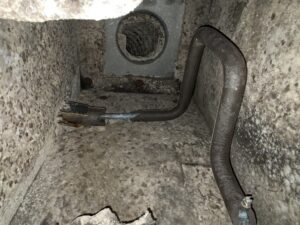
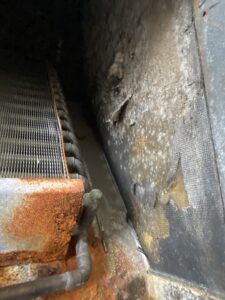
One of the more desirable – but less noticeable – “hot spots” for mould is within fan coil units (FCUs). Relative humidity (RH) levels within these heating and cooling systems are between 75% and 97%, which is an ideal range for mould growth. Moreover, the materials around fan coil units (e.g., insulation) often hold moisture, providing the right foundation for mould spores to thrive. Put these elements together, along with a lack of maintenance, and it’s no surprise that mould is a common consideration for any fan coil unit.

As UofT’s study affirms: “FCUs are highly susceptible to becoming contaminated with mould and distributing spores throughout the living areas. Since these units are out of sight, they are often out of mind, a situation that poses potentially serious health and legal risks.”

A breath of (un)fresh air
Mould’s resiliency and appetite make it a particular threat in built environments where organic materials are plenty and water from leaks, moisture, or building envelope deficiencies can arise. It’s also mould’s long-term impacts on humans that make it a threat that must be addressed at first sight.

Indeed, both Health Canada and the Ontario Ministry of Labour classify mould as a considerable risk factor for anyone who breathes it in. Coming in contact with mould spores can cause various symptoms, including allergies, asthma attacks, rashes, and respiratory difficulties of varying severity. Moreover, these impacts can multiply on people with weaker immune systems.

One can see why leaving mould to spread inside an HVAC system heightens these risks. When spread by fans in the HVAC system, mould spores can take flight into a condo resident’s unit or public areas throughout the building. Impacted residents may not even notice they’re inhaling mould until the symptoms take shape, at which point it becomes a case of reacting to public health issues rather than preventing them.

Erosion from within
Health risks are the main motivation for addressing mould in buildings. However, as emphasized in UoT’s study, the impacts on a condominium’s finances and reputation also serve as motivation.

Condominium owners and managers have an obligation to provide a safe environment for occupants and guests. This obligation is enforced to various degrees in the Condominium Act, the Residential Tenancies Act, Human Rights Act, Occupational Health and Safety Act, and related legislation. A failure to prevent mould from growing and circulating within a building can be seen as violation of that obligation, raising the possibility for legal issues, liabilities, fines, or other penalties. And given the fact most building stakeholders don’t typically have little coverage when it comes to mould, one event can have rippling negative impacts.

Mitigation matters
On mould remediation for FCUs, UoT’s study makes a strong case for prevention. This means recognizing that mould is a common issue to watch out for and that plans need to be in place to respond when and if it is spotted.

As the study insists: “The most prudent course of action when it comes to mould growth in fan coil units is to be proactive – i.e. to investigate for fan coil mould growth when complaints are received, communicate any adverse findings in a timely manner to all stakeholders, and remediate mould growth as soon as possible. Experts agree that ignoring the problem or deferring a solution due to the perceived complexity and cost will only serve to increase risk, liability and ultimate cost.”

Important safety measures must also be taken when and if it comes time to combat mould in FCUs. For one, remediation efforts fall under Environmental Abatement Council of Canada (EACC) protocol Level 2, formerly called EACO Level 2, which refers to medium-scaled projects of less than 10 square feet of mould growth in HVAC equipment in occupied areas. As such, the job needs to be done by qualified contractors who follow this important protocol as they will make sure the negative air in the work area is properly contained, and that the surrounding air is cleaned with HEPA (high-efficiency particulate air) technology.


Indeed, effective mould remediation begins with property managers and board members adopting a proactive mindset. This means recognizing that mould is a common issue to watch out for and that plans need to be in place to respond when and if it is spotted. In the event of the latter, a testing lab can be used to confirm its presence using a sample of fibreglass insulation.

Even before fan coil mould remediation efforts begin, however, the first move is to contact the original equipment manufacturer (OEM) to request a condition assessment. You can often find the OEM’s contact information on the inner door of the fan coil, which is behind the outer return air grille. Once this assessment is done, you will have the information and clarity you need to begin making plans for its eradication.

Mould can make condo teams and residents lose sleep. Yet, with proactive measures, a watchful eye, and professional HVAC support, everyone can breathe easier.

This article was provided by Unilux CRFC, a global leader in retrofit fan coil design and manufacturing. 

Staying safe on a step ladder

As the weather warms up and you start to conduct your annual spring building maintenance, focusing your attention on ladder safety is important. Reaching high places to clear eavestroughs, paint, clean windows – and many more tasks – require you to get on a ladder and your team’s safety is paramount.

At this time of year, it’s a good idea to review general tips for the safe use and proper care of your ladder.

Safe use

As you pull that ladder out for the first time this spring, check for any winter damage or corrosion that might make it unsafe to use. Make sure there is no corrosion on the rungs, and check for loose rivets or any defective parts.

Here are a few more general tips for reaching those high places and staying safe:

  • Check the load rating to ensure you will not exceed that, even with the added weight of the tools you will be using.
  • Do not prop the ladder up against a wall, extend it to its height. Lock it into place for safety and stability.
  • Extend the ladder to about three feet below where you need to work to give you enough room to work comfortably.
  • Do not overreach. Keep the ladder stable and climb down to move it to a new location, rather than shifting its position while in use.
  • Face the ladder when climbing up and down, using both hands to hold on for balance.

Safe care

Keeping your step ladder in good shape will increase safety and ensure that you will be able to use it when you need it for your next job. There are a few things you can do to lengthen its lifespan and keep it in good working order.

  • When moving it to another location, dragging your ladder can weaken it or make it unstable over time, so pick it up and carry it to avoid causing damage.
  • Store it in a location that is protected from the elements to avoid it breaking down and weathering.
  • Before you store it away for the season, look for signs of  weakening, including exposed fibreglass, cracks deformed or dented rails, and worn tread. If any of this damage exists, it’s time for a replacement.

Safety is important and as the weather gets warmer and you may need your ladder more, be sure to care for it and use it properly to prioritize safety for your team.

Getting the Most from Your Facility

In today’s modern, conscientious world, it’s more important than ever to ensure all facets of building operations are functioning at their maximum efficiency. With aggressive ESG mandates, rising utility costs, and the impacts of climate change bringing considerable new challenges to the table, facility owners have their hands full—and the costs and implications of a system failure can be devastating.

These are just some of the reasons so many commercial property owners are enlisting the support of a trusted facility services provider.

“Today’s building systems are complex and often operate in conjunction with each other,” says Joe Laine, Operations Manager at Black & McDonald G.T.A Service. “When we receive a call day or night, we work with our clients to triage their needs and provide an integrated response. Similar to the way building systems work together as a whole, our licensed technicians are skilled in their specific disciplines, yet they work as an integrated unit. From the beginning of a call to the follow-up reporting and invoicing, our process is smooth and reliable.”

Whether it’s a healthcare facility, office, warehouse or data centre, the peace of mind that comes from working with a multi-trade service provider can’t be underscored enough. As Laine puts it, “It allows for one contractor to deliver a holistic and coordinated response, freeing up the facility manager or owner to focus on the core business. Our ‘boots on the ground’ services are complemented by a strong support staff and project managers. We work closely with our Energy & Sustainability Team to ensure we maintain and optimize building operations and guide our clients through the increasingly complicated world of building systems.”

facility manager B&MIn fact, the adage “An ounce of prevention is worth a pound of cure” aptly sums up Black &McDonald’s approach to doing business. When meeting with a prospective client, the first step involves reviewing each building system for an overview before developing a custom maintenance plan balanced against the client’s budget requirements.


“Our tailored maintenance programs are automatically scheduled, and our service technicians are professional and knowledgeable,” says Laine. “When we are on site, we are not only a client’s eyes and ears, but also a trusted advisor who can summarize equipment status, review items requiring attention, and provide meaningful recommendations.”

Risks & Rewards

Despite being a major cost centre, mechanical and electrical systems tend to go unnoticed—that is, until they fail. When systems suddenly stop working, the costs of reacting to a failure can add up to a lot more than the cost of conducting scheduled repairs or replacements.

“Combining regular preventative maintenance and capital planning for new equipment reduces the risk of catastrophic failure,” says Laine. “It means repairs are completed in a scheduled and controlled environment, reducing after-hours costs and producing better results with minimal downtime.”

On the other hand, failing to maintain or properly address issues as they arise can have serious cost implications. Property managers without a trusted partner can expect costs associated with everything from downtime, to overpaying for repairs, to liabilities if unqualified trades people were unwittingly hired to fulfill the work. Many building owners have found themselves paying for repeat repairs due to unsatisfactory results. As Laine points out, having a multi-trade service provider like Black & McDonald eliminates these risks.

“Through regular maintenance, OEM efficiency ratings can be sustained—which will also help to avoid unnecessary gas and electricity consumption, as equipment ages,” he adds. “We take pride in being available to answer the phone and direct any type of mechanical or electrical requests to an appropriate team member. Whether it’s a tripped breaker or a broken water main, one phone number makes it simple for you to get the assistance you need.”

New World, New Standards

If the pandemic has taught us anything, it’s the value of indoor air quality and the need for mechanical and electrical systems that operate at their best. Prior to COVID, these systems were only addressed when there was problem—but those days are behind us.

“Today, building owners are thinking about how well their systems are working and they are actively seeking ways to improve them,” observes Laine. “Indoor Air Quality monitoring and management have never been more important. Similarly, the introduction of the Federal Carbon Tax is having a major impact on operating costs, not to mention the social responsibility side of reducing GHG emissions.”

As the cost of utilities increases and technology changes, it can be difficult to manage the road forward given the number of options and confusion around incentives and loan products.

“Black & McDonald offers a full range of consultation and technical support to guide and assist you on your journey,” he says. “We’ll develop a tailored solution to meet the specific requirements of your building or portfolio.”

For more info, visit www.blackandmcdonald.com

CWC celebrates wood design award winners

The Canadian Wood Council (CWC) has announced the winning projects of the 39th annual Wood Design & Building Awards program. The influential awards program recognizes and celebrates the outstanding work of architectural professionals around the world who achieve excellence in wood design and construction.

A record of 181 nominations from 25 countries were received by the program this year, with 24 winning projects selected from the impressive field of entries. The creative talent of the participating design teams, and the beauty and versatility the wood structures they have created, are transforming the built environment.

”We are privileged to honour wood design leaders through the awards program, “says Martin Richard, VP communications and marketing at CWC. “The quality, quantity, and diversity of the project nominations we received this year is inspiring. It also signals a growing architectural interest in renewable biomaterials and the expanded use of wood as a versatile, sustainable, high-performance construction element that offers better outcomes for people and the planet.”

HONOR

  • Churchill Meadows Community Centre and Mattamy Sports Park, Mississauga, Ontario, MJMA Architecture & Design
  • Neil Campbell Rowing Centre, St. Catharines, Ontario, MJMA + RAAI
  • Lake Muskoka Boathouse, Port Carling, Ontario, Turkel Design
  • TUM Campus in the Olympic Park, Munich, Germany, Dietrich | Untertrifaller
  • HAUT Amsterdam, Amsterdam, the Netherlands, Team V Architectuur
  • Pavilion of Floating Lights, Jinju-si, Korea, JK-AR

MERIT

  • Prince George Fire Hall, Prince George, British Columbia, HCMA
  • MacLac Building D – Rebirth of An Historic Paint Factory, San Francisco, California, Marcy Wong Donn Logan Architects with PLAD Peter Logan Architecture and Design
  • Historians’ library and residence, Cambridge, Ontario, Dowling Architects
  • Ombú, Madrid, Spain, Foster + Partners
  • Wooden Annex, London, United Kingdom, Tsuruta Architects
  • SuperHub Meerstad, Meerstad, the Netherlands, De Zwarte Hond

CITATION

  • Wu Tsai Theater, David Geffen Hall, Lincoln Center, New York, New York, Diamond Schmitt Architects
  • Angle of Repose , Algonquin Highlands, Ontario, Reasonable Projects
  • Rouyn-Noranda Air Terminal, Rouyn-Noranda, Québec, EVOQ+ARTCAD architects
  • Our-Shelves-Houses, Madrid, Spain, SUMA architecture+ Madergia
  • Doune Castle: Ardoch Burn Crossing, Stirlingshire, Scotland, UK, Historic Environment Scotland
  • Revitalization of the school building Ceskobrodska in Prague into a Smart, Secure, Sustainable, Operation Energy and Carbon Negative Building, Prague, Czech Republic, ECOTEN


Preventing title and mortgage fraud

The purchase of a condominium is often the first foray into home ownership for many Canadians. Gaining a toehold in Canada’s hottest housing markets is no easy feat; it is the product of good investment decisions, scrimping and saving, and often requires financial assistance from family.

As real estate values have skyrocketed in the past five years, especially in Canada’s major cities, so too have cases of mortgage fraud. In fact, mortgage fraud has recently gained national media exposure from a series of news reports by the CBC. Picture this scenario: you have just returned to your Toronto condo after a lengthy sabbatical only to discover that your key doesn’t fit in your front door. You are then met by complete strangers, who believe themselves to be the rightful owner of your condo and have the legal documentation to prove it.

Two types of real estate fraud that are on the rise in the past 12 months:

Fraudsters impersonate individual homeowners and use stolen IDs to sell or mortgage properties. The mortgage or sale happens quickly and the fraudulent proceeds are dissipated outside the jurisdiction almost immediately. The CBC recently reported that a handful of organized crime syndicates are behind these real-estate frauds, in which 30+ homes in the GTA have either been sold or mortgaged without the owners’ knowledge.

Fraudsters dupe unsuspecting homeowners into registering one or more mortgages on their properties at “cut rates.” The victims of these frauds are normally part of a vulnerable group of homeowners who cannot qualify for a loan from a Schedule I bank. The unsuspecting homeowners end up with one or more mortgages registered on title to their properties on terms they never agreed to while failing to receive some or all of the mortgage proceeds advanced by the lender.

So, how do condo owners protect themselves and their biggest investment from being victims of title fraud or mortgage fraud? Here are some practical tips:

1. Title insurance: title insurance is an insurance policy covering the condition of title or ownership of real property and protects homeowners (and lenders) against losses related to the property’s title or ownership, including certain types of mortgage fraud involving identity fraud or impersonation. For a one-time, up-front premium, typically in the range of $200 to $500, title insurance provides homeowners and lenders with some peace of mind against title defects outlined in the policy including fraud and forgery. Your title insurance policy will protect you as long as you own your property and will cover losses up to the maximum coverage set out in the policy. It may also cover most legal expenses related to restoring your property’s title.

Lawyers strongly recommend to their clients to purchase title insurance when purchasing or financing their home. Title insurance policies can also be purchased by existing homeowners who did not purchase title insurance on their original acquisition. This is particularly advisable where the subject property is mortgage free.

There are four title insurance companies in Canada: Stewart Title, First Canadian Title, Chicago Title Canada, and TitlePLUS, operated by the Law Society of Ontario (LSO).

2. Property searches: if you have any concerns or suspicions that something improper may be occurring to your condo or home, for a nominal fee you can pull a parcel register of your condo PIN [property identifier number] through your province’s land registry office, providing you with a snapshot of ownership and all charges registered on title to the property. The parcel register can be accessed by your local real estate lawyer through Teranet or on your own online through OnLand Help Centre.

3. Notify others of any extended absences: if you’re going out of the country, for an extended period or even for vacation (and your condo will be vacant), you should notify people whom you trust. They can check up on your condo while you are away and notify the property manager or police if they notice any suspicious activity while you are absent. Fraudsters who steal property titles generally do not list a property on the MLS service, but your neighbours or family members may notice suspicious activity around your condo while you are away. You can also set up a “Google Alert” through your Gmail address. If your condo is listed on MLS, you will get an alert within an hour.

4. Protect your IDs and your signatures: the rules of professional conduct require lawyers to verify the identity of clients in certain circumstances. However, lawyers may also be the victims or the vehicle of mortgage schemes involving stolen identification especially when the lawyer does not actually meet with the client in person. In order to minimize the risk involved in mortgage fraud and impersonation, never give out your government issued photo ID.

Be very careful whom you share your SIN (social insurance number) with. Fraudsters will often only use your SIN, obtained under false pretences or through identity fraud, to open new bank accounts in your name without your knowledge. They can then use the bank account to deposit and disburse fraudulently obtained funds including mortgage advances.

Lastly, do not sign any documents without fully understanding them or having a lawyer explain those documents to you. Fraudsters often prey on unsophisticated peoples or those with language barriers to perpetrate mortgage fraud. Title insurers may not provide coverage where the homeowner signed the documentation used to register a mortgage, even if the homeowner did not understand or appreciate the legal significance of those documents.

5. Check your credit report: reviewing your credit report can help you find out if someone has opened unauthorized financial accounts in your name. There are two credit reporting agencies in Canada: Equifax Canada and TransUnion Canada.

6. Guard your privacy through these precautions: do not give out personal information on the phone, through email or text to people you suspect may be posing to conduct research, surveys, contests, and so on while harvesting your personal information. Unless you have initiated the transaction, do not give out any personal information. Make sure you know and trust your real estate brokers, real estate agents, lawyers, and bank employees. Google everyone: do they have a LinkedIn profile? Who else are they connected to? A Facebook profile? Are the photos the same? Check out Google Reviews, too. Invest in a cross-cut paper shredder. Shred receipts, bank statements, bills from utilities, copies of credit applications, insurance forms, physician statements, and unsolicited credit offers you get in the mail.

Fraudsters still “dumpster dive” and rummage through blue recycling bins because enough people remain lackadaisical about safeguarding their personal information. Lastly, minimize the identification cards you carry with you. Lost or stolen ID cards are useful to fraudsters to perpetrate identity theft.

7. Pay attention to your billing cycles: follow up with creditors if your bills don’t arrive on time. Stolen bills are another source used by fraudsters to steal your identity.

Ellad Gersh, a partner at Robins Appleby LLP, focuses on commercial real estate property disputes among landlords, owners, and tenants. He is representing one condo owner who is the victim of a mortgage fraud scheme.

Geothermal energy systems now in on tax credit

The Canadian government has added geothermal energy systems to the list of clean technologies that qualify for a 30 per cent tax rebate. The newly released 2023-24 federal budget also pledges to retain the maximum tax credit at 30 per cent straight through to 2034 rather than paring it back in 2032, as was contemplated when the measure was announced in the fall economic statement last November.

“The federal government is expanding the eligibility for the clean technology investment tax credit to further support the growth of Canada’s burgeoning clean technology sector,” the budget document states. “Expanding eligibility of the investment tax credit to include technologies for geothermal energy projects would generally be expected to help reduce emissions of greenhouse gases and air pollutants by displacing the use of fossil fuels.”

The tax credit applies on qualifying capital costs of a range of low-carbon heating, renewable energy generation and energy storage systems, as well as zero-emission construction machinery and associated charging equipment. Geothermal piping, pumps, heat exchangers, steam separators and electrical generating components are now included in the mix with the condition that the equipment cannot be used in energy projects that co-produce oil, gas or any fossil fuel.

The tax credit for geothermal systems kicks in for purchases made as of budget day, March 28, 2023. The addition of the new category is forecast to cost $185 million over the next five years, increasing to the overall expenditure for the tax credit to $6.9 billion for the period from 2023-24 to 2027-28.

The budget also clarifies that the purchase and installation of low-carbon heating systems are exempt from the tax credit’s labour conditions, meaning that all investors can expect a full 30 per cent rebate. For other categories of investment, such as renewable energy generation or energy storage systems, businesses must ensure that workers are paid “a total compensation package that equates to the prevailing wage” or they will forfeit a portion of the available credit, reducing it to a 20 per cent rebate on qualifying costs.