



Articles Archive - Page 189 of 927 - REMINET
REMI

Continuing education for condo board directors

Condominiums are complex entities to manage and yet are governed by elected directors who are not required to have any relevant expertise. Most new directors have no prior experience about being on a condo board. It is the luck of the draw if a director has expertise pertinent to the condominium.

Condo directors shoulder heavy responsibilities and make decisions with significant financial implications. The consequences of poor decisions can be profound, even if the decision was welcomed in the short term. Keeping condo fees low makes owners happy until years later when an inadequate reserve fund must be topped up with a large special assessment to fund a major repair and replacement project.

Condominiums across Ontario and in many other localities face the challenge of aging infrastructure and new pressures to implement climate-friendly and energy-efficient solutions that require cutting-edge technologies that have not yet been widely implemented. It takes extraordinary effort and knowledge to navigate in this area.

What happens when directors make the wrong decisions? Mostly nothing. The courts have been reluctant to charge directors for bad decisions. Did they commit fraud or negligence, or was it just an honest mistake?

There are no condo police. No one reviews a board’s decisions. No penalties get assessed when the boards screw up. It doesn’t matter if it was an honest mistake; honest mistakes can have painful consequences. Appointed administrators step in to rescue the worst condo boards, but this is done as a last resort and should never be implemented unless absolutely necessary. Bringing cases of fraud or negligence to trial is costly and time-consuming.

Continuing education is hailed as a means for directors to develop the necessary skills and expertise. Even though the Condominium Authority of Ontario’s online mandatory training program provides a solid foundation, directors can never stop learning and continue to gain experience over their terms.

Directors are expected to seek appropriate expertise when needed. Depending on the specific situation, they will consult with their legal counsel, engineer, accountant or other expert or even a combination of several experts. These experts provide sound advice, but the board must make and understand their decisions. Condo managers are critical to any discussion, but making the final decision is the board’s responsibility.

Making decisions in the best interest of the condominium requires directors to be as well-informed as possible about their condo and knowledgeable about condominiums in general. Condos need expert directors, but volunteer directors don’t become experts overnight.

Can continuing education be more effective? Here are eight ideas to consider.

1. Handover Meetings: Encourage boards to hold handover meetings and invite retiring current directors to provide updates on ongoing activities. While the meeting is most relevant to new directors, take advantage of the opportunity to discuss ongoing issues more broadly and discuss the future of the condo as a group. It is also an opportunity to discuss board policies, conflicts of interest, and any other issues that could benefit from current and retiring directors being together. Be sure to ask if a retiring director could be consulted.

2. Legacy Documentation: Ensure retiring directors leave behind detailed records, including:

  • Document decisions, highlighting the reasoning behind them,
  • Lessons learned to guide new directors,
  • Handover notes.

Use technology to capture and store this knowledge securely to prevent loss.

3. Council of Advisors: Establish a team of veteran directors willing to offer consultancy services to boards. To make the council effective, create a mechanism for feedback and compensation for these advisors. Directors on the council will have no ties to industry and follow the strictest conflict of interest guidelines, ensuring that their advice is unbiased. Advisers can also help boards through decisions.

4. Incorporate Real-life Experience in Training: Engage current and past directors in CAI’s mandatory training. Add panel discussions, roundtables, video presentations, interviews, discussion groups, or other format to the existing content from CAI programs.

5. Director-Only Conferences: Facilitate platforms where current and past directors can network, share, and learn from each other.

6. Promote Committees: Encourage the formation of both permanent and ad hoc committees that can delve into specific condo challenges. Invite past directors and owners with particular expertise to be committee members. Engage consultants as part of the process as needed.

7. Neutral Directors’ Intervention: Develop a system where directors from other condos could be consulted about owner-board or manager-owner disagreements before the dispute gets out of hand.

8. Create Learning Opportunities for Owners: Knowledgeable condo owners understand their roles and responsibilities and become active and knowledgeable participants in their condominium communities.

Directors will continue to learn over their terms. Preserving their knowledge when directors leave their positions is even more critical. Directors bring perspectives that lawyers, engineers, accountants, and condo managers do not have and have inside information about their condo that no one else has.

Ensuring that condo board directors are up to governing complex multi-million-dollar buildings will positively affect the condominium’s overall financial and social well-being and reduce risk over the long term.

Pat Crosscombe is the past president of her condo board and the founder and CEO of BoardSpace, a company that provides board management software for condo boards and property managers.
Edmonton reveals urban design winners

Edmonton’s top architects, designers, builders, artists and planners were celebrated at the Edmonton Urban Design Awards gala. Awards were given in eight categories, as well as the People’s Choice Award winner, recognizing excellence in urban design and contributions to enhancing city life.

“The Edmonton Urban Design Awards is a reminder of the talent and creativity we possess here in Edmonton,” said Mayor Amarjeet Sohi. “These gifted professionals help to create a city that Edmontonians want to live in, and remind us that we all deserve beautiful, functional and sustainable urban design.”

The Awards, created in 2005, have been held every two years (except 2021) since that time. Six Canadian and international architects, planners and artists served as the jury for this year’s awards. This year, a total of 57 submissions were received.

The Awards of Excellence winners are:

Civic Design: a civic project implemented as the result of an urban design plan or initiative.

Award of Excellence:
  • Edmonton City Hall Plaza and Fountain by GEC Architecture
  • Kinistinâw Park by Dialog

Community Projects: any built project, however modest, initiated and implemented by a community-based organization that enhances the public realm.

Award of Excellence:
  • Confetti (Michael Phair Park) by HCMA Architecture and Design
Heritage Projects: projects that demonstrate sensitivity and creativity in preserving the heritage values of a building or site.
Award of Excellence:
  • The Strathcona by Hodgson Schilf Evans Architects
Housing Innovations: residential properties of a high architectural standard that demonstrate innovation in housing design and promote community health and wellbeing.
Awards of Excellence:
  • The Mercury Block by Hodgson Schilf Evans
  • T5M Connect North Glenora by T5M Connect
Sustainable Urbanism: including plans, studies, buildings, public spaces and other urban design interventions.
Award of Excellence:
  • Strathcona Back Street by EDA Planning and Urban Design
Urban Architecture: an individual building or group of buildings of a high architectural standard. Design excellence is achieved through their unique relationship with their immediate surroundings because of their scale, visual interest, and pedestrian amenities.
Awards of Excellence:
  • Stadium Station by GEC Architecture
  • Roxy Theatre by Group2 Architecture and Interior Design
Urban Design Plans: recognizing a plan or study of a significant area within Edmonton that provides a development or redevelopment strategy for urban transformation in the mid to long-term.
Awards of Excellence:
  • Students’ Boulevard by ISL Engineering and Land Services
  • 100 Street Pedestrian Bridge by Entuitive
Urban Fragments: recognizing a single, small-scale piece of a building or landscape that contributes significantly to the quality of the public realm.
Award of Excellence:
  • If the Drumming Stops (Mill Woods transit stop) by Tania Willard, Peter Morin and Cheryl L’Hirondelle
People’s Choice Award: chosen by Edmontonians from all submissions.
  • Roxy Theatre by Group2 Architecture Interior Design


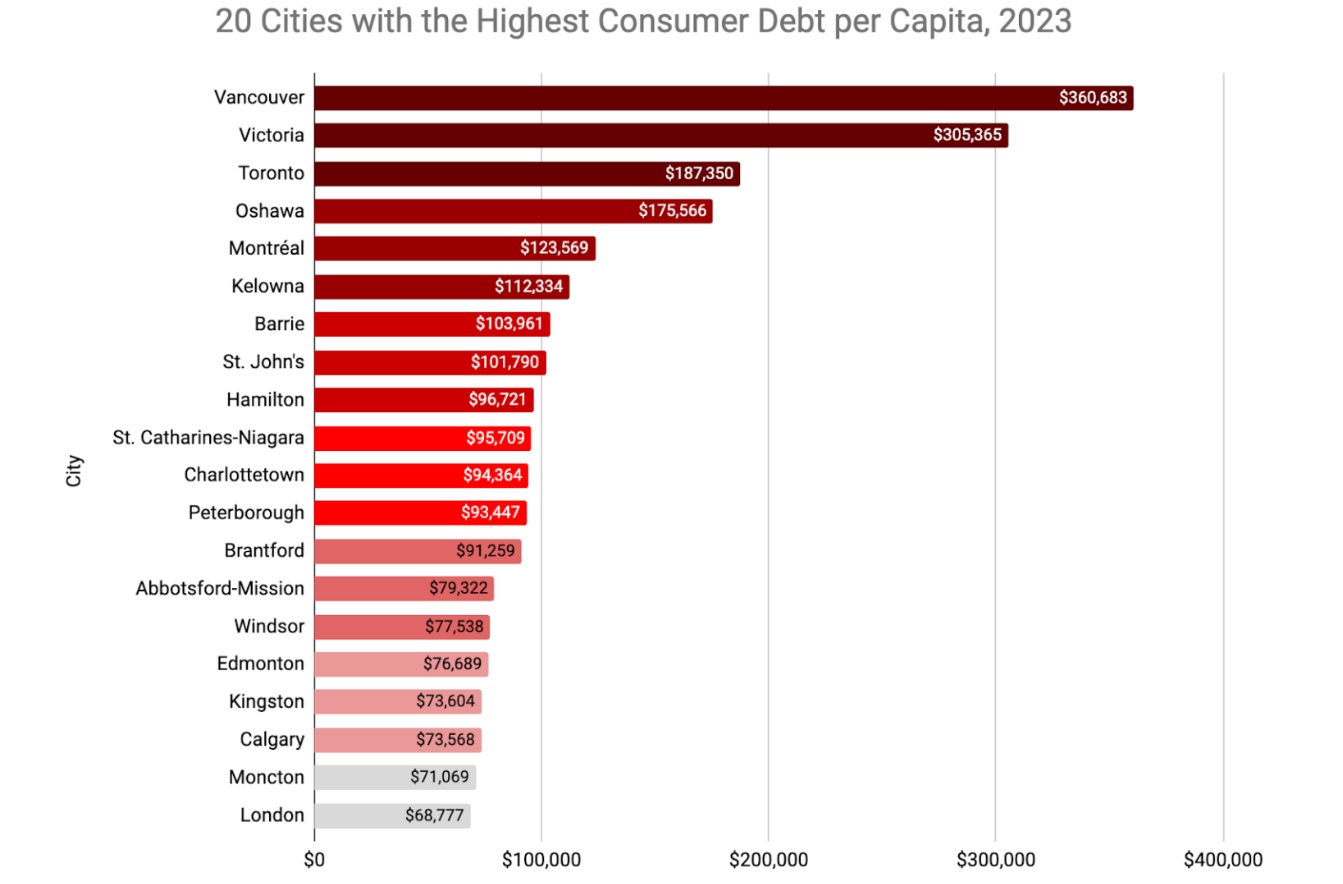
New report compares consumer debt in Canadian cities

An analysis by savvynewcanadians.com breaks down complex financial data from CMHC and Statistics Canada to reveal how much debt Canadians are carrying in different cities across the nation. The report looks at various types of debts, from mortgages to credit cards and car loans, using official figures from late 2019 to mid-2023. Findings  paints a clear picture of Canada’s economic state and shows how debt is spread out across the country’s urban areas.

Key findings include:

  • Canada has the highest household debt levels among G7 nations with 74.3% of its debt in mortgages.
  • Mortgage debt contributes 22.88% to Canada’s total consumer debt, driven by limited housing supply and increased borrowing.
  • Vancouver’s per capita consumer debt is the nation’s highest, growing by 14.14% since 2019 due to high housing prices.
  • Victoria leads in credit card debt per capita at C$12,874, reflecting a 2.72% growth since 2019 and showcasing its residents’ spending habits.

Top 20 cities 

  1. Vancouver

Vancouver confidently holds the crown at rank one, with no fluctuation in its per capita debt of C$360,683, standing testament to the city’s status as a premium urban enclave despite a steady population of 662,248.

  1. Victoria

Victoria’s per capita debt gently ebbs by 0.14% to C$305,365, a reflection of the city’s prudent financial currents amidst its population of 93,664, often seen as a retreat for both the affluent and the conservative spender.

  1. Toronto

Canada’s economic titan, Toronto, sees a subtle 0.31% uptick in per capita debt to C$187,350, a number that mirrors the vibrancy and the cost of its bustling streets which are home to 2,794,356 people.

  1. Oshawa

Oshawa, with its robust 0.64% growth in per capita debt to C$175,566, suggests a community of 175,383 residents engaging with the city’s economic revival, leveraging opportunities in a transforming industrial landscape.

  1. Montréal

Montréal, the cultural mosaic, notes a 0.30% increase in debt per person to C$123,569, a modest stride in the financial fabric of 1,762,949 inhabitants, balancing its historic charm with contemporary urban challenges.

  1. Kelowna

Set against the backdrop of picturesque vineyards, Kelowna registers a 0.40% rise in per capita debt to C$112,334, reflecting the aspirational lifestyle of its 144,576 residents.

  1. Barrie

With a ripple of growth at 0.66% to C$103,961, Barrie is an emergent node of commuter and local economic activity for its 147,829 residents, perhaps indicative of the spillover from Toronto’s economic engine.

  1. St. John’s

St. John’s sees a contraction of 0.67% to C$101,790, signaling a community of 110,525 tightening the belts against the harsh winds of economic uncertainty.

  1. Hamilton

Hamilton climbs 0.57% to C$96,721 in per capita debt, with 580,412 residents navigating through the city’s industrial evolution and embracing the cost of urban renewal.

  1. St. Catharines-Niagara

The combined region presents a 0.17% increment to C$95,709, where 231,218 individuals live amidst the interplay of tourism-driven commerce and the nuances of border economics.

  1. Charlottetown

With its modest 0.12% rise to C$94,364, Charlottetown depicts a slow-paced increase in the fiscal responsibilities of its 38,809 residents, maintaining its character as a quaint yet economically steady capital.

  1. Peterborough

This city reflects a 0.28% increase to C$93,447, hinting at a gentle fiscal momentum among its 83,651 denizens, possibly tied to its manufacturing and educational sectors.

  1. Brantford

Brantford ticks up 0.35% to C$91,259, where 104,688 inhabitants resonate with the city’s manufacturing pulse and the corresponding financial cadences.

  1. Abbotsford-Mission

This city marks a 0.42% rise to C$79,322, a mirror to the ambitions of its 195,043 residents, balancing agricultural richness with suburban growth.

  1. Windsor

Windsor’s 0.60% increase to C$77,538 reflects the economic intertwinement of its 234,954 residents with the automotive and manufacturing sectors, underscored by cross-border influences.

  1. Edmonton

Edmonton reveals a 0.68% downtick to C$76,689, where the 1,010,899 residents may be echoing a broader provincial shift in financial attitudes amidst an oil-reliant economy.

  1. Kingston

Kingston’s slight 0.08% growth to C$73,604 could be whispering tales of steady academic investment among its 135,687 inhabitants, nestled within a historic setting.

  1. Calgary

Calgary’s per capita debt dips 0.28% to C$73,568, a subtle but indicative trend among its 1,306,784 residents, balancing the dynamism of its oil and corporate sectors with fiscal prudence.

  1. Moncton

A 0.20% increment to C$71,069, for its 90,174 residents, could be indicative of growing consumer confidence in a city poised as a logistical hub.

  1. London

London rounds out the list with a 0.44% rise to C$68,777 in per capita debt, as 422,324 individuals navigate the financial demands of a city anchored in education and health sciences.

For the full report, click here: Canada’s Consumer Debt Surge 2023.

Major Highway 1 expansion begins in Fraser Valley

The next phase of Highway 1 expansion through the Fraser Valley to the Sumas Prairie has begun. The multi-billion project aims to relieve traffic congestion and accommodate more sustainable transportation options in the region.

Accelerated advance work along the Highway 1 median east of 264th Street has begun, with work delivered by local companies including Kwantlen First Nation. People travelling Highway 1 will see crews in the median undertaking utility relocation, median soil removal, tree clearing and preloading of soil. This work will prepare the area between 264th Street and Mt. Lehman Road for the addition of high occupancy vehicle (HOV)/electric vehicle lanes and other multi-modal upgrades.

“The Fraser Valley is growing fast and we are building infrastructure that people need,” said Rob Fleming, minister of transportation and infrastructure. “People need to be able to get to work and back home without facing gridlock. We’re taking action to relieve congestion for drivers, to make goods movement more efficient and to accommodate more sustainable transportation options.”

The widening of Highway 1 between 264th Street and Mt. Lehman Road has an approved budget of $2.34 billion. This is Phase 3A of the province’s Fraser Valley Highway 1 Corridor Improvement Program, a multi-phase program to improve goods movement and travel along Highway 1 in the Fraser Valley through the Sumas Prairie to Chilliwack.

The centrepiece of Phase 3A will be a new 264th Street Interchange, reconfigured to better serve road users in the region. The 264th Street area is highly travelled during morning and afternoon hours, including a high volume of commercial vehicles heading to and from the border crossing. Along with more efficient goods movement, the new interchange will include improvements for active transportation, truck parking and public transit. The new interchange is in procurement, with construction expected to begin in 2024.

The 264th Street Interchange and associated highway widening is one of the three major construction contracts that make up Phase 3A. The other contracts will be upgrades to the Mt. Lehman Interchange and 3.7 kilometres of highway widening, and replacement of the Bradner Road overpass with 3.9 kilometres of highway widening. These contracts will go to tender in 2024. Completion of Phase 3A is expected in 2029.

Work is underway on Phase 2 between 216th and 264th streets, with a new Glover Road overpass currently under construction and completion expected in summer 2024.

Two more tenders are on track for release, including a new interchange at 232nd Street and highway widening for HOV lanes, along with a replacement to the existing CP Rail overhead.

Opinion: Accessibility is everybody’s business

Society benefits, and invariably prospers, when people everywhere can more easily share their experience, knowledge and culture and exercise their spending powers. In conjunction with the International Day of Persons with Disabilities, December 3, this guest column by Brad McCannell, vice president of access and inclusion with the Rick Hansen Foundation, reiterates that universal access spells universal opportunity – REMI Network.

An Angus Reid survey revealed that disability touches almost 50 per cent of the Canadian population through their experience of having a permanent or temporary physical disability or living with someone who has. And that number continues to increase steadily year after year.

By not prioritizing accessibility, commercial and retail operators are creating a barrier between them and half of their customers. It’s crucial to recognize that accessibility isn’t just about the one in five Canadians with a disability. It extends to their partners, friends and family. Consider the statistics. In Canada, people with disabilities, along with their friends and families, command a whopping $538.5 billion in disposable income, according to the Conference Board of Canada.

Despite this, a significant number of people with disabilities report subpar customer experiences. Various barriers hinder participation, from simply not being able to get into buildings, to not being able to function in the space without support from items like hearing loops that support people with hearing loss use.

Investing in accessibility aligns with ethical considerations but also makes good business sense. Beyond tapping into a vast market share, it streamlines processes and enhances brand value because many appreciate businesses prioritizing inclusivity. For instance, one of Canada’s iconic landmarks — the CN Tower — has achieved a record level of accessibility, attaining the highest level of recognition from the Rick Hansen Foundation Accessibility Certification (RHFAC) program.

Peter George, chief operating officer of the CN Tower reports: “By making accessibility updates to the CN Tower, the amount of time people spend in our building has increased. People are calmer, happier and more willing to spend time in our retail store. Not only is improved access the right thing to do, but it also makes good business sense.”

Amidst the current labour shortage, businesses must look beyond traditional sources for workers. Employees with disabilities have equal or superior productivity, and an impressive retention rate of 93 per cent, according to a 2018 University of British Columbia study.

Yet, more than half a million Canadians with disabilities are kept out of the workforce by barriers in the built environment. If these barriers were removed, having people with disabilities in the workforce could add nearly $17 billion to the national gross domestic product (GDP) by 2030. So, the current practice of only meeting code minimums that limit the participation of people with disabilities, actually holds the whole country back.

Workplace accommodations aren’t demanding. Common requirements include flexible work arrangements, workstation modifications and human or technical supports. And contrary to common misconceptions, it does not have to cost a lot to make changes.

A feasibility study by the architecture firm, hcma, in collaboration with the Rick Hansen Foundation, reveals that integrating accessible features at the project planning stage adds virtually no additional costs. Retrofits, while more complex, can often achieve greater accessibility with simple, cost effective changes.

When people with disabilities have jobs, they have income and can establish solid credit ratings. That, in turn, means having access to credit cards, mortgages and all financial foundations that enable social participation. That reinforces to employers and retailers that enabling access is a normal and necessary business function. More than just a paycheck for people with disabilities, it’s an opportunity to contribute, to feel valued, to create social interaction and to be part of the solution.

The fastest way to create employment is to create accessible work environments in the retail and commercial sectors. The most straightforward way to create access in these environments is the practical application of universal design beginning with the Rick Hansen Foundation Accessibility Certification Program to create common language and common methodology to measure accessibility. The RHFAC puts everyone on the same page; it makes everything measurable across different projects, portfolios, cities, even across different countries.

In 2019, the Accessible Canada Act mandated federal buildings and businesses be accessible, and provinces such as British Columbia and Saskatchewan have followed suit, aligning their accessibility requirements to these new national standards.

But where to start? RHFAC offers an invaluable road map for organizations regardless of where they are on their accessibility journey. RHFAC not only measures and rates sites for meaningful accessibility but provides data to help prioritize improvements over the short and long term. For those eager to learn how to create welcoming spaces, the Foundation offers a variety of courses, ranging from the one-hour Inclusion and accessibility training to more comprehensive courses for industry professionals.

A survey from the Return on Disability Group in the Harvard Business Review revealed that only 4 per cent of employers included disability as part of their definition of diversity, equity and inclusion (DE&I) environments. Without meaningful access, there can be no diversity or equity. There can be no inclusion.

Brad McCannell is vice president of access and inclusion with the Rick Hansen Foundation.

The Sngequ House student complex opens at UVic

A new student housing complex is open at the University of Victoria (UVic), the university’s largest capital infrastructure project to date. Completed a year ahead of schedule, the Sngequ House features 385 single-room dormitory-style beds, primarily for first-year students, and an Indigenous student lounge.

“When young people move away from home for school, they need to be able to find safe, secure and affordable housing,” said Premier David Eby. “These new homes are helping students enjoy campus life, easily access student services and focus on their studies, while also easing demand on Victoria’s rental market.”

The new 11-storey residence is part of a larger student housing project that was built in two phases. The first building, which opened in September 2022, includes 398 single-room dormitory-style student beds and a 600-seat dining hall. As part of the project, two old buildings are being torn down. In total, the project adds 621 new beds and 162 replacement beds, increasing affordable on-campus housing by 25 per cent.

Both student housing residences were constructed using natural products such as stone and wood, consistent with the province’s CleanBC plan. Wood is incorporated into the building designs through mass timber structural elements in the first building and wood finishes in the second building.

Designed by Perkins+Will, both buildings are seeking Passive House and Leadership in Energy and Environmental Design (LEED) V4 Gold certifications, two of the most rigorous global building standards for sustainability and energy efficiency. This means reduced energy, operating and maintenance costs, and lower carbon emissions, which are critical for a clean future.

“The opening of Sngequ House in the fall completed the UVic’s Student Housing and Dining project, our biggest capital project to date. We know how challenging it is to find appropriate accommodations in our community and this project is helping to alleviate some of those pressures. We continue to look at ways to make higher education accessible for more students at UVic,” said Kevin Hall, president and vice-chancellor, University of Victoria.


Three prevailing value drivers of smart restroom technology

Smart technology is not only a common phrase within the facility management field; today it is virtually ubiquitous with optimized facility operations. Over the last several decades, facility managers and building services contractors have deployed and integrated smart solutions for everything from HVAC, lighting, and inventory control to disaster management, security, and building occupancy, helping to advance smart buildings from concept to reality.

RELATED: How smart buildings affect commercial cleaners

With smart solutions being developed, proven, and adopted, it was only a matter of time before smart restroom innovations came to market. Not unlike other smart technologies, smart restroom technology relies on the Internet of Things, sensors, and an application to collect, relay, and analyze data – and it is proving to be an investment with the potential for a highly valuable return.

Cleaning program optimization

With smart restroom technology, the custodial staff has real-time information on the state of the restroom and a checklist of hygiene-focused tasks to complete. The more dispensers and fixtures that are connected and the more detailed the checklist, the more robust and actionable that real-time information is.

Sensors collect information such as dispenser product levels, faucet water pressure, toilet water flow, and battery power levels, which leads to insights on how frequently the restroom and specific dispensers, faucets, and toilets are used, as well as peak usage times and overall foot traffic.

Sensors also identify issues such as a jammed dispenser, a clogged toilet, or a leaky faucet, which allows the custodial staff to quickly rectify the situation. Automated task alerts help ensure critical touchpoints, like doorknobs, toilet and faucet handles, and towel and tissue dispensers are monitored, cleaned, and sanitized regularly.

Big deal, you say? Indeed! All of this data takes the guesswork out of restroom cleaning and maintenance. It empowers informed and impactful operational decision-making and helps create improved custodian workflows. It supports maintainer retention by making the job of the maintainer more manageable and helps improve cleanliness and hygiene by prompting maintainer action when and where it is needed. As well, it buoys sustainability efforts by reducing stub roll waste and driving water efficiency.

Let’s put numbers to this cleaning program optimization. Customer data shows a 95 per cent reduction in unnecessary dispenser checks due to smart restroom technology. In a high-rise office building with 600 dispensers that are checked twice daily, that equates to saving an estimated 1,485 hours of labour per year. One customer has achieved zero per cent towel waste, and another improved their on-time task completion rate by 135 per cent in their first year using smart restroom technology.

Customer experience improvement

It’s no secret that public restrooms can elicit a significant number of user complaints related to odours, product outages, clogs, wet floors, and so much more. While some in facility management may view these complaints as a normal part of doing business, more and more are finding that smart restroom technology can help alleviate most – if not all – of them. Case in point: a recently renovated state-of-the-art sports arena leveraging smart restroom technology had zero restroom complaints during the 2022-2023 NBA season.

But the benefits of deploying smart restroom technology extend far beyond the restroom itself.

A survey on public restroom perceptions revealed that 51 per cent of consumers have avoided using a specific public restroom due to hygiene concerns, negative expectations of cleanliness, and concerns about paper towel outages. Yet another survey found that 50 per cent of consumers said they have chosen not to return to a business at all because the restrooms were not clean and stocked.

That latter research also found that for 90 per cent of both live venue customers and restaurant customers, a clean and well stocked restroom contributes to their overall satisfaction with an event or dining experience; and for 89 per cent of employed consumers, a clean and stocked restroom contributes to their workplace satisfaction, more so than free parking, on-site fitness, and childcare facilities.

Further validation of the value of a positive customer experience is found in a Harvard Business Review article, which found that customers who had the best past experiences with a brand spent 140 per cent more than those who had the poorest past experience.

These statistics clearly convey that a good public restroom experience contributes to a better overall customer experience, and that often means more money spent by the customer.

Rent premiumization

By delivering on the previous two value drivers, it should come as no surprise that smart restroom technology may also warrant a premium above base rent.

A recent study of commercial real estate professionals found that 93 per cent of property managers and 98 per cent of commercial real estate brokers consider consistently clean and well-stocked restrooms important for attracting and retaining tenants. In fact, similar to employed consumers, they found it more important than free parking and on-site cafeterias, workout facilities, and childcare centres.

Further, more than 90 per cent of property managers and 90 per cent of commercial real estate brokers believe a smart monitoring system that helps maintain restroom cleanliness warrants a premium over base rent. As well, two-thirds of property managers and 57 per cent of commercial real estate brokers put that premium at or above three per cent.

In conclusion

Every day, technology solutions continue to get more innovative, and facilities continue to get smarter. This is not a reason to delay embracing the smart restroom solutions available today; rather, it is a reason to reap the incredible value proposition currently available with the recognition that said value will only increase over time.

John Strom is vice president and general manager of Innovation at GP PRO, a division of Georgia-Pacific. In this position, John leads the team responsible for all aspects of the company’s KOLO™ Smart Monitoring System, an award-winning open platform smart restroom solution. To learn more about GP PRO and its smart restroom solution, visit www.gppro.com.

VICA elects 2023-2024 board of directors

The Vancouver Island Construction Association (VICA) and its membership re-elected three industry leaders to its 2023-2024 board of directors during its 2023 Annual General Meeting. There were 10 nominees from across Vancouver Island.

Of the 10 nominees, incumbents Stuart Cuthbert, Slegg Building Materials, Morley Wilkins, Method Chartered Professional Accounting and Scott Torry, AFC Construction, were re-elected for another term.

For 2023/24 VICA welcomes Stuart Cuthbert as its new board chair, Barclay Ellis, Trades Labour Corporation (TLC) Victoria, as vice-Chair, Scott Torry as Treasurer, Morley Wilkins as Secretary, and Kate Ulmer, Herold Engineering, as past chair.

With nearly two decades of domestic and international industry experience, Cuthbert’s leadership and prowess for exceptional governance positions VICA for success for the coming years. Drawing from his experience on the VICA board and the BC Construction Association board of directors, as well as his background in supply, sub-contracting, and manufacturing, he brings a holistic perspective to the board chair, understanding the diverse needs and priorities of members.

Outgoing past-chair Chris Lyons, Omicron Construction, was recognized for his years of service on the VICA board. He was part of the founding group of what is now VICA’s successful Young Builders Network, creating a space for young industry professionals in the construction sector to network and mentorship opportunities.

During Lyons’ tenure, he oversaw the pilot and expansion of VICA’s Tailgate Toolkit Program, Construct Your Future youth employment program, as well as stewarding VICA through the COVID-19 pandemic. With his departure from the VICA board, he now joins the BC Construction Association’s board of directors.

“The need for construction services is at a historically high level, with government presenting policy to address the increasing need for housing and public infrastructure. Guided by the leadership of our 2023-2024 board of directors, I am confident that the Vancouver Island Construction Association and its members will be positioned to succeed in addressing the construction needs of Vancouver Island communities,” said Rory Kulmala, VICA CEO.

Woodfibre LNG selects Bridgemans accommodation

Bridgemans Services Group has been selected to provide on-site workforce accommodation for Woodfibre LNG’s liquified natural gas (LNG) export project near Squamish, beginning spring 2024.

Woodfibre LNG, designed to be the world’s first net zero LNG export facility, chose Bridgemans for its commitment to sustainability and ability to deliver turnkey, safe and secure live-work offshore accommodation for more than 600 workers at the site.

“From the start, it’s been a priority to make sure the construction of the Woodfibre LNG facility has as little impact on Squamish as possible and Bridgeman’s expertise in floating accommodation helps make that possible,” said Christine Kennedy, president of Woodfibre LNG. “We look forward to working with Bridgemans to offer the non-local project workforce the most comfortable and sustainable option in workforce accommodation available today.”

Bridgemans will moor the MV Isabelle at the Woodfibre LNG project site, so workers can easily move between the vessel and their workplace. The MV Isabelle underwent an extensive refit of its environmental systems and living, dining, recreation, and gathering areas in Europe and is in the final stages of preparation before being deployed to site in spring 2024.

The floatel will offer a luxurious home away from home with 652 newly renovated single cabins with private ensuites, a high-end dining room, lounges, meeting rooms, fast wi-fi, offices, medical care, a state-of-the-art 8,000-square-foot fitness facility, billiards and games room, and dedicated accommodations for crew members. Project workers will have every comfort of home during their rotations, while working within recent BC Environmental Assessment Office and Squamish Nation amendments that restrict non-emergency access to Squamish.

The floatel will also offer a wide array of advanced environmental systems including an ultraviolet water purification system, the ability to run on shore hydro power, industrial-sized heat pumps, and sewage treatment that includes ultrafiltration, a low intensity UV unit, and shipping to a waste management facility in BC. In addition, Bridgemans is designing the MV Isabelle to eliminate waste and recycle as much as possible.

Bridgemans is also providing floatel support and workforce transfers through its Marine Services division.