


Articles Archive - Page 141 of 928 - REMINET
REMI

Next gen homebuyers tackling affordability barriers

Canada’s next generation of homebuyers, aged 18 to 38, see real estate as a long-term investment despite how unaffordable it may seem.

Eighty-four per cent of respondents in the Royal LePage 2024 Next Generation Survey feel this way. The majority live in Saskatchewan and Manitoba (94 per cent) and Atlantic Canada (93 per cent).

Three quarters of those who do not currently own a primary residence say that owning a home is a priority for them and a milestone they hope to achieve in their lifetime. Just over half of respondents believe that home ownership is an achievable goal. Twenty-six per cent are unsure and 20 per cent do not believe it is achievable for them at all.

Strong savings and confidence in their career trajectory was cited as the most common factors driving this belief that home ownership is within reach. Respondents in Quebec are the most optimistic about owning a home, while those in Ontario are the least likely to say it is achievable.

“What is both surprising and promising in these findings is the practical and purposeful manner in which these people are tackling affordability barriers,” said Phil Soper, president and CEO of Royal LePage. “They are well educated on the state of the real estate market and the wide variety of government programs put in place to assist young families find homes. They are hyper-focused on saving for a down payment, which is often the biggest hurdle homebuyers face. And, they are open to creative solutions, such as shared ownership with friends and family, or buying a property with the express intention of renting a portion of the home to a tenant.”

About 73 per cent of the next generation potential homebuyers say they desire a permanent place to live that is their own, while 57 per cent say that owning a home provides stability. Forty-five per cent say that renting is restrictive due to tenant-landlord policies, and 32 per cent say home ownership is a key part of their retirement plan. Respondents were able to select more than one answer to this question and others.

Forty per cent of respondents who plan to purchase say that they wish to buy a property within the next five to 10 years, while 25 per cent say they are planning to purchase a home more than 10 years from now. Nearly one in five respondents say they plan to purchase a home within the next three years, and another 13 per cent plan to buy in three to five years despite supply shortages.

Almost half are regularly saving a portion of their earnings for a down payment. Forty-two per cent say they are diligently paying their loans and bills to ensure a good credit rating and 34 per cent say they are reducing their discretionary spending in an effort to save more. Thirty per cent are living with family and saving for a down payment, paying little to no rent.

To increase their chances of being able to afford a home, 45 per cent of respondents who are planning to purchase say they would consider buying a property with the potential for rental income to offset their mortgage costs, and 31 per cent would consider a rent-to-own program, where the occupant leases the property and a portion of the monthly payments is put towards a future down payment on the unit.

If and when they do buy, nearly half of respondents say they will not receive any financial assistance from family members, but 32 per cent say they will receive some form of financial support toward the purchase of their first home.

Clark Builders awarded Red Deer Hospital project

Clark Builders has been awarded the construction manager contract to build the new patient tower and expand and renovate the existing hospital building in Red Deer.

The contractor will complete early site preparations such as demolishing the existing annex building and surface parking lot. By early 2025, construction will begin on the new patient tower. Renovations will also begin in specific locations of the existing facility, with a focus on minimizing any disruption to hospital operations.

The redevelopment of the Red Deer Regional Hospital Centre will add 200 inpatient beds, increase the size of the emergency room and add six new operating rooms. Additionally, the redevelopment will add a new medical device reprocessing department, new cardiac catheterization labs and a new centralized power plant.

A new ambulatory building will also be constructed as part of the Red Deer Regional Hospital Centre redevelopment, but as a standalone project to be delivered using a public-private partnership delivery method.

“The Red Deer Regional Hospital redevelopment project is a priority for our government. We recognize there is an urgent need to increase capacity and expand services in central Alberta, and the awarding of this contract signifies progress being made towards ensuring patients can receive the health care they deserve close to home,” said Adriana LaGrange, minister of health; MLA for Red Deer North.

Initial site preparation is currently underway with a separate construction management team (Shunda Consulting and Construction Management) that was engaged in June 2024 to complete early construction activities.

Alberta’s 2024 Capital Plan is providing $810 million toward a $1.806-billion investment for the redevelopment of the Red Deer Regional Hospital Centre over the next three years.


Do you buy your cleaning supplies in bulk?

As companies look for ways to trim their expenses, buying cleaning supplies in bulk may be one way to cut costs over the long haul. There are a few advantages to choosing larger quantities for your commercial cleaning supplies, including:

  • Purchasing larger quantities often offers buyers a lower per-unit price. Investing in those savings across all types of cleaning supplies, departments, and locations could offer substantial annual cost-cutting. Not only that, but larger quantities often mean less attention needs to be paid to inventory regularly, saving you the time of ordering and monitoring levels more often.
  • Having the chemicals you need on hand could help mitigate any upcoming supply chain shortages or delays, too. While the upfront cost may seem prohibitive, remaining fully stocked ensures that you will have the products you need when you need them.
  • As well, with sustainability and ESG goals continuing to be important to companies, larger quantities offer less packaging and a smaller carbon footprint. With fewer materials used, manufacturers can also save energy, fuel, transportation, and other operational costs which can offer you additional savings.
  • Along with helping to reach your financial and sustainability goals, having bulk amounts of commercial cleaning supplies on hand means you will be ready for any cleaning emergency that arises. Worrying about running out or having to order more products when you’re in a pinch could mean a less effective strategy for addressing last-minute cleaning needs.

While buying in bulk offers some advantages for your business, there are a few challenges to consider before you move ahead to decide what makes the best sense for your business:

  • Do you have enough storage space to support housing the inventory? Buying in bulk means storing large containers of cleaning products safely, so ensuring that you have somewhere large enough to accommodate your inventory and that follows storage directions is part of the process.
  • Along with storage recommendations, reading labels becomes crucial when you are relying on your janitorial or cleaning staff to dilute these chemicals for daily use. Staff training is very important to achieve product potency, ensure staff safety, and get the best results from your cleaning products.

RELATED: Why reading chemical labels has never been more important

Staying stocked with commercial cleaning supplies can help out when the unexpected arises, save you time and money, and help you reach your ESG goals. Keep these advantages and challenges in mind when deciding whether buying in bulk makes the best sense for your business.

Energy storage becomes a planning consideration

Energy storage gets new prominence in the most recent update of Ontario’s rules for land use planning. The 2024 iteration of the provincial planning statement (PPS), set to take effect on October 20, explicitly lists energy storage systems among the options that municipalities are expected to consider to ensure there is an adequate energy supply to meet current and projected needs.

That’s an addition to the recognized energy supply roster, which also continues to reference: electricity generation facilities; transmission and distribution systems; district energy; renewable energy systems; and alternative energy systems. Otherwise, the 2024 PPS is organized somewhat differently than its 2020 predecessor, but includes most of the same directives related to energy conservation, reducing greenhouse gas (GHG) emissions and promoting resiliency to climate change.

The PPS sets out broad policy parameters for municipalities to follow in developing their official plans and associated policies, documents and bylaws. In addition to ensuring that the energy supply will be sufficient to enable the growth their plans envision, municipal decision-makers are also instructed to:

  • incorporate climate change considerations into the planning and development of infrastructure, including stormwater management systems, and public service facilities;
  • support energy conservation and efficiency;
  • promote green infrastructure, low-impact development and active transportation, protect the environment and improve air quality; and
  • take into consideration any additional approaches that help reduce greenhouse gas emissions and build community resilience to the impacts of a changing climate.

Meanwhile, Ontario electricity customers can expect a nominal uptick in pass-through regulatory charges on their monthly bills for the next 16 months, related to the implementation of the provincial government’s plan to develop energy supply and electrification capacity. Earlier this month, the Ontario Energy Board approved a small increase to the Independent Electricity System Operator’s (IESO) budget to the end of 2025 to allow it to carry out work arising from that plan, which was introduced in the summer of 2023.

That will add slightly more than $0.03 per megawatt-hour (MWh) or 0.003 cents per kilowatt-hour (kWh) to the IESO’s previously approved usage fee beginning with September bills. The charge will increase to about $1.45 per MWh (0.145 cents/kWh) for the remainder of 2024 and to $1.48 per MWh (0.148 cents/kWh) in January 2025.

Liborio’s legacy continues

A great leader is often described as someone who thrives on embracing challenges, fostering connections, and solving problems in pursuit of progress; someone who isn’t afraid to adapt, learn, and motivate others down the same road to success.

Liborio Gurreri, visionary architect and founder of Tor Can Waste Management and Tor Can ICI Roofing Inc, exemplified these exceptional traits, and more.

“Liborio was a friend who was always one to offer words of wisdom, encouragement, and advice. You could always count on him, and he never let you down. The same characteristics were evident in his approach to business. He always did what he said he would. There was no problem he could not solve.”
– Mark Veneziano, Partner at Lenczner Slaght LLP

All those who knew him, defined Liborio as a kind, committed professional who embodied the true spirit of entrepreneurism, embracing every triumph and defeat with one prevailing philosophy: “Only by exceeding our customers’ expectations can we hope to have the opportunity to earn their business another day.”

Liborio will be remembered as a celebrated member of the construction community in the GTA, and for his leadership and commitment to high-quality service and safety standards in the roofing industry.

“Liborio’s legacy cannot be measured by money, success, or material possessions. The relationships he built with his family, friends, and business associates made a profound impact that is rare for most people to experience. He leaves a meaningful and memorable mark on our lives. ”
– Italo Lunardo, Founder, President & CEO at LPI Mechanical Inc.

Liborio established Tor Can Waste Management in 2000, followed by Tor Can ICI Roofing Inc in 2019. Both wholly owned companies were built on the mantra “service over profit,” which became the guiding ideology that allowed the small enterprises to successfully challenge the corporate Goliaths of the day.

With five successful years in business, Tor Can ICI Roofing Inc’s expertise lies in the installation of commercial, industrial and institutional roofing systems using TPO, EPDM, PVC, metal and traditional 4 ply tar and gravel buildup, always to the manufacturer’s strictly specified applications. The company is also proud to be recognized as a Soprema authorized installer, which is often cited as the best roofing system in the industry. The team continues to hone its re-roofing  expertise  in  the  property management sector in a manner that would make its founder proud – by exercising sensitivity to the needs of tenants while delivering the highest quality service that it helped garner the business of property management icons. Some of their most notable customer projects include Shoppers World Brampton, Iron Mountain, Yorkdale, McDonalds, and Rogers.

Liborio’s footprint was vast, but so too was his focus on the future and succession plans. This includes the 18- year mentorship of Michael Collura, VP, and the accompaniment of a handpicked management team that were all reared for their understanding of good business and a commitment to earning their clients’ trust daily.

Liborio’s brother, Domenic Gurreri, founder and President of Forest Group, remembers him as a “true gentleman, admired amongst his friends, family and the community alike. His dynamic energy had a remarkable way of filling any room with a sense of warmth. His absence has left a significant void in our lives. He will be forever loved and never forgotten.”

It’s safe to say that all those who knew and worked for Liborio Gurreri are grateful for his visionary leadership, commitment to quality, and tireless work ethic that guided him every step of the way, and the industry remembers him fondly.

Liborio also had a great spirit of generosity, which he demonstrated through his support and involvement with several charitable initiatives, including Josie’s Pink Truck Foundation, which the family launched in loving memory of his daughter, Josie.

Liborio  Liborio

logo


Applications open for Ontario sports facility funding

The Ontario government is now accepting applications for the new Community Sport and Recreation Infrastructure Fund (CSRIF).

The province previously announced its investing $200 million through the fund to help communities revitalize existing community sport and recreation infrastructure and build new facilities.

Applications are open to municipalities, Indigenous communities, non-profit organizations and (for new builds only) for-profit organizations, through two streams:

Stream 1: Repairing and upgrading existing sports and recreation facilities into more accessible, state-of the art facilities that better meet the community’s needs. Eligible projects will receive between $150,000 and $1 million and must be completed within twenty-four months. The deadline to submit applications is October 29, 2024.

Stream 2: Building new and transformative sports and recreation facilities, including replacing existing facilities that have reached the end of their lifespan. Eligible projects will receive up to $10 million and must be completed no later than March 31, 2027. Applications will be accepted on an ongoing basis until funding has been fully allocated.

More information about eligibility is available in the application guidelines. The government is hosting an information webinar on August 27, 2024, to help prospective applicants navigate the application process.

B.C. multifamily investment activity expected to increase

As inflation trends downward and interest rates continue to decrease over the second half of the year, multifamily investment activity is expected to increase in Vancouver and Victoria, according to CBRE’s new 2024 Mid-Year Apartment Report.

“Mid-year sales activity and pricing reflects both the demand for and confidence in the B.C. multifamily asset class from both local private investors and national institutional investors,” says CBRE Vancouver Vice President Greg Ambrose. “With further rate cuts expected over the coming quarters, confidence is returning to the investment market which is starting to show signs of recovery.”

While sales volume has been trending down since the peak in 2021, the first half of 2024 saw 61 transactions totaling 2,386 units and $830 million, suggesting it is back on track to exceed last year’s sales and possibly be similar to 2022’s numbers.

According to the report, multifamily cap rates throughout B.C. edged slightly higher in the second quarter of 2024. The expansion of cap rates was influenced by motivated seller deals driven by the capital gains inclusion rate increase, which in most instances yielded lower accepted pricing (higher cap rates) to take advantage of higher net proceeds prior to the June 25 cut-off.

Monthly asking rents

Nationally, apartment rents reached record highs in the first half of 2024, with average asking rents for all residential property types in Canada hitting $2,202 in May, surpassing $2,200 level for the first time. All provinces recorded annual increases in apartment rents for purpose-built and condo rentals, but British Columbia boasts the highest average asking rent of all the provinces at $2,526 in May 2024.

In Vancouver, total average asking rents are the highest in the country at $3,008 with bachelors at $2,317, 1-bedrooms at $2,684 and 2-bedrooms at $3,729.

For more multifamily investment research and analysis, visit: Commercial Real Estate Services | CBRE Canada

B.C. investing in $560M UBC housing project

The B.C. government is investing in a new 1,508 student bed housing project at UBC.

The $560 million project is the province’s largest capital investment and the largest number of student beds to date. The provincial government is providing $300 million and UBC providing the remaining $260 million.

The complex will be built in the Lower Mall Precinct at UBC with five buildings, ranging from eight to 18 storeys, with 1,508 new student housing beds (1,333 new and 175 replacement).

The project will also include a 400-seat dining hall; 37 new child care spaces; common amenity space; and academic and administrative office space to accommodate the displaced St. John’s College.

The new buildings will focus on providing homes to graduate students. Child care on campus will make it easier for students, faculty and staff with children to streamline their daily routines through one nearby drop-off and pickup location.

Construction is set to begin in fall 2026. The project is expected to be open for students in phases, starting in fall 2028 and completing in fall 2029.

Design and construction of the complex will target LEED Gold. One of the five buildings will be built using mass timber.

“We know people want to find homes near where they live, work and study in British Columbia,” said Premier David Eby. “Our government is building on-campus housing at an unprecedented pace – including our biggest project to date right here at UBC – helping more students find a safe, secure and affordable place to call home and relieving pressure on the rental market. This is just one way our government is tackling the housing crisis so everyone can find a good home at every stage of life.”


Paving the road to the future

The ripple effects of British Columbia’s labour shortage have been felt across the trades, where the need for new skilled workers spans every sector — from residential construction to highway and road maintenance.

With several major infrastructure projects scheduled for the years ahead, there’s never been a better time to consider a career in road building. The BC Road Builders and Heavy Construction Association is leveraging its role as industry advocates to raise the profile of careers in the sector, and the RoadShow is a key initiative in this effort—a mobile talent-attraction experience putting people in the driver’s seat to learn about careers in road building and highway maintenance.

A Critical Time for Recruitment in Trades
Demographically, every industry is seeing a huge wave of retirements on the horizon. Over the next few years, tens of thousands of workers will age out of the trades, and the road building and highway maintenance sector is no exception. With nearly 50,000 kilometres of highway to upkeep across B.C., the industry needs to do everything it can to attract the workers of the future, today.

The RoadShow gives potential job seekers a realistic feel for what it’s like to operate heavy machinery. Comprised of a 34 foot trailer with four state-of-the-art simulators, the interactive experience includes the opportunity to test out a snowplow, excavator, wheel loader, rock truck, and many other pieces of heavy equipment.

As the recipient of grant funding from the Ministry of Social Development and Poverty Reduction, the trailer began its tour in March, and has travelled from Powell River to Vanderhoof and everywhere in between. The RoadShow will continue its cross-province adventure for the next two years, visiting high schools, job fairs, trade shows, and private events on its mission to reach new demographics, with a focus on women, Indigenous communities, and other underrepresented groups.

Career Training Programs
In addition to funding initiatives like the RoadShow, the BC Road Builders foster career pathways into the sector by partnering with career training programs, like the Abbotsford School District’s Heavy Equipment Operator (HEO) program.

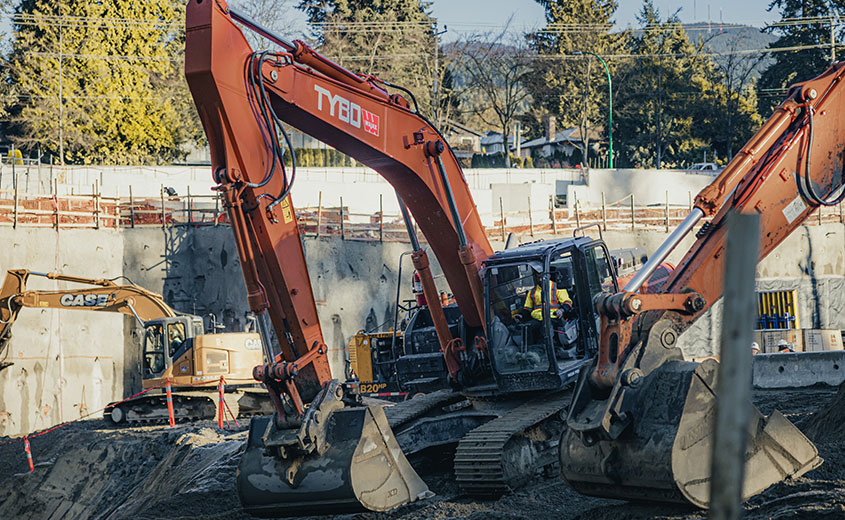
Quentin Ansley is one of the many success stories to have come from the program. After graduating, he was quickly hired by TYBO, a civil construction company based in Langley, and a member of the BC Road Builders. Ansley is no outlier. With an impressive 90 per cent of graduates offered job placements after completion, the program has been a huge success in its 15 years of operation.

Michael Pearson, district vice principal of the Abbotsford School District Career Programs, says the RoadShow has been well received by students and experienced operators and would like to see it become a permanent fixture in the HEO program.

“There are huge advantages to using the simulators prior to using the actual equipment,” he says. “It forms a bridge between the theoretical knowledge and helps them get a sense of what the real-life scenario is like. That makes them safer future operators.”

When it comes to using simulators in conjunction with recruitment, “There’s nothing better to get young people excited about road building as a career pathway,” he says.

Connecting Candidates with Careers
Shane O’Donnell, principal and chief operating officer at TYBO, thinks initiatives like the HEO program and the RoadShow are a great way to introduce people to an industry they might not have otherwise considered. Besides educating people about opportunities in the sector, participating in these programs can connect job seekers directly with employers, like in Ansley’s case.

Following a talk O’Donnell gave to his HEO class one day, Ansley introduced himself. “After talking for a few minutes, he handed me his resume. I could tell immediately that he had a great attitude, a strong work ethic, and was eager to get to work,” says O’Donnell. After graduating, Ansley got the chance when TYBO offered him a job as a Junior Operator.

Five months into his role, Ansley is enjoying the seat time and the rewards of seeing a day’s work on the road in front of him. Having transitioned from a simulator to operating the real equipment, he believes the RoadShow offers a valuable learning experience for those new to heavy machinery — and thinks people will get a kick out of the realistic sounds and movements of the simulators.

Matt Pitcairn is president of the BC Road Builders and Heavy Construction Association. Learn more about the RoadShow and find it coming to a community near you at www.bcroadshow.ca.


UK looks to investor role models in Canada

Canada’s largest pension funds have been identified as investor role models as the new government of the United Kingdom looks to catalyze growth with more assistance from the Local Government Pensions Scheme (LGPS) and other UK-based defined contribution pension plans. Earlier this month, Chancellor of the Exchequer Rachel Reeves announced that a comprehensive review of the country’s “pension landscape” would begin with a focus on investment and an eye to how the LGPS’s ₤360 billion (CAD $640.8 billion) asset base could be better deployed to stimulate national economic development and infrastructure investment.

In step with the government initiative, Local Pensions Partnership Investments (LPP) — which currently oversees ₤25.7 billion (CAD $45 billion) of assets under management as one of the LGPS’s eight pools — has released a report endorsing the whole-scheme management approach that Canada’s largest pension funds, dubbed the Maple 8, employ. That includes a significantly greater allocation to private markets than the current LGPS average, as well as larger allocations to infrastructure and real estate.

“The approach taken by Canada to management of public pensions is internationally recognised as a leading example of ‘what good looks like’,” the report maintains. “They have also built a circa CAD $2 trillion capital pool to back the pensions of Canadians. This is equivalent to approximately 100 per cent of Canadian GDP.”

The UK government projects individual LGPS beneficiaries could realize a ₤11,000 (CAD $19,580) boost to their savings pot through a realignment of investment priorities and consolidation of the scheme’s 87 existing funds that now cost nearly ₤2 billion (CAD $3.5 billion) in annual fees. The LPP report theorizes that replicating the Maple 8 approach across the whole of the LGPS could garner an additional ₤16 billion (CAD $28.5 billion) in equity capital that could be invested in infrastructure and suggests “wind farms, grid upgrades and flexible manufacturing facilities” could engender good returns.

The Maple 8 is comprised of: Canada Pension Plan Investment Board (CPP Investments); Alberta Investment Management Corporation (AIMCo); British Columbia Investment Management Corporation (BCi); Caisse de dépôt et placement du Québec (CDPQ); Healthcare of Ontario Pension Plan (HOOPP); Ontario Municipal Employees Retirement System (OMERS); Ontario Teachers’ Pension Plan; and Public Sector Pension Investment Board (PSP Investments). The LPP report notes they share “key features” which include: independent governance; large allocations to the private markets; internal management; and a focus on long-term value creation.

Collectively, 48 per cent of the Maple 8 allocations are to the private markets, while there is a much more modest 20 per cent allocation to the private markets across the LGPS. Currently, the Maple 8 have an 11 per cent allocation to infrastructure and a 13 per cent allocation to real estate versus the LGPS’s respective allocations of 6 per cent and 9 per cent to those asset classes.

The first phase of the UK review is meant to look at how investment in UK-based assets could boost returns for pension savers, contribute to the capital and financial markets and stimulate economic growth. It is also expected to inform the government’s promised Pension Schemes Bill, which is anticipated for later this year.

Maintaining your solar panels

As the end of summer draws near, many maintenance managers are performing tasks that will prepare their buildings for the colder months. Solar power is expected to generate 10 per cent of our global power by the year 2030, so more and more maintenance managers will need to learn about their functionality and upkeep. If you have solar panels on your property, have you been performing regular maintenance?

While it’s true that solar panels are not typically high maintenance, there are a few steps you can take to maximize their optimal performance.

Keep them clean

The rain often cleans the panels through the summer, but dust, dirt, and debris can still accumulate. MIT research reveals that dirty solar panels can be up to 30 per cent less efficient, so keeping them clean is a priority.  If you can walk safely between the panels, the best way to clean them is with a soft sponge or squeegee and a bucket of soapy water. Letting panels air-dry is recommended.

Companies located in low-water areas may be challenged to clean the panels regularly, but new technology is being developed using electrostatic repulsion to clean the panels without using water or brushes that could scratch the surface.

Your panels in the winter

Solar panels produce energy year-round, but you may need to periodically visit the roof to remove accumulated snow to maximize their exposure to sunlight and keep them at optimal performance. Some installers recommend incorporating features like snow guards to protect the panels from accumulating ice and snow, limiting their maintenance needs.

Tilting and positioning your panels can also help you access the most sunlight through the winter months.  By monitoring your energy capture, you can make necessary adjustments to maximize your energy gain through the winter.

Solar panels are designed to last up to 30 years, so with a little year-round maintenance, your panels will perform at their best and experience a long lifespan.

B.C. funds $2.6B Highway 1 upgrades in Abbotsford

The Government of British Columbia is investing $2.65 billion in new funding to widen and improve Highway 1 through the Fraser Valley. The funding will upgrade Highway 1 between Mount Lehman Road and Highway 11 in Abbotsford.

“To make life better for people in the fast-growing Fraser Valley, our government is building the homes, schools, hospitals and highways families need,” said Premier David Eby. “By improving Highway 1, we’ll keep goods moving smoothly and help people get to work and back home faster, so they can spend less time stuck in traffic and more time with their families.”

This new funding builds on the $2.34-billion provincial funding approved in fall 2023 for upgrades between 264th Street and Mount Lehman Road. The Fraser Valley Highway 1 Corridor Improvement Program will eventually see the highway expanded through the Sumas Prairie in Abbotsford toward Chilliwack.

Along the 28-kilometre stretch of Highway 1 between 216th Street and Abbotsford, overpasses at Peardonville Road, Bradner Road and the CPKC rail overhead will be rebuilt to improve the height clearance for commercial vehicles, improving safety for all road users. The Glover Road crossing has been completed.

New interchanges will be constructed at 232nd Street, 264th Street, Mount Lehman Road and Highway 11 to improve community connections, and to make travel by walking or bike safer and more accessible. High-occupancy vehicle (HOV) lanes along the length of this section of highway and bus-on-shoulder lanes in some sections will make travel by transit quicker and more reliable.

Major construction will begin on the $2.34-billion section between 264th Street and Mount Lehman Road in 2024, with completion of the fourth major phase expected in 2029.

Procurement for the $2.65-billion improvements to Highway 1 between Mt. Lehman Road and Highway 11 – the fourth major phase – will begin in 2025. Major construction will start in 2026, with completion in 2031.


IBG launches library of low-rise building designs

Innovation Building Group (IBG) has launched IBG Designs, a new online platform that provides readily-available designs for multi-tenant buildings that smaller communities and organizations can use to address their affordable housing supply challenges.

The customizable building designs offered through IBG Designs are high-performance, climate-resilient, and cost-effective designs for low-rise buildings. By providing accessible and affordable design options, IBG Designs aims to make advanced, sustainable architecture accessible to smaller communities and organizations that might otherwise be constrained by limited resources or financial limitations.

IBG Designs is the culmination of IBG’s successful 40-year track record of constructing energy-efficient buildings. By bringing together the team’s accumulated experience with the latest advancements in building technology, each design offered by IBG Designs integrates substantial improvements at every project stage, ensuring both cost efficiency and high performance.

“We are sharing our hard-earned knowledge to empower smaller communities and organizations to unlock the housing potential in their own backyards,” said Rod Nadeau, CEO and founder of Innovation Building Group. “We’ve spent years constructing and operating our own projects, so every design is meticulously refined and rigorously tested by independent case studies and real-life operations, ensuring they are of the highest quality. Local builders and organizations can now pursue projects they might not have thought were possible.”

Benefits for smaller communities and organizations include:

Expertise and Technology Integration: Each architectural plan in the IBG Designs library is a result of extensive testing and refinement, incorporating state-of-the-art technology to enhance building performance.
Diverse and Customizable Options: The library currently features nine customizable designs that cater to various project sizes and needs, with plans to increase the number of designs and options over the next year.
Municipal Pre-Approval Initiative: IBG Designs streamlines project approvals as each of the designs have previously undergone rigorous municipal approval processes and incorporate changes and improvements that will ultimately reduce delays and uncertainties for builders and developers.


Banking rules probe includes cheque clearance

Potential new banking rules could give landlords and contractors speedier access to funds deposited by cheque. The Canadian government is seeking input on the regulated timelines that, in some cases, give banks up to eight business days to clear cheques and release funds to payees.

The opportunity to comment is part of a broader public consultation on Canada’s financial sector, which is considering a range of measures related to competitiveness, consumer protection, oversight and risk abatement. A newly released discussion paper presents “potential proposals” arising from two earlier consultation exercises, occurring in the fall of 2023 and the winter of 2024.

The rules enabling holds on cheques are set out in the federal Bank Act and were last updated in 2012. When a bank employee administers a cheque deposit, payees can expect the full release of funds (in Canadian dollars) four business days later for cheques of up $1,500 or seven business days later for cheques of greater amounts. However, an extra day is added before clearance if the cheque is deposited via an automated teller machine (ATM) or a bank’s mobile app.

In the interim, depositors can obtain up to $100 of the amount at the time that a bank employee processes the cheque or one day later if it is deposited through an automated service. The federal consultation is now considering the appropriateness of both the holding period and the $100 threshold for earlier release of funds.

“While Canadians are using cheques less often than in previous decades, cheques are still an important form of payment for many, with over 400 million used in Canada in 2022,” the discussion paper states. “Bank systems have become more sophisticated over time, allowing cheque funds to clear faster.”

Although existing rules reinforce the primacy of in-branch service, the discussion paper acknowledges physical bank branches are becoming scarcer. It’s suggested that banks might be required to disclose more information about their rationale for closing retail branches and/or potentially be restricted from applying transfer surcharges for affected branch patrons who choose to move their accounts to other financial institutions still operating in the vicinity.

As well, it’s proposed that data disclosure requirements could be expanded to mandate more information about banks’ retail branch operations, including the average volume and value of annual transactions. “More detailed publicly available data on branch closures would enable the public, as well as regulators, policy-makers, and researchers, to better understand how banks make determinations about what branches to maintain and how communities are impacted by branch closures,” the discussion paper states.

The public can submit comments on any or all of the discussion paper’s considerations until September 11, 2024.

VRCA and VCC partner for new leadership course

The Vancouver Regional Construction Association (VRCA) has announced a new partnership with Vancouver Community College (VCC) to launch the Inclusive Leadership in Construction and Trades micro-credential course.

The innovative program is designed to equip construction and trade professionals with the skills needed to foster a more inclusive, diverse, and equitable workplace.

“The VRCA is thrilled to keep expanding opportunities for our members to engage, learn, and dive into the important work of inclusion, diversity, and equity in construction and trades. As our industry faces a significant labour shortage, recognizing the benefits of a diverse workforce is more important than ever. We believe that leading by example is the best way to drive change. This course allows current and future leaders to grow personally and commit to building a more inclusive culture in our industry,” said VRCA president Jeannine Martin.

The 30-hour course offers students more than just knowledge—it awards a digital badge, a shareable asset that enhances their CV, LinkedIn profile, or online portfolio.
The Inclusive Leadership in Construction and Trades course provides the opportunity for construction professionals to elevate their leadership skills while earning up to 10 Gold Seal Credits. Plus, it’s eligible for the Future Skills Grant, making it an even more valuable investment in their future.

“We are dedicated to empowering lives through innovative learning opportunities, and this micro-credential is designed to encourage reflective and equitable practices for emerging and experienced leaders in the industry. We are proud to contribute towards building stronger, more inclusive teams that reflect the diverse communities of British Columbia, through this partnership with VRCA,” said Claire Sauvé, associate director, Continuing Studies.


Housing starts up 16% in July

Housing starts across Canada rose by 16 per cent to 279,509 units, up from 241,643 units in June, according to the latest data from Canada Mortgage and Housing Corporation (CMHC). The six-month trend in housing starts also saw an increase of 3.2 per cent, moving from 247,840 units in June to 255,783 units in July. This trend measure is a six-month moving average of the SAAR (seasonally adjusted annual rate) for total housing starts across all regions in Canada.

Urban centres in Canada with populations of 10,000 or more have seen 132,823 starts year-to-date (January to July) in 2024, representing a 7.5 per cent increase compared to the 123,593 starts during the same period in 2023.

“Both the SAAR and Trend of housing starts increased in July,”  said Bob Dugan, CMHC’s Chief Economist. “This was due to growth in actual year-over-year starts, driven by higher multi-unit starts, particularly in Calgary and Ottawa. As the national housing shortage continues, developers remain focused on multi-unit construction in Canada’s major centres.”

The monthly SAAR of total urban (centres 10,000 population and over) housing starts was 17 per cent higher at 261,134 units recorded. Multi-unit urban starts increased 21 per cent to 217,306 units, while single-detached urban starts increased 2 per cent to 43,828 units.

In Montreal, actual year-to-date starts between January and July 2024 are up 47 per cent from the same period last year, showing some recovery from a historically low year for new home construction in 2023.

In Vancouver, actual starts are down 18 per cent in 2024 compared to 2023, but CMHC notes that 2023 was a record year for new home construction in the region.

In Toronto, actual year-to-date starts are down 9.5 per cent when compared to the same period in 2023.

Click here for more: Monthly Housing Starts and Other Construction Data Tables | CMHC (cmhc-schl.gc.ca)


Consortium closes on SkyTrain stations contract

South Fraser Station Partners, a consortium comprised of Pomerleau, Aecon, and ACCIONA, has been awarded the Surrey Langley SkyTrain Project’s Stations contract by the Province of British Columbia.

The Surrey Langley SkyTrain will extend the existing Expo Line along Fraser Highway from King George Station to a new terminus station in Langley City Centre. The project includes the design and construction of eight stations, three transit exchanges, nine power substations, and 250 metres of guideway at the SkyTrain’s terminus station.

Early works are underway, and construction is expected to commence in late 2024, with anticipated substantial completion in 2029.

“Pomerleau is honoured to be part of the Surrey Langley SkyTrain project, a key milestone in advancing sustainable transportation in the region”, said Philippe Adam, President and CEO at Pomerleau. “This project underscores our dedication to creating lasting infrastructure that connects our communities and strengthens the BC economy.”

Once complete, the Surrey Langley SkyTrain extension will provide a reliable 22-minute travel time between Langley City and King George Station and a 65-minute ride between Langley City and downtown Vancouver.

“We look forward to working with the Province of BC and our partners to deliver this critical transit extension – improving mobility for one of the fastest growing areas in Metro Vancouver,” said Jean-Louis Servranckx, president and Chief Executive Officer, Aecon Group. “The stations contract is a significant component of the Surrey Langley SkyTrain Project and we are proud to bring our expertise in delivering complex transit projects to build sustainable infrastructure that meets the needs of future generations.”

The Surrey Langley SkyTrain project is being delivered through three separate contracts. All three contracts have now been awarded with major construction set to begin this year.

The cost of the project is now pegged at $5.996 billion due to market conditions, including rising inflation costs and key commodity escalation, supply-chain pressures and labour-market challenges.