



Public restrooms are often the most visited spaces in a facility, but they’re also often the most underestimated. While cleanliness and functionality have long been the benchmarks of restroom management, a growing body of research suggests that these standards fall short of what today’s users actually need. For facility leaders across Canada, the next frontier is inclusive hygiene: designing and maintaining restrooms that consider the full range of individual abilities and circumstances, so hygiene is truly accessible to all.
The unseen majority
Recent research reveals that 59 per cent of Canadians contend with some form of physical or cognitive challenge[1] that can impact how they experience public restrooms. Many face barriers to hygiene in restrooms, some that are visible and others that are not.
Barriers might include loud air dryers that overwhelm auditory and neuro sensitivities, paper towel dispensers out of reach for small children or requiring fine motor controls to use, or harsh soaps that affect skin sensitivities.
These barriers have real consequences for users and for the businesses they visit:
- 44 per cent of people feel anxious about using public restrooms, often planning their day around access.
- 38 per cent avoid eating or drinking to limit restroom use.
- 52 per cent have changed behaviour after a poor restroom experience, including eating or drinking less to avoid using the restroom or filing a complaint.
These behaviours don’t just reflect discomfort; they impact business performance, public trust, and facility reputation.
Inclusive hygiene: beyond accessibility
Facility managers are familiar with Canada’s Accessible Canada Act (ACA), which sets important standards for physical accessibility. But inclusive hygiene goes even further than that. It’s about recognizing that many barriers are not visible, and that hygiene experiences are shaped by greater context – not just compliance.
Inclusive hygiene asks:
- Does the restroom feel safe and clean?
- Does it offer privacy and comfort?
- Does it reflect care and consideration for all users?
The answers to these questions can help determine whether a restroom can act as a business asset that drives repeat visits, stronger satisfaction scores, and fewer complaints.
Three design principles for inclusive hygiene
The Inclusive Hygiene Playbook is a research-informed guide based on interviews with restroom users, cleaners, and facility managers across 20 cities in North America, including Toronto. From this work, three key design principles have emerged to guide facility leaders toward driving inclusive hygiene in their restrooms:
A clean and safe environment is paramount: Cleanliness is not just about sanitation – it’s about how safe a space feels. Overflowing trash, exposed toilet paper rolls, and damp handles signal contamination. Today, only one in five restrooms meets cleanliness expectations[2].
Canadian facilities can improve perceived safety by:
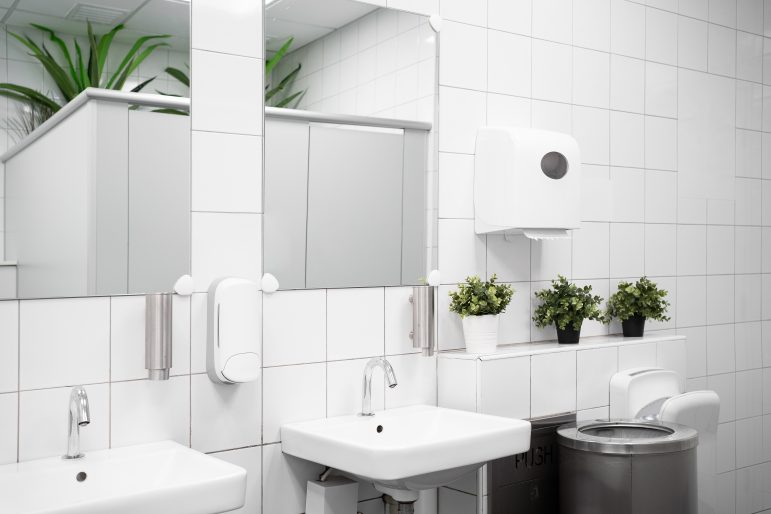
- Installing no-touch fixtures to reduce contact points.
- Providing paper hand towels and toilet seat covers.
- Placing trash bins at exits to support hygienic behaviour.
- Using durable finishes that resist streaks and wear.
These changes not only reduce contamination risk but also foster trust – especially among users who rely on visual cues to assess safety.
Put the rest back in restroom: Restrooms should offer relief – not added stress. Yet many users report feeling overwhelmed by harsh lighting, unpleasant odours, and lack of privacy. In fact, 23 per cent of people avoid restrooms due to unpleasant smells[3], and many feel exposed due to stall gaps and poor layout.
Design strategies include:
- Replacing fluorescent lighting with warm, ambient alternatives.
- Installing floor-to-ceiling stalls or privacy gap covers.
- Playing calming music to mask unwanted sounds.
- Providing changing tables, hooks, and space for mobility aids.
The restroom should feel cared for: Restrooms are a reflection of a facility’s values. Generic signage, unclear cleaning protocols, and inaccessible fixtures can make users feel unwelcome or confused. In contrast, thoughtful communication and design signal care and community.
Foster this sense of care by:
- Using on-brand, personality-driven signage that educates and welcomes.
- Displaying cleaning schedules and protocols prominently.
- Enabling feedback via QR codes or comment cards.
- Highlighting sustainability and accessibility practices.
A Canadian lens on inclusive hygiene
Canada’s diversity, across age, ability, culture, and language, makes inclusive hygiene not just relevant, but essential. Facilities across the country – from urban centres like Toronto, Vancouver, and Montreal, to suburban and rural areas – serve populations with wide-ranging needs.
Moreover, Canadian legislation and public sentiment are moving toward greater accountability in accessibility. Inclusive hygiene offers a proactive way for facility leaders to align with these values while improving user experience.
Inclusive hygiene challenges facility leaders to go beyond the visible, beyond the minimum, and beyond the expected to transform restrooms into business assets that drive repeat visits, stronger satisfaction scores, and fewer complaints. By reimagining restrooms as spaces of dignity, safety, and care, Canadian facilities can meet the needs of today’s diverse users and build environments that truly welcome everyone, while driving business performance and reputation.
Katrin “Kat” Ferge is the North American Regional Marketing Manager for Professional Hygiene – Commercial segment at Essity. In her role, she is focused on Essity’s professional hygiene brand Tork and helping businesses leverage better hygiene for better business performance. She has more than 15 years of experience in brand communications and marketing. Kat received her bachelor’s degree from Ludwigshafen University of Business and Society in Germany and later received her MBA from the Thunderbird School of Global Management at Arizona State University.
Sources:
[1] Tork Insight Survey 2025, conducted in US, UK, Germany, France, Mexico, Canada, Australia, Spain, Sweden, Netherlands and Poland among 11,500 people from the general public and 1,000 cleaning staff.
[2] Tork Insight Survey 2025.
[3] Tork Insight Survey 2025.