





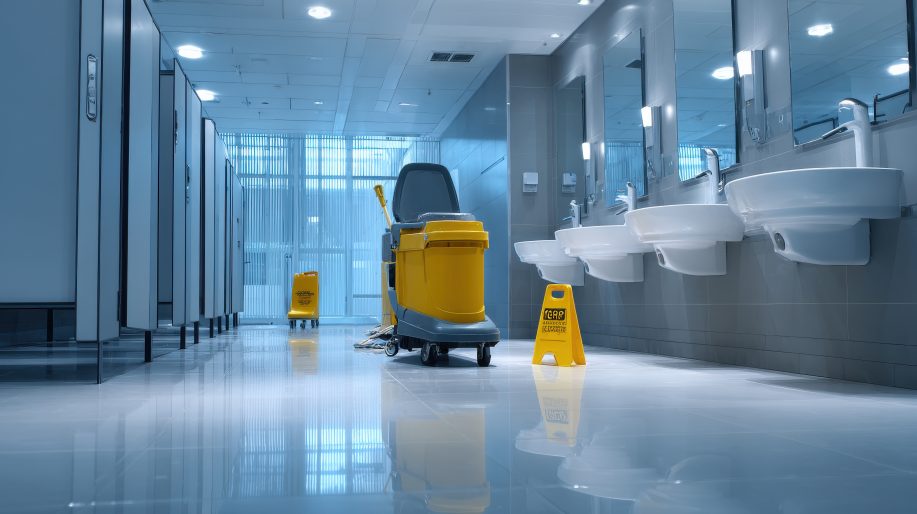
The pandemic highlighted the vital role of the professional cleaning industry, especially in restrooms, where hygiene is most visible and most scrutinized. Cleaning companies and their crews responded swiftly and heroically, stepping up to meet unprecedented hygiene and disinfecting demands when the world needed them most.
In the time since, as emergency protocols have normalized, the everyday focus on fine-detail cleaning has naturally shifted. While day-to-day expectations may feel different today, the core expertise of professional cleaning teams remains as critical as ever.
Nowhere is this truer than in commercial restrooms, and refining these high standards ensures that facility restrooms stay safe, hygienic, and welcoming. To accomplish this, let’s look at several often-overlooked, high–priority areas that define a truly clean and healthy restroom environment:
Toilets
Urine and mineral deposits frequently build up where the seat attaches to the toilet porcelain. In severe cases, the seat may need to be removed entirely to achieve a thorough clean. However, in most instances, a cleaning professional simply needs to detail-clean the area using an all-purpose cleaner or sanitizer.
Another area where urine deposits accumulate is along the sides of the toilet fixture, extending down to the floor connection. Pathogens can quickly collect around the base of the toilet when that happens. Regularly, detail-cleaning these areas using an all-purpose cleaner paired with a microfiber cleaning cloth can help ensure cleanliness and hygiene.
Urinals
Urinals should be cleaned with an all-purpose cleaner. On conventional (water using) flush urinals, water spots or mineral buildup can develop over time, often requiring a mild abrasive powder cleaner for removal. These specific mineral issues are rarely found on waterless urinals. The broader challenge with traditional water using urinals extends beyond the fixture itself. Splatter, especially when flushed, frequently coats adjacent walls, partitions, and flooring. Left unaddressed, this buildup rapidly produces persistent unpleasant odours and unsightly appearance. Unpleasant odours, regardless of their source, quickly make a commercial restroom feel unwelcoming and unhygienic, leaving an negative impression on visitors.
Drains
Some of the most severe odour issues originate directly from floor drains. This problem is particularly common in schools or facility areas that have been closed for extended periods, as the water seal inside the P-trap eventually evaporates. While pouring water down the drain provides temporary relief, a long-term solution requires a trap-seal liquid (often called an “ever prime” liquid). This biodegradable, long lasting liquid prevents fluid evaporation across all climate conditions, keeping sewer gases and odours at bay for months.
Vent covers and exhaust fan grills
Dusty and neglected vent covers are a common sight in commercial facilities. In restrooms, these covers act as magnets for dust, hair, and lint. As they collect soil, they no longer circulate air properly, allowing the restroom to become more humid and creating conditions where bacteria can build up. In most cases, wiping vents down with a microfiber cloth and soapy water, followed by a clean rinse and drying, will resolve the issue. In worst-case scenarios, the vent covers should be removed and washed outside the facility to prevent redistributing soils onto surfaces that have already been sanitized.
Door handles and push plates
While all-purpose cleaners or sanitizers work effectively across many restroom surfaces, high-touch areas like door handles and push plates require a disinfectant. All-purpose cleaners effectively remove surface soil and contaminants, and sanitizers take this a step further by reducing germs to safe levels. Disinfectants, however, are specifically formulated to destroy targeted pathogens on contact. Because handles and plates are touched continuously throughout the day, applying a true disinfectant helps ensure these surfaces remain safer for everyone.
Bringing colour back into restroom cleaning
During the pandemic, colour-coded cleaning systems gained renewed prominence to ensure pathogens from one surface were not transferred to another. Colour coding microfiber cleaning cloths prevents cross-contamination across distinct restroom zones, such as toilets, sinks, mirrors, and doors. To remain effective, no cloth or mop should ever be used outside its assigned zone.
A standard colour arrangement typically looks like this:
- Red: Reserved for toilets, urinals, and high-touch soil surfaces (minimum of 4 per restroom).
- Yellow: Reserved for sinks and counters (minimum of 4 per restroom).
- Blue: Reserved for mirrors and glasswork (minimum of 2 per restroom).
- Green: Reserved for floors and general wall surfaces (typically 1 or 2 per restroom).
Additionally, to prevent the spread of bacteria and disease, all cleaning cloths must be changed frequently. Waiting until a cloth becomes excessively damp or soiled is often too late to prevent cross-contamination.
Quick wins
Some pro-tips are not being followed today as often as they were during the pandemic:
- Always allow proper dwell time for disinfectants to work. Typically, this is five to ten minutes. If the disinfectant has dried on the surface, it must be reapplied.
- Stagger chemical pre-spray. Start pre-spraying a disinfectant in one restroom and then immediately move to the next restroom. Referred to as “walk ahead” restroom cleaning, this method honours necessary dwell time while also improving worker productivity.
- Never mix cleaning solutions: if two solutions are necessary, apply one, rinse the surface, and then apply the other.
- Workers must remember to always wear protective gear: gloves, eye protection, proper footwear, a protective apron, and masks. It’s time to ensure these safety measures are still applied and in place.
Final thoughts
The pandemic proved just how essential professional cleaning teams are to keeping public spaces safe and functional. Today, maintaining those hard-earned standards comes down to consistency and unyielding attention to detail. When cleaning professionals are equipped with the right tools, colour-coded systems, and proper techniques, they do far more than just keep restrooms looking spotless, they protect the health and confidence of everyone who walks through the door.
Robert Kravitz is a former building service contractor, having owned and operated three companies in Northern California.

