




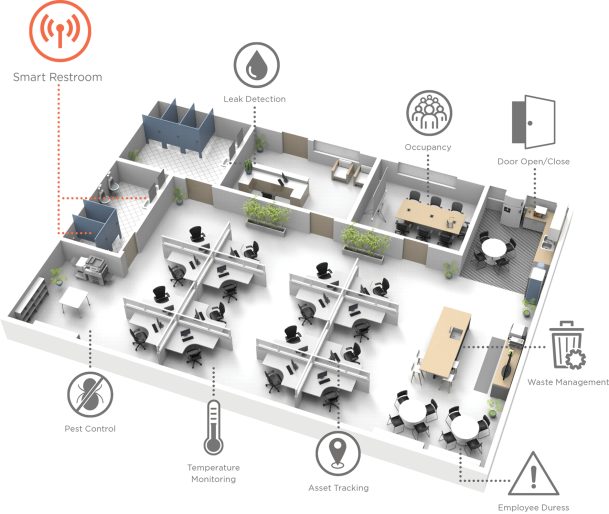
The biggest hurdle to a smart building is not the technology – it is bridging the gap between strategy and execution. Too often, the grand vision of large-scale Internet of Things (IoT) projects falls short because these projects are too complex or poorly integrated. That is why savvy facility managers are increasingly starting with one of the most frequently used and scrutinized building areas: the restrooms.
This smart-building “sweet spot” offers a highly visible, low-risk launchpad for data-driven intelligence. Restrooms represent a high-pressure environment where traditional cleaning schedules often fail to meet fluctuating demand. In high-traffic environments, like sports stadiums, entertainment venues, airports, and office buildings, customer complaints about restroom conditions offer a real-time metric of operational inefficiencies, wasted resources or poor hygiene standards. In these high-pressure zones, a complaint is not just a grievance; it is a data point indicating a breakdown in labour or inventory management.
Smart restroom improvements like consistently stocked tissue, soap, sanitizer, and paper towel dispensers offer fast, tangible benefits. Unlike upgrading an entire HVAC system or retrofitting a 50-story lighting grid, adding sensors to restroom dispensers is non-invasive, wireless, and battery-powered. As a result, restrooms offer facility managers a rare opportunity to elevate operations in a highly visible area without requiring significant Information Technology (IT) overhead.
By starting small and succeeding where it matters most, facility managers can turn a single smart restroom into the blueprint for a fully realized smart building. This blueprint for success rests on three foundational pillars: labour, inventory, and experience.
Work smarter, not harder
If the restroom is the launchpad, then labour is the first area where real-time data pays immediate dividends in staffing allocation and operational efficiency. In a traditional facility, labour is often governed by the “static loop,” a rigid schedule where cleaning teams visit restrooms at set intervals regardless of actual usage.
The result? The “ghost walk,” which occurs when a maintainer travels to a restroom and inspects dispensers only to find they are already full. By transitioning to an outcome-based model supported by smart technology, facility managers can fundamentally change the nature of work performed by maintenance teams. Along the way, they can boost not only the job satisfaction of dedicated cleaning teams but elevate overall restroom experiences for tenants, guests, and customers alike.
As the industry pivots toward outcomes-based Service Level Agreements (SLAs), cleaning staff duties will no longer be dictated by how often restrooms are checked, but by the cleanliness and satisfaction of the occupants. This transition creates a catch-22 for facility managers as they must guarantee specific outcomes while dealing with labour shortages and escalating costs.
The answer is not working harder; it is about using real-time data to react faster. Sensor-equipped dispensers capture and prioritize alerts, which then are sent to mobile devices for fast and seamless problem resolution. This approach not only reduces unnecessary dispenser checks, but it reallocates labour dynamically to support more timely and valuable tasks. This shifts the ROI by converting formerly wasted hours into productive, high-impact labour.
Precision at scale
Connected restroom solutions deliver the data needed to reduce product outages and waste simultaneously. As a result, 99.5 per cent of dispensers equipped with the KOLO® Smart Monitoring System are fully stocked[i]. Unnecessary dispenser checks are reduced by 95 per cent[ii] while cost savings and environmental responsibility are elevated by 100 per cent product usage and near-zero waste[iii].
Without a smart system, facility managers struggle with a tradeoff: high waste with low outages, or low waste with high outages. A prescriptive maintenance model removes this barrier by treating inventory like a strategic asset. Instead of relying on “safety stock,” usage trends help predict when shipments should arrive, freeing capital and physical space.
The journey to a smart building is not a single giant leap; it is a series of intentional, easy-to-activate steps. By starting in a high-visibility area with low technical friction, facility managers can move with precision today while scaling capabilities as part of an integrated IoT ecosystem tomorrow.
It is crucial to collaborate with strategic partners to verify device accuracy and collect baseline data on a site level for outages, waste, and response times. Once the baseline and training are complete, alerts are activated, alongside ongoing performance measurement.
Setting the stage with an enterprise-grade solution must be backed by continuous support led by dedicated customer support teams to facilitate integration across a growing IoT ecosystem. Equally important is embracing open standards and multi-purpose network infrastructure.
Scaling the network does not require new wiring; today’s platform is designed to expand easily to support temperature monitoring, asset tracking and utilization, leak detection, power monitoring, occupancy monitoring, recycling, waste reduction, pest control, and more.
Return on data-driven intelligence
The transition to a smart building does not have to be an all-or-nothing proposition. By solving persistent restroom challenges first, facility managers can prove that data-driven intelligence can yield immediate ROI in labour and tenant experiences. Ultimately, a smart building is only as intelligent as the outcome it produces. Starting with a connected restroom ensures those outcomes are viable, measurable, and most importantly, scalable for the future.
Jens Fossen is Sr. Director of Product Management for the KOLO Smart Monitoring System at GP PRO, the away-from-home division of Georgia-Pacific, where he leads the product team responsible for KOLO’s full-stack portfolio, including connected devices, dispensers, networking infrastructure, and software across the entire system. GP PRO is a recognized leader in designing innovative restroom solutions that meet the needs of both restroom users and maintainers. To learn more, visit www.gppro.com.
Sources:
[i]Time fully stocked based on data from 4,579 connected towel, tissue, and soap dispensers.
[ii] Estimate based on a building with 600 dispensers, 20 seconds per dispenser check twice daily.
[iii] Based on how the product is designed to work.