



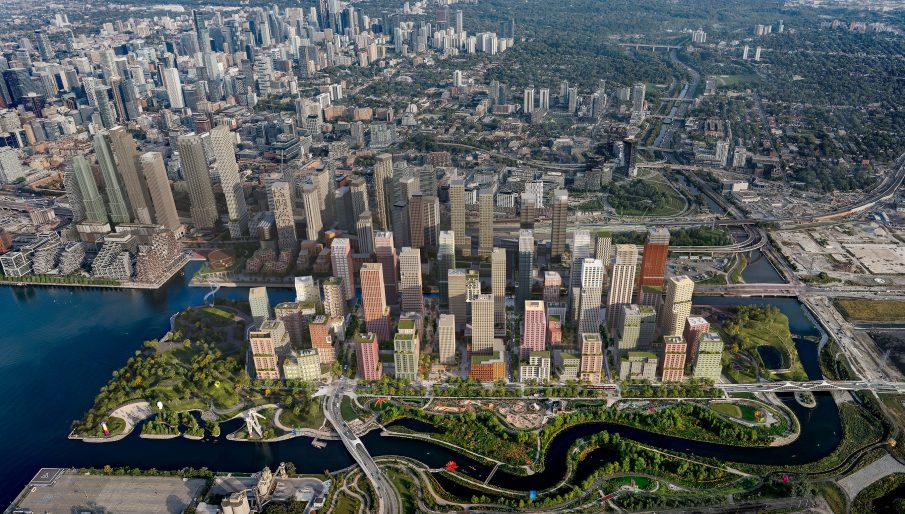
The Government of Canada, the Province of Ontario and the City of Toronto have officially launched Waterfront Toronto’s Request for Qualifications (RFQ) for the first residential buildings on Ookwemin Minising. The RFQ signals the beginning of developer selection for what will become a complete, mixed‑income island community — and a defining chapter in the city’s next generation of waterfront growth.
Backed by $1.4 billion in tri‑government flood protection, parks and bridges, and an additional $975 million for streets, utilities and public spaces, Ookwemin Minising and nearby Quayside are planned to support up to 14,000 new homes. The first development block alone is expected to deliver roughly 700 units, including a target of 30 per cent affordable rental housing. As part of the Toronto Builds portfolio, the project leverages public land to create mixed‑income communities designed for long‑term affordability and resilience.
This RFQ marks the start of a multi‑decade buildout projected to generate 100,000 skilled‑trade jobs and contribute an estimated $13.2 billion to the economy. With flood protection complete and zoning in place, early‑works construction is anticipated to begin this year. The future Waterfront East Rapid Transit Line — supported through a tri‑government partnership announced in 2026 — will further connect the new community to downtown and the broader waterfront.
“The revitalization of Toronto’s waterfront is one of the most significant infrastructure projects in Canada,” said Federal Housing and Infrastructure Minister Gregor Robertson. “This is an important step toward delivering the very first homes on the island with the launch of this Request for Qualifications.”
At the heart of the emerging neighbourhood is Biidaasige Park, set to become Toronto’s largest new park in a generation. The selected development partner will help shape not only the buildings but the character of an inclusive, sustainable and architecturally ambitious waterfront district.
“Ookwemin Minising represents a generational opportunity to build a complete waterfront community,” said Toronto Mayor Olivia Chow. “Together, these investments are helping build a more affordable, caring, and safe city for current and future generations.”